At twenty-four, Claire Bennett had learned that most people walked past trouble if it did not shout loudly enough.
She lived in a small town in Vermont called Millbrook, where the streets curved around old maple trees, brick storefronts, white churches, and houses with front porches that had seen more winters than most people could count. Claire was a young white American woman with fair skin, long chestnut-brown hair usually tied into a loose ponytail, soft green eyes, and the kind of quiet face people trusted when they were frightened.
She worked at the Millbrook Public Library.
It was not glamorous work. She shelved books, helped children find reading assignments, printed documents for elderly patrons, organized community flyers, answered the phone, and ran the small local history desk three afternoons a week. But Claire loved it because the library was one of the few places where people could enter without needing to buy anything.
Her grandmother had loved libraries too.
When Claire was little, Grandma Ruth took her every Saturday morning. They would walk through the aisles slowly, Ruth’s hand warm around Claire’s, and Ruth would say, “A library is a town’s memory. Treat it kindly.”
After Ruth passed away, Claire found herself drawn back to that idea. A town’s memory. The quiet proof that ordinary lives mattered.
Claire had a dream of becoming a community archivist one day. She wanted to collect old photographs, letters, diaries, church records, school pictures, farm journals, and family stories from people who thought their lives were too small for history. She wanted to build a local memory project called The Millbrook Story Room, where older residents could record their memories before they vanished.
But dreams took money, training, recording equipment, preservation supplies, and time.
Claire had a small paycheck, an old laptop, one secondhand audio recorder, and a notebook full of plans.
So she worked at the library and helped people where she could.
One Thursday evening in early October, Claire stayed late to finish setting up chairs for a weekend children’s book sale. By the time she locked the library doors, the sky had turned dark and heavy. Cold rain had begun to fall, first as a mist, then as a steady downpour that turned the sidewalks silver under the streetlights.
Claire pulled her denim jacket tighter and hurried toward her old blue car parked near the town square.
That was when she saw him.
An elderly man was walking alone along the edge of Maple Street, hunched against the rain.
He looked to be in his late seventies, tall but bent slightly at the shoulders, with thin white hair flattened by the storm, a deeply lined face, and pale blue eyes squinting through wet glasses. He wore a brown wool coat, dark trousers, and old leather shoes that were already soaked. In one hand, he gripped a cane. In the other, he carried a cardboard mailing tube and a leather folder pressed tightly against his chest.
The sidewalk ahead of him had flooded near the curb.
Water rushed across the path from a blocked storm drain. The old man stopped, looked down at the water, then tried to step around it.
His cane slipped.
The leather folder fell from under his arm.
Papers slid out onto the wet sidewalk.
The old man gasped and bent down too quickly. His knee buckled. He dropped one hand to the ground, trying to catch the papers before the rain ruined them.
Claire ran.
“Sir! Don’t bend down. I’ll get them.”
The man looked up, startled and embarrassed.
“I’m all right,” he said, though his voice shook.
“No, you’re not. Stay still. The sidewalk is slick.”
Claire dropped to her knees in the rain and gathered the papers first. They were old photographs, handwritten pages, and what looked like a map. Some pages were already damp at the edges. One photograph had nearly slid into the gutter. She caught it just before the water took it.
The old man reached for the cardboard tube.
“The map,” he whispered. “Please, the map.”
“I’ve got it.”
Claire grabbed the tube, tucked it under her jacket to keep it dry, then gathered the leather folder and stood carefully.
The old man tried to rise, but his cane slipped again.
Claire moved beside him and held out her arm.
“Let me help you stand.”
“I don’t want to trouble you.”
“You already tried not troubling me and almost fell into a flood. Let’s try my way now.”
The man blinked at her.
Then, despite the rain, he gave a faint laugh.
“All right.”
Claire helped him stand slowly. His hand trembled on her sleeve. His coat was soaked through, and his breathing sounded uneven from the shock.
“What’s your name?” Claire asked.
“Arthur Whitman.”
“I’m Claire Bennett. I work at the library.”
At that, his eyes changed.
“The library?”
“Yes. Right there.”
He looked past her toward the warm yellow lights glowing behind the locked front doors.
“I was trying to get there before it closed.”
Claire looked at the wet papers in her arms.
“With these?”
Arthur nodded.
“My wife’s records. I thought someone there might know what to do with them.”
“In this rain?”
“I didn’t know it would get this bad.”
Claire looked at the flooded sidewalk, the old man’s soaked shoes, the papers, and the cardboard tube pressed under her jacket.
“Come inside,” she said.
“The library is closed.”
“I have the key.”
“I don’t want you getting in trouble.”
“I’ll risk it.”
Arthur looked down at the papers.
“They’re important.”
“Then they shouldn’t be standing in the rain.”
She guided him slowly back to the library entrance. The rain beat against the awning above the door. Claire unlocked it, helped Arthur inside, then turned on the front lights again.
The library was silent and warm.
Arthur stood dripping on the entry mat, looking ashamed of the water pooling around his shoes.
“I’m making a mess.”
“Messes can be mopped.”
Claire pulled a chair near the circulation desk.
“Sit here. Slowly.”
Arthur lowered himself into the chair with a quiet groan.
Claire brought paper towels, clean cloths, and blotting sheets from the local history room. She spread the papers across a large table, carefully separating wet edges before they stuck together. Then she placed the photographs on clean towels and weighted the corners lightly so they would dry flat.
Arthur watched her every movement.
“You know how to handle old papers.”
“A little. Enough to not ruin them.”
“That is more than I knew.”
Claire smiled softly.
“What are they?”
Arthur removed his wet glasses and wiped them with shaking fingers.
“My wife, Eleanor, spent thirty years collecting stories from Millbrook’s older families. Not official history. Real history. Farm journals, school photographs, church picnic names, recipes, letters, cemetery notes, old property maps. She always said the town was forgetting itself.”
Claire looked down at the pages more carefully.
Her heart began to beat faster.
Some were handwritten interviews.
Some were family trees.
Some were labeled photographs.
One page read: Millbrook Oral Histories, 1978–1994.
Claire looked up.
“Your wife collected all this?”
Arthur nodded.
“She wanted to donate it to the library one day. Then she got sick. After she died, I packed everything into boxes because looking at it hurt too much.”
“I’m sorry.”
“She passed three years ago.”
Arthur looked at the cardboard tube.
“The map in there was her favorite. She drew it herself. Every old farm, every closed schoolhouse, every family cemetery. She said someday children should know what stood where their houses stand now.”
Claire carefully opened the end of the tube and slid the map out just enough to check it.
It was hand-drawn, detailed, and beautiful.
Ink lines marked roads, fields, houses, churches, schools, bridges, and notes written in careful script.
She whispered, “This is incredible.”
Arthur’s face softened.
“You think so?”
“Yes. This belongs in the library’s collection.”
His eyes filled.
“Eleanor would have liked hearing that.”
Claire looked at the wet edges of the folder.
“Did anything else get wet?”
“Some letters in my coat pocket.”
He reached inside his coat and pulled out a smaller envelope, damp but still sealed.
Claire took it gently.
“I’ll dry this too.”
“No,” Arthur said quickly, then stopped himself.
Claire paused.
“Is it private?”
He looked at the envelope as if it weighed more than paper.
“It was the last letter she wrote me. I carry it sometimes when I need courage. Foolish, I know.”
“No,” Claire said softly. “Not foolish.”
Arthur looked at her with sudden gratitude.
Claire placed the envelope between two dry sheets and set it aside carefully.
For the next hour, she worked while Arthur sat nearby wrapped in a dry blanket from the children’s reading corner. She called the library director, Mrs. Halpern, explained the situation, and received permission to stay late. Then she brewed tea in the staff room and brought Arthur a paper cup.
He held it with both hands.
“You didn’t have to do all this.”
“I know.”
“Then why?”
Claire looked at the table full of rescued papers.
“Because your wife was trying to save the town’s memory. It would be a shame if rain got the final word.”
Arthur’s mouth trembled.
For a moment, he could not speak.
Then he whispered, “Eleanor would have liked you.”
The next morning, Arthur returned to the library with two cardboard boxes.
This time, Claire made sure he came by car with his neighbor.
Inside the boxes were more of Eleanor’s work: labeled tapes, notebooks, photographs, index cards, old church bulletins, school programs, and envelopes of handwritten memories from families who had since moved away or passed on.
Mrs. Halpern nearly cried when she saw them.
“This is a treasure,” she said.
Arthur looked overwhelmed.
“I didn’t know if anyone would care.”
Claire answered before Mrs. Halpern could.
“I care.”
That was how the project began.
Every Saturday morning, Arthur came to the library and sat with Claire in the local history room. Together, they sorted Eleanor’s collection. Claire scanned photographs, labeled folders, created digital backups, and listened while Arthur explained names and places. Sometimes he remembered clearly. Sometimes he became quiet and said, “Eleanor would know.”
Claire never rushed him.
When they found an unlabeled photograph, she would ask gentle questions.
“Do you recognize the porch?”
“Does the road look familiar?”
“Was this before the bridge was rebuilt?”
Arthur would study the image, and slowly, the past would come back.
“That’s the old Miller farm.”
“That boy became the postmaster.”
“That woman baked pies for every church supper for forty years.”
“That house burned in 1982.”
Claire wrote everything down.
The work gave Arthur something grief had stolen from him: a way to speak about Eleanor without only speaking about loss.
It gave Claire something too.
Purpose.
The Millbrook Story Room began to feel less like a dream and more like a responsibility.
By winter, the library created a small display called Eleanor Whitman’s Millbrook Memories. It featured old photographs, the hand-drawn map, and audio clips from Eleanor’s interviews. People came in slowly at first, then steadily. Older residents stood before the pictures and pointed with trembling fingers.
“That’s my uncle.”
“That was our old school.”
“I haven’t seen that road in fifty years.”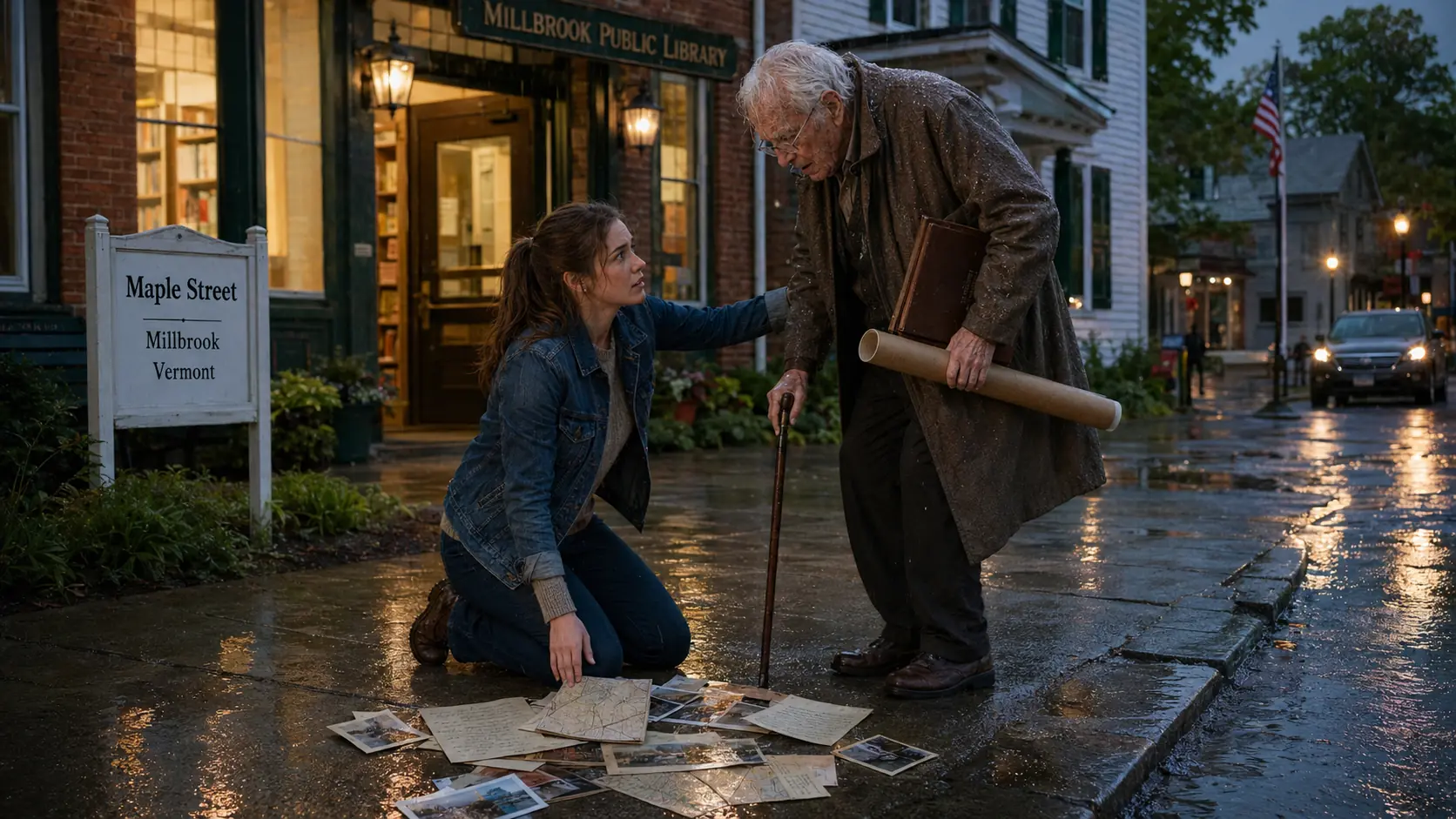
Children came with grandparents and asked questions. Families brought more photographs. A retired teacher donated class lists. A farmer brought journals from his father’s barn.
The display became a living thing.
Arthur attended the opening in his brown coat, his cane beside him. He stood near Eleanor’s map with tears in his eyes.
“She did it,” he said.
Claire stood beside him.
“You helped her finish.”
Arthur shook his head gently.
“No. You stopped in the rain.”
Years passed, but that night became the story Arthur told everyone.
Not dramatically. Not as if Claire had saved his life, though maybe she had saved a part of it. He told it plainly.
“I was foolish enough to walk through a storm with Eleanor’s papers. Claire saw me slip. She saved the map.”
The library received a small local grant to expand the history project. Claire became the part-time community archive coordinator. It was not a grand promotion, but to her, it felt like a door opening. She recorded interviews, trained volunteers, scanned donations, and helped families preserve their stories.
Still, she needed more training.
A regional preservation workshop opened applications in Boston, focused on oral history, paper preservation, and community archives. Claire wanted to attend badly. It was exactly what she needed. But the cost of travel, lodging, and registration was more than she could manage.
She printed the application and kept it folded inside her notebook.
Arthur noticed.
He always noticed.
One Saturday, he tapped the paper with his cane.
“What is that?”
“Nothing.”
“At my age, nothing usually has a deadline.”
Claire laughed.
“It’s a workshop.”
“Do you want to go?”
“Yes.”
“Then apply.”
“I can’t afford it.”
“That was not my question.”
Claire looked down.
“I’m not sure I belong there.”
Arthur’s expression sharpened.
“You do.”
“You don’t know that.”
“I know you knelt in the rain to save papers that were not yours because you understood they mattered. That is exactly who belongs in such rooms.”
A week later, Claire applied.
She was accepted.
No scholarship.
She tried not to be disappointed, but disappointment came anyway.
When Arthur found out, he came to the library carrying a small cloth bag and a folded envelope.
“I have something for you,” he said.
Claire immediately shook her head.
“No.”
He frowned. “You do not even know what it is.”
“I know you.”
“Then you know arguing wastes energy.”
Inside the cloth bag was an old portable tape recorder.
Not fancy. Not new. A small silver recorder with a built-in microphone, carefully cleaned and wrapped in cloth. Beside it were two unused tapes and a pair of headphones.
“It was Eleanor’s,” Arthur said.
Claire held it carefully.
“She used this for the interviews?”
“For many of them. Later she used a better one, but this was the first. She bought it secondhand and said it had a patient soul.”
Claire’s eyes filled.
“I can’t take this.”
“You can borrow it permanently.”
“That means take it.”
“It means I am old and allowed to phrase gifts however I like.”
Claire laughed through tears.
Then he handed her the envelope.
Inside was a letter.
Arthur had written to the workshop committee, explaining Eleanor’s collection, the rescue in the rain, and Claire’s work building the Millbrook Story Room. Mrs. Halpern had added her own recommendation.
At the bottom was a note from the committee.
They had reconsidered her application for aid and awarded her a partial community scholarship.
Claire stared at the paper.
“I don’t understand.”
Arthur smiled.
“I wrote the truth. Apparently, the truth had good timing.”
She covered her mouth.
“This is too much.”
“No,” Arthur said gently. “It is a recorder and a letter.”
“To me, that’s everything.”
He looked toward Eleanor’s map on the wall.
“Then use it well.”
Claire went to Boston.
She learned how to preserve fragile paper, how to conduct ethical oral histories, how to digitize recordings properly, how to create community archives that belonged to the people whose stories they held. She carried Eleanor’s recorder in her bag every day, not because she used it for every interview, but because it reminded her where the work began.
When she returned, The Millbrook Story Room grew.
Claire recorded elders in kitchens, church basements, farmhouses, nursing homes, school gyms, and front porches. She scanned photo albums before they faded further. She helped families label pictures while names were still remembered. She taught children how to ask grandparents about the past.
Arthur became her first official recorded interview after the workshop.
He sat in the library’s local history room, Eleanor’s map behind him, the old recorder on the table.
Claire asked, “What do you want people to know about Eleanor?”
Arthur thought for a long time.
Then he said, “She believed no life was ordinary to the person living it.”
Claire saved that sentence.
It became the heart of the project.
Years later, The Millbrook Story Room became one of the town’s proudest efforts. It was still small. Still local. Still run from two rooms in the library. But families came from all over the county to add photographs, letters, and memories. Schoolchildren used the archive for projects. Older residents came to hear familiar voices again.
Arthur grew older and weaker, but he came as long as he could.
One spring morning, he visited with his neighbor and asked to sit beside Eleanor’s map.
Claire sat with him.
He handed her a small envelope.
“Another letter?” she asked softly.
“Not this time.”
Inside was a fountain pen.
The black finish was worn. The silver clip was scratched. The pen looked old but cared for.
“Eleanor’s,” Arthur said. “She used it to write labels on half the collection.”
Claire touched it gently.
“Arthur…”
“It is not worth a fortune.”
“It is to me.”
He smiled.
“That is why you should have it.”
“I don’t know what to say.”
“Say you will keep writing names down.”
Claire’s eyes blurred.
“I will.”
Arthur passed away that winter.
At his memorial, the library displayed one photograph of him standing beside Eleanor’s map, his hand resting gently on the edge of the frame. Beneath it, Claire placed his words:
“No life was ordinary to the person living it.”
After the service, Claire returned to the local history room alone. She placed Eleanor’s recorder, Arthur’s letter, and Eleanor’s fountain pen on the table.
None of them were grand gifts.
No house.
No building.
No fortune.
Just small things.
A recorder.
A recommendation letter.
A pen.
But each one had opened something.
The recorder reminded her to listen.
The letter helped her learn.
The pen reminded her to name what mattered before it disappeared.
Years later, whenever people asked how The Millbrook Story Room began, Claire told them the truth.
“It began with an old man walking in the rain, trying to protect his wife’s papers.”
Then she would describe the flooded sidewalk, the cane slipping, the photographs scattering, the hand-drawn map nearly ruined, and the moment she chose to stop.
She would tell them that helping someone did not always require a grand rescue.
Sometimes it meant kneeling on wet pavement to pick up papers.
Opening a locked library after hours.
Making tea.
Drying photographs.
Listening to why an old thing mattered.
And sometimes, years later, what returned was not wealth, but direction.
A letter.
A recorder.
A pen.
Enough to help a young woman understand that her dream was not too small.
It was exactly the size of a town’s memory.