At twenty-four, Emily Dawson had learned that emergencies did not announce themselves.
They did not knock politely before entering someone’s life.
They arrived as a squeal of brakes, a cloud of smoke, a tire blown in the middle of the street, or a car that simply refused to move while rain poured down and time kept moving without mercy.
Sometimes an emergency looked dramatic.
Sometimes it looked like fire trucks, flashing lights, and people shouting across a parking lot.
But sometimes it looked like an old man standing beside a dusty blue sedan with the hood up, one hand wrapped around a cane, the other pressed against the edge of the car as if he were trying to keep himself from collapsing.
Emily had always noticed those moments.
She noticed because she had grown up in a family where one missed ride, one late bill, one broken car, or one unexpected illness could turn an ordinary day into a disaster.
Her mother had worked two jobs after Emily’s father left, one at a diner in the morning and another cleaning offices at night.
Their old station wagon broke down so often that Emily learned the sound of trouble before she learned algebra properly.
She learned what a weak battery sounded like.
She learned the smell of an overheated engine.
She learned that panic had a taste, sharp and metallic, especially when a parent whispered, “Not today,” under their breath while turning the key again and again.
When Emily was fourteen, their car stalled outside a grocery store during a winter rainstorm.
Her mother had cried quietly in the driver’s seat, not because of the car itself, but because she had to pick up medication for Emily’s younger brother before the pharmacy closed.
A stranger had stopped that evening.
A mechanic on his way home.
He tightened something beneath the hood, gave them a jump, and waited until the engine ran long enough for them to reach the pharmacy.
Emily never forgot him.
She never forgot the way one person stopping at the right moment could keep a bad day from becoming something worse.
Years later, she carried that memory like a small light.
Emily lived in Cedarville, North Carolina, a small town where the streets were lined with oak trees, brick storefronts, old churches, family diners, and porches with rocking chairs that seemed to hold generations of stories.
It was not a wealthy town.
But it was the kind of town where people remembered faces, where a librarian knew which books a child loved before the child could read the titles aloud, and where old men still waved from pickup trucks even when they had nowhere urgent to go.
Emily worked part-time at the Cedarville Public Library.
The building stood at the corner of Maple and Greene, with white columns, wide windows, and a children’s reading room painted pale yellow.
She loved the library deeply.
She loved the quiet hum of people reading.
She loved the smell of paper, dust, and coffee from the staff break room.
She loved helping children find books about dinosaurs, helping elderly patrons print forms, and helping job seekers use computers when they were too embarrassed to admit they did not know where to click.
Her official job was library assistant.
But like most small-town jobs, it meant doing a little bit of everything.
She shelved books.
Checked returns.
Printed library cards.
Ran story time when Mrs. Keller was sick.
Carried boxes of donated books to the storage room.
Helped seniors enlarge text on the public computers.
Explained online job applications.
And sometimes, when someone came in holding a letter from an insurance company or a pharmacy notice they did not understand, Emily sat beside them and helped them read it slowly.
She liked useful kindness.
Not the loud kind.
Not the kind that needed applause.
The kind that quietly helped someone breathe again.
Her dream was to work in community outreach one day.
She wanted to build a program that connected elderly residents with practical emergency help: rides to pharmacies, small home safety checks, appointment reminders, transportation support, and volunteers trained to respond when ordinary problems became urgent.
She had even written a name for it in a notebook.
Quick Hands Cedarville.
It was not a perfect name, but she loved what it meant.
Quick hands to steady someone.
Quick hands to make a phone call.
Quick hands to open a hood, protect documents from rain, carry groceries, or drive someone to a pharmacy before the doors locked.
But dreams needed money, training, approval, and people who believed in them.
Emily only had a notebook, a part-time paycheck, and a history of noticing when other people were quietly afraid.
On a gray October afternoon, she left the library later than usual.
Rain had been falling since lunch, turning the sidewalks slick and dark.
The sky was low and heavy, and the air smelled like wet leaves, old pavement, and the faint sweetness of pine needles crushed beneath tires.
Emily zipped her navy raincoat up to her chin and walked across the library parking lot, holding her tote bag close to her side.
Inside the tote were two library books, her notebook, a half-eaten granola bar, a cheap umbrella with one bent rib, and a small emergency pouch she carried everywhere.
Her coworker, Mrs. Keller, always teased her about that pouch.
“You pack like you’re expecting a crisis,” Mrs. Keller had said once.
Emily had smiled.
“I’m from a family of old cars. Crisis travels.”
The pouch held bandages, tissues, a penlight, a phone charger, safety pins, a plastic document sleeve, and a pair of thin work gloves.
She had bought the gloves after remembering the mechanic who helped her mother years before.
She never knew when they might matter.
That afternoon, she was thinking about rent, groceries, and whether she should apply for a full-time position at the county office, even though the idea made her nervous.
She loved the library, but she wanted to do more.
She wanted to be where need was happening, not only where people came afterward to ask for forms.
Her old hatchback waited near the back of the parking lot.
It was silver, slightly dented, and loyal in the way old cars sometimes were when treated kindly.
Emily started the engine, let the windshield wipers slap back and forth, and pulled onto Maple Street.
Rain blurred the town into soft lines.
The bakery sign glowed through the drizzle.
The hardware store had already turned on its window lights.
Two kids ran under one umbrella near the school bus stop.
Emily turned onto Willow Street, the narrow road that cut behind the pharmacy, crossed near the small church cemetery, and connected to the older residential part of town.
That was when she saw him.
At first, she noticed the steam.
A pale cloud rising from the front of a dusty blue sedan stopped at an awkward angle near the curb.
Then she noticed the hood raised.
Then the elderly man standing beside it.
He was clearly in his late seventies, thin and stooped, with white hair peeking out from beneath a worn brown cap.
His pale, weathered skin was damp from the rain, and his face had gone tight with panic.
One hand gripped a wooden cane.
The other waved helplessly toward the car, then toward the road, then back at the engine as if he were begging the machine to understand him.
Cars slowed and moved around him.
One driver honked lightly, not cruelly, but impatiently.
The old man flinched.
Emily’s foot moved to the brake before she fully decided.
She pulled over a safe distance behind the sedan, turned on her hazard lights, grabbed her emergency pouch, and stepped out into the rain.
Cold water splashed around her boots.
By the time she reached him, her coat sleeves were already wet.
“Sir, are you all right?” Emily called out, keeping her voice steady despite the sudden rush of adrenaline.
The old man turned toward her.
His blue eyes flicked up, frightened and unfocused for a second before they settled on her face.
“My… my car won’t start,” he said. “And I have to get to the pharmacy.”
His voice trembled in a way that made the situation immediately clear.
This was not just inconvenience.
This was urgency.
Emily glanced at the street sign.
Cedarville General Pharmacy was only five minutes away by car, maybe fifteen on foot for someone young and healthy.
For this man, with a cane and rain-slick sidewalks, it might as well have been across the county.
“What’s your name?” she asked gently.
“Arthur,” he said. “Arthur Cole.”
“I’m Emily Dawson. I work at the library.”
“The library,” he repeated, as if that made her real to him.
“Yes. Are you hurt?”
“No. No, I don’t think so.”
“Are you having chest pain? Trouble breathing?”
“No. Just…” He looked back at the car. “I’m scared I’m going to miss the pharmacy.”
“What time does it close?”
“Five.”
Emily checked her phone.
4:37.
Twenty-three minutes.
“What do you need to pick up?”
Arthur hesitated.
Pride and fear crossed his face at the same time.
“My heart medication,” he said finally. “My doctor changed the dose. I was supposed to start it tonight. They called to say it was ready, but if I don’t pick it up before closing, I won’t have it until tomorrow afternoon.”
Emily’s attention sharpened.
“Do you have any of the old dose left?”
“One pill,” he said. “But the nurse said not to wait. She said to start the new dose tonight.”
Emily nodded.
“All right. We’ll solve one thing at a time.”
Arthur looked at her as if the word solve had given him something solid to hold.
“I can help,” she said. “First, can we push the car fully out of the road?”
Arthur looked ashamed.
“I tried. I couldn’t.”
“That’s okay. I can call someone if needed.”
He shook his head quickly.
“I don’t want to cause trouble.”
“You’re not causing trouble. Your car is having a public moment.”
Despite everything, Arthur gave a short, startled laugh.
Then the worry returned.
“The engine smoked, and then it died. I turned the key, and nothing happened. I thought maybe if I waited…”
Emily looked into the engine bay.
Steam rose lightly from the front, but it did not smell like fire.
It smelled mostly like rain hitting hot metal.
The engine did not seem dangerously overheated anymore.
She kept a respectful distance at first, waiting to make sure nothing was boiling over.
“Did the temperature gauge go high?” she asked.
Arthur blinked.
“I don’t know. I was watching the clock.”
“That’s fair.”
She took the work gloves from her pouch and put them on.
Arthur looked at her with surprise.
“You know anything about cars?”
“Just enough to help in an emergency,” Emily said.
“My wife knew more than I did,” Arthur admitted, looking embarrassed. “Margaret used to say I could teach history to a room full of teenagers but couldn’t hear a car complaining until it had filed a formal protest.”
Emily smiled.
“She sounds smart.”
“She was.”
The word was small and heavy.
Was.
Emily heard it and did not push.
She lifted the hood fully and secured the prop rod.
Rain ran down the metal frame and dripped onto the engine bay.
She leaned in carefully, using her phone flashlight to see better.
The battery terminals were visible.
The positive cable looked secure.
The negative terminal, however, was loose, sitting crookedly against the post.
The cable had likely been weak for a while, and the rain, vibration, and old age of the car had finally made the connection fail.
“That might be it,” she murmured.
Arthur leaned forward anxiously.
“What is it?”
“Loose battery connection. Maybe. I’m going to tighten it and see if that helps.”
“Is it dangerous?”
“It can be if we’re careless. But we’ll be careful.”
She stepped back and looked at him.
“Do you have any tools in the car?”
Arthur searched his memory.
“There may be a small kit in the trunk. Margaret kept one. She said every car needed tools, napkins, and peppermints.”
“She was right about all three.”
Arthur fumbled with the keys, opened the trunk, and Emily found a small plastic toolbox tucked beside an old blanket and a reusable grocery bag.
Inside were a wrench, screwdriver, tire gauge, flashlight, and jumper cables.
“Margaret was prepared,” Emily said.
Arthur’s face softened.
“She always was.”
Emily selected the wrench and returned to the battery.
She gently adjusted the loose terminal, cleaned away a bit of corrosion with a folded tissue from her pouch, and tightened the connection.
Rainwater dripped from her hairline onto her cheek.
The wrench slipped once, and she steadied her hand.
Arthur stood beside the car, gripping his cane tightly.
“Will that work?” he asked.
“Let’s see.”
She stepped back.
“Try starting it.”
Arthur got into the driver’s seat, moving slowly but urgently.
He turned the key.
The engine clicked.
Then coughed.
Then roared to life.
Steam rose for a second more, then diminished.
Arthur stared through the windshield as if the car had returned from the dead.
“Oh,” he breathed. “Oh my stars.”
Emily smiled.
“Good. But I don’t want you driving it until we know it won’t stall again in traffic.”
Arthur’s face fell.
“But the pharmacy.”
“I can drive you there in my car.”
He opened the door and looked at her, torn between relief and pride.
“I couldn’t ask you to do that.”
“You didn’t ask.”
“I don’t want to trouble you.”
“Arthur, if you drive this car and it stalls in the middle of the intersection, that will be trouble. If I drive you five minutes to the pharmacy, that’s a plan.”
He looked at her.
“A plan,” he repeated.
“Yes.”
He glanced back at the blue sedan.
“My wife would have liked that. She liked plans.”
“Then let’s honor Margaret with a good one.”
Arthur’s eyes glistened.
For a second, Emily worried she had said too much.
Then he nodded.
“All right.”
Emily helped him lock the sedan and move to her hatchback.
She opened the passenger door and made sure he got in safely, folding his cane and placing it within reach.
Then she pulled back onto Willow Street, her hazards still blinking until she merged safely.
The rain had grown heavier.
The wipers moved fast, clearing the windshield only for a second before the glass blurred again.
Arthur sat upright, both hands folded over the pharmacy card in his lap.
“Thank you,” he said quietly.
“We’re not there yet.”
“I mean for stopping.”
Emily glanced at him.
“People should stop.”
“Yes,” Arthur said. “They should.”
He looked out the window.
“Many don’t.”
Emily did not argue.
They passed the church cemetery, its old stones darkened by rain.
Arthur turned his head slightly, watching it.
“My wife is buried there.”
Emily softened her voice.
“Margaret?”
“Yes.”
“I’m sorry.”
“Thank you.”
He kept looking until the cemetery disappeared behind them.
“She died eighteen months ago. Heart failure. She had a bad valve for years, but she never let illness make her small. She ran our house, corrected my grocery lists, bullied me into doctor appointments, and kept the car maintained better than I did.”
He looked down at the pharmacy card.
“After she passed, I realized how many little systems in my life had been her love.”
Emily felt that sentence deeply.
Little systems as love.
Appointments remembered.
Tools in the trunk.
Medication refills.
Peppermints in the glove compartment.
A person could disappear, but the care they built remained everywhere.
“She sounds wonderful,” Emily said.
“She was difficult.”
Emily laughed softly.
Arthur smiled.
“Also wonderful.”
They reached Cedarville General Pharmacy at 4:49.
The lights were still on.
Emily parked near the entrance and helped Arthur out.
He insisted he could walk inside alone.
Emily let him take the lead, but stayed close enough to steady him if needed.
Inside, the pharmacy smelled of paper bags, hand sanitizer, plastic packaging, and warm air from the heater above the door.
A pharmacist with gray hair and kind eyes looked up from the counter.
“Mr. Cole,” she said, relief clear in her voice. “I was about to call you.”
“My car gave me trouble,” Arthur said.
“This young woman helped,” he added, gesturing to Emily as if presenting a hero to a courtroom.
Emily smiled awkwardly.
“I just drove him.”
“She fixed the car first,” Arthur said.
The pharmacist turned to Emily.
“Then thank you. This medication needed to start tonight.”
Emily felt a small chill that had nothing to do with rain.
The situation had been urgent exactly as Arthur feared.
The pharmacist explained the new dosage carefully.
Arthur listened, but Emily noticed his eyes losing focus slightly.
Too much stress.
Too much information.
Too much fear.
She stepped closer.
“Would it help if I wrote the instructions in large print?”
Arthur looked embarrassed.
The pharmacist answered before he could.
“That would be excellent.”
Emily took a pen and wrote clearly on a blank pharmacy information card.
Tonight: one tablet with water after dinner.
Tomorrow morning: follow label instructions.
Call pharmacy with any dizziness, unusual weakness, or questions.
Do not mix with old dose unless doctor says so.
She wrote the pharmacy phone number underneath.
Arthur read it slowly.
“This helps,” he said.
“Good.”
He paid for the medication, then took the small white pharmacy bag in both hands as if it were far more fragile than paper.
Outside, the rain had softened into mist.
Arthur stood under the awning and took a deep breath.
“I thought I was going to miss it,” he said.
“But you didn’t.”
“I almost did.”
“But you didn’t.”
He looked at Emily.
“Because you stopped.”
She looked down, embarrassed.
“Because I remembered what it felt like when someone stopped for us once.”
Arthur nodded as if he understood that better than she expected.
“Kindness travels,” he said. “Sometimes slowly. But it travels.”
Emily drove him back to his car.
The blue sedan was still running poorly but had not moved.
Arthur asked if he could drive it home.
Emily shook her head.
“I don’t think that’s wise.”
He sighed.
“I suspected you would say that.”
“Do you have someone who can tow it?”
“My neighbor Pete has a towing company. But I hate calling him.”
“Why?”
“He’ll fuss.”
“Let him.”
Arthur looked offended by the idea.
Emily smiled.
“Fussing is how some people love.”
Arthur stared at her, then laughed.
“Margaret would agree.”
They called Pete, who arrived fifteen minutes later in a tow truck.
He was a broad man in his sixties with a white beard, a red rain jacket, and the tired expression of someone who had rescued Arthur before.
“Battery again?” Pete called.
“Possibly,” Emily said.
Arthur looked at her.
“You two are already teaming up against me.”
Pete inspected the sedan and agreed it needed to go to his shop for a full check.
Arthur tried to protest that he could drive it home.
Pete said, “Arthur, that car is old enough to vote twice. Let me tow it.”
Emily laughed.
Arthur surrendered.
Pete offered to drive Arthur home in the tow truck, but Emily said she could take him.
Arthur looked at her.
“You have already done so much.”
“And I’m still here.”
That silenced him.
On the way to Arthur’s house, they passed quiet neighborhoods shining with rain.
Arthur lived in a small white house on Laurel Avenue, with green shutters, a narrow porch, and two empty flower pots by the steps.
The porch light was on.
Inside, the house smelled faintly of old books, lemon polish, and coffee.
Photographs lined the hallway.
Arthur and Margaret at a beach years ago.
Arthur in a classroom, standing before a chalkboard.
Margaret holding a pie with a triumphant expression.
A young woman, likely their daughter, standing between them at graduation.
And a teenage boy with his arm around Arthur, both of them laughing.
“My grandson Eli,” Arthur said, noticing Emily’s gaze.
“He looks happy.”
“He is now.”
The way Arthur said now hinted at a story.
Emily did not ask.
Arthur placed the medication bag carefully on the kitchen table.
Emily noticed the table was covered in papers.
Not messy exactly.
Organized chaos.
Flyers from the volunteer center.
Notes.
A folder labeled Cedarville Response Apprenticeship.
A calendar with several dates circled in red.
Arthur saw her notice.
“I was reviewing applications.”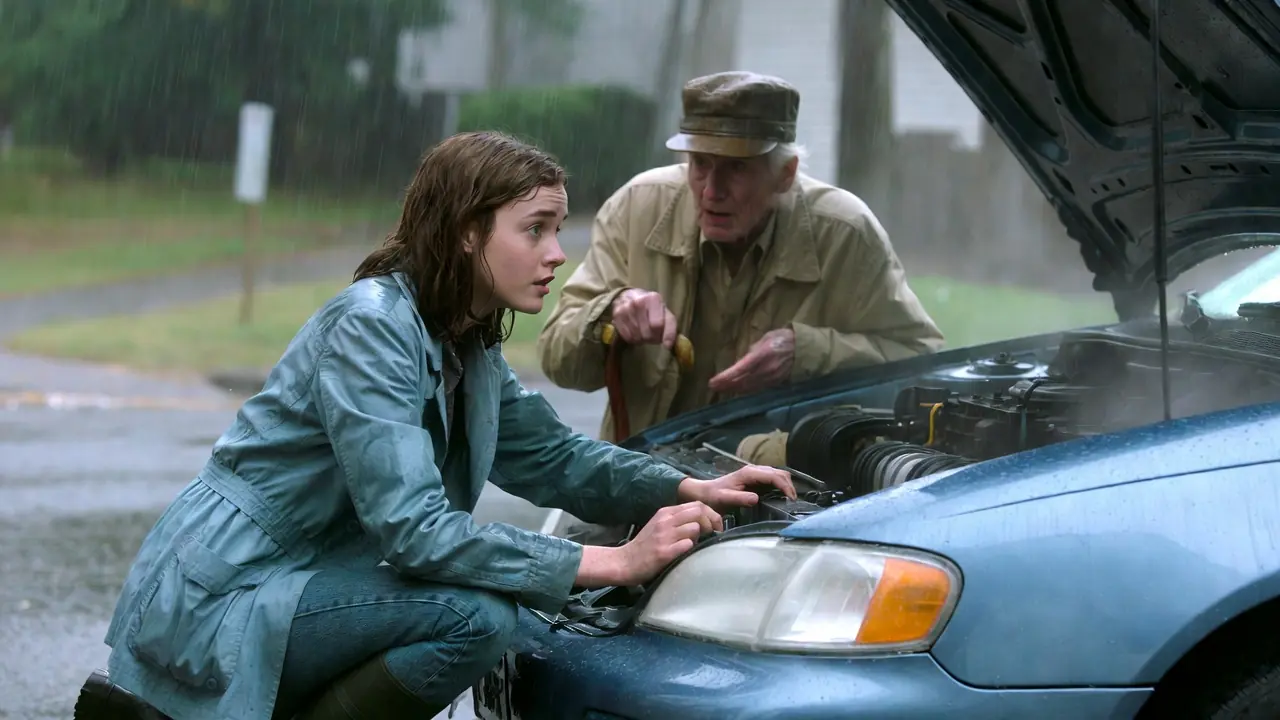
“For what?”
“A foundation project.”
He pulled out a chair slowly.
“Sit for a moment, please. Let me at least offer coffee.”
Emily checked the time.
It was nearly six.
She should go home.
Her shoes were wet.
Her hair was damp.
Her stomach was empty.
But Arthur looked as if he wanted to explain something, and she had learned that sometimes helping meant staying a few minutes past the obvious ending.
“Just for a moment,” she said.
Arthur made coffee slowly, apologizing twice for the weak brew.
Then he sat across from her.
“I run a small foundation,” he said. “It was Margaret’s idea, mostly. She believed Cedarville had too many young people with good hearts and no path to use them.”
Emily smiled.
“That sounds like something a good person would notice.”
“She noticed everything.”
Arthur tapped the folder.
“The foundation offers apprenticeships for young adults interested in community service, emergency response support, volunteer coordination, and practical outreach. Not medical training exactly. Not social work exactly. The space between. The place where people need someone calm before official help arrives.”
Emily became very still.
The space between.
That was exactly the place she had always cared about.
Arthur continued.
“We train apprentices to organize ride networks, senior check-ins, emergency delivery systems, phone trees, basic response protocols, and volunteer teams. Small things that prevent bigger disasters.”
Emily looked at the folder.
“That sounds incredible.”
“It is useful,” Arthur said. “When run well.”
“Are you accepting applications?”
He looked at her over his coffee cup.
“We were.”
“Were?”
“The deadline was today.”
“Oh.”
“I was on my way to the pharmacy before reviewing the final stack.”
Emily laughed softly.
“That is a very strange full circle.”
Arthur studied her.
“Do you work only at the library?”
“Yes. Part-time.”
“Do you like it?”
“I love the library.”
“But?”
Emily hesitated.
Arthur waited.
“I want to do more community outreach,” she admitted. “I like helping people with practical things. Forms, rides, appointments, emergencies. I keep thinking there should be better systems for people who don’t know who to call when something small becomes urgent.”
Arthur’s expression changed.
It was not surprise.
It was recognition.
“Do you have a notebook?” he asked.
Emily blinked.
“What?”
“People with ideas like that usually have notebooks.”
She laughed, embarrassed.
“Yes.”
“May I ask the name?”
She hesitated.
“Quick Hands Cedarville.”
Arthur smiled.
“That is a good name.”
“It’s not perfect.”
“No name is perfect at first. It has to grow into itself.”
Emily looked down.
“I don’t have funding or training.”
“That is what apprenticeships are for.”
Her heart beat faster, but she did not let herself hope too quickly.
“I missed the deadline.”
Arthur lifted the pharmacy card she had written for him.
“And I almost missed my medication.”
Emily frowned.
“That’s different.”
“Is it?”
“Yes. You had an emergency.”
Arthur leaned back.
“So did you. You just do not yet recognize it.”
Emily did not know what to say.
Arthur did not offer anything that night.
Not directly.
He thanked her again, gave her a granola bar from his pantry “because helpers should not faint dramatically,” and insisted she text him when she got home safely.
She did.
The next morning, Emily returned to the Cedarville Public Library.
The rain had stopped, but the town still looked washed and gray.
She arrived before opening, carrying damp shoes in a plastic bag and wearing a sweater that smelled faintly of engine grease despite washing her hands four times.
Mrs. Keller looked at her from behind the circulation desk.
“You look like yesterday followed you home.”
“It did.”
Before Emily could explain, Mrs. Keller nodded toward her desk.
“A letter came for you. Hand-delivered by Mr. Arthur Cole.”
Emily froze.
The envelope sat beside the return cart.
Her name was written in careful blue ink.
Emily Dawson.
She opened it slowly.
Inside was a handwritten note on cream paper.
Dear Emily,
Thank you for helping me yesterday.
Your quick thinking, calm courage, and practical kindness prevented me from missing medication that I needed to begin that evening.
But more than that, you did what community work requires at its best.
You noticed.
You assessed.
You acted.
You protected my dignity while helping me accept help I did not want to need.
I am retired, but I remain connected to Cedarville through the Cole Foundation for Community Response, a small foundation my wife Margaret and I began years ago.
We provide scholarships and apprenticeships for young adults seeking training in public service, volunteer coordination, emergency preparedness, and community outreach.
I would like to offer you an apprenticeship position.
This is not a reward for one good deed.
It is recognition of something already present in you.
If you accept, you will learn organizational and community service work through the foundation, including how to build practical support systems for elderly residents, vulnerable families, and people facing urgent everyday problems.
I hope this opportunity will help you develop your skills and continue the good work your heart already knows how to begin.
With gratitude,
Arthur Cole
Emily read the letter once.
Then again.
Then a third time.
Her hands trembled.
Mrs. Keller watched from the front desk.
“Well?” she asked.
Emily looked up, eyes bright.
“I think I just got offered the future.”
Mrs. Keller smiled softly.
“Then don’t stand there. Call him.”
Emily accepted the apprenticeship that afternoon.
She expected paperwork, maybe a few meetings, maybe some volunteer hours.
Instead, Arthur Cole gave her a year that changed the shape of her life.
The Cole Foundation office was small, located in a converted storefront between the bakery and the old insurance office.
A brass plaque on the door read:
Cole Foundation for Community Response.
Practical help before crisis becomes disaster.
Inside were two desks, a meeting table, metal filing cabinets, shelves of binders, a bulletin board covered in maps, and framed photographs of past volunteers.
One photograph showed Margaret Cole standing beside a group of teenagers holding emergency supply bags.
She had short silver hair, bright eyes, and the posture of someone who did not waste time.
Arthur caught Emily looking at it.
“She started the best parts,” he said.
“What did she do?”
“Everything I was too slow to imagine.”
Emily smiled.
“That sounds like a lot.”
“It was.”
Her apprenticeship began with listening.
Arthur made her sit in on planning meetings.
Senior ride network meetings.
Winter storm preparation meetings.
Medication delivery coordination.
Volunteer check-in calls.
Grant review sessions.
Emergency phone tree drills.
At first, Emily felt overwhelmed.
Everything had a form.
Everything had a protocol.
Everything required follow-up.
Arthur taught her that kindness without structure often burned out quickly.
“Good intentions are matches,” he said. “Systems are lanterns. Build lanterns.”
Emily wrote that in her notebook.
He taught her how to document incidents without making people sound helpless.
How to call families without shaming the person who needed help.
How to ask for consent before arranging support.
How to create volunteer schedules that did not depend on one heroic person doing everything.
How to read budgets.
How to prepare grant reports.
How to design outreach flyers for seniors who did not use email.
How to speak at town meetings without apologizing for taking up space.
He also taught her that practical help required humility.
“You are not saving people,” Arthur told her one afternoon after she returned from delivering groceries to a widow during a storm.
“You are helping them continue their own lives.”
Emily nodded.
“That sounds simple.”
“It is not. People like to feel like heroes. Community work is better when people feel like neighbors.”
The apprenticeship brought Emily into places she had passed all her life without fully seeing.
Senior apartments where residents knew exactly which stair rail was loose.
Trailer parks where one broken car affected three families.
Church basements where donated coats were sorted by volunteers who remembered every child’s size.
County offices where a form missing one signature could delay help for weeks.
Pharmacies where elderly customers waited quietly because they did not understand insurance changes.
Emily learned that Cedarville was full of people doing their best beside invisible cliffs.
A missed ride.
A closed office.
A broken phone.
A confusing letter.
A car that would not start.
These were not small problems when a person had no backup plan.
Arthur became more than a mentor.
He became a steady presence.
He corrected her grant drafts with a red pen and kind brutality.
He made coffee too weak.
He forgot where he put his glasses.
He told stories about Margaret when he was tired.
He once spent ten minutes lecturing a volunteer team about the importance of labeling extension cords.
He believed deeply in young people but refused to flatter them.
“You have talent,” he told Emily once. “That means very little unless you build discipline around it.”
Emily did not love hearing that.
Then she realized he was right.
Six months into the apprenticeship, he asked her to bring him the Quick Hands Cedarville notebook.
She did.
The notebook looked worn now.
Its corners had softened.
Some pages were smudged with rain from the day she helped Arthur.
Arthur read it carefully.
Page by page.
Senior emergency ride list.
Pharmacy pickup support.
Car trouble response referrals.
Weather check-ins.
Document protection.
Volunteer phone tree.
Partnership with library, pharmacy, mechanic shop, and church basement.
Training for “ordinary emergencies.”
Arthur looked up.
“This is stronger than you think.”
Emily swallowed.
“It’s still rough.”
“Everything useful begins rough.”
“I don’t know if Cedarville needs it.”
Arthur stared at her.
“My car died in the rain while I was trying to pick up heart medication.”
Emily laughed nervously.
“That is one example.”
“One example is a window. Look through it.”
So they built a pilot.
Not a large program.
Not yet.
A three-month test.
They called it Quick Hands.
The library hosted the sign-up table.
The pharmacy provided medication pickup guidelines.
Pete’s towing company agreed to answer car trouble calls for seniors at a reduced emergency rate.
The volunteer center provided five trained volunteers.
The foundation funded rain kits, phone cards, plastic document sleeves, reflective vests, and a dedicated phone line.
The program would not repair cars professionally.
It would not give medical advice.
It would not replace emergency services.
It would help people make the next safe move.
Call the pharmacy.
Arrange a ride.
Contact a family member.
Protect documents from rain.
Wait with someone until help arrived.
Connect a stranded person with a reliable mechanic.
Make sure a person did not choose a dangerous option simply because they felt embarrassed.
The first month was quiet.
Emily worried no one needed it.
Then November came.
A retired woman called because her ride to the pharmacy canceled and she had no way to pick up antibiotics.
Quick Hands arranged a volunteer ride with consent and confirmation from the pharmacy.
A widower called from the grocery store parking lot because his battery died and he did not know which towing company to trust.
Quick Hands called Pete, stayed on the phone, and notified the man’s daughter.
A grandmother came to the library with a damp envelope of medical forms she had nearly lost in the rain.
Emily gave her a document sleeve and helped her make copies.
A man with limited vision called because he received a confusing medication change notice and did not know whether to wait.
Quick Hands helped him call the pharmacy directly.
Each problem sounded ordinary.
Each one mattered.
At the end of three months, Emily prepared a report.
Number of calls.
Types of help.
Response times.
Volunteer hours.
Outcomes.
Stories, with names changed.
Arthur read the first draft and shook his head.
“You buried the heart.”
“I thought reports needed data.”
“They do. But data without human meaning is just a fence.”
He pointed to one section.
“Tell the story of the battery call. Tell the story of the antibiotic ride. Tell them why the numbers matter.”
Emily rewrote it.
The town council approved expanded support in January.
The Cole Foundation matched the funding.
Quick Hands became official.
Emily became the program coordinator.
She was still only twenty-five by then, but she had learned more in one year than she had in the decade before.
The library became the program’s public home.
Mrs. Keller loved that.
“I knew books would save the town eventually,” she said.
The pharmacy placed Quick Hands cards near the prescription counter.
Pete’s towing company put the number on his fridge magnets.
The senior center hosted monthly workshops.
The first workshop was called: What To Do When A Small Emergency Stops You.
Arthur sat in the front row.
He raised his hand halfway through.
Emily pointed at him reluctantly.
“Yes, Arthur?”
He said, “Add a section on stubbornness. It delays help.”
The room laughed.
Emily added it.
Over the years, Quick Hands grew beyond Cedarville.
Nearby towns asked for the model.
Emily trained volunteers in three counties.
She created manuals.
She spoke at community health conferences.
She built partnerships between libraries, pharmacies, mechanics, clinics, volunteer centers, and senior housing offices.
She learned that the work was never about one dramatic rescue.
It was about building enough small bridges that people did not have to stand alone on the wrong side of trouble.
Arthur remained her mentor for as long as his health allowed.
He grew slower.
His blue sedan was eventually retired, towed one last time by Pete while Arthur stood in the driveway and saluted it with a cup of weak coffee.
Emily drove him to the pharmacy sometimes.
He hated accepting rides and loved complaining about her music.
“Young people make songs too complicated,” he said once.
“You taught history. You should appreciate cultural development.”
“I appreciate melody.”
“You appreciate control.”
“Also true.”
Their friendship became one of the great blessings of Emily’s life.
When she doubted herself, Arthur reminded her to build lanterns.
When she got too emotional in a meeting, he reminded her to give the heart a spine.
When she buried meaning under statistics, he reminded her that data needed a face.
When she worked too late, he called Mrs. Keller and told on her.
Emily protested.
Arthur said, “Mentorship includes interference.”
Three years after the rainy afternoon on Willow Street, the Cole Foundation held a small ceremony at the library.
Quick Hands had served its thousandth call.
The mayor came.
The pharmacist came.
Pete came.
Mrs. Keller came.
Arthur came wearing a dark suit and holding a cane.
He looked thinner than before, but proud.
Emily gave a short speech.
She told the story without making herself the hero.
She told them about a rainy October afternoon, a dusty blue sedan, a loose battery cable, a pharmacy closing at five, and an old man who did not want to be trouble.
Then she said, “Quick Hands exists because ordinary emergencies become safer when people know who to call and when help arrives without shame.”
Arthur cried quietly in the front row.
He pretended he was wiping his glasses.
No one believed him.
Later, he handed Emily a small envelope.
Inside was a note in his careful handwriting.
Dear Emily,
The day my car failed, I thought I was only going to miss medication.
I did not know I was about to meet the person who would carry Margaret’s belief forward.
You stopped.
You listened.
You fixed what you could.
You drove me where I needed to go.
Then you built a way for others to receive that same practical grace.
The apprenticeship was not repayment.
It was recognition.
You already had the heart.
You only needed the tools.
With gratitude,
Arthur Cole
Emily framed the note in the Quick Hands office.
Arthur passed away peacefully two years later.
He died at home, in the white house on Laurel Avenue, with photographs of Margaret nearby and a Quick Hands card still taped beside his phone.
At his memorial gathering, the church hall was full.
Former apprentices came.
Volunteers came.
Library patrons came.
Seniors who had used Quick Hands came.
Pete parked the old tow truck outside with a black ribbon tied to the mirror.
Emily stood near the back, unable to stop remembering the rain on Willow Street.
Arthur’s grandson Eli spoke.
He said, “My grandfather believed small systems were love made practical. He believed my grandmother taught him that. He believed Emily proved it.”
Emily cried then.
She did not try to hide it.
After the service, Eli handed her a box of Arthur’s foundation papers.
Inside was the original folder labeled Cedarville Response Apprenticeship.
Inside that folder was Emily’s acceptance form.
At the top, Arthur had written in pencil:
This one already knows how to stop.
Years later, whenever people asked how Quick Hands began, Emily told them the truth.
“It began with an old man, a broken blue sedan, a rainstorm, and a medication pickup that could not wait.”
Then she showed them Arthur’s letter.
The gift Emily received was not a house.
Not a car.
Not a fancy reward.
It was an opportunity.
A mentorship.
A path.
A future wide enough for one rainy roadside moment to become a community program that helped thousands of people.
And every time a call came in from someone stranded in a parking lot, stuck outside a pharmacy, confused by a medication pickup, or afraid to ask for help, Emily answered gently.
“You did the right thing by calling. Let’s make a plan.”
Because sometimes the smallest, quickest actions opened doors no one could see at the moment.
A tightened battery cable.
A ride through the rain.
A handwritten pharmacy card.
A granola bar offered with trembling hands.
A mentor who recognized a future before the person carrying it did.
And sometimes, when one person stopped instead of driving past, two lives changed direction forever.