At twenty-four, Olivia Harper had learned that a bicycle could stop a life in the middle of the road.
Not forever.
Not always.
But long enough for fear to catch up.
A chain could jam.
A wheel could sink into mud.
A brake could lock.
A basket could tip.
And suddenly, an old man who had ridden the same streets for forty years could be standing in the rain, holding important papers against his chest, wondering if one broken piece of metal would make him fail someone he loved.
Olivia understood that small emergencies were rarely small to the people living through them.
She lived in Maplewood, Oregon, a quiet town bordered by pine trees, wet sidewalks, and low gray skies that seemed to hold rain even on days when no rain fell.
Main Street had a bookstore, a bakery, a pharmacy, a senior center, a post office, a diner, and a bicycle repair shop that smelled of rubber tires, chain grease, and old wood.
Olivia worked part-time at the bookstore, but she had grown up around bicycles.
Her father had never owned much, but he had owned a toolbox.
When Olivia was eight, he taught her how to patch a tube on the kitchen floor.
When she was ten, he taught her how to put a slipped chain back on without pinching her fingers.
When she was twelve, he taught her how to adjust a brake cable and said, “Most people panic because they don’t know which small thing failed. Find the small thing first.”
Olivia never forgot that.
She carried a small emergency kit in her backpack because of him.
A folding tool.
A rag.
A tiny bottle of chain oil.
A flashlight.
Bandages.
A plastic sleeve for papers.
A granola bar.
Her roommate teased her for it.
Olivia just said, “Someday it’ll matter.”
She did not know how right she was.
That Thursday afternoon in late April began with heavy rain.
The morning had been cloudy but calm, the kind of Oregon weather that made people leave home without thinking too hard.
By noon, the sky had turned darker.
By three o’clock, rain poured down hard enough to blur storefront windows and make every passing car throw water across the curb.
Olivia finished her shift at the bookstore at four-fifteen.
She wore a faded green raincoat, dark jeans, old boots, and a gray backpack slung over one shoulder.
Inside the backpack was her notebook for a program she dreamed of starting one day.
She called it Roadside Hands.
It would be a community program teaching basic repair skills to young people and helping elderly residents with small mobility emergencies.
Bicycles.
Walkers.
Shopping carts.
Loose wheels.
Broken baskets.
Flat tires.
Stuck brakes.
Not a tow truck.
Not a mechanic shop.
Just practical neighborhood help.
Olivia believed people lost independence not only through big disasters, but through small failures no one showed up to fix.
A loose screw.
A flat tire.
A rusted chain.
A missing bolt.
A broken handle.
She wanted to build a team of volunteers who could respond to simple, urgent problems before they became dangerous.
But dreams needed tools, insurance, storage space, volunteers, approval, and money.
Olivia had a notebook, a part-time paycheck, and stubborn hope.
So for now, she walked home through the rain.
She had only gone two blocks when she heard it.
A sharp metallic crack.
Then the scrape of a wheel twisting against pavement.
Then an elderly man’s voice, strained and frightened.
“No, no. Not here. Please.”
Olivia turned toward the intersection near Cedar Lane.
Through the rain, she saw an old man standing in the street beside a blue bicycle.
The bicycle had stopped at an awkward angle halfway between the curb and the crosswalk.
The back wheel was stuck deep in a muddy pothole near the edge of the road.
The chain had jumped off the sprocket and twisted around the rear derailleur.
The front basket had tipped forward.
Inside the basket was a plastic folder, a brown paper envelope, and a small cloth bag tied with string.
The old man was trying to lift the back wheel, but his hands shook.
He was in his late seventies, a white American man, thin and slightly stooped, with silver hair under a soaked brown cap, pale skin, and anxious blue eyes behind rain-speckled glasses.
He wore a dark green coat, gray trousers, worn black shoes, and one glove.
The other glove had fallen into the gutter.
He held the bicycle with one hand and a cane with the other.
Cars slowed around him, annoyed but cautious.
One driver honked.
The old man flinched.
Olivia ran.
“Sir! Don’t lift it. I’m coming.”
He looked up, startled.
“I’m sorry,” he called through the rain. “I’m trying to move it.”
“Don’t worry about that yet,” Olivia said. “Are you hurt?”
“No. I don’t think so.”
“Did you fall?”
“No. The back wheel sank, then the pedal locked. I stepped off before it tipped.”
“That’s good.”
She moved to the street side of the bicycle to shield him from traffic.
Then she waved at the closest car to slow down and pointed toward the other lane.
The driver looked irritated, but moved around them.
Olivia crouched beside the bike.
Rain ran down the sleeves of her coat.
The chain was jammed badly.
The rear wheel had twisted because the tire sank into the mud while the pedal kept moving forward.
The derailleur was bent inward.
The chain was wedged between the cassette and the frame.
This was not a clean slipped chain.
This was a tangled, muddy mess.
“What’s your name?” Olivia asked.
“George Miller.”
“I’m Olivia Harper.”
He nodded, breathing hard.
“I need to get home.”
“We’ll get you out of the street first.”
He looked toward the basket.
“My papers.”
“I’ll protect them.”
She lifted the plastic folder and brown paper envelope from the basket.
The folder was wet on the outside but sealed.
The envelope had one damp corner.
Olivia opened her backpack, pulled out a plastic document sleeve, and slid both inside.
George watched with wide eyes.
“You carry those?”
“Yes.”
“Why?”
“Paper hates rain.”
For the first time, even through panic, George gave a tiny laugh.
“That is true.”
She picked up the cloth bag too.
It was heavier than she expected.
“What’s in this?”
“Medication,” George said quickly. “And my daughter’s house key.”
“Okay. That goes in the backpack too.”
“No, no, I can hold it.”
“You need both hands for balance.”
He looked like he wanted to argue.
Then another car passed, spraying water near the curb.
George stepped back and almost slipped.
Olivia caught his elbow.
“Backpack,” she said firmly.
He handed over the cloth bag.
“Thank you.”
“Now hold the handlebars. I’m going to lift the back wheel out.”
“I can help.”
“You are helping by keeping the bike steady.”
Olivia set her boots firmly in the muddy water and lifted the back end of the bicycle.
It was heavier than it looked.
The wheel came free with a sucking sound.
Mud splashed onto her jeans.
She pulled the bike toward the sidewalk while George guided the front wheel.
Together, slowly, they got the bicycle out of the road.
A truck passed just after they cleared the lane.
George looked at it and went pale.
Olivia pretended not to notice his fear too sharply.
They reached the sidewalk under the narrow awning of a closed flower shop.
Rain dripped from the awning’s edge in a steady curtain.
George leaned on his cane and tried to catch his breath.
“I’m sorry,” he said.
“You don’t need to apologize.”
“I held up traffic.”
“Traffic survived.”
“My bike made a mess.”
“Bikes do that.”
“I should have taken the bus.”
“Maybe,” Olivia said gently. “But we’re here now.”
He looked at the bicycle.
The chain hung twisted and muddy.
The rear tire was low.
The basket bracket was loose.
The right pedal had scraped hard against the curb.
George looked at the document sleeve in Olivia’s backpack.
“I have to get those papers home before five.”
“What papers are they?”
He hesitated.
Pride rose in his face.
Then urgency defeated it.
“My daughter Claire has a housing meeting tomorrow morning. She works at the hospital and could not get across town before the office closed. I picked up copies from the records office for her. Lease papers. Payment records. Something from the county. She needs them tonight.”
Olivia looked at the wet street.
“What time is it now?”
George pulled out an old flip phone with shaking hands.
The screen lit up.
4:31.
“Where does your daughter live?”
“Cedar Lane. Seven blocks from here.”
“In this rain?”
“Yes.”
“Were you planning to ride all the way there?”
“It is downhill after Maple.”
“With that tire?”
He glanced at the back wheel and looked ashamed.
“It was fine this morning.”
Olivia softened her voice.
“I believe you.”
“I know this bike is old.”
“Old doesn’t mean useless.”
He looked at her.
The sentence seemed to matter.
“My wife used to say that.”
“What was her name?”
“Margaret.”
The name changed his face.
“She died two years ago. She bought me this bicycle when I retired. Said if I stopped moving, I would start arguing with the furniture.”
Olivia smiled.
“She sounds practical.”
“She was terrifyingly practical.”
George touched the wet handlebar.
“I use this bike for the pharmacy, grocery store, library, and Claire’s house. I don’t drive anymore. My eyes aren’t good enough at night, and my hands…” He looked down. “They are not what they were.”
Olivia understood.
The bike was not just transportation.
It was independence.
It was dignity.
It was the difference between asking for every ride and still being able to do something useful for his daughter.
She crouched beside the bicycle again.
“All right,” she said. “I can probably free the chain. I might be able to get it rolling, but I don’t want you riding it until it’s properly checked.”
George’s face fell.
“But the papers—”
“I can help you deliver them.”
He shook his head immediately.
“No, dear. You’ve already done enough.”
“You were stuck in traffic with important documents in the rain. We are past ‘enough.’”
He gave a weak laugh.
“You sound like Margaret.”
“I’ll take that as a compliment.”
“It is.”
Olivia pulled out her folding tool and rag.
The chain was slick with water and mud.
She wiped the worst of it away and studied the jam.
“Okay,” she said. “I’m going to move slowly. If I force it, I can bend the derailleur worse.”
George nodded as if he understood, though his eyes were fixed on the document sleeve.
Rain hammered the awning.
People hurried past, glancing at them but not stopping.
Olivia worked carefully.
First, she shifted the gear lever to release some tension.
Then she lifted the rear wheel slightly, rotated the pedal backward by hand, and used the flat end of her tool to guide the chain away from the frame.
It resisted.
Mud had packed between the gears.
She wiped again.
Pulled gently.
Turned the pedal half an inch.
The chain snapped tighter.
George flinched.
“It’s all right,” Olivia said. “That was tension releasing.”
“It sounded bad.”
“Bicycles are dramatic.”
George smiled faintly.
“So are old men.”
“Sometimes.”
She worked for several minutes.
Her fingers went numb from cold water and grease.
Finally, the chain came free with a metallic click.
“There.”
George leaned closer.
“Is it fixed?”
“Free, not fixed.”
“That sounds like a sermon.”
“It’s bicycle theology.”
This time he laughed properly.
Olivia placed the chain back onto the gear.
Then she spun the pedal slowly.
The chain moved, but skipped.
The derailleur was still bent.
The bike could roll if walked.
It should not be ridden.
She squeezed the rear tire.
Too soft.
Maybe slow leak.
Maybe rain made it feel worse, but she would not trust it.
“We can walk it,” she said. “Not ride.”
George looked toward the street.
“Seven blocks.”
“You walk with the cane. I’ll push the bicycle and carry the papers.”
“You don’t have to.”
“I know.”
He looked at her for a long moment.
Then the fight left his shoulders.
“All right.”
Olivia secured the basket with a spare strap from her kit so it would not swing.
She kept the documents in the plastic sleeve inside her backpack.
George kept one hand on his cane and one on the handlebar for balance, but Olivia took most of the bicycle’s weight.
They began walking toward Cedar Lane.
Slowly.
The rain softened for a minute, then came hard again.
Water ran along the curb.
The sidewalks were uneven, cracked by tree roots and patched badly in places.
George moved carefully.
Every few steps, he apologized.
“I’m sorry this is taking so long.”
“We’re not late yet.”
“I’m sorry about your coat.”
“It has survived worse.”
“I’m sorry you’re missing whatever you were going to do.”
“I was going home to make instant noodles. They’ll wait.”
George looked at her, amused despite himself.
“Instant noodles are patient.”
“Very.”
They reached the next intersection.
The crosswalk was slick.
George stopped.
“I hate crossing here.”
“Why?”
“Cars turn too fast.”
“Then we wait.”
The pedestrian light changed, but Olivia did not move until all turning cars stopped fully.
She walked slightly ahead with the bicycle, making herself visible.
George crossed beside her, one careful step at a time.
Halfway across, his cane slipped on a painted line.
Olivia reached out and steadied him.
“I’m fine,” he said automatically.
“I know.”
“I almost wasn’t.”
“I know that too.”
He looked at her, and for a second his pride softened into honesty.
“I am afraid of falling,” he admitted.
Olivia slowed.
“That makes sense.”
“I used to be afraid of bigger things.”
“Falling is big.”
“People act like it isn’t. They say, ‘Be careful,’ like careful fixes gravity.”
Olivia smiled gently.
“Careful needs good sidewalks, working brakes, and someone nearby sometimes.”
George nodded slowly.
“That should be written somewhere.”
They continued.
As they walked, George told her about Margaret.
He did not seem to mean to at first.
The stories came out because rain and fear had loosened something.
Margaret had worked at the town library for thirty-two years.
She labeled everything.
She made soup too thick.
She believed every home needed a junk drawer but only one.
She bought George the blue bicycle after his retirement and tied a red ribbon around the handlebars.
He said he didn’t need it.
She said, “That is not the point.”
He used it every week after that.
When Margaret got sick, he rode the bike to the pharmacy and back so often the pharmacist began keeping her medicine ready before he reached the counter.
After she died, he kept riding because the house felt too quiet when he stayed inside.
“I thought if I kept the wheels turning, I might not feel so stuck,” he said.
Olivia looked at the old blue frame.
“Did it help?”
“Yes,” he said. “Not always. But enough.”
They passed the senior center.
The windows glowed warmly inside.
A few people sat near the entrance waiting for rides.
George looked toward it.
“I used to go there for cards.”
“Why did you stop?”
He shrugged.
“After Margaret, people asked too many gentle questions.”
“Gentle questions can be hard.”
“Yes,” he said. “They expect gentle answers.”
Olivia understood that too.
Sometimes kindness still asked for energy a person did not have.
They turned onto Cedar Lane at 4:49.
George’s face changed.
Relief and worry together.
“My daughter’s house is the yellow one near the corner.”
Olivia could see it.
A small yellow house with white shutters, a porch light already on, and a car in the driveway.
A woman stood on the porch in hospital scrubs, holding a phone to her ear and looking down the street.
The moment she saw George, she ran down the steps.
“Dad!”
George stopped.
“I’m here.”
Claire hurried toward him, rain soaking her hair.
She was in her early forties, with dark blonde hair pulled into a loose bun, tired blue eyes, and the exhausted face of someone who had been working too many shifts and worrying through all of them.
She reached George and put both hands on his shoulders.
“Are you okay? I called three times.”
“I’m fine.”
Claire looked at Olivia, the muddy bicycle, the soaked clothes, and the document sleeve in Olivia’s hand.
Her face changed.
“You are not fine.”
George sighed.
“The bike chain jammed.”
“In the road?”
“Near Cedar and Maple.”
Claire closed her eyes.
“Dad.”
“I got the papers.”
Olivia stepped forward and handed her the plastic sleeve.
“Everything is dry.”
Claire took it with both hands.
Her eyes filled with relief.
“Oh my God. Thank you.”
She opened the sleeve and checked quickly.
Lease papers.
Records.
County form.
Everything safe.
Claire pressed the folder against her chest.
“I needed these for tomorrow. I couldn’t leave work early enough, and Dad insisted—”
“I was useful,” George said.
Claire looked at him.
The anger in her face dissolved.
“Yes,” she said softly. “You were.”
George looked down.
“The bicycle had other opinions.”
Claire almost laughed, then almost cried.
Olivia pushed the bicycle under the porch roof.
“It needs proper repair before he rides again. The chain is moving, but the derailleur is bent, the rear tire is soft, and the brake should be checked.”
Claire nodded quickly.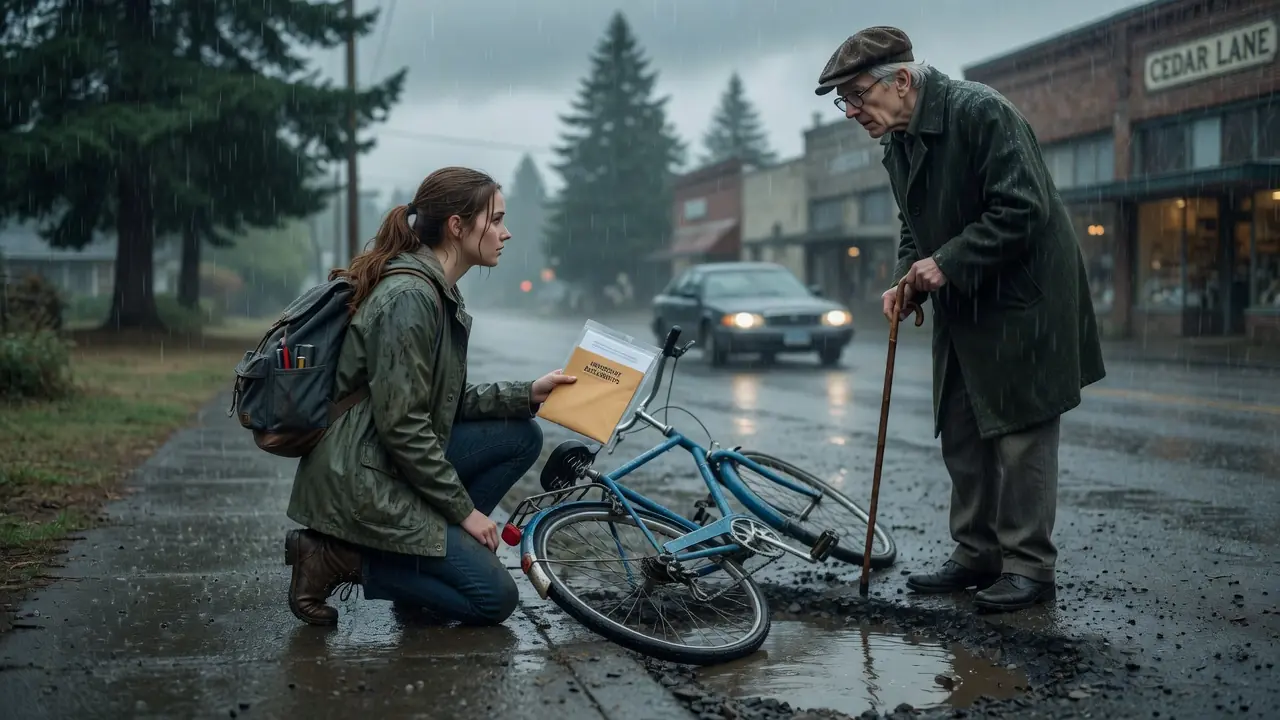
“I’ll take it to a shop.”
George protested at once.
“I can do that.”
“No,” Claire said.
George’s face tightened.
Olivia saw the old battle beginning.
Independence against worry.
Pride against care.
She spoke gently.
“Maybe tomorrow, if the rain stops, I can help get it to the repair shop. That way George still handles the bike, but it gets there safely.”
Both of them looked at her.
Claire’s face softened.
“That would actually help.”
George hesitated.
“A plan,” he said quietly.
Olivia smiled.
“A plan.”
Claire invited Olivia inside to dry off.
Olivia almost refused, but the rain was still coming down, and George looked as if he wanted to thank her properly but did not know how.
So she stepped inside.
Claire’s house smelled of coffee, laundry detergent, and the faint antiseptic scent that seemed to follow hospital workers home.
A little boy of about seven stood in the hallway holding a toy dinosaur.
“Grandpa!” he said.
George’s face lit.
“Caleb.”
The boy ran to him.
George hugged him carefully.
“I brought your mom’s papers.”
Caleb looked at Olivia.
“Did you fix Grandpa’s bike?”
“Enough to get it here.”
“Can you fix dinosaurs?”
“Depends what broke.”
He held up the toy.
“The tail is loose.”
Olivia laughed.
“Let’s start with the bicycle.”
Claire brought towels.
George sat at the kitchen table while Claire checked the documents again.
Olivia noticed the stress on Claire’s face.
Not just paperwork stress.
Life stress.
A stack of bills sat near the coffee maker.
A lunchbox rested open on the counter.
A calendar on the wall was full of hospital shifts, school reminders, appointment dates, and notes written in different colored pens.
Claire looked at the folder and exhaled shakily.
“If we don’t bring these tomorrow, they’ll delay the housing review again.”
“Housing review?” Olivia asked.
Claire glanced at George.
He nodded.
“My lease is being corrected,” he said. “Building changed management. They made a mistake with my renewal. Claire is helping me fix it.”
Claire added, “Dad could stay, but only if we prove payment history and file corrections before the meeting. The records office printed some copies today, and I couldn’t pick them up because my shift ran over.”
“I said I could do it,” George said.
“You did,” Claire replied. “And I’m grateful. But I don’t want you getting hurt.”
George looked down at his hands.
“I don’t want to become someone who can’t help his own daughter.”
The room went quiet.
Claire’s eyes filled.
“Dad, you are not becoming that.”
“I used to fix your car. Your sink. Your porch light. I used to carry everything.”
“I know.”
“Now you worry if I cross a street.”
Claire sat beside him.
“I worry because I love you, not because you are useless.”
George swallowed.
Olivia looked down at her hands, feeling like she was witnessing something private and important.
After a moment, Claire turned to her.
“Thank you for not just walking past.”
Olivia smiled softly.
“He was hard to miss.”
George gave her a look.
“In a dignified way, I hope.”
“Very dignified. Muddy, but dignified.”
Caleb giggled.
Claire insisted on driving Olivia home.
Before Olivia left, George asked for a piece of paper.
He wrote her name carefully after she spelled it.
Olivia Harper.
Then he wrote her phone number because Claire insisted they coordinate the bicycle repair.
“You have mechanic hands,” George said.
“My dad taught me.”
“He taught well.”
“Thank you.”
“And you have community eyes.”
Olivia paused.
“What does that mean?”
George looked at the wet bike on the porch.
“You saw a stuck old man, but you also saw the papers, the traffic, the rain, the pride, and the need to make a plan. Most people only see the inconvenience in front of them.”
Olivia did not know what to say.
So she said, “I’m glad I was there.”
The next morning, the rain had stopped, but the streets were still wet.
Olivia met George and Claire at George’s house.
The blue bicycle leaned on the porch, mud dried on the tires.
In daylight, it looked older than it had in the storm.
The paint was scratched.
The seat was cracked.
The chain was rusted in places.
The basket was tied with two different straps.
But it had character.
And it had clearly been loved.
George stood beside it wearing a dry cap and a stubborn expression.
“I can walk it,” he said.
Claire crossed her arms.
“Dad.”
Olivia said, “You can walk beside it. I’ll push through rough patches.”
George considered this.
“That is acceptable.”
They took the bicycle to Maplewood Cycle Works, a small shop owned by a broad-shouldered woman named Denise who had known Olivia’s father years ago.
Denise inspected the bike.
“Old Raleigh,” she said. “Good frame. Tired parts.”
George stood straighter.
“Frame is good?”
“Frame is excellent.”
He looked relieved, as if she had complimented his own bones.
Denise listed repairs.
Derailleur alignment.
New chain recommended.
Rear tube replacement.
Brake adjustment.
Basket mount.
Cable inspection.
George’s face tightened at the cost.
Claire immediately said, “I’ll pay.”
George immediately said, “No.”
Olivia watched the familiar tension return.
Denise, who had clearly handled many such arguments, leaned on the counter.
“We can do safety essentials first. Chain, tube, brake. Basket mount if I can use spare parts. Full tune-up later.”
George looked at her.
“That is safe?”
“For gentle riding, yes.”
Claire still looked worried.
Olivia said, “And maybe no riding in heavy rain until full tune-up.”
George sighed.
“Everyone keeps making weather rules.”
“Weather keeps earning them,” Claire said.
The repair took two days.
During that time, George called Olivia once to ask whether he had chosen the correct repair plan.
Then again to tell her Caleb’s dinosaur tail had been fixed with tape but “not professionally.”
Olivia laughed both times.
When the bicycle was ready, George invited Olivia to see him pick it up.
The blue bike stood outside Maplewood Cycle Works in the sun.
Cleaned.
Chain replaced.
Rear tire firm.
Brakes adjusted.
Basket straight.
Denise had polished the bell too.
George touched the handlebar.
“It looks like Margaret just bought it again.”
Claire wiped her eyes quickly.
George pretended not to see.
He turned to Olivia.
“You were right. Old doesn’t mean useless.”
“No,” Olivia said. “It means worth maintaining.”
George smiled.
“That should be on a sign.”
Olivia thought about her notebook.
Roadside Hands.
Maybe it should be.
Over the next few months, George became a regular part of Olivia’s life in a way neither of them expected.
He called when his bike made a strange sound.
He called when Caleb’s scooter wheel loosened.
He called when a neighbor’s walker brake stopped catching.
Olivia came when she could.
Sometimes she fixed the issue.
Sometimes she called the right person.
Sometimes she simply helped make a plan.
George began asking about her work, her family, her dreams.
One afternoon, while Olivia tightened the basket bolt on his bicycle, he noticed her notebook sticking out of her backpack.
“What is that?”
“Just ideas.”
“At my age, just ideas usually means something important looking for courage.”
Olivia smiled.
“You sound like you’ve said that before.”
“I have lived long enough to recognize hiding.”
She opened the notebook and showed him Roadside Hands.
George read slowly.
Basic mobility repairs.
Bicycle safety checks.
Walker brake adjustments.
Shopping cart wheel fixes.
Senior errand support.
Youth repair workshops.
Emergency document protection.
Rain kits.
Volunteer response team.
George read every page.
Then he looked at Olivia.
“This is not about tools.”
“It isn’t?”
“No. It is about keeping people moving.”
Olivia felt her throat tighten.
“Yes.”
“Then you should build it.”
“I don’t have funding.”
“Start with what you have.”
“I don’t have volunteers.”
“Find people who like being useful.”
“I don’t have a place.”
“The senior center has a garage.”
Olivia blinked.
“It does?”
“Yes. Full of folding chairs, broken fans, and one suspicious artificial Christmas tree. Plenty of room.”
“You know that?”
“I play cards there again.”
“You went back?”
George nodded.
“After the rain day, Claire insisted I stop isolating like a damp old newspaper.”
Olivia laughed.
“Good for Claire.”
“She said it with less poetry.”
George tapped the notebook.
“I can talk to the senior center director.”
“You don’t have to.”
“I know. That is why I can.”
A week later, George introduced Olivia to Mrs. Patel, the senior center director.
Mrs. Patel was practical, quick-moving, and impossible to impress with vague ideas.
Olivia arrived with her notebook, repair kit, and nervous hands.
George sat beside her like an elderly witness prepared to testify.
Olivia explained Roadside Hands.
Small mobility repairs.
Volunteer training.
Safety check days.
No major mechanical liability without referral.
Basic bicycle and walker maintenance.
Emergency help when someone is stranded.
Partnerships with the bike shop, library, and senior center.
Mrs. Patel listened.
Then she asked twelve difficult questions.
Insurance?
Training?
Tool storage?
Boundaries?
Transportation?
Background checks?
Waivers?
Scheduling?
Costs?
Olivia answered what she could.
When she faltered, George spoke.
“If this existed three weeks ago, I would not have been stuck in traffic with legal papers getting rained on.”
Mrs. Patel turned to him.
“And you would use it?”
“I would pretend not to need it, then use it.”
Mrs. Patel smiled.
“Honest.”
George nodded.
“At my age, honesty saves time.”
The senior center approved one trial event.
Roadside Hands Safety Day.
Bicycles, walkers, carts, and small mobility items.
Free basic checks.
No major repairs on site.
Referrals available.
Olivia barely slept the night before.
She made forms.
Labels.
Checklists.
Tool lists.
A sign.
George helped by calling everyone he knew.
Which turned out to be too many people.
The trial event drew thirty-two residents.
Olivia expected ten.
People brought bicycles with flat tires.
Walkers with loose brakes.
Shopping carts with squeaky wheels.
A cane with a worn rubber tip.
A stroller one grandmother used for groceries.
A scooter with a crooked handlebar.
Denise from the bike shop came to help.
Two teenagers from the high school volunteered.
George sat at the check-in table wearing a handmade name tag that read:
George Miller.
Movement Consultant.
Olivia stared at it.
“Movement Consultant?”
He lifted his chin.
“It sounds official.”
“It sounds like you invented it.”
“All titles are invented.”
The event was exhausting.
And wonderful.
One woman cried when Denise adjusted the brakes on her walker because she had been afraid to go downhill to the library.
A retired man smiled like a boy when his bicycle tire held air for the first time in a year.
A grandmother hugged a volunteer after her grocery cart stopped squealing.
A widower admitted he had stopped going to the pharmacy because his bike chain slipped too often.
Olivia saw what George had seen.
This was not about tools.
It was about keeping people moving.
The trial became monthly.
Then twice monthly.
The senior center cleared half the garage.
Local people donated tools.
Denise donated old but usable bike parts.
The hardware store donated rubber cane tips, bolts, washers, and reflective tape.
The high school shop teacher sent students to learn repair skills.
George came every week.
Sometimes he helped check people in.
Sometimes he told stories.
Sometimes he drank coffee and declared that young volunteers needed more common sense and less energy.
They adored him.
Claire said Roadside Hands gave her father back his sense of usefulness.
George said it gave him more people to supervise.
Both were true.
Six months later, Olivia applied for a community mobility grant.
She included repair numbers, event attendance, senior testimonials, photos of tool tables, and George’s letter.
His letter told the story of the rainy street, the stuck bicycle, the protected documents, and the way Olivia had helped him without taking over his dignity.
At the end, he wrote:
Olivia Harper understands that mobility is not only transportation. It is independence, purpose, and the ability to remain useful to the people we love. She does not simply fix wheels. She helps people keep moving through their lives.
The grant was approved.
Not a fortune.
Not a building.
Not a full salary.
But enough to buy repair stands, tool kits, reflective safety supplies, storage shelves, volunteer shirts, insurance coverage for events, and a small stipend for Olivia to coordinate the program.
Roadside Hands became official.
Olivia became its coordinator while still working part-time at the bookstore.
Her father attended the opening event.
He stood beside the tool table, looked at the program sign, and wiped his eyes with a shop rag he had brought from home.
“You found the small thing first,” he said.
Olivia hugged him.
“I learned from you.”
Years passed.
Roadside Hands grew beyond Maplewood.
It helped seniors maintain bicycles, walkers, carts, canes, and small mobility tools.
It trained teenagers in repair work.
It partnered with the library for safety workshops.
It worked with the pharmacy to identify elderly customers struggling with transportation.
It built rain kits with ponchos, reflective bands, plastic document sleeves, and emergency contact cards.
George’s blue bicycle became the unofficial symbol of the program.
It still rolled.
It still squeaked sometimes.
But it kept going.
Just like George.
One afternoon, George came to the senior center with Claire and Caleb.
Caleb was older now, nearly twelve, and taller than Olivia remembered.
George carried a folder.
Claire carried a small plaque.
Olivia immediately felt suspicious.
“What is happening?”
George smiled.
“Something useful.”
“That is vague.”
“Intentionally.”
Inside the folder was an offer from a local community college.
The college wanted to partner with Roadside Hands to create a paid apprenticeship for young adults learning practical repair and community service coordination.
The apprenticeship would be named after Olivia’s father, who had agreed to teach the first basic bicycle repair course.
Olivia stared at the papers.
Then at her father, who had apparently known.
“You knew?”
He smiled.
“George called me.”
George said, “Your father knows tools. You know people. The program needs both.”
Claire added, “The grant covers the first year. The college covers classroom space. The senior center provides the garage.”
Olivia could barely speak.
“This is too much.”
George lifted one eyebrow.
“You helped me deliver papers that kept my apartment. You helped me keep being useful to my daughter. You built a program that keeps people moving. This is not too much. This is what should happen next.”
The apprenticeship changed everything.
Roadside Hands became a training program, not only a repair service.
Teenagers learned basic mechanics.
Young adults learned volunteer coordination.
Seniors taught old skills.
Mechanics taught safety.
The program repaired hundreds of small mobility problems each year.
And Olivia, who had once carried a notebook full of uncertain ideas, became the director of a program people across the county wanted to copy.
George lived long enough to see the first apprentices graduate.
At the ceremony, he sat in the front row with Claire and Caleb.
His blue bicycle stood beside the stage, polished, with its basket straight and its bell shining.
When Olivia thanked him, George shook his head.
“You did the work.”
“You helped open the door.”
“I got stuck in mud.”
“And changed my life.”
He laughed.
“That is a generous summary.”
Two years later, George passed away peacefully in his apartment.
Claire told Olivia he had ridden his blue bicycle around the block only three days before, slowly and stubbornly, with Caleb walking beside him.
At his memorial, the bicycle stood near the entrance with yellow flowers in the basket.
Beside it was a photograph of George and Margaret on the day she gave him the bike.
George was smiling like a man pretending not to be delighted.
After the service, Claire handed Olivia an envelope.
“Dad wrote this for you.”
Inside was a note in George’s careful handwriting.
Dear Olivia,
The day my bicycle got stuck in the rain, I thought I had failed my daughter.
You protected the papers.
You freed the chain.
You walked beside me.
Most importantly, you did not make me feel useless.
Then you built Roadside Hands so others could keep moving too.
If life is kind, may we all meet someone who knows how to find the small thing that failed before the whole person gives up.
With gratitude,
George Miller
Olivia framed the note in the Roadside Hands garage.
Beside it, she placed the first program sign, the one she had made by hand before the trial event.
Years later, whenever people asked how Roadside Hands began, Olivia told them the truth.
“It began with an old man, a stuck bicycle, important papers, and a rainstorm that almost made him feel useless.”
Then she would point to George’s blue bicycle.
The gift she received was not a house.
Not a car.
Not a fortune.
It was an opportunity.
A partnership.
An apprenticeship program.
A way to turn one urgent roadside repair into hundreds of moments where people kept moving.
And every time someone came to Roadside Hands holding a broken walker, a flat bicycle tire, a squeaking cart, or a cane with a worn tip, Olivia smiled gently.
She never made them feel foolish.
She never made them feel old.
She simply opened her toolbox and said, “Let’s find the small thing first.”
Because sometimes independence did not disappear all at once.
Sometimes it got stuck in a chain.
Caught in a wheel.
Loosened by one missing bolt.
And sometimes, with the right help at the right moment, it could start moving again.