At twenty-four, Sophie Reynolds had learned that winter made small obstacles dangerous.
A cracked sidewalk was just a cracked sidewalk in July. In January, it became a trap.
A curb was just a curb in spring. In freezing weather, it became a wall for someone with weak knees, a cane, a walker, or a wheelchair.
Sophie noticed those things because her mother had used a wheelchair for the last six years of her life. After a car accident left her partially paralyzed, Sophie had learned how difficult ordinary places could become. Grocery store entrances. Narrow doorways. Broken ramps. Uneven pavement. Heavy doors. Snow pushed into curb cuts by careless plows.
People talked about independence like it was only a matter of attitude.
Sophie knew independence also needed good design.
She lived in a small town in Minnesota called Lakewood Falls, where winter lasted long enough to feel personal. She was a young white American woman with fair skin, long dark-blonde hair usually tied into a low ponytail, blue-gray eyes, and quiet hands that were always sketching something: a ramp, a doorway, a better bench, a safer corner, a room someone could actually move through without fear.
She worked at Northline Hardware, a family-owned store near the town square. She stocked shelves, cut keys, mixed paint, helped customers find screws, carried salt bags to cars, and answered questions about hinges, grab bars, weatherstripping, and porch lights.
It was not the career she wanted.
But it was close enough to the world she cared about.
Her dream was to become an accessibility designer, someone who helped homes, small businesses, and public spaces become safer for elderly people and people with disabilities. She wanted to create practical designs that did not make people feel like patients in their own homes. A ramp could be beautiful. A grab bar could be dignified. A doorway could welcome instead of block.
She kept a notebook full of ideas.
She had a name written on the first page:
Open Way Design
But dreams needed training, certification, tools, a portfolio, connections, and money.
Sophie had a hardware-store paycheck, a used laptop, and her mother’s old measuring tape.
So she kept working and kept sketching.
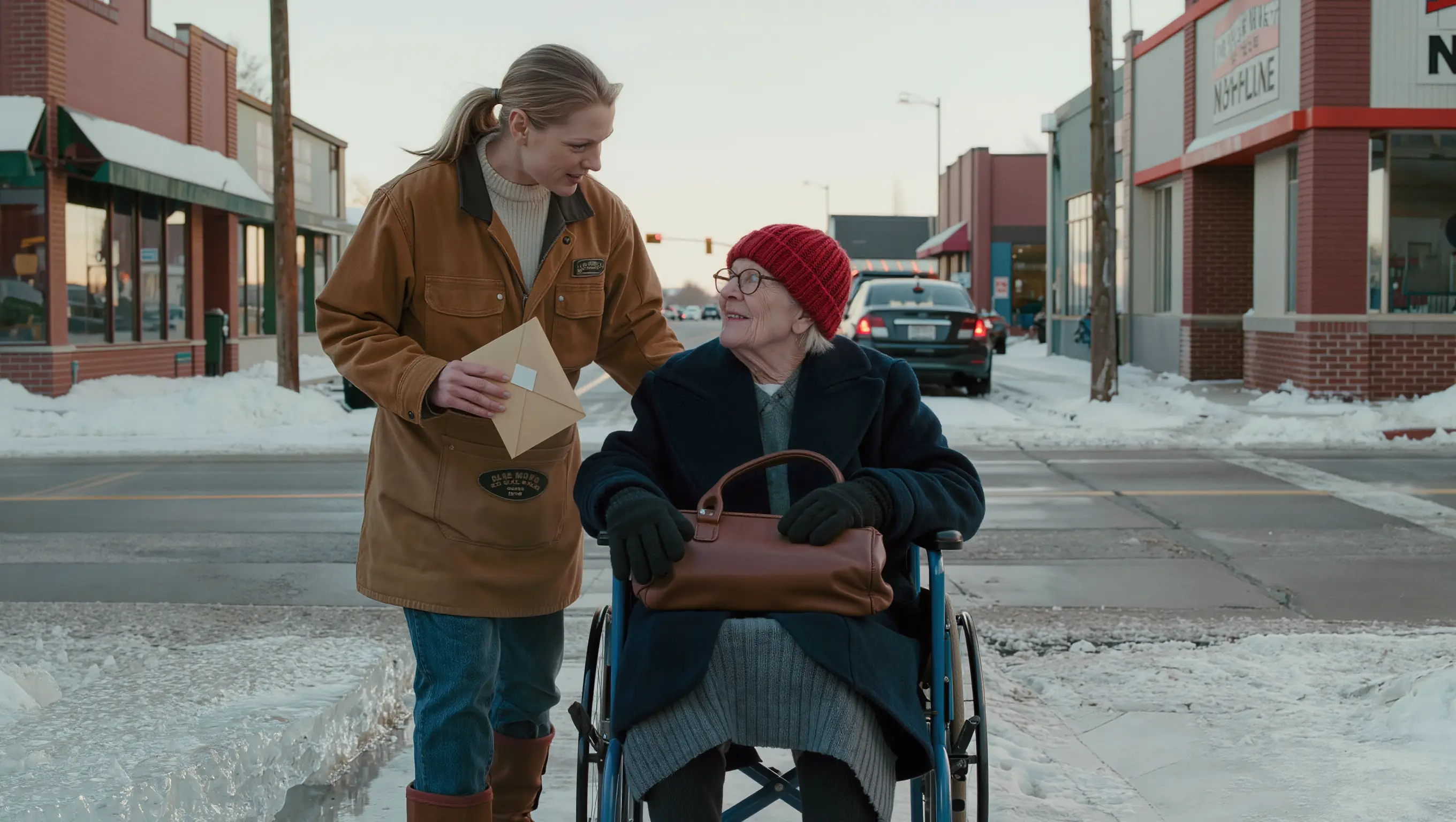
One bitter Wednesday afternoon in January, Sophie finished her shift just as the sky began turning pale violet over the snow-covered town square. The air was sharp enough to hurt her nose when she breathed in. Salt crunched under boots. Cars moved slowly along Main Street, their tires hissing over slush. Snowbanks lined the curb where the plows had pushed them high, leaving only narrow cuts at the crosswalks.
Sophie was walking toward the parking lot behind the hardware store when she saw the elderly woman.
The woman was at the far corner of Maple and Third, trying to cross the street in a wheelchair.
She looked to be in her late seventies, a white American woman with short silver hair tucked under a red knit hat, pale skin flushed from cold, and tired blue eyes behind round glasses. A thick navy coat covered her lap. A brown leather purse sat across her knees. One hand gripped the wheel of her chair. The other held a folded paper envelope.
The pedestrian signal was still on.
But the curb cut was blocked by frozen snow.
The woman tried to push forward.
The front caster wheel hit the ridge of ice and stopped.
She tried again.
The chair jerked.
Her purse slid sideways, and the paper envelope dropped onto the wet street.
A car waiting at the light honked once.
The woman flinched.
Sophie ran.
“Ma’am! Stop pushing. I’m coming.”
The woman looked up, embarrassed and frightened.
“I’m all right,” she called, though her voice shook.
“No, you’re stuck.”
Sophie stepped into the crosswalk and raised one hand toward the waiting cars.
“Please wait!”
A driver threw up his hands impatiently.
Sophie ignored him.
She picked up the envelope first, shaking slush from the edge. Then she crouched beside the wheelchair. The front wheel was wedged against a hard ridge of packed snow and ice. If the woman forced it, the chair could tip forward.
Sophie looked at her.
“My name is Sophie. I’m going to help you back up slightly, then angle the chair over the clear part of the curb. Is that okay?”
The woman nodded quickly.
“My name is Evelyn Carter.”
“Nice to meet you, Mrs. Carter. Keep your hands in your lap for a second.”
Sophie moved behind the chair, leaned carefully, and pulled it back just enough to free the wheel. Then she turned the chair at an angle, found a lower break in the ice, and pushed steadily. The chair bumped once, then rolled safely onto the sidewalk.
The crossing signal ended seconds later.
Cars began moving.
Evelyn let out a breath that sounded like it had been trapped in her chest.
“Thank you,” she whispered.
“You’re welcome. Are you hurt?”
“No. Just humiliated.”
“That crosswalk is humiliating, not you.”
Evelyn looked at the snowbank blocking the curb.
“It wasn’t this bad when I came earlier.”
“Plows push snow into curb cuts all the time. They clear the road and block the people who need the crossing most.”
Evelyn stared at her with surprise.
“You noticed that quickly.”
“I notice it a lot.”
Sophie handed back the envelope. It was damp but not ruined.
“This fell.”
Evelyn took it with both hands.
“Oh, thank goodness.”
“Important?”
“Yes.” Her voice softened. “Very.”
Sophie glanced at the darkening sky.
“Where are you headed?”
Evelyn looked toward the community hall across the square.
“There. I’m late already.”
“The community hall?”
“Yes. There’s a planning meeting for the town’s winter memorial garden.”
Sophie knew about the project. The town wanted to turn an empty lot beside the library into a small public garden honoring longtime residents who had passed away. There had been arguments for months about benches, paths, budget, maintenance, and whether the project mattered enough.
“My husband’s design is in here,” Evelyn said, touching the envelope. “He drew it before he died.”
Sophie looked at her more carefully.
“Your husband designed the garden?”
“He was a landscape architect. Not famous. Just thoughtful. He believed public places should give people somewhere to breathe. When the town asked for ideas, he drew a little plan. Wide paths, low benches, winter shrubs, places for wheelchairs to turn.” She looked down. “He died before he could submit it.”
Sophie felt something tighten in her chest.
“And you’re bringing it to the meeting?”
Evelyn nodded.
“They’re voting tonight on a final plan. I wanted them to see his.”
Sophie looked at the blocked curb, the ice, the envelope, the woman’s shaking hands.
“Then I’ll walk with you.”
“Oh, no. You already helped enough.”
“You still have two more curbs between here and the hall.”
Evelyn glanced ahead.
The sidewalk looked clear in places, but Sophie could see the trouble immediately: uneven patches of ice, a narrow section where snow had fallen from a roof, and another curb cut half blocked by plowed slush.
“You’re right,” Evelyn admitted softly.
“I wish I wasn’t.”
Sophie moved beside her, not pushing without permission.
“Would you like me to push, or would you rather I help only where it’s rough?”
Evelyn’s face changed.
Many people had probably grabbed her chair without asking.
“Only where it’s rough,” she said.
“Got it.”
They moved slowly toward the community hall.
At the next curb, Sophie cleared loose snow with her boot and helped guide the chair around a patch of ice. At the hall entrance, she pulled open the heavy door and frowned at the threshold, which rose almost an inch too high.
Evelyn followed her eyes.
“You see everything, don’t you?”
“Only the things that shouldn’t be this hard.”
Inside the hall, the meeting had already begun. Folding chairs faced a long table where three committee members sat with papers, coffee cups, and tired expressions. About twenty townspeople were scattered across the room.
Evelyn hesitated near the doorway.
“I’m too late.”
Sophie looked at the front table.
“No, you’re exactly dramatic enough.”
That startled Evelyn into a laugh.
Sophie walked beside her as she rolled down the center aisle. A few people turned. One woman at the front whispered something to another. The committee chair, a gray-haired man with a red folder, paused.
“Mrs. Carter,” he said. “We were just about to close public comments.”
Evelyn lifted the damp envelope.
“Then I arrived in time.”
Her voice trembled, but she did not back down.
Sophie stood near the aisle, ready to leave but unable to move.
The chair asked, “Do you have something to submit?”
“Yes.” Evelyn looked at Sophie for a second, then back at the committee. “My husband’s garden plan.”
A murmur moved through the room.
Evelyn continued, “Walter drew this before he passed. I know there are more polished proposals. I know his is hand-drawn. But he understood this town. He understood older people. He understood paths that don’t punish wheelchairs and benches that don’t trap people once they sit down.”
Sophie watched the committee members shift.
Evelyn opened the envelope and unfolded the drawing.
It was beautiful.
Not flashy.
Practical and gentle.
A winding path wide enough for wheelchairs and walkers. Several benches with armrests. Raised planters. Winterberry shrubs. A small central stone engraved with names. Space near the entrance for snow clearance. Turning circles marked clearly. Notes about slope, drainage, and visibility from the library windows.
Sophie’s breath caught.
Walter Carter had drawn exactly the kind of design she wanted to create one day.
Accessible without looking clinical.
Beautiful without forgetting bodies.
The committee chair leaned forward.
“May we see that?”
Evelyn handed it to him.
Sophie noticed the paper tremble in her hand.
After the meeting, several people came up to Evelyn. Some remembered Walter. Some praised the drawing. One committee member admitted that none of the other plans had considered winter snow clearance or wheelchair turning space.
The vote was delayed.
Walter’s plan would be reviewed properly.
Evelyn sat near the back afterward, visibly exhausted.
Sophie brought her a paper cup of tea from the refreshment table.
“You did it,” Sophie said.
Evelyn held the cup with both hands.
“We did it. I would still be stuck at the curb without you.”
“You had the plan.”
“You made sure it arrived.”
Sophie smiled softly.
“That counts.”
Evelyn studied her.
“What do you do, Sophie?”
“I work at Northline Hardware.”
“No,” Evelyn said gently. “What do you want to do?”
Sophie hesitated.
Then, because Evelyn had spoken about paths and benches like they were moral choices, she told the truth.
“I want to design accessible spaces. Homes, small shops, gardens, community rooms. Places that let people move with dignity.”
Evelyn’s eyes softened.
“Walter would have liked you.”
“I think I would have liked him too.”
“He kept sketchbooks,” Evelyn said. “Years of them. Ramps, gardens, entries, sidewalks, benches. He said good design was kindness made visible.”
Sophie felt that sentence settle inside her.
Kindness made visible.
Over the next few months, Sophie and Evelyn became friends.
The memorial garden committee asked Sophie to help photograph and document the town’s problem areas after Evelyn told them how the curb almost stopped her. Sophie spent weekends measuring curb cuts, photographing blocked crossings, sketching safer entrance ideas, and comparing them to Walter’s plan.
She was not paid.
But she was learning.
Evelyn invited her over for tea one Saturday afternoon. Her small house was filled with plants, old design books, framed landscape drawings, and photographs of Walter standing in gardens he had created. On the dining table sat several worn sketchbooks.
“These are his,” Evelyn said.
Sophie touched one carefully.
“May I?”
“Please.”
Inside were pages of thoughtful drawings: park paths, porch ramps, garden benches, railings, library entrances, public seating, school courtyards, and notes written in careful pencil.
Slope too steep for walker.
Bench needs arms for standing.
Beauty must include access.
Snow storage cannot block crossing.
Sophie read that last line twice.
Evelyn noticed.
“He complained about that for thirty years.”
“He was right.”
“He usually was, which was inconvenient.”
Sophie laughed.
Evelyn gave her one sketchbook to borrow.
Not keep.
Borrow.
Sophie studied it every night.
She learned more from Walter’s notes than from any online article. He did not draw accessibility as an afterthought. He drew it into the first line.
The memorial garden was eventually approved using Walter’s plan as the foundation. Sophie helped the committee mark path widths, choose bench placement, and write a small accessibility checklist.
At the garden dedication the following spring, Evelyn sat in her wheelchair near the entrance, wrapped in a pale blue shawl. The paths were smooth. The benches had arms. The winterberry shrubs had begun to leaf out. A small stone at the center read:
For Those Who Helped This Town Grow
Below the inscription was a smaller line:
Design inspired by Walter Carter
Evelyn cried when she saw it.
Sophie stood beside her.
“He made it here,” Sophie said.
Evelyn took her hand.
“So did I.”
A local newspaper ran a short article about the garden. It mentioned Walter’s design and Sophie’s volunteer work documenting accessible routes. A regional nonprofit focused on aging-friendly communities saw the article and invited Sophie to apply for a training fellowship in accessible residential design.
Sophie stared at the application for two weeks.
She did not think she was qualified.
She had no degree in architecture. No official design job. No portfolio except sketches, photos, and volunteer notes.
Evelyn disagreed.
“You have eyes,” she said. “Real ones.”
“That’s not a credential.”
“It should be.”
Sophie laughed.
Evelyn became serious.
“Apply.”
“What if they reject me?”
“Then you remain exactly where you are, except braver.”
Sophie applied.
With her application, she included photos of the blocked curb from that first night, drawings from the garden process, and a letter from Evelyn.
The letter told the story of the frozen crosswalk, the wheelchair stuck in ice, the envelope nearly lost, and the young woman who did not simply push without asking, but asked how to help. Evelyn wrote that Sophie understood dignity before she understood credentials.
Three months later, Sophie received the fellowship.
It came with training, mentorship, and a small stipend.
Not a fortune.
Not a building.
But a door.
On the day Sophie got the acceptance letter, she ran to Evelyn’s house.
Evelyn was waiting with tea as if she had already known.
“You got it,” she said before Sophie spoke.
“How did you know?”
“You knocked like a person trying not to fly.”
Sophie laughed and handed her the letter.
Evelyn read it slowly, then wiped her eyes.
“Walter would be proud.”
“I wish I could tell him.”
Evelyn stood from her chair with effort and went to the sideboard. She returned with a small wrapped package.
“I was saving this for the right day.”
Sophie opened it.
Inside was one of Walter’s sketchbooks.
The first one she had borrowed.
On the cover, Evelyn had written in small letters:
For Sophie — keep making kindness visible.
Sophie looked up quickly.
“No. Evelyn, I can’t take this.”
“Yes, you can.”
“It’s Walter’s.”
“And Walter believed drawings should become places.”
“This is too important.”
“That is why it belongs with someone who will use it.”
Sophie ran her hand over the worn cover.
“I don’t know what to say.”
“Say thank you. Then study.”
Sophie hugged her carefully.
“Thank you.”
The fellowship changed Sophie’s life.
She learned about accessible design standards, home modifications, aging-in-place planning, public space audits, universal design, and community advocacy. She built a portfolio around real problems in small towns: icy curb cuts, heavy doors, unsafe thresholds, inaccessible gardens, narrow store aisles, and poorly placed benches.
Walter’s sketchbook stayed on her desk through all of it.
Whenever Sophie doubted herself, she opened to one page where Walter had written:
A place is not welcoming until the person with the hardest journey can enter.
Years later, Sophie became an accessibility consultant for small towns, libraries, community centers, and older homeowners. Open Way Design became real, though slowly. She still worked part-time at the hardware store in the beginning, then less, then finally not at all.
She never became famous.
But she became useful.
She helped a bakery add a proper entrance without ruining its old storefront. She helped a church redesign its side path so older members could reach the hall in winter. She helped homeowners add dignified ramps, safer bathrooms, better lighting, and railings that looked like part of the home instead of punishment.
Evelyn lived long enough to see Sophie’s first official project completed: a safe walkway and entrance redesign for the Lakewood Falls library.
At the ribbon cutting, Sophie placed a temporary sign near the entrance:
Inspired by Evelyn and Walter Carter
Evelyn cried again.
“You cry at every opening,” Sophie teased gently.
“I am old. I have earned efficiency.”
Evelyn passed away peacefully two winters later.
At her memorial, Sophie brought Walter’s sketchbook and placed it beside a photograph of Evelyn in the memorial garden. During the service, she spoke about the night they met.
She described the frozen crosswalk.
The wheelchair wheel stuck in the ice.
The damp envelope.
The impatient cars.
The hand-drawn garden plan.
The old woman who refused to let her husband’s final design go unseen.
Then Sophie said, “I thought I was helping Mrs. Carter cross the street. I did not know she was helping me cross into the work I was meant to do.”
Years later, whenever someone asked how Open Way Design began, Sophie told the truth.
“It began at a frozen curb cut with a woman who could not cross safely.”
Then she would open Walter’s sketchbook and show the page that changed her life.
Good design is kindness made visible.
Evelyn had not given her a house.
Not a fortune.
Not anything too large to believe.
She had given her a sketchbook.
A letter.
A chance.
And the reminder that sometimes the most important gift is not a place to live, but a way to see.
Every winter, when snow piled along the streets and curb cuts disappeared beneath plowed ice, Sophie thought of Evelyn waiting at the crosswalk with the envelope in her lap.
Then she picked up her measuring tape, opened her notebook, and went looking for the next path that needed to be opened.