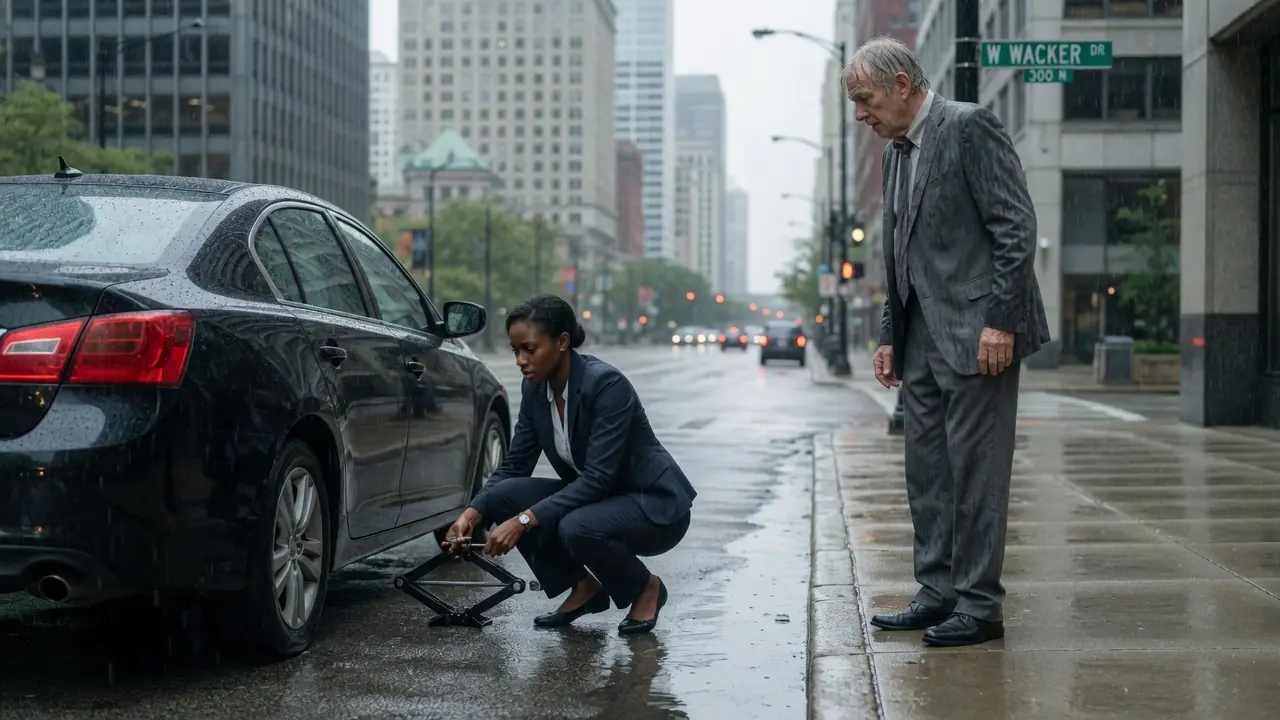
On a rainy morning in Chicago, a young woman was rushing to an important job interview when she suddenly spotted an elderly white man struggling with a car jack.
The old man was soaked, anxious, and exhausted, trying desperately to fix a flat tire in the middle of a storm.
Even though she knew she would be late, the young woman ran over to help.
What she didn’t know was that her selfless act of kindness that morning would change her life forever.
The morning started the way most Chicago mornings did.
Gray, close, and undecided between drizzle and rain.
The light came in dull through the small window of the Southbridge apartment, brushing across the counter where a half-empty coffee mug steamed beside a wrinkled blouse, a navy blazer, and a pair of worn heels polished carefully the night before.
Maya Reed stood in front of the mirror nailed above the sink, running a comb through her short curls and smoothing the front of a navy suit that had seen better days. The blazer pinched slightly at her shoulders. The color had faded just enough that the word navy seemed generous. One sleeve had a tiny repaired seam near the cuff, stitched so neatly that no one would notice unless they were looking closely.
Still, Maya looked at herself and nodded once.
Today mattered.
Her mother, Denise, stood at the stove, frying two eggs in a cast-iron pan older than Maya. The pan had belonged to Maya’s grandmother first, then Denise, and now it was the kind of family object that survived because no one could afford to replace anything that still worked.
“You’re not leaving on an empty stomach,” Denise said, sliding the eggs onto a plate. “Big day like this, you need something in you.”
Maya smiled, though her stomach was a tight knot.
“I’ll grab something on the train, Ma. I can’t risk getting sauce on this blouse before I even make it there.”
Denise turned and gave her the look Maya had known all her life.
The one that said there would be no arguing.
She wiped her hands on a dish towel and nodded toward a small box on the table. Inside, on a square of worn cloth, sat a pair of silver cufflinks.
Maya blinked.
“Ma…”
“They were your granddaddy’s,” Denise said softly. “He wore them when he got hired at the steel mill. Said they reminded him to keep his sleeves rolled down and his chin up.”
Maya picked them up carefully.
The metal was cool and smooth, the engraving faint but visible: a pair of linked hands.
“They’re beautiful,” Maya whispered.
“You always liked a shirt with proper cuffs,” Denise said. “Figured today was the day.”
Maya fastened them onto her blouse, feeling the small weight of memory against her wrists. She thought of her grandfather, a man she mostly knew through stories and photographs, standing tall outside the mill in a pressed shirt and polished shoes, determined to become more than what the world expected of him.
“Thanks, Ma,” she said quietly. “I’ll make him proud.”
Denise crossed the kitchen and kissed her cheek.
“You already did.”
The train rocked its way north, every seat taken, people pressed shoulder to shoulder in the humid warmth of wet coats and morning breath. Maya held her briefcase on her knees, her reflection ghosted against the dark window.
She rehearsed what she would say when she sat across from the hiring manager at Whitmore and Blake Financial.
She practiced answers for every question she could imagine.
What drew her to finance?
What had she learned from working double shifts at the grocery store while finishing night classes?
How did she handle pressure?
She had answers ready.
Good answers.
Honest answers.
She had worked too hard to walk into that room unprepared.
Outside, the Chicago skyline came into view, gray towers poking through mist. It should have looked promising, but the clouds above them were swelling darker, heavy with something worse than drizzle.
A woman nearby muttered, “They said thunder later. Looks early to me.”
Maya checked her watch.
Plenty of time if everything ran smoothly.
She had left early for that reason. She was not going to let anything—weather, traffic, bad luck, or fear—keep her from walking through that door on time.
Whitmore and Blake Financial was not just another interview.
It was the interview.
The kind of opportunity people in her neighborhood talked about in the same voice they used for distant relatives who had made it out. The company had a reputation for being selective, polished, intimidating. Maya had applied months ago, not really believing she would hear back. Then came the email. Then the phone screen. Then the second call. Then the invitation to meet in person.
Her mother had cried when Maya told her.
Not loudly. Denise was not a loud crier.
She had simply covered her mouth, turned toward the sink, and stood there for a minute, shoulders trembling.
Maya had pretended not to see because sometimes dignity meant letting people have their private joy without naming it.
When the train screeched into the downtown station, the city had already changed its mind.
By the time Maya stepped onto the street, the rain had turned mean.
It came down in hard sheets, driven sideways by wind. People ducked under umbrellas, newspapers, briefcases, tote bags, anything they could lift over their heads. Water rushed along the curb in gray streams, carrying leaves, cigarette butts, and bits of paper toward clogged drains.
Maya pulled up her collar and jogged toward the avenue, dodging puddles that were quickly turning into small rivers.
She tapped open her rideshare app.
The screen spun.
And spun again.
Every driver was unavailable.
She cursed under her breath and lifted an arm toward an approaching taxi. It slowed, tires hissing through water. But before she could reach it, a man in a beige trench coat ran from behind, yanked the handle, and slid in without looking back.
Maya froze there, dripping, one hand still raised.
For a second, she just stood in the storm, anger boiling hot in her chest.
Then she took a breath, forced her shoulders back, and looked down the street.
She could see the tower that held Whitmore and Blake’s offices, its glass face vanishing into the clouds.
Five blocks.
Maybe six.
She could make it on foot if she hurried.
“Keep moving,” she told herself. “Don’t lose it now.”
She set off, shoes splashing, suit darkening with every step.
The sidewalks were chaos. Umbrellas turned inside out. People ran for overhangs. A bus roared past and sent a wave of water over the curb, soaking the lower half of Maya’s pants. Thunder rolled close, loud enough to make the streetlights flicker.
Maya was halfway there when she noticed the car.
A sedan sat angled by the curb, hazard lights blinking steadily through the rain. One tire was flat to the rim.
Next to it stood an older white man, maybe in his sixties, gray hair plastered to his forehead. He was crouched low, trying to fit a jack under the car, his hands shaking from the cold and the rain. Every few seconds, the handle slipped, clattering against the wet pavement.
No one stopped.
People glanced, then kept walking.
Maya slowed.
The office tower loomed just ahead, glimmering through the downpour.
She could almost see the revolving doors.
Her watch said 8:44.
The interview was at 9:00.
She hesitated.
The man’s suit jacket was soaked through. His shoulders were hunched. He looked miserable, defeated, and quietly frightened in the way older people sometimes looked when their bodies stopped doing what they needed them to do.
Maya thought of her mother’s voice that morning.
You help people not when it’s easy, but when it’s right.
She looked at the tower again.
Then at the old man.
Then she set her briefcase on a dry patch of steps beneath a stone awning and jogged toward the car.
“Sir,” she called over the rain. “Are you okay?”
The man looked up, blinking water from his eyes.
“Flat tire,” he said. “Jack keeps slipping. My driver went for help, but I don’t know how long he’ll be.”
Maya crouched beside him.
“You’ve got a spare in the trunk?”
“Yes, but I can’t…” He looked down at his shaking hands. “These old hands don’t want to cooperate.”
Maya reached for the jack.
“Let me try.”
The man shook his head.
“You’ll ruin your suit.”
“It’s already ruined,” Maya said with a short laugh. “Pop the trunk.”
The rain came harder.
Maya slipped off her blazer and laid it on the curb, then knelt on it to keep from sliding on the wet pavement. She worked the jack steady, found the right placement, and began lifting the car.
Her uncle Terry had taught her how to change a tire when she was thirteen.
Back then, she had been annoyed that he made her learn.
“A woman should know how to do this,” he had said, standing over her in his auto shop with a rag thrown over his shoulder. “Not because men won’t help, but because needing help should be a choice, not a trap.”
Now his voice came back clearly.
Loosen the lug nuts before lifting too high.
Keep the wrench steady.
Don’t rush.
Don’t strip the nut unless you want to meet pain personally.
Maya worked quickly, but carefully.
Her fingers were slick from rain. Her hair clung to her forehead. Water ran down the back of her neck. A taxi splashed by close enough to soak her side, but she only clenched her jaw and kept working.
The old man watched her with growing amazement.
“You’ve done this before.”
“My uncle runs an auto shop,” Maya said, grunting as she loosened a stubborn lug nut. “He taught me not to strip a lug nut if I valued my knuckles.”
The man chuckled.
“Good lesson.”
“One of many.”
They worked in silence for a while, just the sound of rain, passing cars, and the metallic click of tools. Maya removed the damaged tire, rolled it aside, lifted the spare from the trunk, and lined it up.
The old man tried to help, but she waved him back.
“Just keep yourself steady, sir. I’ve got it.”
He did as he was told.
When Maya tightened the last nut, he stepped closer.
“What’s your name?” he asked.
“Maya Reed.”
“Maya,” he repeated carefully, as though placing the name somewhere important. “You are a good woman. I wish I could repay you somehow.”
Maya brushed rain from her face.
“No need. I’m just glad to help.”
“You sure? You look like you were on your way somewhere important.”
Maya hesitated, wiping her hands on her soaked pants.
“Interview,” she admitted. “A big one.”
The man frowned.
“Go. Don’t let me keep you.”
Maya shook her head and gave the tire one last check.
“Can’t leave a job half done.”
She lowered the car, tightened the bolts again, and gave the wheel a final firm push.
“All set.”
The man straightened, rubbing his wrist.
“You saved me from a disaster. Let me give you a ride at least.”
Maya hesitated.
“If it’s not out of your way.”
“Get in.”
The car rolled through flooded streets. Maya sat stiffly in the back seat, trying not to drip all over the leather. She could see the time on the dashboard.
8:59.
Her chest tightened.
“You said Whitmore and Blake?” the man asked from the front.
“Yes, sir.”
“I know the place.”
The way he said it was calm, almost too calm, but Maya was too anxious to notice.
They pulled up to the front steps just after 9:00. Maya grabbed her briefcase and reached for the door handle.
“Thank you, sir. Really.”
The man looked at her through the rearview mirror.
“I won’t forget this, Maya.”
She gave a quick nod and stepped out into the rain.
Inside the lobby, the world changed again.
Quiet.
Polished.
Dry.
The air smelled of coffee, cologne, and expensive carpet. People in pressed suits walked briskly across marble floors, their shoes tapping with purpose. A large digital directory glowed on the wall behind a security desk.
Maya caught a glimpse of herself in a mirrored column.
Her hair was damp and slightly flattened. Her blouse clung at the collar. Her blazer was wrinkled from the curb. Her pants were dark with rain below the knees. Her shoes squeaked softly when she walked.
She swallowed hard and approached the security desk.
“Maya Reed,” she said. “I have a 9:00 interview with the finance team.”
The guard glanced at his computer.
“You’re late. They’ve already started the first round.”
Maya’s throat tightened.
“Please. It’s only a few minutes. There was an emergency.”
The guard looked at her again, not unkindly, but not with much hope either.
“Fourteenth floor,” he said, tapping his badge printer. “Can’t promise they’ll still see you.”
“Thank you,” Maya said quietly.
She rode the elevator up, feeling every floor like another chance slipping away.
When the doors opened, a young woman at a reception desk looked up.
“Ms. Reed?”
“Yes. I’m sorry. I know I’m late.”
The receptionist’s expression softened, but her voice carried practiced finality.
“Mr. Callaway just started with the next candidate. His schedule is packed today.”
Maya nodded slowly.
“I understand.”
It took everything in her not to let her face fall apart.
“Could you give him my resume, please?”
“Of course.”
The receptionist took the folder carefully. It was still slightly damp at the edges.
“You came a long way, didn’t you?”
Maya forced a small smile.
“Feels like it.”
She turned to leave, the faint squeak of her wet shoes sounding too loud against the carpet.
Outside, the storm was thinning.
The clouds still hung heavy, but the light was changing, softening into silver. Maya stood under the building’s awning and watched cars crawl through puddles.
Her suit clung to her.
Her hands smelled faintly of metal and rain.
The cufflinks glinted in the weak light.
For a long moment, she did not move.
Then she breathed out slowly.
“You did what was right,” she whispered to herself. “That has to count for something.”
She turned toward the train station, her steps splashing quietly on the wet sidewalk.
Back home, Denise looked up as the apartment door opened.
Maya stepped in, water still dripping from her cuffs.
“Oh, baby,” Denise said, her voice full of both worry and sympathy.
Maya set down her briefcase and sat at the table.
“Didn’t go well.”
Denise came closer.
“What happened?”
“I was late,” Maya said. “Helped a man with a flat tire. Got there after nine. They’d moved on.”
Denise poured her a cup of coffee and set it down in front of her.
“You did right,” she said simply.
Maya looked up.
“I lost my chance, Ma.”
Denise smiled softly.
“Maybe not.”
Maya let out a tired laugh.
“Ma.”
“No,” Denise said gently. “Maybe you just can’t see the whole picture yet.”
Maya rubbed her eyes. She was tired and disappointed, but under the ache, there was something steadier. A quiet knowledge that she had done what she could.
Outside, the rain eased into drizzle, tapping gently against the window.
One door closed, she thought.
But maybe that was not the end of the story.
And for the first time all morning, Maya smiled.
The next morning broke with a thin, pale light that stretched through the blinds as if testing the room. The rain had stopped, but the city still smelled of it: wet pavement, iron, and the faint sweetness of soaked leaves.
Maya sat at the kitchen table in an old T-shirt, a coffee going cold beside her. The navy suit hung by the window, rumpled and drying on its hanger like a flag that had weathered something serious.
Denise hummed quietly while she sorted laundry.
She did not press Maya to talk, though her glances said she wanted to.
Maya finally spoke.
“Feels like I ran the whole city for nothing.”
Denise looked up and smiled softly.
“You didn’t run for nothing. You ran toward someone who needed you.”
Maya rubbed her face wearily.
“That doesn’t pay bills.”
“No, it doesn’t,” Denise said. “But it keeps you human. And sometimes, baby, that’s worth more than any paycheck.”
Maya did not answer.
She wanted to believe her, but the bitterness stuck. The job had been her chance to climb out, to prove something to herself and to the world that looked past women like her too easily. She had done everything right, and still, one morning of rain had swallowed it.
She took a long breath and stood.
“I’m going down to the shop. Uncle Terry needs help changing oil on those delivery vans. Keeps my hands busy.”
Denise nodded.
“Take your time, Maya. The world’s not done with you yet.”
The shop sat on the corner of Ashland and 48th, a low cinder-block building with peeling blue paint and the smell of oil that never left your clothes. Maya had spent half her teenage years there, turning wrenches, learning patience, learning that machines did not care who you were. They just needed a steady hand.
“Look who’s back from the financial district,” Uncle Terry called as Maya walked in, wiping grease off his hands with a rag. “You bring that fancy job with you?”
Maya gave him a small grin.
“Not this time.”
Terry raised an eyebrow.
“They were the ones losing out. You were the best worker I ever had.”
“You say that because I’m family.”
“I say it because you once fixed a timing belt faster than my paid assistant.”
Maya laughed despite herself.
Terry gestured to an old Ford on the lift.
“Help me with this tire, huh? Lug nuts are rusted on.”
As they worked, the clang of tools and the low murmur of blues music filled the air. Maya found the rhythm of it comforting. No polished floors. No receptionist smile. No pressure to prove that she belonged. Just work.
“You’ll get another shot,” Terry said after a while. “People notice good hearts, even if it takes them a while.”
Maya tightened the last nut and looked at her uncle.
“You really think that matters in the city?”
Terry grinned.
“Everywhere matters. You just got to keep showing up as the same woman you are here.”
That afternoon, Maya took the bus home. The sky was clearing, streaks of sunlight breaking through the gray. She leaned her head against the window, eyes following the people on the sidewalks: kids splashing through puddles, a man helping his wife out of a cab, a delivery driver hauling boxes up wet steps.
Life moved on.
It always did.
Back in the apartment, the phone buzzed on the counter.
Unknown number.
Maya frowned and picked it up.
“Ms. Reed?” a woman’s voice said. “This is Natalie Quinn from Whitmore and Blake. Mr. Whitmore would like to meet with you this afternoon if you’re available.”
Maya straightened in her chair.
“Mr. Whitmore? The CEO?”
“Yes, ma’am. His office is on the executive floor. Three o’clock, if that works.”
Maya looked toward her mother.
“I’ll be there,” she said, trying to keep her voice steady.
“Excellent. Security will have your name.”
When the call ended, Maya sat there for a long moment, staring at the phone.
Then she laughed.
A quick, unbelieving sound.
“What in the world just happened?”
Denise peeked around the corner.
“Good news?”
“You could say that,” Maya said. “They want me back. The CEO himself.”
Denise’s face broke into a smile.
“See? Told you the world wasn’t done with you.”
Maya stood in front of the mirror again. This time, she pressed her shirt collar smooth, shined her shoes until the leather caught the afternoon light, and brushed her curls carefully into place. The suit looked better now that it had dried.
The cufflinks gleamed faintly.
Little hands clasped together.
She rode the train into the city, the same route as before, but the world felt different, cleaner, brighter, almost forgiving.
At the tower, security handed her a pass labeled executive access.
The guard, who had scolded her the day before, nodded politely this time.
“Good luck, Ms. Reed.”
Maya smiled.
“Thank you.”
The elevator ride was long and silent as the numbers climbed. Her reflection swayed slightly in the brushed metal.
“You earned this one way or another,” she told herself.
When the doors opened, she stepped into a space that looked more like a sky than an office. Windows stretched from floor to ceiling. Sunlight poured across glass tables and silver fixtures. A woman approached holding a tablet.
“Ms. Reed, Mr. Whitmore is expecting you.”
“Thank you.”
Natalie led her through a hall lined with old -and-white photographs of the company’s founders standing beside chalkboards full of numbers. At the end of the hall stood a wide office with a view of Lake Michigan, silver-blue under the afternoon sun.
A man sat with his back to the door, gray hair bright against the light.
Maya stopped.
Recognition dawned slowly.
“Come in, Maya,” the man said, turning his chair.
It was him.
The man from the street.
The one with the flat tire.
For a heartbeat, neither spoke.
Then Whitmore smiled.
“I thought we should talk under better circumstances.”
Maya blinked, still processing.
“Sir, I didn’t realize.”
“I know,” Whitmore said gently. “That’s the point. You didn’t help me because of who I was.”
Maya took a cautious step forward.
“I was just doing what anyone would have done.”
Whitmore chuckled softly.
“Not anyone. I stood on that curb for fifteen minutes before you came along. You were the only person who stopped.”
Maya looked down, unsure how to respond.
Whitmore leaned back in his chair.
“I read your resume. It impressed me. But I’ll be honest. So did the fact that you showed up late yesterday, soaking wet, because you helped a stranger. That told me more than any interview could have.”
The words hit Maya like a wave.
“I didn’t expect this,” she said quietly.
“I imagine not,” Whitmore said. “But I believe in hiring people, not just paper.”
He opened a folder on his desk.
“So here is my offer. I don’t want you as another entry-level analyst. I want you as my special assistant. You’ll learn everything from the inside: how decisions are made, how power moves, how money shapes lives, and how people should be treated when no one thinks it matters. I think you’ll handle all of it well.”
Maya stared, stunned.
“Your special assistant?”
“Yes.”
“I don’t know if I’m qualified for that.”
Whitmore smiled.
“You are qualified to learn. That is enough. Experience can be built. Character is harder.”
Maya swallowed hard.
“What do you say?”
She looked at him, at the office, at the lake beyond the glass, at the city that had nearly swallowed her hope the day before.
Then she thought of her mother.
Her uncle.
Her grandfather’s cufflinks.
The old man in the rain.
“I say yes, sir,” she said. “I’d be honored.”
Whitmore stood and extended a hand.
Maya shook it, the firm grip sealing something far more meaningful than a job.
As she left the building later, the sky was clear. The city sparkled with a washed-clean light, and for the first time in a long time, Maya felt not just lucky, but seen.
She got off the train in Southbridge just as the sun began to drop. The streets glowed orange. Kids played stickball by the curb, and the smell of dinners drifted from open windows.
She walked home slowly, briefcase swinging lightly at her side.
Denise met her at the door, eyes searching her face.
“Well?”
Maya grinned.
“Turns out the man I helped runs the company.”
Denise’s hand flew to her chest.
“You’re kidding.”
“No, ma’am. Offered me a better job than the one I applied for.”
Denise let out a laugh that turned into a tearful chuckle.
“See? I told you kindness doesn’t go to waste.”
Maya hugged her, holding on a little longer than usual.
“You were right, Ma. You always are.”
Outside, the first stars were appearing, faint but certain.
That night, Maya looked at them through the window, cufflinks glinting in the lamplight. She thought of her grandfather, her uncle, her mother, and all the people who had shown her what hard work and decency looked like.
You help people not when it’s easy, but when it’s right.
And for the first time, she believed that maybe doing right had a way of finding its own way back.
The morning light over Southbridge was clean and clear, the kind that made the world look briefly forgiving.
Maya sat on the edge of her bed, tying her shoes. The apartment was quiet except for the sound of Denise in the kitchen humming the same hymn she always hummed when her heart was light.
Today would be Maya’s first full week at Whitmore and Blake.
It still did not feel real.
The polished office.
The view over the lake.
The title special assistant printed under her name on the small plate outside her workspace.
Every morning when she walked through the lobby and the guards greeted her with a nod, something inside her stirred.
Part disbelief.
Part gratitude.
Part responsibility.
She checked her reflection one last time. The navy suit pressed clean, the silver cufflinks shining. She ran a finger over them and smiled.
Downtown was already awake when Maya stepped out of the train station.
Delivery trucks honked. People hurried. Sunlight bounced off wet streets from last night’s rain. As she crossed the plaza toward the building, she saw a woman struggling with a cart stacked high with coffee boxes. The wheels caught on a curb, tipping slightly.
“Need a hand?” Maya asked.
The woman looked up, surprised, then nodded.
“Oh, thank you. These things have a mind of their own.”
Maya steadied the cart and lifted it over the step.
“There you go.”
“Appreciate it,” the woman said.
Maya smiled and kept walking.
Just a small thing.
A moment.
But it made her think of that rainy morning again. The storm. The broken tire. The choice she had made.
She felt that same quiet satisfaction now, like something inside her had settled into place.
Inside the office, Natalie Quinn greeted her at the reception desk with her usual warm smile.
“Morning, Ms. Reed. Mr. Whitmore is expecting you at nine sharp.”
Maya nodded.
“Thank you.”
She rode the elevator to the top floor. Each time the doors opened, she felt that same mixture of humility and purpose. When she reached the executive floor, the air itself felt different, quieter, more deliberate, as if people there measured their words like currency.
Whitmore’s office door stood half open.
Maya knocked lightly.
“Come in,” Whitmore said.
The older man was at his desk, glasses perched low on his nose as he studied a folder of reports. He looked up and smiled.
“Good morning, Maya. Have a seat.”
Maya sat.
“Morning, sir.”
Whitmore leaned back, stretching.
“I’ll tell you something about this business,” he began. “You can teach numbers. You can teach policy. You can teach negotiation. But you cannot teach conscience. That is what separates the good from the great.”
Maya nodded, listening.
Whitmore continued.
“You’ve got that, Maya. You showed it before you ever walked through these doors. But now I want you to see how it fits into the world. You are stepping into a world of money, pressure, and people who do not always stop to change tires.”
Maya smiled faintly.
“I’m ready to learn.”
The next few weeks unfolded in steady rhythm.
Maya shadowed Whitmore through meetings, presentations, and long afternoons of negotiations. She took notes, organized briefs, prepared summaries, fetched coffee when needed, and quietly observed how people spoke when they thought power was watching.
One afternoon in the conference room, a junior analyst made an error in a report.
The room went tense.
The young man’s face flushed red as others murmured and corrected him sharply. Maya watched him shrink slightly in his chair, embarrassment turning into panic.
She also watched Whitmore.
His eyes were calm, steady.
Before she knew it, she heard herself speaking.
“Excuse me,” Maya said gently. “We all miss things sometimes. What matters is that we fix them. He spotted the issue before final submission. That’s a good catch, isn’t it?”
The room went silent for a heartbeat.
Then Whitmore nodded slowly.
“That’s right, Maya. Thank you.”
Afterward, as the meeting broke up, the analyst, a young man named Luis, came over.
“Thanks for that,” he said quietly. “I thought I was done for.”
Maya smiled.
“Happens to everyone. You did good catching it yourself.”
As Luis left, Whitmore turned to Maya.
“You see what I mean about conscience?”
Maya nodded.
“I think I do.”
Days passed, and Maya began to notice the smaller details.
The receptionist who stayed late without complaint.
The janitor who always smiled even when almost no one greeted him first.
The accountant who ate lunch alone every day.
The security guard whose daughter had just started community college.
Maya started greeting them by name.
Asking how they were.
Remembering answers.
It did not take long before smiles followed her down the hallway.
But the real test came one gray Tuesday morning.
Whitmore had a flight to New York for a board meeting. Maya was assigned to review a series of investment proposals in his absence, a stack of polished reports from the acquisition team.
As she read through them, one caught her attention.
The numbers looked right.
The projected returns were strong.
The language was clean.
But the deeper she read, the more uneasy she felt.
It was a deal that promised high profit by buying out a struggling nursing home chain on the south side. The kind of place that looked after elders like her mother’s friends, people who had worked hard all their lives and now needed care more than they needed efficiency.
Maya leaned back, heart tightening.
The plan would streamline costs.
That meant layoffs.
Closures.
Higher fees.
Reduced staffing.
Profitable, yes.
But cruel.
She sat there tapping a pen against the folder.
Do you stay quiet?
It is not your place, she thought.
You are new.
You are lucky to be here.
Do not make trouble.
Or do you say something?
Finally, she gathered the file and walked to Natalie’s desk.
“Can I run something by you?” Maya asked.
Natalie looked up.
“Of course.”
Maya explained the deal, her concerns, and the gut feeling that something was wrong.
Natalie listened carefully.
“You’re not wrong, Maya. But raising it could ruffle feathers. It’s not exactly your role yet.”
Maya nodded, uncertain.
“I just don’t want us to make a profit off people’s hardship.”
Natalie smiled faintly.
“You sound like him.”
“Mr. Whitmore?”
“He built his name on that kind of integrity.”
Maya glanced toward Whitmore’s empty office.
“Then I guess I’ll take the risk.”
Later that day, Maya sent a concise memo to Whitmore summarizing her concerns. She did not expect a reply before his flight landed, but less than an hour later, an email came through.
Good catch, Maya. You’re right. We’ll review this one more closely. Never be afraid to speak up for what’s right.
Maya read it twice.
Then she leaned back in her chair, relief and pride mixing quietly inside her.
That evening, as she left the building, the sun was setting low behind the skyline. The light was golden, filtering through the glass towers like warm honey.
She walked toward the train, coat slung over her shoulder, when she saw a familiar face by the curb.
Luis, the analyst, waited with an umbrella in hand.
“Hey, Maya,” Luis called. “Headed home?”
“Yeah.”
“Come on. I’ll walk you to the station. You’ve been my good luck charm lately.”
Maya laughed.
“I’ll take the credit.”
They walked together, trading stories about their families, their neighborhoods, their hopes. For the first time, Maya realized how her small choices—a word in a meeting, a hand with a cart, a moment of courage—were rippling outward, touching lives in ways she had not planned but quietly hoped for.
As they reached the station, Luis said, “You know, people talk about you around the office.”
Maya raised an eyebrow.
“That sounds dangerous.”
He smiled.
“They say you make it feel different.”
“Different how?”
“Nicer. More human.”
Maya looked away, almost embarrassed.
“Just trying to do what’s right.”
Luis nodded.
“Well, keep doing it. The rest of us notice.”
That night, Maya sat by her window again. The city lights shimmered, and the breeze carried the distant hum of traffic. Her mother was asleep in her chair, the TV low and flickering.
Maya looked at the cufflinks glinting in the lamplight.
Small.
Steady.
Silver hands clasped together.
You help people not when it’s easy, but when it’s right.
She smiled to herself, realizing the truth of it now more than ever.
Kindness was not just one act in a storm.
It was how you walked through every day afterward, holding the world together one small gesture at a time.
And Maya Reed, daughter of Southbridge, sat there in the quiet glow of her own peace, ready to keep doing just that.
The months that followed rolled by like calm water, steady, sure, and marked by small, meaningful ripples.
The storm that had once soaked Maya’s suit was long behind her, yet in quiet moments she still thought about it. Sometimes on her way to work, when the city was half awake and the sidewalks glistened from overnight rain, she would catch the faint smell of wet asphalt and smile.
That morning, a light breeze swept across the plaza as she walked into the Whitmore and Blake Tower.
The same security guard who had once told her she was late now greeted her by name.
“Morning, Ms. Reed.”
“Morning, Clarence,” Maya replied with a nod.
The rhythm of the place had changed.
It was not that Maya had transformed the company overnight. She knew better than that. Large places changed slowly, if they changed at all. But something in her presence—steady, respectful, human—had softened a few edges.
People smiled more.
They held doors.
They remembered each other’s names.
Whitmore had begun easing into semi-retirement. He still came in most days, but he relied on Maya to handle more meetings, manage projects, and mentor younger employees.
One afternoon, the older man invited Maya into his office.
“Sit down,” he said, motioning toward the chair across from his desk.
Maya took a seat.
Whitmore leaned back, his hands folded loosely.
“You remember the day we met?”
Maya smiled.
“Hard to forget. You had a flat tire, and I was supposed to be in your lobby ten minutes later.”
Whitmore chuckled softly.
“I remember thinking how ridiculous I must have looked, soaked to the bone in that rain. But what I really remember is how calm you were. You didn’t rush. You did the job right.”
Maya shrugged lightly.
“My uncle taught me. If you’re going to help, do it like it matters.”
Whitmore nodded, his eyes kind.
“It does matter, Maya. More than most people realize. This company is changing. The next generation coming in needs to see leadership that isn’t just sharp. It has to be decent. You’ve shown that here.”
The words landed gently, but they carried weight.
Maya looked down at her hands, then back up.
“I just try to do what my mama raised me to do. Treat people right.”
Whitmore smiled.
“Keep doing that. The rest will follow.”
That weekend, Maya went back to Southbridge to visit her uncle’s auto shop.
The air smelled of motor oil and summer rain. A few kids from the neighborhood were hanging around, watching Terry work on a car with its hood propped open.
Maya stepped inside, rolling up her sleeves.
“You kids want to learn something?”
They turned, surprised.
Terry grinned from beside the car.
“Well, look who’s here. Ms. Bigshot executive.”
Maya laughed.
“Still changing tires, Uncle T. Just fancier ones now.”
She picked up a jack and motioned for the kids to gather close.
“All right. First thing, never put your hands where they can get crushed. Always keep steady ground. You take your time, and you respect the tools.”
The kids nodded, watching her hands.
The lesson went on.
How to check tire pressure.
How to line up lug nuts.
How to keep your head steady when things go wrong.
Afterward, one of the kids, a wiry boy named Darnell, asked, “Why are you doing this? You got a big job now.”
Maya smiled, wiping her hands on a rag.
“Because someone once showed me how to do it. And because the world gets better when we pass the good stuff along.”
Darnell nodded, thoughtful.
That night, Maya sat outside on her mother’s porch. Fireflies flickered over the yard, and the air was soft with the smell of cut grass. Denise came out with two glasses of sweet tea and handed one to her.
“You’re looking at peace, aren’t you?” Denise said.
Maya smiled.
“Feels like it. Been a long time since I did.”
Denise looked at her for a long moment.
“Your granddaddy would be proud. You turned one hard morning into something beautiful.”
Maya turned the cufflinks at her wrists, feeling the cool metal under her fingertips. The engraving, two hands clasped, caught the porch light.
“I think he’s been with me every step,” Maya said quietly.
Denise nodded.
“That’s how love works, baby. You keep doing right by people, and that love never leaves you.”
Weeks later, back in the city, a small moment closed the circle.
Maya was leaving work when she saw a young woman outside the building, soaked to the skin under a sudden burst of rain. The woman clutched a folder to her chest, eyes darting nervously toward the revolving doors. She looked lost, desperate, and painfully familiar.
Maya hesitated only a second.
Then she stepped forward.
“Hey,” she said gently. “You okay?”
The young woman blinked at her.
“I’ve got an interview up there. Nine o’clock. But my train got delayed, and my cab never came, and I’m already late.”
Maya smiled softly.
“Come with me.”
She led the young woman inside and waved to Clarence at the desk.
“She’s with me.”
The guard nodded and printed a badge.
Maya turned to the woman.
“Take a deep breath. Don’t rush. Go do your best. That’s all anyone can ask.”
The young woman nodded, her shoulders easing.
“Thank you, ma’am.”
As she hurried toward the elevators, Maya watched her go. The scene was so familiar it made her chest ache with quiet gratitude.
Whitmore’s voice echoed in her mind.
You can teach numbers, but you can’t teach conscience.
Maya smiled, then stepped back out into the soft drizzle and walked toward the train.
That night, she stopped by her uncle’s shop again. The air was filled with laughter. The neighborhood kids had set up an old radio and were listening to soul music while they worked on a battered old sedan.
Maya stood watching them for a moment, feeling a deep warmth rise inside her.
“Got something to fix?” Terry asked from under the hood.
Maya shook her head.
“Nah. Just checking in.”
Terry grinned.
“Looks like you’ve been fixing things plenty lately.”
Maya laughed quietly.
“Guess I have.”
She stayed until dusk, then walked home.
As the city lights came on, Maya sat at her desk, opened her notebook, and wrote a few lines. It was something she had started doing since that stormy morning long ago.
Kindness is not a job.
It is a way of walking through the world.
It is the bridge between where you are and who you could be.
She closed the notebook, turned off the lamp, and looked out at the skyline.
The night was calm.
The air was washed clean.
Somewhere far below, cars moved like quiet stars.
And Maya Reed smiled.
Not because she had won.
But because she had understood.
She had learned that helping others did not just change the moment.
It changed the person who chose to help.
And that was enough.