At twenty-four, Emily Carter had learned that people did not always cry when they were desperate.
Sometimes they counted bills twice.
Sometimes they searched the same purse pocket again and again, even when they already knew nothing was there.
Sometimes they stood at a pharmacy counter with their shoulders straight, their voice polite, and their heart quietly breaking because the medicine they needed cost more than the money they had.
Emily noticed those moments.
She noticed because she had spent most of her life watching her own mother make impossible choices with a calm face.
Groceries or electricity.
Gas money or school supplies.
Medicine now or rent on time.
Her mother never called those choices sacrifices. She called them “figuring things out.”
But Emily had learned early that some people spent their whole lives figuring things out while the world walked past them.
She lived in a small town in Ohio called Maple Grove, where Main Street had a grocery store, a post office, a small diner, a hardware shop, and a family pharmacy with a green awning that had faded from years of sun and rain.
The pharmacy was called Maple Grove Pharmacy.
Emily worked there as a front-counter assistant.
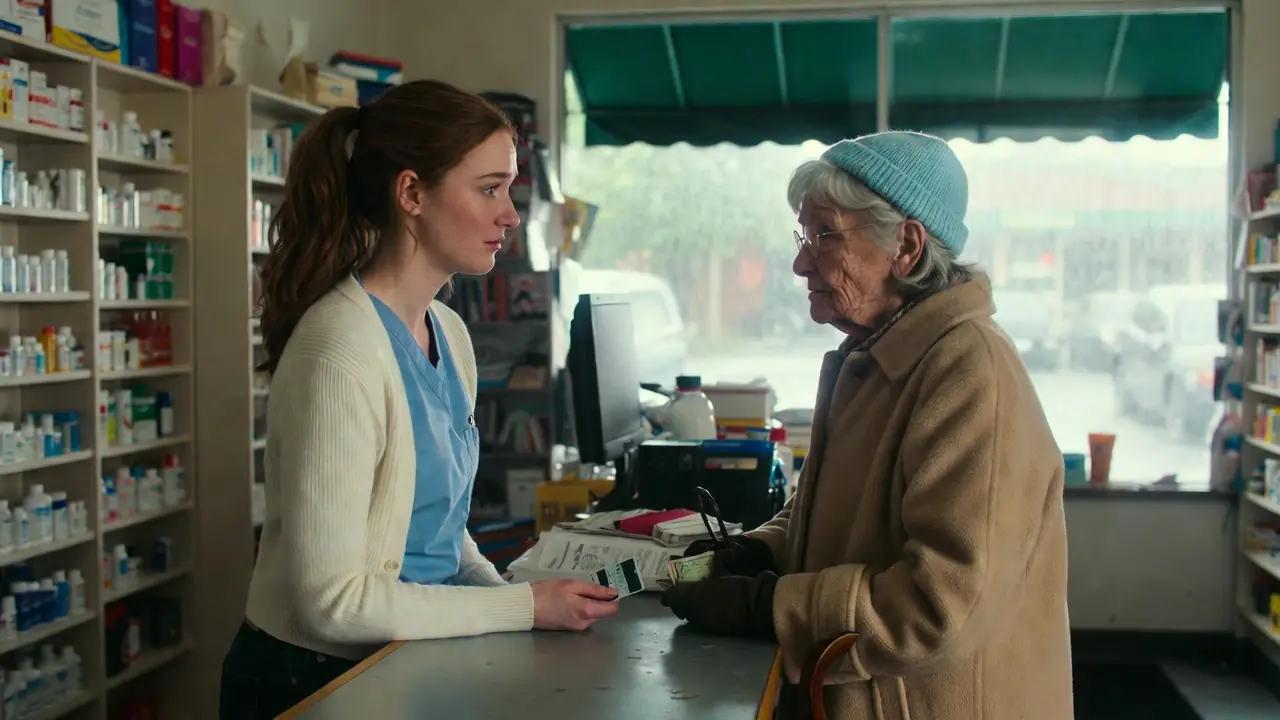
She was a young white American woman with fair skin, long chestnut-brown hair usually tied into a low ponytail, soft gray eyes, and a gentle voice that made nervous customers feel less embarrassed when they had to ask questions.
Her job was simple on paper.
She rang up purchases, answered the phone, restocked shelves, printed labels, helped elderly customers find vitamins and cold medicine, called insurance lines when the pharmacist asked, and carried heavy bags to cars when someone looked too tired to ask.
But the work was not simple in real life.
People came to the pharmacy when their lives were already uneasy.
They came after doctor visits.
They came after bad news.
They came after nights without sleep.
They came with prescriptions they hoped would fix pain, calm fear, lower numbers, stop dizziness, help breathing, or buy a little more time.
Emily saw all of it.
She saw the man who joked too much when his heart medication went up in price.
She saw the young mother counting change for antibiotics.
She saw the retired teacher pretending she did not need the eye drops after hearing the total.
She saw elderly customers nod politely while the pharmacist explained instructions they were too overwhelmed to remember.
Emily’s dream was to start a small support program one day called The Mercy Shelf.
It would help elderly patients and struggling families cover urgent medicine costs when insurance failed, coupons did not work, or a prescription price suddenly rose.
Not a big charity with public forms and humiliating interviews.
Something quiet.
Something discreet.
A small emergency fund behind the pharmacy counter.
A way for the cashier to say, “A community credit is available for this today,” instead of watching someone walk away without medicine.
Emily had the idea written in a notebook hidden in her locker.
But dreams needed permission.
Money.
A system.
Trust.
A manager willing to say yes.
A town willing to give.
Emily had none of that yet.
So she kept working at the pharmacy and helped in small ways whenever she could.
One cold Tuesday afternoon in February, freezing rain fell over Maple Grove.
It tapped against the pharmacy windows and turned the parking lot shiny and dangerous. Customers entered slowly, stamping wet shoes on the mat, folding umbrellas, and shaking water from their coats.
Emily stood behind the front counter, placing cough drops into a display basket, when the bell above the door rang.
An elderly woman stepped inside.
She was in her late seventies, a white American woman, short and thin, with silver hair tucked beneath a pale blue knit hat, pale skin, and gentle blue eyes behind round glasses.
She wore a beige winter coat, black gloves, and old brown shoes with rubber soles worn nearly smooth.
One hand gripped a wooden cane.
The other held a folded prescription paper and a small black purse.
Emily had seen her before.
Her name was Margaret Lewis.
Margaret came in every month for blood pressure medicine, arthritis cream, and sometimes peppermint tea from the small grocery shelf near the front.
She was always polite.
Always neat.
Always careful with money.
She counted coupons in a small envelope and kept receipts folded by date.
She also always asked the price before saying yes to anything.
That day, however, she looked more tired than usual.
Her cheeks were pale from the cold, and her hand shook slightly when she handed the prescription paper to the pharmacist.
“Good afternoon, Mrs. Lewis,” Emily said warmly.
Margaret turned and smiled.
“Hello, dear.”
“Cold out there?”
“Cold enough to make an old woman regret every errand.”
Emily smiled.
“Would you like to sit while the prescription is filled?”
“Oh no, I’m all right.”
But Margaret was not all right.
Emily noticed the way she leaned a little too heavily on her cane.
She noticed the way Margaret pressed one gloved hand against her chest, not dramatically, just as if she were tired and trying to steady herself.
She noticed the way Margaret glanced toward the pharmacy counter every few seconds, worry tightening around her mouth.
The pharmacist, Mr. Daniels, took the prescription and looked it over.
“This is a new one, Mrs. Lewis?”
Margaret nodded.
“My doctor said I need it after the tests. He said it was important.”
Mr. Daniels typed at the computer.
Emily continued arranging shelves, but she could hear the quiet conversation.
She tried not to listen too obviously.
A few minutes passed.
Mr. Daniels frowned at the screen.
Then he checked another system.
Then he picked up the phone and called the insurance line.
That was usually not a good sign.
Margaret watched him with anxious eyes.
Emily felt her stomach tighten.
Finally, Mr. Daniels hung up and walked back to the counter with the kind of careful expression pharmacists used when they had to deliver bad news that was not medical but could still hurt someone deeply.
“Mrs. Lewis,” he said gently, “your insurance is covering part of it, but not as much as expected.”
Margaret’s hand tightened around her purse.
“How much?”
Mr. Daniels hesitated.
“The copay today is one hundred and eighteen dollars.”
Margaret stared at him.
For a moment, she did not seem to understand the number.
Then her face slowly changed.
“One hundred and eighteen?”
“I’m sorry,” Mr. Daniels said. “I checked. There may be a manufacturer coupon, but it does not apply with your plan.”
Margaret opened her purse.
Her movements became small and careful.
She pulled out a wallet.
Then a folded envelope.
Then a few bills.
Emily watched from the front aisle, her hands still around a box of tissues.
Margaret counted the bills.
Twenty.
Forty.
Fifty.
Sixty.
Then coins.
Her fingers trembled.
She counted again.
The line behind her grew by one person, then two.
A man in a dark jacket glanced at his watch.
A woman holding cold medicine shifted her weight and sighed quietly.
Margaret heard it.
Her shoulders drew inward.
“I have sixty-three dollars,” she said softly.
Mr. Daniels lowered his voice.
“We can hold it for you.”
Margaret looked at the small white prescription bag on the counter.
“Is it something I can wait on?”
Mr. Daniels did not answer quickly.
That was answer enough.
“It would be better to start it today,” he said carefully.
Margaret nodded.
Her lips pressed together.
“I see.”
Emily felt the moment settle over the store.
The cold rain against the windows.
The impatient line.
The old woman holding half enough money.
The medicine waiting behind the counter like a door she could not open.
Margaret began placing the bills back into her wallet.
“I’ll come back,” she said.
Her voice was polite.
Too polite.
“I just need a few days.”
Mr. Daniels looked troubled.
“Mrs. Lewis—”
“It’s all right,” Margaret said quickly. “I understand. I should have asked the doctor about the price.”
Emily saw her eyes shine.
Margaret turned away from the counter.
And something inside Emily moved before fear could stop it.
She stepped forward.
“Mrs. Lewis.”
Margaret paused.
Emily came around the counter and stood beside her.
“I can cover the rest.”
Margaret blinked as if she had not heard correctly.
“No, dear.”
“It’s okay.”
“No.” Margaret shook her head quickly. “Absolutely not.”
Emily lowered her voice.
“You need the medicine today.”
“I cannot take money from you.”
“It’s not taking,” Emily said. “It’s me choosing to help.”
Margaret’s face flushed with embarrassment.
The man behind her sighed again, louder this time.
Emily turned to him.
“This will take a moment.”
Her voice was still polite, but firm enough that he looked away.
Margaret whispered, “Please don’t.”
Emily softened.
“I won’t make a scene.”
“You already are helping too much.”
“Then let me help quietly.”
Margaret looked down at the floor.
“I have always paid my own way.”
“I believe you.”
“I am not careless.”
“I know.”
“My son offered to help before he moved away, but I told him I could manage.”
Emily kept her voice gentle.
“Managing does not mean never needing help.”
Margaret closed her eyes.
That sentence seemed to hurt and comfort her at the same time.
Emily took out her debit card.
She did not have much money.
Rent was due in eight days.
Her car needed tires.
Her own grocery list was sitting in her coat pocket, already shortened because she knew what she could and could not afford that week.
But the difference between sixty-three dollars and one hundred eighteen dollars stood between Margaret and medicine she needed that day.
Emily could not watch her walk back into freezing rain without it.
She paid the remaining fifty-five dollars.
Mr. Daniels quietly processed the payment.
No announcement.
No dramatic gratitude.
Just a receipt, folded and placed inside the bag.
Emily took the prescription bag and handed it to Margaret.
Margaret did not take it at first.
Her eyes were full.
“Dear,” she whispered, “I don’t know how to accept this.”
Emily smiled softly.
“Start by taking the medicine home.”
Margaret let out a broken little laugh.
Then she took the bag.
“I will pay you back.”
“You don’t have to rush.”
“I will pay you back.”
“I believe you.”
Margaret held the bag against her chest.
For a second, she looked as if the whole pharmacy had disappeared and only the two of them remained.
“You kept me from walking out without it,” she said.
Emily swallowed.
“Yes.”
Margaret looked at the floor again.
“I was going to.”
“I know.”
The words were quiet.
They both understood what they meant.
Emily walked Margaret to the front door because the freezing rain had made the pavement slick.
“Do you have a ride home?” Emily asked.
“I was going to walk.”
“In this weather?”
“It’s only four blocks.”
Emily glanced through the window.
Ice shone on the sidewalk.
“No. I’ll call you a cab.”
Margaret shook her head.
“No, no. That costs money.”
“I’ll ask Mr. Daniels if we can use the pharmacy delivery driver. He’s taking an order near Elm Street anyway.”
Margaret hesitated.
“I don’t want special treatment.”
Emily smiled gently.
“Mrs. Lewis, this is not special treatment. This is weather treatment.”
Margaret gave a watery laugh.
“You are very good at renaming help.”
“It makes people less likely to refuse it.”
The pharmacy delivery driver, Sam, agreed to take Margaret home after his next drop-off.
While they waited, Emily brought Margaret a chair near the front window and made her a cup of tea from the employee break room.
Margaret held the warm paper cup in both hands.
“My husband used to make tea when I was upset,” she said.
“What was his name?”
“Arthur.”
The name softened her entire face.
“He passed seven years ago. He used to tell me that pride was useful until it started making decisions alone.”
Emily sat beside her during a quiet moment between customers.
“That sounds wise.”
“He was wise at other people. Not always at himself.”
Emily smiled.
“That seems common.”
Margaret looked down at the prescription bag.
“He would be angry with me for almost leaving without this.”
“Because he loved you?”
“Yes.”
“Then maybe take the medicine for both of you.”
Margaret looked at Emily.
Then nodded slowly.
“I will.”
Sam came to the door a few minutes later.
Emily helped Margaret step carefully outside and watched as she got into the delivery car with the prescription bag protected inside her coat.
Before the car door closed, Margaret reached for Emily’s hand.
“I won’t forget this.”
Emily squeezed her gloved fingers.
“You just get home safe.”
Margaret looked at her with deep, trembling gratitude.
Then the car pulled away into the freezing rain.
Emily went back inside and finished her shift.
She did not tell anyone how much the payment mattered to her own budget.
She did not tell anyone that she bought rice, eggs, and tea that week instead of the groceries she had planned.
She did not regret it.
Not once.
Three days later, Margaret returned to the pharmacy.
The weather had cleared, though the air was still cold.
This time, she came with an envelope in her hand and a determined look on her face.
Emily was restocking bandages when Margaret approached.
“Emily,” she said.
“You’re looking better.”
“I feel better.”
“I’m glad.”
Margaret held out the envelope.
“I told you I would pay you back.”
Emily hesitated.
“Mrs. Lewis, you didn’t have to do it this quickly.”
“Yes, I did.”
Inside the envelope were fifty-five dollars and a small handwritten note.
Emily unfolded it.
Dear Emily,
You did not make me feel poor.
You made me feel cared for.
There is a difference, and I will remember it.
With gratitude,
Margaret Lewis
Emily read the note twice.
Her throat tightened.
“Thank you,” she said softly.
Margaret smiled.
“No, dear. Thank you.”
After that day, Margaret became more than a regular customer.
She became part of Emily’s life in a quiet, steady way.
She came in every month for medicine, but she also stopped by sometimes just to bring Emily a small paper bag of homemade oatmeal cookies or a jar of peach jam.
She asked about Emily’s mother.
She asked whether Emily had eaten lunch.
She learned that Emily took evening classes online when she could afford them.
She learned that Emily wanted to become a patient advocate.
And eventually, she learned about The Mercy Shelf.
It happened one afternoon in April, when the pharmacy was slow and rain tapped gently against the windows.
Margaret found Emily writing in her notebook during her break.
“What are you always writing in there?” she asked.
Emily closed the notebook quickly.
“Just ideas.”
Margaret raised one silver eyebrow.
“At my age, just ideas usually means something important is trying to become real.”
Emily laughed.
“That sounds like something Arthur would have said.”
“No, Arthur would have said, ‘Stop hiding the notebook and let the old woman read.’”
Emily smiled, then slowly opened it.
She turned the notebook toward Margaret.
On the first page, written in careful blue ink, were the words:
The Mercy Shelf.
Margaret read quietly.
Emergency prescription support.
Anonymous pharmacy credits.
Community donations.
No public embarrassment.
Help before people walk away without medicine.
Medication cost counseling.
Senior assistance cards.
A monthly fund for urgent copays.
Margaret’s eyes moved slowly over the page.
Then she looked up.
“This is because of what happened with me.”
Emily hesitated.
“Partly.”
Margaret did not look offended.
She looked moved.
“How long have you been thinking about this?”
“Before you,” Emily admitted. “But that day made it feel urgent.”
Margaret touched the notebook gently.
“It is urgent.”
“I don’t know how to start.”
“You start small.”
“With what money?”
Margaret gave her a look.
“Dear, you work in a pharmacy. Put a jar on the counter.”
Emily laughed.
“It’s not that simple.”
“No,” Margaret said. “But many things begin by refusing to wait for simple.”
The next week, Margaret came in with her son.
His name was Daniel.
He was in his early fifties, tall, with graying brown hair, kind eyes, and the tired expression of someone who had been carrying guilt for too long.
He shook Emily’s hand.
“My mother told me what you did,” he said.
Emily immediately felt embarrassed.
“It was just one payment.”
Daniel shook his head.
“It was not just one payment. She almost walked out without medicine she needed.”
Margaret looked away.
Daniel’s voice softened.
“I didn’t know things had gotten that tight for her. She didn’t tell me.”
“I didn’t want you worrying,” Margaret said.
“I worry more when you don’t tell me.”
Emily stood quietly behind the counter, feeling as if she were witnessing a private repair.
Daniel turned back to her.
“Mom also told me about your Mercy Shelf idea.”
Emily glanced at Margaret.
Margaret looked entirely unashamed.
“You told him?”
“Yes.”
Daniel said, “I work with the local credit union. We do small community sponsorships. Not huge grants, but seed funds. If you can get the pharmacy owner to approve the structure, I can help you apply.”
Emily stared at him.
“I don’t even know if Mr. Daniels would agree.”
Margaret said, “Ask him.”
Emily swallowed.
“What if he says no?”
“Then ask better,” Margaret replied.
Daniel laughed.
“She’s been like this my whole life.”
That evening, Emily showed the notebook to Mr. Daniels.
She expected hesitation.
She expected a polite refusal.
Instead, he read the pages slowly and sighed.
“I’ve wanted something like this for years,” he said.
Emily blinked.
“You have?”
“Yes. But it’s complicated. Payments, records, fairness, privacy. You need rules.”
“I wrote some.”
“I see that.”
He turned another page.
“You thought about anonymous credits?”
“Yes.”
“And a monthly cap?”
“Yes.”
“And priority for urgent prescriptions?”
“Yes.”
Mr. Daniels looked up.
“You’ve thought about this more than I expected.”
Emily could not tell if that was praise or surprise.
Maybe both.
He leaned back in his chair.
“We can try a pilot. Small. Private. Thirty days. Donation jar, credit union seed fund if approved, and a written policy.”
Emily’s heart began to pound.
“Really?”
“Really. But we do it carefully.”
Carefully was enough.
The Mercy Shelf began with a small jar near the front counter.
The label read:
Help A Neighbor Fill An Urgent Prescription.
No faces.
No sad pictures.
No long explanation.
Just that.
Daniel helped secure a small sponsorship from the credit union.
Mr. Daniels added a little from the pharmacy’s community fund.
Margaret brought the first cash donation in an envelope.
Five dollars.
She placed it in the jar and said, “For someone who is about to say, ‘I’ll come back later.’”
Emily nearly cried.
The first person helped by The Mercy Shelf was a retired bus driver whose blood thinner copay had unexpectedly doubled.
He was short by eighteen dollars.
Emily quietly applied the community credit.
He blinked at the reduced total.
“What happened?”
Emily said the line she had practiced.
“A community credit is available for this today.”
He looked confused.
Then relieved.
Then deeply emotional.
“I can pay it back next week.”
“You can donate later if you want,” Emily said. “Today, just take your medicine.”
He nodded and left with the prescription.
Emily wrote the amount in the Mercy Shelf ledger.
Eighteen dollars.
Urgent medicine.
Approved.
No name visible on the public record.
The second person was a young mother short on antibiotics for her daughter.
The third was an elderly man whose insulin supplies cost more than expected.
The fourth was a widow who had quietly asked Mr. Daniels if she could pick up only half her prescription.
Within a month, The Mercy Shelf had helped nine people.
No announcements.
No public shame.
Just quiet help at the moment people needed it most.
The donation jar filled slowly but steadily.
Some customers dropped in coins.
Some added a dollar.
One man put in a twenty and said, “Someone did this for my mother once.”
A little girl donated three quarters and asked if that could help buy medicine.
Emily told her yes.
Margaret became the unofficial guardian of the jar.
Whenever someone looked at it curiously, she explained, “It helps people leave with what they came for.”
That sentence became the program’s heart.
The pilot extended to three months.
Then six.
Then a year.
The credit union increased its small sponsorship.
The clinic began referring patients to the pharmacy for cost-support counseling.
The senior center asked Emily to speak about medication affordability.
Emily hated public speaking, but Margaret sat in the front row and nodded at her the entire time.
“Look at me if you get nervous,” Margaret whispered before the talk. “I already know you’re right.”
Emily did.
And she got through it.
Over time, The Mercy Shelf grew beyond emergency payments.
Emily created medication folders for seniors.
She helped patients list prescriptions before doctor visits.
She worked with Mr. Daniels to find discount programs.
She helped people call insurance lines.
She trained cashiers on language that protected dignity.
Never say charity.
Never announce a discount loudly.
Never ask personal questions in front of a line.
Never make someone explain poverty at the counter.
Always say:
“A community credit is available.”
Or:
“Let’s see what support options we have today.”
Margaret said Emily was teaching the town how to help without making noise.
Emily liked that.
One autumn afternoon, almost two years after the freezing rain day, Margaret came into the pharmacy carrying a small velvet pouch.
She looked older now.
Her steps were slower, and Daniel had driven her to the store, but her blue eyes were bright.
Emily came around the counter.
“Mrs. Lewis, are you all right?”
“I am,” Margaret said. “And I have something for you.”
Emily looked at the pouch and immediately shook her head.
“No.”
Margaret laughed.
“You don’t know what it is.”
“I know that tone.”
“It is a very good tone.”
Daniel stood behind her, smiling softly.
Margaret opened the pouch.
Inside was a small gold locket on a delicate chain.
It was old and slightly worn, with tiny flowers engraved on the front.
Emily stopped breathing for a second.
“Margaret,” she whispered.
“This was mine,” Margaret said. “Arthur gave it to me on our twenty-fifth anniversary.”
“I can’t take that.”
“Yes, you can.”
“No. That belongs to your family.”
“My family has many things of Arthur. This one is for you.”
Emily shook her head again, tears already rising.
“It’s too much.”
Margaret opened the locket.
Inside were two tiny photographs.
One of Margaret as a young woman.
One of Arthur, smiling in a suit that looked slightly too large at the shoulders.
Margaret touched the locket gently.
“When Arthur gave it to me, he said, ‘Keep me close when life gets expensive.’”
Emily laughed through tears.
“He said that?”
“He did. We were very poor that year. He apologized that the locket was small. I told him small things can carry large love.”
She closed the locket and placed it in Emily’s hand.
“The day you paid for my medicine, you kept me close to the life Arthur wanted me to keep living. You gave me more time to sit in my kitchen, call my son, argue with my doctor, and complain about weather.”
Emily laughed and cried at the same time.
Margaret continued.
“Now I want this locket to remind you that small things can carry large love.”
Emily held it carefully.
“I don’t know what to say.”
Margaret smiled.
“Say you’ll keep going.”
“I will.”
Margaret also handed her an envelope.
Inside was a formal letter of recommendation.
It was addressed to the county health foundation.
Margaret had written about the day she almost left without her medication, the way Emily helped her privately, and the program that had grown from that moment.
At the end, she wrote:
Emily Carter understands that medicine is not only a product on a shelf. It is time, safety, dignity, and the chance to keep living ordinary days. She helps people receive that chance without shame.
Emily could barely read the final line through tears.
With Margaret’s letter, Mr. Daniels’s records, credit union support, clinic referrals, and data from The Mercy Shelf, Emily applied for a county health foundation grant.
She worked on the application for weeks.
She included numbers.
How many prescriptions supported.
How many patients connected to discount programs.
How many seniors helped with medication lists.
How many people avoided leaving without urgent medicine.
She also included stories with names changed for privacy.
An elderly woman with heart medicine.
A mother with antibiotics.
A retired man with insulin supplies.
A widower with blood pressure medication.
The grant committee called her in for an interview.
Emily wore her best blue blouse and Margaret’s locket tucked beneath the collar.
When they asked why the program mattered, Emily did not begin with statistics.
She began with the pharmacy counter.
She told them what it felt like to watch someone count money twice.
She told them how shame could keep a person from saying, “I need help.”
She told them medicine did not work if people could not bring it home.
And she told them that dignity was not extra.
It was part of care.
Three weeks later, the letter arrived.
The Mercy Shelf had won the grant.
Not a fortune.
Not a hospital wing.
Not a miracle solution to every broken part of healthcare.
But enough to fund the program for two years, expand prescription support, create printed medication organizers, train volunteers, and set up a private consultation desk inside the pharmacy.
Emily read the letter in the break room and cried so hard that Mr. Daniels knocked on the door to make sure she was okay.
When she told him, he took off his glasses and wiped his eyes.
“Good,” he said gruffly. “Now we build it properly.”
The Mercy Shelf became official.
A small desk was placed near the back of the pharmacy, away from the checkout line.
The sign read:
The Mercy Shelf
Prescription Support, Medication Lists, And Patient Help
Private. Respectful. No Shame.
Emily became the program coordinator.
For the first time, her job matched the dream she had been carrying quietly for years.
She still rang up customers.
She still stocked shelves.
But part of every week was now dedicated to helping people navigate the cost and confusion of medicine.
She helped patients call insurance.
She helped them ask doctors about alternatives.
She helped them find manufacturer programs.
She helped seniors create medication lists to bring to appointments.
She helped families understand refill schedules.
She helped people who were embarrassed sit down and breathe before making decisions.
Margaret came to the opening of the new desk.
Daniel helped her through the door.
She wore a lavender cardigan and the proud expression of someone watching a seed finally become visible above the soil.
Emily hugged her carefully.
“You made this happen,” Emily whispered.
Margaret shook her head.
“No, dear. I was only the old woman who needed help first.”
“That matters.”
“Yes,” Margaret said. “I suppose it does.”
At the small opening, Mr. Daniels gave a short speech.
Daniel from the credit union spoke.
The clinic director spoke.
Then Margaret insisted on speaking too.
She stood with both hands on her cane and looked at the small crowd gathered near the pharmacy shelves.
“I was the woman at this counter who did not have enough money,” she said.
The room went silent.
Emily’s eyes widened.
Margaret continued.
“I was embarrassed. I was proud. I almost walked away from medicine I needed because I did not know how to accept help.”
She turned toward Emily.
“This young woman helped me without making me feel small. Then she built a way for others to receive help the same way.”
Margaret looked back at the crowd.
“Please give to this program if you can. And if you ever need it, please receive from it without shame. One day you may be the giver. Another day you may be the one who needs the shelf. Both are human.”
There was no applause at first.
People were too moved.
Then the room filled with clapping.
Emily cried openly.
Margaret pretended not to notice, but she squeezed Emily’s hand afterward.
Years passed.
The Mercy Shelf grew across Maple Grove and beyond.
Other independent pharmacies called to ask how Emily had structured it.
She created training guides.
She spoke at county health meetings.
She partnered with clinics, senior centers, churches, food pantries, and local businesses.
She learned more about patient advocacy and eventually completed certification with grant support.
She never became rich.
But she became known for something better.
She became someone people called before giving up.
Margaret’s health rose and fell over the years.
Some months she came into the pharmacy smiling, asking if Emily had eaten lunch.
Other months Daniel picked up her medicine because walking had become harder.
Emily still checked in.
She still made sure Margaret’s copays were manageable.
She still printed medication lists in large font.
Margaret still insisted on donating five dollars to the Mercy Shelf jar whenever she could.
Even when Emily told her she did not have to, Margaret gave the same answer.
“I know.”
One winter afternoon, Margaret came in for what would be the last time.
Emily did not know it then.
Margaret wore her pale blue hat, the same one from the freezing rain day years before.
She sat at the Mercy Shelf desk while Emily updated her medication list.
“You have done well,” Margaret said.
Emily looked up.
“With the list?”
“With the life.”
Emily laughed softly.
“I’m still figuring it out.”
“We all are. You are simply helping others figure it out with folders.”
Emily smiled.
“That might be the best description of my job.”
Margaret reached across the desk and touched the locket at Emily’s throat.
“You still wear it.”
“Always.”
“Good.”
Her eyes grew distant for a moment.
“Arthur would have liked seeing this.”
“The desk?”
“You,” Margaret said.
Emily could not answer.
Margaret passed away peacefully two months later, with Daniel beside her and a cup of peppermint tea on the nightstand.
At her memorial gathering, Daniel placed photographs of Margaret and Arthur on a table, along with jars of peach jam, oatmeal cookies, and the little envelope where she had once repaid Emily fifty-five dollars.
Emily stood near the table, holding the locket.
Daniel came to her with an envelope.
“Mom wanted you to have this.”
Inside was a handwritten note.
Dear Emily,
The day I stood at the pharmacy counter without enough money, I thought I had reached the end of my dignity.
You proved me wrong.
You paid the difference, but more than that, you protected my pride.
You helped me carry home medicine, and then you helped many others carry home theirs.
Keep the shelf full.
Keep the help quiet.
Keep reminding people that needing help does not make them less worthy.
With love,
Margaret Lewis
Emily pressed the note to her chest and cried.
Later, she framed it at The Mercy Shelf desk beside a small photograph of Margaret smiling in her pale blue hat.
Years later, whenever people asked how The Mercy Shelf began, Emily told them the truth.
“It began with an old woman at a pharmacy counter, sixty-three dollars in her hand, and a prescription she needed that cost one hundred and eighteen.”
Then she would show them the locket.
The gift was small.
A locket.
A note.
A repaid envelope.
But inside those small things was the future Emily had been trying to build.
And every time someone stood at the counter, looked at the total, and whispered, “I’ll come back later,” Emily remembered Margaret’s trembling hands.
She would lower her voice and say gently, “Let’s see what support options we have today.”
Because medicine was not only medicine.
It was time.
It was dignity.
It was one more ordinary morning in a kitchen.
One more phone call with a son.
One more complaint about the weather.
One more chance to keep living.
And sometimes, all of that depended on someone noticing before a person walked away.