At twenty-four, Emily Carter had learned that shame had a sound.
It was not always crying.
Sometimes it was coins being counted too slowly at a checkout counter.
Sometimes it was a wallet opening and closing three times.
Sometimes it was an old man whispering, “Take the bread off,” while everyone behind him pretended not to hear.
Emily lived in a small town in Ohio called Maple Ridge, where Main Street had a grocery store, a pharmacy, a post office, a diner, and a row of old brick shops with faded awnings.
She worked at Maple Ridge Market, a family grocery store that smelled of coffee, fresh bread, paper bags, and rain whenever customers came in from bad weather.
Her job was simple.
She ran the checkout register, stocked shelves, packed grocery bags, helped elderly customers carry food to their cars, marked down produce near closing, and cleaned the front windows every Friday morning.
But Emily loved the store.
Not because it was exciting.
Because it was honest.
People came in needing ordinary things: milk, bread, eggs, potatoes, medicine, soup, coffee, dog food, birthday candles, apples, paper towels. A grocery list could tell the truth about a life. A young mother buying pasta and diapers.
A widower buying one can of soup and one banana. A grandmother buying cake mix for a child’s visit. A tired worker buying frozen dinners at nine at night.
Emily noticed all of it.
Her dream was to start a small community food program one day called The Quiet Basket, helping elderly people and struggling families buy groceries without embarrassment. She did not want a program that made people stand in long lines or prove how poor they were.
She wanted something gentle: prepaid store credits, anonymous grocery cards, small weekly baskets, and a system where people could receive help while still feeling like customers, not charity cases.
But dreams needed money, permission, records, volunteers, and someone willing to trust a young cashier with a serious idea.
Emily had a notebook full of plans and almost nothing else.
So she kept working at the market and helping quietly when she could.
One cold Tuesday afternoon in February, rain fell steadily over Maple Ridge. The sky was gray, and customers came into the store shaking water from umbrellas and stamping mud from their shoes.
It was a slow day.
The lunch rush had passed. The after-school crowd had not arrived yet. Emily stood behind register three, wiping the counter and listening to the soft beep of another cashier scanning items two lanes away.
That was when the old man came in.
Emily had seen him before.
His name was Arthur Bennett.
He was a white American man in his late seventies, tall but thin, with neatly combed silver hair, pale blue eyes behind square glasses, and a deeply lined face that looked stern until he smiled. He wore the same brown wool coat most winter days, polished shoes, and a flat cap he removed politely whenever he stepped indoors.
Arthur usually bought simple things.
Oatmeal.
Tea.
Soup.
Apples.
A small loaf of bread.
Sometimes a single slice of cake from the bakery case, always on Thursdays.
Emily had once asked if Thursday was special.
Arthur had smiled and said, “It was my wife’s cake day.”
His wife’s name had been Margaret.
Emily knew because he spoke her name gently, like setting a cup down without making noise.
That Tuesday, Arthur moved slowly through the aisles with a small basket on his arm. Emily noticed he chose carefully. Not casually. Carefully.
A bag of potatoes.
A carton of eggs.
A loaf of bread.
A small block of cheese.
A can of coffee.
A package of chicken thighs from the discount cooler.
Two cans of tomato soup.
One apple.
Then he stopped in front of the bakery case.
He looked at the small lemon cake slices.
For a long moment, he did not move.
Finally, he picked one.
Emily smiled softly from the register.
When Arthur came to her lane, the rain had grown harder against the front windows.
“Good afternoon, Mr. Bennett,” she said.
He smiled faintly.
“Good afternoon, Emily.”
“You staying dry?”
“Trying. The weather is winning.”
She began scanning his items.
Bread.
Eggs.
Potatoes.
Soup.
Chicken.
Coffee.
Cheese.
Apple.
Lemon cake.
The total appeared on the register screen.
Arthur reached for his wallet.
Then froze.
Emily saw it immediately.
His fingers moved through the wallet once.
Then again.
Then slower.
He pulled out a few bills.
A small handful of coins.
A folded receipt.
His face changed.
Not dramatically.
But enough.
His jaw tightened. His ears reddened. His eyes dropped to the counter.
Emily glanced at the total, then at the money in his hand.
He was short.
Not by much.
Enough to hurt.
Arthur cleared his throat.
“Take off the coffee, please.”
Emily’s hand paused.
The coffee was not fancy. It was the store brand.
“Are you sure?”
“Yes.” He did not look up. “And the cake.”
A man behind him shifted impatiently.
Arthur heard it.
His shoulders drew inward.
Emily felt anger rise in her chest—not at Arthur, but at the moment itself. At the small public cruelty of needing food and not having enough money under fluorescent lights.
She removed nothing.
Instead, she reached into her apron pocket, took out the folded ten-dollar bill she had saved from tips helping customers load groceries, and slipped it toward the register.
Arthur looked up quickly.
“No.”
Emily kept her voice low.
“Mr. Bennett—”
“No, dear. I won’t let you.”
“It’s just a few dollars.”
“That is not the point.”
“I know.”
His face flushed deeper.
“I can put things back.”
“You can,” Emily said gently. “But you don’t have to.”
The man behind him sighed loudly.
Emily looked at him and said, still polite, “This will only take a moment.”
The man looked away.
Arthur’s voice trembled.
“I have never done this before.”
Emily softened.
“Needed help?”
He nodded once.
“I thought I had enough. My prescription cost more than I expected this morning. I miscounted.”
“That happens.”
“Not to me.”
“It happened today,” Emily said. “That does not make you less yourself.”
Arthur’s eyes filled suddenly.
He looked down, embarrassed by the tears.
Emily leaned slightly closer and spoke so only he could hear.
“My grandmother used to say dignity is not being able to do everything alone. Dignity is being treated kindly when you can’t.”
Arthur closed his eyes.
For one moment, he seemed to be fighting every ounce of pride he had left.
Then he whispered, “I’ll pay you back.”
“No rush.”
“I will.”
“I believe you.”
Emily added the ten dollars, completed the payment, and packed his groceries carefully. She placed the lemon cake on top so it would not be crushed.
Arthur reached for the bags, but his hands shook.
Emily came around the counter.
“I’ll carry these to your car.”
“I walked.”
“In this rain?”
“It wasn’t raining this hard when I left.”
Emily looked toward the window. Water streamed down the glass.
“Then I’ll walk you home.”
“No, absolutely not.”
“Mr. Bennett, you’re carrying potatoes, coffee, and pride. That is too much in a storm.”
He stared at her.
Then, despite himself, he laughed.
It was small.
But real.
“You remind me of Margaret.”
“She sounds practical.”
“She was terrifyingly practical.”
Emily grabbed the large store umbrella from behind the service desk and carried Arthur’s groceries while he held his cane. They stepped outside into the cold rain.
Arthur lived only four blocks away, in a small white house with green shutters and a narrow porch. The walk was slow. Emily kept the umbrella over him more than herself. Twice, he apologized. Twice, she pretended not to hear.
At his front door, he fumbled with his keys.
Emily noticed his hands were stiff from cold.
“May I?” she asked.
He hesitated, then handed her the key ring.
Inside, the house was neat and quiet. It smelled faintly of lemon polish, old books, and coffee. On the kitchen table sat a framed photograph of a woman in a blue sweater, smiling warmly at the camera.
Margaret.
Emily placed the groceries on the counter.
Arthur removed his cap.
“I’m sorry you had to see that today.”
“See what?”
“An old man failing at simple arithmetic.”
Emily turned to him.
“I saw an old man buy food after paying for medicine. That is not failure.”
Arthur looked at her for a long moment.
Then he sat slowly at the kitchen table.
“My wife handled the shopping for fifty-two years,” he said. “After she died, I thought groceries would be the easy part.”
“They rarely are.”
“She knew prices. Sales. Which apples were worth buying. Which coffee I pretended not to like but drank anyway.” He smiled sadly. “She always bought lemon cake on Thursdays. Said one slice split in two made an ordinary day less rude.”
Emily glanced at the cake in the bag.
“Today is Tuesday.”
“I know.” His voice softened. “It would have been our anniversary.”
Emily’s throat tightened.
Arthur looked at the photograph.
“I wanted to have coffee and lemon cake at the table tonight. Just once.”
Emily quietly unpacked the groceries. She put the chicken in the refrigerator, the soup in the pantry, the potatoes in the lower cabinet. Then she placed the lemon cake beside the framed photograph.
Arthur watched her.
“You didn’t have to walk me home.”
“I know.”
“You didn’t have to pay.”
“I know.”
“Then why did you?”
Emily thought about it.
“Because I hope someone would do the same for me without making me feel small.”
Arthur’s eyes shone.
“You did not make me feel small.”
That was all he said.
But Emily carried those words back to the market with her through the rain.
The next morning, Arthur returned to Maple Ridge Market.
He came straight to register three.
Emily looked surprised.
“Mr. Bennett?”
He placed a small envelope on the counter.
Inside was ten dollars.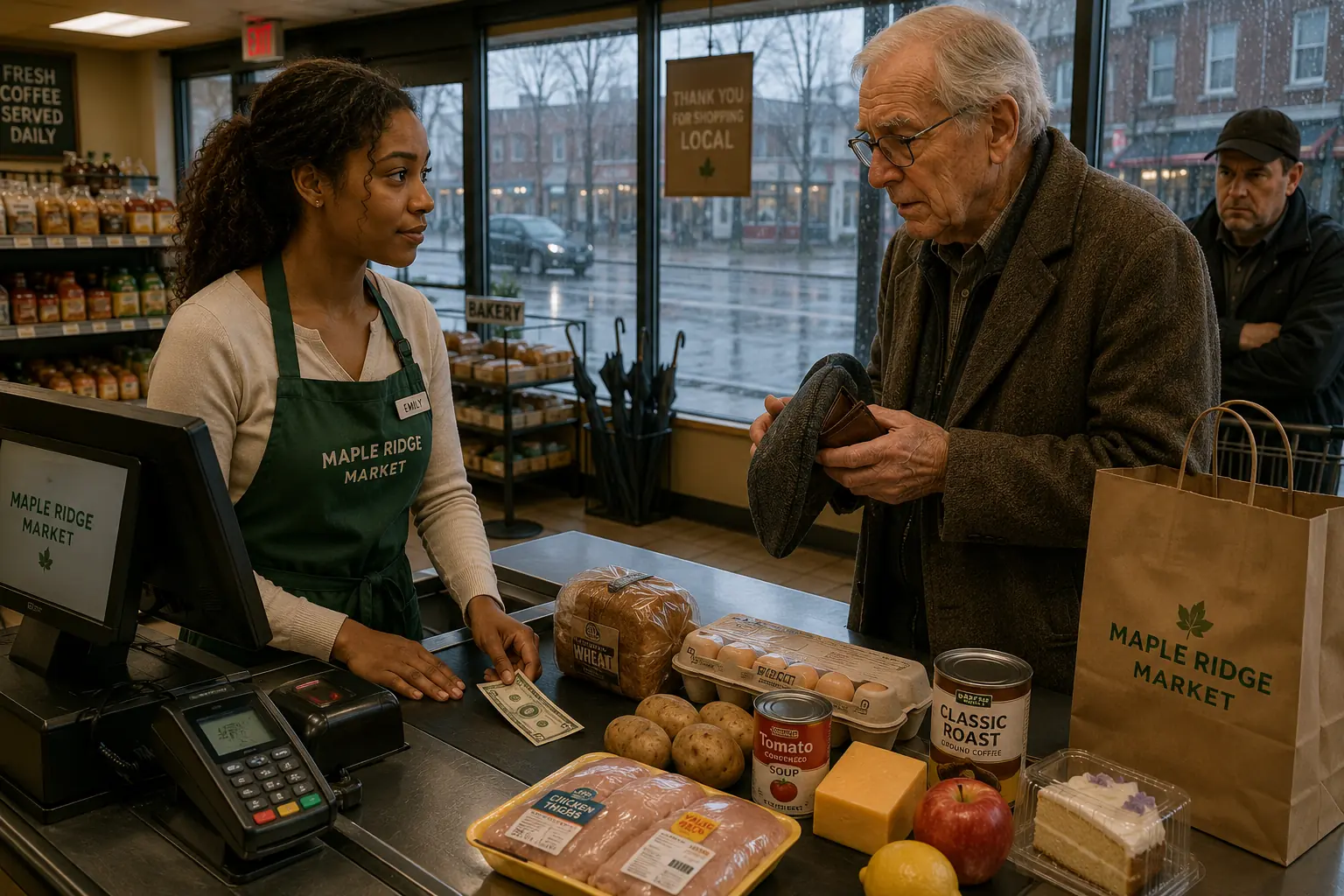
And a folded note.
Emily opened it after he left.
Dear Emily,
Margaret used to say help given gently does not bruise a person’s pride.
Yesterday, you proved her right.
Thank you for the coffee, the cake, and the walk home.
Arthur Bennett
Emily kept the note in her apron pocket for weeks.
After that day, Arthur began shopping more often in Emily’s lane. Sometimes he paid with exact change. Sometimes he used coupons Margaret had taught him to save. Sometimes he asked Emily if the sale price on soup was “actually a sale or grocery store theater.”
Emily always answered honestly.
They became friends.
Not loudly.
Quietly.
The way lonely people and observant people sometimes do.
One Thursday afternoon, Arthur brought her a small paper bag.
Inside was half a lemon cake slice wrapped in wax paper.
“Margaret would not approve of me eating the whole thing alone,” he said.
Emily smiled.
“So I’m a medical necessity?”
“More or less.”
She ate it during her break and cried a little where no one could see.
Over the next months, Emily noticed more customers like Arthur.
Mrs. Wilson buying cat food and putting back her own tea.
Mr. Alvarez choosing between bread and batteries.
A young mother counting coins for milk.
A retired teacher asking the price of eggs twice, then quietly taking them out of her basket.
Emily began writing in her notebook again.
The Quiet Basket.
Anonymous grocery credits.
Round-up donations.
Senior emergency food cards.
Prescription cost support partnerships.
No public lines.
No shame.
Help at checkout before humiliation.
Arthur saw the notebook one afternoon when Emily walked him home after another heavy rain.
“What is that?” he asked.
“Just ideas.”
“At my age, ‘just ideas’ often means something important is trying to be born.”
Emily laughed.
Then she showed him.
Arthur read every page slowly.
“This is good.”
“It’s not real.”
“Neither was any business before someone became stubborn.”
“I don’t have funding.”
“You have proof.”
“What proof?”
Arthur looked at her over his glasses.
“Me.”
Emily’s chest tightened.
“I would never use your story without permission.”
“I am giving permission.”
“No. Mr. Bennett—”
“Arthur,” he corrected.
“Arthur. I don’t want to embarrass you.”
“You didn’t embarrass me at the register. You won’t embarrass me by telling the truth carefully.”
Emily looked down.
Arthur tapped the notebook.
“People like me do not need pity. We need systems that let help arrive before shame does.”
Emily wrote that sentence down immediately.
Arthur smiled faintly.
“Margaret would have liked that one.”
With Arthur’s encouragement, Emily spoke to Mrs. Bell, the market manager.
At first, Mrs. Bell was hesitant.
“We’re a small store,” she said. “We can’t run a whole charity.”
“I’m not asking for that,” Emily replied. “I’m asking to try something small.”
The first version of The Quiet Basket was simple.
A jar at the register labeled:
Help A Neighbor Buy Groceries
Customers could drop in spare change or round up their purchases. The money went onto anonymous store cards worth five or ten dollars. Cashiers could quietly use them when someone was short, especially seniors.
No announcement.
No manager call.
No embarrassment.
Just help.
Mrs. Bell approved a one-month trial.
In the first week, the jar collected thirty-eight dollars.
In the second, ninety-two.
By the end of the month, The Quiet Basket had helped eleven customers avoid putting back food.
No one made speeches.
No one clapped.
That was the point.
Arthur came in every Thursday and dropped one dollar into the jar.
Every time.
Emily told him he did not have to.
Every time, he said, “I know.”
Soon, the program grew.
The local pharmacy agreed to place a small donation jar too, helping customers whose prescriptions disrupted their food budget. The senior center added a list of staple items people could sponsor. The market began making low-cost senior grocery bags: soup, bread, eggs, fruit, oatmeal, and tea.
Emily created a discreet system.
A blue sticker on a shelf tag meant the item could be covered by Quiet Basket funds if needed. Store cards were kept at each register. Cashiers were trained to say:
“Looks like you have a store credit available today.”
Not charity.
Not pity.
A store credit.
Arthur loved that.
“Elegant,” he said. “Margaret would approve.”
One afternoon, Arthur invited Emily to his house.
On the kitchen table sat an old leather ledger book.
The cover was worn. The pages were yellowed. Inside were columns written in beautiful handwriting.
Names.
Dates.
Amounts.
Items.
Notes.
Emily looked up.
“What is this?”
“Margaret’s grocery ledger,” Arthur said.
“Grocery ledger?”
“She kept one for decades. Not only for us. For neighbors too. If someone was ill, she wrote what they needed. If someone had a baby, she tracked meals. If someone lost a job, she quietly paid for basics and never told anyone.” His mouth trembled. “I found it after she died.”
Emily turned the pages carefully.
Mrs. Green — milk, bread, tea. Do not mention bill.
Tom Alvarez — soup and oranges after surgery.
Janet’s children — cereal, peanut butter, apples.
Widow Clark — coffee, because grief wakes early.
Emily’s eyes filled.
“She was doing The Quiet Basket before I had a name for it.”
Arthur nodded.
“Margaret believed food help should move quietly.”
He pushed the ledger gently toward Emily.
“I want you to have it.”
Emily immediately shook her head.
“No. I can’t.”
“Yes, you can.”
“This is hers.”
“And her work has found yours.”
“It belongs to your family.”
“My children have copies. I had them scanned. But the original should stay where its spirit continues.”
Emily touched the edge of the ledger.
“It’s too precious.”
“That is why I am not leaving it in a drawer.”
Arthur also handed her a folded letter.
It was addressed to the Maple Ridge Community Foundation.
He had written about the rainy Tuesday, the groceries, the lemon cake, and the program Emily had built from one quiet moment of help.
At the end, he wrote:
Emily Carter understands that hunger is not always empty cabinets. Sometimes it is the painful gap between what someone needs and what they can admit. She closes that gap with dignity.
Emily cried at Arthur’s kitchen table.
With Arthur’s letter, Margaret’s ledger, Mrs. Bell’s support, and records from the trial program, Emily applied for a small community grant.
She won.
Not a fortune.
Not a building.
Not a grand reward.
But enough to fund six months of senior grocery credits, print discreet store cards, buy staple items, create delivery bags, and train volunteers.
The Quiet Basket became official.
It stayed small at first.
Then other stores asked how it worked.
Then the pharmacy joined more formally.
Then the senior center helped identify people who needed grocery support after medical expenses.
Emily became the program coordinator while still working at the market.
She never became rich.
But she became useful in exactly the way she had dreamed.
Arthur remained the heart of the program.
Every Thursday, he bought groceries, chose one lemon cake slice, and put one dollar in the jar.
Even after Emily told him the grant had funded the program, he continued.
“It keeps me part of it,” he said.
Years passed.
The Quiet Basket grew across Maple Ridge. It helped seniors, families, widows, workers between paychecks, and anyone caught in that terrible moment of being just short at the register.
No one had to explain their whole life.
No one had to be humiliated.
The help arrived quietly.
Like Margaret’s ledger.
Like Emily’s ten-dollar bill.
Arthur grew older.
He moved more slowly. Emily or a volunteer began delivering groceries to him on rainy days. Every delivery included lemon cake on Thursdays.
One winter afternoon, Arthur handed Emily one final envelope.
Inside was the original note he had written after she paid for his groceries.
Dear Emily,
Margaret used to say help given gently does not bruise a person’s pride.
Yesterday, you proved her right.
Thank you for the coffee, the cake, and the walk home.
Arthur Bennett
Emily looked up, confused.
“You already gave me this.”
“I gave you a copy,” he said. “I kept the original. Now it belongs with the ledger.”
Her eyes filled.
“Arthur…”
He smiled.
“Some receipts matter.”
Arthur passed away peacefully the following spring.
At his memorial gathering, held at his home with coffee and lemon cake on the kitchen table, his children displayed photographs of him and Margaret beside the old grocery ledger. Emily stood quietly near the counter, remembering the rainy walk, the trembling hands, and the small brass bell of the register printing his receipt.
Arthur’s daughter gave Emily a final note he had left for her.
Dear Emily,
The day I was short at the register, I thought I had lost more than the ability to pay.
I thought I had lost the version of myself that could stand in public without shame.
You gave me a way through that moment.
Then you built a way through for others.
Keep the help quiet.
Keep the dignity loud.
With gratitude,
Arthur Bennett
Emily framed the note in the small office behind Maple Ridge Market where The Quiet Basket eventually had its own desk.
Years later, whenever people asked how the program began, Emily told the truth.
“It began with an old man at my checkout counter, a few dollars short, trying to put back coffee and lemon cake on his anniversary.”
Then she would show them Margaret’s ledger.
The gift was small.
A ledger.
A letter.
A ten-dollar debt repaid with a lifetime of purpose.
But inside those small things was the future Emily had been trying to build.
And every time a cashier quietly said, “Looks like you have a store credit available today,” Emily remembered Arthur’s trembling hands and the cake he almost left behind.
Help did not have to be loud to change a life.
Sometimes it only had to arrive gently enough not to bruise someone’s pride.