At twenty-four, Ava Miller knew how to build things that stayed standing.
She worked as an apprentice carpenter in Lancaster, Pennsylvania, a city of old brick houses, narrow streets, church bells, farmers’ markets, and quiet neighborhoods where front porches still mattered. Some people measured a home by square footage or price. Ava measured it by the way the front steps held a person’s weight, the way a railing fit in an old hand, and whether the porch light made someone feel safe coming home after dark.
Her father had taught her that.
Frank Miller had been a carpenter for thirty years before a fall from a second-story deck ended his career. He did not die, but he never walked the same way again. After the accident, bills rose faster than his body healed. Ava dropped out of community college, took a job with a local construction crew, and learned the trade from the bottom up.
She carried lumber. Hauled tools. Measured twice. Swept sawdust. Sanded boards until her hands blistered. The older men on the crew sometimes called her “kid” even after she proved she could frame a wall straighter than half of them. Ava did not argue much. She let the work answer.
Her dream was simple.
One day, she wanted to open her own small repair company called SafeStep Home Repairs. Not luxury remodels. Not expensive kitchen redesigns for people who changed their minds every week. Ava wanted to help older homeowners fix the things that made daily life dangerous: broken steps, loose railings, narrow doorways, leaking roofs, weak floors, bad lighting, slippery bathrooms.
She had seen what one unsafe step could do to a family.
But dreams cost money, and Ava had very little of that.
Every morning, she drove her old white pickup to job sites across Lancaster County. The truck had a dented tailgate, a cracked passenger mirror, and a heater that worked only when it felt generous. In the back, she kept her tool belt, work gloves, a circular saw, scrap lumber, fasteners, tarps, and an old thermos her father had used for years.
Most days, she worked for Halden Construction, a company that specialized in quick renovations. The owner, Rick Halden, cared about speed, profit, and appearances. He liked Ava’s work because she was precise, but he did not like her habit of noticing problems that were not on the invoice.
“If the client didn’t pay for it, don’t fix it,” Rick told her often.
Ava always nodded.
Then she fixed small things anyway.
A loose stair tread. A nail sticking up near a doorway. A shaky railing outside a back porch. She told herself those things mattered. Rick told her they wasted time.
One cold afternoon in early November, Ava was driving back from a job site after repairing cabinets in a renovated townhouse. Rain had been falling since morning, thin and steady, turning the streets shiny and gray. She took a shortcut through the East Walnut neighborhood, where old houses stood close together with small yards, stone steps, and porches built long before anyone thought about aging knees or walkers.
That was when she saw the woman.
An elderly woman stood halfway between a front gate and a sagging porch, frozen in the rain with two grocery bags at her feet. She was small and thin, wearing a faded green coat, a knitted cream hat, and black shoes that were soaked at the toes. One hand gripped a cane. The other pressed against her chest as she stared at the porch steps.
The bottom step had broken.
Not cracked. Broken.
One side had collapsed completely, leaving the board tilted at a dangerous angle. The railing beside it leaned outward, separated from the post. The porch itself was old, with peeling blue paint and dark water stains along the edges.
Ava slowed the truck.
Several cars passed. No one stopped.
The old woman looked toward the house, then down at the grocery bags, then back at the broken step as if trying to solve an impossible problem. She lifted one foot, tested the edge of the step with her shoe, and quickly pulled back when it shifted.
Ava pulled over.
She grabbed her rain jacket, stepped out, and jogged across the street.
“Ma’am?” she called. “Are you okay?”
The woman turned, startled.
“I’m fine,” she said immediately, though her voice shook. “Just a little stuck.”
Ava looked at the step.
“That step isn’t safe.”
“I know.” The woman tried to smile. “It chose a dramatic time to retire.”
Despite the rain, Ava smiled back.
“I’m Ava. I’m a carpenter. Let me help you get inside.”
The woman’s expression tightened with pride.
“Oh, I don’t want to be trouble.”
“You’re standing in the rain with groceries and a broken step. Trouble already arrived. I’m just dealing with it.”
The old woman blinked, then gave a small laugh.
“My name is Ruth Callahan.”
“Nice to meet you, Mrs. Callahan.”
“Ruth is fine, dear.”
Ava looked at the porch again, calculating quickly. The old railing could not support weight. The bottom step might collapse if Ruth stepped on it. The side yard had a narrow path leading to a back door, but Ava could see from the street that the gate was rusted shut and the ground was uneven.
“Do you have another entrance?” Ava asked.
“The back door, but I haven’t used it in months. The latch sticks, and there are stones back there. I’m not steady on them.”
“All right. Stay right here.”
Ava ran back to her truck and pulled out two short boards, a scrap piece of plywood, and a box of screws. She worked fast in the rain. First, she checked the porch frame, then placed the plywood over the broken step area as a temporary bridge. She braced it with scrap boards underneath and drove screws into the strongest parts of the old frame. It was not a proper repair, but it would hold long enough for Ruth to get inside safely.
Ruth watched from the walkway, holding her cane with both hands.
“You carry all that in your truck?” she asked.
“Were you expecting to rescue old women from porches?”
“Not specifically, but carpentry likes surprises.”
Ava tested the temporary platform with her own weight. It held.
“All right,” she said. “I’m going to walk beside you. Hold your cane in your right hand and keep your left hand near the doorframe. Don’t use the railing.”
“I don’t like being told what to do.”
“I figured.”
Ruth raised an eyebrow. “You figured?”
“You have the look.”
“What look?”
“The look of someone who has been doing things by herself too long.”
Ruth’s face changed for a second.
Then she looked away.
Ava did not push. She picked up the grocery bags and carried them to the porch. Ruth moved slowly, one careful step at a time. The rain tapped against Ava’s hood. Ruth’s breath came short with effort, but she made it across the temporary platform and into the doorway.
Inside, the house smelled of lemon soap, old wood, and something baking, maybe cinnamon. It was neat, but dim. A narrow hallway led to a small living room filled with framed photographs, crocheted blankets, and shelves of books. Near the door, Ava noticed a stack of unopened mail, a pair of slippers, and a small table where medication bottles were lined up in careful rows.
Ruth set her cane against the wall and exhaled.
“There,” she said. “See? Fine.”
Ava set the groceries on the kitchen counter.
“Ruth, that porch needs real repairs.”
“I know.”
“The framing is weak. The railing has pulled loose. Some boards may be rotten.”
“I know that too.”
“Has someone looked at it?”
Ruth busied herself with a grocery bag. “A contractor came in September.”
“And?”
“He gave me a number I couldn’t say yes to.”
Ava understood.
“How much?”
Ruth hesitated.
“Four thousand dollars.”
Ava almost laughed, not because it was funny, but because it was cruel.
“For that porch?”
“He said everything needed replacing.”
“Some of it does. Not all. And four thousand is too high for basic safety repairs.”
Ruth pressed her lips together.
“I thought so. But what do I know? I taught second grade for thirty-eight years. I know multiplication tables and how to stop children from eating paste. I do not know porches.”
Ava smiled.
“You know enough to not get cheated.”
Ruth looked toward the front door.
“I tried calling other places. Most didn’t call back. One man said small jobs weren’t worth his crew’s time.”
Ava felt anger tighten in her chest.
Small jobs. As if a broken step was small to someone who could not get into her own house safely.
“I can come back tomorrow after work and give you a proper assessment,” Ava said.
Ruth shook her head quickly. “I can’t hire you, dear. I don’t want you wasting your time.”
“It won’t be a waste.”
“I told you, I can’t pay much.”
Ava looked at the porch through the rain-streaked window.
“Then we start with what keeps you safe. Temporary repairs first. We can figure out the rest.”
Ruth studied her with clear blue eyes.
“Why would you do that?”
Ava thought of her father, sitting at home with a leg that ached whenever it rained. She thought of the hospital bills. The months when her mother helped him shower because one fall had changed everything.
“Because one bad step can steal a whole life,” Ava said.
Ruth’s expression softened.
For a moment, neither of them spoke.
Then Ruth reached for a jar of soup from the grocery bag.
“At least let me feed you.”
Ava glanced at her watch. She was already late getting the company truck report back to Rick. He would be annoyed. But Ruth stood there with wet sleeves and stubborn dignity, trying to offer something back.
“All right,” Ava said. “But only if you let me check the porch frame afterward.”
Ruth smiled.
“Deal.”
That was the beginning.
The next evening, Ava returned after work with better tools, a flashlight, and a notebook. She inspected the porch properly. The old structure was damaged, but not beyond saving. The bottom step needed replacement. Two stringers had rot. The railing needed new posts and secure anchors. Several porch boards had softened near the edge. The handrail height was wrong for Ruth, too low and too unstable.
Ruth stood inside the doorway, wrapped in a cardigan.
“How bad?” she asked.
“Bad, but not hopeless.”
“That sounds like a weather report for my knees.”
Ava laughed.
She showed Ruth the notebook.
“I can make it safe in stages. First, replace the broken step and brace the frame. Then rebuild the railing. Then replace the bad porch boards. Later, if you want, we can add better lighting and a grip rail near the door.”
Ruth looked at the list.
“How much?”
Ava had already calculated the lowest possible material cost. She planned to use some leftover lumber from job sites, but she would need proper pressure-treated boards and new fasteners.
“For the first stage, materials are about one hundred eighty dollars.”
Ruth looked relieved and worried at the same time.
“And labor?”
Ava hesitated.
“You can pay what you can.”
“No.”
“Ruth.”
“No, dear. I will not have a young woman working for free because I am old.”
Ava respected the firmness in her voice.
“Then pay me in installments. Small ones.”
“I can do that.”
“And soup.”
Ruth blinked.
Ava smiled. “Your soup was good.”
Ruth’s face brightened.
“That I can afford.”
So Ava began repairing the porch.
She came after work, often in the fading evening light. She wore jeans, a gray hoodie, work boots, and a tool belt heavy enough to pull at her hips. Ruth sat inside by the front window, watching as Ava removed rotten boards, cut new lumber, drilled screws, checked angles, and tested each piece with careful pressure.
The first clear moment came three days later.
Ava finished the new bottom step and motioned Ruth to the door.
“Try it.”
Ruth opened the door slowly.
The step looked plain, fresh, and strong. A simple board, properly fitted, supported by a solid frame. To most people, it was nothing special.
To Ruth, it was freedom.
She placed her cane down first, then one foot, then the other. The step did not shift. It did not creak. It held.
Ruth’s eyes filled with tears.
“Oh,” she whispered.
Ava stood beside the porch, suddenly unsure what to do with her hands.
“It’s just the first step.”
Ruth looked at her.
“That is not a small thing.”
Ava never forgot that.
Over the next two weeks, she rebuilt the railing. This time, Ruth insisted on helping by sitting on the porch and handing Ava screws from a coffee can. She called herself “assistant supervisor.” Ava called her “management.”
Neighbors began noticing.
An older man from across the street stopped by and asked if Ava had a business card. She said not yet. A mother pushing a stroller asked if Ava could look at her back steps sometime. A mail carrier said half the older homes on the block needed someone like her.
Ava began to wonder if her dream was not as far away as it had seemed.
Rick Halden noticed too, but not in a good way.
One Friday morning, Ava arrived at the job site and found him waiting beside the lumber pile.
“You’ve been doing side jobs?” he asked.
Ava tightened her grip on her tool belt.
“One small repair after work.”
“Using leftover material from my sites?”
“Scrap that was being thrown out.”
“That scrap belongs to the company.”
“It was in the waste pile.”
Rick folded his arms.
“You want to run charity repairs, do it with your own materials and on your own time. Don’t let it affect my schedule.”
“It hasn’t.”
“You were late returning the truck last week.”
“Twenty minutes.”
“Twenty minutes costs money.”
Ava swallowed her response.
Rick leaned closer.
“You’re a good worker, Ava. Don’t get distracted playing hero for people who can’t pay.”
Something hot moved through her chest.
“She needed a safe way into her house.”
“Not your problem.”
Ava looked at him, and for the first time, she understood why she could never build the kind of future she wanted under a man like Rick.
But she still needed the paycheck.
So she said nothing.
At Ruth’s house, the porch slowly became strong again.
Ava replaced loose boards. Installed a sturdy handrail at the right height. Added non-slip strips to the steps. Mounted a bright porch light near the door. Fixed the latch so Ruth did not have to fight it every morning. She also repaired the back gate, cleared the uneven stones, and laid a simple flat path using pavers Ruth already had stacked beside the shed.
Each repair was practical, visible, easy to understand.
Before, Ruth had been trapped by small dangers.
After, she could move.
She began stepping outside every morning with her cane and a cup of tea. She sat on the porch in a blue chair and watched the neighborhood wake up. Children walking to school waved at her. The mail carrier stopped to chat. The mother with the stroller brought banana bread. The house no longer looked abandoned by time.
One evening, Ruth invited Ava inside after the final handrail was installed.
On the kitchen table sat two bowls of chicken soup, warm bread, and a small envelope.
Ava eyed the envelope.
“Ruth.”
“Sit down.”
“That sounds dangerous.”
“It is.”
Ava sat.
Ruth pushed the envelope toward her.
“This is the first payment.”
Ava opened it and found twenty dollars.
It was not much, but she knew it mattered. Ruth’s hands twisted together as if waiting to be judged.
Ava folded the money carefully and placed it in her pocket.
“Thank you.”
Ruth relaxed.
“You’re not going to argue?”
“No.”
“Good. I prepared a speech.”
“I’ll still listen if you want.”
Ruth smiled.
For a while, they ate quietly.
Then Ava noticed a photograph on the wall she had not studied before. It showed Ruth as a younger woman standing in front of a classroom, surrounded by children holding paper stars. Beside it was another photo of a man in a sweater vest, smiling from a porch that looked bright and freshly painted.
“Your husband?” Ava asked.
Ruth looked at the photo.
“Henry. He died eight years ago.”
“I’m sorry.”
“He built half the little things in this house. Shelves, window boxes, the porch swing out back. None of it perfect, but all of it strong.” She touched her spoon. “After he died, I could still hear him on the porch. Every loose board sounded like him saying, ‘I’ll fix that Saturday.’”
Ava listened.
“Then the boards got worse,” Ruth continued. “The house got harder. I got slower. People kept telling me I should move somewhere easier.”
“Do you want to?”
“No.” Ruth’s voice grew firm. “This is my home.”
Ava nodded.
“My dad says a house remembers who loved it.”
Ruth smiled sadly.
“Your father is right.”
Over the months that followed, Ava became part of Ruth’s life.
She stopped by once a week at first, then whenever she could. Sometimes she fixed small things: a sticking cabinet door, a loose towel bar, a window that would not lock, a shelf that sagged under old cookbooks. Sometimes she just drank tea and listened.
Ruth told stories about teaching second grade. She remembered names from decades earlier. Children who became nurses, mechanics, artists, parents, bus drivers, shop owners. She kept a drawer full of letters from former students, some written in wobbly handwriting, others sent by adults who still remembered her classroom.
One snowy evening, Ruth showed Ava a wooden box filled with handmade cards.
“I used to think teaching meant giving children knowledge,” Ruth said. “Now I think it meant giving them proof that someone expected them to become good.”
Ava held a card decorated with crooked stars.
“Did anyone do that for you?”
Ruth smiled.
“My grandmother. She raised me after my mother died. She had nothing, but she made me feel rich in possibility.”
Ava thought of her own father, who still apologized for the accident that changed their family’s life.
“Sometimes people give us more than they know,” she said.
Ruth looked at her.
“Yes, dear. They do.”
Winter passed into spring.
Ava kept working for Rick, but her patience thinned. Every time he dismissed a safety issue as “not in the budget,” she thought of Ruth standing in the rain, unable to enter her own home. Every time he rushed a job, she thought of her father’s fall. She began collecting photos of repairs she had done, writing down material costs, and sketching a business plan late at night.
SafeStep Home Repairs.
The name still made her heart beat faster.
But starting a business required licenses, insurance, tools, a proper truck, advertising, and enough savings to survive the first months. Ava had none of that. She had skill, determination, and a used notebook full of ideas.
One Saturday in April, Ruth found Ava sitting on the newly repaired porch steps, staring at the notebook.
“What are you building in your head?” Ruth asked.
Ava looked up.
“A business I can’t afford.”
Ruth lowered herself carefully into the blue chair.
“Tell me.”
Ava almost laughed. “You’ll think it’s unrealistic.”
“At my age, unrealistic is just another word for interesting.”
So Ava told her.
She described SafeStep Home Repairs, a company focused on small safety repairs for older adults and people with limited mobility. Affordable porch repairs. Railings. Grab bars. Ramps. Better lighting. Door adjustments. Simple fixes that helped people remain in their homes.
Ruth listened without interrupting.
When Ava finished, she expected gentle encouragement.
Instead, Ruth said, “Why haven’t you started?”
Ava stared.
“Because I need money, insurance, tools, a business license, a website, customers, and a miracle.”
“Leave out the miracle. The rest is a list.”
“A very expensive list.”
“Lists can be handled.”
“Ruth, it’s not that simple.”
“No important thing is simple. That does not make it impossible.”
Ava closed the notebook.
“I’m scared.”
Ruth’s expression softened.
“Good.”
“How is that good?”
“Fear means you understand the size of the doorway. Courage means walking through anyway.”
Ava looked at the porch she had rebuilt.
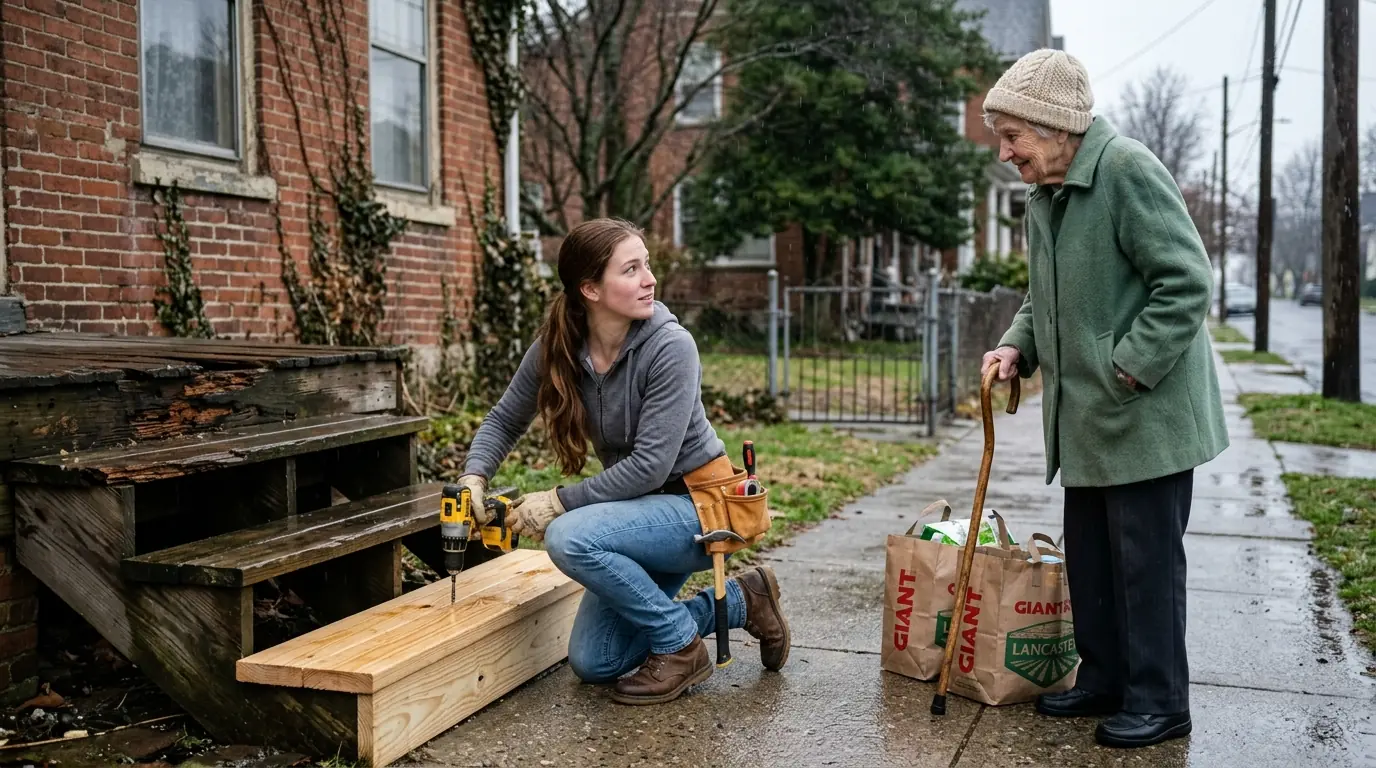
Ruth tapped her cane lightly against the new step.
“You already started, dear. You just have not admitted it.”
That sentence stayed with Ava.
Two weeks later, everything changed.
Rick assigned Ava to a renovation outside Lancaster, a large farmhouse being turned into a weekend rental. The project was rushed, and Rick cut corners wherever he could. On the third day, Ava noticed that the temporary stair platform leading to the side entrance was loose. Workers were carrying heavy materials across it.
She told Rick.
He barely looked up from his phone.
“It’s fine.”
“It’s not. The support is shifting.”
“We’re pulling it out tomorrow.”
“Someone could get hurt today.”
Rick’s jaw tightened.
“Then fix it after lunch.”
“It needs to be fixed now.”
“Ava.”
“No. I’m not watching someone fall because you don’t want to lose twenty minutes.”
The other workers went quiet.
Rick stepped closer.
“You work for me.”
“And I’m telling you it’s unsafe.”
His face hardened.
“Pack your tools.”
Ava stared at him.
“What?”
“You’re done. If you want to run safety lectures, do it somewhere else.”
For a second, Ava felt the ground drop beneath her.
She needed that job.
Her father still had medical bills. Her truck needed repairs. Her savings were almost nothing.
But then she looked at the loose platform, at the men carrying lumber across it, and at Rick’s angry face.
She packed her tools.
Before leaving, she used her own screws and two spare boards from her truck to brace the platform anyway.
Rick shouted after her, but she did not stop.
She drove straight to Ruth’s house and sat in the truck outside, gripping the steering wheel until her hands hurt.
Ruth opened the front door before Ava knocked.
“What happened?”
Ava tried to answer, but her voice broke.
Ruth stepped aside.
“Come in.”
In the kitchen, Ava told her everything. The unsafe platform. The argument. Being fired. The fear pressing against her ribs so hard she could barely breathe.
“I don’t know what I’m going to do,” Ava said. “I wanted to start my own business someday, not today. Not like this.”
Ruth placed a mug of tea in front of her.
“Maybe someday got tired of waiting.”
Ava let out a shaky laugh.
“This isn’t funny.”
“No. But it may still be true.”
“I don’t have enough.”
“You have skill.”
“That doesn’t pay insurance.”
“You have proof.”
“Proof of what?”
Ruth pointed toward the front porch.
“That.”
Ava looked through the window at the porch, sturdy and safe in the afternoon light.
“And this.” Ruth gestured to the repaired cabinet, the fixed window, the new back path, the rail by the kitchen step. “You have a house full of proof.”
Ava wiped her face.
“One house isn’t a business.”
“No,” Ruth said. “But one house can become a beginning.”
The next morning, Ruth did something Ava did not expect.
She invited neighbors over.
By noon, six people were sitting in Ruth’s living room with coffee, cookies, and a handwritten sign on the table that said: Ask Ava About Safe Home Repairs.
Ava stood in the doorway, horrified.
“Ruth.”
Ruth looked entirely innocent.
“What?”
“You organized a business meeting without telling me?”
“I organized tea.”
“With a sign.”
“Good tea deserves clarity.”
The neighbors asked questions.
Could Ava fix a loose porch railing?
Could she install a grab bar near a bathtub?
Could she repair a back step?
Could she add brighter lights near an entryway?
Could she build a small ramp for a man recovering from surgery?
Ava answered carefully, honestly, and with more confidence than she felt. She explained what she could do, what required permits, what materials cost, and how she would keep prices fair.
By the end of the afternoon, she had four small jobs scheduled.
Ruth handed her a folder.
“What’s this?”
“Names and phone numbers of former students.”
“Ruth.”
“Many of them have parents. Some are old themselves now. Do not look at me that way. I taught half this town to read. It is time they learned to maintain railings.”
Ava laughed for the first time in two days.
That week, SafeStep Home Repairs quietly began.
Ava used her final paycheck to register the business name. Her father helped her fill out forms and called every friend he had in the trades for advice. Her mother designed a simple flyer at the kitchen table. Ruth proofread every word with a red pen, because retired teachers never truly retire.
The flyer was plain but clear.
SafeStep Home Repairs
Porch Steps, Railings, Grab Bars, Lighting, Small Safety Fixes
Helping You Stay Safe At Home
At the bottom was Ava’s phone number.
Ruth insisted on one more line.
Built With Care. Priced With Honesty.
The first months were hard.
Ava worked constantly. Some jobs paid well. Others barely covered materials. She made mistakes in scheduling. She underestimated how much time paperwork required. She spent nights watching videos about small business taxes and mornings crawling under porches with a flashlight.
But word spread.
People trusted her because Ruth trusted her.
Ava’s repairs were easy to see, easy to understand, and deeply needed. An old man could safely reach his mailbox again. A widow stopped slipping on her back steps. A grandmother could hold a proper rail while carrying laundry. A retired teacher could sit on her porch without fear of falling through it.
Every job felt like a small act of protection.
One year passed.
Then another.
SafeStep grew slowly. Ava bought a better truck, hired one part-time assistant, and later trained a young woman named Jenna who had been told construction was “not really for girls.” Ava taught her the same way her father had taught her: measure carefully, respect tools, never ignore a weak step, and do work you would trust beneath someone you love.
Ruth remained Ava’s loudest supporter.
She sat proudly on her rebuilt porch every spring and summer, telling anyone who passed, “Ava Miller built this. Best carpenter in Lancaster. Don’t argue. I taught second grade for thirty-eight years, and I know talent when I see it.”
Ava always blushed when she heard it.
Then, in Ruth’s eighty-seventh year, her health began to fail.
It happened gradually. Shorter walks. Longer rests. More doctor visits. The blue chair on the porch stayed occupied less often. Ava came by more, not as a contractor now, but as family.
One evening, Ruth asked Ava to help her sit on the porch.
The sky was soft with late September light. The maple tree near the sidewalk had begun to turn red. The porch boards Ava had installed years earlier still held firm beneath their feet.
Ruth ran one hand along the railing.
“Still strong,” she said.
“Of course.”
“I knew you’d say that.”
Ava sat on the step below her.
For a while, they watched children ride bicycles along the street.
Then Ruth said, “Do you know why I stayed in this house?”
“Because it’s your home.”
“Yes. But more than that. Henry and I wanted it to become something useful after we were gone.”
Ava looked up.
“What do you mean?”
Ruth folded her hands over her cane.
“We never had children. But I spent my life with children. Some came to school hungry. Some came frightened. Some lived in houses where nobody fixed anything, not broken windows, not broken promises.”
Her voice grew soft.
“Henry and I used to talk about opening a little place where young people could learn practical skills. Carpentry. Repair. Gardening. Cooking. Things that make a person feel capable. We never managed it. Life got busy. Then he died, and I got old, and the dream sat in a drawer.”
Ava listened, her chest tightening.
Ruth turned toward her.
“Then you stopped in the rain.”
Ava looked at the step beneath her boots.
“I just fixed a porch.”
“No, dear. You opened the door again.”
Ruth reached into her cardigan pocket and pulled out an envelope.
“I want you to have this.”
Ava took it carefully.
Inside was a letter and a key.
Not a house key.
A brass key on a ring labeled: Maple Street Workshop.
Ava frowned.
“What is this?”
Ruth smiled faintly.
“Henry’s old workshop. It’s behind the house, past the back garden. You’ve never seen inside because the door sticks, and I was saving the embarrassment.”
“Ruth.”
“It needs work.”
Ava laughed softly through sudden tears.
“Of course it does.”
“I have left it to you in my will, along with a small fund Henry and I saved. Not a fortune. Enough to repair it. Enough to begin.”
Ava stared at her.
“No.”
“Yes.”
“Ruth, I can’t accept that.”
“You can. And you will not argue with an old woman on her own porch.”
“This is too much.”
“No,” Ruth said gently. “It is the right size.”
Ava shook her head, tears falling now.
“Why?”
Ruth’s eyes shone.
“Because you build safety. I want you to build confidence too. Use the workshop. Teach young people. Train girls who are told they do not belong with tools. Help older homeowners. Make it the place Henry and I never finished.”
Ava covered her mouth.
Ruth placed her hand over Ava’s.
“You gave me my porch back. Then you gave me my street back. Then you gave me the dignity of staying in my own home. Let me give you the key to something that can outlive us both.”
Ava could not speak.
So she leaned against Ruth’s knee and cried like a daughter.
Ruth passed away that winter, peacefully, in her sleep.
The funeral filled the church.
Former students came from across Pennsylvania. Some were grandparents now. They brought letters, class photos, and stories about the woman who had taught them to read, tie their shoes, apologize properly, and believe they could become good.
Ava sat near the front, holding the brass key in her pocket.
After the service, many people came to her.
“You’re Ava?” one man asked. “Mrs. Callahan wrote me about you.”
“She told me you fixed her porch,” said another woman. “She said you fixed more than that.”
A retired nurse squeezed Ava’s hand and whispered, “She was proud of you.”
Ava cried every time.
In the spring, Ava opened Henry’s old workshop.
It stood behind Ruth’s house, half hidden by overgrown shrubs. The roof sagged slightly. The windows were cloudy. The door did, in fact, stick badly. Inside, dust covered workbenches, hand tools, jars of screws, old clamps, planes, saws, and pieces of carefully stacked wood. On the wall hung a faded sign Henry had painted by hand.
Build It Strong Enough For Someone You Love.
Ava stood in the doorway for a long time.
Then she got to work.
She repaired the roof first. Then the windows. Then the floorboards. She rebuilt the door, installed bright lights, cleaned the benches, sharpened tools, and painted the outside a soft blue to match Ruth’s porch. Her father helped when his leg allowed. Jenna helped every weekend. Ruth’s former students donated supplies, money, and time.
By summer, the workshop was ready.
Ava named it The Callahan Workshop.
Under the name, she painted Ruth’s favorite words.
A Safe Step Can Change A Life.
The first class had six students.
Three teenage girls, two boys, and one quiet nineteen-year-old who had dropped out of college and did not know what came next. Ava taught them how to use a tape measure, how to drive screws straight, how to recognize rotten wood, how to build a simple step, and how to install a handrail.
She began every class with Ruth’s story.
“Years ago,” Ava said, standing beside a workbench, “I saw an elderly woman stuck in the rain because her porch step had broken. I thought I was stopping to do one small repair. But small repairs are not small when someone’s freedom depends on them.”
The students listened.
Outside, Ruth’s porch stood strong in the sunlight.
The Callahan Workshop grew.
SafeStep Home Repairs expanded into a training program. Ava and her team repaired homes for elderly residents at reduced cost, funded partly by donations and partly by paid work. Students learned on real projects under careful supervision. Older homeowners received safer steps, stronger railings, better lighting, and the comfort of knowing someone had not forgotten them.
News spread through Lancaster.
A local paper ran a story: Young Carpenter Turns One Porch Repair Into A Community Mission.
Ava taped the article inside the workshop, not because of the headline, but because the photo showed Ruth’s porch in the background.
Years later, when Ava was no longer the young woman with one dented pickup and a notebook full of fears, people asked how her company began.
They expected a business story.
They expected her to talk about risk, branding, contracts, and growth.
Ava always told them the truth.
“It began with an old woman standing in the rain, unable to get into her own home.”
Then she would describe the broken step, the leaning railing, the grocery bags on the wet walkway, and the way Ruth Callahan tried to pretend she was fine because pride was sometimes the last thing a person had left.
She told them how she built a temporary platform in the rain.
How Ruth paid her first with soup and twenty dollars.
How one porch became a business.
How one business became a workshop.
How one elderly teacher, who had spent her life helping children stand taller, gave Ava the key to help others do the same.
The gift Ruth left Ava was not only the workshop, or the small fund, or the old tools Henry had kept in careful rows.
It was proof.
Proof that one clear act of help could become a calling.
Proof that safety was not a small thing.
Proof that a young woman’s hands could build more than steps and railings. They could build trust, dignity, and a place where people learned they were capable.
Every autumn, on the anniversary of the day Ava first stopped in the rain, she returned to Ruth’s porch alone.
She would sit on the step she had rebuilt, run her hand along the railing, and look at the blue chair where Ruth used to sit.
Then she would take out the brass key, hold it in her palm, and whisper the words painted inside the workshop.
Build it strong enough for someone you love.
And she did.