At twenty-four, Lily Harper worked in a quiet repair shop where broken things came in carrying stories nobody else had time to hear.
The shop sat on a narrow street in Burlington, Vermont, between a used bookstore and a family-owned pharmacy with faded green awnings. On most mornings, the sidewalk outside smelled faintly of rain, coffee, and old brick warmed by the early sun. Inside Harper & Sons Instrument Repair, the air held the scent of wood polish, brass cleaner, felt, dust, and time.
Lily had grown up there.
Her grandfather had opened the shop forty years earlier, repairing violins, guitars, trumpets, clarinets, and old upright pianos that families could not bear to throw away. Her father, Matthew Harper, had taken over after him. Lily had started by sweeping floors after school, then learned how to replace violin strings, polish brass valves, tune stubborn piano keys, and listen carefully to the smallest changes in sound.
By twenty-four, she could tell when a piano had been loved.
A neglected piano made a dull sound, tired and flat. A loved piano, even when broken, still seemed to breathe beneath the dust. The wood held warmth. The keys carried fingerprints. The pedals remembered feet. Lily believed instruments were like people. Some were damaged, some were forgotten, some were silent for years, but that did not mean their music was gone.
Her father used to say that was why she was good at the work.
“You don’t just fix the instrument,” he told her once. “You make it feel wanted again.”
Lily never forgot that.
After her father died from a sudden heart attack, the repair shop became both her inheritance and her burden. She was only twenty-two then, too young to feel like a business owner and too tired to feel like a dreamer. Customers still came, but not as many as before. Bigger music stores had cheaper services. Online companies sold new instruments faster than Lily could repair old ones. Rent kept rising. Bills stacked up in the little office behind the counter.
Still, every morning, Lily unlocked the front door and turned the old wooden sign from Closed to Open.
She did not know how to quit.
On a gray Tuesday afternoon in November, while cold rain streaked the front windows, Lily was repairing a cracked cello bridge when the bell above the door gave a weak little ring.
She looked up.
An elderly woman stood just inside the shop, holding the handle of a rolling grocery cart with both hands. She looked to be in her late seventies or early eighties, small and slightly stooped, with silver hair tucked beneath a knitted blue hat. Her coat was old but carefully buttoned. Her gloves did not match. One was black, the other brown. Rainwater clung to the shoulders of her coat and trembled at the edges of her sleeves.
The woman looked around the shop as if she had stepped into a memory.
“Hello,” Lily said gently. “Can I help you?”
The old woman blinked, then smiled with quiet embarrassment.
“I hope so, dear. My name is Margaret Winslow. I have a piano.”
Lily wiped her hands on a cloth and stepped around the counter.
“What kind of piano?”
“An upright. Very old. Older than you, older than me, maybe older than both of us put together.”
Lily smiled. “Those are usually the best ones.”
Margaret’s smile faded a little.
“It has not played properly in years.”
“Do you want it tuned?”
“I want it to sing once more.”
There was something in the way she said it that made Lily pause.
Most customers talked about sound, price, repairs, damage, or value. Margaret spoke as if the piano were a person she missed.
Lily nodded. “I can come take a look at it.”
Margaret’s shoulders loosened with relief, but only for a second. Then worry returned to her face.
“I should tell you before you come. I cannot afford much.”
Lily had heard that sentence many times. It was usually followed by shame, apology, or silence.
She glanced at the unpaid invoices on her desk. The shop needed money badly. She had a rent notice waiting in her mailbox. The heating system needed repairs before winter deepened. She could not keep giving discounts just because her heart softened.
But Margaret stood there with rain on her coat, clutching the cart handle, trying to ask for help without asking too much.
Lily heard her father’s voice in her mind.
Make it feel wanted again.
“Let me inspect it first,” Lily said. “No charge for that.”
Margaret’s eyes widened. “No charge?”
“No charge.”
“But your time is worth something.”
“So is your piano.”
Margaret pressed one hand lightly against her chest.
“That is kind of you.”
“It’s practical,” Lily said, though both of them knew it was not.
Margaret pulled a folded piece of paper from her coat pocket and handed it over. Her address was written in careful handwriting: 18 Willow Lane.
Lily knew the street. It was in the older part of Burlington, near Lake Champlain, where many houses had broad porches, narrow staircases, and histories hidden beneath peeling paint.
“I can come by tomorrow morning,” Lily said.
“You don’t have to.”
“I know.” Margaret smiled softly. “That is why I will.”
The next morning, Lily loaded her tuning kit, repair tools, felt strips, and a small flashlight into her old Subaru. The sky was pale and cold. Bare trees stood along the road like dark sketches against the clouds. When she arrived at Willow Lane, she found Margaret’s house at the end of the street, a white two-story home with blue shutters, a sagging porch, and ivy climbing one side like a memory refusing to let go.
Margaret opened the door before Lily knocked.
“You found it.”
“I did.”
“Come in before the cold steals your fingers.”
Inside, the house smelled of lavender, old books, and wood smoke, though Lily saw no fire burning. The hallway walls were lined with framed photographs. A young Margaret in a white dress beside a tall man in a dark suit. A little girl with pigtails standing near a lake. A teenage boy holding a baseball glove. A family Christmas photo from decades ago. Then fewer photos. Then none.
The silence in the house was not empty exactly. It was full of absence.
Margaret led Lily into the front parlor.
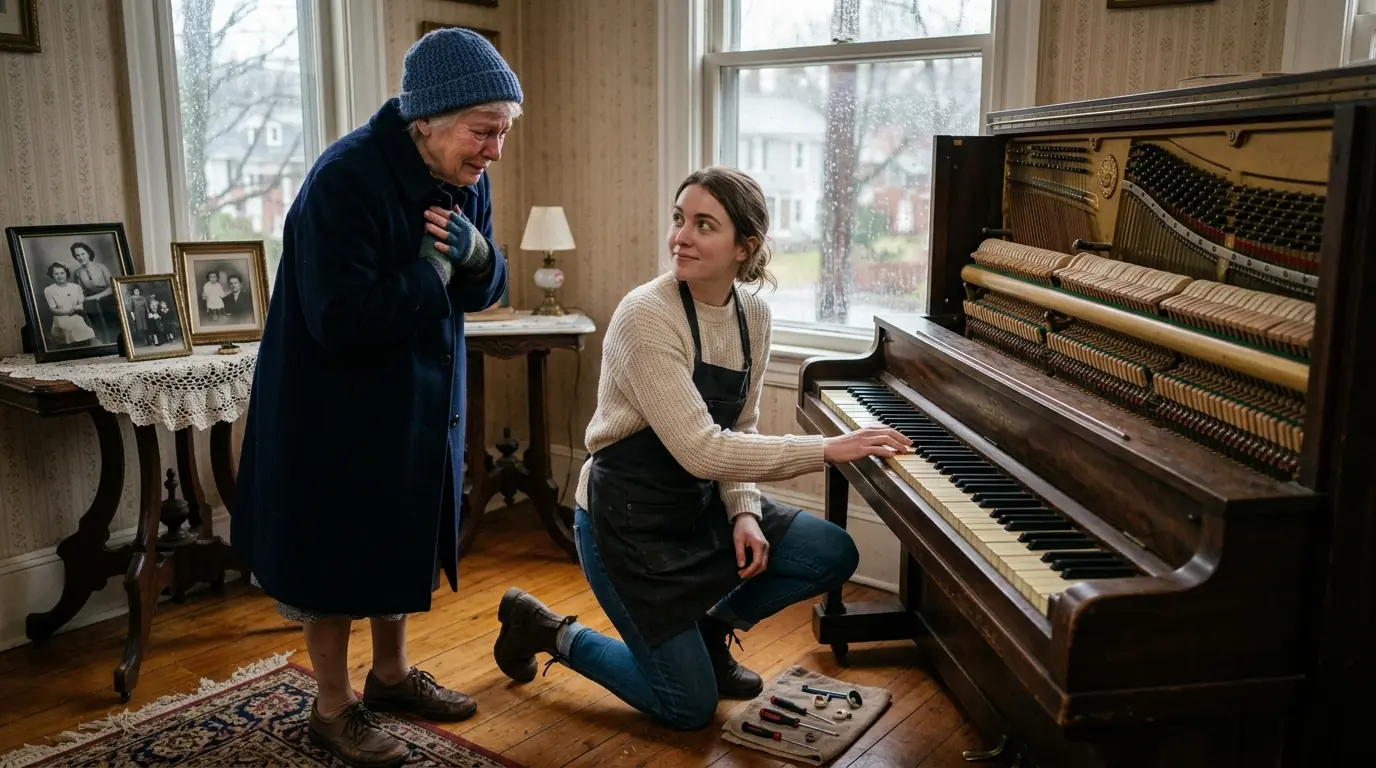
The piano stood near the window.
It was a dark walnut upright with carved legs, yellowed ivory keys, and a long scratch across the right side. Dust covered the top, but not carelessly. A lace runner protected the wood. A small framed photograph rested above the music stand. In it, Margaret sat beside a man at the piano bench, both laughing at something outside the frame.
Lily approached slowly.
“Oh,” she whispered.
Margaret watched her. “Is it terrible?”
“No,” Lily said. “It’s beautiful.”
She lifted the fallboard and pressed a middle C.
The note came out sour and weak, followed by a faint metallic buzz.
Margaret flinched.
“It used to sound lovely,” she said.
Lily tested a few more keys. Some stuck. Some rang too long. Several hammers were badly worn. One pedal barely responded. The strings were out of tune, but the bigger problem was neglect. Years of changing humidity had affected the wood. The action needed cleaning and regulation. A few parts would need replacement.
It was not impossible.
But it would take time.
Lily opened the top panel, leaned in with her flashlight, and studied the interior.
“Has anyone repaired it recently?”
Margaret shook her head. “Not since my husband, Thomas, passed.”
“How long ago?”
“Twelve years.”
Lily looked back at the photograph on the piano.
“He played?”
“Every evening.” Margaret’s voice softened. “He was a music teacher. Not famous, not rich, but every child in three towns knew Mr. Winslow and his piano.”
Lily smiled. “That’s a good kind of famous.”
Margaret’s eyes warmed.
“He believed every child had a song hidden somewhere inside. He spent his life trying to help them find it.”
Lily ran her fingers gently over the keys. “And you?”
“I sang.” Margaret looked embarrassed. “Only at home. Only for him.”
“That still counts.”
Margaret’s gaze lowered to the piano. “After he died, I tried to play once. It sounded wrong. I never tried again.”
Lily understood more than she wanted to.
After her father died, she had avoided his workbench for three months. The tools had seemed too heavy with memory. The first time she picked up his tuning hammer, she cried so hard she had to sit on the floor.
Grief could make beloved things unbearable.
“I can fix it,” Lily said.
Margaret turned to her quickly.
“You can?”
“Yes. But I want to be honest. It needs a lot of work.”
“How much?”
Lily hesitated.
A proper repair would cost more than Margaret could likely pay. Even with a discount, parts and labor would add up. Lily thought of rent. Heating. Insurance. The letter from the bank warning about late payments.
Then she looked at Margaret’s hands. Thin fingers. Wedding ring loose on one hand. A faint tremble when she touched the piano’s edge.
“How soon do you need it?” Lily asked.
Margaret looked toward the window.
“Before Christmas, if possible.”
“That’s only six weeks.”
“I know.”
“Is there a special reason?”
Margaret pressed her lips together.
For a moment, Lily thought she would not answer.
Then the old woman said, “My daughter is coming home.”
Lily stayed quiet.
“We have not seen each other in nine years.” Margaret’s voice was careful, as if each word had a sharp edge. “After Thomas died, I was difficult. Grief made me bitter. My daughter, Caroline, tried to help, but I pushed her away. There were arguments. Things said. One day she left for Oregon with her husband and son, and calls became shorter, then rare.”
“I’m sorry,” Lily said.
Margaret nodded, accepting the words but not hiding from the truth.
“She wrote last month. Her marriage ended. She asked if she and my grandson could come for Christmas.” Margaret touched the piano. “Thomas used to play ‘Silent Night’ every Christmas Eve. Caroline loved it when she was little. I thought if the piano could play again, perhaps this house might feel less like a museum and more like a home.”
Lily felt the decision settle inside her before her practical mind could fight it.
“I’ll do it.”
Margaret breathed out shakily. “How much?”
“We’ll work that out later.”
“No, dear. I need to know.”
Lily closed her tool case. “You can pay what you can, when you can. I’ll make it work.”
Margaret looked at her for a long time.
“You are too young to be that tired,” she said quietly.
Lily looked away.
Margaret did not press.
Instead, she made tea.
That was how the work began.
Every Wednesday and Saturday morning, Lily came to Margaret’s house on Willow Lane. She cleaned the action, replaced worn felt, adjusted hammers, repaired sticky keys, tuned strings little by little, and coaxed life back into the old walnut piano.
Margaret always had tea ready.
Sometimes she baked shortbread, though the first batch was so hard Lily nearly cracked a tooth. Margaret laughed for the first time then, truly laughed, and the sound changed the room.
They began talking while Lily worked.
Margaret told stories about Thomas and his students, about summers by the lake, about Caroline as a stubborn little girl who once refused to practice piano unless every stuffed animal in the house was given a front-row seat. Lily told Margaret about her father, the repair shop, and the way she still expected to hear his footsteps in the back room.
“You miss him very much,” Margaret said one morning.
Lily tightened a screw inside the piano. “Every day.”
“Does the shop help or hurt?”
“Both.”
“That is usually how love leaves things.”
Lily paused, surprised by the sentence.
Margaret looked toward the photograph on the piano. “The things we inherit are rarely simple.”
Lily thought about the bills waiting at the shop.
“No,” she said. “They’re not.”
As weeks passed, the piano improved.
The first time Lily played a clean scale across the middle keys, Margaret covered her mouth with both hands. The sound was not perfect yet, but it was no longer broken. It carried warmth.
“There,” Lily said. “That’s the beginning.”
Margaret’s eyes filled. “I had forgotten that sound.”
Lily smiled. “It remembered you.”
Outside the house, winter tightened around Burlington. Snow fell over Willow Lane. Shop windows glowed against early darkness. Lily worked late most nights, repairing instruments for school concerts and church programs while trying to keep her own business alive.
Some days, the numbers terrified her.
She had three months before she would have to make a serious decision about the shop. Either find money, take on a second job, sell some equipment, or close. She had not told anyone. Not her friends, not her neighbors, not even Margaret.
But Margaret noticed things.
She noticed when Lily’s hands shook from too much coffee and too little sleep. She noticed when Lily’s coat lost a button and was repaired with thread that did not match. She noticed when Lily smiled too quickly after checking her phone.
One Saturday, Margaret asked, “How much trouble is the shop in?”
Lily froze beside the piano.
“What?”
“Dear, I am old, not blind.”
Lily tried to laugh. “It’s just business. Small shops struggle.”
“That was not an answer.”
Lily adjusted a tuning pin. “I’ll figure it out.”
“You sound exactly like Thomas when he was hiding bad news.”
“I’m not hiding.”
“Then tell me.”
Lily set down the tuning hammer and sat back on her heels.
For a moment, pride fought exhaustion.
Exhaustion won.
“The rent went up. School contracts went to a bigger repair company. The heating system is failing. I’m behind on payments.” She swallowed. “I don’t know how long I can keep it open.”
Margaret’s face softened.
“Why didn’t you say something?”
“Because everyone has problems.”
“That does not mean yours disappear.”
“I know.”
“And because you are afraid if you say it aloud, it becomes real.”
Lily looked down.
Margaret nodded gently. “Yes. I know that feeling.”
Lily wiped dust from her fingers. “My grandfather built that shop. My father gave his whole life to it. If I lose it, it feels like I’m losing them again.”
“No,” Margaret said firmly.
Lily looked up.
Margaret’s voice was quiet but strong. “Buildings matter. Work matters. But your father is not trapped inside a lease. Your grandfather is not contained in a sign above a door. What they gave you lives in your hands, your patience, your ear, your heart.”
Lily’s throat tightened.
“I still don’t want to lose it.”
“Of course not.” Margaret reached over and touched the piano. “We do not stop loving a thing just because we know we might survive without it.”
That night, Lily returned to the shop and stood alone in the dark.
She ran her hand along the counter her grandfather had built. She touched her father’s old stool. She looked at rows of instruments waiting for repair and wondered how many would have to be returned unfinished if the shop closed.
For the first time, she allowed herself to cry there.
Not quietly. Not politely. She cried like someone who had spent two years being brave because bravery was cheaper than help.
Then she wiped her face, turned on the lights, and kept working.
By mid-December, Margaret’s piano was nearly ready.
The final tuning took almost four hours. Lily adjusted each string carefully, listening as notes settled into each other. The old walnut upright would never sound new, but that was not the goal. It sounded like itself again. A little weathered, a little soft around the edges, but full of warmth.
When Lily finished, Margaret stood near the doorway with both hands clasped.
“Will you play something?” she asked.
“I’m not really a pianist.”
“But you know enough.”
Lily hesitated, then sat on the bench.
She played the opening notes of “Silent Night.”
The sound filled the parlor.
Margaret closed her eyes.
For the first time since Lily had met her, the old woman did not look lonely. She looked accompanied. As if someone unseen had stepped into the room and stood beside her.
When the song ended, Margaret whispered, “Thomas would have liked you.”
Lily’s own eyes burned.
“I think I would have liked him too.”
Margaret sat beside her on the bench. For a while, neither moved.
Then Margaret said, “Caroline arrives tomorrow.”
“Are you nervous?”
“Terrified.”
“That means it matters.”
Margaret gave a small laugh. “You sound like an old woman.”
“I’ve been spending time with one.”
“Good. We are underrated.”
The next evening, Lily was closing the shop when her phone rang.
Margaret.
“Hello?”
There was no answer at first, only breathing.
“Margaret?”
“She came,” Margaret whispered.
Lily leaned against the counter.
“Is everything okay?”
“She came with Daniel. My grandson. He is seventeen now. Tall. Quiet. Looks like Thomas around the eyes.”
“That’s good.”
“I wanted to play the song, but my hands froze. I could not do it.”
Lily waited.
“Then Caroline sat beside me,” Margaret continued, voice breaking. “She said, ‘Mom, we can start with one note.’ One note, Lily.”
Lily closed her eyes.
“And did you?”
“Yes. We played badly.” Margaret laughed through tears. “Terribly. Thomas would have covered his ears. But we played together.”
Lily smiled into the empty shop.
“That sounds perfect.”
“It was.”
On Christmas Eve, Margaret invited Lily to dinner.
Lily almost refused, not wanting to intrude on a family reunion still tender around the edges. But Margaret insisted.
“You repaired the piano,” she said. “You are part of why there is dinner at all.”
So Lily went.
Caroline was warm but cautious, a woman carrying her own bruises from life. Her son, Daniel, was quiet at first, then became interested when Lily mentioned repairing guitars. By dessert, he was asking questions about soundboards, tuning, and whether old instruments were better than new ones.
Margaret watched him with shining eyes.
After dinner, they gathered around the piano.
Margaret’s hands trembled when she sat down, but Caroline placed a hand near hers, not touching, just close enough. Daniel stood beside them. Lily remained near the doorway.
Together, mother and daughter played “Silent Night.”
The tempo wavered. A few notes slipped. Margaret laughed once through tears. Caroline cried openly by the final verse. Daniel looked embarrassed by everyone’s emotion but did not leave.
Lily thought of her father.
She thought of how music could survive silence, how love could survive years of pain, how broken things could become beautiful not by hiding their cracks, but by sounding through them.
After the song, Margaret stood and turned to Lily.
“This house has not heard Christmas in twelve years,” she said. “Thank you for bringing it back.”
Lily could not answer.
Margaret hugged her gently, and for one brief second, Lily let herself be held like a daughter.
January came hard.
Snow piled along the sidewalks. The shop’s heating system failed twice. Lily wore fingerless gloves while working and kept a space heater near the bench. Repair requests slowed after the holidays. Bills did not.
Then one morning, she found a letter taped to the shop door.
It was from the landlord.
Final notice.
She had thirty days to pay the overdue amount or vacate.
Lily read it twice, then folded it carefully because tearing it would not change anything.
For the next week, she worked in a fog. Customers noticed she was quieter. Friends texted, but she did not respond. Margaret called twice. Lily let it go to voicemail because she did not trust her voice.
On the third call, Margaret left a message.
“Lily Harper, if you avoid an old woman long enough, she becomes determined. Determined old women are dangerous. Call me.”
Lily laughed despite herself, then cried because laughter felt like betrayal.
She called back.
“I got a notice,” Lily admitted. “The shop might close.”
“How much time?”
“Thirty days.”
“How much money?”
“Too much.”
“Come over tomorrow.”
“Margaret, I can’t ask you for money.”
“I did not say you were asking. I said come over.”
Lily went.
Margaret was waiting in the parlor, but she was not alone. Caroline sat at the dining table with a laptop. Daniel was on the floor sorting papers into piles. There were old boxes everywhere.
Lily stopped.
“What’s going on?”
Margaret pointed to a chair.
“Sit.”
“That never sounds good.”
“It is good. Sit.”
Lily sat.
Margaret folded her hands in her lap.
“Thomas kept everything. Programs from concerts. Letters from parents. Notes from students. Old photographs. Newspaper clippings. I thought they were just memories. Caroline thought otherwise.”
Caroline turned the laptop toward Lily.
On the screen was a page titled: The Winslow Music Fund.
Lily frowned. “What is this?”
Caroline smiled. “My father left a small fund when he died. Mom never used it. It was meant to support music education in the community, but after he passed, everything froze. Grief, paperwork, family conflict. It’s been sitting there for years.”
Margaret looked ashamed. “I could not face it.”
Caroline touched her mother’s shoulder. “But now we can.”
Lily still did not understand.
Margaret leaned forward.
“Thomas believed music should not disappear just because families lacked money. Your shop has kept instruments alive for this town. You have kept children playing, churches singing, old people remembering, and lonely houses filled with sound. That is music education too.”
Lily shook her head slowly. “Margaret…”
“The fund cannot simply pay your private debts,” Caroline explained. “But it can create a community repair program. Schools, low-income families, senior centers, churches, young musicians who cannot afford full repair costs. The fund can contract Harper & Sons Instrument Repair as its service provider.”
Lily stared at her.
Caroline continued, “We spoke with an attorney. It is legal. We also spoke with three school music directors. They are interested. Very interested.”
Daniel looked up from the floor. “I made a list of instruments in the high school storage room. There are like thirty broken ones.”
Margaret smiled. “Daniel has become very invested.”
“I just think it’s dumb that kids can’t play because a trumpet valve is stuck,” he muttered.
Lily looked at the laptop again.
Her heart was pounding.
“I don’t know what to say.”
Margaret’s eyes were bright.
“You once repaired my piano for what I could pay. Now let this town pay you properly for repairing what still matters.”
Lily covered her mouth.
“This could save the shop,” Caroline said gently. “Not magically. You’ll still have work to do. But it gives you contracts, visibility, and a reason for people to support you.”
Margaret reached across the table and placed a small envelope in front of Lily.
“And this is not from the fund. This is from me.”
Lily did not touch it.
“Margaret, no.”
“Yes.”
“I can’t.”
“You can. It is payment.”
“For the piano?”
“For the piano. For the tea you drank politely even when I brewed it too strong. For listening to an old woman talk about grief. For giving my daughter and me a song to begin with.”
Lily opened the envelope with trembling hands.
Inside was a check.
It was not enough to solve everything, but it was enough to pay the immediate overdue rent and stop the eviction notice.
Lily’s vision blurred.
“Margaret, this is too much.”
“No,” Margaret said. “It is late.”
That broke Lily.
She cried at Margaret’s dining table while Caroline quietly brought tissues and Daniel pretended to organize papers very seriously so he would not have to admit he was emotional too.
For the next month, everything changed.
Caroline helped Lily set up a proper website for the shop. Daniel filmed short videos of Lily repairing instruments and posted them online. Margaret called former students of Thomas Winslow, many of whom were now adults with children of their own. Word spread.
The Winslow Music Fund announced its community repair program.
Local news picked up the story.
The headline read: Young Repairwoman Keeps Burlington’s Music Alive With Help From Late Teacher’s Legacy.
Customers returned.
Some brought instruments. Some brought donations. Some brought stories.
A retired teacher brought a violin that had belonged to her mother. A church brought a box of handbells. A high school student brought a saxophone with a bent key and admitted he had almost quit band because his family could not afford repairs. Lily fixed it through the fund. The boy played in the spring concert three months later, and Margaret insisted they all attend.
The shop did not become rich.
It became alive.
That was better.
Lily hired a part-time assistant, a college student named Grace who wanted to learn instrument repair. She replaced the heating system with help from a local grant. She painted the front door deep blue, her father’s favorite color. She kept her grandfather’s sign but added new lettering beneath it.
Harper & Sons Instrument Repair
Community Repair Partner of the Winslow Music Fund
The first day the new sign went up, Lily stood outside on the sidewalk and cried.
Margaret stood beside her, leaning on a cane.
“Your father would be proud,” Margaret said.
Lily wiped her face. “I hope so.”
“I know so.”
“How?”
Margaret looked through the window at the workbenches, the instruments, the tools, the light inside.
“Because pride is not only for grand success. Sometimes it is for endurance. Sometimes it is for staying gentle when life gives you every reason not to.”
Lily looked at her.
“You always say things that sound like they belong in a book.”
“I am old. We are allowed.”
Spring softened the city.
Snow melted from the curbs. Lake Champlain shimmered under pale blue skies. Students came into the shop carrying dented instruments and nervous hopes. Lily worked long days, but the exhaustion felt different now. It had purpose, not panic.
Margaret came by every Friday afternoon.
She sat in the corner chair near the window, drank tea from a travel cup, and greeted customers as if she owned the place. In a way, Lily thought she did. Not legally, not financially, but spiritually. Margaret had become part of the shop’s heartbeat.
One afternoon, Daniel brought in an old guitar from his school.
“Can this be fixed?” he asked.
Lily inspected it. “Yes.”
“Can you teach me?”
She looked up. “To fix it?”
“Yeah. I mean, maybe. I don’t know. I like how things work.”
Margaret watched from the chair with quiet delight.
Lily handed him a cloth. “Start by cleaning it. Slowly. Don’t rush. Instruments can tell when you’re impatient.”
Daniel raised an eyebrow. “That sounds fake.”
“It’s not.”
“It definitely sounds fake.”
“Clean the guitar, Daniel.”
He grinned and obeyed.
By summer, Daniel was spending two afternoons a week at the shop. He learned quickly. He had careful hands and a good ear. Margaret pretended not to be proud, which fooled no one.
Caroline, too, began changing.
She visited her mother more often. Sometimes she worked remotely from Margaret’s dining room. Sometimes she and Margaret argued, but now the arguments ended differently. With apologies. With tea. With someone staying instead of leaving.
One evening in July, Margaret invited Lily to dinner again.
After the meal, Margaret asked Caroline and Daniel to bring something from upstairs. They returned with a flat wooden box wrapped in a faded blue ribbon.
Margaret placed it in Lily’s hands.
“What is this?”
“Open it.”
Inside was sheet music.
The pages were yellowed but carefully preserved. Across the top, handwritten in elegant script, were the words: For Margaret, When The House Is Quiet.
Lily touched the paper gently.
“Thomas wrote this?”
“Yes. He wrote it when Caroline was born. He played it often when she was a baby, then later when the house felt too still.” Margaret smiled sadly. “I thought I had lost it.”
Caroline looked at Lily. “We found it in Dad’s old files.”
Margaret’s hands trembled.
“I would like you to have a copy.”
Lily looked up quickly. “I can’t take this.”
“A copy, dear. Not the original.” Margaret smiled. “I may be generous, but I am not foolish.”
Lily laughed softly.
Margaret continued, “Thomas always wanted music to keep moving from one person to another. I think he would like knowing you had this.”
Lily looked at the notes.
She could read music well enough to hear parts of it in her mind. The melody was gentle, full of pauses and returning phrases, like someone walking through rooms of memory and finding light in each one.
“It’s beautiful,” she whispered.
“It is not finished,” Margaret said.
Lily looked at her.
“Thomas never completed the ending. He said some songs should wait until life teaches the final line.”
Caroline’s eyes filled.
Margaret took Lily’s hand.
“You helped us find our ending. I wondered if you might write yours.”
Lily was speechless.
She had repaired music all her life. She had preserved other people’s songs, tuned other people’s memories, restored other people’s instruments. But she had never thought of writing something herself.
“I don’t know if I can.”
Margaret smiled.
“Of course you don’t. That is how beginnings usually feel.”
For weeks, Lily kept the copied sheet music on her desk at the shop.
Between repairs, she played fragments on the small upright piano near the back wall. She followed Thomas’s melody, listened to where it wanted to go, then stopped whenever fear told her she had no right to add anything.
One evening, after closing, Margaret found her sitting at the piano in frustration.
“I keep ruining it,” Lily said.
“Play what you have.”
“It’s not ready.”
“Most honest things are not.”
Lily played.
The beginning was Thomas’s. Gentle, patient, full of tenderness. Then Lily’s section entered uncertainly, a little lower, a little sadder. The melody bent around grief, then lifted slowly, not into triumph, but into peace.
When she finished, Margaret was crying.
Lily turned, alarmed. “Was it wrong?”
Margaret shook her head.
“No, dear. It was true.”
They premiered the completed piece in October at the Burlington Community Music Night, hosted in a small hall near the waterfront. Students performed on repaired instruments. Teachers spoke about the Winslow Music Fund. Parents applauded too loudly. Someone’s clarinet squeaked, and everyone clapped anyway.
At the end, Lily sat at the piano with Margaret beside her.
Margaret introduced the piece.
“My husband, Thomas Winslow, believed music could give people back parts of themselves they thought were gone forever. For many years after he died, I let silence take over my home. Then a young woman named Lily Harper repaired an old piano and, without meaning to, repaired more than that.”
Lily stared down at the keys, overwhelmed.
Margaret continued.
“Tonight, we play a song Thomas began and Lily helped finish. It is called ‘When The House Sings Again.’”
They played together.
Margaret’s part was simple, just a few notes she could manage with stiff fingers. Lily carried the rest. The hall grew quiet. The melody moved through grief, memory, repair, and return. By the final notes, Caroline was crying, Daniel was wiping his face with his sleeve, and Lily felt something inside herself loosen after years of holding tight.
When the applause came, Margaret leaned close and whispered, “That is what you received, Lily.”
Lily looked at her, confused through tears.
Margaret smiled.
“Not just money. Not just the shop. Your own song.”
Years passed, but people in Burlington remembered that winter.
They remembered the old woman who brought a broken piano to a struggling young repairwoman. They remembered the repair shop nearly closing. They remembered the music fund that helped children play again. They remembered the concert where an unfinished song found its ending.
Lily’s shop grew slowly, steadily, honestly.
She trained apprentices. She repaired instruments for schools across the county. She kept a corner of the shop open for seniors who wanted to bring in old instruments and tell stories about them. Margaret became a beloved fixture there, known to local children as Mrs. Winslow, the lady who always carried peppermints and corrected posture during piano practice.
Margaret’s health declined gradually, as old age does when it comes gently but firmly.
She walked slower. Her visits became shorter. Some days, she forgot small things, like where she had left her gloves or whether she had already told Lily a story about Thomas. Lily listened every time as if it were new.
One snowy afternoon, Margaret came into the shop with Caroline and Daniel, who was now studying music education in college.
Lily noticed immediately that Margaret looked tired.
“Tea?” Lily asked.
“Always.”
They sat by the window while snow fell softly outside.
Margaret looked around the shop, at the instruments waiting for repair, the students laughing near the counter, the old blue door, the sign above the workbench, and the little framed copy of “When The House Sings Again” on the wall.
“You did not just save a shop,” Margaret said.
Lily smiled. “You helped.”
“No. I mean it.” Margaret’s voice was thin but clear. “You made a place where broken things are not thrown away. That matters.”
Lily reached for her hand.
“So did you.”
Margaret squeezed her fingers.
“When I first came here, I thought I was asking you to fix a piano. But I was really asking if my life could still make music after so much silence.”
Lily’s eyes filled.
“And did it?”
Margaret looked toward Caroline and Daniel, who were laughing near the counter over something Grace had said.
“Yes,” she whispered. “It did.”
Margaret passed away the following spring, peacefully, in the house on Willow Lane.
At her memorial, Caroline asked Lily to play “When The House Sings Again.”
Lily almost said she could not. The grief felt too close, the notes too full of Margaret’s voice. But then Daniel stood beside her and said, “Grandma would call you dramatic, but in a classy way.”
Lily laughed through tears.
So she played.
The old walnut piano stood at the front of the small chapel. Its sound was softer than ever, but steady. Lily played Thomas’s beginning, her own ending, and every note in between for the woman who had taught her that inheritance was not only what people left behind, but what they awakened in others.
After the memorial, Caroline handed Lily a letter.
“Mom wanted you to have this.”
Lily waited until she was alone in the shop that evening to open it.
Dear Lily,
If you are reading this, I have gone where old songs go when no one can hear them for a while.
Do not be sad too long. Be sad properly, then make tea.
You once came to my house to repair a piano. You found an old woman who had mistaken silence for safety. You gave me back music, my daughter, my grandson, and the courage to be forgiven.
People may say I helped save your shop. Perhaps that is partly true. But you saved something in me first.
I have left the piano to you, not because you need another instrument to repair, but because you understand what it means. Keep it where people can hear it. Let children play wrong notes on it. Let old hands remember songs on it. Let it be useful. Let it be loved.
And when life becomes too quiet, play.
With gratitude beyond words,
Margaret Winslow
Lily pressed the letter to her heart and cried until the shop lights blurred.
A month later, the old walnut piano was moved carefully from Willow Lane to Harper & Sons Instrument Repair. Lily placed it near the front window, where afternoon light touched the carved wood. Above it, she hung a small sign.
Margaret’s Piano
For Anyone Who Needs To Remember Their Song
People came to play it.
Children played clumsy scales. Teenagers played fragments of pop songs. Retired teachers played hymns. A widower once sat down and played the first song from his wedding, then cried quietly while Lily brought him tea.
Sometimes, after closing, Lily played it herself.
She played when bills were paid and when they were not. She played when students succeeded. She played when old grief returned. She played on Margaret’s birthday, on her father’s birthday, and every Christmas Eve.
Years later, when Lily was no longer twenty-four but still carried that age somewhere in her heart, people often asked how she had kept the shop alive.
She could have told them about the Winslow Music Fund, the community contracts, the news article, the donations, and the repairs.
But that was only part of the truth.
The deeper truth was this.
One rainy afternoon, an old woman walked into her shop with a broken piano and not enough money. Lily chose to help her anyway. She thought she was giving away time she could not afford, labor she badly needed to charge for, and kindness that might never return.
But kindness rarely returns in the form expected.
For Lily, it returned as a rescued shop, a renewed family, an unfinished song, a piano by the window, and the quiet certainty that her life’s work mattered.
And whenever someone pressed a hesitant hand to Margaret’s old keys, whenever one imperfect note rose into the air and made a lonely person feel less alone, Lily remembered what Margaret had told her.
Some songs wait until life teaches the final line.
Lily had found hers.