The rain had started as a whisper, but it quickly grew into a torrent, drumming against the rooftops of Cedar Creek, Ohio, and turning the streets into rivers of black water.
By early evening, the sky had turned heavy gray. Strong gusts of wind rushed through the downtown streets, rattling shop signs and bending the few trees that lined the sidewalks.
Puddles formed quickly along the asphalt, reflecting the blurred headlights of passing cars.
The storm swallowed most of the usual town sounds, leaving only the splash of tires, the whistle of wind, and the steady roar of rain.
Lily Thompson, twenty-four, tightened the belt of her soaked trench coat and gripped her umbrella with both hands. She had stayed late at the Cedar Creek Community Center, finishing grant applications for senior literacy and outreach programs.
She was tired, hungry, and already late for the last bus home. Her mind was still filled with paperwork, deadlines, and the list of things she had not finished.
As she turned the corner near the town fountain, she saw him.
An elderly man stood near the edge of the street, hunched slightly, one hand clutching a cane while the other held his dark coat tight against the wind.
He looked to be in his late seventies, with silver hair beneath a worn brown flat cap, pale skin, and wide blue eyes behind glasses speckled with rain.
He was swaying slightly with each gust of wind.
His cane slipped once against the wet pavement, and he caught himself just in time.
Lily’s heart jumped.
One wrong step, one strong gust, one slippery curb, and he could fall straight into the street.
“Sir!” Lily shouted, running toward him. “Sir, wait!”
The old man flinched and turned toward her.
“I’m fine,” he called back, but his voice shook so badly that even the storm could not hide it.
“You’re not fine,” Lily said as she reached him. “You can’t stand this close to the street in this weather.”
His fingers tightened around the cane.
“I was only trying to get home,” he said. “I thought I could make it before the storm got worse.”
The rain beat hard against both of them.
Lily moved closer, keeping her umbrella over his head as best she could.
“What’s your name?” she asked gently.
“Henry Wallace,” he said, his teeth chattering. “I live just a few blocks from here.”
“I’m Lily Thompson,” she said. “I work at the community center. I’m going to help you get home safely.”
Henry shook his head at once.
“No, no. I don’t want to trouble you.”
“You’re not troubling me,” Lily said firmly. “This storm is dangerous, and you’re shaking. Give me your arm. We’ll move slowly.”
Henry hesitated.
His pride was still fighting his fear.
Then another gust of wind hit, and his cane slid again.
Lily reached out, steadying him by the elbow.
This time, he did not pull away.
“All right,” he whispered. “I suppose I must trust you.”
“You can,” Lily said. “One step at a time.”
They began moving along the sidewalk.
The rain came sideways now, stinging Lily’s face and soaking the front of her coat. She kept one hand on Henry’s arm and the other wrapped tightly around the umbrella handle.
The umbrella was nearly useless, but she kept it up anyway.
Henry’s steps were slow and unsteady. His shoes slipped more than once on the wet pavement, and every time, Lily tightened her grip just enough to keep him balanced without making him feel helpless.
Cars passed beside them, spraying water over the curb.
A delivery truck thundered by, sending a wave of dirty water across the sidewalk.
Lily turned her body slightly, shielding Henry as much as she could.
“I’m sorry,” he said, breathing hard. “I should have called my daughter before I left.”
“That’s okay,” Lily said. “Right now, just focus on walking.”
“I forgot my phone,” he said. “I left it on the kitchen table.”
“We’ll call your daughter when we get you home.”
“She’ll be angry.”
“She’ll be relieved first.”
Henry gave a weak laugh.
“You don’t know Claire.”
“Then I’ll meet her after we survive this sidewalk.”
That made him smile, just a little.
They reached the first crosswalk, but the street was flooded near the curb. Water rushed along the gutter, hiding the edge of the pavement.
Henry stopped.
“I can’t see the curb,” he said.
“I can,” Lily answered. “Wait for me.”
She stepped ahead, testing the curb with her foot.
A truck came around the corner too fast, tires slicing through the water.
Henry instinctively stepped forward.
Lily grabbed his arm and pulled him back.
The truck roared past, sending a spray of water across the crosswalk.
Henry froze.
For a moment, neither of them moved.
His face had gone pale.
Lily’s heart pounded so hard she could feel it in her throat.
“You’re okay,” she said, keeping her voice steady. “You’re okay. We’re waiting for the light.”
Henry looked at her, shaken.
“I didn’t see it.”
“I know.”
“I could have—”
“But you didn’t,” Lily said. “Stay with me. We’ll cross when it’s safe.”
The light changed.
This time, Lily kept herself between Henry and the street. They crossed slowly, step by careful step, the rainwater splashing around their ankles.
When they reached the other side, Henry leaned against the wall of a closed flower shop, trying to catch his breath.
“Do you need to sit?” Lily asked.
“If I sit, I may not get up.”
“Then we rest standing for a moment.”
He nodded.
Rain dripped from the brim of his cap.
“I used to walk this street every day,” he said quietly. “My wife and I would come downtown on Fridays. Coffee, newspaper, then the bakery.”
“What was her name?”
“Margaret.”
The name changed his face.
Even in the rain, even with fear in his eyes, something softened.
“She passed last year,” he said. “Since then, the house has been too quiet.”
Lily said nothing at first.
Some grief did not need a quick answer.
Henry looked down at his coat pocket.
“I was carrying something of hers,” he said. “That’s why I didn’t want to fall.”
Lily looked at him more carefully.
“What is it?”
“A small pouch,” he said. “Letters. A watch. A few things I meant to show Claire tonight.”
“Your daughter?”
He nodded.
“She asked me to come for dinner. Said we should talk about her mother, not avoid her name like it burns.”
His voice broke slightly.
“I almost didn’t go.”
Lily’s grip on his arm softened.
“But you did.”
“I tried.”
“You’re still trying,” she said.
Henry looked at her.
Then he nodded.
“Yes,” he whispered. “I suppose I am.”
They kept moving.
The storm grew louder. The streets of Cedar Creek looked almost unfamiliar beneath the rain. Storefront windows glowed through the downpour, but most doors were closed. The world felt washed out, emptied, and cold.
Lily’s shoes were soaked through. Her hair clung to her cheeks beneath her hood. Her fingers ached from gripping the umbrella.
But Henry was still upright.
That was what mattered.
They turned onto a quieter residential street where the houses were small, old, and close together. Porch lights glowed through the rain.
Henry pointed with a trembling hand.
“There,” he said. “The brick house. Green door.”
Lily guided him carefully up the short walkway.
The steps were slick.
She moved ahead first, then turned and offered her arm.
“Slowly,” she said.
Henry climbed one step.
Then another.
At the top, he exhaled as if he had been holding his breath for the entire journey.
Lily took the keys from his shaking hand and opened the front door.
Warm air met them.
Inside, the house smelled faintly of lemon polish, old books, and soup.
Henry stepped inside and sank into a chair near the entryway.
For a moment, he did not speak.
Then he covered his face with both hands.
Lily closed the door against the storm.
“You’re safe now,” she said softly.
Henry lowered his hands.
His eyes were wet.
“I don’t know what would have happened if you hadn’t stopped.”
“You held on long enough for someone to help,” Lily said. “That counts too.”
He shook his head.
“You did more than help me walk. You kept me from turning into a story people tell sadly afterward.”
Lily swallowed.
The truth of it sat heavily between them.
She helped him remove his wet coat and hung it near the door. Then she brought a towel from the bathroom and wrapped it around his shoulders.
His hands were still shaking, so she went into the kitchen and made tea.
On the table sat a framed photograph of a woman with kind eyes and silver-streaked hair.
Margaret.
Lily recognized her before Henry said anything.
“That’s my wife,” he said from the doorway.
“She has a beautiful smile.”
“She did,” Henry said. “Especially when she was about to win an argument.”
Lily smiled.
“Was that often?”
“Always, according to her.”
He reached into his coat pocket with slow care and pulled out a small leather pouch.
The pouch was damp, but not soaked.
Lily brought it to the table and helped him open it.
Inside were several folded letters, a wedding photograph, and an old wristwatch with a worn leather band.
One letter had a damp corner.
Lily immediately placed it between two clean towels.
“We need to dry this slowly,” she said. “Not near direct heat.”
Henry watched her carefully.
“You know how to rescue paper too?”
“I work with old flyers and records at the community center. Also, I panic-use common sense.”
He laughed softly.
The watch lay in the center of the table.
It was simple, silver, and worn smooth around the edges.
Henry touched it with one finger.
“Margaret gave me that on our tenth anniversary,” he said. “She said I was always late, so she was giving me time as a warning.”
Lily smiled.
“Did it work?”
“No. But I became late with a better watch.”
They both laughed.
Then Henry grew quiet.
“I was bringing these to Claire because she wants to make a memory box. I kept putting it off. Every time I opened the drawer, it felt like losing Margaret all over again.”
Lily sat across from him.
“And today?”
“Today I thought maybe if I waited any longer, I would never do it.”
He looked toward the window, where rain still battered the glass.
“Then the storm came.”
“And you kept going anyway.”
Henry looked at her.
“I nearly failed.”
“No,” Lily said. “You needed help before you could finish.”
He looked down at the watch.
“That is a difficult difference to accept.”
“I know.”
A few minutes later, Lily helped him call Claire.
His daughter arrived quickly, soaked from the rain, fear written across her face before she even stepped fully inside.
“Dad!”
Henry stood, but Claire reached him first and wrapped him in her arms.
He closed his eyes.
“I’m sorry,” he whispered.
“No,” Claire said, holding him tighter. “Don’t be sorry. I was so worried.”
“I forgot my phone.”
“I know.”
“I thought I could walk.”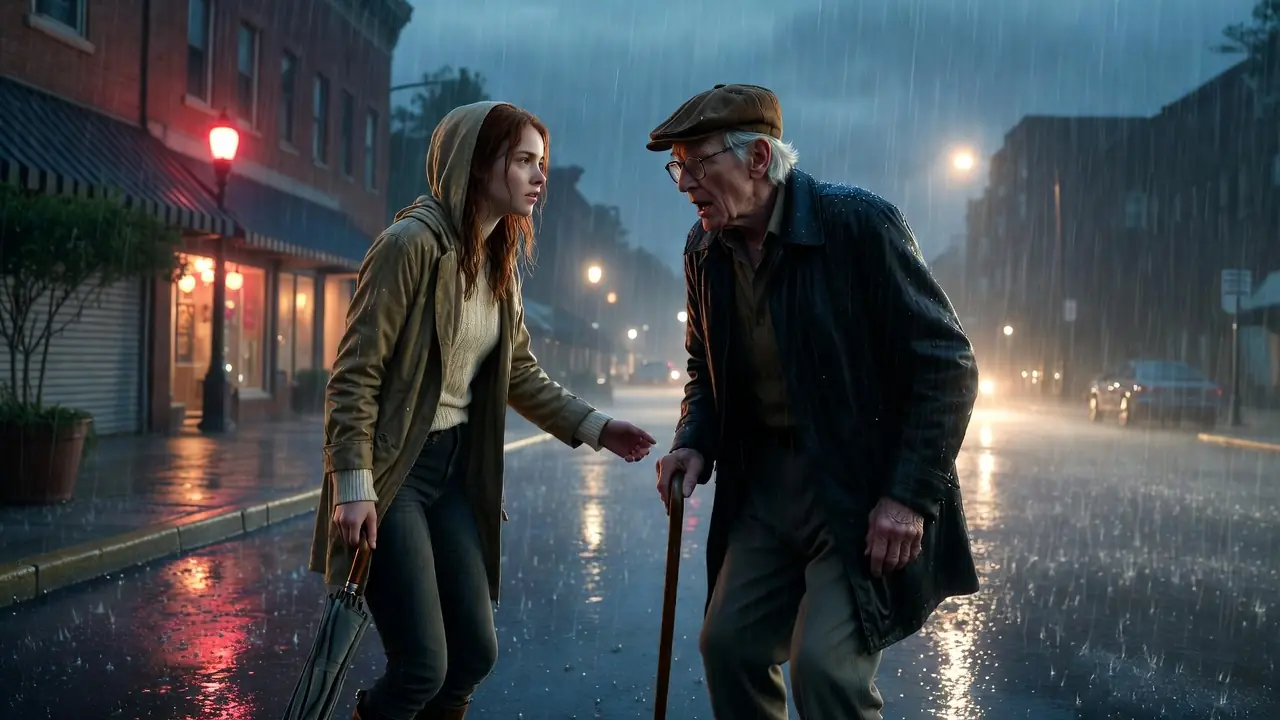
“I know, Dad.”
Lily stood near the kitchen doorway, ready to leave quietly.
But Claire turned toward her.
“You’re Lily?”
“Yes.”
“My father said you helped him.”
“He was caught in the storm,” Lily said.
Claire looked at Henry, then back at Lily.
“You got him home.”
Lily nodded.
Claire’s eyes filled.
“Thank you.”
Henry sat at the table and opened the leather pouch again.
“I brought them,” he said to Claire.
Claire’s face changed when she saw the letters and the watch.
“Mom’s things?”
“Yes.”
“I didn’t want to push you.”
“I know,” Henry said. “But you were right. We should talk about her.”
Claire sat beside him.
For the next few minutes, Lily watched them touch the letters carefully, as if handling pieces of a life that still breathed.
Then she slipped toward the door.
Henry noticed.
“Lily.”
She turned.
“Thank you,” he said. “For helping me arrive.”
Those words stayed with her all the way home.
The next morning, Henry came to the Cedar Creek Community Center.
Lily was setting up chairs in the main room when she saw him at the entrance. Claire stood beside him, one hand lightly on his arm.
Henry looked much better than the night before. Dry coat. Warm scarf. Steadier color in his face.
In his hands, he carried a small wooden box.
“I wanted to thank you properly,” he said.
“You didn’t have to come out.”
“I know. That is why I came.”
He placed the box on the table.
Inside was the silver wristwatch.
Lily stepped back at once.
“No,” she said. “I can’t take that.”
Henry smiled gently.
“I thought you might say that.”
“It was Margaret’s gift to you.”
“Yes. And now I want it to become a gift with another purpose.”
“I can’t.”
“You can,” Henry said. “The watch reminded me for years that time mattered. Yesterday, you reminded me that timing matters too.”
Lily’s eyes filled.
Henry picked up the watch.
“If you had passed by five minutes earlier, you would not have seen me. Five minutes later, I might have fallen. You arrived at the right time, and you chose to stop.”
Claire stood quietly beside him, crying softly.
Henry placed the watch in Lily’s hands.
“It is not valuable in money,” he said. “But it is valuable in meaning. Keep it as a reminder. When someone needs help, time is not small.”
Lily held the watch carefully.
The metal was cool against her palm.
“I don’t know what to say.”
“Say you will keep doing the work you are meant to do.”
She looked up.
Henry nodded toward the community center around them.
“Claire told me you want to start a storm safety program for seniors.”
Lily blinked.
Claire smiled faintly.
“You mentioned it last night when you thought Dad was asleep.”
Henry said, “I was not asleep. I was listening with my eyes closed.”
Despite the tears in the room, Lily laughed.
“I only have notes,” she said. “It’s not real yet.”
Henry reached into his coat pocket and pulled out an envelope.
“This may help.”
Inside was a letter.
He had written about the storm, the street, the crosswalk, the fear, and the way Lily had guided him home without making him feel helpless.
At the end, he wrote:
Lily Thompson understands that emergency help is not only about rescue. It is about preserving dignity in the moment when fear could take it away. She saw danger, acted quickly, and helped me reach my family safely.
Lily read it twice.
Her hands shook.
“This is for your grant applications,” Henry said.
Claire added, “And I know three families who would sign support letters. There are many seniors in this town who shouldn’t be walking alone during storms.”
That was the beginning.
Not the full program.
Not yet.
But the beginning.
Lily brought Henry’s letter to the community center director, Mrs. Lawson. She brought her notebook too, the one filled with ideas she had been afraid to show.
Storm check-in lists.
Volunteer walking escorts.
Emergency ride contacts.
Weather alerts for elderly residents.
Safe waiting spots downtown.
Reflective umbrellas.
Non-slip shoe covers.
A phone tree for families.
A small fund for emergency taxi rides.
Mrs. Lawson read everything carefully.
Then she looked up.
“You’ve been thinking about this for a long time.”
“Yes.”
“What made you bring it now?”
Lily touched the watch in her pocket.
“Because yesterday I realized five minutes can be the difference.”
Mrs. Lawson approved a small trial.
The program was called The Safe Passage Project.
At first, it was simple.
Ten volunteers.
A list of twenty elderly residents.
A phone tree before heavy rain or snow.
A few local businesses willing to act as safe waiting places.
The community center kept a small shelf with towels, umbrellas, tea, emergency contact cards, and reflective vests.
Henry became the first person on the list.
He hated that at first.
“I do not need watching,” he said.
Lily smiled.
“It’s not watching. It’s weather partnership.”
“That sounds invented.”
“It is.”
He sighed.
“Margaret would have liked it.”
“Then you have to like it too.”
“Dangerous logic.”
But he signed up.
The first storm after the program began, volunteers called every person on the list. Three needed help rescheduling errands. Two needed medicine picked up. One had gone downtown and needed a ride home before the rain worsened.
No one fell.
No one was stranded.
No one had to pretend they were fine.
The program grew.
The pharmacy joined.
The library joined.
Rose Street Café offered free tea to any senior waiting for a Safe Passage volunteer.
The hardware store donated salt buckets for icy sidewalks.
The local taxi company offered discounted emergency rides.
Claire helped design large-print cards that seniors could carry in their wallets:
If weather is bad and I seem unsafe, please call Safe Passage.
Henry carried his card proudly after the first month, though he insisted on calling it his “storm license.”
Whenever Lily visited, the watch was on her desk.
She did not wear it every day.
She kept it beside the program phone.
A reminder that when it rang, time mattered.
Years passed.
Safe Passage became one of Cedar Creek’s most trusted community programs. Lily eventually became its coordinator full-time. She trained volunteers to walk slowly, speak respectfully, never grab someone without asking, and understand that fear often hid behind pride.
She taught them what Henry had taught her.
A person could need help and still need dignity.
A person could be fragile in one moment and strong in many others.
A rescue should not make someone feel smaller than the danger already had.
Henry remained part of the program for years.
He came to volunteer meetings, telling new volunteers the story of the storm with more drama each time.
“The wind nearly carried me into the next county,” he would say.
Lily would roll her eyes.
“It did not.”
“It felt possible.”
Claire would laugh and say, “Let him have the story.”
Henry always ended the story the same way.
“She did not drag me home. She walked with me.”
That became the heart of Safe Passage.
Walk with.
Not drag.
Not command.
Not embarrass.
Walk with.
Henry grew older. His walks became shorter. Claire visited more often. The memory box of Margaret’s letters sat in their living room, and every year on Margaret’s birthday, they read one aloud.
One winter afternoon, Henry came to the community center carrying another small envelope.
Inside was a photograph of him and Margaret on their tenth anniversary.
He was wearing the watch.
She was laughing at something just outside the frame.
On the back, Henry had written:
She gave me time. You gave me more of it.
Lily cried when she read it.
Henry passed away peacefully two years later, in his own home, with Claire beside him and Margaret’s letters on the table nearby.
At his memorial gathering, Claire placed the memory box on a table beside a photograph of Henry and Margaret. The watch was not there.
It was with Lily, because Henry had insisted it remain where “someone might still need the reminder.”
After the gathering, Claire handed Lily one final note.
“My dad wrote this for you.”
Lily opened it with trembling hands.
Dear Lily,
The night of the storm, I thought I was only trying to get home.
But I was also trying to carry grief, pride, fear, and my wife’s memory through weather too strong for me.
You did not shame me for needing help.
You did not rush me.
You walked beside me until I could reach my door.
Then you built a way for others to reach theirs.
Keep answering when the weather gets loud.
With gratitude,
Henry Wallace
Lily framed the note at the Safe Passage office.
Years later, whenever people asked how the program began, she told them the truth.
“It began with an old man in a storm, a slippery crosswalk, and five minutes that could have changed everything.”
Then she would show them Henry’s watch.
The gift was small.
A watch.
A letter.
A photograph.
But inside those small things was the future Lily had been trying to build.
And every time the storm phone rang, every time a volunteer stepped out with an umbrella, every time an elderly person said, “I didn’t want to bother anyone,” Lily remembered Henry’s hand trembling on his cane.
She would answer gently.
“You’re not a bother. We’re here to walk with you.”
Because sometimes saving a life did not begin with sirens.
Sometimes it began with one person noticing another person struggling in the rain.
And stopping in time.