At twenty-four, Grace Bennett had learned that fear could fit inside a folder.
Most people thought fear looked loud.
They imagined screaming, crying, panic, or someone running for help.
But Grace knew fear could also look like an elderly woman standing frozen on a rainy sidewalk, staring at wet papers scattered in the gutter.
It could look like trembling hands.
It could look like a voice whispering, “Please, not those.”
Grace lived in a small town in North Carolina called Mapleford, where the streets were lined with old brick shops, dogwood trees, narrow sidewalks, and houses with front porches that creaked softly in the wind.
She was a young white American woman with fair skin, long chestnut-brown hair usually tied into a low ponytail, soft green eyes, and careful hands that were always ready to help before her mind had time to think too much about it.
Grace worked at Mapleford Community Clinic as a front-desk assistant.
Her job was not glamorous.
She checked patients in, answered phone calls, printed appointment forms, helped elderly visitors fill out insurance papers, scheduled follow-ups, found missing charts, and walked people to the right hallway when the clinic felt too confusing.
Some days, people were impatient.
Some days, people were scared.
Some days, people snapped at her because they had spent the whole morning trying not to cry.
Grace had learned not to take it personally.
The clinic was a place where people came carrying pain, worry, bills, test results, and questions they were afraid to ask.
Her dream was to become a patient advocate.
She wanted to help elderly patients understand medical instructions, organize documents, communicate with doctors, and make sure no one missed important care because paperwork was too confusing or because they felt too embarrassed to ask for help.
She had already given the dream a name.
The Clear Path Desk.
A small support program for seniors and families who needed help with appointments, medical papers, transportation notes, prescription lists, and family contact forms.
But dreams needed funding, approval, training, time, and someone willing to believe a young front-desk worker could build something meaningful.
Grace had a notebook full of ideas and not much else.
So she kept working at the clinic and helping one person at a time.
One rainy Monday afternoon in March, Grace left the clinic later than usual.
The sky had turned dark and heavy by four o’clock, and rain fell hard over Mapleford, striking the sidewalk in silver sheets and turning the gutters into small rushing streams.
Grace pulled her coat tight and held a folder of extra clinic flyers under one arm.
She was heading toward the bus stop when she heard a sharp gasp from across the street.
Then an elderly woman cried out.
“Oh no! Please, please, not the papers!”
Grace turned immediately.
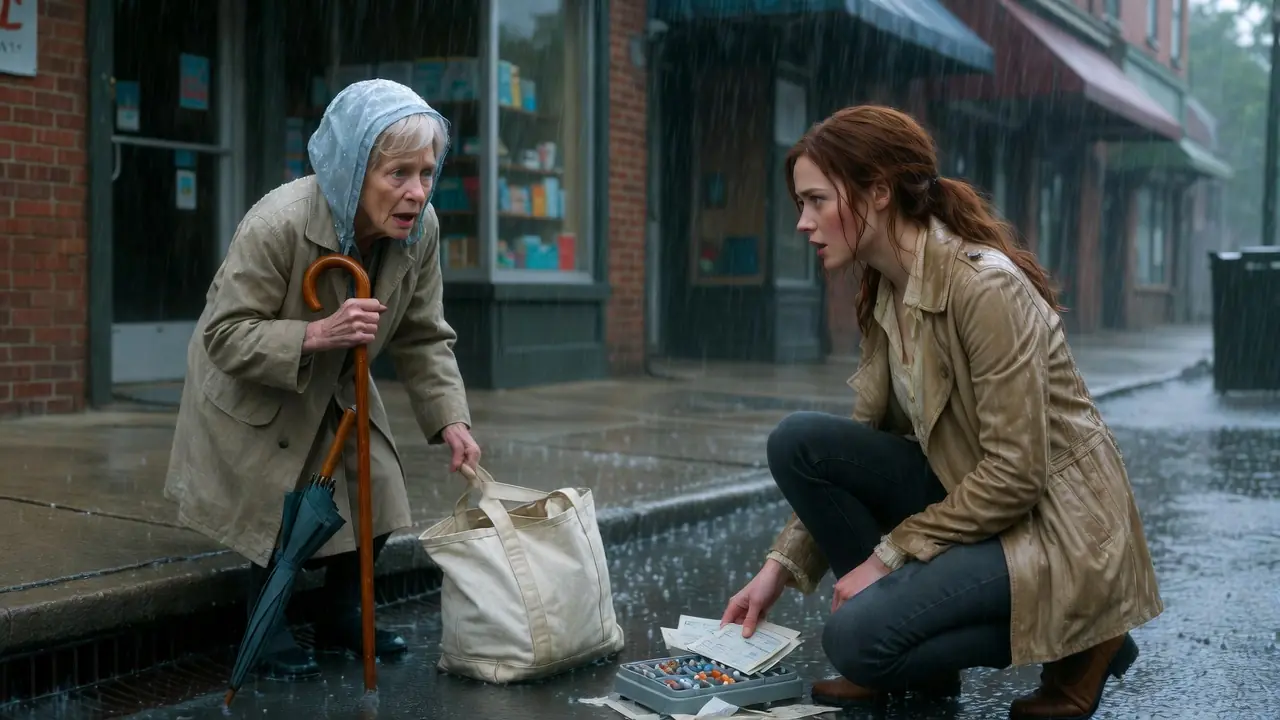
Near the pharmacy entrance, an elderly woman stood beside a tipped canvas tote bag.
She was a white American woman in her late seventies, short and thin, with silver hair tucked beneath a pale blue rain hood, pale skin, and frightened blue eyes behind rain-specked glasses.
She wore a beige coat, black shoes, and held a wooden cane in one trembling hand.
At her feet, the tote bag had fallen open.
A pill organizer had spilled across the sidewalk.
A small umbrella lay broken near the curb.
Several folded medical papers had blown loose in the rain.
Some were stuck to the wet pavement.
One page floated toward the storm drain.
Another slid into the gutter water.
The old woman tried to bend down, but her cane slipped.
Grace ran.
“Ma’am, don’t bend down. I’ll get them.”
She reached the first page just before the gutter carried it away.
Then she grabbed the page near the storm drain, pressing it carefully against her coat so the rain would not tear it.
She gathered the pill organizer, the broken umbrella, and the remaining papers from the sidewalk.
The old woman stood shaking so badly Grace worried she might fall.
“The appointment papers,” the woman whispered. “Are they ruined?”
Grace looked down.
The papers were wet at the corners, but the print was still readable.
“They’re wet, but not ruined,” she said gently. “We can save them.”
The woman closed her eyes.
For a moment, relief nearly made her knees buckle.
Grace stepped closer.
“Are you hurt?”
“No,” the woman said. “Only foolish.”
“You’re not foolish. Your bag tipped over in the rain.”
“I should have held it tighter.”
“The wind should have behaved better.”
The woman gave a tiny laugh, but tears still filled her eyes.
Grace looked at the papers.
There were appointment forms, a medication list, a doctor referral, insurance notes, and a handwritten letter from someone named Claire.
“What’s your name?” Grace asked.
“Margaret Ellis.”
“I’m Grace Bennett. I work at the clinic down the street.”
Margaret looked up quickly.
“The Mapleford Community Clinic?”
“Yes.”
“I was trying to get there.” Margaret’s voice trembled. “My appointment is at four-thirty. The pharmacy printed my medication list, and I had the referral paper, and the letter from my daughter. I can’t lose them.”
Grace checked her watch.
4:18.
The clinic was only two blocks away.
“You won’t miss it,” Grace said.
Margaret shook her head.
“I don’t walk fast.”
“That’s okay. We’re not going to run.”
“My daughter told me not to come alone, but she had work. I told her I could manage.” Margaret looked down at the wet papers. “I wanted to prove I could manage.”
Grace softened.
“I understand.”
Margaret’s lips trembled.
“No, dear. You’re young. You don’t.”
Grace did not argue.
She only said, “Maybe not fully. But I know you deserve help without feeling like you failed.”
Margaret looked at her.
The rain kept falling around them.
That sentence seemed to reach a place inside the old woman that had been bracing for shame.
Grace opened her coat and tucked the papers inside to protect them.
Then she placed the pill organizer and referral envelope into her own tote bag.
“Margaret, I’m taking you to the clinic.”
“Oh no, I don’t want to trouble you.”
“You’re already my clinic visitor,” Grace said. “I’m just starting customer service early.”
Margaret blinked.
Then she laughed softly.
“You sound very official.”
“I can be official when rain attacks paperwork.”
Grace offered her arm.
“May I walk beside you?”
Margaret hesitated, then took Grace’s arm carefully.
They moved slowly down the sidewalk.
Grace held her umbrella low over both of them, though it mostly protected Margaret. Rain soaked Grace’s shoulders and sleeves, but she barely noticed.
Margaret’s cane tapped against the pavement.
Every few steps, she apologized.
“I’m sorry I’m slow.”
“You’re not slow,” Grace said. “We’re moving at the correct speed for wet sidewalks.”
“I’m sorry about your coat.”
“It needed washing anyway.”
“I’m sorry about the papers.”
“The papers are safe.”
At the first corner, Margaret stopped and breathed heavily.
Grace paused with her.
“We can rest here for a moment.”
“I hate this,” Margaret whispered.
“The rain?”
“No.” Margaret looked at her own hands. “This. Needing someone. Forgetting what forms go where. Not understanding what doctors say. My daughter explains it, but I don’t want to keep asking the same questions.”
Grace’s chest tightened.
She had seen that look at the clinic so many times.
The look of a person who was not only sick or old, but overwhelmed by the system built around their care.
“You are not the only one who feels that way,” Grace said.
Margaret glanced at her.
“At the clinic?”
“Yes. Many people do.”
“They all look like they understand.”
“A lot of people look like they understand because they’re afraid to admit they don’t.”
Margaret stared at her.
Then she looked away, blinking back tears.
“That makes me feel less alone.”
“Good,” Grace said softly. “Because you’re not.”
They reached the clinic at 4:27.
Grace pushed open the front door, and warm air rushed around them.
The lobby smelled faintly of hand sanitizer, coffee, and rain-soaked coats.
A few patients sat in blue chairs near the wall.
Behind the desk, Grace’s coworker, Daniel, looked up in surprise.
“Grace? I thought you left.”
“Emergency paperwork rescue,” Grace said.
Daniel saw Margaret, the wet coat, the cane, and Grace’s soaked sleeves.
He nodded immediately.
“I’ll check her in.”
Grace guided Margaret to a chair near the desk.
Then she took the wet papers from inside her coat and laid them carefully on clean paper towels behind the counter.
She separated each page.
Appointment confirmation.
Medication list.
Referral form.
Insurance copy.
Daughter’s letter.
The letter had suffered the most.
One edge was damp, and the ink had blurred slightly, but the writing was still readable.
Margaret watched anxiously.
“That one,” she said. “That letter matters.”
Grace lifted it carefully.
“From Claire?”
Margaret nodded.
“My daughter couldn’t come, so she wrote down what I needed to ask the doctor. She said if I got nervous, I could hand him the letter.”
Grace looked at the page.
The handwriting was firm and loving.
Please ask about the dizziness.
Please review the new medication.
Please explain the test results slowly.
Please call me if Mom needs another appointment.
At the bottom, Claire had written:
Mom, you are not being difficult. You are allowed to ask.
Grace swallowed.
“She sounds like a good daughter.”
“She is,” Margaret said. “That is why I don’t want to worry her.”
“Good daughters worry anyway.”
Margaret smiled sadly.
“That is what she says.”
Grace copied the letter onto a fresh sheet so Margaret would have a clean version. Then she placed the original between dry paper towels.
She also printed a new medication list from the pharmacy notes Margaret had brought and placed all the papers into a plastic folder from the clinic supply drawer.
On the front, she wrote:
Margaret Ellis — Appointment Papers
Margaret watched her as if she were watching someone rebuild a bridge plank by plank.
“You made it organized,” Margaret whispered.
“That helps.”
“Yes,” Margaret said. “It helps very much.”
When the nurse called Margaret’s name, the old woman stood slowly.
Her hands still shook.
Grace noticed.
“Would you like me to walk you to the exam room?”
Margaret hesitated.
“I don’t want to be a bother.”
“You’re not.”
“Could you… maybe just tell them I get nervous?”
Grace smiled gently.
“Yes.”
She walked Margaret down the hallway and handed the plastic folder to the nurse.
“These are Mrs. Ellis’s appointment papers,” Grace said. “Her daughter also wrote questions for the doctor. Mrs. Ellis would appreciate it if the instructions could be explained slowly and printed clearly.”
The nurse nodded.
“Of course.”
Margaret looked at Grace with deep relief.
“Thank you.”
“I’ll be at the front desk when you’re done.”
The appointment lasted nearly an hour.
Grace stayed late.
She could have gone home, but she did not.
When Margaret came back into the lobby, her face looked tired but calmer. She held the plastic folder against her chest.
“The doctor explained it,” she said. “He changed one medicine and wrote it down. He said the dizziness might be from the old dosage.”
“That’s good.”
“He answered Claire’s questions.”
“Very good.”
Margaret looked down.
“I would have forgotten half of them without the letter.”
“That’s why letters help.”
Margaret’s eyes filled.
“And people.”
Grace smiled.
“And people.”
Grace helped Margaret call Claire from the clinic phone.
Claire answered immediately.
“Mom?”
“Claire, it’s Grace Bennett from Mapleford Community Clinic. Your mother is here with me. She’s safe. She made it to her appointment.”
“Oh, thank God,” Claire said, her voice breaking. “She wasn’t answering her phone.”
“Her bag tipped over in the rain, but we got her papers saved. She’s okay.”
Margaret took the phone.
“Claire, I’m all right. A young woman helped me. No, don’t cry. I asked the questions. Yes, all of them.”
Grace looked away to give her privacy.
But she heard Margaret’s voice soften.
“You were right. I was allowed to ask.”
After the call, Grace arranged a taxi through the clinic’s senior ride list because the rain had not stopped.
She waited with Margaret until the car arrived.
At the door, Margaret took Grace’s hand.
“You did not make me feel helpless.”
Grace squeezed her hand gently.
“You weren’t helpless. You were carrying too much in the rain.”
Margaret nodded.
“That sounds kinder.”
“It is also true.”
The taxi took Margaret home.
Grace watched until the taillights disappeared into the wet street.
She thought that would be the end.
It was not.
The next week, Margaret returned to the clinic.
This time, she came with her daughter, Claire.
Claire was in her late forties, with tired blue eyes, dark-blonde hair pulled into a bun, and a face that looked as if worry had been living there for years.
She walked straight to the front desk.
“Are you Grace?”
“Yes.”
Claire reached across the counter and took both of Grace’s hands.
“Thank you for helping my mother.”
Grace smiled softly.
“I’m glad I was there.”
“She told me you saved the letter.”
“The rain tried to steal it.”
Claire laughed through tears.
“She said you made her feel brave enough to ask the doctor questions.”
Grace looked toward Margaret, who was pretending to examine the pamphlets near the wall.
“She already had the questions. She just needed them protected.”
Claire’s eyes filled again.
“That means more than you know.”
After that, Margaret became one of Grace’s favorite clinic visitors.
Every appointment, she brought her plastic folder.
Inside were medication lists, doctor notes, questions from Claire, and a small notebook Grace had given her labeled:
Things I Am Allowed To Ask
Margaret loved that notebook.
She wrote in it carefully.
Why am I taking this pill?
Should I eat before this medicine?
What does this test mean?
Can Claire get a copy?
Please explain again.
The last one made Grace smile every time.
Margaret began telling other seniors in the waiting room about it.
“You are allowed to ask,” she would say. “Even twice. Even three times if the doctor talks like a speeding train.”
Some laughed.
Some nodded.
Some quietly asked Grace if they could have a notebook too.
Grace started keeping a small stack at the front desk.
Then she printed simple question sheets.
Then medication list templates.
Then emergency contact forms.
She did not call it a program yet.
She just helped.
But the need grew quickly.
One elderly man came in with three prescription bottles and no idea which one had been changed.
A widow came with a lab report she had been too frightened to open.
A retired teacher brought her son on speakerphone so Grace could help write down the doctor’s instructions.
A man caring for his wife asked if there was a way to keep all her appointment papers in one place.
Grace began staying after work to organize packets.
Daniel teased her gently.
“You’re building something.”
“I’m just making folders.”
“Folders with a mission.”
Grace smiled.
He was right.
The Clear Path Desk was beginning.
Not officially.
Not yet.
But in practice.
One afternoon, Margaret arrived with a small gift bag.
Inside was a fountain pen.
It was navy blue with a silver clip, worn smooth near the grip.
Grace stared at it.
“It’s beautiful.”
“It was my husband’s,” Margaret said.
Grace looked up quickly.
“Margaret, no.”
“Yes.”
“I can’t take that.”
“You can.”
“It belonged to your husband.”
“And he would want it used.”
“What was his name?”
“Thomas,” Margaret said softly. “He kept records for a small insurance office for forty years. He believed anything important should be written clearly, because confusion costs people more than money.”
Grace held the pen carefully.
“That sounds like something I should write down.”
Margaret smiled.
“You will. With his pen.”
“I really can’t—”
Margaret interrupted gently.
“Grace, you saved my daughter’s letter. You saved my appointment. You saved me from pretending I understood things I did not understand.”
Her voice trembled.
“Thomas used this pen to make things clear. Now I want you to use it for the same purpose.”
Grace’s eyes filled.
Margaret also handed her an envelope.
Inside was a letter of recommendation addressed to the clinic director and the Mapleford Community Health Fund.
Margaret had written about the rainy sidewalk, the scattered medical papers, the appointment questions, and the small notebooks Grace had begun giving patients.
At the end, she wrote:
Grace Bennett understands that medical care does not end with the doctor’s words. It must be understood, organized, and carried home. She helps people find dignity in the middle of confusion.
Grace cried in the supply room after reading it.
The next day, she brought her Clear Path Desk notebook to the clinic director, Mrs. Lawson.
Her hands shook as she placed the notebook on the desk.
“I have an idea,” she said.
Mrs. Lawson looked at the notebook, then at Grace.
“I thought you might.”
Grace explained everything.
A front-desk support program for elderly patients.
Appointment folders.
Medication lists.
Question sheets.
Family contact forms.
Printed doctor instructions.
Follow-up call reminders.
A small table in the clinic lobby where patients could organize papers before and after appointments.
Training for volunteers to help without giving medical advice.
Mrs. Lawson listened carefully.
Then she read Margaret’s letter.
When she finished, she looked up.
“This is not a small idea.”
Grace swallowed.
“I know.”
“It is also very needed.”
The clinic approved a three-month pilot.
They called it The Clear Path Desk.
At first, it was only open two afternoons a week.
Grace sat at a small table in the lobby with folders, pens, forms, plastic sleeves, and notebooks labeled:
Things I Am Allowed To Ask
Patients came slowly at first.
Then steadily.
An elderly man needed help listing his medications before a cardiology visit.
A woman wanted her daughter added as a contact.
A couple needed help understanding which papers to bring to a specialist.
A widower needed someone to write down his questions because his hands shook.
Grace never gave medical advice.
She did something simpler and deeply necessary.
She helped people prepare.
She helped them ask.
She helped them remember.
She helped them carry the appointment home.
Margaret became the program’s first volunteer, though she insisted she was only there to “keep people from acting brave in foolish ways.”
Her name tag read:
Margaret Ellis
Allowed To Ask
She wore it proudly.
Claire helped design large-print forms.
Daniel helped organize the file cabinet.
The nurses began sending patients to the desk before appointments.
Doctors noticed patients asking clearer questions.
Families noticed fewer missed instructions.
The clinic noticed fewer confused follow-up calls.
The pilot worked.
With Margaret’s letter, patient feedback, and support from the clinic director, Grace applied for the Mapleford Community Health Fund grant.
She won.
Not a fortune.
Not a new building.
Not a sudden career handed to her.
But enough to buy a proper desk, printing supplies, folders, large-print forms, translation cards, volunteer badges, a dedicated phone line, and training materials.
The Clear Path Desk became official.
Grace became its coordinator.
For the first time, her dream had a chair, a sign, and a place in the clinic.
Years passed.
The Clear Path Desk grew beyond Mapleford Community Clinic.
Other clinics called Grace to ask how it worked. Senior centers invited her to teach workshops. Pharmacies asked for medication list templates. Families sent thank-you notes. Patients brought cookies, flowers, and sometimes simply tears.
Grace eventually completed training in patient advocacy.
She never became rich.
But she became the person many families called when medical instructions became too heavy to carry alone.
Margaret continued visiting as long as her health allowed.
Some days, she came for appointments.
Some days, she came to volunteer.
Some days, she sat near the desk and told nervous patients, “Write it down, dear. Doctors are clever, but paper is patient.”
Grace wrote that down too.
Thomas’s pen stayed at the Clear Path Desk.
Grace used it only for special moments.
The first question sheet of a new patient.
A letter to a family.
A grant signature.
A note to someone afraid to ask.
One spring afternoon, Margaret came to the clinic with Claire.
She moved more slowly now, but her eyes were bright.
She brought a small framed copy of the original letter Claire had written for her appointment years before.
At the bottom, Margaret had added one sentence in her own handwriting:
This letter taught me I was allowed to ask.
Grace placed it beside the Clear Path Desk sign.
Margaret passed away peacefully the following winter.
At her memorial gathering, Claire displayed the plastic folder Grace had made on that rainy day. Inside were old appointment papers, question sheets, medication lists, and the first notebook labeled Things I Am Allowed To Ask.
After the gathering, Claire handed Grace an envelope.
“Mom wanted you to have this.”
Inside was a note written in Margaret’s careful handwriting.
Dear Grace,
The day my papers fell into the rain, I thought I had lost more than forms.
I thought I had lost my courage.
You ran into the storm, saved the papers, walked me to the clinic, and helped me ask the questions I was afraid to ask.
Then you built a desk where others could find their courage too.
Keep making things clear.
With love,
Margaret Ellis
Grace framed the note beside Thomas’s pen.
Years later, whenever people asked how The Clear Path Desk began, Grace told them the truth.
“It began with an old woman in the rain, a tipped tote bag, and medical papers almost washed into a storm drain.”
Then she would show them Thomas’s navy-blue pen.
The gift was small.
A pen.
A letter.
A plastic folder saved from the rain.
But inside those small things was the future Grace had been trying to build.
And every time an elderly patient sat across from her and whispered, “I don’t want to bother the doctor,” Grace gently slid a notebook across the desk.
On the cover, it said:
Things I Am Allowed To Ask.
Then Grace would smile and say, “Let’s write it down together.”