At 10:30 on a Saturday morning, every sound in Riverside Cafe stopped.
Forks froze midair. Coffee stopped pouring. Conversations died mid-sentence because the man walking through that door was impossible.
He wore a charcoal suit that cost more than most people made in a year.
Two assistants in sharp suits flanked him. Security stood behind them. Every head in the packed diner turned in perfect unison.
A customer whispered, "That is Arthur Brennan, the billionaire."
Emily Hayes stood at table seven holding a coffee pot, her body frozen.
Twenty-four hours earlier, she had given this stranger her only coat in a blizzard. She had walked him fifteen blocks through sub-zero temperatures. Then she had gone home alone, shivering, certain she would never see him again.
She was wrong.
What happened next did not just change her life. It changed an entire neighborhood.
But first, she had to survive the worst night of her life.
Friday morning, 5:30 a.m.
Emily Hayes had exactly $163 to her name.
In three days, her rent was due. She needed $420.
The alarm clock rattled on the milk crate beside her mattress. She slapped it silent and stared at the cracked ceiling of her studio apartment.
The radiator clanged but produced no heat. Her breath made small clouds in the cold air.
She pulled herself up, wrapped a thin blanket around her shoulders, and shuffled to the corner that served as her kitchen.
One hot plate. A plastic electric kettle with a frayed cord she had taped together three times.
The instant coffee jar was nearly empty. She had been stretching the same grounds for three days now, adding just a pinch of fresh to the used ones. The coffee tasted like brown water, but it was warm.
She poured a small amount of oatmeal into a bowl, half a serving. She would eat the rest tomorrow.
While the oatmeal cooked, she examined her work shoes.
The sole had separated from the leather on the right one. She grabbed the duct tape from under the sink and wrapped it carefully around the shoe, pressing hard to make it stick.
These shoes had to last another month.
She could not afford new ones.
Emily stood in front of the cracked mirror by the door and practiced her smile.
Waitresses who smiled earned better tips. She had read that somewhere, and in her two years at Riverside Cafe, she had found it to be true.
Her reflection looked tired. Her fair skin looked pale in the weak morning light, and gray hairs were coming in at her temples.
She was only thirty-four, but life had a way of aging you fast.
She pulled her light brown hair back into a neat ponytail and reached for the coat hanging on the hook.
The burgundy wool coat.
Her mother's coat.
Emily ran her fingers over the fabric. Real wool, with a satin lining that still held the faintest scent of her mother's perfume.
White Diamonds. Cheap drugstore perfume.
But to Emily, it smelled like home.
Her mother had died two years ago. Breast cancer, stage four. By the time they caught it, the hospital bills had been crushing.
Emily had worked double shifts for eighteen months to pay them off. She had sold everything. Her mother's furniture, her jewelry, her car, everything except this coat.
This coat was all she had left.
She put it on carefully, buttoning it against the cold, and headed out into the pre-dawn darkness.
The bus ride to work required two transfers. Emily could not afford the direct route. It cost an extra $1.50 each way. Three dollars a day added up over a month.
She sat by the window and watched the city change as the bus moved through different neighborhoods.
First, the run-down apartment complexes like hers, then the gentrified blocks with coffee shops that charged six dollars for a latte. Finally, the tree-lined streets with brownstones that cost more than she would earn in a lifetime.
A woman in a camel-hair coat sat across from her, scrolling through her phone. The coat looked soft, expensive, probably cashmere.
Emily did the math automatically.
That coat cost more than three months of her wages.
She looked away and noticed the community center passing by her window.
She volunteered there on Sundays, teaching kids to read. It was the one thing she did that had nothing to do with money or survival. It was the thing that made her feel like her mother's daughter.
As the bus turned onto Market Street, she saw Mrs. Lane's apartment building. Another eviction notice on the door. The third one on her floor this month.
Rent was going up everywhere. Landlords were selling to developers. People were being pushed out.
Emily knew she might be next.
Riverside Cafe sat on the corner of Market and Ninth, a neighborhood institution for forty years. The vinyl booths were patched with duct tape. The floors were scuffed. The neon sign out front flickered on the second E in Cafe, but it was clean.
The food was good, and the people were family.
Dmitri Paulus, the owner, was already in the kitchen when Emily arrived.
He was sixty-seven, a Greek immigrant who had bought the place in 1985 with his life savings.
She hung her coat in the small staff closet and called out, "Morning, Dmitri."
"Morning, korítsi mou," he replied, his accent still thick after forty years in America. "You look tired."
"I am fine."
She was not fine.
But Dmitri had his own problems.
In her locker, Emily kept a small photograph taped to the inside of the door. Her and her mother at her high school graduation fifteen years ago. They were both wearing the burgundy coat in the picture, squeezed together to fit in the frame, laughing.
Her mother's arm was around her shoulders. Her smile was wide and proud.
Emily touched the photo gently, then closed the locker.
She tied on her apron, clipped on her name tag, scratched and faded from years of washing, and headed to the floor.
Maria Rodriguez was already setting up tables. Single mother of two, working the morning shift so she could pick her kids up from school. She and Emily had become close over the years.
"Girl, you look exhausted," Maria said.
"Did not sleep great."
"Have you ever slept great?"
Emily smiled. "Not lately."
Tommy Bennett came through the back door, still half asleep. Nineteen years old, community college student, working his way through school one breakfast shift at a time.
Emily had taken him under her wing when he started six months ago. Taught him how to balance plates, how to read customers, how to smile even when you wanted to scream.
The morning rush started at seven.
Emily knew every regular's order by heart.
Mr. Patterson, two eggs over easy, white toast, coffee, black.
Mrs. Williams, oatmeal with brown sugar, hot tea.
The construction crew from the site down the block, six orders of the breakfast special, extra hash browns.
She moved through the routine on autopilot, her mind running numbers.
Rent, $420.
Current money, $163.
Shortfall, $257.
If she got good tips today and tomorrow, worked a double on Sunday, maybe she could cover it.
Maybe.
At 11:30, during a brief lull, Dmitri called her into the kitchen. His face was drawn, worried.
"Emily, I need to tell you something," he said quietly. "But not today. Tomorrow. I am having a meeting with the staff tomorrow morning."
"Dmitri, what is wrong?"
"Tomorrow," he said. "I promise."
A customer called for more coffee. Emily grabbed the pot and headed back to the floor, Dmitri's worried face lingering in her mind.
She thought Friday night would be quiet.
She thought she would close up, catch the last bus home, and wake up to another day of barely surviving.
She had no idea that in nine hours, everything would change.
At 9:47 p.m., the blizzard warning flashed across every phone in the diner.
By 10:15, the streets were empty except for one man.
The dinner rush had been steady, but not great. Tips were lower than Emily had hoped. She had made $63.
Still not enough.
The TV mounted in the corner showed the weather forecast. A major winter storm was moving in faster than predicted.
The meteorologist pointed to the radar, her face serious.
Temperatures would drop to twelve degrees Fahrenheit within the hour. Wind chill would push it below zero. Authorities urged everyone to seek shelter immediately. Exposure could cause hypothermia in under twenty minutes.
Customers started asking for checks.
Maria wiped down her last table and grabbed her coat.
"Emily, I have to go. Babysitter just texted. She is freaking out about getting home."
"Go," Emily said. "I will close."
"You sure?"
"I need the extra hour anyway."
Every hour meant another twelve dollars.
Maria squeezed her arm.
"Be safe, okay? Last bus is at 11:30."
By 10:30, the last customer had left.
Wind rattled the windows. Ice formed in the corners of the glass. Emily could see snow coming down in thick sheets, street lights barely visible.
Dmitri had left her the keys with strict instructions.
Lock up by midnight.
Be careful going home.
She started closing. Wipe tables. Stack chairs. Count the register. Sweep.
She had done this hundreds of times.
The radiator clanked, fighting to keep the old building warm. Outside, the wind screamed.
Emily glanced at the clock.
10:43 p.m.
She could finish by 11:15. Catch the last bus with time to spare.
Then she saw him.
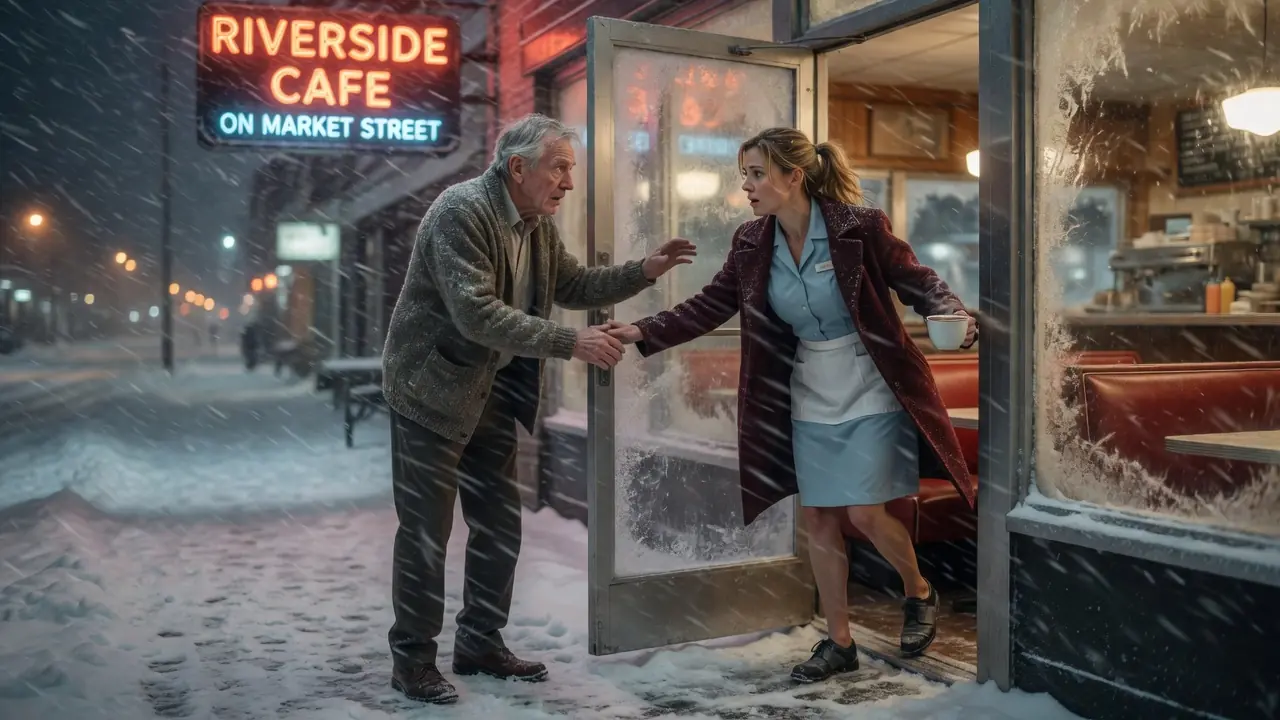
Through the frosted window, a figure moved on the sidewalk.
Emily stopped sweeping and walked closer.
A man, older, maybe seventy, white, with silver hair. He wore wool slacks and a thin cardigan sweater, leather dress shoes, no coat, no hat, no gloves.
He stood in the middle of the sidewalk, turning in slow circles like he was looking for something. His shoulders hunched against the wind.
Even from inside, she could see him shivering.
She watched, her hand on the broom.
He was not asking to come in. He was not knocking. He was just standing there, patting his pockets over and over, his face confused.
The wind picked up. Snow swirled around him.
He stumbled, then caught himself.
Emily looked at the clock.
10:47 p.m.
Forty-three minutes until the last bus.
She should finish and go.
This was not her problem.
But her mother's voice echoed in her head.
"Baby, we do not have much, but we have enough to share."
Emily set down the broom.
She walked to the door and tapped on the glass. The old man turned, squinting through the snow. She gestured for him to come inside.
He hesitated, then slowly made his way to the door.
She unlocked it and pulled it open.
Arctic air hit her face.
The man stumbled inside. She quickly locked the door behind him.
Up close, she could see how bad it was. His lips had a bluish tint. His hands shook violently. His thin cardigan was dusted with snow, already melting. He looked disoriented, eyes unfocused.
"Sir, are you okay?"
Emily guided him to the nearest booth.
"Sit down. Let me get you some coffee."
He sank into the seat, trembling.
Emily rushed behind the counter and poured hot coffee. She brought it with sugar packets and creamer.
"Here, drink this slowly."
His hands shook so badly he could barely hold the cup. She steadied it, helping him bring it to his lips.
He took a small sip, then another.
Slowly, color started returning to his face.
"Thank you," he said, his voice weak. "I seem to have gotten turned around."
"Where are you trying to go?"
He looked at her blankly.
"I am not entirely sure. I was walking, and then..."
He trailed off, brow furrowed.
"I cannot quite remember."
Emily pulled out her phone.
"Do you have someone I can call?"
He patted his pockets.
"I do not have my phone. I do not..."
He looked at his hands like they belonged to someone else.
"I do not know where my wallet is."
She dialed 911.
The dispatcher answered after four rings.
"911. What is your emergency?"
"I have an elderly man who seems disoriented. He has been outside in the cold."
"What is your location?"
"Riverside Cafe, Market and Ninth."
Typing on the other end.
"Ma'am, we are experiencing high call volume due to the weather. All units are responding to emergencies. Wait time is approximately two hours."
"Two hours?"
"Keep him warm. We will get someone there as soon as possible."
The line clicked off.
Emily called the nearest shelter. Full.
Another shelter. Also full.
She looked at the old man.
He was warming up, but he still looked fragile, lost.
She noticed his watch, expensive, Swiss-made, leather band worn soft from years. On his right hand, a signet ring with an intricate crest. His cardigan was thin but high quality, cashmere, maybe.
This was a man who had money, who had a home somewhere.
But right now, he had nothing.
"Do you know where you live?" she asked gently.
He closed his eyes, concentrating.
"East, I think. A few blocks east."
Emily knew that neighborhood. Brownstones, wealthy families.
In good weather, fifteen minutes.
In this blizzard, impossible.
Her phone buzzed.
11:14 p.m.
Last bus in sixteen minutes.
She looked at the coat hanging by the door, her mother's burgundy wool coat.
Then she looked at him.
What Emily did next broke every rule of self-preservation she had ever learned.
But some things matter more than survival.
She stared at the coat on the hook.
Three miles home.
Twelve degrees.
Wind chill below zero.
She was already fighting off a cold. If she got sick, she would miss work. If she missed work, she would lose everything.
But this man was seventy years old, frail, confused. He would not last twenty minutes out there.
Emily walked to the kitchen and found crackers and soup packets. She heated water and brought him instant chicken noodle soup.
He wrapped his shaking hands around it gratefully.
"What is your name?" she asked, sitting across from him.
"Arthur," he said slowly, like he was making sure it was correct.
"I am Emily Hayes."
"Miss Hayes."
He met her eyes. Even confused, there was clarity in his gaze, a dignity.
"I will not forget this. I will not forget you."
Something about the way he said it made her pause.
It was not just gratitude.
It sounded like a promise.
She glanced at the clock.
11:19 p.m.
Eleven minutes until the last bus.
"Arthur, I need to get you somewhere safe. Do you remember your address?"
He frowned, concentrating.
"Brownstone. Red door. There is a gate. Iron gate."
"That is the neighborhood east of here. Can you make it if I help you?"
He started to stand, then wobbled.
She caught his arm.
"I can try."
Emily looked at him. Really looked at him, in his expensive watch and cashmere cardigan, shivering in her worn booth.
She thought about her mother.
Diane Hayes had been a nurse for twenty-three years. Worked double shifts. Stayed late with patients who had no one. Gave her lunch to families who could not afford the cafeteria.
"We do not have much, baby, but we have enough to share."
Emily stood and walked to the coat hook.
She took down the burgundy wool coat.
The weight felt heavier than usual.
She brought it to her face and breathed in. The faint scent of White Diamonds perfume. Her mother's scent.
This coat had kept her mother warm through twenty winters. Had wrapped around Emily at her high school graduation. Had been the backdrop of a thousand memories.
It was all she had left.
She walked back to Arthur and draped it over his shoulders.
"Wait," he said. "I cannot take your coat."
"Yes, you can."
She buttoned it for him, fingers moving quickly.
"This was my mama's. It is warm, real wool."
"But you will freeze."
"I am young. I move fast. I will be fine."
She was not sure that was true, but she said it anyway.
She grabbed her thin apron from behind the counter and tied it around her waist for an extra layer, then pulled up the hood of her work uniform.
It was not much, but it was something.
Arthur stood slowly, the coat hanging large on his thin frame.
She grabbed his arm.
"Come on. Let us get you home."
The moment she opened the door, the cold hit like a physical blow.
Wind sliced through her uniform. Ice pellets stung her face. She gasped, and frigid air burned her lungs.
Arthur stumbled on the first step. She caught him, steadied him.
"Slow and steady. Just lean on me."
They moved into the storm.
Within seconds, Emily could not feel her hands.
The wind screamed. Visibility dropped to almost nothing. She could barely see ten feet ahead.
She locked her arm through Arthur's and pulled him close.
He moved slowly, each step deliberate. She matched his pace, even though every instinct screamed at her to run.
The cold was brutal. It found every gap in her clothes. Her uniform dress froze against her legs. Her feet went numb in her duct-taped shoes.
She started shivering violently.
"East," she muttered. "Just keep going east."
Arthur's weight pressed against her.
They passed a closed bodega, a dark laundromat. Everything was shut down against the storm.
"I am sorry," Arthur said, words barely audible. "I am slowing you down."
"Do not be sorry. Just keep moving."
Her teeth chattered so hard she could barely speak.
The cold was worse than she had imagined. Her lungs burned. Ice formed on her eyelashes.
They had been walking for ten minutes.
It felt like an hour.
"Tell me about yourself," Arthur said suddenly.
"Not much to tell. I work at the diner. Volunteer on Sundays. That is about it."
"The coat? You said it was your mother's?"
"Yes. She died two years ago. Cancer."
"I am sorry."
"She was a nurse. Worked at Jefferson Memorial for twenty-three years. She loved taking care of people."
Emily did not know why she was telling him this.
Maybe talking kept her mind off the cold. Maybe she needed to remember why she was doing this.
"She sounds like a remarkable woman," Arthur said.
"She was."
They turned a corner, and the wind hit them full force.
Emily's legs almost gave out. She grabbed a lamp post to steady herself.
Arthur held on to her.
"How much farther?"
"I think two more blocks."
Two blocks.
She could do two blocks.
They pushed forward.
Emily's whole body shook. Her fingers were completely numb. She could not feel her toes. The cold had seeped into her bones.
But Arthur was still moving, still breathing.
The coat was keeping him alive.
Finally, she saw them.
The brownstones. Beautiful historic homes with pristine stoops and ornate railings.
Even through the snow, she could see the difference.
This was old money. Real wealth.
"Which one?" she shouted.
Arthur pointed halfway down the block.
Red door. Iron gate. Just like he had said.
They stumbled up to it.
Arthur fumbled at the security panel, fingers too cold to work. Emily helped him, pressing the buttons he indicated.
The gate buzzed and clicked open.
Warm light spilled from the windows. Beautiful furniture inside. Artwork on the walls.
This house was worth more than she would make in ten lifetimes.
"I can get in from here," Arthur said.
He started to take off the coat.
"Please take this back."
"No."
Emily backed away.
"Keep it. Get inside. Get warm. Promise me you will stay inside."
"How can I repay you? Let me at least call you a car."
"No need. Just pay it forward someday. Help someone else."
"Wait, I do not even know your last name. How can I find you?"
"It is better this way. Just be safe, okay?"
She turned and started walking before he could protest, before she could change her mind.
The walk home was the longest three miles of her life.
Without the coat, the cold was merciless. She ran when she could, but her legs were weak. She ducked into doorways when the wind got too strong. Wrapped her arms around herself. Thought about her mother.
"You did right, baby."
Her mother's voice, clear as day.
"You did right."
By the time she reached her apartment, it was past midnight.
She was hypothermic, shaking uncontrollably. Her lips were blue. She could barely get her key in the lock.
She stumbled inside and went straight to the shower, turned it as hot as she could stand, and sat under it fully clothed until the shaking stopped.
She made the last packet of hot cocoa, wrapped herself in every blanket she owned, and crawled into bed.
Her last thought before sleep was simple.
I hope he is okay.
I hope that coat keeps him warm.
She did not think she would ever see him again.
She was wrong.
But first, everything had to fall apart.
Saturday, 6:00 a.m.
Emily woke to three missed calls and a text.
Emergency. Need you at diner now. Dmitri.
Her head pounded. Her throat felt like sandpaper. Every muscle ached.
She tried to sit up and immediately started coughing. Deep, rattling coughs that shook her chest.
Fever.
She had a fever.
She checked her phone.
Eight degrees outside.
The blizzard had passed, but the cold remained.
Emily dragged herself to the bathroom.
Her reflection looked terrible. Dark circles. Pale skin.
She touched her forehead. Burning hot.
She opened the medicine cabinet. Two Tylenol left. She could not afford more until payday.
She swallowed them dry and leaned against the sink, waiting for the room to stop spinning.
Her phone buzzed.
Dmitri: Please hurry. Important.
She looked at the empty hook where her coat should be.
The apartment felt colder without it.
She went to the donation bin in her building and found a threadbare gray hoodie. It smelled like mothballs, but it was better than nothing.
The bus ride felt endless.
Emily kept her eyes closed, trying not to throw up. Her body alternated between chills and sweats.
She should be home in bed, but Dmitri sounded desperate.
When she walked into Riverside Cafe at 7:15 a.m., Dmitri sat at a corner booth with papers spread across the table. His head was in his hands.
Maria was there too, eyes red.
Emily's heart sank.
"What is going on?"
Dmitri looked up. His face was drawn, aged ten years overnight.
"Sit down."
She slid into the booth. Maria squeezed her hand.
Dmitri pushed a document toward her.
Official letterhead. Legal language.
"The building has been sold. New owner is tripling the rent starting next month."
Emily's head snapped up.
"Tripling?"
"Or we can buy the building. $480,000. Thirty days to decide."
The number hung in the air like a death sentence.
"I went to three banks yesterday," Dmitri continued. "They all said no. My credit is not good enough. I am too old. The neighborhood is too risky."
He laughed bitterly.
"Forty years here, and now it is over."
Maria wiped her eyes.
"I started looking for other jobs. Nothing has hours like this. Nothing lets me pick up my kids."
Emily felt the room tilt.
Not the diner.
Not their home.
"What about Tommy?" she asked.
"I called him this morning. Told him to start looking too."
They sat in silence.
Outside, people walked past bundled in warm coats. Life going on like normal while their world fell apart.
"If you know anyone," Dmitri said, "anyone with money, anyone who might invest..."
She thought of Arthur. The expensive watch. The brownstone.
He clearly had money.
But she had no way to contact him. She did not even know his last name.
And even if she could, she would not ask.
That was not why she had helped him.
"I do not know anyone like that," she said quietly.
Dmitri nodded.
"I did not think so, but I had to ask."
They would all start looking for new jobs.
Give it one month.
Hope for a miracle that would not come.
Emily worked her shift in a fog.
The fever made everything feel distant. She kept coughing. Had to step into the back.
By noon, Dmitri sent her home.
"You are sick. Go rest."
She took the bus back and crawled into bed.
She slept through Saturday and all day Sunday.
Monday morning, there was a notice under her door.
Eviction warning.
Pay full rent by Friday or proceedings would begin.
She counted her money.
$163 total.
She needed $420.
Short by $257.
Even working every shift this week, she would not make it.
Emily sat on her mattress and did the math.
No matter how she calculated it, the numbers did not work.
The diner was closing. She was getting evicted. She was sick and could not afford medicine.
Should she have kept the coat? Asked Arthur for help?
No.
She had made the right choice.
Her mother would have done the same.
But knowing you did the right thing did not keep you warm, did not pay rent, did not save your job.
Tuesday morning, Emily dragged herself back to work.
Maria burst through the kitchen doors at 9:15 a.m., phone in hand, eyes wide.
"Emily, you need to see this."
Maria shoved her phone in Emily's face.
A news article from Saturday morning filled the screen.
Headline: City philanthropist Arthur Brennan found safe after blizzard disappearance.
Emily's breath caught.
There was a photo.
The old man.
Her old man.
But he looked completely different. Professional headshot, confident smile, expensive suit.
"That is him," she whispered. "That is him."
Maria's voice rose.
"Do you know who he is?"
Emily scanned the article.
Arthur Brennan, seventy-two, prominent investor and philanthropist, went missing Friday evening during a medical episode related to early Alzheimer's, wandered from his residence, found safe at home around 11 p.m.
Family statement: We are grateful to the anonymous good Samaritan who helped Mr. Brennan.
The article continued.
Brennan is reportedly searching for the person who assisted him to express his gratitude.
"Emily."
Maria grabbed her shoulders.
"Arthur Brennan. He is worth like half a billion dollars."
Half a billion.
The number did not seem real.
"I just wanted him to get home safe," Emily said.
"And you gave him your mama's coat."
"He needed it more than me."
Maria stared at her.
"Girl, he could have bought you a hundred coats."
"That is not why I did it."
Tommy appeared from the kitchen.
"Yo, some lady came in yesterday asking about you."
Emily's stomach dropped.
"What?"
"Professional woman, suit, briefcase. Asked Dmitri about the night-shift waitress from Friday. He did not give your name. She left a business card, but he cannot find it now."
Emily felt uneasy.
"He did not tell her anything?"
"Just that someone closed that night. That is it."
Wednesday, Tommy mentioned something else.
"That black town car is still out there."
"What car?"
"Parked across the street. Been there since Tuesday. Driver just sits there."
Maria walked to the window.
"That is weird."
Emily's anxiety grew.
What if they found her? What if they made a big deal? What if people thought she had done it for a reward?
She did not want attention.
She did not want charity.
Her pride was all she had left.
Thursday morning, she found a package on the diner doorstep, brown paper tied with string, her name on top.
Emily Hayes.
She brought it inside and opened it carefully.
Her mother's coat.
Professionally dry cleaned.
The small tear she had forgotten about was invisibly mended.
Tucked in the pocket was a handwritten note on cream stationery.
I believe this belongs to you. I have not forgotten.
AB.
And a business card.
Arthur C. Brennan.
Brennan Capital Partners.
With a phone number handwritten on the back.
Emily held the coat to her face.
Underneath the dry cleaner chemicals, faintly, her mother's perfume remained.
She was still holding the card when, at 10:30 a.m., a black town car pulled up outside.
Two people in suits stepped out and walked toward the door.
Every conversation in Riverside Cafe died mid-sentence.
Forks froze. Heads turned in perfect unison because Arthur Brennan had just walked in.
The breakfast rush was in full swing.
Every booth was packed. Regulars lined the counter. Tommy was juggling three tables. Maria was pouring coffee. Emily was taking an order at table seven when the door opened and time stopped.
Arthur Brennan stepped through the doorway.
But this was not the confused old man from Friday night.
This was someone else entirely.
He wore an impeccable charcoal suit. His silver hair was perfectly styled. His posture was straight, commanding.
The transformation was shocking.
Behind him, a woman in a sharp navy suit carried a briefcase. A man in glasses and an expensive tie stood beside her. Both radiated polished authority.
The diner went silent, not gradually, instantly, like someone had hit mute on the entire room.
Mr. Patterson's fork stopped halfway to his mouth. Mrs. Williams's coffee cup hovered midair. The construction crew froze mid-conversation.
Every single person turned to look.
A customer whispered, "That is Arthur Brennan."
Another said, "Brennan? What is he doing here?"
Emily stood frozen, coffee pot in hand.
Her heart hammered.
Arthur's eyes scanned the room and found her.
Recognition flashed across his face.
He started walking toward her.
Every eye tracked his movement. Emily could feel the weight of their stares. She wanted to disappear, but her feet would not move.
Phones came out. Customers started recording.
Dmitri emerged from the kitchen, dish towel in hand. His mouth fell open. Maria's hand went to her chest.
Arthur stopped at Emily's table.
The customers she had been serving stared up at him, then at her, fascinated.
"Miss Hayes," Arthur said.
His voice was clear, strong. Nothing like Friday night.
"I have been looking for you."
Emily's mouth was dry.
"Sir, you do not need to..."
"Yes, I do."
Arthur turned to address the entire diner. His voice carried to every corner.
"Everyone here should know what this woman did."
The room leaned in. Phones held higher.
"Friday night during the blizzard, I had a medical episode. I wandered from my home confused and disoriented. I was outside in subzero temperatures without a coat. I would have died from exposure."
You could hear a pin drop.
"This woman invited me into this diner, gave me hot coffee, warmed me up. Then she gave me her only coat, her mother's coat, the only valuable thing she owned."
Emily felt tears prickling her eyes.
This was too much, too public.
"She walked me fifteen blocks through the blizzard to my home. Then she walked home alone, freezing, with no coat. She asked for nothing, refused everything, just told me to pay it forward."
The diner was utterly silent.
Mrs. Williams wiped her eyes. Mr. Patterson set down his fork.
Arthur turned back to Emily.
"I would like to speak with you. It is important."
Dmitri stepped forward.
"Emily, you do not have to."
"It is okay, Dmitri."
Emily's voice was barely above a whisper.
Arthur looked at her.
"Would you prefer to speak privately?"
Emily glanced around at Maria, tears streaming. At Dmitri, concerned. At Tommy, holding his phone up, recording. At the regulars who had become family.
"Whatever you need to say, you can say it here. These are my people."
The woman and man in suits exchanged a glance.
Something like respect flickered across their faces.
Arthur nodded.
"Very well."
He gestured to the woman.
"This is Catherine Morrison, my chief operating officer, and David Carter, my attorney."
Catherine stepped forward, opening her briefcase. She pulled out a tablet.
"Miss Hayes, may I ask something personal? Your mother's name was Diane Hayes, correct?"
Emily tensed.
"How do you know that?"
"She worked as a nurse at Jefferson Memorial Hospital."
"Yes. For twenty-three years. Why?"
Catherine turned the tablet toward her.
Old photographs filled the screen.
Emily's breath caught.
Her mother, young in scrubs, smiling.
"What is this?" Emily whispered.
Arthur's voice softened.
"Twenty-eight years ago, my son Michael was seven years old. He had leukemia. Acute lymphoblastic leukemia, stage three."
He paused, emotion flickering across his face.
"Your mother was his primary nurse. She worked double shifts to be there for him. She stayed late when he was scared. She fought for him when his treatment got complicated."
Catherine swiped through more photos.
Young Diane holding a sick child's hand. Diane beside a hospital bed. Diane with her arm around a bald little boy.
Emily's hands started shaking.
"Michael survived," Arthur said. "He is thirty-five now. A pediatric oncologist. He saves children's lives because your mother saved his."
The diner was so quiet, Emily could hear her own heartbeat.
"I tried to thank your mother back then. I endowed a nursing scholarship in her name at the hospital, but she had moved to another facility. I lost touch. I never got to properly thank her."
He looked directly into Emily's eyes.
"Friday night during my episode, I was walking toward where the old hospital used to be. In my confused state, I was trying to find her. The nurse who saved my son. I was looking for Diane Hayes."
Emily could not breathe.
"And her daughter found me instead."
Arthur's voice cracked slightly.
"Your mother saved my son's life twenty-eight years ago. You saved mine Friday. The universe brought us full circle."
A sob escaped from somewhere in the diner.
Maria was crying openly. Dmitri had his hand over his mouth. Mrs. Williams was hugging Mr. Patterson. Tommy's phone shook as he recorded.
Emily felt tears streaming down her face.
"I did not know. I did not know any of this."
"That is what makes it extraordinary," Catherine said gently. "You helped him because that is who you are. Because that is who your mother raised."
Arthur pulled out an old photograph.
He handed it to Emily.
It showed her mother beside a hospital bed. A little boy with no hair smiled up at her.
In the corner, in pen handwriting, it said, Diane Hayes, RN. Michael's Angel.
Emily clutched the photo, shoulders shaking.
"I promised you Friday night I would not forget," Arthur said. "I meant it. Now I would like to do something meaningful. Not just a thank you, something that honors both you and your mother's legacy."
He looked around the diner at all the watching faces, at the phones recording, at the community bearing witness.
"What I am about to offer will change more than just your life, Miss Hayes. It will change this entire neighborhood."
Arthur Brennan pulled out a folder.
Inside were documents that would save everything Emily was about to lose.
"I hope you do not mind," Arthur said, "but I have done some research. Public records, and I visited this cafe yesterday."
Emily tensed.
Dmitri's eyes widened.
"I spoke with Mr. Paulus. I learned about the building situation, the impending closure."
Dmitri's face went pale.
"Mr. Brennan, I..."
Arthur held up a hand.
"I also learned this diner has been a neighborhood institution for forty years. That you are a good man who treats employees like family. That this place matters."
He turned to address the room.
Customers leaned forward, phones still recording.
"I have three proposals. The first concerns this establishment."
Catherine opened the folder and pulled out a document.
"Brennan Capital Partners will purchase this building and place it in a community trust. Mr. Paulus, you retain full operational control. No rent increase ever."
Dmitri made a choking sound.
"What?"
"We will fund necessary repairs, equipment upgrades, ADA compliance. This becomes a community cornerstone property, a model for preserving neighborhood businesses with cultural and social value."
Dmitri's legs gave out. He sank into a chair.
Maria rushed to his side.
"You are serious?" Dmitri whispered.
"Completely," David Carter said. "Paperwork ready by Monday."
The diner erupted.
Customers clapping. Tommy whooping. Maria crying and laughing.
Arthur waited for quiet.
"The second proposal concerns education."
Catherine pulled out another document.
"We are establishing the Diane Hayes Memorial Nursing Scholarship, a five-million-dollar endowment providing four to five full-ride scholarships annually in perpetuity for underserved students pursuing nursing."
Emily's knees went weak. She grabbed the table.
"My son Michael will sit on the selection board," Arthur said. "Miss Hayes, you are welcome to participate if you wish."
Catherine tapped her tablet.
A video call connected.
A man appeared. Early thirties, kind eyes, doctor's coat, healthy, vibrant, alive.
"Emily," Michael Brennan said warmly. "I wanted to meet the daughter of the woman who saved my life."
Emily could not speak.
"Your mother sat with me when I was scared. She read to me, made me laugh, fought for me when things got bad. I became a doctor because of her. I specialize in pediatric oncology because I want other kids to have what she gave me, a chance."
Tears streamed down Emily's face.
"These scholarships will continue her legacy. Every nurse we help train will carry a piece of her forward."
The diner was silent except for sniffling.
Mrs. Williams had her hand over her heart.
Arthur nodded to Catherine, who ended the call.
"There is more. We are announcing the first scholarship recipient today."
He turned to Tommy, frozen with his phone.
"Tommy Bennett, you are enrolled at City Community College, working toward nursing, correct?"
Tommy's eyes went wide.
"Yes, sir."
"You work hard. You are dedicated. Miss Hayes speaks highly of you. You are exactly the kind of student this scholarship was created for."
Catherine handed Tommy an envelope.
"Full tuition, books, and living stipend for your entire nursing program."
Tommy opened it with shaking hands.
He looked at the letter.
His face crumpled.
He started crying.
Emily pulled him into a hug.
The diner burst into applause. Customers standing, clapping, cheering.
Arthur raised his hand for quiet.
"The third proposal is for you, Miss Hayes."
Emily's heart pounded.
"Mr. Brennan, you have already..."
"Please hear me out."
She nodded.
"I am establishing a community impact investment program. We will identify neighborhood businesses and organizations needing support, provide capital, mentorship, resources."
He paused.
"But I need someone who knows these communities from the inside. Someone people trust. Someone who understands both struggle and dignity."
Emily felt the room spinning.
"I am offering you a position as community outreach director. Identify worthy businesses and causes. Make recommendations. Build relationships. Be the bridge between capital and community need."
Catherine handed Emily a document.
"Salary, eighty-five thousand annually, plus full benefits. Health insurance. 401k. Professional development."
Emily stared at the number.
Eighty-five thousand.
She currently made twenty-two.
"Additionally," David added, "we will pay your rent in advance for one year. Eliminate immediate pressure."
Emily's vision blurred.
This was not real.
"Why me?" she whispered. "I have no experience. No credentials. I am just a waitress."
Arthur's expression softened.
"You are not just anything, Miss Hayes. You saw a confused old man who needed help. You did not see a problem or opportunity. You saw a human being. That judgment, that compassion, cannot be taught."
Catherine added, "You understand what our analysts miss. You see value others overlook."
Michael's voice came from the tablet.
"My dad has been trying to do meaningful philanthropy for forty years. He needed someone who lived it, someone who gets it. That is you."
Emily looked around.
At Dmitri, saved from losing his life's work.
At Tommy, holding a scholarship that would change his future.
At Maria, whose job was secure.
At her community watching with hope.
"Can I ask something?" Emily said quietly.
"Anything," Arthur replied.
"Do I get to keep working at the diner sometimes? I do not want to lose this. These are my people."
Arthur smiled genuinely.
"As long as Dmitri will have you."
Dmitri shouted through tears, "Always. Always, korítsi mou."
Emily looked at the document, at the number that would change everything, at the chance to help others the way she had been helped.
She thought of her mother, of twenty-three years spent caring for others, of a legacy she had never known existed.
"Yes," Emily whispered.
Then louder.
"Yes. I accept."
The diner exploded.
Customers on their feet, applauding, cheering.
Tommy was live streaming to thousands. Maria grabbed Emily and hugged her tight.
On phones across the diner, notifications popped up.
Tommy's video was going viral.
Kindness Echoes was trending.
But Emily could not have known the real transformation was just beginning.
Three months later, Riverside Cafe looked the same from the outside.
But step inside, and you would feel the difference immediately.
The grand reopening happened on a Saturday in early spring. The neighborhood packed in. Local news crews set up cameras. The mayor showed up for photos.
The physical changes were subtle but meaningful.
New kitchen equipment gleamed behind the counter, but Dmitri kept the vintage aesthetic. Old vinyl booths reupholstered in the same red pattern. Floors refinished but still showing their age. The neon sign repaired. Both Es in Cafe now worked.
But the real difference was not what you could see.
It was what you could feel.
Dmitri moved through his kitchen with a lightness that had not been there before. No more worry lines. No more sleepless nights calculating impossible numbers.
He cooked with joy again.
Maria was promoted to manager with a real salary and benefits. She could finally afford reliable childcare. Her kids came in after school, doing homework in corner booths.
Tommy balanced college with weekend shifts. The Diane Hayes scholarship covered everything. He had framed the scholarship letter and hung it in the break room.
The wall of honor went up in March.
Photographs covered an entire section near the entrance. Longtime staff, regular customers, neighborhood history spanning forty years.
At the center hung a photograph of Diane Hayes in nursing scrubs, young, vibrant, smiling.
Below it, a plaque.
Diane Hayes, RN, 1968 to 2023.
She taught us that caring for others is the highest calling.
Next to it, the scholarship article and a candid photo from that December morning. Arthur and Emily in the diner. The moment everything changed.
Arthur had become a regular.
Every Tuesday morning at 8:00 a.m. Two eggs over easy, white toast, coffee, black.
He read the paper. Chatted with Dmitri about soccer. Asked Maria about her kids.
Just another customer.
Except everyone knew he had saved their diner.
Emily still worked Sunday brunch, not because she needed to. Her new salary meant she could breathe, but because she wanted to.
Because these people were family.
Because pouring coffee and remembering orders grounded her.
Her tips went into a jar behind the counter.
The Emily Fund, Maria called it.
When customers were short on cash or looked like they were struggling, their meal got paid for.
No questions asked.
The scholarship ceremony happened in late February at Jefferson Memorial Hospital.
Five students received the first Diane Hayes Memorial Scholarships. The auditorium was packed with families and press.
Emily spoke, hands shaking at the podium.
"My mother believed everyone deserves dignity. Everyone deserves care. She lived that belief every day for twenty-three years. These scholarships are not just financial aid. They are my mother's voice, still teaching, still healing, still changing lives."
Michael Brennan presented each scholarship personally.
He showed students the old photograph of young Diane holding his hand in his hospital bed.
"This woman saved my life. Now you will save others. That is how kindness works. It never stops. It just keeps going."
One recipient, Tamika Richards, nineteen and a single mother, broke down crying.
"This does not just change my life. It changes my daughter's life. It changes what she thinks is possible."
Tommy's original video had been viewed over five million times.
Kindness Echoes had become a movement.
People across the country shared stories of unexpected kindness, of strangers helping strangers, of small acts creating big ripples.
Emily's work at Brennan Capital was thriving.
In three months, she had identified twelve struggling community businesses worth saving.
Garcia's Bodega, family-owned for thirty-five years, now secured.
Thompson Boxing Gym, keeping kids off streets, fully renovated.
Lighthouse Community Center, after-school programs funded for three years.
She brought Arthur and Michael to these places, introduced them to real people with real stories, and broke down barriers between capital and community.
Catherine Morrison told Arthur privately, "Emily has found more impactful investments in three months than our analysts found in three years."
The local paper ran a profile.
From Waitress to Changemaker, Emily Hayes's Journey.
But Emily stayed humble.
When reporters asked for interviews, she redirected them.
"Talk to the business owners. Talk to the scholarship students. They are the real stories."
The impact was real.
Twelve businesses were saved. Forty-seven jobs preserved. Over two hundred families directly helped. The scholarship fund was growing as additional donors inspired by the story contributed.
Arthur's private reflection to Michael was simple.
"I have been trying to do meaningful philanthropy for forty years. She figured it out in three months because she lived it. She knows what matters."
But the biggest change was not in the numbers or the headlines or the viral videos.
It was what happened every Friday night at 9:47 p.m.
Six months to the day after Emily gave away her coat, the diner was packed.
It was 9:47 p.m. on a Friday night, and she was about to start a new tradition.
Dmitri rang the old service bell behind the counter.
The sound cut through conversations.
"Ladies and gentlemen, it is time for our coat check."
Regulars knew what this meant. Newcomers looked curious.
Emily walked to the wall near the entrance where a wooden coat rack had been mounted.
Five coats hung there.
A hand-painted sign above read:
In memory of Diane Hayes.
Take what you need. Leave what you can.
No questions asked.
Every Friday at 9:47 p.m., the exact time she had helped Arthur, the community came together.
People donated coats, scarves, gloves. Anyone who needed one could take one.
Free.
No judgment.
"My mother's coat saved a life," Emily had said. "Let us keep that going."
Tonight, an elderly woman came through the door wearing a thin jacket.
She hesitated near the entrance, eyes on the rack, but uncertain.
Emily recognized that look.
She had seen it in her own mirror six months ago.
She selected a nice wool coat, navy blue, good quality.
"This one looks like it would fit you perfectly."
The woman's eyes filled.
"I cannot pay."
"No payment needed. It is yours."
"God bless you, child."
"Someone blessed me. I am just passing it on."
At his corner booth, Arthur Brennan sat with his son, Michael, their weekly Friday tradition.
Tonight, Michael had brought his daughter, five years old, healthy, vibrant, coloring on a placemat.
"Grandpa, tell me the story again."
Arthur smiled.
"Which story?"
"The one about the nurse and the coat."
"A long time ago, when your daddy was very sick, there was a nurse named Diane. She took care of him every day. Made him feel safe."
"And then your daddy got better, grew up to be a doctor," Michael continued.
"Years later, Grandpa got lost in a snowstorm. Diane's daughter, Emily, found him. She gave him her coat to keep him warm."
The little girl nodded.
"And now you are all friends."
"That is right. And now we help lots of people, just like they helped us."
Emily brought their dessert, pie on the house.
Michael's daughter held up her drawing.
Stick figures holding hands in a circle, hearts floating above.
In crayon, it said:
Kindness goes around.
"That is beautiful," Emily said.
"It is for you."
Emily's throat tightened.
"Thank you. I am putting this somewhere special."
She taped it to the wall of honor next to her mother's photograph.
At closing time, Emily stood alone in the quiet diner.
She wore her mother's burgundy coat, cleaned, mended, returned.
She ran her hand over the satin lining, breathed in the faint scent of White Diamonds still lingering.
"You would be proud, Mama. It is all spreading. The kindness is spreading."
Her phone buzzed.
Text from Tamika.
Just finished my first week of clinical rotations. Thought of your mom. Thought of you. Making you both proud.
Emily smiled.
She locked up and stepped into the cool night.
Street lights reflected off pavement. She pulled the coat tight.
She was warm.
Not just from the coat, but from everything it represented.
The circle was complete.
But circles do not end.
They just keep going.
Emily Hayes gave away her coat in a blizzard.
She did not know it would lead to all of this.
She did not do it for recognition.
She did not do it for reward.
She did it because she saw someone who needed help and she had something to give.
Your act of kindness might not involve a billionaire. It might not go viral. It might not make the news. But it might save someone's day, someone's hope, someone's belief that good people still exist.
Diane Hayes saved a little boy.
Emily saved his father.
Now that kindness is saving an entire community.