At twenty-four, Lucia Morales believed food could carry love farther than words.
She was a woman living in Tucson, Arizona, with warm skin, long dark hair usually braided over one shoulder, deep eyes, and hands that always smelled faintly of flour, cinnamon, or vanilla. She worked in the back room of a small neighborhood bakery called Desert Bloom Bakes, where the mornings started before sunrise and the ovens made the whole building feel alive.
Lucia was not the owner.
She was not even the head baker.
Her title was assistant baker, which meant she did everything nobody else had time to do. She mixed dough, rolled pastry, washed bowls, piped frosting, filled display trays, packed orders, labeled boxes, cleaned counters, and carried heavy sacks of flour into the storage room.
But when the bakery was quiet, and nobody was watching too closely, Lucia experimented.
She made orange-cinnamon rolls like her mother used to make on Christmas morning. She made tres leches cupcakes with roasted strawberries. She made small honey cakes with lavender and lemon zest. She made pan dulce shaped like desert flowers. She wrote every idea in a flour-dusted notebook she kept hidden beneath the prep table.
Her dream was to open a small bakery of her own one day.
Not a fancy place with expensive cakes behind glass and customers afraid to touch anything. Lucia wanted a warm neighborhood bakery where families could afford birthday cakes, where older people could sit with coffee and remember recipes from home, where children could press their faces to the display case and see something beautiful waiting for them.
She already had the name.
Abuela’s Table.
It was named after her grandmother, Camila, who had raised Lucia while her mother worked hotel shifts. Camila had cooked without recipes, measuring with her palm, tasting with her heart, and feeding anyone who walked through her door.
“Food is memory you can hold,” Abuela Camila used to say.
Lucia believed that more than anything.
But belief did not pay rent.
Her mother still needed help with bills. Her younger brother was in community college. Lucia’s old car made a strange clicking noise whenever she turned left. She had no savings for a bakery deposit, no investor, and no time to attend business classes.
So she baked for someone else.
Desert Bloom Bakes sat on a busy street near a pharmacy, a laundromat, and a small senior apartment building. The owner, Mr. Keane, was a practical man with a sharp voice and a sharper pencil. He made good bread, but he treated baking like inventory.
“Pretty doesn’t matter if it doesn’t sell,” he often said.
Lucia never argued.
She simply made things beautiful anyway.
One Friday afternoon in late May, the bakery was crowded.
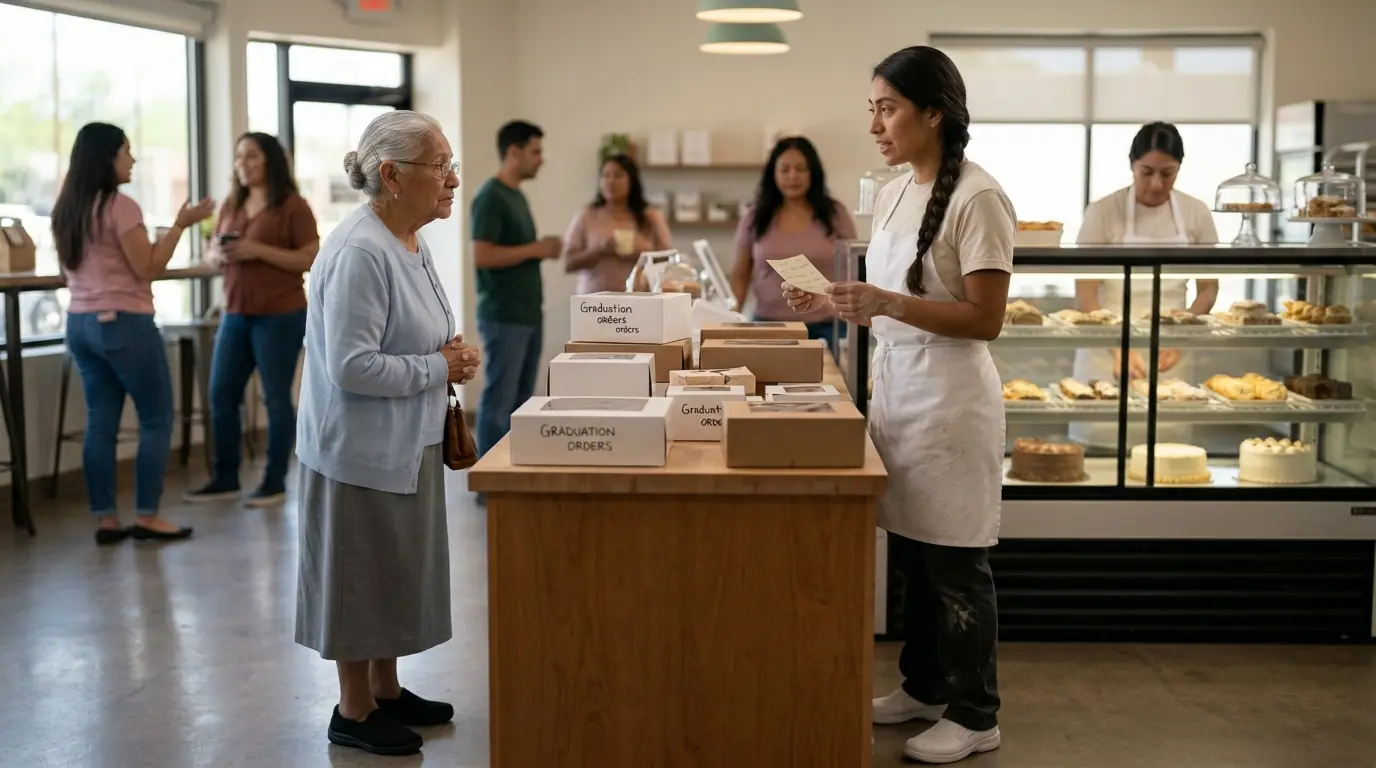
Graduation weekend had filled the town with families, balloons, flowers, and last-minute cake orders. The front counter was stacked with white boxes tied in string. The display case was full of cupcakes, fruit tarts, cookies, and sheet cakes with names written in frosting. The phone rang almost constantly.
Lucia was in the back, frosting a tray of vanilla cupcakes, when she heard raised voices from the front.
“I ordered it two weeks ago,” an elderly woman said.
The voice trembled, but it was not weak. It carried the strained dignity of someone trying not to fall apart in public.
Mr. Keane answered sharply, “Ma’am, I’m telling you, there’s no order under that name.”
Lucia paused.
The elderly woman spoke again.
“It was for today. A lemon cake with raspberry filling. White frosting. Blue flowers. The name was Clara.”
“I checked the book,” Mr. Keane said. “There is no order.”
“There has to be. I came in myself. I paid a deposit.”
“Do you have a receipt?”
There was silence.
Then the woman said, “I put it in my purse. I thought I did.”
“Without a receipt, I can’t just make a custom cake appear.”
Lucia set down the piping bag and walked toward the doorway.
At the counter stood an elderly woman in a pale blue cardigan, a long gray skirt, and comfortable black shoes. She had silver hair pinned at the back of her head, soft skin, and tired eyes behind thin glasses. One hand held a small purse. The other gripped the edge of the counter.
Beside her on the floor was a folded walker.
Her face was full of panic.
Not anger.
Panic.
Mr. Keane sighed.
“I’m sorry. We have extra cakes in the case. You can buy one of those.”
The woman looked at the display case.
The extra cakes were pretty, but none had Clara’s name. None had blue flowers. None were lemon with raspberry filling. None carried the promise she had clearly been holding in her heart.
“I told her I ordered the same flavor her mother loved,” the woman whispered.
Lucia stepped forward.
“Ma’am, what is your name?”
The woman turned.
“Evelyn Rivera.”
Lucia felt something pull in her chest.
Rivera. The name sounded familiar.
She looked at the order board behind the counter, then at the old paper clipboard where Mr. Keane still kept special notes when the computer system failed. She flipped through pages.
Mr. Keane frowned. “Lucia, we don’t have time.”
“Just a second.”
She searched carefully.
Graduation orders. Birthday orders. Wedding tasting notes. Cancelled orders.
Then she found it.
A note written on the back of a delivery invoice.
Rivera. Lemon raspberry. White frosting. Blue flowers. Clara. Friday. Deposit paid cash.
Lucia held it up.
“She did order it.”
Mr. Keane’s expression tightened.
“That should have been transferred into the system.”
“But it wasn’t.”
Evelyn pressed one hand to her mouth.
“So it exists?”
“The note exists,” Lucia said gently. “The cake wasn’t made.”
Evelyn’s eyes filled.
“Oh no.”
Mr. Keane looked at the clock.
“We can refund the deposit.”
Lucia turned to him.
“Her dinner is tonight.”
“And we have thirty-seven other orders.”
“I can make it.”
“No, you can’t. A lemon layer cake needs cooling time.”
“I’ll use the lemon sponge rounds from the backup tray, fill them with raspberry compote, chill it hard, frost it, and decorate it.”
“That backup tray is for tomorrow’s case.”
“I’ll bake more tonight.”
Mr. Keane lowered his voice.
“You are not staying late for a mistake that isn’t yours.”
Lucia looked at Evelyn.
The old woman stood there with her purse clutched tightly, trying not to cry in front of strangers because a promise to her granddaughter was collapsing at a bakery counter.
Lucia knew what it meant to have one special thing become important because money had been tight for too long. She knew what it meant to want a celebration to feel complete, not because of pride, but because someone you loved deserved a memory.
“I’ll make it,” Lucia said.
Evelyn looked at her.
“You can?”
“Yes.”
“It doesn’t have to be perfect.”
Lucia smiled softly.
“It has to be Clara’s.”
That sentence broke Evelyn’s composure. Tears slipped down her cheeks.
Mr. Keane rubbed his forehead.
“Fine. But if other orders fall behind, that’s on you.”
“They won’t.”
Lucia moved fast.
The trailer scene would be clear.
An elderly woman stands at a crowded bakery counter, told her granddaughter’s graduation cake does not exist. A young Latina baker finds the lost handwritten order, steps forward, and says, “I’ll make it.” Then she runs into the kitchen, pulls cake layers from a cooling rack, and begins saving the promise.
Lucia washed her hands, tied her apron tighter, and began.
She took three lemon sponge layers from the backup rack and leveled them carefully. She brushed them with light lemon syrup so they would stay moist. She pulled raspberry compote from the refrigerator, tasted it, added a little more lemon zest, then spread it between the layers with steady hands.
She built the cake inside a ring mold so it would hold its shape quickly.
While it chilled, she mixed white buttercream, smoother and softer than the bakery’s usual stiff frosting. She tinted a small bowl of frosting blue and prepared piping bags with petal tips. Her hands moved quickly, but not carelessly.
Evelyn stood near the doorway to the kitchen, watching.
“You don’t have to stand,” Lucia said. “There’s a chair by the wall.”
“I’m afraid if I sit, I’ll start crying again.”
“That’s allowed.”
Evelyn laughed through tears.
“My granddaughter, Clara, she worked so hard. Her mother passed when she was fourteen. I raised her after that. There were nights she studied at the kitchen table while I ironed uniforms for work. She said one day she would graduate and buy me a house with a porch.”
Lucia smiled while smoothing frosting over the chilled cake.
“That sounds like a good granddaughter.”
“She is stubborn.”
“Even better.”
“I wanted tonight to be special. Not expensive special. Just… remembered.”
Lucia paused, spatula in hand.
“Remembered special is the best kind.”
Evelyn looked at her carefully.
“You understand.”
“I was raised by my grandmother too.”
“What was her name?”
“Camila.”
“Is she still with you?”
Lucia shook her head.
Evelyn’s face softened.
“Then you understand more than I wished you had to.”
Lucia did not answer. She focused on the cake.
The buttercream went on smooth. She piped small blue flowers around the top edge, delicate but simple. She added tiny green leaves, then wrote Clara in careful cursive across the center. Finally, she added a thin border at the base and placed the cake in the cooler for ten minutes to set.
When she brought it out, Evelyn covered her mouth.
The cake was not extravagant.
It was better.
It looked personal.
White frosting. Blue flowers. Clara’s name. Lemon scent rising faintly from the box when Lucia lowered the cake inside.
Evelyn touched the edge of the counter as if steadying herself.
“It looks like the one my daughter had for her graduation,” she whispered.
Lucia froze.
“Her mother?”
Evelyn nodded.
“My daughter, Maribel. Clara’s mother. Lemon with raspberry. Blue flowers. She loved blue flowers.”
Lucia looked at the cake again, and suddenly the order felt even heavier.
This was not just dessert.
It was a bridge between a mother gone too soon, a grandmother who kept going, and a granddaughter stepping into a future built on both of them.
Lucia closed the cake box carefully.
“Then Clara should have it.”
Evelyn opened her purse.
“I owe you more.”
“No, you paid the deposit.”
“But you did extra work.”
Lucia shook her head.
“The bakery made the mistake.”
“I still want to pay you.”
“Then send me a picture of Clara with the cake.”
Evelyn stared at her, then smiled through tears.
“That I can do.”
Lucia carried the cake to Evelyn’s car herself. She placed it flat on the back seat, adjusted the air conditioning, and made sure nothing could slide into it.
Evelyn took Lucia’s hand.
“Food is memory,” the old woman said softly. “You gave us one tonight.”
Lucia’s breath caught.
“My grandmother used to say almost the same thing.”
“Then she was wise.”
“She was.”
That night, long after closing, Lucia stayed to bake replacement lemon layers for the next day’s display case. Mr. Keane barely thanked her. He only locked the front door and told her not to burn anything.
Lucia did not mind.
At 9:42 p.m., her phone buzzed.
A photo appeared.
A young woman in a white graduation dress stood beside Evelyn, smiling with tears in her eyes. Between them sat the lemon cake with blue flowers. Clara held one hand over her heart. Evelyn’s caption read:
She said it tasted like her mother was there.
Lucia sat on a flour bucket in the bakery kitchen and cried.
After that day, Evelyn began visiting the bakery every Friday afternoon.
At first, she came for bread. Then coffee cake. Then pan dulce when Lucia convinced Mr. Keane to let her make a small tray on weekends. Sometimes Clara came with her, now working as a teacher at an elementary school. They always greeted Lucia as if she were family.
Evelyn had a way of noticing things.
She noticed Lucia’s tired eyes.
She noticed the notebook full of recipes.
She noticed how Lucia decorated even simple cookies with small careful touches.
One afternoon, while Mr. Keane was out making a delivery, Evelyn leaned over the counter.
“You don’t want to work here forever.”
Lucia nearly dropped a tray.
“What?”
“You heard me.”
Lucia laughed nervously. “I’m lucky to have a job.”
“That is not what I said.”
Lucia glanced toward the kitchen door.
“I want my own bakery someday.”
“What kind?”
Lucia hesitated.
Most people smiled politely when she described Abuela’s Table, then changed the subject. But Evelyn waited as if the answer mattered.
So Lucia told her.
A small neighborhood bakery with affordable cakes, Latin pastries, American classics, coffee, a community table, and a shelf where elderly people could leave handwritten recipes. A place where nobody felt embarrassed asking for a small cake instead of a large one. A place where birthday candles, graduation cakes, and mourning trays were treated with equal care.
Evelyn listened quietly.
When Lucia finished, the old woman said, “You already know the heart of it.”
“I don’t know the business side.”
“That can be learned.”
“I don’t have money.”
“That can be found.”
Lucia smiled sadly.
“You make it sound easy.”
“No,” Evelyn said. “I make it sound possible. Easy and possible are not the same thing.”
Months passed.
Lucia kept working at Desert Bloom. Her pan dulce became unexpectedly popular. Customers started asking which items were hers. Mr. Keane liked the sales but not the attention.
“Don’t get distracted,” he told her. “People come here because of the bakery, not because of your little flower designs.”
Lucia said nothing.
But Evelyn heard about it from Clara and arrived the next Friday with a serious expression.
“Little flower designs?” she repeated.
Lucia winced. “Clara talks too much.”
“Good. She learned from me.”
“It’s fine.”
“It is not fine when people make small what is meaningful.”
Lucia wiped the counter.
“I need the job.”
“I know. But do not let needing the job make you forget your name belongs on your work.”
That sentence stayed with Lucia.
The next winter, the bakery had a holiday market booth downtown. Mr. Keane assigned Lucia to manage the table because he did not want to stand in the cold. Lucia packed boxes of cookies, sweet bread, small cakes, cinnamon rolls, and her own orange-anise conchas that Mr. Keane had agreed to sell only after three customers requested them.
The market was busy, full of lights, music, families, and the smell of roasted nuts.
Halfway through the evening, a woman approached the booth and pointed at the conchas.
“Who made these?”
Lucia raised her hand slightly.
“I did.”
The woman bought six.
Then came back an hour later.
“My mother said these taste like the ones from her childhood,” she said. “Do you take custom orders?”
Mr. Keane, who had arrived just in time to hear, stepped forward.
“The bakery does.”
The woman looked at Lucia.
“I asked if she does.”
Lucia froze.
Mr. Keane’s face hardened.
“She works for me.”
The moment passed awkwardly, but not quietly. Evelyn, sitting nearby with Clara and a cup of hot chocolate, saw everything.
After the market, Lucia returned to the bakery and found Mr. Keane waiting.
“You are not to give personal cards to customers,” he said.
“I didn’t.”
“But you wanted to.”
Lucia stayed silent.
“You’re talented,” he said. “But talent without a business is just labor. Remember that.”
He meant to warn her.
Instead, he told her the truth.
Talent without a business is just labor.
For weeks, Lucia could not stop thinking about it.
Then everything changed.
Mr. Keane announced in March that he was selling Desert Bloom Bakes to a regional café chain. The staff might be kept, he said, depending on “efficiency needs.” The recipes would change. The name would change. Custom orders would be reduced. The community feeling, small as it was, would disappear.
Lucia felt the floor drop from under her.
She had given years to that bakery.
Not because it was perfect, but because it had ovens, counters, customers, and possibility. Now even that uncertain place was being taken over by people who would never understand why a lemon raspberry cake with blue flowers mattered.
That Friday, Evelyn found Lucia sitting on the curb behind the bakery after closing.
The old woman lowered herself carefully beside her, though it took effort.
“Tell me,” Evelyn said.
Lucia laughed weakly. “You don’t even ask what’s wrong.”
“At my age, guessing wastes time.”
Lucia told her everything.
The sale. The fear. The possibility of losing her job. The dream that felt farther away than ever.
Evelyn listened.
Then she said, “Come with me tomorrow.”
“Where?”
“To see something.”
The next morning, Clara drove Evelyn and Lucia to a quiet street not far from the senior apartment building. They stopped in front of an old corner storefront with dusty windows, faded green trim, and a small sign that had been painted over years ago.
Lucia looked through the glass.
Inside was an empty room with worn tile floors, a long counter, a small kitchen area in the back, and sunlight pouring through the front windows.
“What is this place?” she asked.
Evelyn’s hands tightened around her cane.
“My husband’s first grocery.”
Lucia turned.
“You owned this?”
“Many years ago. Before the bigger store. Before he got sick. Before life became hospital bills and paperwork. We sold the grocery business, but kept the building. It has been rented out a few times. Empty now.”
Lucia stared at the space.
She could see it immediately.
Display case by the window.
Coffee near the side wall.
Long community table in the center.
Shelves for recipe cards.
Blue tile behind the counter.
Abuela’s Table written above the door.
Her heart began pounding so hard she could barely breathe.
Evelyn watched her face.
“You see it.”
Lucia swallowed.
“I shouldn’t.”
“But you do.”
“Evelyn…”
The old woman pulled an envelope from her purse.
“I am not giving you a building outright. That would make you run away.”
Lucia gave a broken laugh.
“But Clara helped me arrange a lease. One dollar a month for the first two years. After that, a rent based on what the bakery can manage. If the business becomes stable, we can discuss transfer into a community trust, because I like making lawyers work.”
Lucia shook her head, tears rising.
“No. I can’t accept this.”
“Yes, you can.”
“It’s too much.”
Evelyn’s eyes filled.
“Too much was standing in a bakery with no cake for my granddaughter, thinking I had failed the child I raised. Too much was telling Clara I ordered something special and then watching it disappear because someone forgot to copy a note.”
She stepped closer.
“You did not make me feel foolish. You did not tell me to choose something easier. You went into that kitchen and saved a promise.”
Lucia covered her mouth.
Evelyn continued.
“That night, my granddaughter tasted her mother’s memory. Do you understand what that gave us?”
Lucia cried openly now.
Evelyn placed the key in her hand.
“Let this place become Abuela’s Table. Let other families bring their memories here before they think they are lost.”
The renovation was not easy.
The old storefront needed cleaning, painting, plumbing repairs, electrical work, used ovens, health inspections, permits, and more patience than Lucia thought she had. But the community came.
Clara helped build a simple website and design flyers. Lucia’s mother scrubbed floors after hotel shifts. Her younger brother painted walls. Evelyn’s friends donated chairs, plates, and an old wooden table. A retired electrician from the senior apartments fixed the lights at a discount. A local carpenter repaired the counter after Evelyn told him the lemon cake story and stared until he agreed to help.
Lucia left Desert Bloom before the café chain took over.
Mr. Keane told her she was taking a foolish risk.
Maybe she was.
But for the first time, the risk belonged to her.
Opening day came in late August.
The sign above the door read:
Abuela’s Table
Bakery & Community Coffee
Inside, the display case held conchas, cinnamon rolls, tres leches cups, lemon raspberry slices, honey cakes, empanadas, sugar cookies, and small affordable celebration cakes. On one wall, Lucia hung a framed photo of Abuela Camila. Beside it, she hung the photo Evelyn had sent her of Clara standing with the graduation cake.
Under the photo, a small card read:
The Cake That Opened The Door.
Evelyn was the first customer.
She wore a pale blue cardigan, the same color as the flowers on Clara’s cake. Clara helped her to the counter.
Lucia placed a small lemon raspberry cake in front of her.
White frosting.
Blue flowers.
No writing.
Evelyn touched the box with trembling fingers.
“For Maribel?” Lucia asked softly.
Evelyn nodded, tears already falling.
“For Maribel.”
The bakery filled steadily that morning.
Neighbors came. Former customers came. Seniors from Evelyn’s building came. Families came. Children pressed their faces to the display case. Lucia’s mother cried behind the coffee station. Clara took photos until her phone battery died.
At noon, Evelyn raised her coffee cup.
“To Lucia,” she said. “Who proved that food is memory you can hold.”
Everyone applauded.
Lucia could barely speak.
Abuela’s Table grew slowly, but it grew with roots.
Lucia kept prices fair. She created a “small celebration” menu for families who could not afford large cakes. She set aside one afternoon a month for elders to bring recipes and stories. She baked from those recipes when families requested them. The long wooden table became a place where strangers sat together and somehow became less strange.
Evelyn came every Friday.
Always at the same time.
Always for coffee and a small slice of lemon raspberry cake.
Sometimes she brought friends. Sometimes Clara. Sometimes she sat alone and wrote in a little notebook. Lucia never asked what she wrote.
Years passed.
Abuela’s Table became one of those places people described with affection instead of directions.
“The bakery where they remember your name.”
“The place with the recipe wall.”
“The place that made Mrs. Rivera’s graduation cake.”
“The place where old people cry over cookies, but in a good way.”
Lucia hired two employees, then three. She trained them to treat every order like it might be carrying more than frosting. Because sometimes it was.
A cake could be a mother.
A cookie could be a country.
A loaf of bread could be a childhood kitchen.
A recipe could be the last thing someone still knew how to say.
Evelyn’s health declined slowly.
She still came on Fridays, but Clara brought her more often. Then Clara pushed her in a wheelchair. Then, some weeks, Lucia brought lemon raspberry cake to Evelyn’s apartment instead.
One afternoon, Evelyn asked Lucia to sit beside her.
The room smelled of tea and old books. Rain tapped softly against the window.
Evelyn handed Lucia the little notebook she had carried to the bakery for years.
“What is this?” Lucia asked.
“My recipes.”
Lucia smiled. “You finally wrote them down?”
“Some. But not only recipes.”
Lucia opened it carefully.
Inside were handwritten recipes, yes. Lemon raspberry cake notes. Rice pudding. Orange cookies. Holiday bread. But between them were stories. Memories of Maribel. Stories of Clara as a child. Notes about the night Lucia saved the graduation cake. Descriptions of Abuela’s Table customers. Thoughts about food, grief, family, and memory.
On the last page, Evelyn had written:
If Lucia ever doubts the bakery matters, remind her that some doors open because one young woman refused to let an old woman leave empty-handed.
Lucia’s eyes blurred.
“Evelyn.”
“I want you to keep it.”
“I can’t.”
“You can. I am very old, and I am tired of arguing.”
Lucia laughed through tears.
Evelyn took her hand.
“You gave my family back a piece of Maribel. That cake was not just a dessert. It was proof that love can still arrive on time, even when the order gets lost.”
Lucia bowed her head.
Evelyn squeezed her hand.
“Keep feeding people memory.”
Evelyn passed away that winter.
Her memorial was held at Abuela’s Table because Clara said no church hall could have held her grandmother’s spirit properly. Lucia closed the bakery for the day but filled the cases with Evelyn’s recipes. Lemon raspberry cake. Orange cookies. Rice pudding. Small blue-flower cupcakes for Maribel.
People came all afternoon.
They ate, cried, laughed, and told stories at the long wooden table.
Clara stood beside Lucia near the recipe wall.
“She left something else for you,” Clara said.
Lucia looked at her.
“The building?”
Clara smiled through tears.
“The trust papers are complete. She wanted Abuela’s Table to stay here as long as you keep the community table open and the recipe wall alive.”
Lucia covered her mouth.
“She already gave me so much.”
Clara nodded.
“She said you gave first.”
That night, after everyone left, Lucia sat alone at the long wooden table with Evelyn’s notebook open before her.
She thought back to the first day.
The crowded bakery.
The missing order.
Mr. Keane offering a refund like money could replace meaning.
Evelyn standing at the counter with panic in her eyes.
Lucia saying, “It has to be Clara’s.”
That was where everything began.
Not with a business plan.
Not with an investor.
Not with perfect timing.
With one old woman’s ruined promise and one young baker who refused to let it stay ruined.
Years later, when people asked Lucia how Abuela’s Table began, she always told the truth.
“It began with a cake that almost didn’t exist.”
Then she would point to the framed photo of Clara and Evelyn beside the lemon raspberry cake.
“She needed a graduation cake for her granddaughter. We lost the order. I stayed late and made it. Years later, she gave me the key to this building.”
People always loved that part.
But Lucia knew the deeper gift was not only the building.
It was the recipe.
The recipe for a life where food carried memory, kindness opened doors, and a table could become a home for people who needed to feel remembered.
Every Friday, Lucia still baked one small lemon raspberry cake with white frosting and blue flowers.
She placed it in the display case beside a little sign.
Evelyn’s Cake.
And whenever someone asked about it, Lucia smiled.
Then she told them about the old woman at the counter, the lost order, the granddaughter named Clara, and the promise that arrived just in time.