At twenty-four, Emily Carter knew that paper could carry a whole life.
Most people walked into Oak Street Print & Copy in Fort Worth, Texas, thinking paper was simple. A form. A photograph. A receipt. A copy of an ID. A stack of pages needing staples in the left corner.
But Emily knew better.
A single sheet could be a birth certificate, a deed, a tax notice, a school transcript, a hospital bill, a military record, a court letter, or the last handwritten note from someone who was gone. Paper looked quiet, but it could decide who got heard and who got ignored.
Emily was a young white American woman with fair skin, long chestnut-brown hair usually tied into a thick braid, gray-blue eyes, and careful hands that moved quickly around printers, flatbed scanners, laminators, paper cutters, binding machines, and photo sleeves. She worked six days a week at the little print shop across from the county records office, a place that smelled like toner, warm copier paper, cardboard, and burnt coffee.
She was not the owner.
The shop belonged to a practical man named Mr. Nolan, who believed everything in life should fit neatly into an order number, a service fee, and a closing time.
“People come here to print,” he liked to say. “Not to turn their lives into our problem.”
Emily never argued much.
But she never believed him either.
She had seen too many people come in holding papers with the same expression: tight shoulders, careful voices, and that strained look people wore when they were one mistake away from panic. Elderly men trying to copy pension forms. Widows faxing insurance claims. Teenagers printing financial aid documents. Mothers making copies of school records. People who did not need only a machine. They needed a steady pair of hands and someone to say, “Let’s do this one step at a time.”
Emily understood that because of her grandmother.
Her grandmother, Helen Carter, had kept every important paper in a metal recipe tin lined with wax paper. Deeds, insurance letters, tax receipts, marriage certificates, old report cards, church programs, and photographs were all tucked inside, organized with little handwritten tabs.
“Documents speak for you when you’re too tired to speak for yourself,” Helen used to tell her. “And pictures remind you that your life was real.”
When Helen died, Emily inherited the tin.
Inside, tucked beneath an old black-and-white photo of Helen as a young woman standing outside a portrait studio, was a folded note:
Someday, make a room where people feel safe bringing what matters.
Emily kept that note in her wallet.
Her dream was to open a small community document and photo studio called Seen & Saved , a place where people could scan and organize important papers, restore old photographs, make archival copies, create emergency folders, and sit down with someone patient before life became urgent.
But dreams needed money.
Scanners. Cameras. Archival sleeves. Editing software. Insurance. Rent. Permits. A storefront. Shelving. Tables. Marketing. Utility bills.
Emily had none of that.
She had a paycheck, an old laptop, a secondhand camera, and a notebook full of ideas.
So she stayed at Oak Street Print & Copy and helped people where she could.
One Wednesday afternoon in early May, a storm rolled over Fort Worth like it meant business.
The morning had been hot and sticky, the sky pale and still, but by midafternoon heavy clouds swallowed the light. Thunder shook the windows. Rain came down in thick, slanting sheets so hard it blurred the street into streaks of gray and silver. The county records office across the street announced it would close early because water was collecting near the front steps.
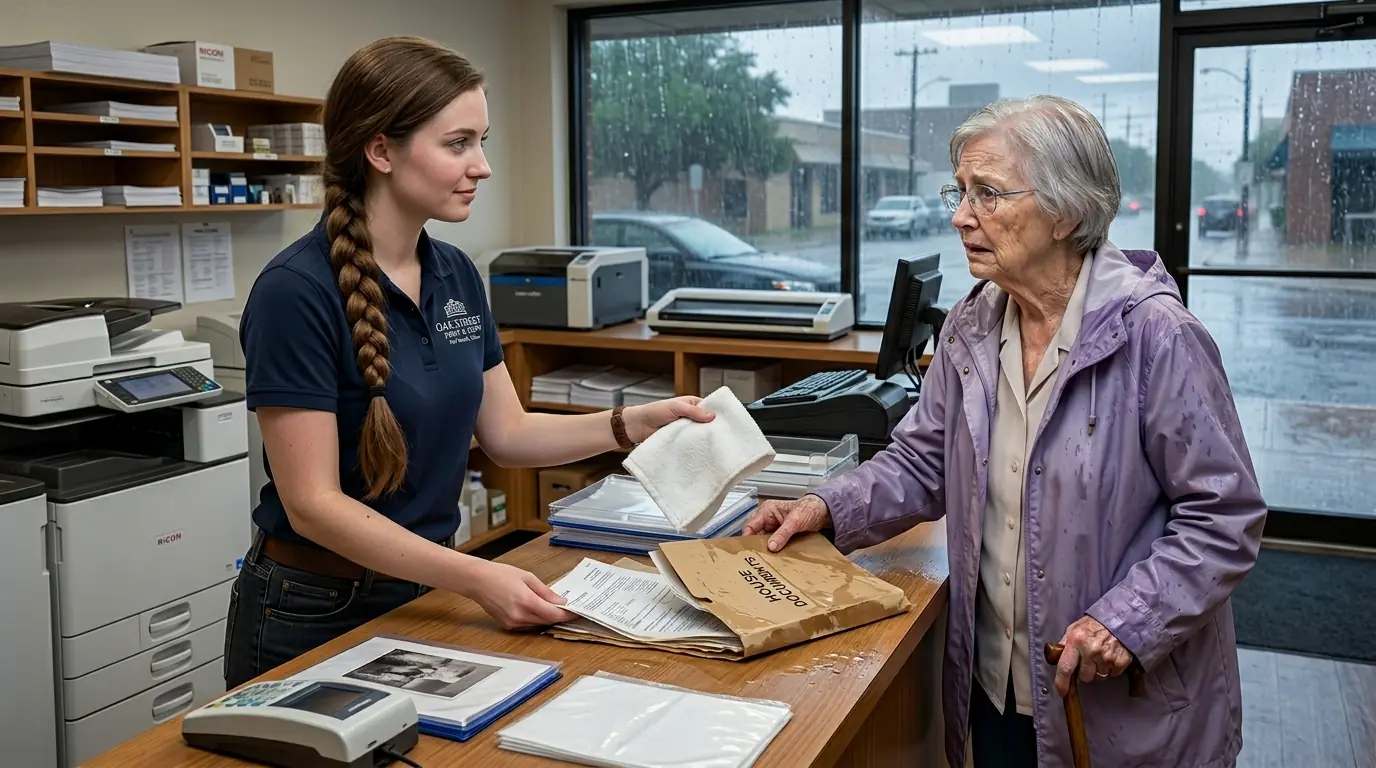
Emily was behind the counter binding a stack of training manuals when the shop door flew open so hard it rattled the glass.
An elderly woman staggered inside.
She was a white American woman in her late seventies, small-boned and clearly exhausted, with short silver hair plastered around her face by rain, pale blue eyes behind wet glasses, and a faded lavender raincoat that had lost its battle with the storm. In one hand she held a cane. In the other she clutched a cardboard file folder against her chest.
But the folder was collapsing.
Rainwater streamed from the edges. The bottom split open. Papers sagged and slid out. A small envelope burst free, scattering photographs across the wet tile near the entrance.
The woman gasped.
“Oh no. No, no, no.”
Emily ran from behind the counter.
“Ma’am, don’t bend down. I’ve got them.”
The woman tried to lower herself anyway, but her cane slipped on the wet floor. Emily caught her elbow just before she lost balance.
“Please sit,” Emily said. “I’ll get everything.”
“I can’t lose those papers,” the woman cried. “Please, I can’t lose them.”
The trailer image would have been clear: an elderly woman, soaked from a violent rainstorm, stumbling into a print shop while house papers and old photographs spill across the floor, and a young woman dropping to her knees to save every page before the water ruins them.
Emily moved fast.
She scooped up the photographs first, supporting them from underneath so the softened edges would not tear. One showed a younger version of the woman standing beside a smiling man in front of a small white house with blue shutters. Another showed two children sitting on a porch swing. Another was an old wedding photo, faded nearly to sepia.
Then Emily gathered the wet papers: a county hearing letter, a deed copy, tax notices, utility receipts, handwritten notes, and an old envelope labeled in careful blue ink: House Documents .
Mr. Nolan came out of the back office, saw the puddle near the front mat, and frowned.
“What happened?”
“She needs help,” Emily said.
The elderly woman stood trembling near the counter, rain dripping from the hem of her coat.
“The records office,” she said breathlessly. “They told me I had until four to bring copies. The sidewalk flooded. I dropped the folder. Everything got wet.”
Emily looked at the wall clock.
3:34 p.m.
The records office would close at four.
“What’s your name?” Emily asked.
“Margaret Whitaker.”
“Mrs. Whitaker, please sit down.”
“I don’t have time to sit.”
“You don’t have time to fall either.”
That reached her.
Emily pulled a chair closer and guided Margaret into it. Then she ran to the worktable for paper towels, blotting sheets, protective sleeves, a portable fan, and a clean dry tray.
Mr. Nolan looked at the wet stack with irritation.
“Those can’t go through the scanner like that.”
“I know.”
“They’ll jam the machine.”
“I’m not putting them straight through the feeder. I’ll use the flatbed and protective sheets.”
“That takes forever.”
Margaret looked between them with rising panic.
“Please,” she whispered. “My house.”
Emily turned to her.
“What about your house?”
Margaret gripped the handle of her cane so tightly her knuckles went white.
“My husband died last year. We lived in that house for forty-two years. The county changed my mailing address wrong somehow, and I missed a tax notice. They told me if I brought proof and copies today, they could correct the account before tomorrow’s penalty hearing.”
Her voice broke.
“I have the deed. Receipts. Payment records. Everything. But now—”
She looked down at the wet papers like they were slipping out of her life.
Emily felt her jaw tighten.
This was not paperwork in the abstract.
This was a home.
Mr. Nolan checked the clock again.
“We can make copies of what’s readable. But if she misses the deadline, that’s not on us.”
Emily did not answer him right away.
She put on gloves, separated the wet documents one at a time, and laid them flat on blotting sheets.
The deed copy was damp but legible.
The tax notice had bleeding ink along one side.
The utility receipts had stuck together at the corners.
The county hearing letter was wet enough to wrinkle but still salvageable.
The photographs would need careful drying.
Margaret watched with her lips trembling.
“I should have put them in plastic,” she whispered. “Henry always told me to keep them in plastic.”
“What was your husband like?” Emily asked while she worked.
Margaret gave a shaky laugh that turned almost into a sob.
“Stubborn. Organized. He labeled every drawer in the kitchen. Every single one. Even the spoon drawer.”
“That sounds useful.”
“It was.” Her eyes filled. “After he died, every envelope felt like another language.”
Emily glanced up at her.
“We’re going to make this language speak clearly.”
Margaret stared at her as if she had never heard anyone talk about papers that way before.
Mr. Nolan folded his arms.
“Emily, remember we have paying customers.”
A man near the copy counter muttered, “She is a paying customer.”
Mr. Nolan did not answer that.
Emily began the scanning process.
She slipped the deed inside a clear protective sheet, laid it carefully on the flatbed scanner, lowered the lid only halfway to avoid pressing moisture deeper into the paper, and captured the image. Then she adjusted the contrast until the county stamp showed clearly.
Next came the tax notice.
Then the receipts.
Then the hearing letter.
Each page took time.
Too much time.
The rain slammed harder against the windows.
The lights flickered once.
Margaret gasped softly and looked up as if the whole world were conspiring against her.
Emily kept moving.
By 3:46, she had scanned the key documents.
By 3:50, she had printed two clean copies of each page.
By 3:53, she had saved digital versions to a flash drive.
Then she created a cover sheet: Margaret Whitaker — Property Correction Documents — Submitted Before Deadline , listing every enclosed document in clear order.
Mr. Nolan watched from behind the counter, silent now.
At 3:55, Emily placed the clean copies and flash drive into a new waterproof plastic envelope from the office supply rack and sealed it shut.
Margaret stood so quickly her chair scraped the floor.
“I have to go.”
Emily looked out through the rain.
The crosswalk was flooded. Cars were pushing through standing water, sending spray over the curb.
“You’re not crossing alone.”
“Oh, I can’t ask you to—”
“You didn’t.”
Emily grabbed the big shop umbrella from beside the door, tucked the waterproof envelope inside her jacket, and took Margaret’s free arm.
She glanced back at Mr. Nolan.
“I’m taking her across.”
He opened his mouth, then shut it again. For once, he had no rule ready.
“Go,” he said shortly.
The crossing felt longer than it should have.
Rain whipped under the umbrella. Water splashed over their shoes. Margaret’s cane caught once near the curb, and Emily tightened her grip immediately.
“I’ve got you,” she said.
“I’m slowing you down.”
“No. We’re moving together.”
By the time they reached the county records office, both of them were damp again. A security guard was already half-closing the front door.
“Please wait!” Emily called.
The guard frowned. “We’re shutting down.”
Margaret lifted the waterproof envelope with both hands.
“They told me I had until four.”
The guard looked at the wall clock behind him.
3:58.
Then he stepped aside.
“Two minutes.”
Inside, the property desk clerk looked exhausted and ready to leave. Emily did not give her room to dismiss them. She laid the papers out in order on the counter, set the cover sheet on top, and explained clearly:
“Mrs. Whitaker was told to bring proof before closing. Her original documents were damaged in the storm, but these copies are readable. The deed, tax notice, payment receipts, county letter, and digital backup are all here.”
Margaret stood beside her, soaked and trembling.
“Please,” she said. “That house is all I have left of my husband.”
The clerk’s face softened.
She reviewed the pages one by one.
Seconds stretched.
Rain hammered the windows.
Then the clerk stamped the cover sheet.
“Correction request received before deadline,” she said. “The penalty hearing will be paused pending review.”
Margaret’s knees nearly gave out.
Emily caught her arm again.
“Paused?” Margaret whispered.
“Yes, ma’am.”
Margaret covered her face and began to cry.
Not politely.
Not neatly.
Just the honest, relieved tears of someone who had been carrying too much fear for too long.
When they returned to Oak Street Print & Copy, Mr. Nolan had put out a wet floor sign and turned the heater a little higher. He even handed Margaret a paper cup of coffee without making a speech about it.
Emily carefully laid out the original photographs and documents on fresh blotting paper in the back room. Some corners curled. Some ink had bled. But most were saved.
Margaret picked up the old photograph of the white house, now resting safely in a drying tray.
“Henry painted that porch three different times,” she said softly. “He said a house ought to look proud.”
Emily smiled.
“It still does.”
Margaret looked at her.
“You don’t know that.”
“No,” Emily said. “But I know you crossed a flood to protect it.”
Margaret laughed weakly through tears.
When Emily totaled the copy charges, flash drive, and plastic envelope, Margaret reached for her purse.
Mr. Nolan surprised them both.
“No charge for the umbrella run,” he muttered.
Emily looked over.
He shrugged awkwardly.
“Don’t make it into a sentimental thing.”
Margaret paid the rest with careful bills and coins. Before leaving, she took Emily’s hands in both of hers.
“You saved my papers.”
Emily shook her head gently.
“You saved your house. I just helped the papers survive the rain.”
Margaret’s eyes filled again.
“No,” she said quietly. “You helped me be heard.”
That sentence stayed with Emily long after the floor dried.
The following Monday, Margaret came back with dry hair, a fresh cardigan, and a tin of butter cookies.
“The county called,” she said the moment Emily came to the counter. “They corrected the account. The hearing is canceled.”
Emily’s whole face lit up.
“That’s wonderful.”
Margaret set the cookie tin down.
“For you.”
“You didn’t have to.”
“I know. That’s why it counts.”
Then she lifted a second envelope.
It held old photographs.
“Could you scan these when you have time?” Margaret asked. “That storm scared me. I realized how much I’ve kept in one place and how easily it could disappear.”
Emily smiled.
“Of course.”
That was how it began.
Every Wednesday afternoon after that, Margaret Whitaker came to Oak Street Print & Copy with another envelope, small box, or file folder. Emily scanned faded family photos, copied old letters, restored damaged snapshots, and organized documents onto labeled flash drives. Sometimes Margaret sat at the counter and told stories as Emily worked.
Henry on a ladder painting the porch.
Their daughter Claire learning to ride a bicycle in the driveway.
Their son Daniel in a Cub Scout uniform.
Christmas dinners in the dining room.
The little white house through decades of birthdays, storms, and ordinary Tuesday evenings.
Margaret had once worked as a school secretary, and it showed in the way she respected paper.
“I spent thirty years making sure no child left school without the right forms,” she said one day. “But after Henry died, my own documents felt heavier than bricks.”
Emily understood that perfectly.
Over time, Margaret became more than a customer. She became a steady part of Emily’s week.
She noticed the notebook Emily kept under the counter.
One afternoon she tapped it.
“What’s in there?”
“Nothing.”
“At my age,” Margaret said, “nothing always has a name.”
Emily laughed.
“It’s just a dream.”
“Then let me hear it.”
So Emily opened the notebook.
She showed Margaret sketches of Seen & Saved : a welcoming studio with document tables, photo scanners, archival storage boxes, a restoration desk, and a wall where families could display restored photographs. There were notes about workshops for seniors, emergency home folders, and memory-preservation sessions.
Margaret read every page carefully.
“You want to help people preserve both proof and memory,” she said.
“Yes.”
“And teach them how to protect their important papers before emergencies.”
“Yes.”
“And restore old photographs so families don’t lose their history.”
“If I can ever afford the software and proper equipment.”
Margaret looked up.
“This is needed.”
Emily smiled sadly.
“I know. I just don’t know how to build it.”
“Money is often the rude part of a beautiful dream.”
Emily laughed softly.
“That sounds about right.”
As the months passed, more people began asking for Emily by name. A widow brought in letters from her late husband. A teacher brought class photos from 1978. A church member brought baptism records. A veteran brought discharge papers and old photographs from service. Emily handled every page and every photo with the same quiet respect.
Mr. Nolan appreciated the extra business, but he did not appreciate the way people started trusting Emily more than the shop itself.
One day a woman at the counter asked, “Do you have a personal card? I’d love to come to your studio someday.”
Mr. Nolan answered before Emily could.
“She works here.”
The woman nodded politely, but Emily felt the truth sit hard in her chest.
Not yet.
Then the breaking point came.
A family brought in a box of photographs damaged by a roof leak. Emily wanted to separate them properly, dry them in stages, and help create a recovery plan. Mr. Nolan wanted either a rush fee or a refusal.
“We are not an archive,” he said.
“No,” Emily answered. “But they came here because they need help.”
“They came here because they think you’ll give them more time than they paid for.”
The words landed hard because they were true.
A week later, Emily’s hours were cut.
“Business adjustments,” Mr. Nolan said.
Emily knew better. He wanted less mess, fewer emotional projects, and fewer customers who came for her instead of the standard services.
That night, Emily sat on the floor of her small apartment with her grandmother’s metal tin open beside her. Deeds. Letters. Certificates. Recipes. The old photo of Helen outside a portrait studio. And the note:
Someday, make a room where people feel safe bringing what matters.
Emily cried because she could see the room so clearly.
She just could not reach it.
The next morning, Margaret called.
“Come to my house after work,” she said.
“Is everything okay?”
“Yes,” Margaret replied. “Something is waiting.”
Margaret’s house was exactly the white house from the old photographs: blue shutters, a wraparound porch, rose bushes by the walkway, and a brass mailbox polished enough to catch the evening light. Emily had seen it through pictures so many times that stepping onto the porch felt like walking into a story she already knew.
Inside, the walls were covered with restored photographs Emily had scanned. Henry painting the porch. Claire as a little girl with missing front teeth. Daniel in uniform. Margaret young and laughing. The house through every season of a long life.
“You brought them back to the walls,” Emily whispered.
“You helped me see them clearly again,” Margaret replied.
Then she led Emily to the dining room table.
On it were a ring of keys, a stack of legal papers, and an old photograph of a storefront.
Emily sat down slowly.
“What is this?”
Margaret touched the photograph.
“Henry and I once owned a little portrait and document studio downtown. Passport photos, family portraits, document copies, photo enlargements, all of it. I handled clients and records. Henry loved cameras.”
Emily stared at her.
“You had a studio?”
Margaret smiled at the memory.
“Before the children. Before life got busier. We closed it, but we never sold the building. It’s been rented a few times over the years. Empty now.”
Emily felt the air leave her lungs.
Margaret slid the keys toward her.
“No,” Emily said immediately.
“You haven’t heard the offer.”
“I can already feel it.”
“Then feel it politely.”
Despite herself, Emily laughed through tears.
Margaret continued.
“I spoke with my children. They know what you did for me. They know what you want to build. The studio building is available to you for one dollar a month for the first three years. After that, rent based on what Seen & Saved can honestly afford. If you keep using it to serve families and seniors, we can later move it into a community trust.”
Emily shook her head.
“This is too much.”
Margaret’s face grew serious.
“No. Too much was standing in the rain with the proof of my home melting in my hands. Too much was believing one storm could erase forty-two years of life with my husband.”
She placed one hand over Emily’s.
“You did not look at me and see an old woman making a mess. You saw someone about to lose her voice. You saved the papers that spoke for me.”
Emily could not stop the tears then.
Margaret pushed the keys closer.
“Now let this old studio help you save other people’s stories.”
The building stood on a quiet corner near a library and a senior apartment complex. When Emily unlocked it for the first time, dust floated in the evening light. The front room had tall windows, faded tile floors, and a long built-in counter. There was a back room that had once been a darkroom, an office with shelves, and enough space for scanners, photo tables, filing cabinets, and workshops.
Emily could see it all immediately.
Document help near the entrance.
A scanning and restoration station by the windows.
A photo wall.
Shelves of archival boxes.
A memory table where people could sit and sort important things without shame.
Seen & Saved .
The renovation took months.
Emily’s mother painted walls. Her cousins carried furniture. Margaret’s son repaired the front door. Her daughter donated a better computer. A retired photographer gave Emily old equipment. A librarian helped plan document workshops. The county records clerk who had stamped Margaret’s paperwork agreed to speak at the first senior safety class.
Margaret came every Friday with coffee and opinions.
“That wall needs color.”
“It’s white for better light.”
“It looks nervous.”
Emily repainted one wall a soft blue.
Margaret approved immediately.
Opening day arrived in late summer.
The sign above the door read:
Seen & Saved
Photo, Memory, And Document Studio
And beneath it:
Copies For The Life You Need To Prove.
Photos For The Life You Never Want To Forget.
Margaret was the first customer through the door.
She carried her original wedding photograph of herself and Henry in an archival sleeve. Emily scanned it in front of a room full of neighbors, family, and first-time customers. On the screen appeared a younger Margaret and Henry smiling outside a little church, both of them dressed as if the future could only be kind.
Margaret cried.
So did half the room.
Seen & Saved grew slowly but steadily. Seniors came for emergency home folders. Families came with shoeboxes of photos. Widows came with letters. Veterans came with service records. Young couples came to preserve their grandparents’ recipes. People who had once felt embarrassed by their paper chaos now sat down at Emily’s table and left with labeled folders, digital backups, and relief on their faces.
Emily offered monthly workshops: “Protecting Important Documents,” “What To Keep In A Home Emergency Folder,” “How To Preserve Old Family Photos,” and “Paper Help Without Panic.”
At the front of the studio, she framed two things side by side:
Her grandmother Helen’s note.
And the water-stained cardboard folder from the day Margaret came through the rain, now preserved behind glass, still labeled: House Documents .
Underneath, a small sign read:
Papers Speak. Photographs Remember.
Years passed.
Margaret grew older, but she never stopped coming. Sometimes she helped greet nervous customers. Sometimes she sat near the window and watched families bring in boxes full of their lives. She loved the way people relaxed when Emily told them, “We’ll do this together.”
One rainy afternoon, Margaret arrived with her daughter Claire, carrying a wrapped package.
Emily hurried to help them in.
“Margaret, you should not be out in weather like this.”
Margaret smiled.
“This weather is exactly why I came.”
Inside the wrapping was a small brass nameplate from the original studio Henry and Margaret had owned decades ago.
It read:
Whitaker Portrait & Copy Studio
Emily stared at it.
Margaret nodded.
“It belonged to the first room where Henry and I tried to help people keep their memories. I want it here.”
Emily’s eyes filled immediately.
“I don’t know what to say.”
“Say you’ll hang it where you can see it.”
“I will.”
Margaret handed her one more thing: a sealed letter.
“Read it later,” she said.
Emily knew what that meant. Her heart tightened.
Margaret Whitaker died the following winter, peacefully, in the white house with blue shutters that she had fought to keep.
Her memorial began at the house and ended at Seen & Saved because her children said the studio had become part of her story. People came carrying restored photographs, family papers, and stories about the day she nearly lost her home to a storm and found her way into Emily’s life instead.
That evening, after everyone had gone, Emily sat alone in the studio and opened Margaret’s letter.
Dear Emily,
The day I met you, I thought I was losing my home.
The rain had soaked the papers. The office was closing. My hands were too old, my heart too frightened, and Henry was no longer there to tell me what to do next.
You did not make me feel foolish.
You knelt on the floor and picked up every page like it mattered.
Because it did.
You saved the papers that helped me keep my house. But more than that, you saved the story those papers carried.
This studio is not a gift from me alone. It is from Henry too. He believed ordinary people deserved beautiful proof that they had lived and loved in this world. You believe the same thing.
Keep saving what storms try to take.
With love,
Margaret Whitaker
Emily pressed the letter to her chest and cried in the soft blue room Margaret had helped bring to life.
Years later, Seen & Saved became one of the most trusted community studios in Fort Worth. Families came before storm season to prepare waterproof document kits. Seniors came to digitize records and label emergency folders. Children came with grandparents to restore old family photographs. People left not only with copies and files, but with a sense that what they carried mattered.
When anyone asked Emily how the studio began, she always told the truth.
“It began with an old woman in the rain and a folder that was falling apart.”
Then she would point to the framed cardboard folder near the front door.
House Documents.
She would explain how one violent storm nearly destroyed the papers that proved Margaret Whitaker’s home, how a race across a flooded street changed everything, and how helping one elderly woman be heard became the doorway to helping hundreds more.
Margaret had given Emily a building.
But the deeper gift was something else.
She had given her a purpose with walls around it.
And every time thunder rolled over Fort Worth, Emily checked the emergency folders near the front desk, turned on the scanners, straightened the archival sleeves, and waited.
Because somewhere, someone was carrying a life in paper form.
And Emily Carter was ready to help save it.