At twenty-five, Naomi Carter had learned that some people did not ask for help because they had forgotten how.
Not because they did not need it.
Not because they were strong enough to survive everything alone.
But because life had taught them to make themselves small, to apologize before speaking, to say “I’m fine” even when their coat was soaked, their hands were shaking, and they had nowhere safe to sleep.
Naomi had seen that kind of silence before.
She had seen it at the library where she worked.
She had seen it in elderly patrons who came in only to sit near the heater.
She had seen it in women who carried old grocery bags filled with important papers because they trusted plastic more than people.
She had seen it in men who spent twenty minutes pretending to read a newspaper because they needed somewhere warm but did not want to be seen needing it.
Naomi noticed because she had once been raised by a woman who knew how to survive quietly.
Her grandmother Ruth had raised her in a small brick apartment in Charlotte, North Carolina, after Naomi’s mother died.
Ruth Carter had been proud, loving, stubborn, and practical.
She kept emergency cash in a coffee tin.
She labeled medicine bottles with strips of tape.
She saved grocery bags, rubber bands, old envelopes, and glass jars because “useful things should not be rushed into the trash.”
She taught Naomi to cook rice without measuring, to check the weather before leaving home, to carry a phone charger, and to never walk past a person who looked lost without at least asking one question.
“Sometimes,” Ruth used to say, “the question is the bridge.”
Naomi did not understand that fully as a child.
She understood it as an adult.
A question could let someone say yes.
A question could let someone admit fear.
A question could turn a stranger from a shadow on the sidewalk into a person with a name.
By the time Naomi was twenty-five, she lived in Cedarville, North Carolina, a quiet town with old oak trees, narrow streets, brick storefronts, a public library, a diner, a pharmacy, a laundromat, and a row of weathered houses that seemed to lean toward each other in the rain.
She was a young woman with deep brown skin, warm dark eyes, a gentle oval face, and shoulder-length natural curls often wrapped in a patterned scarf when the weather was damp.
She was five feet six, with a steady posture, strong hands, and a calm voice that made people feel less ashamed when something had gone wrong.
Naomi worked part-time at Cedarville Public Library.
The library was not large.
It had a children’s corner with soft rugs, a row of public computers, a community bulletin board, a copy machine that jammed whenever it sensed urgency, and tall windows that looked out over Maple Street.
Naomi loved the library because people came there when they did not know where else to go.
Children came for books and after-school quiet.
Teenagers came for Wi-Fi and scholarship applications.
Parents came to print forms.
Elderly residents came to read newspapers, use computers, ask about bus schedules, and sometimes simply be around other people without having to explain loneliness.
Her job title was library assistant.
But like most small-town library jobs, that title did not say enough.
She shelved books.
Registered new library cards.
Helped people print documents.
Taught seniors how to enlarge text on screens.
Assisted children with reading logs.
Found tax forms.
Refilled the community coffee pot.
Explained online portals.
Called transportation services when someone’s ride did not come.
And sometimes, when someone sat too long by the front window with fear in their face, Naomi quietly asked, “Do you need help figuring out the next step?”
Her dream was to create a small community program called One Safe Night.
It would help elderly residents, women in crisis, stranded travelers, and vulnerable people who needed emergency overnight shelter but did not need a hospital or police station.
Not a big shelter.
Not a place where people felt processed.
A simple local network.
A warm bed for one night.
A clean bathroom.
A hot meal.
A phone call to family.
A safe ride the next morning.
A volunteer host system with background checks, clear rules, and support from the community center.
Naomi knew it would not be easy.
Emergency shelter was serious.
Safety mattered.
Boundaries mattered.
Training mattered.
No one should be casually sent into a stranger’s home without care and preparation.
But Naomi also knew there were people who slipped between systems.
Too proud to call a hotline.
Too confused to explain their situation.
Too cold to wait until morning.
Too afraid to sleep outside but unsure where else to go.
She had written the idea in a green notebook she carried in her tote bag.
One Safe Night.
Emergency host network.
Library referral point.
Senior center partnership.
Church basement backup.
Transportation vouchers.
Meal kits.
Safety protocols.
Family contact forms.
Privacy rules.
Clear host guidelines.
But dreams needed permission.
Funding.
Screening.
Insurance.
Partnerships.
A director brave enough to try.
So the notebook stayed in her bag.
And Naomi kept helping people one at a time.
The night everything changed came in late November.
Rain had been falling all day over Cedarville.
Not a dramatic storm at first.
Just cold, steady rain that tapped on windows, soaked into coats, and made the whole town look tired by sunset.
By six o’clock, the sky had turned dark.
The sidewalks reflected streetlights in broken yellow lines.
Water ran along the curbs.
The air smelled like wet leaves, chimney smoke, and cold pavement.
Naomi had stayed late at the library because an elderly man needed help printing medical transportation forms and a young mother had trouble submitting an online school lunch application.
The library closed at seven, but Naomi did not step outside until nearly seven-thirty.
Mrs. Keller, the head librarian, locked the front door behind them.
“You sure you don’t want a ride?” Mrs. Keller asked.
Naomi pulled her hood up.
“I’m only four blocks away.”
“It’s cold rain.”
“I’ve walked through worse.”
Mrs. Keller gave her a look.
“Text me when you get home.”
“I will.”
Naomi started down Maple Street with her tote bag held close against her coat.
Inside were her green notebook, a phone charger, a small first-aid kit, a plastic document sleeve, a granola bar, and a folded reusable grocery bag.
The rain had softened to a mist, but the cold had deepened.
Most shops were closed.
The bakery lights were off.
The diner still glowed at the corner, but only a few customers sat inside.
The pharmacy sign flickered across the street.
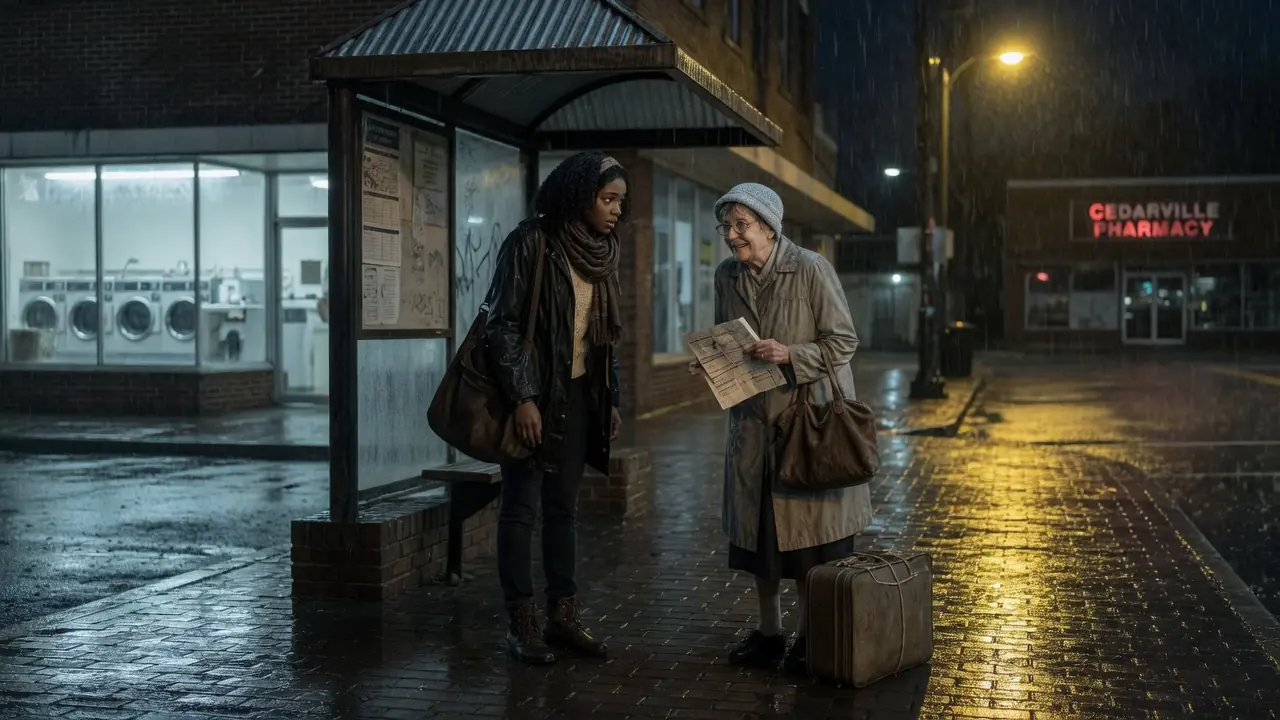
Naomi was halfway past the laundromat when she saw the old woman.
At first, she thought the woman was waiting for a ride.
She stood beneath the narrow awning of the closed bus stop shelter, holding a small cloth handbag against her chest.
Her coat was too thin for the weather.
Her gray hair had escaped from a pale blue knit hat, and rain had dampened the loose strands around her face.
She was white, probably in her late seventies, short and fragile, with pale skin, tired blue eyes behind round glasses, and hands that trembled as she clutched her purse.
A small suitcase stood beside her.
Not a travel suitcase.
An old fabric one with worn corners and a broken zipper tied shut with string.
The woman looked down the street.
Then back at the bus sign.
Then at a folded piece of paper in her hand.
Then she looked at the dark road again.
Something about her stillness made Naomi slow down.
The woman did not look like someone simply waiting.
She looked like someone whose plan had disappeared and left her standing in the cold.
Naomi approached carefully.
“Ma’am?”
The old woman startled so hard she nearly dropped the paper.
“I’m sorry,” Naomi said quickly. “I didn’t mean to scare you.”
The woman blinked at her.
“Oh. No. I’m sorry. I was just… waiting.”
Her voice was thin and polite.
Too polite.
Naomi stopped a few feet away, giving her space.
“My name is Naomi. I work at the library down the street.”
“The library,” the woman repeated softly.
“Yes. Are you waiting for someone?”
The woman looked toward the road.
“I thought so.”
That answer told Naomi more than yes or no would have.
“What’s your name?”
“Margaret Ellis.”
“It’s nice to meet you, Margaret.”
Margaret tried to smile.
Her lips trembled with cold.
Naomi glanced at the bus sign.
The last bus on that route had passed at seven.
It was now almost seven-forty.
“Margaret, did you miss the bus?”
“I think so.”
“Where were you trying to go?”
Margaret looked at the paper in her hand.
“My sister’s house.”
“Does she live in Cedarville?”
“No. Raleigh. Well, near Raleigh.” She frowned slightly. “My daughter wrote the route for me.”
Naomi looked gently at the paper.
“May I see?”
Margaret hesitated.
Then handed it over.
The paper was damp at the edges.
On it was a bus route, a transfer point, a phone number, and an address.
But the route was not for Cedarville.
It began from a town twenty miles away.
Naomi read it twice.
Her concern deepened.
“Margaret, where did you start today?”
Margaret looked embarrassed.
“Greenville.”
Naomi’s heart tightened.
Greenville was hours away.
“Did someone bring you here?”
“I took a bus. Then another bus. Then there was supposed to be another.” Margaret looked toward the empty road again. “I think I got off at the wrong stop.”
Naomi kept her face calm.
“Do you have a phone?”
Margaret opened her handbag and searched inside with trembling fingers.
Tissues.
A wallet.
A pill bottle.
A small comb.
A folded photograph.
No phone.
“I had one,” she whispered.
“Did you lose it?”
“I don’t know.” Her voice grew smaller. “I may have left it on the last bus.”
Naomi breathed slowly.
“Do you know your daughter’s number?”
Margaret looked at the paper.
“It’s written there.”
Naomi checked.
There was a phone number labeled Claire.
Good.
That was something.
“Have you eaten today?”
Margaret looked startled by the question.
“I had crackers.”
“When?”
“Morning.”
Naomi felt anger rise quietly, not at Margaret, but at the situation.
A woman in her late seventies had traveled for hours, lost her phone, missed a bus, eaten only crackers, and was standing in cold rain with a suitcase and a paper route that did not match the town.
“Margaret,” Naomi said gently, “you can’t stay out here.”
“Oh, I’ll be all right.”
“No,” Naomi said softly. “Not tonight.”
Margaret looked down.
“I don’t want to be trouble.”
“You’re not trouble. You’re cold, lost, and carrying a suitcase in the rain.”
Margaret gave a tiny, broken laugh.
“When you say it like that, I sound less capable.”
“No,” Naomi said. “You sound like someone having a very hard night.”
The old woman’s eyes filled.
She looked away quickly, ashamed of the tears.
Naomi softened her voice.
“Let’s call your daughter first.”
She pulled out her phone and dialed the number on the paper.
It rang.
Once.
Twice.
Three times.
Then voicemail.
A woman’s recorded voice said, “This is Claire. Please leave a message.”
Naomi left a clear message.
“Hi, Claire. My name is Naomi Carter. I work at Cedarville Public Library. I’m with your mother, Margaret Ellis. She’s safe, but she missed a bus and doesn’t have her phone. Please call me back at this number as soon as you can.”
She hung up and looked at Margaret.
“No answer yet.”
Margaret’s face fell.
“Claire works nights sometimes.”
“Where does she work?”
“A hospital.”
“Okay.”
Naomi looked toward the diner.
It was still open, but only until eight.
The community center was closed.
The library was locked.
Mrs. Keller had already driven away.
Naomi could call a taxi, but where would Margaret go?
The address near Raleigh was too far, especially at night in the rain.
A hotel would be expensive.
Margaret looked exhausted and unsteady.
Leaving her in a diner until closing would only delay the same problem.
Naomi’s apartment was four blocks away.
Small, clean, safe.
Her roommate was out of town visiting family.
There was a sofa bed in the living room.
A lock on the door.
A phone charger.
Soup in the refrigerator.
Naomi knew taking a stranger home was serious.
She also knew Margaret could not stay outside.
She made a careful decision.
“Margaret,” she said, “I live nearby. My roommate is away tonight, and I have a sofa bed. You can come in, eat something warm, dry your coat, and sleep there tonight. In the morning, we’ll reach your daughter and make a plan.”
Margaret stared at her.
“Oh, no. No, dear. I couldn’t.”
“You can.”
“You don’t know me.”
“I know enough to know you need somewhere safe tonight.”
“But your home—”
“My home has soup, towels, and a couch.”
Margaret shook her head, tears rising again.
“I can’t impose like that.”
“You can accept help for one night.”
“I should have planned better.”
“Maybe. But tonight we need shelter, not blame.”
Margaret looked at her for a long moment.
Then she whispered, “I’m very tired.”
“I know.”
“And cold.”
“I know.”
“I don’t want to sleep outside.”
The honesty seemed to cost her something.
Naomi stepped closer and gently offered her arm.
“You won’t.”
Margaret placed her hand on Naomi’s sleeve.
It was light, trembling, and cold.
Naomi picked up the small suitcase with her other hand.
It was not heavy.
That made her sad.
They walked slowly down Maple Street.
Naomi kept her pace gentle.
Margaret’s shoes slipped slightly on wet leaves, so Naomi guided her around puddles and uneven places in the sidewalk.
The town had gone quiet.
Only the diner lights and the occasional passing car broke the darkness.
At one corner, Margaret stopped and looked behind them.
“Are you sure?” she asked.
“Yes.”
“I don’t want people to think badly of you.”
Naomi looked at her.
“For helping an old woman in the rain?”
“For bringing a stranger home.”
Naomi gave a small smile.
“I’ll think carefully, lock my door, keep my phone charged, and text my librarian where I am. We can be kind and careful at the same time.”
Margaret nodded slowly.
“That sounds wise.”
“My grandmother taught me.”
“What was her name?”
“Ruth.”
Margaret smiled faintly.
“Ruth sounds like a woman who kept extra blankets.”
“She did.”
“Good woman.”
“The best.”
Naomi texted Mrs. Keller as they walked.
Found elderly woman named Margaret Ellis, missed bus, lost phone. Bringing her to my apartment for one night, calling daughter. I’ll update you.
Mrs. Keller replied within seconds.
Call me when you’re inside. Lock the door. Proud of you. Careful.
Naomi smiled.
Her apartment was above a small used bookstore on Willow Lane.
The staircase was narrow but well-lit.
Naomi helped Margaret climb slowly, one step at a time.
When they reached the second floor, Margaret was breathing harder.
Naomi unlocked the door and turned on the lights.
The apartment was small but neat.
A living room with a faded green sofa, a bookshelf, a small table, a lamp, and two houseplants near the window.
A kitchen with cream cabinets, a round table, and a kettle on the stove.
A hallway leading to Naomi’s bedroom and bathroom.
The air smelled faintly of lavender soap and the vegetable soup Naomi had made the night before.
Margaret stood just inside the door, clutching her handbag.
“It’s lovely,” she said.
“It’s small.”
“Small can still be lovely.”
Naomi smiled.
“Come in. Let’s get you dry.”
She locked the door, texted Mrs. Keller that they were inside, then hung Margaret’s coat on a chair near the heater.
She gave her a clean towel, a pair of warm socks, and one of her grandmother Ruth’s old cardigans, folded neatly in the closet.
The cardigan was soft gray with large buttons.
Margaret touched it carefully.
“This was your grandmother’s?”
“Yes.”
“I don’t want to use something precious.”
“She would be offended if I didn’t offer it.”
Margaret smiled through exhaustion.
“Then I won’t offend Ruth.”
Naomi made tea and warmed soup on the stove.
Margaret sat at the kitchen table, hands wrapped around the mug Naomi gave her.
Her fingers slowly stopped trembling.
The warmth changed her face little by little.
Color returned to her cheeks.
Her shoulders lowered.
Her breathing steadied.
Naomi placed a bowl of vegetable soup and two slices of toast in front of her.
Margaret looked at it as if she had not expected food to be part of help.
“I can pay you,” she said quickly.
“No.”
“I have money in my purse.”
“No.”
“I don’t like taking.”
“Then call it sharing dinner.”
Margaret looked at her.
“Sharing dinner sounds less shameful.”
“That’s why I said it.”
Margaret laughed softly.
Then she began to eat.
At first, she took small polite spoonfuls.
Then hunger overcame manners.
She ate slowly but steadily, finishing the whole bowl.
Naomi poured more tea.
For a while, they sat in silence.
Rain tapped against the window.
The apartment heater hummed.
A car passed below, tires whispering over wet pavement.
Margaret looked down at her empty bowl.
“I did not realize how hungry I was.”
“Long days do that.”
“I left home early.”
“Why were you traveling alone?”
Margaret pressed her lips together.
Naomi did not push.
After a moment, Margaret said, “I was going to my sister’s.”
“In Raleigh?”
“Yes. Her name is Eleanor. She’s eighty-two and still tells people what to do like she’s running a courtroom.”
Naomi smiled.
“She sounds strong.”
“She is. Stronger than me.”
“I doubt that.”
Margaret looked at her with surprise.
Then she looked down.
“My apartment building is being sold. The new owner gave notices. My daughter Claire wants me to move closer to her, but she works so much. I didn’t want to be another thing she had to carry. Eleanor told me to come stay with her while we sorted everything out.”
“So you tried to get there.”
“Yes.” Margaret’s voice trembled. “Claire wanted to drive me next week, but I thought if I did it myself, she would stop worrying that I was becoming helpless.”
Naomi sat quietly.
That made sense in the heartbreaking way pride often made sense.
“You wanted to prove you could still make the trip.”
Margaret’s eyes filled.
“Yes.”
“And then everything went wrong.”
She nodded.
“The bus station was confusing. A man told me the wrong stop. I dropped my phone, I think. Or left it on the seat. By the time I realized, the bus was gone. Then I got off here because I thought the transfer was here. I kept telling myself not to panic.”
“But you were panicking.”
“Very much.”
Naomi reached across the table and placed her hand near Margaret’s, not touching without permission.
“You did the best you could with a hard day.”
Margaret looked at her.
“I made a mess of it.”
“You survived it.”
The old woman stared at those words.
Then she began to cry.
Quietly at first.
Then with both hands covering her face.
Naomi did not tell her to stop.
She simply got up, brought tissues, and sat nearby.
Sometimes crying was what happened when the body finally believed it was safe.
After a few minutes, Margaret wiped her face.
“I’m sorry.”
“No need.”
“I don’t cry in front of strangers.”
“We shared soup. We’re not fully strangers now.”
Margaret gave a watery laugh.
“That is a generous promotion.”
Naomi helped her call Claire again.
No answer.
Then she called Eleanor’s number from the paper.
This time, someone answered.
A sharp older woman’s voice.
“Hello?”
“Hi, is this Eleanor?”
“Yes. Who is this?”
“My name is Naomi Carter. I’m with Margaret Ellis. She’s safe.”
There was a loud silence.
Then Eleanor’s voice changed completely.
“Margaret? Where is she?”
“She missed her connection in Cedarville, lost her phone, and was outside in the rain. She’s at my apartment now. She’s warm, fed, and safe.”
Eleanor made a sound that was halfway between relief and fury.
“That stubborn woman.”
Margaret leaned toward the phone.
“Eleanor.”
“Margaret Ann Ellis, do not Eleanor me. Claire has been calling me in tears.”
Margaret’s face crumpled.
“Claire called you?”
“Of course she called me. You vanished from the known world.”
“I didn’t mean to.”
“I know you didn’t. Are you hurt?”
“No.”
“Are you warm?”
“Yes.”
“Did you eat?”
Margaret glanced at Naomi.
“Yes.”
Eleanor exhaled.
“Good. Put Naomi back on.”
Naomi took the phone.
“Thank you,” Eleanor said, her voice still brisk but emotional. “Thank you for not walking past her.”
“I’m glad I saw her.”
“Claire is at the hospital, but I’ll keep calling. I’m too far to drive tonight safely. Can Margaret stay with you until morning?”
“Yes.”
“You’re sure?”
“Yes.”
Eleanor’s voice softened.
“You have a good heart, child. But use your head too.”
“I am. My librarian knows where I am. The door is locked. In the morning, we’ll make a proper plan.”
“Good. Ruth raised you right.”
Naomi blinked.
“How did you know Ruth?”
Margaret, listening, said softly, “I told her your grandmother’s name.”
Eleanor said, “Well, Ruth had sense. I can hear it.”
Naomi laughed.
They agreed to call again in the morning.
Naomi prepared the sofa bed.
She found clean sheets, a blanket, and one extra quilt from the closet.
Margaret changed into dry socks and Ruth’s cardigan.
Naomi placed a glass of water and a lamp beside the sofa.
She also placed Margaret’s handbag on the side table.
“Your things are right here.”
Margaret looked at the sofa bed.
“I don’t know how to thank you.”
“Sleep.”
“That is thanks?”
“Tonight, yes.”
Margaret sat on the edge of the bed.
The gray cardigan made her look smaller, softer, and safer.
“I have not slept in a stranger’s home since I was a girl.”
“My grandmother used to say hospitality turns strangers into witnesses.”
Margaret smiled.
“Ruth again?”
“Yes.”
“She left you a lot.”
“She did.”
Margaret touched the blanket.
“I hope I leave someone that much.”
Naomi looked at her.
“You probably already have.”
Margaret did not answer, but her eyes glistened.
That night, Naomi slept lightly.
She kept her phone charged beside her bed.
She woke twice to check the living room.
Both times, Margaret was sleeping, one hand resting near her handbag, Ruth’s cardigan pulled close around her shoulders.
At six in the morning, Naomi woke to the smell of coffee.
She hurried into the kitchen and found Margaret standing carefully at the counter, wearing the cardigan and stirring oatmeal in a pot.
“Oh,” Naomi said. “You didn’t have to cook.”
Margaret turned, embarrassed.
“I woke early. I wanted to do something useful.”
Naomi smiled.
“You found oats?”
“And cinnamon.”
“You’re resourceful.”
“I used to run a house with three children and one husband who thought laundry folded itself. Oatmeal is not beyond me.”
Naomi laughed.
They ate breakfast together at the small kitchen table.
Morning light, gray and soft, filled the apartment.
The rain had stopped.
The streets below were wet but calm.
At seven-thirty, Claire called.
Naomi answered quickly.
“Hello?”
A woman’s voice came through, tight with fear.
“This is Claire Ellis. Are you with my mother?”
“Yes. She’s safe. She’s right here.”
“Oh God.”
The sound of Claire’s breath breaking made Margaret close her eyes.
Naomi handed her the phone.
“Claire?”
“Mom.”
“I’m all right.”
“Mom, I thought something happened to you.”
“I know. I’m sorry.”
“You lost your phone. The bus company couldn’t confirm where you got off. Aunt Eleanor was calling everywhere.”
“I didn’t want to worry you.”
“You disappearing worried me more.”
Margaret began to cry.
“I wanted to prove I could do it myself.”
Claire was silent.
Then her voice softened.
“Mom, I don’t need you to prove that. I need you safe.”
“I don’t want to be another burden.”
“You are my mother.”
“That doesn’t answer it.”
“Yes, it does,” Claire said, voice breaking. “It answers everything.”
Margaret sat down slowly.
Naomi looked away, giving her privacy but staying close.
Claire continued.
“I’m leaving the hospital in an hour. I’ll drive to Cedarville and pick you up. Aunt Eleanor is ready too. We’ll decide together what happens next. Together, Mom. Not you proving something alone.”
Margaret wiped her eyes.
“All right.”
When the call ended, Margaret held the phone in her lap.
“She was so frightened.”
“Yes.”
“I did that.”
“You also called her back.”
Margaret looked at Naomi.
“With your help.”
“Yes. With help.”
The phrase seemed to sit differently now.
Not as defeat.
As connection.
Claire arrived midmorning.
She was in her late forties, white, with dark blonde hair pulled into a messy bun, tired blue eyes, and hospital scrubs beneath a coat.
She knocked on Naomi’s door with the urgency of someone trying not to run.
When Naomi opened it, Claire looked past her and saw Margaret standing in the living room.
“Mom.”
Margaret barely had time to speak before Claire crossed the room and hugged her tightly.
The old woman held on.
For a long moment, neither said anything.
Then Margaret whispered, “I’m sorry.”
Claire pulled back and took her mother’s face in both hands.
“No more disappearing to prove things.”
Margaret gave a weak laugh.
“I did a poor job of it anyway.”
Claire laughed through tears.
Then she turned to Naomi.
“Thank you.”
“You’re welcome.”
“No,” Claire said, taking Naomi’s hands. “Really. Thank you. You brought my mother into your home. You fed her. You called us. You kept her safe.”
“She needed one safe night.”
Claire looked at her.
“One safe night,” she repeated.
Naomi felt the words from her notebook rise in the room.
Margaret noticed.
“What?”
Naomi smiled faintly.
“Nothing. Just an idea.”
Claire looked at her carefully.
“What kind of idea?”
Naomi almost brushed it off.
But Margaret, now wrapped in Ruth’s cardigan, said, “Show her the notebook.”
Naomi laughed.
“You’ve known me one night.”
“And I already know you have a notebook.”
Claire smiled.
“You do?”
Naomi hesitated, then pulled the green notebook from her tote bag.
She opened it to the pages for One Safe Night.
Claire read first.
Then Margaret.
Emergency host network.
Screened volunteers.
Library referral point.
One-night shelter.
Warm meal.
Family contact.
Transportation next morning.
Safety rules.
Clear boundaries.
Elderly residents.
Stranded travelers.
No shame.
No questions beyond safety.
Claire read slowly.
When she finished, she looked up with tears in her eyes.
“This should exist.”
Naomi swallowed.
“I know. But it’s complicated.”
“It should be complicated,” Claire said. “Safety matters. But last night, my mother needed exactly this.”
Margaret touched the page.
“One night can be the difference between danger and morning.”
Naomi wrote that down.
Claire noticed.
“That line matters.”
“Yes,” Naomi said softly. “It does.”
Claire insisted Naomi keep Ruth’s cardigan at first, but Margaret folded it carefully and handed it back before leaving.
Naomi shook her head.
“Keep it for the ride.”
Margaret held the cardigan.
“Are you sure?”
“Yes. Bring it back when you visit the library.”
Margaret smiled.
“Then I must visit.”
“You must.”
Before leaving, Margaret hugged Naomi.
Her arms were thin but warm.
“You gave me more than shelter,” she whispered.
“What did I give you?”
Margaret pulled back.
“A way to stop pretending I was not afraid.”
Naomi did not know how to answer.
So she only held her hand.
Two weeks later, Margaret returned to the library with Claire.
She brought Ruth’s cardigan, freshly washed and folded in tissue paper.
She also brought a letter.
Dear Naomi,
The night you found me under the bus stop awning, I was cold, hungry, lost, and too proud to say all of that clearly.
You asked one question.
Then another.
You gave me warmth, soup, a safe bed, and the courage to call my family.
You did not make me feel foolish for needing help.
You made one night safe enough for morning to come.
With gratitude,
Margaret Ellis
Naomi read the letter behind the circulation desk and cried quietly.
Mrs. Keller found her and said, “That notebook idea of yours?”
Naomi looked up.
Mrs. Keller smiled.
“Bring it to the staff meeting.”
That was the beginning.
Not easy.
Not quick.
But real.
Naomi presented One Safe Night to the library director, the community center director, a social worker from the county, and a pastor who managed a church basement emergency shelter during winter storms.
There were hard questions.
There needed to be.
Who would host?
How would hosts be screened?
What about safety?
What about liability?
What if someone needed medical care?
What if someone was in danger from another person?
What if the family could not be reached?
What if the guest needed more than one night?
What if the host felt unsafe?
Naomi did not pretend to have every answer.
Instead, she said, “Then we build the answers before we begin.”
That sentence impressed Mrs. Keller.
It also impressed Claire.
Claire had come to the meeting as Margaret’s daughter, but also as a hospital social worker.
She knew systems.
She knew risk.
She knew how often vulnerable people were sent from one closed door to another.
Claire helped Naomi design boundaries.
One Safe Night would not replace existing shelters.
It would not take people in active medical crisis.
It would not handle domestic violence situations without professional referral.
It would not casually send strangers into homes.
Instead, it would create a screened emergency host network for specific situations: elderly residents stranded after missed transportation, out-of-town seniors who lost phones, vulnerable adults temporarily displaced by weather or transit problems, and people who needed one safe overnight stay while family or services were reached.
Every host would be background-checked.
Every guest would be screened by trained staff.
Every stay would be logged.
Every case would have a next-morning plan.
There would be backup locations: the church guest room, the community center rest room during weather emergencies, and a small fund for motel vouchers when home hosting was not appropriate.
Margaret attended the planning meetings too.
Her name tag at the first public information session read:
Margaret Ellis.
One Safe Night Witness.
Naomi laughed when she saw it.
Margaret lifted her chin.
“Truth should introduce itself properly.”
The pilot began that winter.
Three screened host homes.
Two church backup rooms.
Five trained volunteers.
A small transportation fund.
A hotline number routed through the community center after library hours.
The first call came during a January cold snap.
An eighty-year-old man missed the last bus after a medical appointment and had no family within two hours.
The program placed him in the church guest room overnight and arranged a ride home in the morning.
The second call came from a senior center volunteer who found an elderly woman stranded after her caregiver’s car broke down.
A screened host family took her in for one night.
The third call came from the bus station.
A confused older traveler had lost his phone and missed his transfer.
Naomi remembered Margaret under the awning.
She answered gently, “We can help him get safely to morning.”
One Safe Night grew slowly, carefully, and with respect for safety.
It never became careless.
It never became sentimental without structure.
Naomi learned that compassion needed rules if it wanted to last.
She learned to train volunteers.
To write incident reports.
To ask hard questions kindly.
To say no when the situation required professional intervention.
To protect both guests and hosts.
To explain to donors that a warm bed was only one part of the work.
The real work was dignity.
A person arrived frightened and embarrassed.
They left with a plan.
A phone call made.
A ride arranged.
A family reached.
A next step written down.
Margaret became a constant presence.
She eventually moved closer to Claire, but she visited Cedarville often.
She came to volunteer trainings and told her story.
She never dramatized it.
She simply said, “I was one missed bus away from sleeping outside because I was too proud to admit I was lost.”
Then she would pause.
“And Naomi asked the bridge question.”
People always asked what that meant.
Naomi would smile and say, “My grandmother used to say the question is the bridge.”
Margaret would add, “It was.”
Three years later, One Safe Night had helped over two hundred people.
Some stayed in host homes.
Some stayed in church rooms.
Some received motel vouchers.
Some only needed a safe place to sit until family arrived.
But none were left standing alone in the cold because the official answer was closed for the night.
Then came the opportunity Naomi never expected.
Claire and Margaret nominated Naomi for a community care fellowship through a regional foundation.
The fellowship would pay for Naomi to study emergency housing coordination, volunteer safety, and community program leadership.
It would also fund a full-time coordinator position for One Safe Night for one year.
Naomi received the letter at the library.
Her hands shook as she read it.
Mrs. Keller stood nearby, smiling like she had known.
Naomi looked up.
“I can’t accept this.”
Margaret, who had come in with Claire, sat in the reading chair by the window.
“Yes, you can,” she said.
“It’s too much.”
Margaret shook her head.
“No. Too much was standing in the rain with nowhere to sleep. Too much is people pretending they are fine because help has no gentle door. This is the proper size of response.”
Claire laughed softly through tears.
“She practiced that.”
“I did,” Margaret said.
Naomi cried.
The fellowship changed everything.
She completed training.
She strengthened the program.
She created host manuals.
She built referral partnerships.
She helped nearby towns start their own safe-night networks.
She spoke at conferences about the gap between emergency systems and ordinary human crisis.
She always began with the same story.
A bus stop awning.
A cold November night.
A woman named Margaret holding a suitcase tied with string.
Years later, Margaret passed away peacefully in Claire’s home.
On the chair beside her bed was Ruth’s gray cardigan.
Naomi had given it to her the previous winter after Margaret admitted she still wore it whenever she felt afraid.
At Margaret’s memorial gathering, Claire placed the cardigan beside a framed photograph of Margaret smiling in the library.
After the service, Claire handed Naomi one final envelope.
“Mom wrote this for you.”
Inside was Margaret’s careful handwriting.
Dear Naomi,
The night you found me, I thought I had failed at being brave.
I had lost my way, my phone, my plan, and nearly my pride.
You did not rescue me like I was helpless.
You welcomed me like I was human.
You gave me one safe night.
Then you built a door so others could reach morning too.
The fellowship was not repayment.
It was my way of helping your kindness become a system strong enough to hold more people.
Keep asking the bridge question.
With love,
Margaret Ellis
Naomi framed the letter in the One Safe Night office.
Beside it, she placed a copy of the first intake card from the pilot program.
Years later, whenever people asked how One Safe Night began, Naomi told them the truth.
“It began with an old woman outside a bus stop in the rain, a lost phone, a missed transfer, and a suitcase tied with string.”
Then she would show them Margaret’s letter.
The gift Naomi received was not a house.
Not a car.
Not a fortune.
It was a chance.
A fellowship.
A way to turn one night of shelter into a program that helped hundreds of people find safety before morning.
And every time the phone rang after dark, every time a volunteer said, “Someone is stranded, and I don’t know what to do,” Naomi answered calmly.
“Start with the bridge question. Ask what they need to get safely to morning.”
Because sometimes help was not dramatic.
Sometimes it was soup.
A dry cardigan.
A locked door.
A sofa bed.
A phone call to a daughter.
A promise that morning would come with a plan.
And sometimes, one safe night was enough to change the rest of a life.