At twenty-four, Clara Evans had learned that fear did not always look loud.
Sometimes fear looked like an old woman standing still in the rain.
Sometimes it looked like a purse held too tightly.
Sometimes it looked like eyes moving from one street sign to another, searching for a world that had quietly stopped making sense.
Clara lived in a small town in Connecticut called Willow Glen, where old maple trees leaned over narrow streets, family houses had white porches, and the downtown shops closed early whenever the weather turned bad.
She was a young white American woman with fair skin, long chestnut-brown hair usually tied into a low ponytail, soft green eyes, and a calm voice people trusted when they were frightened.
She worked at Willow Glen Community Shelter, a small daytime shelter that served people who needed warmth, food, a safe chair, a phone call, or simply somewhere to sit when life became too heavy.
The shelter was not large.
It had a front desk, a small kitchen, a laundry room, a row of donated coats, a few shower rooms, a community table, and a quiet corner with armchairs for elderly visitors who became overwhelmed by noise.
Clara’s job was not glamorous.
She checked people in, served soup, folded towels, organized donated clothes, helped visitors fill out forms, called family members, cleaned tables, and made sure no one was treated like a problem just because they needed help.
She loved the work because the shelter believed something simple:
Everyone deserved a safe place before they were asked to explain themselves.
Clara believed that too.
Her dream was to start a special program one day called The Safe Chair, a small network of safe resting places for elderly people with memory loss, confusion, dementia, or Alzheimer’s.
She imagined cafés, libraries, shelters, pharmacies, and community centers trained to welcome a confused elder gently, help identify them, contact family, and keep them calm until someone arrived.
But dreams needed training, funding, partnerships, privacy forms, volunteers, and people willing to believe that a chair, a phone call, and patience could prevent a crisis.
Clara had a notebook full of plans and almost nothing else.
So she kept working at the shelter, helping one person at a time.
One cold afternoon in November, rain began falling before sunset.
It was not a soft rain. It came hard and slanted, pushed by wind that scattered leaves across the sidewalk and made car headlights blur in the gray street. By four o’clock, most people had hurried indoors.
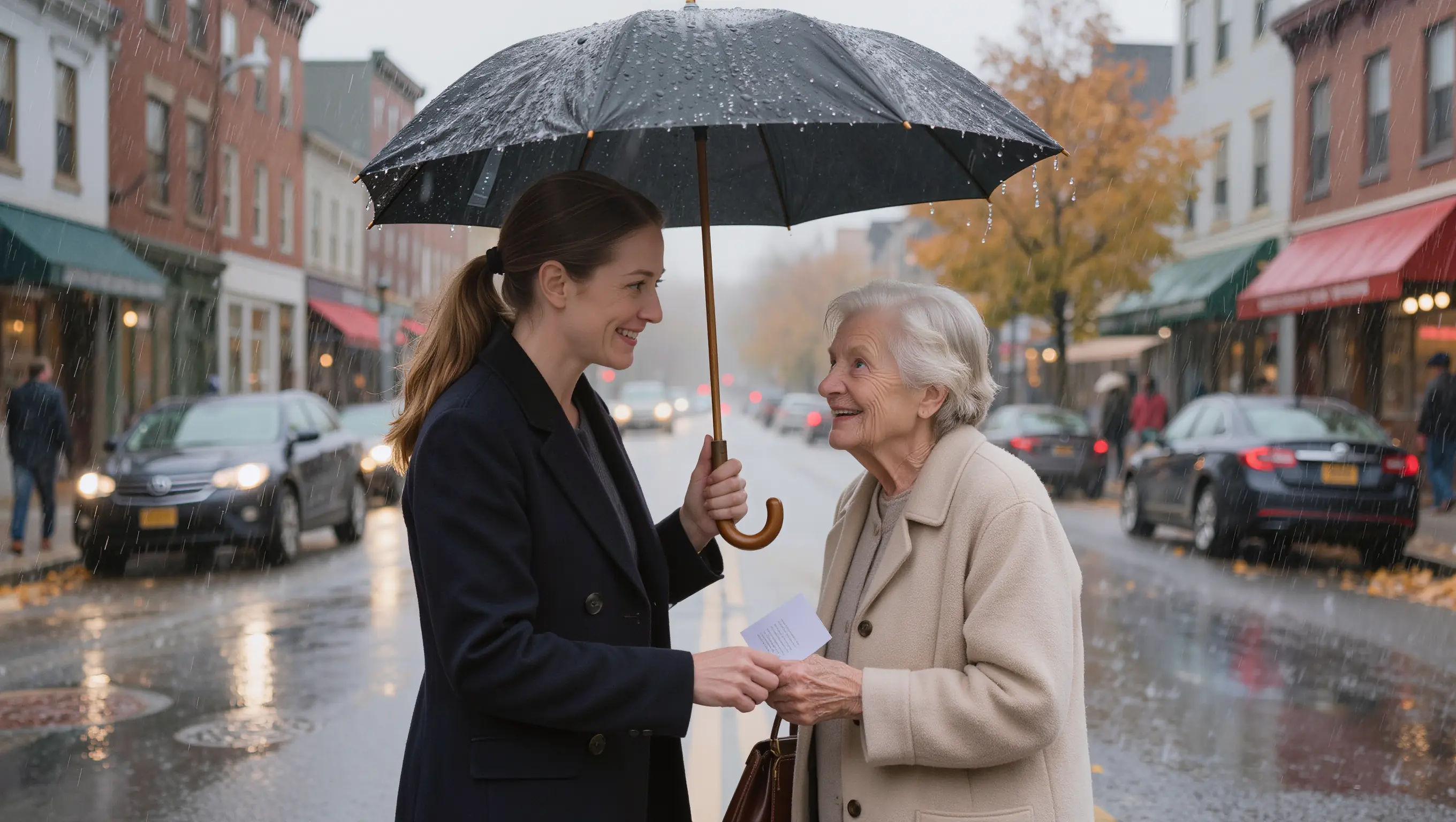
Clara was standing near the front window of the shelter, taping a flyer for the winter coat drive to the glass, when she saw the elderly woman across the street.
The woman stood near the bus stop without an umbrella.
She was small and thin, probably in her late seventies, with short silver hair soaked flat against her face, pale skin, and wide blue eyes behind rain-specked glasses. She wore a beige cardigan under a light coat that was not warm enough for the weather. One hand clutched a brown purse. The other held a folded paper that had gone limp from rain.
Cars passed.
People walked around her.
The woman did not move.
Clara watched for only a few seconds before something inside her tightened.
That woman was not waiting for a bus.
She was lost.
Clara grabbed the shelter umbrella, pulled on her coat, and stepped into the rain.
She crossed the street carefully and approached slowly, keeping her voice gentle.
“Ma’am?” Clara said. “Are you all right?”
The old woman turned toward her, startled.
“I’m waiting for Henry,” she said.
Clara paused.
“All right. Where is Henry meeting you?”
The woman looked toward the street.
“At the pharmacy.” Her voice trembled. “Or the bakery. He said he would come back.”
Clara looked around.
The pharmacy was two blocks away.
The bakery had closed three years earlier.
“What’s your name?” Clara asked.
The woman blinked.
“My name?”
“Yes.”
The old woman looked down at the wet paper in her hand. Her fingers shook badly.
“Margaret,” she whispered. “Margaret… I know it. Margaret…”
Clara softened immediately.
“That’s okay, Margaret. You don’t have to remember everything right now.”
The woman’s eyes filled with tears.
“I’m not supposed to be here.”
“Where are you supposed to be?”
Margaret looked around the rainy street.
“Home.” Then she frowned. “No. The blue house. There was a blue house. Henry painted the door.”
Clara noticed that Margaret’s lips were turning pale from the cold. Her hands shook not only from fear, but from exposure.
“Margaret,” Clara said gently, “I work at the shelter right across the street. It’s warm inside. We can sit down, dry off, and figure out how to find Henry.”
Margaret stepped back.
“I can’t go with strangers.”
“You’re right to be careful,” Clara said immediately. “So let’s do this slowly. My name is Clara Evans. I work in that building with the green sign. See it?”
Margaret looked.
The sign read:
Willow Glen Community Shelter
Clara continued, “I will stand right here with you. You can decide. But you’re very wet, and I don’t want you getting sick.”
Margaret looked at Clara’s face for a long moment.
Then she whispered, “I’m cold.”
“I know. Let’s get you warm.”
Margaret allowed Clara to hold the umbrella over her. She did not take Clara’s arm at first. She simply walked beside her, slow and frightened, across the street.
Inside the shelter, warm air surrounded them.
The front desk volunteer, Marcus, looked up.
Clara quietly said, “Elderly woman found outside, possibly memory loss. I need the quiet corner, towels, tea, and a phone.”
Marcus nodded without asking unnecessary questions.
Clara guided Margaret to the quiet corner, away from the busy community table. She helped her sit in a soft chair, then brought a towel for her hair and a dry blanket for her shoulders.
Margaret held her purse tightly against her chest.
“I didn’t steal anything,” she said suddenly.
Clara knelt in front of her, keeping her voice calm.
“I know. No one thinks you did.”
“They get angry when I move things.”
“Who gets angry?”
Margaret looked confused.
“I don’t know.”
Clara did not push.
She brought tea with honey and set it on the small table.
“You don’t have to answer questions fast,” Clara said. “You’re safe here.”
Margaret stared at the tea.
“My mother used to put honey in tea.”
“That sounds nice.”
“She said sugar was for cheerful people. Honey was for serious days.”
Clara smiled.
“Then this is definitely a honey day.”
For the first time, Margaret gave a tiny laugh.
It was quick, fragile, and gone almost at once.
Clara asked softly, “May I look in your purse for an ID or a phone number? I won’t take anything away. I’ll look right here where you can see.”
Margaret tightened her grip.
“My purse?”
“Yes. Just to help call someone who knows you.”
Margaret shook her head at first.
Clara waited.
She had learned not to rush frightened people.
Finally, Margaret opened the purse herself and placed it on her lap.
Inside were tissues, a wallet, a small comb, a house key, a lipstick, several receipts, a folded photograph, and a medical bracelet tucked into a side pocket.
Clara saw the bracelet and gently asked, “May I read that?”
Margaret handed it to her.
The bracelet had a name engraved on it:
Margaret Ellis
Alzheimer’s — Memory Support Needed
Call Daniel Ellis
A phone number followed.
Clara’s chest tightened.
Alzheimer’s.
Now the pieces fit.
The old bakery.
Henry.
The blue door.
The confusion.
The fear.
Clara took the shelter phone and dialed Daniel Ellis.
A man answered on the first ring, breathless.
“Hello?”
“Hi, is this Daniel Ellis?”
“Yes.”
“My name is Clara Evans. I work at Willow Glen Community Shelter. I’m here with Margaret Ellis. She’s safe. I found her outside near the bus stop in the rain.”
For one second, there was silence.
Then the man’s voice broke.
“Oh my God. Mom. You found my mom?”
“Yes. She’s here with me. She’s wet and frightened, but she’s safe. We’re warming her up now.”
“We’ve been looking for her for forty minutes. She slipped out when the home aide went to get her coat. I was driving around near the pharmacy. Is she okay?”
“She’s calm right now.”
“Can I speak to her?”
“Of course.”
Clara turned to Margaret.
“Margaret, Daniel is on the phone.”
Margaret looked confused.
“Daniel?”
“Your son.”
Her face shifted.
For a moment, the name reached her.
“My Danny?”
Clara smiled gently.
“Yes. Your Danny.”
Margaret took the phone with both hands.
“Danny?”
Clara looked away to give her privacy, but she heard Margaret’s voice crack.
“I was waiting for your father. He didn’t come.”
A pause.
Then Margaret whispered, “Oh. He’s gone, isn’t he?”
Clara felt tears sting her eyes.
Daniel must have answered gently, because Margaret closed her eyes and nodded as if receiving bad news she had received many times before.
“I forgot again,” she said.
Clara sat beside her.
Margaret handed the phone back, shaking.
Daniel said, “I’m ten minutes away. Please don’t let her leave.”
“She won’t,” Clara said. “We’ll stay with her.”
“Thank you. Thank you so much.”
While they waited, Clara did not ask Margaret more questions about how she had gotten there. Instead, she helped her dry her glasses. She brought a bowl of soup from the kitchen. She placed the folded photograph from Margaret’s purse on the table, asking permission before touching it.
The photo showed a younger Margaret standing beside a man in a blue shirt in front of a small house with a blue door.
“Is this Henry?” Clara asked.
Margaret smiled.
“Yes. My husband. He painted the door blue because he said white doors had no imagination.”
“He sounds wonderful.”
“He was.” Margaret’s smile trembled. “Is he coming?”
Clara took a breath.
She remembered training from a dementia-care workshop: do not argue harshly with the person’s reality. Redirect gently. Offer safety.
“Daniel is coming,” Clara said. “He’ll help us get you home.”
Margaret looked relieved.
“Daniel is a good boy.”
“I can tell.”
“He worries too much.”
“That is what good sons do.”
Margaret ate a few spoonfuls of soup. Her hands steadied slightly.
When Daniel arrived, he came through the shelter door soaked from rain, his face pale with panic. He was in his early fifties, with tired eyes, dark hair streaked with gray, and a jacket thrown on so quickly it was buttoned wrong.
“Mom.”
Margaret looked up.
For a second, she did not recognize him.
Then something opened in her face.
“Danny.”
He crossed the room and knelt in front of her chair.
She touched his wet hair.
“You’ll catch cold.”
Daniel laughed and cried at the same time.
“You scared me half to death.”
“I was waiting for your father.”
“I know,” he whispered.
“I forgot.”
“It’s okay.”
“No,” Margaret said, her voice breaking. “It’s not.”
Daniel took her hands carefully.
“It’s okay right now. You’re safe.”
Clara stepped back, letting them have the moment.
But Daniel turned to her.
“I don’t know how to thank you.”
“She was across the street. I’m glad I saw her.”
“You did more than see her,” he said. “You stopped.”
Margaret looked at Clara.
“She gave me honey tea,” she said.
Daniel wiped his eyes.
“That sounds important.”
“It was,” Margaret said seriously.
Before leaving, Daniel explained that Margaret had been diagnosed with Alzheimer’s three years earlier. She still lived at home with him and daytime aides, but her memory had worsened recently. On rainy days, she sometimes believed she was younger, waiting for Henry near the old bakery they used to visit every Friday.
“She can be calm for weeks,” Daniel said quietly, “then suddenly she’s looking for a place that doesn’t exist anymore.”
Clara listened carefully.
“Does she have a recent photo and emergency card she carries?”
“The bracelet, yes. But she sometimes takes it off.”
Clara looked at the bracelet, then at Margaret’s purse.
“What if she had something she liked carrying? Something that didn’t feel medical?”
Daniel looked at her.
“Like what?”
“A memory card. Laminated. A photo of you. Her address. Your number. Maybe a line that says, ‘If I feel lost, please call Daniel.’ Something gentle.”
Daniel looked exhausted but hopeful.
“That might work.”
Margaret was listening.
“I’m not lost,” she said.
Clara smiled at her.
“No. But sometimes streets are rude.”
Margaret laughed softly.
“Very rude.”
The next day, Daniel returned to the shelter with Margaret.
Not because she was lost.
Because he wanted to thank Clara properly.
Margaret wore a warmer coat and a small necklace with her emergency information tucked inside a locket-style case. She also carried a laminated card Clara had helped Daniel design.
On one side was a photograph of Margaret and Daniel.
On the other, in large letters, it said:
My name is Margaret Ellis.
If I seem confused, please call my son Daniel.
He loves me and knows how to help.
Margaret read it slowly.
“He loves me,” she said.
Daniel’s eyes filled.
“Yes, Mom.”
“That’s nice to have in writing.”
Clara smiled.
“It is.”
After that, Margaret and Daniel began visiting the shelter once a week.
Sometimes Margaret remembered Clara.
Sometimes she did not.
But she always liked the honey tea.
Daniel began talking with Clara about how difficult it was to care for someone with Alzheimer’s at home. Not because he did not love his mother, but because love did not automatically teach a person what to do when the past and present tangled together.
“She gets frightened,” Daniel said one afternoon. “Then I get frightened. Then we both feel guilty.”
Clara nodded.
“People need safe steps before crisis moments.”
That sentence stayed with her.
The Safe Chair idea began changing from a dream into something urgent.
Clara started researching dementia-friendly spaces. She read about calm rooms, memory cards, emergency contacts, caregiver support, wandering prevention, and community response systems. She spoke to the shelter director, local café owners, the library, the pharmacy, and the senior center.
At first, people were unsure.
“We’re not trained for medical situations,” one café owner said.
“You don’t need to become a hospital,” Clara replied. “You need to know how to offer a safe chair, call the right person, and avoid making the person more afraid.”
The shelter director agreed to let Clara run a small pilot workshop.
Daniel came and spoke.
He told the story of the rainy afternoon, Margaret waiting for Henry, Clara bringing her inside, and the difference between being treated like a problem and being treated like a person.
Margaret sat beside him, drinking honey tea.
At the end, she raised her hand.
Everyone turned gently.
She said, “If I am lost, please do not shout. I am already frightened.”
The room went completely still.
Then the café owner who had been skeptical wiped his eyes.
The Safe Chair program began with four locations: the shelter, Rose Street Café, Willow Glen Library, and the pharmacy.
Each location had a small sign inside, not outside:
Safe Chair Partner
If someone seems lost, confused, or frightened, we offer a seat, calm help, and a call to family.
Volunteers were trained to speak gently, avoid crowding, offer water or tea, check for ID bracelets or cards, call emergency contacts, and contact emergency services when needed.
Clara created memory-card templates.
Daniel helped review them.
Margaret chose the color blue for the cards because Henry had painted the door blue.
So the Safe Chair cards were blue.
A month later, the program helped its second person: an elderly man who became confused outside the library after missing his ride. He was seated, warmed, and reunited with his daughter in fifteen minutes.
Then a woman at the pharmacy.
Then another man near the café.
Each time, Clara updated the procedures.
Each time, the community became a little less helpless.
One afternoon, Daniel brought Clara a small velvet pouch.
“My mother wanted you to have this,” he said.
Margaret sat beside him, smiling.
Inside the pouch was a silver bracelet.
Not the medical bracelet.
An older one.
Delicate, with a small blue stone charm.
Clara looked up.
“No. I can’t take this.”
Daniel smiled sadly.
“It was hers before the Alzheimer’s. My father gave it to her on their twentieth anniversary.”
Clara shook her head.
“Then it belongs to your family.”
“My daughter has the matching necklace. Mom wanted this one to go to you.”
Margaret leaned forward.
“I know you,” she said suddenly.
Clara’s eyes widened.
Margaret touched her hand.
“You brought me in from the rain.”
Clara could not speak.
Margaret placed the bracelet in her palm.
“Henry liked blue,” she said. “You should have blue.”
Daniel’s voice was thick.
“She doesn’t remember everything, but she remembers feeling safe with you.”
Clara closed her fingers around the bracelet and cried.
Daniel also gave her a letter of recommendation for a community health grant. He wrote about the rainy day, the shelter, his mother’s Alzheimer’s, and the Safe Chair pilot program.
At the end, he wrote:
Clara Evans understands that memory loss does not erase dignity. She helps communities respond to confusion with calm, respect, and human warmth.
With Daniel’s letter, shelter records, pilot results, and support from the library and pharmacy, Clara applied for the grant.
She won.
Not a fortune.
Not a building.
Not a miracle cure.
But enough to buy training materials, printed blue memory cards, lanyards, safe-chair signs, caregiver resource folders, a dedicated phone line, and outreach sessions for families.
The Safe Chair became an official community program.
Clara became its coordinator.
She still worked at the shelter, but now part of her job was training people across Willow Glen to recognize confusion without judgment.
She taught them:
Do not argue with fear.
Do not shame confusion.
Do not demand fast answers.
Offer a chair.
Offer warmth.
Ask one question at a time.
Look for a card, bracelet, phone, or contact.
Call someone who loves them.
And above all, remember that the person is still a person.
Margaret continued visiting as long as she could.
Some days she called Clara by name.
Some days she called her “the honey tea girl.”
Clara accepted both as gifts.
When Margaret’s Alzheimer’s worsened, Daniel eventually moved her into a memory-care home nearby. Clara visited twice a month. She brought honey tea in a thermos and sometimes sat beside Margaret without speaking.
One afternoon, Margaret looked at Clara’s wrist and saw the blue bracelet.
She touched it softly.
“Pretty,” she said.
“It was yours.”
Margaret smiled faintly.
“Then I had good taste.”
Clara laughed through tears.
Years passed.
The Safe Chair program spread to nearby towns. Clara trained café workers, librarians, bus drivers, shelter staff, pharmacy clerks, and volunteers. Families began creating blue memory cards before emergencies happened. Caregivers said they felt less alone knowing there were places their loved ones could be welcomed, not feared.
Clara never became rich.
But she became part of the invisible net that caught people before panic turned into tragedy.
Margaret passed away peacefully one spring morning.
At her memorial gathering, Daniel placed the blue memory card beside a photograph of his mother and Henry in front of their house with the blue door. Clara stood quietly in the back, wearing the silver bracelet with the blue stone.
After the gathering, Daniel handed her one final note.
“Mom dictated parts of this on a clear day,” he said. “I wrote the rest with her.”
Clara opened it with trembling hands.
Dear Clara,
Some days I remember the rain.
Some days I only remember that someone was kind.
Daniel says you found me when I was waiting for Henry.
Maybe I was lost.
Maybe I was looking for home.
You gave me a chair, tea, and my son’s voice.
Please keep doing that for others.
No one should be frightened alone.
With love,
Margaret Ellis
Clara framed the note at the shelter’s Safe Chair desk.
Years later, whenever people asked how the program began, Clara told them the truth.
“It began with an old woman with Alzheimer’s standing in the rain, waiting for a husband who had been gone for years.”
Then she would show them the blue bracelet.
The gift was small.
A bracelet.
A letter.
A memory card.
But inside those small things was the future Clara had been trying to build.
And every time someone confused and frightened came through a Safe Chair door, Clara remembered Margaret’s words.
No one should be frightened alone.
So she offered a chair.
She offered warmth.
And she called someone who loved them.