A fierce winter storm swept across the Iowa plains when a young farm woman spotted a luxury car stranded in the snow. Inside was an elderly man trembling from the cold and refusing help.
She took him home, fed him soup, and offered shelter for the night.
By morning, he was gone, leaving only a polished government card on her table.
Days later, as she faced losing her farm, a sedan stopped at her gate again.
The wind came early that December afternoon, sweeping across the Iowa fields like something alive and angry. Hannah Whitmore pulled her coat tighter, her breath forming small clouds in the freezing air.
Twenty-eight years old, and she’d spent every one of them learning how to stand against the wind.
The hay bales weren’t going to stack themselves. She grabbed another one, her hands raw even through the work gloves, and hoisted it onto the pile. Her knees sank into the half-frozen mud.
The sky was that particular shade of gray that meant snow. Serious snow. The kind that shut down highways and left entire towns dark.
Just two more rows, she told herself. Then I can go inside.
But even as she thought it, she knew it wasn’t true.
There was always one more thing. One more fence to check, one more animal to feed, one more bill she couldn’t pay sitting on the kitchen table.
Her father used to say that farming wasn’t a job. It was a promise you made to the land. You kept that promise even when the land couldn’t promise you anything back.
He died three years ago, and Hannah had been keeping that promise alone ever since.
Some days, it felt like keeping a promise to a ghost.
Daisy, her golden retriever, barked twice from near the truck. Sharp, urgent barks that cut through the wind.
Hannah straightened up, pressing one muddy hand against the small of her back.
That’s when she saw it.
Headlights far down the county road. They flickered once, then went dark.
She squinted against the wind. A car, expensive-looking even from this distance, sat crooked in the shallow ditch where the road curved. Its hazard lights blinked weakly like a distress signal growing fainter by the second.
Not my problem, she thought immediately.
I’ve got enough problems.
The wind picked up, howling across the empty fields. The temperature was dropping fast. She could feel it in her bones, the way her father used to predict storms by the ache in his knees.
The radio that morning had said the storm would hit by six. It was almost five now.
Whoever was in that car didn’t have much time. Maybe an hour before the roads became impassable. Maybe less.
Hannah stood there, frozen, not by the cold, but by indecision. Every instinct told her to get in her truck and drive the other way. Strangers meant complications. Strangers meant risk.
And she had enough of both already.
The red envelope from the bank. The phone calls she’d been avoiding. The future that seemed to narrow with each passing day.
But then she heard her father’s voice in her head as clear as if he were standing right beside her.
In the dead of winter, kindness is the only thing that lasts.
She’d been twelve when he first said that. They’d been driving home from church and passed a car broken down on the shoulder. Her father had pulled over without hesitation, helped the family inside, and driven them all the way to Des Moines, even though it took them three hours out of their way.
Hannah had fallen asleep in the back seat, warm and safe, while her father and the stranger talked in low voices about crops and weather and the kindness of small towns.
“Why’d you do that, Dad?” she’d asked the next morning. “We don’t even know them.”
“That’s exactly why,” he’d said, flipping pancakes at the stove. “When you know someone, helping them is easy. It’s helping strangers that shows who you really are.”
Hannah looked at Daisy, who was still staring at the distant car, ears perked forward, tail straight out in that way that meant something was wrong and needed fixing.
“Yeah,” she muttered, her breath fogging in the cold air. “I know.”
She climbed into her pickup truck, a 1998 Ford with rust along the wheel wells and a passenger door that only opened from the outside. The engine coughed twice before turning over, the way it always did when the temperature dropped below freezing.
She pulled onto the dirt road, headlights cutting through the gathering dusk, illuminating the swirling snow that had started to fall.
As she got closer, she could make out more details. The sedan was a BMW, and sleek, completely out of place against the stark winter landscape. It looked like something from a magazine, not something that belonged on a county road in rural Iowa.
One of its front wheels had dropped into the drainage ditch. The driver was still inside, visible as a dark shape behind the steering wheel.
Hannah pulled up alongside and rolled down her window. The cold hit her like a slap, stealing the breath from her lungs.
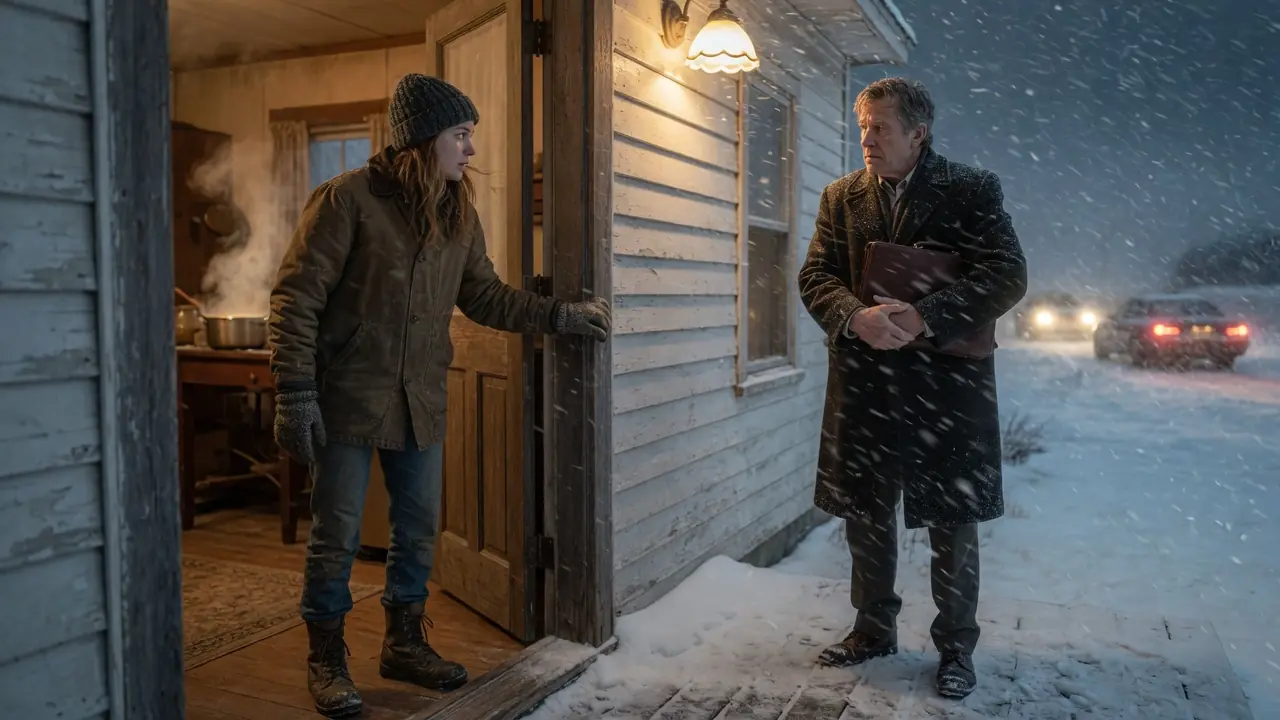
The driver’s door opened. A man in his early sixties stepped out. Salt-and-pepper hair, expensive wool coat, leather shoes completely wrong for Iowa in December.
His face was pale, his eyes a startling shade of blue, and he looked embarrassed more than anything else, like a man who’d made a mistake and knew it but wasn’t quite sure how to fix it.
He looked at her truck, at her mud-stained jeans and work boots, and something like relief crossed his face.
“Evening,” Hannah called out. “You okay?”
“I… yes,” the man said. His voice was educated. East Coast, maybe Boston or New York. “I called roadside assistance. They said ten minutes.”
Hannah glanced at the sky. The clouds were low and dark, moving fast from the north. She could smell the storm coming. That particular scent of snow and cold that meant the world was about to turn white.
“Ten minutes in Iowa winter means tomorrow morning,” she said, her tone matter-of-fact. “Maybe the morning after that if the storm’s bad enough, and this one’s going to be bad.”
The man followed her gaze, and she saw the moment he understood. His shoulders sagged slightly, and he looked back at his car like it had personally betrayed him.
“I don’t want to impose.”
“You’ll freeze if you stay out here.”
She wasn’t usually this direct, but there wasn’t time for politeness. The wind was already strong enough to rock her truck.
“My place is two miles that way. You can wait there until the roads clear.”
The man hesitated. He glanced back at his car like it might somehow start working again through sheer force of will. Hannah could see him calculating pride versus survival, inconvenience versus death.
It was the kind of calculation city people always made too slowly.
“I really don’t want to be a burden,” he said.
A burden? Hannah thought.
Like I don’t already carry enough of those.
But she heard herself say, “If I drive away and leave you here, neither one of us is going to sleep tonight. So do us both a favor and get in the truck.”
Something in her tone must have convinced him. He reached into the back seat, pulled out a leather briefcase and a small overnight bag, and locked the car with a beep that sounded absurdly cheerful in the howling wind.
Then he walked over to her truck, fumbled with the passenger door for a moment before figuring out the trick to opening it, and climbed in.
Daisy, sitting in the narrow space behind the seats, barked once, a question more than a threat. Then, apparently deciding the stranger was acceptable, she settled down with her head on her paws and watched him with dark, intelligent eyes.
“I’m Thomas Reed,” the man said as Hannah pulled back onto the road. “Tom.”
She didn’t offer her last name. Didn’t seem necessary. In another few hours, this man would be gone, and she’d probably never see him again.
They drove in silence for a while. The wind rocked the truck, and Hannah kept both hands on the wheel, her attention fixed on the road ahead.
The first flakes of snow started to fall, small and hard, ticking against the windshield like thrown rice. Within minutes, they grew larger, softer, falling so thick that the road ahead disappeared into white.
“Thank you,” Tom said quietly. “This is very kind of you.”
Hannah shrugged, not taking her eyes off the road.
“This is Iowa. We don’t leave people to freeze.”
“Still, not everyone would have stopped.”
She didn’t have an answer for that, so she said nothing.
The truth was she’d almost kept driving. She’d almost chosen safety over kindness, fear over faith. The knowledge sat heavy in her chest.
After another minute, Tom spoke again.
“I used to work with fields like these. On paper, anyway. Agricultural reports, land-use studies, that sort of thing.”
“Paper doesn’t smell like wet grass,” Hannah said.
Tom smiled. A small, sad sort of smile that made him look younger for a moment.
“No, you’re right about that. It’s been a long time since I remembered what it actually smells like. What it feels like. Real dirt under your fingernails. Real sweat on your back.”
He paused.
“I think I forgot why any of it mattered.”
Hannah glanced at him, curious despite herself, but didn’t push. People told you what they wanted you to know when they were ready.
The headlights picked out the shape of her farmhouse ahead. A small two-story structure with peeling white paint and a sagging front porch. Smoke rose from the chimney. She’d left a fire burning that morning the way her father had taught her.
Never let the fire go out completely in winter. It was easier to feed a living flame than to start from cold ash.
“Home,” she said, more to herself than to him.
She parked near the porch. Tom climbed out carefully, briefcase and bag in hand, and followed her to the front door. His leather shoes slipped on the icy steps, and he caught himself on the railing.
City shoes.
Hannah shook her head, but said nothing.
Daisy bounded ahead, tail wagging, and pushed through the dog door Hannah had installed last spring.
Inside, the house was exactly warm enough, not cozy, not uncomfortable, just livable. Hannah added wood to the fire in the stone fireplace, then went to the kitchen to heat up some corn soup she’d made two days ago.
Tom stood awkwardly in the living room, still wearing his coat, looking around at the modest space. The worn furniture covered in hand-stitched quilts, the photographs on the mantle showing three generations of Whitmores on this land, the bookshelf filled with agricultural journals and old novels with cracked spines.
“You can sit,” Hannah said from the kitchen. “I don’t bite.”
He smiled and sat down on the couch, setting his briefcase carefully beside him.
Hannah brought him a bowl of soup and a thick wool blanket that had belonged to her father. It still smelled faintly of pipe tobacco and Old Spice.
“It’s not much,” she said, handing him a spoon.
“It’s perfect,” Tom replied, and he sounded like he meant it.
He wrapped his hands around the bowl, soaking in the warmth, and took a careful sip.
“This is really good.”
“Family recipe. My grandmother’s.” Hannah sat down across from him with her own bowl. “Nothing fancy, just corn and potatoes and whatever else was around.”
They ate in silence. Outside, the wind grew louder, rattling the windows, finding every crack and gap in the old house.
Hannah made a mental note to stuff more newspaper in the window frames tomorrow.
If there was a tomorrow.
If the bank didn’t take the house first.
The lights flickered once, then went out completely.
Hannah sighed, set down her bowl, and lit two candles she kept on the coffee table. She’d learned to keep them there after the third or fourth time the power went out last winter.
“This happen a lot?” Tom asked.
“Every winter. Sometimes twice a week.”
She sat back down across from him.
“You get used to it. It’s kind of peaceful, actually. Forces you to slow down.”
In the candlelight, the small room felt even smaller, but also warmer, somehow more human. The darkness outside pressed against the windows, but inside, there was light and warmth, and the smell of soup and wood smoke.
Tom looked at the fire, his face thoughtful, light dancing across his features.
“It’s strange,” he said. “The power goes out, but it doesn’t feel dark.”
“That’s because the wind hasn’t found a way in yet,” Hannah said.
It was something her father used to say during storms. The wind would howl and rage, but as long as the house stood firm, as long as the fire kept burning, they were safe.
She reached over to the bookshelf and pulled down a harmonica, dented and old, with her father’s initials scratched into the side.
JW.
James Whitmore.
She brought it to her lips and played a slow, simple melody. Nothing fancy, just the kind of tune you played when you were alone and needed to hear something besides the wind.
A song about fields and sky and the long wait for spring.
Tom closed his eyes and listened. His breathing slowed, his shoulders relaxed.
When she finished, he opened them again, and there were tears on his cheeks that he didn’t bother to wipe away.
“Thank you,” he said softly. “I think I just found something I didn’t know I’d lost.”
Hannah set the harmonica down carefully.
“What’s that?”
“Quiet,” he said. “Real quiet. The kind you can only hear when everything else stops. When you stop running long enough to remember why you started running in the first place.”
They sat in the flickering candlelight, two strangers sheltering from the storm.
And for a moment, neither of them felt quite so alone.
The storm howled outside, but inside the small farmhouse, there was only the crackling fire and two people learning what it meant to be saved.
Tom woke to the smell of coffee and burning wood and something baking.
For a moment, he didn’t know where he was. The ceiling was unfamiliar, lower than his apartment in Arlington. The quilt covering him was handmade, heavy, warm in a way that had nothing to do with temperature.
Then he remembered the broken-down car, the young woman with tired eyes and kind hands, the farmhouse, the storm.
He sat up on the couch, his back stiff from sleeping in an unfamiliar position. Pale winter light poured through the windows so bright it hurt his eyes.
Everything outside was white. The fields, the fence posts, the roof of the barn in the distance. The world had been erased and redrawn in shades of white and gray and the faintest blue.
Hannah was already awake, already dressed. Through the window, he could see her sweeping snow off the porch with a wide push broom. She moved efficiently, economically, like someone who’d done this a thousand times before.
Like someone who knew that survival was built on small, consistent actions repeated until they became instinct.
Tom stood, folded the blanket, and pulled on his coat. He stepped outside into the shocking cold. The air was so crisp it felt like it might shatter. His breath came out in great clouds.
Hannah glanced over, not stopping her work.
“Morning.”
“You’re up early,” he said.
“This is late for me.”
She leaned the broom against the wall and pulled off her work gloves. Her hands were red from the cold.
“If I don’t do it, nobody else will. Out here, the land only listens to people who show up. Every day. No excuses.”
Tom smiled. There was something he admired about that. The straightforwardness, the lack of pretense, the understanding that some things couldn’t be delegated or delayed.
She gestured toward the door.
“Made coffee. You want some?”
“Please.”
They went back inside. Hannah poured two cups from an old percolator and set out corn muffins she’d baked that morning while he slept.
They sat at the small kitchen table. The only sound was the ticking of an old clock on the wall and the occasional pop from the fireplace.
Tom wrapped his hands around the mug, letting the warmth seep into his fingers. The coffee was strong, bitter, perfect.
“You baked these this morning?”
“Had to use up the cornmeal before it goes bad. Can’t afford to waste anything.”
She said it matter-of-factly, without self-pity.
“So,” Hannah said after a while, “what brings someone like you out to Iowa in December?”
“Someone like me?”
She gave him a look, not unkind, but knowing. The kind of look that said she’d sized him up and reached certain conclusions.
“City clothes, fancy car, leather briefcase. You’re not here to check on crops.”
Tom sipped his coffee, considering how much to tell her.
“I had meetings in Des Moines. Agricultural policy stuff. Budget allocations, subsidy programs, that kind of thing. I was driving back to the airport when the storm hit.”
“Agricultural policy,” Hannah repeated.
Her tone was neutral, but he could hear the skepticism underneath. The weariness of someone who’d heard promises before and watched them evaporate.
“I know,” Tom said. “It sounds boring.”
“It sounds like paperwork,” Hannah corrected, breaking a muffin into pieces, “which is different from boring. Paperwork decides who gets to keep farming and who doesn’t. Paperwork decides which families stay on their land and which ones get foreclosed on. Paperwork is life and death. It just doesn’t look like it from an office in Washington.”
There was an edge to her voice now, sharp as winter wind.
And Tom didn’t miss it.
“You’re right,” he said quietly. “It does. And sometimes we forget that. We see numbers on spreadsheets and forget they’re people. Farms. Families. Lives.”
She looked at him over the rim of her coffee mug, reassessing, like maybe he wasn’t just another bureaucrat who thought he understood rural America because he’d driven through it once.
“If you could change one thing about this place,” Tom asked, “what would it be?”
Hannah didn’t answer right away. She looked out the window at the snow-covered fields, at the barn where her father had taught her to milk cows when she was six, at the land that held every memory of everyone she’d ever loved.
“I’d want the banks to believe in young people,” she said finally. “Nobody wants to farm if they can’t get a loan. And nobody gives loans to people who don’t already have money or land or connections.”
She paused, her jaw tightening.
“So the land just sits there or gets sold off to corporations who don’t care about it, who just see soil as something to extract value from until there’s nothing left. My neighbors, the Hendersons, the Kowalskis, the Chens, they’ve all sold out in the last five years. I’m the only one left under forty in this whole county who’s still trying.”
Tom nodded slowly.
He’d heard versions of this story a hundred times in conference rooms and committee meetings. Young farmers couldn’t get credit. Old farmers couldn’t find successors. Land was being consolidated into massive corporate operations that treated farming like any other extractive industry.
But sitting here in this small kitchen with this young woman who’d saved him from freezing, it felt different.
More real.
More urgent.
“Sometimes,” he said, “we forget that faith is capital too. That belief in someone’s potential is worth as much as collateral. Maybe more.”
Hannah blinked, surprised.
Then she smiled just a little, but it transformed her face, made her look younger, less burdened.
“Yeah,” she said. “Something like that.”
They finished their coffee in comfortable silence.
Outside, the sound of an engine broke the quiet. A tow truck came up the long driveway, its yellow lights flashing against the white landscape.
“That’ll be for you,” Hannah said, standing.
Tom stood too. They walked together to the front door.
The tow truck driver, a heavyset man in a John Deere cap and insulated overalls, waved from the cab.
“Morning,” he called out, his breath fogging. “You the guy with the BMW?”
“That’s me,” Tom said.
“She’s frozen solid, but we’ll get her out. Might take a couple hours, though. Roads are still pretty bad.”
Tom turned to Hannah. He reached into his coat pocket and pulled out a business card. Not his official USDA card, but one with just his name and personal cell phone number.
“If you ever need good seed stock,” he said, “call me.”
Hannah took the card, glanced at it, then looked up at him with a wry smile.
“And if you ever need soup, you know where to find me.”
Tom laughed, a real laugh that felt like the first honest sound he’d made in months.
“Deal.”
He walked to the tow truck, briefcase and bag in hand.
As the driver started to pull away, Tom looked back one last time. Hannah stood on the porch, one hand raised in a small wave, Daisy sitting beside her.
He waved back, watching the farmhouse grow smaller in the side mirror until it disappeared behind a curve in the road.
It wasn’t until he was sitting in the passenger seat of the tow truck, the driver talking about the storm and road conditions and how lucky Tom was that someone found him, that he glanced down at the business card still in his hand, the one he’d almost given her but had replaced with a different one instead.
Thomas G. Reed, Under Secretary, U.S. Department of Agriculture.
He wondered when she’d figure it out.
He wondered if it would matter.
Back at the farmhouse, Hannah stood on the porch for a long moment after the tow truck disappeared. The cold bit at her exposed skin, but she didn’t move.
She pulled out the business card Tom had given her and read it again.
Just a name and a phone number. Nothing fancy. She flipped it over, but the back was blank.
“Nice guy,” she said to Daisy. “Probably never see him again.”
She was about to go back inside when she noticed something.
Another card.
This one tucked into the door frame, half hidden by the wreath of dried corn husks she’d hung there in October.
She pulled it out, her hands starting to shake even before she read it.
Thomas G. Reed. Under Secretary, U.S. Department of Agriculture.
Below that, an address in Washington, D.C., and an official phone number with so many extensions it took up two lines.
“Oh my God,” Hannah whispered. “I just made a government under secretary sleep on my couch.”
She started laughing softly at first, then harder until Daisy came over to see what was so funny. Hannah sat down right there on the porch steps in the snow and laughed until tears ran down her cheeks.
The absurdity of it. The impossible luck of it. The fact that, of all the people who could have broken down on her road, it had been someone who actually understood agricultural policy.
But then her eyes fell on the kitchen table, visible through the window, on the envelope sitting there.
Red ink. Bold letters.
Final notice.
The laughter died in her throat.
She looked at the two business cards in her hand. One with just a name and number, one with a title that meant power, influence, connections.
He said to call if I needed anything, she thought.
But he meant seeds.
He didn’t mean this.
No, she couldn’t. She wouldn’t.
He’d been kind to her, yes, but kindness didn’t mean obligation. And besides, what could he even do? He was probably back in Washington by now, already forgetting about the small farm in Iowa where he’d spent one night during a storm.
She tucked both cards into her pocket and went back inside, closing the door against the cold and the hope that had briefly, dangerously, flared in her chest.
The next week, the weather cleared. The snow melted just enough to turn everything into slush and mud. That miserable in-between state where nothing was clean and everything was twice as hard.
Hannah spent the days the way she always did. Feeding the animals, fixing fence posts that had been knocked loose by the wind, checking the equipment in the barn that never seemed to work quite right, no matter how many times she repaired it.
But the envelope on the kitchen table seemed to grow heavier each time she walked past it.
Five days, the letter said.
Vacate the property within five days or face legal action.
She’d tried everything. Called the credit union twice, once getting a busy signal, once getting transferred to three different people before being told that her case was under review and someone would get back to her.
She reached out to the regional co-op, only to learn they’d used up their emergency assistance budget for the year helping farmers hit by last summer’s drought.
She even drove to the county extension office through the slush to ask about emergency assistance programs, sitting in a plastic chair for two hours before being told that she made too much money to qualify for aid, but not enough money to actually survive.
“We can’t help you without collateral,” they all said, as if she hadn’t heard it a dozen times before.
But the land was her collateral, and if she lost the land, she had nothing.
No home, no livelihood, no connection to her father, her grandparents, the five generations of Whitmores who’d worked this soil.
Just nothing.
That morning, Hannah woke to find Tom’s car already gone from where he’d parked it the night before.
She stepped outside, coffee mug in hand, and saw only tire tracks in the mud.
No note.
No goodbye.
Just absence.
Her chest tightened. She told herself it made sense. He had a life in Washington. Responsibilities. A job. Of course he couldn’t stay. Of course last night’s conversation was just talk, just comfort offered in a moment of crisis.
Of course.
She went back inside, trying to ignore the hollow feeling in her stomach, and started her morning chores. Daisy followed her quietly, sensing her mood.
On the eighth day after the storm, two days after Tom had left, a SUV pulled up in front of the farmhouse.
Hannah was in the barn trying to fix a broken hinge on one of the stall doors. The metal was rusted, corroded by years of winter moisture, and she’d been working on it for an hour with increasingly desperate measures.
Daisy barked, not her usual friendly bark, but a warning, the kind of bark that meant danger.
Hannah wiped her hands on her jeans and walked outside, her heart already sinking.
Not another inspection.
Please, God, not another person here to document her failure.
But it wasn’t a SUV this time. A silver sedan was pulling up the driveway, moving slowly over the muddy ruts.
The car looked familiar, and for a moment, Hannah couldn’t place it.
Then the door opened, and Tom Reed stepped out.
Hannah’s breath caught in her throat.
He was wearing a wool sweater and jeans this time, not the expensive coat. He looked tired, like he’d been traveling, like he hadn’t slept much, but his eyes were clear and focused.
Determined.
“Hi,” he said, walking toward her.
Hannah just stared at him, unable to form words. Of all the people she’d expected to see, of all the possible outcomes to her crisis, this wasn’t even on the list.
She didn’t know what to say.
“How did you—”
“You didn’t call,” Tom said simply, stopping a few feet away. “So I came.”
“I don’t understand.”
He shifted his weight, looking suddenly uncertain.
“The card I gave you had my personal number on it. When you didn’t call, not that I expected you to, but I hoped. I checked the agricultural census records for this county. Cross-referenced it with recent foreclosure filings.”
He paused.
“There aren’t that many small farms left, and only one owned by someone named Hannah.”
She felt her throat tighten.
“You shouldn’t have come. This isn’t your problem.”
“I know.”
He looked past her at the farmhouse, at the barn, at the fields that were just starting to show the first hint of green beneath the melting snow.
“But I remembered what you said about the banks not believing in young people. And I thought about this place, about what you’re trying to do here, about what it means.”
He looked back at her.
“And I couldn’t just sit in Washington and do nothing.”
“There’s nothing you can do,” Hannah said.
And she hated the bitterness in her voice. Hated how defeated she sounded.
“They’re taking the farm. I have three days left. Three days. And then everything my family built for five generations is gone. So unless you can magic up a hundred thousand dollars, there’s nothing anyone can do.”
“Not if I have anything to say about it.”
She laughed, a sharp, humorless sound.
“You’re one person. You can’t stop a foreclosure. You can’t make a bank suddenly decide to be compassionate. The world doesn’t work that way.”
“No,” Tom agreed. “But I can make a phone call. I can push some paperwork through channels. I can use discretionary powers that exist specifically for situations like this.”
He stepped closer.
“Hannah, that’s why I came back. Not to make promises I can’t keep. To actually help, if you’ll let me.”
Hannah felt tears burning behind her eyes, but she blinked them back furiously. She didn’t want to cry. She didn’t want to hope.
Hope hurt worse than giving up.
“Why?” she whispered. “Why would you do this?”
Tom was quiet for a moment. Then he said, “Because you saved me that night. Not just from freezing, from forgetting why any of this matters. And because if I can’t help one person, one farmer who actually deserves it, then what the hell have I been doing for the last thirty years?”
Hannah couldn’t hold back the tears anymore. They spilled down her cheeks, hot against her cold skin.
“Come inside,” she said. “Please.”
They went inside.
Tom set his briefcase on the kitchen table, opened it, and pulled out a laptop and a folder thick with documents. He moved with purpose, with the kind of focused energy that came from knowing exactly what needed to be done.
“Tell me everything,” he said, opening his laptop. “Start from the beginning. Your father’s death, the medical bills, the loan terms, every conversation you’ve had with the bank. Don’t leave anything out.”
So she did.
She told him about her father’s cancer diagnosis three years ago, how it had come suddenly, aggressively, without warning. About the experimental treatments that insurance wouldn’t cover, the trips to the Mayo Clinic, the hospital stays that ate through their savings like fire through dry grass.
She told him about continuing to work the farm while spending every evening at his bedside, about the moment he’d taken her hand and made her promise not to sell the land no matter what.
“This land is who we are,” her father had said, his voice weak but clear. “It’s not just dirt and crops. It’s every person who came before us. Every sacrifice they made. You keep this promise, Hannah. You keep it. Even when it’s hard.”
She’d kept it.
God, she tried so hard to keep it.
She told Tom about the bad growing season last year. Too much rain in spring, too little in summer, prices dropping just when she needed them to rise.
About falling behind on the loan payments, then falling further behind. About the credit union’s refusal to renegotiate, their insistence that she either pay in full or face foreclosure.
“I called them twelve times,” Hannah said, her voice shaking. “Twelve times. I explained the situation. I offered to put up additional collateral. I begged.”
She laughed bitterly.
“I actually begged. And do you know what they told me?”
Tom shook his head.
“They said, ‘We’re sorry, but business is business.’ Like my entire life was just a line item on a spreadsheet. Like my father’s death was just bad timing that affected their profit margins.”
Tom’s jaw tightened, but he said nothing. He just kept typing, making notes, pulling up programs on his laptop.
Hannah told him about the co-op’s empty promises, about the county extension office that couldn’t help without collateral she didn’t have, about every door that had slammed in her face.
She told him about the inspection two days ago, about watching strangers photograph her home like they were documenting a crime scene.
When she finished, she felt hollow, emptied out, like she’d just confessed every failure, every weakness, every moment she hadn’t been strong enough.
Tom looked up at her, and his eyes were fierce.
“Okay,” he said. “Here’s what we’re going to do.”
“We?”
“I owe you,” Tom said firmly. “You gave me shelter when I needed it. You showed me kindness when you had every reason to protect yourself first. Now I’m going to do the same for you.”
“This isn’t the same thing.”
“Yes, it is.”
His voice was firm, but not harsh.
“Shelter isn’t just a roof, Hannah. It’s a second chance. It’s someone believing in you when you’ve stopped believing in yourself. You gave me that. Now let me give it back.”
Hannah felt her throat close up, but she nodded.
Tom pulled up a program on his laptop and started typing rapidly.
“There’s a USDA provision for emergency farm assistance,” he said. “It’s not well known because it’s buried under three layers of bureaucracy and requires specific criteria to be met, but it exists. It’s designed for exactly this kind of situation. Young farmers facing financial hardship through no fault of their own who demonstrate commitment to sustainable practices and community benefit.”
“I tried that,” Hannah said. “Last month. They said I didn’t qualify because I didn’t have an approved business plan on file.”
“That’s because they didn’t know who to ask.”
Tom glanced up at her, and there was something almost fierce in his expression.
“I know who to ask. I know which forms to file and which regulations allow for expedited review. And I know how to make this happen.”
He picked up his phone and dialed. Someone answered on the second ring.
“Sarah, it’s Tom Reed. I need you to pull the emergency assistance files for Iowa, Story County. Yes, I know it’s late. This is urgent.”
He listened, typed something into his laptop, then spoke again.
“I’m authorizing an immediate review under discretionary powers, Section 1472, Subsection C. Send the forms to my email within the hour. No, I’ll take full responsibility. Yes, I understand the precedent. I’m doing it anyway. Thank you, Sarah.”
He hung up and looked at Hannah.
“We’ll have the paperwork by morning.”
Hannah sank into a chair, her legs suddenly weak.
“Why are you doing this? Really?”
Tom closed the laptop for a moment.
He didn’t answer at first. Then he said, “My wife and I used to talk about buying a farm someday. When I retired. Something small, manageable. She wanted chickens and a vegetable garden and a porch where we could sit in the evenings and watch the sunset. She said it would be a good life. A real life, not just an existence.”
“Used to?” Hannah asked quietly.
“She died two years ago. Ovarian cancer.”
His voice was steady, but she could hear the grief underneath. The way you could hear ice cracking beneath your feet, even when the surface looked solid.
“We never got that farm. Never even came close. I kept telling her someday, and then someday ran out.”
“I’m so sorry,” Hannah whispered.
“When I saw this place,” Tom continued, “when I saw you working alone in the snow, trying to keep something alive against impossible odds, I don’t know. It felt like a second chance I didn’t know I needed. Like maybe I couldn’t save Margaret’s dream, but I could save someone else’s. And maybe that would mean something.”
They sat in silence for a while.
Outside, the sun was setting, painting the snow-covered fields in shades of pink and gold. The house was quiet except for the ticking of the clock and Daisy’s soft breathing from her bed by the fireplace.
Finally, Hannah said, “Thank you. I don’t know how to say it properly, but thank you.”
Tom smiled.
“Don’t thank me yet. We’ve still got work to do.”
The next forty-eight hours were a blur of phone calls, paperwork, and coffee consumed at increasingly desperate rates.
Tom made calls. Dozens of them. He spoke to people at USDA regional offices, at the Treasury Department, at the Iowa Department of Agriculture and Land Stewardship. He spoke to his former colleagues in Washington, calling in favors accumulated over three decades of government service.
He filled out forms, requested waivers, cited obscure regulations that Hannah had never heard of and suspected most people hadn’t either.
He barely slept.
Hannah made pot after pot of coffee and sandwiches that Tom ate without tasting, his attention fixed on the laptop screen or the phone pressed to his ear.
She watched this man, this stranger who had stumbled into her life by accident, fight for her with the ferocity of someone fighting for family.
On the second day, reality hit a wall.
Tom was on the phone with someone in Washington. Hannah could only hear his side of the conversation, but it clearly wasn’t going well.
“Ellen, I understand your concerns, but no, I’m not bypassing proper channels. I’m using discretionary powers that are explicitly—because time is a factor. Because in three days, this farm will be foreclosed on and a young farmer will lose everything her family built for—no, I don’t care if it sets a precedent. Maybe we need a precedent. Maybe we need to actually help people instead of just—no. I’m not being emotional. I’m being practical.”
He listened for a long moment, his face growing tighter.
“Then put it to a vote. Emergency committee tonight. Yes, I know it’s irregular. Everything about this is irregular. That’s the point. Fine, I’ll be on the call at eight. But Ellen, I’m not backing down on this.”
He hung up and sat back in the chair, rubbing his eyes with the heels of his hands.
“Problem?” Hannah asked, though the answer was obvious.
“The deputy secretary is pushing back. She says I’m overstepping, that I can’t unilaterally approve emergency funding without committee review, that it looks like favoritism.”
He laughed without humor.
“She’s not wrong, technically. But sometimes you have to break the rules to do the right thing.”
“Tom, if this is going to damage your career—”
“I don’t care,” he said flatly. “I spent thirty years playing by the rules. And you know what it got me? An office full of reports about failing farms and farmers losing their land, and not one damn thing actually fixed. So if breaking the rules means saving one farm, saving one person who actually deserves help, then I’ll break them.”
That evening at eight, Tom sat in front of his laptop for a video conference call. Hannah stayed in the kitchen giving him space, but she could hear everything through the thin walls.
“Tom, we need to talk about the Iowa situation,” a woman’s voice said, crisp and professional.
“Ellen, I’m aware of your concerns.”
“Are you?” another voice asked, male and older. “You approved emergency funding without committee review. You expedited a pilot program that was supposed to take six months to launch. You’re using discretionary powers in a way they were never intended to be used.”
“I’m using them exactly as they were intended. To help farmers in crisis.”
“To help one specific farmer,” Ellen corrected. “Tom, we have thousands of applications. Why does this one get special treatment? Is it because you personally spent the night at her farm?”
The room went silent.
Hannah held her breath.
When Tom spoke again, his voice was ice.
“I chose this farm because I saw firsthand what we’re up against. The banks won’t lend to young farmers. The co-ops are underfunded. We spend millions on studies and reports and policy proposals, but we don’t actually help anyone. So yes, I made a decision. I chose one farm to be the pilot for a program that could help thousands, and I’d make that choice again.”
“Tom,” Ellen started.
“Let me finish. Hannah Whitmore is twenty-eight years old. She’s been farming alone since her father died three years ago. She’s kept this operation running through drought, through medical debt that would have bankrupted most people. She’s training other young farmers. She’s using sustainable practices. She’s exactly the kind of person we should be supporting. So if you want to vote this down, fine. Put it to a vote. But understand that you’re not just foreclosing on one farm. You’re sending a message that we don’t actually care about the people we’re supposed to serve.”
Another long silence. Then a third voice, also male, speaking slowly.
“What exactly are you proposing?”
Tom outlined his plan. Emergency assistance to cover the outstanding debt. A five-year support program providing technical assistance, access to better equipment, and connection to markets. Making the Whitmore Farm a demonstration site for sustainable practices that other young farmers could learn from.
“It’s not a handout,” Tom said. “It’s an investment. And it’s a model we can replicate across the country.”
“And if it fails?” Ellen asked.
“Then it fails,” Tom said. “But at least we tried. At least we did something besides watch good people lose everything.”
The committee talked for another hour. Hannah couldn’t follow all of it. Technical language, budget concerns, procedural questions.
But she heard the moment things shifted. The moment when opposition turned to reluctant consideration and then to cautious support.
Finally, Ellen spoke.
“All right, Tom. You win. But if this program fails, it’s on you. Your reputation, your legacy, everything.”
“I know,” Tom said. “I can live with that.”
When the call ended, Tom sat motionless for a long moment. Then he got up and walked into the kitchen, where Hannah was standing by the sink, her hands gripping the counter.
“Well?” she asked, almost afraid to hear the answer.
Tom smiled. A real smile this time, tired but genuine.
“We got it. They approved the funding.”
Hannah’s knees buckled. She grabbed the counter to steady herself.
“Are you serious?”
“Completely.”
He showed her the email on his laptop. Official USDA letterhead, multiple signatures, approval codes.
“You’ve been approved for emergency assistance. Enough to cover your outstanding debt and give you breathing room for the next two growing seasons. Plus technical support, equipment subsidies, and designation as a pilot site for the Roots for the Future program.”
Hannah read the email once, twice, three times, unable to believe what she was seeing. The numbers. The official language. The word approved at the top.
“I don’t… I don’t know what to say.”
“You don’t have to say anything.”
But she did.
She walked over to him and, without thinking, wrapped her arms around him in a fierce hug.
Tom froze for a moment, surprised. Then he hugged her back, and she felt him shaking slightly. Whether from exhaustion or emotion, she couldn’t tell.
“Thank you,” she whispered against his shoulder. “Thank you.”
When they finally stepped apart, both of them were wiping their eyes.
“I need to ask you something,” Tom said. “Are you ready for what comes next? Because this is going to bring attention. Media, other farmers, people who want to know how you did it. Your life is about to get complicated.”
Hannah thought about it. About her father’s promise, about the land, about all the other young farmers out there who were struggling just like she had been.
“I’m ready,” she said. “If this can help other people, then I’m ready.”
Tom nodded, satisfied.
“Good, because we’re about to change some lives.”
That afternoon, an official letter arrived by courier. A man in a USDA uniform made Hannah sign for the thick envelope with her hand still shaking.
She opened it at the kitchen table, Tom watching from across the room.
Dear Miss Whitmore,
Congratulations. Your farm has been selected as the pilot site for the Roots for the Future initiative, a new USDA program designed to support young sustainable farmers across America.
Enclosed you will find the terms of your assistance package, technical resources, and program guidelines.
We believe your farm represents the future of American agriculture, and we’re honored to support your work.
At the bottom, in handwriting, was a note.
Thank you for the shelter. Now it’s my turn.
T.
Hannah sat down on the porch steps, the letter in her lap, Daisy beside her, and cried.
But this time, the tears weren’t from fear or desperation or the crushing weight of impossible odds.
They were from relief, from gratitude, from the overwhelming feeling that maybe, just maybe, she was going to be okay.
That everything was going to be okay.
She looked out at the fields, at the land her family had worked for generations, and felt her father’s presence like a hand on her shoulder.
“I kept the promise, Dad,” she thought. “I kept it.”
And the wind, gentler now, seemed to carry back an answer.
I know.
Three days after the letter arrived, Hannah’s phone rang while she was in the barn organizing seeds for spring planting.
She saw the unfamiliar number and almost didn’t answer, but something made her pick up.
“Hello?”
“Miss Whitmore? This is Janet Kowalski from the Des Moines Register. I’m writing a piece about the new USDA Young Farmer Initiative, and your farm was listed as the pilot site. Would you be willing to answer some questions?”
Hannah leaned against the barn door, suddenly aware of how surreal her life had become in less than a week.
“I… sure, I guess.”
The interview lasted thirty minutes. Janet asked about her background, her father, her struggles with the bank, her plans for the future.
Hannah answered as honestly as she could, though part of her still felt like she was living in someone else’s life, someone luckier and more deserving than her.
When it was over, Janet said, “This is a great story, Hannah. I think people are going to be really inspired by it.”
“Really?”
“Inspired. We need more stories like this. Stories about kindness, about second chances, about people helping people.”
“I hope so,” Hannah said. “If it helps even one other person, then it’s worth it.”
The article came out two days later. The headline read:
From Foreclosure to Future: How One Iowa Farm Became a Beacon of Hope for Young Farmers.
Hannah read it three times, her coffee going cold beside her. They’d included a photo of her standing in front of the barn, Daisy sitting at her feet, and somehow the photographer had captured something in her expression that Hannah hadn’t known was there.
Determination, yes, but also hope.
By that afternoon, her phone was ringing constantly. Other reporters wanting interviews, farmers from neighboring counties asking how they could apply for the program, a producer from a local TV station asking if they could do a segment, even a call from the governor’s office congratulating her and asking if she’d be willing to speak at an agricultural summit in the spring.
Hannah felt overwhelmed. She wasn’t used to attention. She’d spent most of her life trying to keep her head down, do the work, survive.
Now suddenly everyone wanted to talk to her, wanted to know her story, wanted something from her.
But then she got a call from a young woman in Adair named Sarah.
“I read about you,” Sarah said, her voice shaking. “And I just wanted to say I was about to give up. I’ve been trying to start my own farm for two years, and I can’t get anyone to give me a loan. Everyone says I’m too young, too inexperienced, too risky. I was literally packing up to move back to my parents’ house and give up on farming forever. But then I read your story, and I thought, maybe there’s hope. Maybe there’s actually hope for people like us.”
Hannah felt her throat tighten.
“There is,” she said firmly. “I promise you, Sarah, there is. And if you need help, if you need someone to talk to or advice or just someone who understands, you call me anytime.”
“Really?”
“Really. We have to help each other. That’s how this works.”
After she hung up, Hannah sat on the porch steps and realized something.
This wasn’t just about her anymore.
What Tom had done, what they had done together, had opened a door for other people. People who were struggling just like she had been. People who needed someone to believe in them.
That thought was both terrifying and exhilarating.
Meanwhile, in Washington, D.C., Tom Reed sat in a conference room on the third floor of the USDA building. Across from him were three senior officials, and none of them were smiling.
“Tom,” said Ellen Vargas, the deputy secretary, folding her hands on the table. “We need to talk about the fallout from your Iowa decision.”
Tom leaned back in his chair, keeping his expression neutral.
“What fallout?”
“The media coverage was positive. Very positive. But now we’re getting calls from farmers all over the country asking why they weren’t chosen, why this one young woman gets help when thousands of others don’t. It’s creating expectations we can’t meet.”
“Good,” Tom said. “Maybe we should be meeting those expectations.”
Gerald Moss, the head of the Farm Service Agency, leaned forward.
“Tom, you approved emergency funding without proper committee review. You expedited a pilot program that was supposed to take six months to launch. You set a precedent that’s going to be very difficult to manage going forward.”
“I used discretionary powers that are explicitly part of my role,” Tom said calmly. “Powers that exist specifically so we can respond to urgent situations without being strangled by red tape.”
“To help one farmer,” Gerald said, his voice rising slightly. “Tom, we have thousands of applications. Thousands of young farmers who need help. Why does this one get special treatment? How do we justify that?”
Tom met his gaze evenly.
“Because she was the first one I could actually help. And because if we don’t start somewhere, if we keep saying there are too many people who need help so we can’t help anyone, then we’ll never help anyone. We’ll just keep studying the problem until there are no farms left to save.”
Ellen rubbed her temples like she had a headache forming.
“Tom, I understand your intentions. I do. But this sets a precedent. Other farmers are already calling, demanding to know why they weren’t chosen. Some are threatening to sue for discrimination. It looks like favoritism. It looks like you helped this farmer because you personally spent the night at her farm.”
“It’s not favoritism,” Tom said, his voice hardening. “It’s efficiency. The program was always going to need a pilot site. I chose one that met every criteria we established. That’s my job. That’s what you pay me to do. Make decisions.”
“You chose one because you have a personal connection to her,” Gerald said sharply. “That’s the definition of a conflict of interest.”
Tom’s jaw tightened. He’d known this was coming, had prepared for it, but it still stung.
“I chose one because I saw firsthand what we’re up against. Because I spent one night in that farmhouse and learned more about the real challenges facing young farmers than I’ve learned in thirty years of reading reports. The banks won’t lend. The co-ops are underfunded. We talk about supporting young farmers, but we don’t actually do anything substantive. So yes, I made a decision. And I’d make it again.”
The room fell silent. Tom could hear the hum of the fluorescent lights, the muffled sound of traffic from the street below.
Finally, Ellen sighed.
“Tom, if this program fails, it’s on you. Your reputation, your legacy, everything you’ve built here.”
“I know.”
“And if it works?”
Tom allowed himself a small smile.
“Then maybe we expand it. Maybe we actually start helping the people we’re supposed to serve. Maybe we remember why we got into this work in the first place.”
Ellen studied him for a long moment.
“You’re betting everything on this.”
“Yes, I am.”
“Why?”
Tom thought about the farmhouse, the candlelight, the sound of a harmonica in the dark. He thought about Margaret, about the farm they never got to build, about second chances and the cost of regret.
“Because some bets are worth making,” he said. “Because sometimes the only way to change a system is to prove it can work differently. And because that young woman saved my life, and I’m going to spend whatever political capital I have left making sure she doesn’t lose hers.”
That night, Tom sat alone in his apartment in Arlington. It was a modest place, one bedroom, minimal furniture, the kind of space that said its occupant spent most of his time at work.
He poured himself a glass of whiskey and stood by the window looking out at the city lights.
His phone buzzed.
A text from Hannah.
Saw the Register article. They’re pushing back, aren’t they? Your colleagues.
He typed back.
A little. Nothing I can’t handle.
A pause. Then:
Tom, I don’t want you to lose your job because of me.
I’m not going to lose my job. And even if I did, it would be worth it.
Another pause.
Why are you really doing this?
Tom looked at the photograph on his bookshelf. Margaret, smiling, sunlight in her hair, standing in front of a farmers market. She’d loved those markets. Loved talking to the farmers about their crops and their lives. She’d wanted to be one of them someday.
He typed:
Because you gave me shelter when I needed it, and because my wife would have done the same thing.
The response came quickly.
She must have been an amazing person.
She was. You would have liked her. She was stubborn like you.
A laughing emoji appeared on his screen. Then:
Get some sleep, Tom. Tomorrow’s going to be a long day.
He smiled and set the phone down. Margaret’s photograph seemed to smile back at him.
“I think you’d approve,” he said quietly to the empty room. “I think you’d tell me I’m finally doing something that matters.”
He finished his drink and went to bed, but sleep didn’t come easily.
He kept thinking about the farmhouse, the fields, the possibility of a future where young people could actually build lives on the land instead of just dreaming about it.
He thought about second chances and how rare they were, and how sometimes the best thing you could do with your own second chance was give someone else theirs.
Back in Iowa, Hannah stood on her porch, watching the stars emerge one by one in the darkening sky.
Daisy sat beside her, tail thumping occasionally against the wooden boards. The wind was still cold, but it didn’t feel as sharp as it used to. It felt like possibility.
Inside on the kitchen table was a stack of paperwork from the USDA. Forms to fill out, plans to submit, timelines to follow, resources for sustainable farming practices, contact information for agronomists and soil specialists, guidelines for the pilot program.
It was overwhelming, but underneath the anxiety was something else. Something she hadn’t felt in three years, not since her father died and left her alone on this land.
Hope.
She pulled out her phone and looked at the text conversation with Tom.
Then, before she could second-guess herself, she typed:
If you’re ever back in Iowa, dinner’s on me. Real dinner this time, not just soup. I’m actually a pretty good cook when I’m not exhausted and terrified.
The reply came almost immediately.
I’ll hold you to that.
Hannah smiled, tucked the phone away, and went inside.
Tomorrow, she’d start planning for spring planting. Tomorrow, she’d begin filling out the forms and making calls and figuring out how to turn this second chance into something real. Tomorrow, she’d start training other young farmers, sharing what she knew, building the community her father had always believed in.
But tonight, she was just going to sit by the fire, play her father’s harmonica, and let herself believe that everything was going to be okay.
Spring came slowly to Iowa, the way it always did.
The snow melted in uneven patches, revealing brown grass and mud and the first tentative signs of green. But underneath, the soil was waking up, stretching, remembering how to grow.
Hannah stood in the middle of her largest field on a bright March morning, holding a handful of seeds in her palm. They were a new variety of drought-resistant corn, sent by the USDA as part of the pilot program.
She’d spent the last two months working with agronomists from the state university, attending workshops on soil health and water conservation, learning new techniques that her father never knew existed.
It was exhausting, but it was also exhilarating in a way she hadn’t expected.
Around her, the field was marked with neat rows, ready for planting. She’d hired two part-time workers from town, Danny and Marcus, fresh out of high school, looking for work before college.
She was teaching them the way her father had taught her. With patience, with respect for the land, with an understanding that farming wasn’t just a job.
It was a promise.
And she was teaching them how to keep it.
“Miss Whitmore,” Danny called from the edge of the field, waving his arm. “Someone’s here to see you.”
Hannah looked up, shading her eyes against the morning sun.
A silver sedan was parked near the house, the same one from months ago, though she’d recognize it anywhere now.
Her heart did something complicated in her chest.
She walked back across the field, Daisy bounding ahead, tongue lolling happily.
As she got closer, she saw him.
Tom Reed stepping out of the car.
He wasn’t wearing a suit this time, just jeans, a flannel shirt rolled up at the sleeves, and a light jacket. He looked younger somehow, lighter, like he’d set down a weight he’d been carrying for years.
“Hey,” he called out, his face breaking into a genuine smile.
Hannah couldn’t help but grin back.
“Hey, yourself.”
They met halfway between the car and the field. For a moment, they just stood there smiling at each other like idiots.
“I can’t believe you’re here,” Hannah said.
“I told you I’d come back.”
He glanced at the field, at the two young workers watching curiously, at the neat rows waiting to be planted.
“Looks like you’ve been busy.”
“A little.”
She gestured toward the house.
“Come on. I’ll show you around.”
They walked together through the property. Hannah pointed out the new irrigation system the USDA program had helped fund, the repaired barn with a fresh coat of paint, the chicken coop she’d expanded to include fifty birds instead of twenty.
Tom listened, asked questions, nodded approvingly, occasionally stopping to examine something more closely.
When they reached the porch, he pulled something out of his jacket pocket. A small wooden box.
“I brought you something,” he said.
Hannah took the box and opened it carefully. Inside, nestled in velvet, was a harmonica, brand new, polished to a mirror shine, with her initials engraved on the side in elegant script.
HW.
She looked up at him, eyes wide.
“Tom, this is…”
“I figured you could use a new one,” Tom said. “For when the wind starts singing. Your father’s is still special, but maybe this one can be for new memories, new songs.”
Hannah’s throat tightened with emotion.
“Tom, I don’t know what to say.”
“You don’t have to say anything,” he smiled. “Just play it sometime and think about me.”
“I already do,” she said softly.
She watched him register the words, watched something shift in his expression.
They stood there for a moment, the air between them charged with something unspoken, something that had been building since that first night in the storm.
Finally, Tom cleared his throat.
“So, you promised me dinner?”
Hannah laughed, breaking the tension.
“I did, didn’t I?”
“I’m holding you to it. I drove all the way from D.C. for your cooking.”
“Then come on. I’ll make you something that’ll make you forget all about that soup.”
Inside, Hannah cooked while Tom sat at the kitchen table, watching her move around the small space with easy familiarity. She’d roasted a chicken with herbs from the garden she’d started last month. Rosemary, thyme, sage. She made mashed potatoes with butter and cream, roasted carrots glazed with honey, and biscuits that came out of the oven golden and steaming.
It was the kind of meal you made for someone who mattered.
They ate slowly, talking about everything and nothing.
Tom told her about Washington, the endless meetings, the bureaucracy that moved like molasses, the frustration of trying to change systems that resisted change with every fiber of their being.
But he also told her about the expansion of the Roots for the Future program, about how they’d received over three thousand applications in the first month, about how her story had inspired people across the country.
“You’ve become something of a hero,” Tom said, cutting into his chicken.
Hannah snorted.
“Hardly. I’m just trying to keep my head above water and help a few other people do the same.”
“That’s what heroes do,” Tom said quietly. “They keep going when everyone else would quit. They help people even when it costs them something. They make the choice to care over and over again, even when it’s hard.”
Hannah felt her cheeks warm.
She changed the subject, telling him about the fieldwork, about Danny and Marcus, and how they were learning fast, about the other farmers who’d started reaching out for advice.
She told him about Sarah from Adair, who’d gotten approved for a loan and was starting her own farm. About a former construction worker named James who wanted to study sustainable agriculture. About a whole network of young farmers who were connecting, helping each other, building something new.
“It’s like watching seeds take root,” Hannah said. “You plant them, and you water them, and you wait. And then one day, you look around, and there’s a whole field of green where there used to be just dirt.”
Tom smiled.
“That’s beautiful.”
“It’s true.”
After dinner, they took their coffee out to the porch. The sun was setting, painting the sky in shades of orange and pink and deep purple.
The field stretched out before them, peaceful and endless, full of promise.
“I’ve been thinking,” Tom said after a while, “about retirement.”
Hannah glanced at him.
“You’re not that old.”
He smiled.
“Maybe not, but I’m tired. Tired of fighting the same battles. Tired of the politics. Tired of being in an office when I should be outside. And I keep thinking about what Margaret wanted. That farm, that quiet life, that sense of doing something real.”
“You could still have it.”
“Maybe.”
He looked at her.
“If I knew where to look.”
Hannah’s heart was beating fast now. She knew what he was asking, even if he wasn’t saying it directly.
“There’s a property next to mine,” she said carefully. “Old McCreary place. Been empty for almost two years now. Bank’s been trying to sell it, but nobody wants to buy.”
“Is that right?”
“Twenty acres. House needs work, but the bones are good. Barn’s solid. Good soil.”
She paused, trying to keep her voice casual, even though her hands were trembling.
“Could be a good place for someone who wanted chickens and a vegetable garden. Someone who wanted to learn farming. Someone who wanted to build something.”
Tom’s smile widened.
“I’ll look into it.”
They sat in comfortable silence, watching the sun disappear below the horizon. Daisy lay at their feet, content and warm.
The world was turning from day to night, from winter to spring, from loneliness to something that felt almost like belonging.
“Tom,” Hannah said softly.
“Yeah?”
“I’m glad you got lost that night. I’m glad your car broke down, and I’m glad you needed help. Because if none of that had happened, I wouldn’t be here right now. I’d have lost everything.”
He reached over and took her hand. His palm was warm, calloused in different places than hers, but familiar somehow.
“I’m glad too,” he said. “More than you know.”
They sat like that, hands clasped as the stars began to appear one by one in the darkening sky.
The wind moved through the fields, gentle now, carrying the smell of earth and growing things and possibility.