For forty-nine mornings, Hawthorne Pruitt knelt at the same gravestone and pressed both hands against the cold granite as if grief had a pulse and he could feel it through stone.
Every morning, he came before sunrise.
Every morning, he parked his motorcycle outside the black iron gate of Harlan Crossing Municipal Cemetery, walked the gravel path beneath the leafless sycamore trees, and stopped at the small grave marked with his daughter’s name.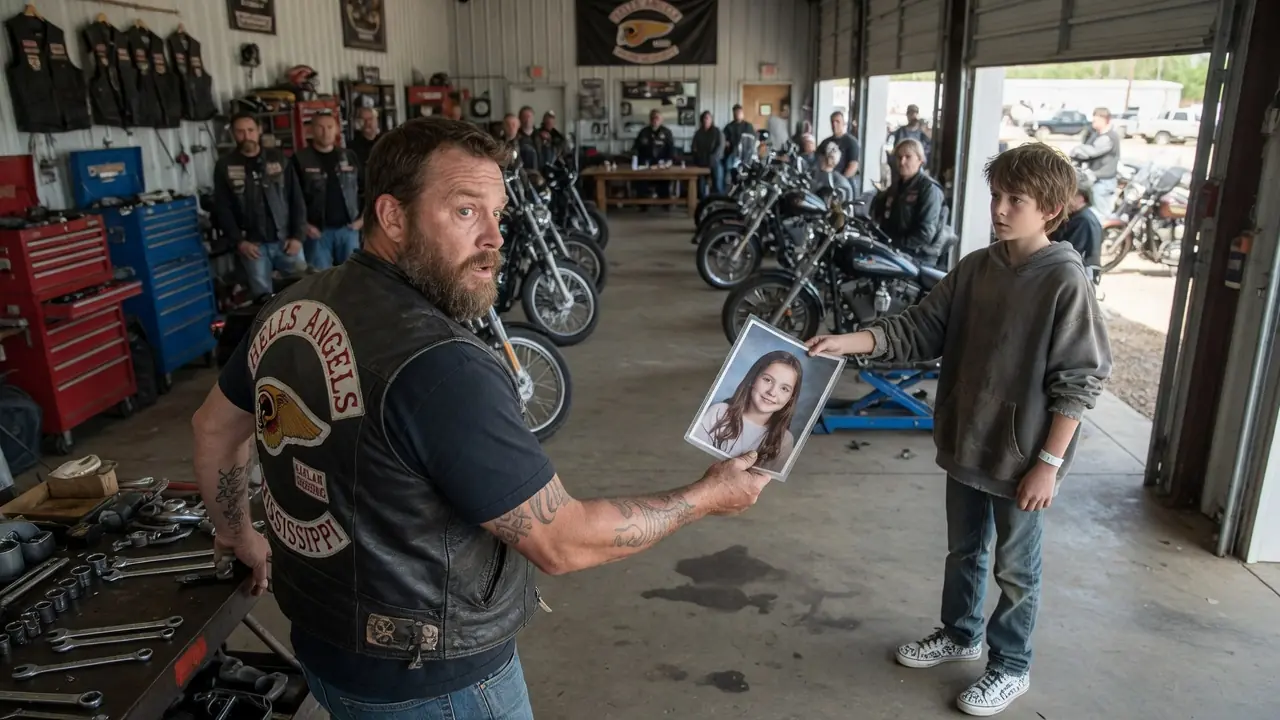
Nell Marie Pruitt.
Age eight.
Beloved daughter.
Daddy’s girl.
Those last two words had been his choice. He had insisted on them when the funeral director asked what should be engraved beneath her name. The man had spoken softly, almost too softly, as though gentleness could turn a lie into mercy.
Daddy’s girl.
Hawthorne had said it every morning since Nell was old enough to understand language. When she woke up with tangled hair and sleepy eyes, he would lean into her bedroom and say, “Morning, Daddy’s girl.” When she brought home drawings covered in purple crayon and glitter, he would tape them to the fridge and say, “That’s my Daddy’s girl.” When she got scared during thunderstorms, she would crawl into his lap, and he would hold her against his chest and whisper, “I’ve got you, Daddy’s girl.”
Now the words were carved into granite.
He hated them and needed them at the same time.
That was grief, he had learned. Two opposite truths living in the same broken room.
His wife, Mara, had been buried beside Nell. Her death had been proven. There had been no confusion there. The crash on Route 9 had taken her instantly, the sheriff had said. A truck had run the stop sign at the east curve near Dorothy Tate’s farmhouse and struck their car hard enough to fold the driver’s side inward.
Hawthorne had arrived too late to see the accident itself. Too late to hold his wife. Too late to hear his daughter call for him. Too late for everything that mattered.
At least, that was what everyone told him.
The paperwork had been clean.
Death certificate filed.
Funeral arranged.
Casket closed.
Graveside service held beneath a gray October sky while half the town stood behind him, whispering about tragedy and fate and God’s will as if any of those words could explain why a man had to bury his wife and little girl on the same afternoon.
For forty-nine mornings, Hawthorne believed the grave was real.
He had no reason not to.
Until the morning an eleven-year-old boy in marker-covered sneakers planted his feet on the gravel path behind him and said eight impossible words.
“Your daughter’s alive, sir. She gave me this.”
Hawthorne did not stand right away.
Not because the words failed to reach him.
Because they reached too deep.
His body wanted to move fast. His mind stopped it. Eight years in the Marine Corps had taught him that the first movement after shock was usually the wrong one. Eleven years wearing a Hell’s Angels patch had taught him that dangerous moments sometimes arrived in small voices.
He turned his head slowly.
The boy stood ten feet away, shoulders hunched against the cold, hood pulled up over messy brown hair, one hand hidden inside the front pocket of a faded gray sweatshirt. He was small for eleven, thin in a way that did not come from sports or genetics. His jeans were too short at the ankles. His sneakers had been drawn on with blue and black markers, stars on one shoe, crooked lightning bolts on the other.
But his eyes did not run.
That was the first thing Hawthorne noticed.
The boy looked straight at him.
Not boldly. Not comfortably. But deliberately, with the exhausted courage of someone who had already learned that adults walk away if you give them the smallest excuse.
Hawthorne’s gaze dropped to the hidden hand.
Then back to the boy’s face.
He held out his palm.
Open.
Flat.
Wordless.
The boy took a breath, pulled something from his hoodie pocket, and placed it in Hawthorne’s hand like it might break if touched too hard.
A laminated school photo.
September.
The blue background was the same one used in every elementary school picture in Harlan County. Nell sat in front of it wearing her yellow church dress, the one with tiny white buttons and a ribbon tied at the waist. She smiled with one front tooth missing, and one braid hung shorter than the other because she always tugged the left braid while thinking.
Hawthorne stared.
The cemetery vanished.
The cold vanished.
For seven seconds, there was only the picture in his hand and the impossible fact of his daughter’s face.
Then he turned it over.
Purple crayon letters covered the back.
Uneven.
Careful.
Daddy’s girl.
Hawthorne stopped breathing.
No one outside his family knew Nell had written those words herself. Not copied from a card. Not traced from a teacher’s example. She had practiced them for weeks because she wanted to write them on Father’s Day.
The letters were wrong in exactly the way her letters were wrong. The second d leaned too far. The y curled upward. The g in girl looked almost like a six.
Hawthorne’s hand began to shake.
His voice was low. Steady.
Not a question.
A command.
The boy swallowed.
This was the moment.
He had been here before, not in this cemetery, but inside this feeling. The moment when an adult decided whether to believe him or send him away.
Three adults had already failed.
The group home supervisor who wrote “overactive imagination” in the night log without lifting his head.
The police officer who ran Wade’s name, saw the fabricator note in the system, and told him to go back to Mill Creek Road.
The three Rotary Club members on the courthouse steps who looked at his sneakers, his hoodie, his group home wristband, and redirected him like lost property.
But Hawthorne Pruitt did not walk away.
He stood slowly.
Fully.
Then he did something Wade did not expect.
He knelt.
All the way down until his eyes were level with Wade’s.
The leather vest on Hawthorne’s back creaked with the movement. The wings and letters sewn onto it looked heavy, weathered, frightening to people who judged men by patches before names. His beard was dark with silver at the chin. His eyes were red from grief, but still sharp.
His right hand rested open on his knee.
Inside his wrist, tattooed in clean black script, was one word.
Nell.
“I’m listening,” Hawthorne said. “Every word. Start from the beginning.”
Wade Hollis planted his feet.
He had learned to do that at the group home. Plant your feet before speaking to adults. If your feet were steady, maybe they could not push your words aside so easily.
“My name is Wade Hollis,” he said. “I’m eleven years old. I live at Harlan County Group Home for Boys on Mill Creek Road. Your daughter is in the old cotton warehouse on Route 9 East. The abandoned Pruitt Agricultural building.”
Hawthorne’s face changed at the name.
The warehouse had belonged to his family once. His grandfather had processed cotton there before the business failed and the land sat empty. He had not been inside it in years.
“She’s been there three weeks,” Wade continued. “Twenty-one days exactly. I found her during the thunderstorm on November sixth. I go through the back fence at the group home when the nights get loud. I was sheltering in the warehouse. She was in the northeast sub-room behind the old gin machinery.”
His voice remained careful.
Not fast.
Not dramatic.
Careful, because he had learned the hard way that adults called urgency lying if it came from the wrong kind of child.
“She was wrapped in burlap sacks. She had a fever. She was alone.”
Hawthorne repeated one word.
“Alone?”
His voice cracked around it.
Wade shook his head quickly.
“No, sir. Not after I found her. She hasn’t been alone. I go every night. I bring crackers and water bottles and anything else I can carry. I cut burlap strips to wrap her feet because her shoes came off in the crash. I sit with her until she falls asleep.”
Something shifted across Hawthorne’s face.
Not softness. The man looked like grief had turned him to carved stone.
But recognition.
He was seeing Wade now.
Not as a boy interrupting mourning.
Not as a problem.
As a person.
“You’ve been walking to that warehouse alone at night?”
“Yes, sir.”
“How far?”
“Two point three miles from the group home if I cut behind the bus depot.”
“Every night?”
“Most nights. A few nights the back fence was watched. I waited until they changed shift.”
Hawthorne closed his eyes for one second.
When he opened them, they were wet.
“Because no one believed you.”
Wade’s throat tightened.
He nodded.
Hawthorne was silent for three seconds, and in that silence Wade felt something he had not felt in almost two years.
An adult was not deciding how to dismiss him.
An adult was listening.
“What’s wrong with her?” Hawthorne asked.
“Her left wrist is broken. It never got treated. It’s healing wrong. The bone is thick where it broke and she can’t close that hand all the way anymore.”
Hawthorne’s jaw tightened.
“Her cough is getting worse,” Wade said. “At first it was small coughs. Now sometimes she can’t stop. She’s pale. Her lips are cracked. She’s wearing the same yellow and white striped dress from the accident. It’s torn at the shoulder. She has no shoes.”
“Jesus Christ.”
The words left Hawthorne like breath punched out of his body.
“She eats what I bring,” Wade added quickly. “Everything. But it isn’t enough. I only have a dollar forty most nights from returning bottles. Crackers are cheapest. Sometimes I get apples from behind the market if they throw them out.”
Hawthorne stood abruptly and turned away.
For a moment, he pressed both hands against the back of his neck.
Wade thought he had made a mistake. Maybe he had said too much. Maybe the details made him sound like he was inventing things. That had happened before. Adults believed feelings less than facts, then believed facts less if there were too many.
But when Hawthorne turned back, he took off his leather vest.
The one with wings.
The one that made strangers cross streets.
He lowered it over Wade’s shoulders.
It was too big. It fell nearly to Wade’s knees. It smelled like road dust, motor oil, leather, and cold morning air.
“You kept my daughter alive for three weeks with a dollar forty and burlap scraps,” Hawthorne said quietly, “while I knelt at an empty grave.”
Wade looked up.
“It’s not empty, sir.”
Hawthorne went completely still.
“What did you say?”
“There’s someone in it,” Wade said. “Just not Nell.”
The cold seemed to deepen around them.
Wade felt his heartbeat in his throat.
This was the part that had made the police officer stop listening. The part too large to fit inside a normal day. The part that sounded impossible because it was easier to call a child confused than admit an entire county could bury the wrong body.
“Fourteen nights ago,” Wade said. “I had just brought Nell crackers. I was leaving the warehouse. It was around eleven twenty. I heard a man talking on the phone. He was in the entry corridor. I was outside by the east wall. There’s a gap in the siding near the loading door. I heard him clearly.”
“What did he say?”
Hawthorne’s voice had gone flat.
Wade had memorized the words the night he heard them. He had repeated them silently during the long walk back to the group home. He had whispered them into his pillow so he would not forget the numbers.
“He said, ‘The paperwork’s filed. Sixty days from the accident date. That certificate is incontestable under state statute.’ Then he listened. Then he said, ‘She stays where she is until the nineteenth. After that, it doesn’t matter.’ Then he said, ‘The annuity triggers at two hundred forty-seven thousand eight hundred the moment the certificate locks. That was always the arrangement.’”
Hawthorne did not blink.
Wade continued.
“Then he said, ‘The father thinks she’s in the ground on Sycamore Road. He’s not looking. Men like that fall apart. They don’t investigate.’”
Hawthorne’s face lost all color.
“And then he said, ‘Same as the old woman in Natchez. Clean paperwork, clean exit. Nobody looks twice at a funeral home.’”
For several seconds, the only sound was a crow somewhere in the trees.
“A funeral home,” Hawthorne said.
“Yes, sir.”
“You know which one.”
“I looked it up at the library. There’s only one funeral home in Harlan Crossing. Voss Family Funeral Services. Randall Voss filed Nell’s death certificate on October tenth. Thirty-one hours after the crash. State procedure says minor accident deaths are supposed to have at least seventy-two hours before final filing unless there’s special authorization.”
Hawthorne stared at him.
“You looked that up?”
“Yes, sir. I had to know if what I heard was real.”
Hawthorne pulled out his phone.
His hand was steady now.
Too steady.
He tapped one contact and lifted the phone to his ear.
“Pitchfork. It’s Tombstone. I need every brother within one hundred miles at Harlan Crossing Municipal Cemetery in one hour. Full chapter.”
A pause.
“No, not a ride. My daughter’s alive.”
Another pause.
“Bring Chainsaw. We need someone who knows probate law.”
He ended the call and looked at Wade.
“You’re coming with me.”
Wade nodded.
“Wade.”
“Yes, sir.”
“You did the right thing. Every time they didn’t listen, you still did the right thing. That ends today. I’ve got Nell from here.”
Then Hawthorne paused, and his voice changed.
“And I’ve got you too.”
Knox “Pitchfork” Delano arrived first.
He was fifty-seven years old with a gray beard braided at the end, tired eyes, and the kind of presence that made people lower their voices without knowing why. Every sheriff’s deputy in Harlan County knew him. So did half the judges, most of the defense attorneys, and every tow truck driver between Harlan Crossing and Jackson.
Pitchfork had one rule.
His club did not start trouble.
But when trouble found a child, a widow, an old man, or a brother, it did not get to leave quietly.
He killed his engine, stepped off his bike, and walked straight to Hawthorne.
“Talk to me.”
“My daughter Nell is alive.”
Pitchfork did not question it.
“Location?”
“Old Pruitt Agricultural Warehouse on Route 9 East.”
“How do you know?”
Hawthorne put one hand on Wade’s shoulder.
“This boy found her three weeks ago. He has been feeding her every night. Voss filed her death certificate early and is waiting for an annuity payout to lock.”
Pitchfork’s eyes moved to Wade.
To the leather vest draped over his small body.
To the marker-covered sneakers.
To the way Wade stood like he had been ordered by life to look brave and had obeyed.
“How much time?” Pitchfork asked.
“Eleven days before the certificate becomes incontestable.”
“Executor?”
“Randall Voss.”
The air around Pitchfork changed.
He took out his phone.
“Chainsaw. Cemetery. Now. Bring your legal kit.”
A pause.
“Probate fraud. Child endangerment. Possible murder conspiracy.”
He ended the call and looked at Hawthorne.
“We’re in.”
By nine in the morning, the cemetery parking lot held sixty-three motorcycles.
By ten, it held more than one hundred.
They came from Mississippi, Arkansas, and two riders from Tennessee who had been passing through Memphis when the call moved through the network. Some were old enough to have ridden with Hawthorne before Nell was born. Some were young enough that their patches still looked too clean. Some had backgrounds no one asked about. Others were known plainly.
Chainsaw, former Mississippi State Police detective.
Sandstone, Army combat medic.
Driftwood, retired middle school principal.
Flintlock, IT forensics.
Coldwater, chapter co-founder, with three attorneys in the county who answered his calls even during dinner.
They were not a mob.
That was what Wade noticed.
He had expected shouting. Engines revving. Rage spilling over. Men making promises about what they would do to whoever hurt Nell.
Instead, they organized.
They asked questions.
They wrote things down.
They treated Wade like a witness.
Driftwood sat with him at a picnic table beneath the oak tree near the cemetery gate. He placed a recorder on the table but did not start it until Wade nodded.
“I need your statement,” Driftwood said. “Take your time. If you know something, say it. If you don’t know, say you don’t know. Don’t guess. The truth is strong enough without guessing.”
Wade nodded.
Driftwood asked about the night he found Nell.
The thunderstorm.
The loose board behind the group home.
The walk down Route 9.
The warehouse sub-room.
The fever.
The broken wrist.
The crackers.
The water.
The burlap strips.
Wade answered everything.
Then Driftwood asked, “Did you tell anyone before Hawthorne?”
Wade looked down at his sneakers.
“Yes, sir.”
“Who?”
“The overnight supervisor at the group home. Mr. Fenway. That was the morning after I found her. I told him there was a sick girl in the warehouse. He was writing attendance sheets. He didn’t look at me. He wrote in the log and told me to brush my teeth.”
“What did he write?”
“I checked later. It said, ‘Overactive imagination. No action required.’”
Driftwood’s pen stopped moving for a second.
Then he continued.
“Second?”
“I flagged down a police car on Route 9. I told the officer. He asked my name. He went to his car and ran it. Then he told me to go back to the group home.”
“Why would he dismiss you after running your name?”
Wade swallowed.
“There’s a note in my file.”
“What kind of note?”
“It says I fabricate stories.”
“Why?”
“Thirteen months ago, I reported that a supervisor was stealing from the boys’ commissary fund. He denied it. They said I made false accusations. He resigned four months later, but the note stayed.”
Driftwood set the pen down.
“Wade, did you lie?”
“No, sir.”
“So you told the truth and got labeled a liar.”
Wade nodded.
Driftwood leaned forward.
“I want you to hear me. You are not the liar in this story. You are the reason a girl is still alive. Every adult who used that label as an excuse failed you. That failure belongs to them.”
Wade’s eyes burned.
He blinked quickly.
“Third attempt?” Driftwood asked gently.
“Rotary Club. Courthouse steps. I saw three adults leaving a lunch meeting. One woman was on the Children’s Services Advisory Board. I asked if they could help a sick child. One man looked at my hoodie and wristband and told me the group home was on Mill Creek Road. They walked away.”
Driftwood’s face tightened.
“Why didn’t you give up?”
Wade was quiet a long time.
Then he said, “Because Nell was still there.”
While Wade gave his statement, Chainsaw and Flintlock began pulling records.
The death certificate.
Filed October tenth.
Thirty-one hours after the crash.
Executor petition.
Randall Eugene Voss.
Approved in four days by Judge Foster Greer.
Annuity.
Two hundred forty-seven thousand eight hundred dollars.
Transfer trigger.
Sixty days after death certificate filing.
Voss had already placed a down payment on Gulfport waterfront property. A boat deposit. A wire to a Costa Rica account. Money he did not yet have but clearly expected to receive.
Then Chainsaw found the name Wade had heard.
Eugenia.
Eugenia Voss Halcourt.
Randall Voss’s elderly aunt by marriage.
Officially deceased in Natchez three years earlier. Voss funeral director. Voss executor. Estate payout transferred through a shell company called Delta Line Holdings.
A nurse had filed a private complaint seven months after Eugenia’s official death, claiming she had seen the woman alive under a different name at an unlicensed private care home.
The complaint had never been investigated.
By 10:47 a.m., the formation rolled out.
Hawthorne led.
Wade rode behind him, arms wrapped around Hawthorne’s waist, vest still around his shoulders.
Behind them came Pitchfork, Chainsaw, Sandstone, Driftwood, Flintlock, Coldwater, and more than one hundred riders moving in disciplined rows toward Route 9 East.
The sound built slowly at first.
Then it became thunder.
Windows trembled as they passed.
People stepped onto porches.
Cars pulled to the shoulder.
No one knew yet what was happening, but everyone understood that something had shifted.
At the abandoned Pruitt Agricultural Warehouse, the riders parked in the field across from the main entrance. Engines shut down in near unison.
Silence returned.
Pitchfork raised one closed fist.
The teams moved.
Not like a gang.
Like a rescue operation.
Medical team with Sandstone.
Evidence team with Chainsaw and Flintlock.
Perimeter team with Pitchfork.
Witness team with Driftwood and Coldwater.
Hawthorne and Wade went with Sandstone to the northeast corner of the warehouse, where a padlocked door sat half-hidden behind rusted metal and weeds.
Hawthorne picked the lock in forty seconds.
The door opened.
The room inside was fourteen feet by nine feet. Concrete floor. Water stains along the wall. No windows. One battery lantern. Burlap sacks. Two wool blankets Wade had taken from the group home laundry.
And in the corner, Nell Pruitt looked up.
For one second, Hawthorne could not move.
His daughter was smaller than memory.
Pale to the point of gray. Hair matted against one side of her face. Lips cracked. The yellow and white striped dress she had worn the day of the accident hung dirty and torn at one shoulder.
But her eyes were his eyes.
Dark.
Alive.
“Nell.”
The word broke in half.
Hawthorne dropped to his knees six feet away.
He did not rush her.
He wanted to. Every part of him wanted to cross that room and gather her up. But she had been trapped for forty-nine days. He would not make even love feel like force.
“Baby, it’s me. It’s Daddy.”
Nell stared as if deciding whether fever had made him.
“Did the boy find you?” she whispered. “Did he show you the picture?”
Hawthorne pulled the laminated school photo from his vest pocket.
“He showed me.”
Wade stepped into the doorway.
“I told you I’d find him,” Wade said softly.
Nell’s face crumpled.
She tried to stand.
Her legs failed.
Hawthorne crossed the distance in two steps and caught her before she hit the concrete.
She weighed almost nothing.
Forty-three pounds, Sandstone would later record.
Nineteen pounds below healthy.
Hawthorne held her against his chest, one hand cradling the back of her head.
“I’ve got you,” he whispered into her hair. “I’ve got you, Daddy’s girl. You’re safe now.”
Nell sobbed without sound.
That was what broke him.
Not the visible injuries. Not the thinness. Not the fever.
The way she cried silently because she had learned noise brought punishment.
Sandstone moved in gently.
“Nell, my name is Sandstone. I’m a medic. I’m going to check where you’re hurt, but I will ask first every time. Okay?”
Nell nodded against Hawthorne.
Her left wrist was visibly wrong. Swollen, thick at the fracture site, healing at an angle. Her lungs rattled under Sandstone’s stethoscope. He found dehydration, fever, early pneumonia, malnutrition, and a circular burn mark on her forearm.
Hawthorne saw it.
“When?”
His voice was empty.
Nell whispered, “I screamed one night.”
No one spoke.
“He said if I screamed again, he would show Daddy pictures that made him think I was already gone.”
Wade began to cry in the doorway.
Hawthorne held Nell tighter.
“He lied,” he said. “I never stopped looking for you. I was looking in the wrong place, but I never stopped.”
Chainsaw photographed everything.
The locked door.
The room.
The blankets.
The water jug.
The burlap strips.
The lantern.
The dress.
The burn mark.
The wrist.
The evidence had to hold.
Rage could not be enough. Rage would not convict Randall Voss. Rage would not restore Nell’s legal identity or expose the previous victims or make every adult who ignored Wade answer for it.
Evidence would.
Flintlock found the burner phone tucked inside a metal storage locker near the loading entrance.
Cheap prepaid Android.
Cracked screen.
Deleted texts.
Recoverable.
The first thread was between R.V. and S.O.
R.V.: Package secure. Location confirmed. Timeline starts tomorrow.
S.O.: Understood. I’m out. Forwarding address is set. Don’t contact me again.
R.V.: Day three, no complications. Proceeding as planned.
R.V.: Certificate filed. Judge approved executor appointment. Sixty-day clock starts now.
R.V.: Day thirty-six, still on schedule. Transfer pre-authorized for day sixty.
Flintlock looked at Chainsaw.
“R.V. is Randall Voss.”
“S.O.?”
“Sandra Oaks. Former EMT. Resigned six days after the accident.”
Chainsaw’s face darkened.
“She intercepted Nell at the crash.”
By noon, the story had widened beyond what any of them wanted to believe.
Dorothy Tate, the neighbor who called 911, confirmed it. She had seen Nell alive after the crash. A white unmarked van arrived before County EMS. A woman loaded Nell into it. Dorothy had called the dispatcher back to report it, but was told it must have been a private transfer.
Harmon Greer, county records clerk, had kept a photocopy of the death certificate because the timeline bothered him. Thirty-one hours. Too fast. He had flagged it to his supervisor, then let it go when Judge Foster Greer confirmed the expedited filing.
Patricia Lowell, a crisis hotline volunteer, remembered Randall Voss asking strange questions eighteen months earlier.
“If someone was declared dead but wasn’t actually dead, how long before the paperwork becomes almost impossible to challenge?”
She had thought it was a hypothetical.
It was not.
At 2:14 p.m., deputies entered Voss Family Funeral Services.
Randall Voss was in an arrangement room with a grieving family, speaking in his low professional voice about dignity and peace.
Deputy Corwin, who had known him for years, walked straight to him.
“Randall Voss, you are under arrest.”
His face did not change immediately.
“I’m sorry,” he said. “There must be some mistake.”
“This is about Nell Pruitt,” Deputy Corwin said. “The child you declared dead on October tenth. The child found alive ninety minutes ago in the Pruitt Agricultural Warehouse.”
The room went silent.
Voss’s hands twitched.
Only once.
Then he put his mask back on.
“I don’t know what you mean.”
“You have the right to remain silent.”
They handcuffed him in front of the family he had been comforting.
Outside, across the street, more than one hundred motorcycles stood in formation.
Hawthorne held Nell wrapped in a thermal blanket.
Wade stood beside him, still wearing the leather vest.
Voss looked at the line of riders.
Then at Nell.
For the first time, his calm fractured.
“I was careful,” he whispered. “I was so careful.”
That night, the Hell’s Angels clubhouse became something between a war room, a shelter, and a family kitchen.
Nell ate spaghetti at a long table while Sandstone sat nearby in case the antibiotics made her stomach hurt. Hawthorne stayed at her side, one hand resting near hers but not holding too tightly. He had already learned that after forty-nine days of captivity, even love had to ask permission.
Wade sat beside Nell.
Someone gave him a clean hoodie.
He kept the vest over it.
When Nell asked for seconds, Hawthorne almost broke.
“You can have as much as you want,” he said. “Always.”
By evening, an FBI agent arrived.
Special Agent Meredith Keane, Financial Crimes Unit.
She had been investigating Randall Voss for fourteen months.
She had the money trail.
Wire fraud.
Shell companies.
Probate irregularities.
But she did not have the victims.
Not until Wade.
Not until Nell.
Not until the warehouse.
Agent Keane reviewed the burner phone, the financial records, the judge’s expedited approvals, the witness statements, and the early death certificate. Her face grew more serious with every page.
“This changes the scope,” she said. “We’re looking at RICO, conspiracy, wire fraud, kidnapping, and possibly more victims.”
Hawthorne stepped closer.
“My condition is simple. Nell gets a victim advocate before anyone interviews her. Nobody pushes her. Nobody treats her like evidence before treating her like a child.”
Agent Keane nodded.
“Agreed.”
“And Sandra Oaks gets arrested tonight.”
“If we can locate her.”
Flintlock turned his laptop.
“Pensacola. Gulf Breeze Boulevard. Apartment 3C. I can send the address now.”
Agent Keane looked at him for a moment.
Then she said, “Send it.”
Over the next weeks, the full horror emerged.
Seven victims.
Eugenia Voss Halcourt.
Eleanor Pritchard.
Samuel Oaks.
Margaret Dean.
Robert Talmage.
Vivian Cross.
Nell Pruitt.
Some had died. Some had been hidden. Four were found alive in nursing homes, private rooms, and unlicensed care arrangements under false names. They had been told their families were gone, that no one wanted them, that paperwork had already moved on without them.
Randall Voss had built his crimes out of trust.
People trusted funeral directors with grief.
Judges trusted familiar professionals.
Clerks trusted signatures.
Police trusted databases.
Supervisors trusted notes in files more than the children standing in front of them.
And every smooth gear in that machine turned until one eleven-year-old boy refused to let it keep moving.
Nell’s surgery happened the morning after she was found.
The doctors had to reset the wrist. Pins. Plate. Cast. Eight weeks of healing. Then months of physical therapy.
Her pneumonia responded to antibiotics.
Her weight returned slowly.
Her sleep did not.
That took longer.
For weeks, she woke screaming without making sound. Her mouth opened but nothing came out, the habit of silence still trapped in her body. Hawthorne would sit beside her bed, not touching unless she reached for him first, and say the same thing every time.
“You’re home. You’re safe. I’m here.”
Sometimes Wade came too.
At first, the group home objected. They said Wade had missed curfew too many times, violated boundaries, and engaged in dangerous behavior.
Pitchfork visited the director with Driftwood and Chainsaw.
The group home changed its tone.
Wade was placed under emergency kinship-style community guardianship while the state reviewed his case. A retired teacher named Mrs. Eliza Monroe, who had fostered boys for twenty-three years and knew Driftwood from his principal years, agreed to take him in.
Wade got his own room.
A desk.
A bed with a quilt.
New shoes.
He still drew on them with marker.
Stars on one side.
Lightning on the other.
Because some things were his.
Three months later, Nell returned to school half days.
She wore a purple cast covered in signatures. Wade had written the largest one.
You were never alone.
At the trial, Nell testified.
She was eight, then nine by the time she sat in the courtroom, wearing a blue dress and holding a small gray elephant Sandstone had given her. Hawthorne sat in the front row. Wade sat beside him. Behind them was a wall of leather, gray beards, folded arms, and quiet discipline.
The prosecutor asked, “Nell, do you see the man who kept you in the warehouse?”
Nell looked at Randall Voss.
He looked smaller than she remembered.
Not a monster now.
A man.
A man in a suit who had chosen money over breath.
“Yes,” she said. “That’s him.”
The jury took ninety-one minutes.
Guilty on all major counts.
Randall Eugene Voss received thirty-four years in federal prison. Sandra Oaks, who testified after a plea agreement, received eleven. Judge Foster Greer lost his seat and faced obstruction and misconduct charges. Harlan County reviewed every accelerated probate filing from the last ten years.
The group home supervisor was fired.
The police officer who dismissed Wade was suspended, then reassigned after formal review.
The Children’s Services Advisory Board member resigned.
But none of that was enough.
Consequences were not the same as repair.
Repair took longer.
Repair looked like Nell learning to sleep with a nightlight, then without one.
Repair looked like Wade accepting that adults could listen and stay.
Repair looked like Hawthorne turning his grief into something useful instead of letting it rot inside him.
One year after Nell was found, Hawthorne, Pitchfork, Driftwood, and Agent Keane helped launch the Daddy’s Girl Response Fund.
The name made Hawthorne cry the first time he saw it on paper.
The fund helped children whose reports had been dismissed. It paid for emergency advocates, safe transportation, after-hours welfare checks, and independent case reviews when a child’s voice was being buried under a label.
Wade became its youngest volunteer.
He spoke at schools, but only when he felt ready.
He never said too much.
He did not describe the warehouse in detail for children.
He told them the part that mattered.
“If someone does not believe you, tell someone else. If they do not believe you, tell again. You are not annoying. You are not difficult. You are trying to survive.”
Six years later, Wade Hollis was seventeen and about to leave for Mississippi State University. Social work major. Child advocacy concentration.
On his last week before moving, Youth Services called him.
A ten-year-old boy named Marcus had reported abuse in a foster placement. Three adults had logged it. No one had acted.
Wade met Marcus in a conference room with yellow walls and a broken clock.
Marcus wore a hoodie too big for him and sneakers covered in marker drawings.
Wade looked at those shoes and felt the past rise like cold water.
Marcus stared at the table.
“You don’t believe me either.”
Wade sat across from him.
“I believed you before I walked in.”
Marcus looked up.
Wade told him just enough.
The cemetery.
The photo.
The adults who walked away.
The man who finally listened.
Then Wade pulled out his phone and called Driftwood.
“It’s Wade,” he said. “I’m here with a boy named Marcus. He needs help now.”
Driftwood answered, “Tell me everything.”
Marcus told him.
Driftwood listened.
Then he said, “I’m forty minutes away. Wade, stay with him. Marcus, I am not hanging up until I’m standing in front of you.”
Marcus started crying.
Wade stayed.
That was how the work continued.
Not with thunder every time.
Not with one hundred motorcycles at every door.
Sometimes rescue looked like a phone call that stayed connected.
Sometimes it looked like a boy who had once been dismissed becoming the person who refused to dismiss someone else.
On the sixth anniversary of Nell’s rescue, Hawthorne returned to the cemetery on Sycamore Road.
The false grave had been removed years earlier.
The plot was empty now, marked only by grass and memory.
He stood at the gate where Wade had first appeared in marker-covered sneakers.
Nell was in college at the University of Southern Mississippi, pre-med. She wanted to become a pediatrician, the kind of doctor who asked children questions directly and believed their answers.
Wade was thriving.
Marcus was safe.
Four victims declared dead by Randall Voss had been reunited with families who thought they had been mourning ghosts.
Hawthorne had a folder on his phone labeled the ones we kept.
He did not open it often.
He did not need pride.
He needed remembrance.
Because the truth was simple and terrible.
The system had not failed because no one cared in theory.
It failed because too many people trusted paperwork more than a child.
Too many people saw a group home wristband and decided the boy wearing it was less credible than the adults who had already failed him.
Too many people chose comfort over disruption.
And then one boy chose differently.
Wade Hollis walked 2.3 miles in the dark for three weeks because a little girl was breathing in a locked room and nobody else was coming.
He carried a laminated photo in his pocket like proof, like prayer, like fire.
He was called a liar.
He kept going.
He was dismissed.
He kept going.
He was sent away.
He kept going.
And on the forty-ninth morning, he planted his feet behind a grieving father and spoke the eight words that brought Nell home.
“Your daughter’s alive, sir. She gave me this.”
Hawthorne looked across the cemetery at the empty patch of earth.
Then he whispered, “Thank you, son.”
Not just for Nell.
For all of them.
For every child who would be believed faster because Wade had refused to be silent.
For every adult who would think twice before walking away.
For every system that would be forced, even briefly, to remember that breath matters more than paperwork.
And somewhere on a college desk miles away, Nell still kept that laminated school photo in a small frame.
On the back, in purple crayon, the words remained uneven and bright.
Daddy’s girl.
Not a grave inscription anymore.
A promise that survived.