On this particular Tuesday, Mark Ellis was making spaghetti.
The cheap kind.
The kind with thin noodles bought on sale, sprinkled with salt because that made them taste a little less like cardboard. The sauce came from a can that cost ninety-nine cents at the discount grocery store two blocks away.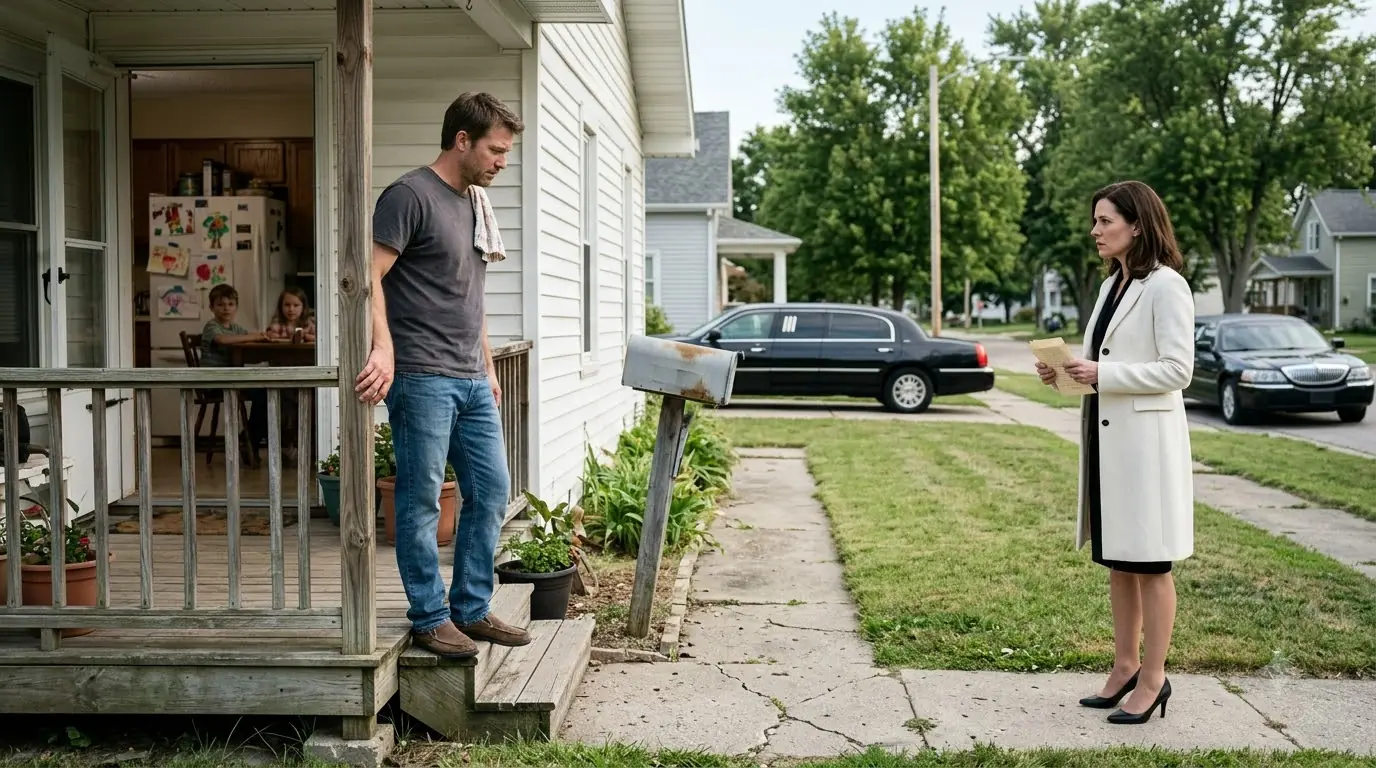
Mark had added garlic powder, half an onion, and a little sugar because his mother had always said cheap sauce could be improved if you treated it like it still deserved respect.
The kitchen was small, warm, and cluttered in the way homes become cluttered when people are trying hard to survive. A stack of unpaid bills sat beneath a chipped ceramic mug near the toaster.
A school permission slip was held to the refrigerator by a magnet shaped like a smiling tomato. Two pairs of children’s shoes were kicked under the table, one with a shoelace missing and the other with glitter peeling from the sides.
Leo, nine years old, sat at the kitchen table doing math homework with the serious frown of a boy who believed multiplication had been invented to ruin his evening.
Mia, six, was drawing a unicorn on a napkin with a purple crayon worn almost down to the paper. The unicorn had wings, three tails, and what Mia insisted were “sparkle hooves,” though Mark could not identify them without guidance.
It was a normal night.
Nothing special.
No birthday.
No holiday.
No good news.
Just spaghetti, homework, crayons, and a father doing his best to make tired look like steady.
Mark stirred the sauce and glanced at the clock.
6:43 p.m.
If the kids ate by seven, baths could happen by seven-thirty. If baths happened by seven-thirty, Mia might be in bed by eight-fifteen. If Mia was in bed by eight-fifteen, Leo might finish reading by eight-thirty. If they were both asleep by nine, Mark could spend an hour sorting bills, then another hour fixing the loose cabinet door before it finally fell off and hurt someone.
Life had become math.
Not just bills.
Everything.
How many days until rent.
How many gallons of gas until Friday.
How many hours of sleep before the morning shift.
How many times a man could tell his children, “We’re okay,” before the words stopped feeling true in his own mouth.
Mark Ellis was thirty-five years old, but exhaustion had added years to his face. He was tall, lean, and broad-shouldered in a way that came less from gym memberships and more from lifting boxes at the hardware warehouse from dawn until noon, then stocking shelves at a grocery store three evenings a week. His hands were rough, his knuckles scarred, his back sore more often than not.
He had once wanted to be a teacher.
History, specifically.
He loved old stories. The kind that made ordinary people seem larger because they had endured something and still chosen decency. Before the children were born, before his wife left, before the second job, before medical bills and rent increases and the kind of adulthood that did not leave room for dreams, he had taken night classes at the community college.
Then life happened.
His wife, Rebecca, did not die.
That might have made the story easier for strangers to understand.
She left.
When Mia was two and Leo was five, Rebecca packed two suitcases, cried in the hallway, said she could not breathe in a life this small, and drove away before Mark could decide whether to beg or be angry. For six months she called every Sunday. Then every other Sunday. Then on birthdays. Then not even then.
Mark never told the children the whole truth.
He said their mother was far away and still figuring things out.
He hated that sentence.
He hated how kind it sounded.
But he loved his children too much to hand them bitterness before they were old enough to know what to do with it.
So he became everything.
Father.
Mother.
Lunch packer.
Hair brusher.
Homework checker.
Nightmare chaser.
Bill payer.
Sock finder.
The one who stayed.
On the stove, the sauce began to bubble.
Mark stirred it quickly.
“Dad,” Leo said, still staring at his worksheet, “what is seven times eight?”
“Fifty-six.”
“You knew that too fast.”
“I am a genius.”
Mia lifted her napkin.
“Daddy, does my unicorn look rich?”
Mark turned and studied it with great seriousness.
The unicorn had a crooked horn, four eyelashes on one eye and nine on the other, and a tail that appeared to be on fire.
“Extremely rich,” he said. “That unicorn owns at least three castles.”
Mia beamed.
Then they heard it.
A car.
Not just any car either.
This one sounded expensive.
It did not rattle.
It did not cough.
It purred.
Leo looked out the window, and his eyes widened.
“Dad,” he said, “there is a really shiny car outside.”
Mark wiped his hands on his jeans and walked over to the window.
Sure enough, a black limousine was parked in front of their broken mailbox.
A real limousine.
Long, glossy, and so out of place on their cracked little street that for a second Mark wondered if a wedding party had taken a wrong turn.
Their neighborhood was not dangerous, exactly. Just tired. Small houses with sagging porches. Chain-link fences. Lawns people meant to mow but ran out of energy for. Cars with mismatched doors. Christmas lights left up until March because ladders required time, and time was expensive.
The limousine looked like it had driven in from another planet.
A woman stepped out wearing a white coat that probably cost more than Mark’s entire house. She held a small piece of paper in one hand.
She looked up at the house.
Then down at the paper.
Then back at the house.
Mark’s heart began pounding.
Not because he was afraid of wealthy people.
Because, in his experience, nobody arrived at your door without warning to deliver good news.
It was never a surprise party.
It was always the landlord.
Or a debt collector.
Or child services after some neighbor decided children in secondhand coats meant neglect.
Or someone holding a clipboard and carrying bad news in a polite voice.
The woman walked up the cracked concrete path.
Her heels clicked with every step.
Click.
Click.
Click.
Then she stopped directly in front of the door.
She knocked three times.
Softly, but firmly.
Leo stood behind Mark.
Mia slid off her chair and clutched her napkin unicorn to her chest.
“Should I hide?” she whispered.
“No, baby,” Mark said, though part of him wanted to do the same thing.
He opened the door.
He did not smile.
He did not say hello.
He stood there with a dish towel over his shoulder and asked, “Can I help you?”
The woman looked at him.
Then she looked at the paper.
Then she said, “Your mom gave me this address.”
Mark froze.
His mother had been dead for twelve years.
For a moment, the only sound in the kitchen was the soft bubbling of the sauce on the stove.
Mark stared at the woman on his porch.
She was maybe in her early fifties, though wealth had softened time around her. Her blonde hair was pulled into an elegant knot at the back of her head. Her makeup was discreet, perfect, almost invisible. The white coat was wool, structured and immaculate, with pearl buttons and a silk scarf tucked neatly at the collar.
She looked like someone from a magazine spread about winter charity galas.
She did not look like someone who belonged on Mark’s porch, holding a piece of paper and speaking about his dead mother.
“My mom died twelve years ago,” Mark said.
The woman nodded.
“I know,” she replied. “I’m sorry.”
Mark’s hand tightened on the edge of the door.
You have to understand what was going through his mind at that moment.
His first thought was that this had to be some kind of scam.
Everyone had seen stories like that. A stranger appeared at your door with an emotional story, and before long, your bank account was empty. Not that Mark had much to steal, but poverty did not protect people from being robbed. Sometimes it made them easier targets.
His second thought was that perhaps the woman was unstable.
Why else would someone who looked like she stepped out of a luxury car commercial be standing on the porch of a struggling single father, talking about a waitress who had been buried more than a decade earlier?
But the woman did not look unstable.
She looked nervous.
Her hands were trembling slightly. She kept biting her lower lip. She held that piece of paper as though it were the last treasure map left on earth.
“I never had the chance to meet her again before she died,” the woman said. “But she wrote me a letter before she passed away. In that letter, she gave me your address.”
Mark became even more confused.
His mother, Helen Ellis, had been a waitress.
She worked at Betty’s Diner for thirty years. She wore white sneakers, clipped coupons, saved coffee cans full of coins, and mended worn socks instead of replacing them. She drove an old green Honda until the floor rusted so badly Mark could see the road through a hole near the passenger seat.
She was not the kind of person who knew women who arrived in limousines.
At least, not as far as Mark knew.
“Who are you?” he asked.
The woman drew a deep breath.
“My name is Victoria Ashworth.”
She looked directly at him.
“Your mother saved my life.”
Mark did not invite her in immediately.
He could not.
The name meant something, even to him.
Victoria Ashworth was not merely wealthy.
She was one of the richest women in the country.
Her family owned Ashworth Hotels, a chain almost everyone had stayed in at least once: airport hotels, downtown luxury towers, beach resorts, conference centers, extended-stay suites near hospitals. Their blue-and-silver logo appeared on buildings in nearly every major American city.
The Ashworth fortune was measured in billions.
Victoria had grown up in penthouses and private schools. Her father had put her name on a performing arts wing when she was twelve. Business magazines called her “the heiress who became an empire builder.” Philanthropy pages showed her at galas, standing beside governors, actors, and people whose shoes probably cost more than Mark’s car.
She was that kind of rich.
What people rarely understood about someone like Victoria, however, was that money did not repair everything.
It could buy privacy.
It could buy doctors.
It could buy distance from consequences.
It could buy a penthouse high enough above the street that ordinary noise never reached you.
But it could not buy a reason to keep living when your heart had decided the world was too heavy.
When Victoria was twenty-three, she reached the lowest point of her life.
Not financially.
Emotionally.
Six months earlier, her closest friend, Elise, had died in a car accident on a rainy highway outside Chicago. Elise had been the only person in Victoria’s life who treated her like a person rather than a future inheritance. She had known Victoria before the boardrooms, before the brand training, before the family lawyers taught her how to speak without saying anything.
After Elise died, Victoria’s grief became a room with no windows.
Then came Adrian.
He was charming, ambitious, and dangerous in the quiet way people often miss until the damage is done. He did not hit her. He did not need to. He isolated her with compliments and controlled her with disappointment. He told her she was too fragile for the family company, too emotional for leadership, too dependent on him to survive alone.
By the time she left him, Victoria barely recognized herself.
She had money.
She had access.
She had a last name printed on hotels.
And still, one cold November night, she drove for hours without knowing where she was going, crying so hard she had to pull over twice because the road blurred.
Eventually, she found herself in a small Midwestern town she did not recognize.
It was late.
It was cold.
Most storefronts were dark.
A diner sign flickered at the edge of a quiet road.
Betty’s Diner.
The place had closed half an hour earlier.
Victoria parked outside and sat behind the wheel of her expensive car, shaking, hollowed out, and completely alone.
That diner was where Mark’s mother worked.
Helen Ellis had just finished wiping down the last counter.
She was forty-eight then, tired from a double shift and wearing an apron stained with coffee and pie filling. Her feet hurt. Her back hurt. Her son Mark, thirteen years old at the time, was at home asleep with a neighbor checking in on him.
Helen wanted nothing more than to lock the door, drive home, and sit in silence for ten minutes before becoming a mother again.
Then she saw Victoria sitting alone in the car.
Most people might have ignored her.
Some might have called the police.
Some might have decided another person’s pain was none of their business.
Helen was not most people.
She pulled her coat around herself, walked outside, and tapped gently on the driver’s window.
Victoria startled so hard she nearly screamed.
Helen stepped back and held up both hands.
“You look like you need a cup of coffee and a piece of pie,” Helen said.
Victoria did not want coffee.
She did not want pie.
She wanted to disappear.
But something about Helen’s face made her unlock the door.
Maybe it was the softness.
Maybe it was the complete absence of judgment.
Maybe it was the way Helen looked at her not like a scandal, not like a rich girl, not like a problem, but simply like someone cold.
Victoria followed her inside.
Helen turned the lights back on.
She heated coffee.
Cut a piece of apple pie she was supposed to take home.
Set it in front of Victoria without asking for money.
For the first twenty minutes, Victoria said almost nothing.
Helen did not force her.
She moved around the diner quietly, locking the back door, refilling sugar dispensers, counting tips. Every few minutes, she came back and warmed Victoria’s coffee.
Finally, Victoria broke.
She cried with both hands over her face, the kind of crying that makes pride impossible.
Helen sat across from her.
Not beside her.
Not touching her yet.
Just present.
“I can’t do this anymore,” Victoria whispered.
Helen folded her hands.
“Do what?”
“Be me.”
Helen did not gasp.
Did not panic.
Did not recite something empty about life being precious.
She simply said, “Then tonight, don’t be all of you. Just be the part that drinks coffee. We’ll handle the rest later.”
That sentence saved Victoria.
Not all at once.
Not magically.
But enough for the next breath.
They talked for hours.
Helen did not ask about Victoria’s money, family name, or social position. She did not try to solve every problem or offer empty advice. She simply listened. When Victoria spoke of Elise, Helen listened. When she spoke of Adrian, Helen listened harder. When Victoria admitted she felt ashamed for being miserable despite having everything, Helen’s face changed.
“Pain doesn’t check your bank account before it knocks,” Helen said.
Then Helen told Victoria stories about her own difficult years.
About losing her husband, Ray, to a construction accident when Mark was six. About raising a boy alone on waitress wages. About nights she ate toast so Mark could have chicken. About the day she sat on the bathroom floor with the lights off because she was too tired to cry where her son could hear.
Victoria stared at her.
“What made you keep going?”
Helen smiled faintly.
“My boy laughing in the next room. Some days, that was the whole reason. Not a grand purpose. Not destiny. Just Mark laughing at cartoons while I stood at the sink and remembered I was still needed.”
By the time the sun came up, Victoria was not healed.
But she was not alone anymore either.
Before leaving, she asked Helen for her address.
Helen refused at first.
“I don’t need money,” she said, reading the offer before Victoria made it.
“I wasn’t offering money.”
“You were thinking it.”
Victoria almost smiled.
“Then let me offer a letter.”
Helen considered that.
“A letter I can accept.”
So they wrote.
Real letters.
On paper.
With stamps.
For years.
Victoria returned to her life, but she never forgot Helen.
Helen wrote about Mark’s school plays, his stubbornness, his habit of reading history books at the kitchen table, his dream of becoming a teacher. Victoria wrote about boardroom politics, loneliness, grief, and the slow process of remembering who she was after Adrian.
Helen never asked Victoria for anything.
Not once.
She never asked for money, favors, employment, or access to influential people.
She asked only for friendship.
Victoria sent gifts sometimes. Helen sent them back if they were too expensive. Once, Victoria mailed her a cashmere scarf, and Helen returned it with a note that read, “If I wear this to the diner, Betty will think I robbed somebody.”
Victoria laughed for the first time in weeks when she read it.
The letters became sacred.
A secret room in both of their lives.
Then Helen became ill.
Cancer.
The kind that did not leave much time.
The kind that turned strong women into careful movements and made sons count pills in the kitchen with shaking hands.
Mark was twenty-three when his mother was diagnosed. He had already dropped out of night classes to work full-time. He drove her to appointments. Sat beside her during treatments. Learned how to cook the soups she could keep down. Pretended not to hear when she cried in the bathroom.
Helen did not tell him about Victoria.
Not because she was ashamed.
Because their friendship had become something private. A small bright thing untouched by hospital forms, unpaid bills, and grief.
During her final weeks, Helen wrote Victoria one last letter.
She wrote it slowly, over three days, because her hands tired easily.
Dear Victoria,
If this reaches you, it means I have gone somewhere letters cannot follow. Do not be sad for me too long. I have had sorrow, yes, but I have also had pie, coffee, good music, a son who became my greatest joy, and a friend I never expected to find outside a diner window.
I have never asked you for anything. I am going to ask now.
If you ever have the means, and if you ever have the heart, please check on my son. His name is Mark Ellis. He does not know about you. I wanted to keep you as my secret friend, and maybe that was selfish, but some friendships are easier to protect when the world does not know where to point its hands.
Mark is good. Too good sometimes. He will carry more than he should and call it responsibility. He will refuse help because he thinks pride and dignity are the same thing. They are not. If life becomes hard for him, and if you can do anything, do not rescue him like a queen visiting peasants. Just knock. Sit down. Eat what he offers. Let him remain a man in his own home.
He is alone now, and I worry about him every single day.
Here is his address.
Victoria received the letter two days after Helen died.
She read it once.
Then again.
Then a third time, sitting on the floor of her penthouse while the city glittered beyond the windows.
She did not go.
Not then.
She told herself Mark needed space.
She told herself appearing after Helen’s death would be intrusive.
She told herself she would visit the following month.
The following month became the following year.
One year became twelve.
There were always reasons.
Real ones, sometimes.
The company nearly collapsed during a market crash. Her father had a stroke. She became acting chair, then CEO. She traveled constantly, negotiated mergers, survived lawsuits, expanded the hotel chain, and became the version of herself business magazines admired.
But private guilt does not disappear because a calendar fills up.
It waits.
It grows quiet enough to be mistaken for acceptance.
Then, one winter evening, Victoria sat alone in her penthouse after a gala where five hundred people had praised her generosity and not one person had asked whether she was happy. She returned home, removed diamond earrings that made her earlobes ache, poured a drink she did not want, and found Helen’s last letter in the locked drawer of her desk.
She read it again.
Just knock. Sit down. Eat what he offers. Let him remain a man in his own home.
Victoria looked at her reflection in the dark window.
She realized she had become the person Helen had once saved her from becoming.
Alone.
Frightened.
Pretending everything was fine.
So she canceled her morning meetings.
Told her driver to take her to a small Midwestern town.
And carried Helen’s paper with both hands.
That was how Victoria Ashworth arrived at Mark’s front door.
Mark had just learned that his dead mother had once saved a billionaire’s life.
He had no idea what he was supposed to feel.
Anger came first.
It was easier than grief.
Why had his mother never told him?
Why had she kept such an important friendship secret?
Why had Victoria waited twelve years to appear?
Twelve years.
Twelve years during which Mark had buried his mother, raised two children, lost a marriage, worked double shifts, counted change, ignored dental pain, stretched meals, lied to his kids about being tired, and wondered some nights if anyone in the world remembered he existed outside what he could provide.
Victoria saw the questions and pain moving across his face.
Then she did something Mark did not expect.
She began crying.
It was not the attractive, controlled kind of crying people managed at charity luncheons.
Her eyes turned red. Her nose ran. Her shoulders shook. She pressed Helen’s letter to her chest like a child holding a blanket.
“I am sorry,” she said. “I am so sorry.”
Mark said nothing.
“I should have come sooner. I know that. I told myself I was waiting for the right time, but the truth is I was afraid.”
Her voice cracked.
“I did not know whether you would want to see me. I did not know whether I deserved to see you.”
In the kitchen behind Mark, Mia leaned toward Leo.
“Daddy, why is the pretty lady crying?” she whispered.
Leo, older and more cautious, whispered back, “I think she knows Grandma.”
Something about that undid Mark.
Not entirely.
Not enough to trust.
But enough to remember his mother.
Helen would not have left a crying person on the porch.
Not even if that person arrived twelve years late.
Mark stepped aside and opened the door completely.
“Would you like some spaghetti?” he asked. “It’s not fancy, but there’s enough.”
Victoria looked at him through tears.
Then she nodded.
“I would like that very much.”
She walked inside.
The house was smaller than she expected and warmer than she deserved.
She saw chipped plates, crayon drawings on the refrigerator, the old sofa with a blanket over one torn arm, the stack of bills on the counter Mark tried to slide beneath a dish towel too late. She saw the children watching her with wide eyes, one suspicious and one delighted.
She did not comment on any of it.
She hung her white coat carefully on the back of a chair and sat at the kitchen table beside Mia.
Mia held up the napkin unicorn.
“This is Princess Sparklehoof. She is rich.”
Victoria studied it seriously.
“I can tell.”
“She owns three castles,” Mark said from the stove.
Victoria looked at the unicorn again.
“Only three? With that level of confidence, I assumed five.”
Mia gasped, thrilled.
“Daddy, she understands.”
Just like that, something shifted in the room.
Mark served spaghetti in mismatched bowls.
Victoria ate every bite.
Not politely.
Hungrily.
As if canned sauce and cheap noodles had become sacred because Helen’s son had offered them.
That night, they did not discuss money.
They did not spend hours unpacking the past.
They ate spaghetti.
They laughed about the time Mark accidentally set the toaster on fire trying to make frozen waffles in it because he was thirteen and believed appliances should “adapt.”
Victoria told them about Helen’s terrible meatloaf.
“She made it for me once after I drove back to visit her,” Victoria said. “I think it was mostly ketchup and moral support.”
Mark laughed so hard he snorted.
The sound startled him.
He could not remember the last time he had laughed like that about his mother without grief dragging the joy down.
Victoria told Mia that Helen had once threatened to fight a rude customer with a coffee pot. Mia wanted details. Leo wanted to know whether Grandma had won.
“Your grandmother always won,” Victoria said.
Mark looked down at his bowl, smiling despite himself.
Before Victoria left, she handed him an envelope.
“Do not open it tonight,” she said.
Mark immediately stiffened.
Victoria saw it.
“I know what you are thinking.”
“I doubt that.”
“You’re thinking I came here to throw money at guilt.”
Mark said nothing.
She nodded slightly.
“I understand. That is why I am asking you not to open it tonight. Open it when you are ready. Or throw it away if you want. But please know this. Your mother gave me something I could never repay.”
Mark took the envelope slowly.
Victoria pulled on her white coat.
At the door, Mia hugged her without warning.
Victoria froze for half a second, then bent down and hugged her back.
“Will you come again?” Mia asked.
Victoria looked at Mark.
He did not answer.
So she looked back at Mia.
“If your father allows it.”
Mia turned instantly.
“Daddy.”
Mark sighed.
“We’ll see.”
Mia smiled at Victoria as if this meant yes.
When the limousine pulled away, Mark stood in the doorway long after it disappeared around the corner.
Leo came to stand beside him.
“Dad?”
“Yeah?”
“Was Grandma a secret spy?”
Mark almost laughed.
“No.”
“Then why did she know a billionaire?”
Mark looked at the envelope in his hand.
“I guess your grandma knew a lot of things she never bragged about.”
Mark did not open the envelope that night.
Or the next day.
Or the day after that.
For three days, it sat in the drawer beside batteries, coupons, takeout menus, and one screwdriver that belonged in the toolbox but somehow always returned to the kitchen.
On the third night, after the kids were asleep, Mark opened it.
Inside was a check for one million dollars.
For a long time, he could not move.
The kitchen light hummed above him.
The refrigerator clicked.
Somewhere outside, a dog barked twice and went quiet.
Mark stared at the number, waiting for it to become smaller.
It did not.
There was also a note.
Mark,
Your mother gave me something more valuable than money could ever purchase. She gave me one more night when I did not think I could survive the next one. She gave me coffee, pie, honesty, and a chair at a table when I felt like I had no place left in the world.
This is not payment. Nobody can pay for what Helen gave me.
This is simply my way of saying thank you.
Use it for the children. Use it for yourself. Use it to breathe.
And if you cannot accept it yet, put it away until life gives you a reason. Helen told me you would be stubborn.
She was right.
Victoria
Mark sat down hard.
One million dollars.
More money than he could imagine.
More than all his debts combined.
More than every paycheck he had ever earned stacked together in his mind.
He should have felt relief.
He did not.
He felt exposed.
Angry again.
Small.
As though all his struggling had been seen, measured, and answered by someone so wealthy the solution fit inside an envelope.
He hated that feeling.
He hated needing it.
He hated that his mother had known him well enough to warn Victoria about his pride from beyond the grave.
He folded the check and note carefully.
Then he placed them back in the envelope.
The next morning, he went to work.
He did not deposit it.
He continued waking at 5:15.
Continued packing lunches.
Continued making cheap dinners.
Continued working two jobs.
Mark was not the kind of man who accepted what he considered a handout.
Victoria did not pressure him.
She called once the following week.
He did not answer.
She left a message.
“Mark, this is Victoria. No need to call back if you are not ready. I only wanted to say thank you again for dinner. Mia’s unicorn is on my desk.”
He listened to the message three times.
Then saved it.
A month passed.
Then two.
Victoria sent no more money.
No gifts.
No pressure.
Only one letter, handwritten, on cream paper.
She wrote about Helen.
Not about wealth.
She told Mark about the diner night in more detail. About the apple pie. About Helen’s exact words. About the way Helen had refused to accept cash but accepted letters. About how proud she had been of Mark when he got his first job, when he fixed the kitchen sink, when he read history books at the counter while she worked late.
Mark read the letter alone in his truck during lunch.
He cried for the first time in months.
Not because of the money.
Because his mother’s voice had reached him through someone else.
After that, he answered Victoria’s next call.
Their conversations were awkward at first.
What does a struggling single father say to a billionaire who loved his mother in secret?
The first few calls were short.
Then longer.
Victoria asked about the children.
Mark asked about the hotel business, mostly because Leo wanted to know whether hotel keys were really magic.
Victoria laughed at that.
“No magic. Mostly software and angry guests who lose them.”
Leo began sending questions through Mark.
How many pillows are in one hotel?
Has anyone ever stolen a mattress?
Do rich people complain more than normal people?
Victoria answered each one seriously.
Mia mailed her more unicorn drawings.
Victoria framed three.
She visited again in spring.
This time, she did not arrive in a limousine.
She drove herself in a modest black sedan because Mark had once muttered that the limo made the neighbors act weird.
She brought no expensive gifts.
Only a pie from a bakery and a copy of a history book for Leo about ancient Rome.
Mark almost objected to the book.
Then he saw the used bookstore sticker on the back.
Six dollars.
He accepted it.
Victoria learned the house rules.
Shoes off if it rained.
No phone at the table.
Mia got the blue bowl because she insisted spaghetti tasted better in blue.
Leo pretended not to like hugs but leaned into them anyway.
Mark did not say thank you easily, but he began to make coffee for Victoria without asking if she wanted it.
That was something.
Then, six months after Victoria first knocked on the door, Leo got sick.
At first, it seemed like stomach pain.
Then fever.
Then vomiting.
Then Mark found him curled on the bathroom floor, pale and shaking, unable to stand.
The emergency room became a blur of fluorescent lights, forms, fear, and Mia crying into Mark’s jacket while a nurse took Leo behind double doors.
Appendicitis.
Complicated.
The surgery went well, but there were additional issues. Infection. Extra days in the hospital. Specialist follow-ups.
Insurance covered some.
Not all.
Mark sat in the hospital billing office staring at numbers that made his ears ring.
For a moment, he was thirteen again, watching his mother count coins at the kitchen table.
Then he thought of the envelope.
Use it to breathe.
That night, after Leo was stable and Mia was asleep in a chair, Mark drove home, opened the drawer, and took out the check.
He deposited it the next morning.
His hands shook when he handed it to the bank teller.
The teller looked at the amount, then at him, then quietly called a manager.
Mark nearly walked out twice.
But he stayed.
Because Leo needed surgery.
Because pride could not hold a child’s hand in a hospital bed.
Because dignity was not the same thing as refusing help.
Even then, Mark did not spend freely.
He paid Leo’s medical bills.
Paid overdue rent.
Fixed the car.
Replaced Mia’s too-small winter coat and Leo’s cracked shoes.
Bought groceries without calculating every item twice.
Then he did something Victoria did not expect.
He used half of the money to create the Helen Ellis Fund for Single Parents.
He worked with a local attorney and a community center director. The fund was small compared to Victoria’s world, but enormous in Mark’s. It helped single parents with emergency rent, children’s medical needs, school supplies, utility shutoffs, and car repairs that stood between them and work.
Mark insisted on one rule.
“No humiliation.”
No long applications designed to make people prove their suffering.
No public announcements.
No photos of struggling parents holding oversized checks.
No charity performance.
Just help.
Quietly.
The way Helen would have done it.
When Victoria found out, she called him.
“You used half of it for other people,” she said.
Mark braced for criticism.
“Yes.”
There was a long silence.
Then Victoria said, “Your mother would be insufferably proud.”
Mark laughed.
Then cried.
Then laughed again because grief and love often arrived together and refused to take turns.
Over the next year, the fund helped twenty-seven families.
A mother named Carla kept her apartment after missing two weeks of work when her daughter had pneumonia.
A father named James got his transmission repaired and kept his delivery job.
A grandmother raising three grandchildren received winter coats, boots, and a grocery card.
A young mother finished her nursing certification after the fund paid for childcare during her final exam week.
Mark did not meet all of them.
He did not need to.
Sometimes, anonymous thank-you notes came through the community center.
One read:
I do not know who helped me, but my kids slept warm last night. Thank you.
Mark kept that note in the same drawer where the check had once been.
Victoria and Mark did not become family overnight.
Life was not that simple.
Trust grew in inches.
There were still awkward moments.
Mark still felt uncomfortable when Victoria paid for dinner.
Victoria still sometimes reached for money as a solution too quickly.
Once, she offered to buy Mark a new house, and he looked so offended she apologized before finishing the sentence.
“I’m trying,” she said.
“I know.”
“I don’t always know how to help without making it feel like control.”
“I know that too.”
“What should I do?”
Mark thought for a long moment.
“Show up. Ask first. Don’t assume.”
Victoria nodded.
That was what Helen had taught her.
Showing up was the real gift.
Years passed.
Victoria came every Christmas Eve.
Not always for long.
Sometimes an hour.
Sometimes two days.
She brought reasonable gifts, after several stern conversations with Mark about the definition of reasonable. She attended Mia’s school play. She came to Leo’s science fair. She sent postcards from hotels around the world and always included one strange fact about the city because Leo liked facts.
Mia called her “Miss V” at first.
Then “Aunt V.”
Victoria pretended not to cry the first time.
Leo grew tall and serious.
Mia grew loud and artistic.
Mark finished his teaching degree slowly, one online class at a time, paid partly by the fund he had created and partly by his own stubborn determination. When he finally walked across the community college stage, Leo and Mia screamed loud enough to embarrass him.
Victoria sat beside them, clapping with both hands pressed together afterward like a woman praying.
Mark became a history teacher at the same middle school he had once attended.
On his first day, he wrote a sentence on the board.
Ordinary people change history every day.
When a student asked for an example, Mark thought of his mother.
A waitress in a closed diner.
A cup of coffee.
A piece of pie.
A young woman in a car who thought she could not survive the night.
He said, “I’ll tell you a story.”
The story was never truly about money.
It was not about a billionaire or a struggling single father.
It was about the distance a small act of kindness can travel when it is given without expectation.
Helen Ellis did not help Victoria because she expected something in return.
She did not know Victoria’s last name when she tapped on that car window. She did not know about the hotels, the fortune, the penthouse, the boardrooms, or the money that would one day find its way to her son’s kitchen drawer.
She saw someone crying alone in the cold.
That was enough.
She offered coffee.
Pie.
A chair.
A listening ear.
A reason to survive one more night.
That small act traveled through years of letters.
Through cancer.
Through regret.
Through twelve years of silence.
Through a winter evening and a limousine parked in front of a broken mailbox.
Eventually, it became a knock on her son’s front door.
Most people are not billionaires.
Most people do not have one million dollars to give away.
But everyone has something.
A kind word.
A patient ear.
A ride.
A meal.
A coat.
A cup of coffee and a piece of pie.
You never know how far a small act of kindness might travel.
You never know whose life it might change.
You never know when it might find its way back to your own front door.
And if it does, maybe the best thing you can do is what Helen Ellis would have done.
Open the door.
Offer spaghetti.
Let love sit down at the table.