“Nobody saw me find it,” Ethan said quietly as he pressed the wallet into the large man’s hands. “But I would have known, and that is enough.”
Marcus stared at the young man’s worn shoes, hollow eyes, and backpack held together by one surviving strap. He opened the wallet and counted the money.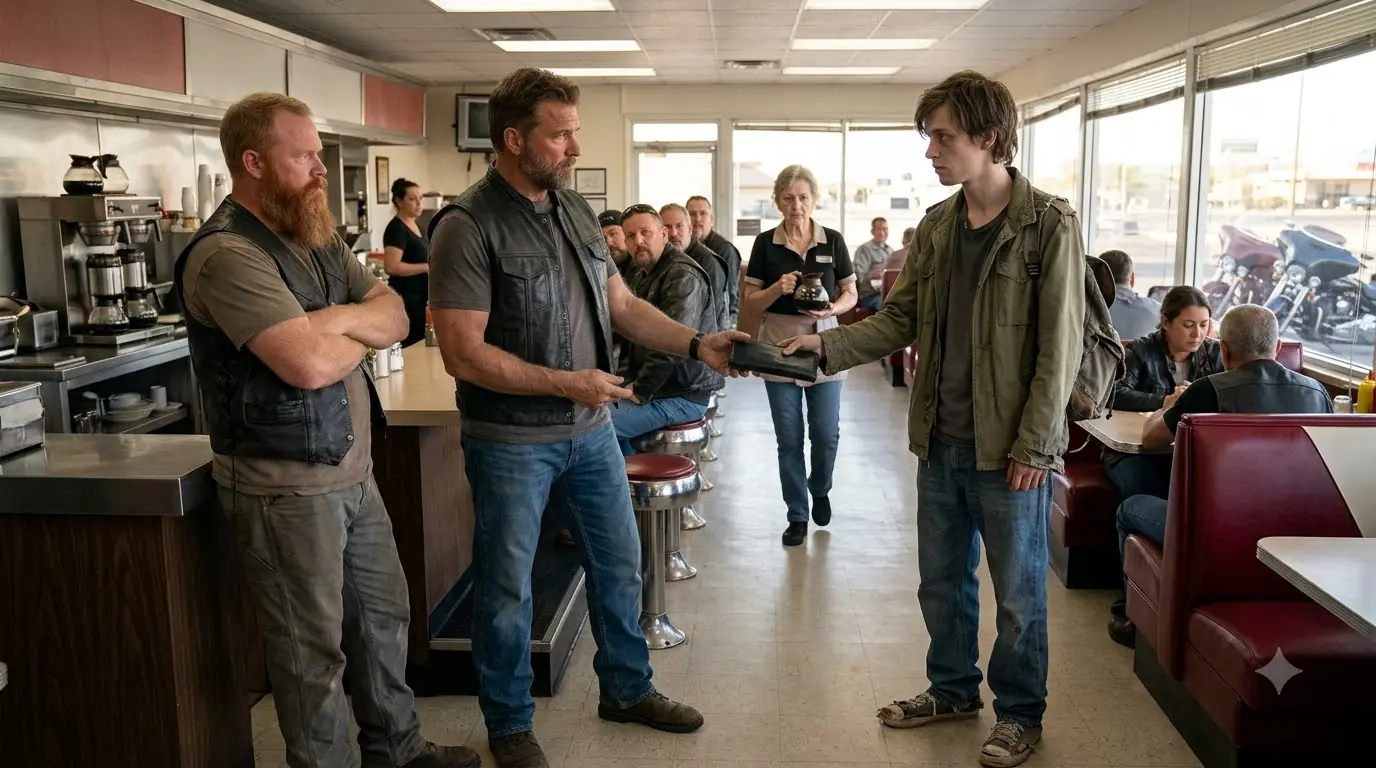
Every dollar remained inside.
Marcus slowly raised his eyes.
“Son,” he said, his voice dropping lower, “do you have any idea who I am?”
Ethan met his gaze without flinching.
“Someone who lost his wallet.”
On the morning Ethan Walker found that wallet, he had not eaten in thirty-one hours.
He knew the exact number because he had been counting. Not because he wanted sympathy or believed there was anything dramatic about his hunger, but because hunger marked time more accurately than any clock when a person lived the way he did.
Thirty-one hours had passed since a gas-station employee left half a sandwich beside a dumpster and deliberately avoided looking too closely at the person who retrieved it. Thirty-one hours of Ethan’s stomach tightening against his spine whenever he moved.
He was twenty years old.
Late October in Phoenix, Arizona, was beginning to remember that the desert possessed a colder side. The parking area beside Route 17 was little more than a stretch of cracked asphalt between a closed auto-parts store and a chain-link fence that had leaned at a forty-five-degree angle for so long that someone painted a smiling face on it.
Truck drivers used the lot occasionally. Motorcyclists used it frequently.
Across the road stood a diner whose lights buzzed and flickered through the night. When the diner’s own parking spaces filled on weekends, the overflow spread into the cracked lot beside the closed store.
Ethan had slept behind the auto-parts building twice before. Three walls protected the space from most of the wind, and the security light above that corner had been broken long enough that nobody remembered when it last worked.
In darkness, Ethan became invisible.
In Phoenix, invisibility was a form of survival.
That morning, he searched along the edges of the lot. He was not stealing. He had promised himself a long time ago that he would never steal.
He was only looking.
People dropped things. They abandoned things. Sometimes there was a half-empty bottle of water, an old phone charger, or food someone no longer wanted.
Once, Ethan found a twenty-dollar bill folded inside an abandoned fast-food bag. That money fed him for two days.
He was not proud of what his life had become, but he refused to pretend it was anything other than what it was.
Ethan noticed the wallet at 6:14 in the morning.
He knew the time because an old analog clock hung beneath the diner sign across the road. Its red second hand jumped from one mark to the next instead of moving smoothly.
Ethan had been watching it because hungry people often watched anything that helped them concentrate on something besides hunger.
The wallet lay beside the rear wheel of a motorcycle.
It was a large, heavy black machine, the kind that seemed unapologetic about the amount of space it occupied. The wallet itself was made from black leather and looked unusually thick.
It had fallen in a position suggesting it slipped from a saddlebag while the motorcycle was being loaded or unloaded.
Nobody stood nearby.
Several motorcycles were parked at the far end of the lot, but their riders were inside the diner. Ethan could see them through the windows, leaning over cups of coffee and breakfast plates.
He studied the wallet for a long time before picking it up.
Ethan told himself he would only examine it, determine who owned it, and find a way to return it without turning the situation into anything complicated.
He lifted the wallet and opened it.
The money struck him first.
Not because he immediately counted it. He did not.
It was the thickness of the stack, the way the bills were packed so tightly that they pressed against the leather and gave the wallet its weight.
Ethan had held lost wallets before. He had found them, returned them, and watched owners take them without offering a word of thanks.
He knew what an ordinary full wallet felt like.
This was something else.
Standing beneath the pale morning light, Ethan carefully removed the cash and counted it. His lips moved slightly as he separated the bills.
Hundreds.
Fifties.
Several twenties near the back.
Four thousand three hundred dollars.
Ethan became completely still.
Four thousand three hundred dollars did not feel like a real number when a person stood inside a broken parking lot with holes in both shoes.
It belonged to another world, the world of people with addresses, bank accounts, refrigerators, and dinner tables.
Four thousand dollars could become a deposit on an apartment.
It could become several months of breathing room.
It could become the distance between where Ethan stood and somewhere that was not there.
He looked at the diner.
Then at the motorcycles.
Then back at the cash.
Finally, he searched the wallet for identification.
The Arizona driver’s license belonged to Marcus Callahan.
The photograph showed a man with a heavy jaw, closely cut gray hair near his temples, and eyes that appeared to have made an important decision long ago without ever reconsidering it.
The wallet contained several additional cards, including club membership cards and a business card. There was also a folded piece of paper Ethan did not open.
At the very back, protected behind everything else, he discovered a photograph.
It showed Marcus standing beside a group of men outside what appeared to be a motorcycle garage. Every man wore a similar vest.
They looked at the camera in the same way, as though the photograph was not merely a photograph but a record of something that mattered.
Ethan stared at it for a long time.
He knew little about motorcycle clubs. He had seen riders on highways, heard their engines, and noticed the vests, but he spent most of his life trying not to notice things that did not concern him.
When a person was homeless, noticing the wrong thing could create trouble.
You lowered your head.
You made yourself small.
You avoided looking at strangers long enough for them to feel observed.
Still, Ethan studied the photograph.
There was something about the way the men stood close together, solid and deliberate, as though they had actively chosen one another.
The sight created a complicated feeling inside his chest.
Ethan closed the wallet.
He stood there for more than a minute with it in his hand.
Four thousand three hundred dollars.
Nobody had seen him find it.
Nobody was watching now.
No one would ever know.
He thought about what the money could do, not in an abstract or wishful sense, but practically. People who lived without resources learned to calculate them precisely.
He could rent a room. It would not need to be a good room, only one with a lock on the door and a bed that was not pavement.
He could eat that day.
He could eat the next day.
He could replace his shoes and perhaps buy a jacket without a tear across the right shoulder that allowed cold air inside regardless of how he positioned himself.
Ethan could disappear with the money, and nobody would stop him.
Then he thought about the one thing he had protected through everything that happened.
He had held on to it through the collapse of his relationship with his family, through months of sleeping on couches, through shelters, and eventually through life on the street.
He kept it through promises of help that never became real and through nights when temperatures dropped low enough that stubbornness was the only thing separating him from serious danger.
Ethan had never taken something that did not belong to him.
Not once.
He had not stolen when doing so would have been easy.
He had not stolen when nobody would have noticed.
He had not stolen on nights when hunger made his hands tremble and every rationalization arrived quickly, logically, and convincingly.
Somewhere beneath conscious thought, Ethan understood why.
If he began taking things that were not his, even small things from people who might never miss them, the version of himself he had been protecting would stop existing.
Once that version disappeared, Ethan did not know whether another one existed underneath it.
He did not know whether anything remained underneath it at all.
Taking the money would answer that question.
Ethan was not prepared for that answer.
He placed every bill back inside the wallet, folded it closed, and slipped it into his pocket.
Then he walked across the parking lot toward the diner.
A bell above the door rang when he entered.
Warmth struck him first.
It was the particular warmth of a diner during the early morning, filled with coffee, cooking grease, low conversations, and the hiss of food against a hot griddle.
Ethan’s stomach contracted painfully at the smell.
He forced himself to ignore it.
Standing near the entrance, he examined the room.
There were four booths beside the windows, a row of eight stools at the counter, and several tables arranged in the center. Five counter stools were occupied.
At the far end sat six men in leather vests, surrounded by enough plates to suggest they had been there for some time.
Ethan recognized the vest from the photograph.
He began walking toward them.
He crossed approximately half the diner before one of the men noticed him.
The man had a large build, a red beard, and forearms suggesting a lifetime of physical labor. He turned on the stool and examined Ethan the way members of a motorcycle club often examined an unknown person approaching without invitation.
It was not exactly threatening.
It was an assessment.
“Something I can do for you, son?” the red-bearded man asked.
His tone was not unfriendly. It was level, the kind of level indicating that unfriendliness remained available if required.
Ethan continued until he stood close enough to speak without raising his voice.
“I am looking for Marcus Callahan.”
The red-bearded man’s expression shifted.
The other men at the counter turned.
“What for?”
Ethan raised the wallet.
The silence that followed possessed weight.
The red-bearded man looked at the wallet, then at Ethan. He turned toward the man seated at the end of the counter and communicated something using only his eyes.
The man with gray at his temples placed his coffee cup down.
Then he stood.
Marcus Callahan appeared larger in person than he had in the license photograph.
It was not only his physical size, although he was large. There was a deliberate quality to the way he moved that made him seem to occupy more space than his actual dimensions required.
He walked along the counter without rushing and stopped in front of Ethan.
Marcus looked at the wallet.
Then he looked at Ethan.
“Where did you find it?”
“In the parking lot, beside your motorcycle. It looked like it fell from a saddlebag.”
Marcus accepted the wallet and opened it.
He examined the contents.
His expression remained unchanged, but something moved behind his eyes, a rapid calculation followed by an assessment.
He closed the wallet.
“Everything is there,” Ethan said. “I did not take anything.”
“I can see that.”
Marcus studied him for several seconds.
It was different from the way the red-bearded man looked at Ethan. Marcus was not assessing a threat.
He was doing something more uncomfortable.
He was seeing him.
“Do you want to sit down?” Marcus asked.
“I am fine.”
“I did not ask whether you were fine. I asked whether you wanted to sit down.”
Ethan sat.
Marcus ordered breakfast for him without asking what he wanted.
He told the waitress, a tired-looking woman named Beverly who had probably witnessed stranger events than a homeless young man eating beside a motorcycle-club leader, to bring whatever was hot and plenty of it.
Ethan attempted not to watch the food arrive with visible desperation.
He believed he was succeeding until Marcus spoke without looking away from his coffee.
“You do not need to pretend. There is no shame in being hungry.”
Ethan picked up his fork.
For several minutes, he ate while neither of them spoke.
The other men returned to their conversations, although they never turned completely away. An awareness remained in the room, a quiet collective attention that did not announce itself.
“When did you last eat a real meal?” Marcus asked.
“I eat.”
“That was not the question.”
Ethan considered lying.
He had become skilled at protective lies, the kind that prevented people from looking too closely or offering things he would then need to refuse.
Something about Marcus made the lie feel pointless.
Perhaps it was the directness of the question. Perhaps it was the fact that Marcus had watched Ethan consume half a plate of eggs in less than two minutes.
Perhaps Ethan was simply exhausted, and warmth made people less careful.
“Yesterday morning,” he admitted. “Sort of. It was not much.”
Marcus nodded.
“How long have you been living outside?”
“A while.”
“How old are you?”
“Twenty.”
Marcus set down his coffee cup.
He gave Ethan the same direct look.
“You found a wallet containing more than four thousand dollars. You are twenty years old, sleeping outdoors, and hungry.”
Ethan continued eating.
“You walked into this diner and returned every dollar.”
“It was not mine.”
“No. It was not.”
Marcus paused.
“Many people in your situation would have reached a different conclusion.”
“I am not many people.”
Marcus almost smiled.
It was not a complete smile, only the beginning of one that stopped halfway.
“No,” he said. “You are not.”
He lifted his coffee again and watched Ethan over the rim.
“Do you have family somewhere?”
The question landed more sharply than Marcus probably intended.
Ethan felt his jaw tighten and forced it to relax.
“Not currently.”
Marcus appeared to understand that not currently carried more complexity than the words suggested. He possessed enough sense not to push.
“Friends? Anyone?”
“I manage.”
“I am certain you do.”
There was no sarcasm or condescension in Marcus’s voice.
It sounded closer to respect, the reluctant kind given after it had been earned rather than offered as encouragement.
Marcus could see that Ethan managed.
That was exactly what made his condition difficult to witness.
He reached into his vest and removed a card.
Marcus placed it beside Ethan’s plate.
The card contained only a name and telephone number.
Marcus Callahan.
No address.
No company.
No title.
“If you need something, call that number.”
Ethan looked at the card and then at Marcus.
“I do not want charity.”
“I know. That is not what I am offering.”
Ethan studied the card for another moment.
Then he placed it inside his jacket pocket.
“I should leave.”
“Finish eating first.”
Ethan finished the meal.
He did not call the number that day.
He did not call the following day or during the week after that.
Instead, Ethan placed the card inside the inner pocket of his jacket, the one whose zipper still worked, and returned to his life.
He returned to parking lots, shelter lines, and the constant calculation of resources that formed the background noise of living without stability.
He returned to surviving inside a city skilled at making people invisible.
Still, Ethan thought about the conversation.
He thought about it more often than he wanted to.
He did not focus on the offer or speculate about what the card might provide. Ethan learned long ago not to invest much energy in what might happen because what might happen often became what did not.
He thought about the way Marcus looked at him.
You are not many people.
Nobody had said anything like that to Ethan in a long time.
Shelter workers processed him like paperwork.
Strangers looked through him on sidewalks.
People who had once known him gradually, and then all at once, decided he was more trouble than he was worth.
Ethan had not realized how badly he needed someone to see him until someone did.
He put the thought away.
Ethan was good at putting things away.
He continued surviving.
The trouble began twelve days after he returned the wallet.
It began with a man named Cole Ramirez.
Ethan had seen Cole around before. He was one of the people living along the city’s margins, as Ethan did, but he made different decisions about what was acceptable.
Cole was in his mid-thirties and thin in a way suggesting more than poverty. There was a sharpness to his movements that Ethan associated with people constantly searching for an advantage.
Cole had been inside the parking lot on the morning Ethan found the wallet.
Ethan had not known.
He believed he was alone, but Cole had been hidden in the shadow beside the leaning chain-link fence.
Cole saw Ethan find the wallet.
He saw Ethan open it.
He saw him count the money.
Perhaps Cole did not see what happened afterward. Perhaps he did, and it did not matter because he intended to use only the beginning of the story.
Three days after the diner, Cole approached Ethan inside a shelter on Van Buren Street, where Ethan occasionally obtained a bed if he entered the queue early enough.
Cole moved beside him in the dinner line and spoke without looking over.
“I know about the wallet.”
Ethan kept his eyes forward.
“More than four thousand dollars.”
Cole collected a tray.
“Quite a discovery.”
“I returned it.”
“Of course you did.”
Cole smiled casually.
“Here is the problem. I do not have proof that you returned it.”
Ethan turned toward him.
“What I do have,” Cole continued, “are two witnesses prepared to tell anyone who asks that they watched you take it.”
Cole’s smile contained no visible malice.
The casualness made it worse.
He behaved as though he had decided this was simply business.
“What do you want?”
“Half.”
“Half of what? I returned everything.”
“That is what you say.”
Cole placed bread on his tray.
“If you returned all of it, then you have nothing to give me, and the problem solves itself.”
Ethan stared at him.
“Unless,” Cole continued, “you kept some money. In that case, half of whatever you kept purchases my silence.”
“I returned every dollar.”
“Then you have no reason to worry.”
Cole smiled again.
“But if the bikers or anyone else starts asking questions, my witnesses may tell their story first.”
He shrugged.
“Something for you to consider.”
Cole walked away with his tray.
Ethan remained motionless in the dinner line while the noise of the shelter continued around him.
He had faced accusations before, although never theft.
Ethan had been careful about stealing.
The previous accusations had been vaguer, the kind that attached themselves to people without addresses, stability, or documentation that made them real in other people’s eyes.
He understood how accusations worked.
He knew how quickly they became true in other people’s minds when the accused person had no way to prove otherwise.
Ethan was a twenty-year-old homeless man.
Cole was a man with two friends willing to lie.
Ethan thought about Marcus’s card.
Then he pushed the thought away, collected his food, and found a seat.
Three days later, the situation became worse.
Ethan had been sleeping inside an abandoned commercial property several blocks from Central Avenue. A loosely organized group of approximately fifteen people used the building for shelter with the unspoken permission of a property manager who chose not to interfere.
Suddenly, access to the building ended.
At first, Ethan did not understand why.
Then he encountered a woman named Darra, one of the other residents.
Darra explained that someone visited the property manager.
The visitor was thin and sharp-eyed.
He implied that one of the people staying inside the building had been involved in a theft.
Cole did not name Ethan directly, but he described him clearly enough.
Ethan stood on the sidewalk after Darra finished and felt something he could not name.
It existed somewhere between fury, grief, and exhausted recognition.
The world possessed a specific way of working against people already trapped beneath it.
Ethan had been foolish to believe one good decision might protect him from that.
Cole had not truly wanted money.
He wanted leverage.
Or perhaps Cole simply wanted to observe what happened after he pushed someone. Certain people did not require a clear benefit from causing damage.
They only needed to know they could.
Ethan returned to the location where he left his backpack.
It was gone.
For several seconds, he could not process the absence.
The backpack contained everything he owned that did not fit inside his pockets.
A change of clothing.
A blanket.
A barely functional phone and its charger.
Several identification documents Ethan spent months replacing after losing everything the first time.
The phone and charger might eventually be replaced.
The documents would require months of administrative work.
The missing blanket would become an immediate problem.
Ethan searched the surrounding area and asked everyone nearby.
The backpack had disappeared.
He sat on a curb.
For a long time, he remained there while Phoenix moved around him.
Cars passed.
People walked.
The merciless afternoon sunlight revealed everything whether a person wanted to see it or not.
Ethan reached into his jacket and found Marcus’s card.
A name.
A number.
Nothing more.
He studied it for a long time.
Calling meant admitting something, not only to Marcus but to himself.
It meant admitting that Ethan could not manage the situation alone.
It meant acknowledging that events had moved beyond his control and that he needed something from another person.
He hated that.
Ethan had spent years developing the ability not to need anything from people.
Needing created obligation.
Obligation created situations where choices disappeared.
He learned that lesson inside a specific house with specific people at a specific age.
It had embedded itself so deeply that Ethan carried it the way other people carried keys.
Still, sitting on the curb beneath the afternoon sun with no backpack, shelter, or plan, Ethan kept returning to one fact.
He had already done the right thing.
He did it during the worst possible moment and under circumstances where the wrong choice would have been easy, profitable, and invisible.
Doing the right thing had not protected him.
It had not made his life easier.
If anything, returning the wallet drew attention and gave Cole Ramirez a story to distort.
Ethan had done everything correctly and still sat on a curb with almost nothing.
Perhaps the belief he had been protecting most carefully was wrong.
Perhaps accepting help was not the same as surrendering something.
Perhaps what he called strength was only an extremely convincing form of pride that learned to describe itself as survival.
Ethan looked at the card again.
His phone had three percent battery power remaining. The charging port was loose and unreliable.
He dialed.
The call rang twice.
“Yeah,” a voice answered.
“Marcus Callahan?”
A pause followed.
“Who is this?”
“Ethan Walker. I returned your wallet approximately two weeks ago at the diner beside Route 17.”
The second pause was shorter.
“I remember.”
Something changed slightly in Marcus’s voice.
“What happened?”
Sitting on a curb beneath the Phoenix sun with a dying phone and only a card to his name, Ethan told him.
He described Cole’s threat.
The alleged witnesses.
The conversation with the property manager.
The loss of the building.
The missing backpack.
Ethan told the story plainly, without decoration, the way people spoke after they no longer possessed enough energy to frame things carefully.
He told it like the truth because it was.
When he finished, silence remained on the line for approximately five seconds.
“Where are you now?” Marcus asked.
Ethan looked toward the nearest street signs and named the intersection.
“Stay there.”
“I do not want…”
“Stay there,” Marcus repeated.
His tone was not loud or forceful.
It was certain.
The call ended.
Shortly afterward, Ethan’s phone died.
He placed it inside his pocket and remained on the curb as afternoon turned toward evening.
The sky above Phoenix changed into the colors it sometimes produced as though apologizing for the day’s heat. Orange, pink, and something almost purple spread across the flat horizon.
Ethan waited.
He did not know exactly what he was waiting for.
He only knew that the voice on the telephone said stay there with a certainty that, for reasons he could not fully explain, seemed worth obeying.
The evening deepened.
Streetlights came on.
Ethan Walker, twenty years old, homeless, hungry, stripped of nearly everything he owned, and already losing his reputation inside the small corner of the city where he lived, sat on the curb and did something he had not done for a long time.
He allowed himself to believe that someone might appear.
Ethan waited for two hours.
The honest reason was that he had nowhere else to be.
There was no other task to complete, destination to reach, or plan extending beyond the next hour.
Another reason existed, one Ethan did not want to examine too closely.
He waited because Marcus Callahan told him to.
Marcus’s voice carried a weight capable of making Ethan believe, against his better judgment, that the instruction meant something.
Ethan stopped trusting instructions long ago.
People issued instructions when they wanted something.
Stay here.
Return tomorrow.
Wait for my call.
Ethan had heard them from social workers, shelter coordinators, and people who sincerely intended to help until they discovered that helping was more complicated than it appeared.
He learned to hold such promises loosely.
They came from people who lost nothing by making them.
Still, Ethan waited.
The streetlights had been operating for forty minutes when he heard the engine.
It was not a group of motorcycles.
There was only one.
The motorcycle approached slowly and deliberately, as though its rider knew precisely where he was going.
Ethan followed it using his peripheral vision, the way he watched most things carefully enough to detect movement without announcing that he was watching.
The motorcycle stopped approximately ten feet away.
Marcus dismounted in one practiced movement.
He wore the same vest, or one nearly identical to it.
Marcus approached Ethan with the same direct expression he had shown inside the diner. It was neither unkind nor soft.
“You still have my number?” Marcus asked.
“I called it.”
“I know.”
Marcus sat beside him on the curb.
He did not choose a bench or lean against a wall. He assumed Ethan’s exact posture, forearms against his knees, as though sitting there did not bother him and perhaps he had done it before.
“Tell me about Cole.”
Ethan repeated the events, but this time his explanation was shorter and more precise.
When people told the same story twice, they no longer needed to search for the facts.
Cole inside the dinner line.
The two claimed witnesses.
The property manager.
The missing backpack.
Marcus listened without interruption.
He did not make the artificial sounds people often produced while technically listening but waiting for their opportunity to speak.
He simply listened.
When Ethan finished, Marcus remained quiet for a moment.
“Do you know where Cole is now?”
“He moves around. I could probably find him.”
“I am not asking you to find him. I am asking whether you currently know where he is.”
“No.”
Marcus nodded.
“What about these witnesses? Do you know who they are?”
“I have a guess. There are two men he associates with, but a guess is not proof.”
“No. It is not.”
Marcus became quiet again.
It was not an uncomfortable silence. It meant he was thinking and that whatever he said next would connect to something real.
“I want you to understand something,” Marcus finally said. “What Cole is doing is not only about you.”
Ethan waited.
“He is using your name to persuade people to believe something false. That is a specific kind of wrong.”
Marcus paused.
“I do not tolerate it. My people do not tolerate it. Do you understand?”
“You do not need to become involved.”
“You returned my wallet.”
Marcus said it simply.
“In my world, that means I am already involved.”
The matter-of-fact statement loosened something inside Ethan’s chest, some hardened structure he carried for so long that he stopped noticing its weight.
He looked down the street as a passing car’s headlights moved across the pavement.
“I do not want trouble.”
“You are already in trouble. What you do not want is additional trouble. That is different.”
Marcus stood and removed his phone.
He made a brief call consisting of three efficient sentences.
Ethan did not hear everything. He heard a name, Ricky, an address, and the phrase, “Find whatever you can.”
Marcus returned the phone to his pocket.
“Have you eaten tonight?”
“I am fine.”
“You said that at the diner.”
Marcus studied him.
“It did not seem accurate then, either.”
Ethan almost repeated the answer.
He stopped.
“No. I have not eaten.”
“Come on.”
The diner Marcus chose was not the one beside Route 17.
It was a smaller restaurant several miles south, the kind of establishment that had remained unchanged for thirty years and saw no reason to become different now.
Marcus ordered without looking at a menu.
The waitress wrote it down without asking for clarification, suggesting this was a familiar arrangement.
They sat inside a booth near the back.
Ethan ate while Marcus drank coffee and watched the room with the relaxed vigilance of someone accustomed to knowing what stood behind him.
“Tell me something,” Marcus said. “What would you have done tonight if you had not called me?”
Ethan considered the question.
“Survived the night. Worked out the rest tomorrow.”
“That was the whole plan?”
“That is usually the whole plan when you live outside.”
Ethan continued eating.
“You learn quickly that plans extending beyond tomorrow are only methods of creating disappointment.”
“How long have you thought that way?”
“Long enough that it does not feel like thinking anymore. It simply feels like how things are.”
Marcus slowly rotated his coffee cup.
“You attended school before all of this?”
“Two years of college. I started an engineering program.”
“You did not finish?”
“Things at home collapsed. I did not have enough money to remain enrolled without the home part.”
Ethan paused.
“I was too proud to tell anyone at school what was actually happening, so I disappeared.”
Marcus watched him steadily.
“You are skilled at disappearing.”
“I once believed that was a useful skill. I am no longer certain.”
Marcus placed down his coffee.
“Do you know what I think?”
Ethan looked up.
“I think you have been punishing yourself for something that was not your fault. You described it as survival because that was easier than calling it what it actually was.”
The directness struck Ethan more powerfully than he expected.
Something defensive moved behind his chest, ready to resist, and then stopped because the energy required to fight had gone elsewhere.
“Maybe.”
“Not maybe. I have seen that expression before.”
Marcus looked directly at him.
“I wore it myself.”
“You did?”
“A long time ago.”
Marcus did not elaborate.
He did not need to.
The way he said it revealed that it was not a story he intended to tell that evening, but neither was it a claim made lightly.
Marcus had been somewhere difficult.
He had returned.
“The important point,” Marcus said, “is that I recognize the expression, and I know what it costs.”
His phone vibrated on the table.
Marcus read the message and placed the phone facedown.
“Ricky found information about Cole.”
“He is not my friend.”
“No. He is not.”
Marcus paused.
“Cole Ramirez has a history of doing this. He creates false stories about people who cannot defend themselves.”
Ethan stopped eating.
“He has done it in other cities with different targets. He selects people who are isolated and have nobody to contact.”
Ethan felt a cold, specific anger.
“He targeted me deliberately.”
“You are young and alone. He watched you interact with my people, which he viewed as both a danger and an opportunity.”
Marcus leaned back.
“He believed that if he moved quickly enough, his story would become accepted before you had the chance to tell yours.”
“First version wins.”
“Frequently.”
Marcus continued.
“The two witnesses are men who owe him. They will repeat whatever he tells them to say.”
Ethan sat with the information.
“That is only a problem,” Marcus added, “if nobody investigates what actually occurred. Ricky is very good at discovering what occurred.”
“What happens now?”
“Tonight, we find you a safe place to sleep. Tomorrow, we address everything else.”
“I told you I do not want charity.”
“I heard you.”
Marcus looked at him.
“You have been awake for most of the previous twenty-four hours. A man spread lies that cost you shelter, and everything you owned was stolen.”
He spoke with practical flatness.
“There is a difference between charity and basic logistics. Accept the logistics.”
The reframing caused Ethan’s objection to collapse before he could properly form it.
“All right.”
Marcus nodded.
“Good.”
Ethan slept that night on a cot in the rear room of a motorcycle garage.
The building smelled of motor oil, old metal, and faintly of coffee from a machine in one corner.
The garage belonged to Gus, a broad, quiet man in his sixties. His hands showed decades of mechanical labor, and his face suggested he had learned not to react strongly to many things.
Gus prepared the cot without comment.
He handed Ethan a blanket, told him there was a restroom down the hall, and mentioned that coffee would be ready at six if he wanted it.
Ethan lay in darkness and stared at the ceiling.
Somewhere beyond the garage, he heard city traffic and a train.
Phoenix produced a constant, uninterested background sound during the night. Ethan found it more bearable than complete silence.
True silence amplified everything a person did not want to consider.
He thought about his backpack and the documents inside it.
Months of work had gone into gathering proof of identity after he lost everything the first time.
He understood the administrative process of proving who he was when he possessed almost nothing capable of proving it.
He would need to start again.
Ethan did not have enough energy to consider the entire process that night.
He also thought about Cole Ramirez.
It was not revenge.
The word did not match the feeling.
What Ethan felt was more complicated.
It was the fury of being selected.
Cole looked at him and identified someone incapable of fighting back.
Ethan spent years being invisible to most people. The one person who noticed his circumstances clearly had viewed that weakness as an opportunity.
That was the part Ethan could not release.
He fell asleep sometime after midnight and did not dream.
At six in the morning, coffee was already prepared.
Marcus sat at a workbench with a mug and telephone, carrying the same settled presence he had shown inside the diner. He seemed like a man who learned long ago not to be hurried by mornings.
Ethan poured coffee and sat on a stool.
“Did you sleep?” Marcus asked.
“Better than I have in a while.”
Marcus nodded and slid a piece of paper across the bench.
“Ricky prepared this last night.”
The document contained names, dates, places, monetary amounts, and a rough timeline covering the previous six months.
It was denser and more thorough than Ethan expected.
He read carefully.
“This is enough to do something.”
“It is enough for the correct people to understand the truth.”
“Who are the correct people?”
Marcus smiled fully for the first time.
The expression suited him. It changed the texture of his entire face and made him look like someone who had decided, on balance, that the world was more interesting than terrible.
“That is the part I manage.”
Marcus made three calls while Ethan ate the breakfast Gus produced from somewhere.
Eggs and toast.
Nothing elaborate.
Everything hot.
With each conversation, the situation shifted incrementally, the way events changed when the correct people began applying pressure at the correct points.
Someone would speak with the property manager.
Another person would visit Cole’s two supposed witnesses.
Marcus made it clear that the conversations would not contain threats.
“They need information,” he said during the third call. “Nothing that could reasonably be described as intimidation.”
The men would learn that the planned story had been thoroughly investigated, that it did not survive scrutiny, and that publicly repeating a deliberate lie might create more serious consequences than refusing to repeat it.
Cole himself would be located.
“We will not touch him,” Marcus explained when the calls ended. “That is not how this works.”
Ethan waited.
“We place the truth in front of the correct people before Cole’s story reaches them. His version survives only if nobody examines it carefully.”
Marcus lifted his coffee.
“We are going to ensure everyone examines it.”
“He can still create problems.”
“He probably will attempt to.”
Marcus nodded.
“Cole Ramirez targets people who are alone.”
He met Ethan’s eyes.
“You are not alone anymore.”
The statement arrived without ceremony.
Marcus did not say it to create a dramatic moment.
He said it as one might update a fact before continuing.
You are not alone anymore.
Ethan looked into his coffee.
He did not possess language capable of matching what formed inside his chest.
Anything he attempted to say would have emerged too small or too large.
He nodded.
Marcus understood and returned to his phone.
By midday, the first part of the situation had shifted.
Gus entered from the work area and told Marcus that Darra had arrived.
She heard that people were investigating Cole’s claims and wanted to speak.
“Send her in.”
Darra entered with the careful posture of someone approaching unfamiliar territory.
She was in her forties, broad-shouldered, with a steadiness suggesting she had made difficult decisions for so long that they no longer felt difficult.
She looked at Marcus, then at Ethan.
Some tension left her expression.
“He told me you might help,” she said to Marcus.
“I am helping. Tell me what you know.”
Darra sat on Ethan’s stool and explained the events without embellishment.
Cole visited the property manager two days earlier.
The manager’s name was Haskell.
Darra described him as not exactly dishonest but easily frightened, the kind of person who chose whichever option appeared least likely to create trouble.
Cole told Haskell that someone matching Ethan’s description had been seen stealing from a parked motorcycle.
He implied that a motorcycle club was searching for the thief.
Cole suggested that Haskell would not want those bikers associating the property with the person they sought.
Haskell made the building unavailable that same afternoon.
“Cole already knew about the bikers,” Ethan said, assembling the sequence. “He watched me return the wallet.”
He considered it further.
“He knew I had contact with them, so he used them as the threat.”
“He reversed the story,” Marcus said. “He turned the bikers into danger instead of protection.”
“Haskell knows nothing about how any of this works,” Darra explained. “Cole entered sounding confident and connected. He described a problem Haskell did not want, so Haskell removed the problem.”
Marcus remained quiet.
“If someone explained the truth and Haskell understood there was no threat, would he admit what happened?”
“Yes. He is frightened, not dishonest.”
“Then that is where we begin.”
Marcus stood.
He looked toward Ethan.
“Come with me.”
Haskell’s office occupied one unit inside a row of commercial spaces near McDowell Road.
It existed mainly to provide a mailing address, a metal desk, and a telephone.
Haskell looked exactly as Darra described.
He was in his late fifties and carried the expression of someone who chose the path of least resistance at so many turns that he arrived somewhere smaller than where he intended to be.
The compromises seemed to have made him smaller too.
He looked up when Marcus entered.
Color disappeared from his face.
“I am not here to create problems,” Marcus said immediately.
He sat across from Haskell without being invited but somehow made the action appear courteous rather than presumptuous.
“I am here to correct information you received.”
Haskell looked at Marcus.
Then at Ethan.
His palms pressed more firmly against the desk.
“Who are you?”
“My name is Marcus Callahan.”
Marcus removed the black leather wallet from his vest and placed it on the desk.
“That young man found this two weeks ago in a parking lot.”
He indicated Ethan.
“It belongs to me. It contained more than four thousand dollars.”
Marcus’s voice remained calm.
“He returned it untouched and walked away without asking for anything.”
Haskell looked at the wallet.
Then at Ethan.
“The man who visited you claimed Ethan stole from a motorcyclist,” Marcus continued. “That statement was false.”
Haskell became still.
“The man’s name is Cole Ramirez. He lied so you would remove Ethan from his shelter.”
“Why?”
“Because Ethan refused to participate in something Cole wanted.”
Haskell’s face moved rapidly through several emotions.
“I did not know.”
“I understand. That is why I am informing you instead of accusing you.”
“He appeared completely certain.”
Haskell’s fear shifted toward embarrassment, which Marcus apparently considered an improvement.
“He had names. He said people had witnessed it.”
“He had people willing to repeat his instructions.”
Marcus looked at him steadily.
“There cannot be genuine witnesses to an event that never happened.”
Haskell turned toward Ethan.
“You truly returned it?”
“Every dollar.”
“You can ask him.”
Haskell looked back at Marcus.
“I already told you.”
Marcus’s quiet answer appeared to settle the issue.
Haskell released a long breath and rubbed the back of his neck.
“What do you need from me?”
“The truth, when it matters. Nothing else.”
Cole found them before they found him.
It happened in the parking area outside Haskell’s office while Marcus and Ethan walked toward the truck.
Ethan heard the voice first.
It was sharp and carried the aggressive edge of someone who already believed he was losing.
“I see you found protection.”
Cole stood approximately twenty feet away.
One of his supposed witnesses stood behind him.
Ethan recognized Danny Ferraro from the Van Buren shelter.
Danny did not appear eager to be there. His posture belonged to someone who agreed to something and was now reconsidering in real time.
Marcus stopped and turned.
“Cole Ramirez.”
It was neither a question nor a greeting.
Cole’s confidence shifted slightly.
He had clearly noticed Marcus’s vest and the controlled presence of a man who did not need to prove anything.
Cole had already committed to the confrontation and attempted to continue.
“I do not know who you believe you are dealing with, but this kid has been lying to people for months.”
Cole pointed toward Ethan.
“I have witnesses who saw him take your wallet.”
“Danny,” Marcus said without raising his voice.
Danny blinked.
“Danny Ferraro. Is that your name?”
Danny looked at Cole.
Then at Marcus.
He took a small step backward.
“I did not really see anything.”
His voice cracked slightly.
“Cole said it would be simple. He said I only needed to claim I was nearby.”
“Danny,” Cole warned sharply.
“I was not there.”
Danny seemed to be speaking as much to himself as to anyone else.
“I was not there. I did not see anything.”
The parking lot took on the particular atmosphere of a story collapsing in real time.
It was the sound of the second version arriving before the first could establish itself.
Cole’s face tightened.
He looked at Marcus, then Ethan.
Ethan could see the calculation behind Cole’s eyes, the rapid reassessment of a position dissolving beneath him.
Cole made the wrong decision.
“You cannot prove anything,” he said. “It is his word against mine.”
He pointed toward Ethan.
“A homeless kid with no address or history against a man with friends.”
“We spoke with Haskell,” Marcus replied. “We spoke with Darra.”
Cole’s expression shifted.
“Ricky has investigated your history since last night.”
Marcus paused.
“A woman in Tempe is interested in discussing something similar you did last spring. So is a man in Glendale.”
Cole became completely still.
“Ricky is thorough.”
Marcus’s tone remained level.
“We are not police officers. We do not operate exactly as they do, but we know people who know people.”
He allowed a moment to pass.
“Several of those people are interested in speaking with you about numerous matters.”
Cole stared at him.
“I suggest that the version of the next several hours where you walk away from this parking lot is preferable to the alternative.”
Cole looked at Marcus.
Then at Ethan.
Ethan expected further aggression, another argument, or continued movement from a man who committed himself too deeply to retreat.
Instead, Cole’s face simply changed.
It did not show remorse or shame.
The expression was more exposed than either.
It was the face of a man who operated under the assumption that he remained hidden and that his story would always move faster than the truth.
Now he understood that the truth had not remained behind him.
It had arrived first.
Cole looked at Danny, who stared at his shoes.
Then he turned and walked away.
He did not run.
He simply disappeared around the corner.
Traffic, wind, and distant music rushed back into the space he left.
Ethan exhaled without realizing he had been holding his breath.
“That is all?” he asked.
“That is usually how it ends when the other version catches up.”
Marcus sounded neither satisfied nor disappointed.
“Men like Cole do not want a fight. They want an advantage.”
He watched the corner where Cole disappeared.
“Remove the advantage, and there is nothing left to fight over.”
“He might return.”
“He may attempt something else, but not immediately and probably not directly against you.”
Marcus looked at Ethan.
“You stopped being easy the moment you were no longer alone. Do you understand that?”
“I think so.”
“The people who choose targets like you depend upon nobody standing beside their victim.”
Marcus paused.
“That is their entire calculation. Remove the isolation, and the calculation changes.”
Danny remained near the edge of the lot.
He looked like someone searching for something to do with his hands and finding nothing.
Marcus approached him.
Ethan followed.
“Tell me what happened that morning,” Marcus said.
Danny’s explanation emerged in short pieces.
He had not been inside the parking lot.
He had been sleeping at the shelter.
Cole approached two days later with the outline of a story and instructed Danny to confirm it if anyone asked.
Cole claimed the matter would never actually arise.
He described Danny’s participation as insurance.
“Did he pay you?” Marcus asked.
“He promised to. He never did.”
Marcus studied Danny.
From a distance, Danny appeared older. Up close, Ethan realized he was perhaps twenty-three or twenty-four.
He carried the worn expression of someone who made poor decisions long enough that they became habits.
“You have nothing to gain from this,” Marcus said. “Walk away from Cole Ramirez.”
“I know.”
Danny glanced at Ethan.
“I understood that when I saw you.”
He hesitated.
“I am sorry. I did not know you well enough to…”
Danny stopped.
“I am simply sorry.”
“Okay,” Ethan said.
It was okay.
Not perfect.
Not fully resolved.
But okay.
Ethan did not require more from Danny.
After Danny left, Marcus and Ethan remained alone in the parking lot.
“What happens now?” Ethan asked.
“We return to the garage and determine what comes next for you.”
“Only tonight?”
“No. Not only tonight or tomorrow.”
Marcus studied him.
“What actually comes next?”
Ethan said nothing.
“I have been considering the facts,” Marcus continued. “You studied engineering for two years. You are twenty.”
He stepped closer.
“You are not the completed version of yourself, Ethan. You are nowhere near it.”
“I know.”
“Then stop acting as though you are.”
The statement was not cruel.
It was direct, and its directness became a form of respect.
Marcus refused to soften the truth until it lost its shape.
“Come on.”
They walked toward the truck.
Phoenix continued around them with the complete indifference of cities toward the exact coordinates of any single person’s turning point.
Ethan Walker, twenty years old, crossed the parking lot beside a man who appeared when nobody else had.
He felt something unfamiliar.
It was not safety exactly.
He was not saved or repaired.
It was the feeling of a day that began in one direction and turned.
It was the feeling of ground that held.
Ethan stored it carefully, the way he stored things that mattered but that he did not yet completely trust.
Then he continued walking.
The garage became Ethan’s world during the next week and a half.
Nobody forced the arrangement.
Marcus did not order Ethan to remain, Gus did not lock the doors, and no formal declaration established how things would work.
It happened the way many changes happened in Ethan’s experience.
Gradually, then suddenly.
A collection of small facts accumulated into something larger.
He slept on the cot.
He drank Gus’s coffee.
He watched what occurred around him and kept his hands available.
Around the third day, Gus handed him a wrench without explanation and pointed toward an engine requiring attention.
Ethan accepted the tool and did what he could.
What he could do turned out to be more than Gus expected.
“You said you studied engineering,” Gus observed while watching him work.
“Two years.”
“You have more than two years inside those hands.”
Gus delivered the statement without decoration.
He seemed to consider words a limited resource and spent them carefully.
Ethan did not respond, but something inside him registered the acknowledgment.
Praise from Gus felt different.
It felt like information.
Marcus visited most mornings.
Sometimes he stayed for an hour.
Other visits lasted ten minutes.
He and Gus discussed logistics, people, and the administrative language of an organization operating under its own rules for long enough that those rules developed a grammar Ethan was only beginning to understand.
Whenever Marcus addressed Ethan, the conversation had purpose.
He asked direct questions and expected direct answers.
Every conversation appeared to build toward something, although Ethan could not always see what it was.
On the sixth day, Marcus asked about the engineering program.
“What specifically were you studying?”
“Mechanical systems.”
“What attracted you to it?”
“The way parts work together.”
Ethan looked at the engine in front of him.
“You can examine a broken thing and understand it by understanding each component.”
“That is what you enjoy? Understanding?”
“I like that the answer is always there.”
Ethan considered how to explain it.
“When something mechanical breaks, the problem exists and the solution exists. You only need to find the path between them.”
He wiped his hands.
“It does not depend on anyone’s opinion. It is either true or it is not.”
Marcus remained quiet.
“You do not trust opinions.”
“I trust what I can verify.”
“And yet,” Marcus said, “you trusted me enough to call.”
Ethan had no answer.
Perhaps he had one but answering honestly required more than he was ready to spend during a single conversation.
He returned his attention to the engine.
“I had no other options.”
“You had options. You selected this one.”
Marcus left the statement there.
He was skilled at saying exactly what needed to be said without adding emphasis or waiting for Ethan to confirm that he understood.
The words remained inside the room, requiring Ethan to return to them later.
That night, Ethan did.
He had chosen to call.
Of every available option, including shelters, streets, and the daily navigation of surviving alone, he called a man he spoke with once for forty minutes in a diner.
The choice was not entirely practical, logical, or guaranteed to produce a result.
Something in Marcus’s voice registered as genuine, the specific frequency of a person who meant what he said.
Ethan had not trusted that feeling in a long time.
He remained uncertain whether he should trust it now.
Still, the call had been answered.
The meal was real.
The cot was real.
The wrench in Ethan’s hand had been real.
Perhaps that was enough evidence for the moment.
On the eighth day, Ricky arrived at the garage.
Ethan had heard his name but had not met him.
Marcus referred to Ricky the way he referred to most people, as though the name itself contained enough information.
Ricky was smaller than Ethan expected, a compact man in his mid-forties with a face that observed more than it displayed.
It seemed built for gathering information rather than broadcasting it.
He shook Ethan’s hand with brisk efficiency.
“The kid handled the Haskell situation well,” Ricky told Marcus.
“He remained present,” Marcus said.
“He did not run or panic when Cole arrived. Many people panic.”
Ethan stood close enough to hear.
“I have experienced worse situations.”
Ricky looked at him with genuine interest rather than disbelief.
“What do you do when it becomes worse?”
“I become quiet. I focus on the next five seconds and whatever needs to happen during those five seconds.”
Ricky exchanged a brief glance with Marcus.
Information passed between them without words.
“Cole has left Phoenix,” Ricky said. “Not because we forced him out. Glendale became interested in the incident from last spring.”
“The woman involved made a formal report?”
“Yes.”
“That was not because of us.”
“It was partly because of us. We placed Cole’s name in front of the right people.”
Ricky shrugged.
“We did not manufacture anything. We ensured that what already existed did not remain hidden.”
He paused.
“Sometimes justice functions. It occasionally needs someone to clear the path.”
Ethan absorbed that.
“What about Haskell and the building?”
“Haskell spoke with the other residents yesterday. He corrected the situation.”
Ricky looked toward Ethan.
“You may return if you want.”
Ethan thought about the building near Central Avenue, the group of fifteen people, and the social structure they created to survive inside an unofficial space.
He compared the familiar to the new.
The building to the cot.
“I do not think I need to return.”
Ricky raised an eyebrow.
“I mean, I am all right here, if that remains acceptable.”
Ethan looked toward Gus, who stood across the garage pretending not to listen.
“Fine with me,” Gus said without turning around.
Marcus eventually told Ethan what he had been considering.
He did not hint or gradually arrange pieces for Ethan to discover.
Marcus communicated directly, and when he reached a decision, he placed it on the table.
He entered on a Thursday morning, poured coffee, sat across from Ethan, and spoke.
“This garage needs a second mechanic.”
Ethan waited.
“Gus is excellent, but he is one person, and the workload has exceeded him for approximately one year. I have considered several options.”
Marcus paused.
“You are not a completed mechanic. You will need training, but you possess the foundation.”
He counted each point without exaggeration.
“The engineering understanding, the hands, and the patience.”
Marcus looked toward Gus.
“He says you are more capable than you reveal.”
“You are offering me a job.”
“I am offering you a position.”
“What is the difference?”
“A job is transactional. You work, receive payment, and leave.”
Marcus leaned forward.
“A position means you are building something. You are learning a trade and becoming someone with a skill worth possessing.”
He met Ethan’s eyes.
“I am offering the second.”
Ethan remained silent.
“Why?”
“I already explained.”
“You said I returned your wallet, but people return wallets every day. You do not offer all of them positions.”
Marcus considered the statement.
“No. I do not.”
He placed down his coffee.
“Do you want the actual answer?”
“Yes.”
“The choice you made that morning mattered.”
Marcus’s voice became quieter.
“Not only returning the money, but returning it while living in your condition.”
He paused.
“I have met many people who speak about integrity and doing the right thing. Most mean they act correctly when the cost remains manageable.”
Marcus looked directly at Ethan.
“You acted correctly when the cost was everything you had.”
Ethan stopped breathing for a moment.
“You could have justified keeping that money to anyone, including yourself.”
Marcus shook his head.
“You did not.”
He allowed the statement to settle.
“I do not find that often. I will not ignore it when I do.”
The words entered a part of Ethan that had operated on empty for so long that he forgot what accurate recognition felt like.
Marcus was not generously giving credit Ethan had not earned.
He was naming something he personally witnessed.
“I need to repay the cot, the food, and the week here.”
“You will earn it.”
Marcus dismissed the concern with one sentence.
“You begin Monday. Gus will explain what he needs. You will make mistakes, he will correct them, and you will learn.”
He paused.
“There is a room above the garage. It is small but clean, private, and has a lock.”
Ethan looked at him.
“Rent will be deducted from your wages.”
“Not charity.”
“Not charity. An arrangement.”
Marcus extended his hand.
“You contribute something. We contribute something. It functions because both sides meet their obligations.”
He kept his hand extended.
“Are you in?”
Ethan looked at it.
He thought about the parking lot, the wallet, the diner, the curb, the dying phone, and the card he almost never used.
Every link seemed small when viewed alone.
Only from that moment could Ethan see the entire chain.
He shook Marcus’s hand.
“I am in.”
The first two weeks of actual work at the garage were the most difficult Ethan had experienced in a long time.
Considering the previous two years, that was meaningful.
The work itself was not beyond him.
Working required a different endurance than surviving.
Survival was reactive.
A person responded, adapted, moved, and managed.
Work accumulated.
Each day built upon the one before it.
Every mistake needed to be understood, corrected, and not repeated.
The not repeating required sustained attention that Ethan rebuilt the way someone strengthened a muscle after a long injury.
He made mistakes.
Gus corrected them.
He did not shout or display impatience.
If Gus possessed impatience, he chose not to use it.
He corrected Ethan clearly enough that the right method became obvious without making the error feel catastrophic.
The room above the garage was small.
It contained a window, bed, bathroom, and door with a lock.
On the first night, Ethan woke twice and could not remember where he was.
It was not dream disorientation.
It was the physical experience of waking inside an enclosed private space after living without one for so long.
The silence felt different.
Darkness possessed a different quality.
Each time, Ethan required several seconds to understand his surroundings.
Once he did, he remained still and felt their weight.
A ceiling above him.
A locked door.
Wind against a window.
Shelter was present as a physical fact.
Ethan thought about how easily most people accepted it.
He promised not to take it for granted.
If life became easier, he wanted to remember precisely how that room felt.
Approximately three weeks after arriving, Ethan first understood what Marcus Callahan represented to the people around him.
He already knew the abstract structure of the club and the community moving through the garage like a tide that never completely withdrew.
Men and women stopped by.
Some wore the official vest.
Others were connected through history, proximity, obligation, or loyalty.
Marcus maintained that web with the practiced ease of someone who had done so for decades.
On a Saturday afternoon, a family arrived.
A woman named Carla entered with two children.
She was in her mid-thirties. Her son appeared nine, and her daughter perhaps six.
Carla’s posture showed that she did not want to ask for help but had exhausted every other option.
She asked for Marcus.
Gus sent Ethan to find him.
Marcus stood in the rear of the garage speaking on the phone. When Ethan explained who had arrived, Marcus ended the call without finishing it.
Carla’s husband, Joey, had been hospitalized for two weeks after a workplace accident.
He would survive but could not return to work for at least three months.
Their rent was due in four days.
Their savings were gone.
Carla had already visited three organizations and could think of nowhere else to go.
Ethan remained close enough to hear because nobody instructed him to leave.
He had learned that inside the garage, a person stayed where he was unless sent elsewhere.
Marcus listened without interruption.
When Carla finished, he entered the particular silence Ethan recognized as thought, the process by which Marcus assembled information and produced a course of action.
“Joey works for Hannigan’s, correct?”
“Yes.”
“Hannigan owes me a conversation.”
Marcus spoke without threat or heat, in the manner of someone stating a fact both parties would understand.
“The safety failures contributing to Joey’s accident are matters Hannigan will want to resolve before they become public.”
He paused.
“Your rent will be handled in the meantime. Speak with Ricky before you leave.”
Carla became quiet.
Her daughter moved until half hidden behind her leg. Her son stared toward the motorcycles with barely restrained amazement.
“I do not know how to thank you.”
“You do not need to.”
Marcus looked toward the children.
“Joey supported this community when we needed him. That obligation moves in both directions.”
He addressed the boy.
“Would you like to see how an engine works?”
The child looked as though Christmas had arrived three months early.
Ethan spent the next forty minutes showing a nine-year-old named Marco the components of a disassembled engine.
He explained each part using the simplest language possible.
What it did.
Why it mattered.
What happened when it failed.
Marco asked more questions per minute than most adults Ethan knew.
They came rapidly and without embarrassment, the questions of someone whose curiosity had not yet learned to feel ashamed of what it did not know.
After Carla left with her children, Ethan cleaned his hands and found Marcus near the front of the garage.
“You do that frequently.”
“Do what?”
“Help people the way you helped her.”
Marcus looked at him.
“Is that a serious question?”
“Yes.”
Marcus considered the answer.
“Do you understand what this is actually for?”
He gestured toward the garage, vests, and wider structure surrounding them.
“What it means beneath everything else?”
“Not entirely.”
“Loyalty.”
Marcus looked toward the street.
“The genuine kind, not the version people describe during speeches.”
He continued.
“The kind that appears at four in the morning. The kind that costs something.”
Marcus explained that Joey remained at a hospital at two in the morning when Ricky’s child required surgery three years earlier and Ricky could not drive.
Carla delivered food to six families during a period when nobody could safely leave home.
“They are not club members,” Marcus said. “They have no official connection, but they are connected.”
He turned toward Ethan.
“That is what I meant when I said you were no longer alone. People who are genuinely connected protect one another.”
“What about me?”
The question escaped Ethan before he decided to ask it.
Marcus studied him.
“What about you?”
“I have not done anything for anyone here.”
Ethan struggled to explain.
“I returned one wallet. That was one action.”
“You protected something when you returned it.”
“It was only your money.”
“No.”
Marcus shook his head.
“You protected the belief that people can still be trusted.”
He stepped closer.
“You demonstrated that someone can be living through the worst circumstances of his life and still choose to become the right kind of person.”
Marcus paused.
“Do you believe I was the only one who needed to see that?”
Ethan said nothing.
“Gus needed to see it. Ricky did. Every person who made a difficult choice and wondered whether it mattered needed evidence.”
Marcus’s voice remained quiet.
“You gave us evidence. We owed you for it.”
Three days later, Marcus told Ethan about a gathering.
He emphasized that it was not a meeting.
It was a gathering held twice each year when members from around the region came together.
It was neither formally ceremonial nor insignificant.
Its importance was understood rather than announced.
“I want you there,” Marcus said.
“Why?”
“I want people to meet you.”
“I am not a member. I do not belong at something like that.”
“I am inviting you.”
Marcus’s answer was immediate.
“That is how belonging begins. Someone opens the door.”
Ethan considered the invitation for an entire day.
He sat with the discomfort of entering a large group whose members possessed shared history and context he lacked.
He imagined walking into a space containing approximately three hundred fifty strangers.
Then he remembered entering the diner three weeks earlier with Marcus’s wallet and almost nothing else.
He had done that.
He could do this.
“All right,” Ethan told Marcus.
The gathering took place on property outside Phoenix.
The land had belonged to the same family for two generations. It contained an open area and a structure large enough to shelter people whenever necessary.
Ethan arrived with Marcus and Gus behind a line of motorcycles extending farther than he expected.
He knew the attendance number in the abstract.
Three hundred fifty, perhaps slightly more or less.
Abstract numbers and physical crowds were different things.
Ethan stood outside and absorbed the sound.
Voices.
Engines cooling.
The ambient noise of hundreds of people sharing a space and knowing one another well enough that the energy between them felt easy rather than cautious.
Ethan had experienced crowds inside shelter lines, streets, and compressed city spaces.
This was different.
It possessed texture.
This was community in the specific sense, with history, fault lines, and the complicated affection of people who continued choosing one another despite evidence that might separate people with less commitment.
Marcus briefly placed a hand on Ethan’s shoulder.
He did not steer him.
He acknowledged the moment.
“Come on.”
During the first hour, Ethan remained near Marcus and Gus.
He met too many people too quickly and immediately forgot most names.
Every new face, name, and piece of context required a place inside his mind.
He shook hands and answered questions.
Ethan remained aware that people were assessing him, not with hostility, but through the careful process of a community that understood the importance of whom it welcomed.
Ricky appeared beside him with his usual quiet efficiency.
“How are you holding up?”
“Fine.”
“You have used that word incorrectly every time I heard you say it.”
Ricky looked toward the crowd.
“You mean overwhelmed.”
Ethan almost laughed.
“Does it become easier?”
“The first time inside a room like this is the hardest.”
Ricky nodded toward the gathering.
“Eventually, you stop seeing three hundred fifty people and begin seeing the individuals you know.”
“That appears to be a long eventuality.”
“Yes, but it is not optional if you want the genuine thing.”
Ricky disappeared back into the crowd.
An hour later, Marcus found Ethan near one side of the building.
“There are people I want you to meet.”
He led Ethan toward three men standing together.
Marcus introduced each by first name and provided one sentence of context.
Dex ran a program for at-risk youth.
Harrison had a legal-aid background and still worked in that field.
Pete had been homeless at twenty-two.
The final detail caused Ethan to examine Pete more carefully.
Pete was in his fifties, compact and solid, with the appearance of a man who built himself from materials that did not initially seem promising.
He met Ethan’s eyes with uncomplicated understanding born from shared experience.
“Marcus told me part of your story,” Pete said.
“The wallet story appears to be widely known.”
“It is a good story.”
Pete did not embellish it.
“When you were living outside, what was the most difficult part?”
Ethan waited.
“Not practical things,” Pete clarified. “The actual hardest part.”
Ethan considered it.
“Believing it was temporary.”
Pete remained attentive.
“I always knew it was temporary, but after enough time, knowing and believing stopped matching.”
Ethan searched for the correct words.
“You understand intellectually that your situation will end, but something inside you stops believing it.”
He looked at Pete.
“The loss of belief becomes worse than the actual circumstances.”
Pete nodded slowly.
“Yes.”
His voice was quiet.
“That is exactly it.”
“What helped you believe again?” Pete asked.
Ethan considered the question.
“Marcus.”
He answered honestly.
“The first conversation with him.”
Pete waited.
“He looked at me as though I would become something, not as though I was something requiring repair.”
Something shifted inside Pete’s expression.
It was not quite visible emotion, but a version managed for so long that it no longer appeared in obvious ways.
“That is Marcus,” Pete said. “Exactly Marcus.”
His voice carried gratitude so old that it became part of his structure.
Ethan stored that information.
He was still considering it when Marcus called the room to quiet.
Three hundred fifty conversations gradually disappeared.
The collective attention shifted.
Marcus stood near the center and did not raise his voice.
Ethan had noticed that he never did.
He possessed the kind of presence around which rooms organized themselves.
“Most of you know why we gather,” Marcus began. “We remember where we came from and examine where we are.”
He looked around the room.
“We account for what we built together and what we still owe one another.”
Marcus paused.
“Tonight, I want to introduce someone.”
Ethan understood what was happening half a second after the words registered.
Every muscle made a small instinctive movement toward an exit.
“His name is Ethan Walker.”
Marcus looked across the room at him.
“He is twenty years old.”
The crowd listened.
“Three weeks ago, Ethan found my wallet inside a parking lot. He was sleeping outdoors and had not eaten for more than one day.”
Marcus’s voice remained steady.
“There were over four thousand dollars inside that wallet.”
The room became completely silent.
“He returned every dollar.”
Marcus continued.
“He did not take a cent, ask for anything, or expect a reward. He entered a diner, located me, placed the wallet inside my hands, and said he believed I would want it returned.”
Marcus met Ethan’s eyes.
“That is who he is.”
Ethan remained motionless.
“He has worked at Gus’s garage during the last three weeks. He is learning the trade and earning his place.”
Marcus paused.
“He is a good mechanic and a better person.”
The words entered Ethan more deeply than he expected.
“I want everyone here to know his name because he will be around.”
Marcus looked across the gathering.
“When you meet him, understand whom you are meeting.”
Silence lasted one more second.
Then the room responded.
It was not wild or theatrical.
Nothing occurred that would deliberately embarrass Marcus or Ethan.
It was a collective acknowledgment, the sound of three hundred fifty people communicating that they heard Marcus, saw Ethan, and understood why it mattered.
Some applauded.
Others nodded.
Many looked at Ethan with expressions he could not entirely interpret.
Respect.
Recognition.
The look of people who remembered their own difficult choices.
Ethan felt his throat close.
He refused to cry in front of three hundred fifty motorcyclists.
That was a boundary he intended to maintain.
He succeeded, but barely.
A large, barrel-chested man with a gray beard appeared beside him.
His handshake felt capable of tightening an engine bolt.
“You are the young man?”
“I am Ethan.”
“Brick.”
Ethan assumed it was a name rather than a description, although it functioned as either.
“Marcus told me about you two weeks ago. He said I should meet you when the time was right.”
Brick examined him.
“Are you frightened?”
“Yes.”
Brick laughed loudly and genuinely.
“Good. Anyone who is not frightened inside a room like this is not paying attention.”
“What should I do?”
Ethan meant the question practically.
He possessed no social map for the territory.
“Be exactly who you are.”
Brick’s answer was immediate.
“That is the only thing that works here. These people detect pretense within thirty seconds.”
He struck Ethan gently on the shoulder.
“Marcus says you do not pretend often.”
“I used to. I became tired of it.”
“That is the only way anyone stops.”
Brick guided Ethan back into the crowd.
For two hours, Ethan did the only thing available.
He remained exactly who he was.
He answered questions honestly, including questions whose answers did not flatter him.
He did not exaggerate his abilities or perform gratitude and humility.
Ethan described where he had been and where he stood now, allowing others to decide what it meant.
He spoke with Dex about the youth program.
During that conversation, Ethan found himself describing an earlier turning point.
Months before finding the wallet, he watched a sixteen-year-old boy turned away from a shelter because every bed was occupied.
The rejection created a clean, sharp fury inside Ethan that reminded him he was still alive.
He spoke with Harrison about the administrative nightmare of reconstructing identity documents without stable housing.
Harrison removed a card from his pocket.
“Call me next week. I work with a paralegal who specializes in precisely that problem.”
Ethan spoke with a woman named Sylvia who operated a coffee shop two miles from the garage.
She owned a machine that had malfunctioned for six weeks and asked whether Ethan might examine it. She promised to pay Gus’s regular rate.
The evening continued that way.
One conversation opened into another.
Each produced something tangible.
By the end of the gathering, Ethan carried six business cards, two standing invitations, a possible job outside the garage, and the number of a woman who managed a GED tutoring program.
She mentioned college-equivalent courses Ethan might take if he ever wanted to resume what he left unfinished.
Near the end of the night, he stood at the edge of the room and looked at everything around him.
Marcus found him there.
“Surviving?”
“Yes.”
For the first time, Ethan meant the word differently.
It no longer described the bare minimum.
“I believe I am.”
Marcus studied the room, the shape of hundreds of individuals who chose one another in different ways.
“Do you know what these people are when you remove the motorcycles, vests, and everything else?”
“No.”
“Proof.”
Marcus spoke simply.
“Every one of them proves that a person can emerge from something difficult and choose to build something good.”
He looked at Ethan.
“Some came from farther away than you. Others not as far. Every one made a choice.”
Marcus paused.
“You made yours three weeks ago at six in the morning inside a parking lot.”
Ethan followed his gaze around the room.
“Most of these people understand the cost. That is why they heard your name and answered the way they did.”
Ethan thought about the young man standing at dawn with more than four thousand dollars and nobody watching.
He thought about the core of that person, the part that survived everything by refusing to become something it was not.
He pictured that person entering the diner and saying he believed Marcus would want the wallet returned.
Ethan did not know then that the sentence referred to more than a wallet.
He understood now.
He was still standing inside what had been returned to him.
The morning after the gathering, Ethan woke at 5:15 without an alarm.
His body retained the habits it learned for survival.
Early hours belonged to people who needed them.
Sleeping past dawn had once seemed like a luxury belonging to an entirely different category of person.
Even with a locked door, window, and ceiling that remained his as long as he upheld the arrangement, Ethan’s eyes opened at 5:15 and his mind began working before he was fully conscious.
He remained still and listened.
The garage below was quiet.
Phoenix occupied its particular predawn state, never silent but muted, with the city’s full volume still an hour from activation.
Ethan heard his breathing and the faint movement of wind against the window.
He considered the previous evening.
Not through anxious review of every sentence or impression, but through images.
Brick’s handshake.
Harrison’s card.
The sound the room made when Marcus spoke Ethan’s name.
Pete’s face when Ethan described losing belief in the temporary nature of homelessness.
Sylvia and her coffee machine.
The tutoring program.
Dex and the youth organization.
Marcus standing beside Ethan and describing every person in the room as proof.
Ethan rose.
He prepared coffee using the small setup inside his room, a kettle, single-cup filter, and ground coffee Gus silently placed on the shelf when Ethan moved upstairs.
Sitting on the edge of the bed with the cup between both hands, Ethan did something he had not allowed himself to do for years.
He considered the future.
Not the next five seconds.
Not the following morning.
The actual future extending beyond immediate survival into something with shape and direction.
Ethan had been so disciplined about keeping his horizon close that he nearly forgot horizons were meant to move.
He thought about the engineering program.
Two years of coursework.
The areas where he had been genuinely good and knew it, not because someone said so, but through the internal certainty of a person doing what he was built to do.
He considered what returning would require.
Not immediately.
Perhaps not that semester.
But someday.
What did the path look like?
Ethan was twenty.
He repeated the number because it mattered.
For so long, his circumstances carried the psychological weight of permanence even when he intellectually understood they could not remain permanent.
He needed the arithmetic.
Twenty years old.
Perhaps sixty functional years ahead if life proceeded normally and more if it went well.
He had lost two years.
The original circumstances were partly beyond his control. Eventually, pride, isolation, and refusal to ask for help became choices.
Two years out of sixty.
Ethan remained with that calculation for some time.
That morning, the future did not resemble a threat.
It looked like space he was permitted to enter.
He was not naïve about the effort required.
Rebuilding would demand work, time, and patience.
Still, Ethan had already completed the hardest form of that work alone and with nothing.
Performing it now with the garage, Gus, telephone numbers, and Marcus at the end of a call belonged to an entirely different category of difficulty.
He thought about his family.
He approached the memory carefully, the way someone touched an injury healed enough for contact but not pressure.
His mother.
His sister.
The sequence of pain, pride, and misunderstanding that closed the door between them.
Neither side reopened it.
Ethan had kept the subject at the edge of his mind for months, where people stored things they knew existed but could not afford to address directly.
That morning, he looked at it.
The thought remained unresolved and complicated, but its edges were less sharp.
He did not reach for his phone.
He was not ready.
He stored the thought and went downstairs to work.
Gus was already present, as always.
His consistent presence suggested he might have been constructed into the building beside the hydraulic lift and tool racks.
He passed Ethan a clipboard without looking up.
“A transmission job arrived last night. The customer needs it by Thursday.”
Ethan examined the details.
“It should occupy most of today and possibly tomorrow.”
The clipboard listed the vehicle, model, year, and description of the problem.
Ethan had worked on a similar transmission three weeks earlier under Gus’s supervision.
He made two mistakes and corrected both.
“I can do this.”
“I know. That is why I gave it to you.”
Ethan looked up.
“You are not supervising?”
“I will be twenty feet away performing my own work. If you need help, I remain twenty feet away.”
Gus looked at Ethan over his reading glasses.
“You have been ready for an independent job for a week. I was waiting for you to understand that.”
“What made you think I understood?”
“You stopped asking me to examine everything twice.”
Gus returned to his task.
“Begin.”
The transmission required nine hours and one thirty-minute lunch break.
Ethan purchased a sandwich from a shop two blocks away.
The employees had begun preparing his usual order when they saw him enter, the kind of small local recognition that felt different after spending years unseen.
He worked carefully and steadily with the concentration that came naturally whenever the material in front of him was mechanical rather than social.
Twice, uncertainty sent him toward Gus.
During the first, Gus listened to the description and asked two questions.
“What do you think?”
“I believe the issue is the seal near the torque-converter housing, but I am not completely certain.”
“You are approximately ninety percent certain.”
Gus removed his glasses.
“That is where many good mechanics operate.”
He continued.
“What do you do when you are ninety percent certain and the remaining ten percent has consequences?”
“Check it anyway.”
“Check it anyway.”
Gus returned to his work.
During the second uncertainty, Gus examined the component, asked no questions, and said, “Trust your judgment.”
Then he walked away.
Ethan trusted it.
He was correct.
By early evening, the transmission was complete.
The work was not perfect. Ethan needed to repeat one adjustment near the end.
It was solid and correct, the kind of work behind which a person could stand.
He cleaned the area, set down his tools, and looked at the completed job.
A problem solved.
The distance between broken and functional crossed through his own hands.
Ethan had not experienced that satisfaction for a long time.
He remained there longer than necessary.
Marcus arrived on Thursday with a man Ethan had never met.
The stranger was slightly younger than Marcus and lean in the way of someone once athletic who had retained most of it.
He carried the controlled energy of a person accustomed to listening before saying the one thing that mattered.
His name was David Reyes.
He managed a vocational-education partnership involving three community colleges around Phoenix.
Ethan determined most of that during the first four minutes before Marcus formally explained it.
They sat at the workbench.
Gus made himself scarce in his usual manner, present enough to hear if necessary and absent enough to give a specific conversation room.
“Marcus told me about you three weeks ago,” David began.
He possessed the same directness as Marcus, the respect implicit in assuming the person opposite him did not require warming up.
“I waited until you had time to settle.”
“Settle into what?”
“The possibility that circumstances can change.”
David spoke simply.
“Some people need time before they can hear a new opportunity without filtering it through the expectation that it will collapse.”
Ethan studied him.
“What are you offering?”
“A conversation first. I do not offer programs without understanding whether they fit.”
David placed a legal pad on the table.
“Sometimes they do not. I prefer discovering that before either person invests in the wrong thing.”
Ethan respected the methodology.
It was practical and unsentimental, designed by someone working with limited resources where matches needed to be accurate.
“What do you want to know?”
“Tell me about the engineering program. Where you attended, what you studied, and where you were when you stopped.”
Ethan explained in greater detail than he had with Marcus.
The context was more specific.
This was not an evaluation of character but of academics.
He described the curriculum, his strengths, difficulties, completed courses, and the difference between what his transcript might show and what he genuinely understood.
David listened and occasionally took notes.
He did not record every word.
He wrote only the information likely to matter later.
When Ethan finished, David remained quiet.
“You are describing a complicated transcript.”
David reviewed the page.
“An incomplete term, an enrollment gap, and an institutional withdrawal rather than formal leave.”
He raised his eyes.
“The paper record will require context.”
Ethan nodded.
“The mechanical understanding you described and the applied work here are genuine and verifiable.”
David looked toward Marcus.
“I reviewed Gus’s assessment.”
“You spoke with Gus?”
“This morning,” Marcus answered without apology.
The conversation represented information gathering, performed because it mattered.
“Gus speaks very little. What he said regarding your work would equal three paragraphs from another person.”
“What did he say?”
Marcus answered.
“‘He makes mistakes once.’”
“That was all?”
“That was all.”
Warmth moved through Ethan.
It might have been pride in a form he did not experience often enough to recognize immediately.
Praise from someone who rarely gave it possessed weight.
“There is a pathway,” David said. “It is not simple.”
He explained the assessment process, placement testing, documentation, and possible remedial coursework.
“The gap is an obstacle, not a wall. People navigate it.”
David leaned forward.
“The question is not whether a route exists. It does.”
He studied Ethan.
“What do you want at the end of it?”
“I want to finish.”
The answer emerged before Ethan consciously selected it.
It came from somewhere ready long before the rest of him caught up.
“I want the credential, but more than that, I want to resume what was interrupted.”
David nodded.
“That is clear enough to work with.”
He closed the legal pad.
“I will arrange a meeting with the admissions coordinator at Maricopa Community College.”
He exchanged a glance with Marcus.
“She owes me a conversation.”
Ethan noticed the phrase, similar to what Marcus said regarding Hannigan.
“She is skilled at finding solutions when she understands someone is worth finding a solution for.”
David paused.
“I will tell her you are worth it. Marcus will tell her the same.”
He made the boundary clear.
“After that, the work belongs to you.”
“I understand. I do not expect anyone to complete it for me.”
“I know. That is why I came.”
David stood and shook Ethan’s hand with the same brisk efficiency Ricky used.
Then he nodded to Marcus and left.
Ethan remained seated after the door closed.
“You began arranging this some time ago.”
“I set it in motion. I did not know where it would lead.”
Marcus lifted his coffee.
“That depended on you.”
“You said I gave the correct answer.”
“You said you wanted to complete what was interrupted, not merely obtain a degree.”
Marcus explained the difference.
“Many people pursue credentials because they believe a document will repair everything. They chase an outcome rather than the work.”
He looked at Ethan.
“David recognizes the difference within five minutes.”
“What if I had said I only wanted the credential?”
“He would have remained polite, provided several resources, and left.”
“But I did not say that because it was not true.”
“No. It was not.”
Seventeen days later, the call arrived on a Tuesday.
Ethan was beneath a sedan addressing an exhaust problem more complicated than the customer initially described, as exhaust problems often were.
His phone vibrated.
He ignored it.
It vibrated again.
Ethan continued working.
On the third call, he slid out and examined the screen.
The number was unfamiliar but had an Arizona area code.
He nearly allowed it to enter voicemail.
Instead, he answered.
“Is this Ethan Walker?”
The woman’s voice was professional and efficient.
“Yes.”
“This is Linda Chow from admissions at Maricopa Community College. I am calling regarding the assessment pathway discussed with David Reyes.”
Ethan sat straighter.
“I have news.”
“Okay.”
“The evaluation panel reviewed your previous coursework and assessment results.”
Linda paused.
“You performed well. Your mechanical-reasoning score was in the ninety-first percentile.”
Ethan pressed the phone more firmly against his ear.
“There are remedial requirements, as David likely explained. One mathematics module and one writing module.”
She continued.
“Both may be completed during your first semester rather than as prerequisites.”
Another pause followed.
“We would like to offer reenrollment for the spring term, conditional upon completing those modules.”
Linda explained that Ethan would receive full credit for previous coursework meeting the required grade threshold.
Ethan did not answer.
“Mr. Walker?”
“I am here. I apologize. I am listening.”
“What does conditional mean exactly? What happens if I do not complete the remedial modules?”
“Your enrollment would be suspended after midterm pending completion.”
Linda’s tone softened slightly.
“Based on your assessment results, I do not anticipate that problem. The modules are designed for a substantially lower starting level than you demonstrated.”
She paused.
“You are not beginning from nothing, Mr. Walker. You are resuming. That is a different position.”
Something inside Ethan’s chest released quietly.
There was no shaking or outward display.
It was the specific sensation of a held breath finally leaving.
“Thank you. When must I respond?”
“By the end of the month. That gives you time to decide and complete enrollment documents.”
Her voice shifted away from strict professional efficiency.
“David explained part of your history.”
Linda hesitated.
“I want you to understand that you earned this through the assessment process, not because of the people advocating for you.”
Ethan closed his eyes.
“Your scores stand independently.”
“I know.”
He needed to know.
The line between what someone opened and what Ethan crossed through his own effort needed to remain clear.
“Good luck,” Linda said.
“Thank you.”
After the call ended, Ethan sat on the garage floor with his back against the sedan.
His phone remained inside his lap.
Machinery and effort continued around him.
Spring semester.
Reenrollment.
Full credit for qualifying previous courses.
Ethan allowed the news to settle.
Then he stood and found Gus.
Gus worked carefully on a component requiring his full attention.
He looked up when Ethan approached.
“Maricopa called.”
Gus waited.
“Spring-semester reenrollment.”
Gus studied him and nodded once.
The nod carried the weight of a man for whom one movement communicated considerable information.
“Good.”
He returned to his task.
Ethan remained there.
“That is all?”
Gus looked up again.
His face entered the territory beside a smile.
“What else should I say?”
“I do not know. It is a significant thing.”
“It is. You earned it. Therefore, good.”
Gus held his gaze.
“That is a complete sentence from me, son. Do not undervalue it.”
Ethan laughed.
He did not suppress it.
The sound felt unfamiliar, not because he never laughed, but because this one came from somewhere unguarded.
It emerged from a place closed for a long time that opened without Ethan consciously deciding to open it.
That evening, Ethan called Marcus from his room.
Marcus answered after two rings.
“Maricopa called.”
“I know. Linda contacted David, and David contacted me approximately twenty minutes ago.”
“Of course he did.”
“How do you feel?”
Marcus did not ask how the call went.
He already knew the result.
He asked how Ethan felt.
Ethan considered the actual question instead of producing a reflexive answer.
“As though something became unstuck.”
He sat on the bed.
“Something I stopped believing was possible has become possible again. I do not know what to do with that yet.”
“You do not need to do anything with it tonight. Tonight, it may simply be true.”
“Yes.”
A pause followed.
“Marcus, I need to tell you something.”
“I am listening.”
Ethan started, stopped, and tried again.
“There was a reason I did not return to the building after Cole’s lie was corrected.”
Marcus remained silent.
“It was not only because the garage was working.”
Ethan looked toward the locked door.
“If I returned there, I would have returned to the same life. I knew it.”
He paused.
“I was afraid I could not force myself to leave again. I needed the change to be made before I could live inside it.”
“Does that make sense?”
“It makes complete sense.”
“I am telling you because I want you to know I understood what you offered.”
Ethan continued.
“When you offered the garage, I knew it was more than employment. I accepted it knowing what it was.”
He drew a breath.
“I wanted you to know it was deliberate.”
Marcus remained quiet.
“I know.”
“How?”
“I knew that about you inside the diner.”
“What did you know?”
“That you make decisions deliberately.”
Marcus explained.
“People acting entirely on impulse do not stand in parking lots considering wallets. They either keep them or return them immediately.”
He paused.
“You thought about everything the money could do. You measured every consequence and still made the other choice.”
Marcus’s voice was steady.
“That is not instinct. It is character.”
He added, “Character is a decision. Someone who made that decision once under those conditions will make it again.”
Another pause followed.
“You will be all right, Ethan. Not because I helped you, but because of who you were before we met.”
Ethan placed his palm against the wall beside the bed.
The motion grounded him in the present.
A room.
A locked door.
Spring enrollment.
The telephone call happening now.
“I need to tell my family.”
The words surprised him as he spoke.
He had not planned or consciously decided it.
With the future suddenly visible rather than something he avoided looking at, it became the next honest thing.
“Your family,” Marcus repeated.
It was an acknowledgment, not a question.
“My mother and sister.”
Ethan paused.
“We have not spoken for a long time. It is complicated, and there are things I am not ready to fully examine.”
“But you intend to contact them.”
“I think so. Not tonight, but soon.”
Ethan looked around the room.
“I needed something real to tell them. I could not call from a curb or from nothing.”
“Now you have something.”
“Now I am someone.”
The distinction mattered, although Ethan could not fully articulate why.
He had always possessed something.
He had character.
He made the choice to return the wallet.
But being someone, a person with a room, job, spring enrollment, and community that knew his name, made the call possible.
Not because he wanted to impress anyone or prove he had won.
He wanted to say, “I am here. I am still myself. This is where I am.”
“When you are ready,” Marcus said, “you know where to find me.”
“I know.”
The revelation arrived on a Thursday evening through a single question that rearranged everything Ethan believed he understood about Marcus’s actions.
It was not dramatic or formally announced.
It appeared during an ordinary conversation, as many significant truths did, embedded inside common moments and easy to miss without close attention.
They sat inside the garage after work.
The building was quiet but still carried the smell of oil and metal.
The lights were lower, and the Phoenix temperature fell in the way November temperatures did, slowly and then suddenly.
Marcus had arrived unusually late.
They discussed spring enrollment, scheduling classes, and structuring garage work around coursework without losing progress in either direction.
Then Marcus spoke in the same tone he used throughout the previous twenty minutes.
“I need to tell you something about why I returned.”
Ethan looked at him.
“To the garage tonight?”
“To the parking lot after you called.”
Marcus paused.
“I arrived alone because I needed to see you before anyone else became involved.”
“Why?”
“I needed to be certain.”
“Certain of what?”
Marcus selected his words more carefully than usual.
Not because he intended to avoid the truth but because he wanted precision.
“Thirty-one years ago, I was twenty-two and living from my truck in Flagstaff.”
Ethan became still.
“I had lost my job, apartment, and contact with most people who had once been in my life.”
Marcus looked down at his hands.
“Some of that resulted from my choices. Some came from circumstances beyond my control. I have never been completely able to separate the proportions.”
He raised his eyes.
“I found a wallet.”
The garage felt different.
“How much?”
“Three thousand eight hundred dollars.”
Marcus continued.
“It was another time, but the amount meant to me what the money inside my wallet meant to you.”
He paused.
“I returned it.”
Ethan stared at him.
“The owner was Robert Delaney. He was sixty, a retired contractor who worked throughout his community.”
Marcus’s voice became quieter.
“He had no connection to me and no reason to care what happened.”
Robert discovered Marcus was living in his truck.
He offered a temporary place to stay.
He helped Marcus locate work and introduced him to people who remained important decades later.
“He changed my life,” Marcus said. “Not by locating me, but by allowing me to locate him.”
Ethan understood.
The realization landed differently from anything Marcus had previously said because it was not advice, instruction, or information.
It was the revelation of a debt’s exact shape.
“You have been paying it forward.”
“Robert told me that someday another person would find my wallet.”
Marcus looked at Ethan.
“He said I would eventually stand on the other side of the same moment, and when it happened, I would know what to do.”
“How long have you waited?”
“Thirty-one years.”
“You thought of him when I entered the diner.”
“From the instant I saw the wallet in your hand.”
Marcus’s expression softened.
“I did not know exactly who you were, but I recognized the moment.”
He paused.
“I carried the debt for thirty-one years. Then you walked through the door.”
Ethan placed both palms against the cool workbench.
“Does Robert know about me?”
“I called him the same night you returned the wallet.”
Marcus’s voice changed enough for Ethan to hear it.
“He is eighty-one now. Still sharp and still the same man.”
Marcus paused.
“He cried during the call. He attempted not to, but did not succeed.”
Ethan felt his throat tighten.
“He asked me to give you a message.”
“What message?”
“He said the choice you made inside that parking lot may already be the best thing you ever do.”
Marcus met Ethan’s eyes.
“Everything afterward is the reward.”
He continued.
“Robert has waited thirty-one years to deliver that message. He said he was grateful it belonged to someone worth giving it to.”
Ethan could not speak immediately.
No words seemed large enough for the thirty-one years, Robert crying inside his home, and the precise chain from one wallet to another.
Stranger to stranger.
Choice to choice.
Across decades and hundreds of miles.
All of it arriving inside a Phoenix garage late on a Thursday night.
“There was never a version where you did not help me,” Ethan finally said.
“No.”
Marcus answered honestly.
“But what you chose to become after I opened the opportunity remained yours.”
He looked directly at Ethan.
“I opened a door. You walked through it. Those are not identical actions.”
“I understand.”
They sat with the weight of the complete story.
What began as coincidence revealed itself as a literal human chain.
Each link came from an individual who, during one of the worst moments of his life, refused to surrender the last piece of integrity he possessed.
“Robert Delaney,” Ethan said.
“Robert Delaney.”
“I would like to meet him.”
Marcus’s controlled expression opened slightly.
“I will arrange it. He wants to meet you too.”
Ethan looked at his hands against the workbench.
He thought about Robert at twenty-two, living in a truck in Flagstaff with $3,800 and nobody watching.
He thought about the choice.
Then he thought about every link created from it and the links that did not yet exist.
Ethan was twenty years old.
Perhaps sixty years of decisions waited ahead.
He wondered what chains he might create.
Snow never reached Phoenix in the way it reached other places, but December changed the air.
Cold gained a sharper quality and made mornings feel more deliberate, as though the city briefly took itself seriously before remembering it was Phoenix.
Ethan noticed on a Monday morning when he exited the garage at 5:45 with coffee and stood inside the alley.
The air possessed clarity.
He had lived outdoors during conditions far colder than a Phoenix December.
He had never paid attention to the good version of cold, the version experienced while standing inside a life that fit and knowing he could return indoors.
There was cold a person became trapped within and cold a person merely visited.
Those who never crossed the boundary could not understand the total difference.
Ethan stood there for one minute.
Then he went inside and began work.
His Maricopa enrollment documents had been submitted two weeks earlier.
His student number had been reassigned.
Previous transcripts were retrieved, examined, and marked as the records of someone resuming rather than beginning.
He had an academic adviser, Dr. Patricia Euan, who managed the mechanical-engineering pathway.
Three days after enrollment confirmation, she called Ethan personally and asked one question.
“What do you want to become good at?”
She did not ask what career he wanted or where he saw himself in five years.
“What do you want to become good at?”
“Diagnostic work,” Ethan answered immediately. “Understanding why something fails.”
He explained that he wanted not only to repair a failure but understand it thoroughly enough to prevent it.
“Systems thinking. How one component affects another and creates a chain.”
“That is a very specific answer for someone absent from a classroom for two years.”
“I have been inside a garage.”
“That is the same classroom with different furniture.”
Dr. Euan laughed genuinely.
“I will see you in January.”
Ethan thought frequently about the precision of her question and his answer.
Two years earlier, he could not have named his ambition so clearly because he lacked the vocabulary and experience to understand its complete shape.
Now he could see its direction.
Direction was enough.
Ethan called his mother on a Wednesday evening.
It was not impulsive.
He built toward the call for two weeks, as a person approached something necessary but difficult, waiting until the conditions felt correct.
Eventually, Ethan understood the conditions were internal.
His mother’s address and phone number had not changed.
The circumstances between them remained unresolved.
Ethan had changed.
He sat on the edge of his bed holding the phone for ten minutes before dialing.
It rang four times.
Ethan began preparing to leave a careful voicemail, a reduced version of what he planned to say that would not require her presence.
Then she answered.
“Hello?”
Her voice remained unchanged.
Ethan carried its exact quality through two years of not hearing it, slightly cautious and slightly hopeful, the voice of a woman who understood calls could bring either good or terrible news.
“Mom.”
Silence lasted approximately three seconds.
It contained rapid adjustment, the recalibration of someone hearing what she had stopped allowing herself to expect.
“Ethan.”
It was not a question.
She spoke his name as though confirming the sound to herself.
“Ethan, where are you?”
“Phoenix. I am still in Phoenix.”
He drew a breath.
“I have a room. I have a job.”
The prepared words suddenly felt inadequate because reality had become larger than the sentences constructed to contain it.
“I am all right, Mom. I am actually all right.”
Another silence followed.
“How long?”
“How long have I been all right, or how long since we spoke?”
“Both.”
“A long time for the second. More recently for the first.”
Ethan heard her release an unsteady breath.
It was the sound of someone discovering she had been holding something.
“Your sister will want to call.”
“Tell her she can.”
“Are you eating?”
“Yes.”
“Are you…”
His mother stopped.
Ethan could hear her selecting what to ask and what not to ask, the careful navigation of a parent who wanted everything but learned to accept what was offered.
“Are you safe?”
“I am somewhere real.”
“I do not understand what that means.”
“It means I have a room with a lock, a job I am good at, and I return to school in January.”
The sound she made was not a word.
It came before words, involuntary and beneath preparation.
“School?”
“Engineering. I am finishing the degree.”
“Ethan.”
His name sounded different now.
Not the sound of adjusting to his presence, but accepting it.
They spoke for forty-seven minutes.
Ethan checked afterward because the conversation felt simultaneously shorter and longer while happening.
They discussed what he had experienced, not every detail or the worst parts, but enough.
He did not want to offer an edited version that omitted the truth.
He also understood that some experiences needed to be described in person, slowly, while they could see one another.
Ethan told her about the wallet, Marcus, the garage, the gathering, David Reyes, Dr. Patricia Euan, and spring enrollment.
She listened to everything.
When Ethan stopped, she spoke quietly.
“You are a good person, Ethan. I always knew that.”
“I know you did. I forgot for a while.”
“People forget. That is why we need one another to remember.”
Ethan pressed his palm against the wall.
The cool, solid surface grounded moments too large to remain inside without assistance.
“I want to come home for several days when I can. After things become more settled.”
“Whenever you are ready.”
“Tell Sarah I will call this week.”
“She will have one hundred questions.”
“I know. I will answer them.”
After ending the call, Ethan sat inside the dark room for a long time without turning on the light.
He was not unhappy.
The darkness felt appropriate for something large, quiet, and filled with the weight of things being repaired.
He allowed it to be what it was.
Then he turned on the light.
An engine diagnostic needed review before morning.
Ethan opened his notes.
January arrived without ceremony, as new things often did after someone waited with so much concentrated energy that the actual arrival became disorientingly ordinary.
On the first day of spring term, Ethan drove himself to campus in a used Ford F-150 purchased with six weeks of savings.
The truck had two hundred thousand miles.
Gus inspected it and declared it mechanically sound using the same three-word economy he applied to every significant judgment.
Ethan parked in the student lot and entered the mechanical-engineering building.
The classroom smelled of new carpet and dry-erase markers.
He sat and opened a notebook.
Two years and two months had passed since he last entered a classroom.
Ethan wrote the date at the top of the page.
For one moment, he remembered every parking lot, shelter line, curb, and alley between the previous class and that morning.
He pictured the geography of two years spent surviving along the margin.
Ethan held it long enough to acknowledge and honor it.
Then he raised his eyes toward the professor and listened.
Dr. Euan’s course fulfilled everything promised by his answer to her question.
Diagnostic systems.
Failure analysis.
The mechanics of how things broke and what the breaking revealed about their construction.
Ethan was not the most naturally brilliant student in the room.
Two others reached answers more quickly and raised their hands before questions were fully complete.
Ethan was the most attentive.
He noticed details they missed because he listened for what came after the answer, not merely the answer itself.
Dr. Euan noticed too.
For three weeks, she said nothing.
Then she asked Ethan to remain after class.
“You listen differently from the other students.”
“I have performed diagnostics in a garage for four months.”
Ethan explained.
“You cannot repair an engine while thinking about the next task. It teaches you to remain inside what is happening.”
“That is a skill some people spend years attempting to develop. Some never do.”
Dr. Euan studied him.
“I want you to consider the honors-thesis program.”
“I am not eligible this term.”
“You may be eligible during the fall.”
She described original research selected and directed by the student.
“The failure-analysis track has a need for diagnostic frameworks involving mechanical systems under high-stress conditions.”
Dr. Euan continued.
“The academic research exists, but practical application remains limited. Someone combining garage experience with engineering study could produce genuinely useful work.”
Ethan thought for ten seconds.
“Okay.”
“You will consider it?”
“I already did. I want to participate.”
Dr. Euan looked at him with the expression of a professor encountering the kind of student who made the profession worthwhile.
“Good. Find me in April, and we will build the framework.”
Gus used six words when Ethan explained the thesis.
“Do not let school ruin the hands.”
Ethan laughed.
“I will not.”
“Good. I need the hands.”
During Ethan’s first four months, the garage changed.
Not dramatically, because Gus did not do dramatic things, but incrementally.
The space absorbed Ethan and adjusted.
Two mechanics could accept more work without sacrificing quality.
A growing capacity improved the shop’s reputation.
More people arrived.
Without announcement, the garage performed significantly better than before Ethan came.
Gus never stated this directly.
He communicated it through increasingly complex and independent assignments.
The apprenticeship followed a steady gradient managed by someone who understood that the purpose was not to keep an apprentice dependent.
It was to eventually make supervision unnecessary.
“When you no longer need to supervise me, what happens?” Ethan asked one afternoon.
“You become a full mechanic. Then you possess options.”
“I do not want to leave.”
“I know. I was not worried.”
Gus paused.
“Options are not the same as leaving.”
He examined Ethan.
“Options mean you remain because you choose to, not because you have to.”
That was a completely different kind of staying.
Ricky visited on a Friday afternoon in February wearing the expression he used when information did not fit inside a simple category.
Ethan was alone.
Gus had left early for a medical appointment, the first time Ethan witnessed him leave before closing for any reason. Ethan filed the detail under matters requiring later attention.
Ricky sat opposite the workbench.
“Cole Ramirez.”
Ethan felt his jaw tighten slightly and placed down the tool in his hand.
“What about him?”
“He returned to Phoenix three days ago.”
Ricky explained that the Glendale case had ended without charges. The complainant withdrew, and the available documentation was insufficient.
“Will he become a problem?”
“I do not know. He may understand that approaching you is not worthwhile.”
Ricky paused.
“He may not. I am informing you so you are not surprised.”
“I appreciate it.”
“You are not frightened.”
“No.”
Ethan examined himself for the old fear.
It was absent.
Cole remained capable of creating problems, but the calculation had changed.
Cole had once been dangerous because Ethan possessed no ground, witnesses, address, or people prepared to stand beside his version of events.
That condition no longer existed.
“You are thinking about what I said inside the parking lot,” Ricky observed.
“The calculation.”
“Yes.”
“It is different now.”
“Completely different.”
Ricky remained quiet.
“Do you know what Marcus told me before I met you?”
“No.”
“He said, ‘This kid will be fine.’”
Ricky leaned back.
“I have known Marcus for twenty years. Whenever he says that about someone, I have never seen him be wrong.”
“What does fine mean to Marcus?”
Ricky considered it.
“It means you will become someone who builds things, not only repairs them.”
He stood.
“That is what he sees.”
Ricky left Ethan alone with the weight of being seen clearly and far ahead by someone whose judgment carried that kind of history.
Cole Ramirez passed the garage four days later.
Ethan was walking to a supply store two blocks away when he saw Cole across the street.
Cole moved in the opposite direction and noticed Ethan at the same moment.
Approximately sixty feet separated them.
Traffic passed between them.
The morning continued with ordinary indifference.
Both men stopped.
They looked at each other across the street.
No words or gestures were exchanged.
Only the recognition of two people sharing one piece of history and now standing on opposite sides of where it had carried them.
Cole saw something he had not seen three months earlier.
Ethan recognized the realization from the change in his expression.
Cole looked away first.
He continued walking.
Ethan watched until he turned the corner, then remained for one additional moment to confirm the encounter had ended as cleanly as it appeared.
It had.
Ethan went to the supply store, bought what he needed, and returned.
He never saw Cole Ramirez again.
Marcus called on a Tuesday evening in March.
“Robert wants to meet you.”
Ethan’s heart reacted physically, a quick contraction followed by spreading warmth.
He thought frequently about Robert Delaney after Marcus revealed the chain’s full history.
Robert existed at the root of something essential.
Ethan did not know him, but understood he was foundational, the way someone understood a building’s foundation without seeing it.
“When?”
“He is flying in next weekend. Robert lives in Colorado now.”
Marcus sounded almost amused.
“He said he waited thirty-one years and would not wait another week for a video call.”
Ethan smiled without guarding it.
“Tell me where.”
“The diner beside Route 17.”
Of course.
It had to be the diner.
Robert Delaney was eighty-one and walked with a cane he handled as people handled objects they considered annoying but necessary, competently and without sentimentality.
He remained tall, or had been before age redistributed his posture.
His hair was white.
Every year of his life appeared accounted for in the lines and texture of his face.
His pale gray eyes might once have been sharper.
Now they seemed more patient.
Robert was already seated when Ethan arrived.
Marcus sat beside him.
Ethan approached and stopped at the table.
He looked at the man at the beginning of the chain, the person whose choice decades earlier set in motion everything leading to that moment.
Ethan did not know what to say.
“Sit down, son.”
Robert’s voice was low and careful, the voice of a man who spoke thoughtfully for decades.
“You are making me nervous standing there.”
Ethan sat.
Robert studied him for a long time.
It was not the assessing gaze others had given Ethan during recent months.
It was personal, the look of someone searching for something he had wondered about for years.
“Marcus described you accurately.”
“How?”
“He said you look like a young man who has decided something.”
Robert folded his hands.
“People who have decided possess a quality others do not. It is difficult to describe and easy to recognize.”
He paused.
“You recognized it in Marcus at the beginning. I recognize it in you.”
“What did you decide?”
Ethan asked honestly, wanting to know what the original version felt like.
“That integrity was not negotiable.”
Robert’s answer was simple.
“No amount of hardship changed its terms.”
He looked toward the table.
“Circumstances could become terrible, but the choice still needed to come from what I genuinely believed, not what desperation allowed me to justify.”
Robert met Ethan’s eyes.
“I was twenty-two, living in a truck, and not in a good place when I found a wallet containing thirty-eight hundred dollars.”
“Marcus told me.”
“Then you know what followed.”
Robert explained that another person offered him shelter, helped him find work, and told him he would someday stand on the other side of the same moment.
“His name was Eugene Marsh. He died in 1998.”
Robert’s pale eyes remained steady.
“He never knew I continued the chain or that I told Marcus the same thing Eugene told me.”
“Eugene never knew.”
“No.”
Robert looked at Ethan.
“But you know.”
“I know. Now I know about you.”
Robert studied his aged hands, hands that had built, repaired, and carried things through eight decades.
“When Marcus called, I sat inside my living room for twenty minutes without moving.”
He smiled faintly.
“My wife kept asking what was wrong.”
Robert paused.
“I did not know how to explain it. I said, ‘Someone kept the chain.’”
He looked toward Ethan.
“She answered, ‘Of course they did.’”
Robert shook his head.
“I told her she did not understand. This time it was real. This time I was allowed to know.”
Ethan felt the full weight of thirty-one years spent carrying an action without confirmation that it mattered.
Robert had finally learned that the decision made during his worst moment did not dissolve into nothing.
It traveled forward and produced something real.
Ethan considered what it cost to do the right thing and send it into uncertainty without knowing what it became.
Eugene Marsh had never known.
There was a particular generosity in giving something forward without a guarantee, closure, or proof it reached anyone.
Ethan imagined what Robert felt at eighty-one with the confirmation sitting across from him.
“Thank you.”
Ethan meant it for everything.
The wallet Robert returned.
The chain he maintained.
The thirty-one years of believing without knowing.
The flight from Colorado to a diner beside Route 17 because he had waited long enough.
Robert briefly placed his hand over Ethan’s.
An old man’s hand against a young man’s hand inside a diner at ten in the morning while Marcus watched.
“Do not thank me.”
Robert withdrew his hand.
“You made the choice. I only left the door open.”
He looked steadily at Ethan.
“What I want from you is simple.”
“Tell me.”
“Continue.”
Robert’s voice remained quiet.
“Not for me or Marcus. Not because anyone sees or rewards you.”
He paused.
“Continue because the version of you five, ten, or twenty years from now should be someone who built something worth building.”
Robert leaned forward.
“That man will need to know you did not stop.”
He allowed the words to settle.
“The chain works only if nobody stops.”
“I will not stop.”
It was not a performance.
Ethan meant it from the same place that produced every important decision in the story.
Returning the wallet.
Calling from the curb.
Accepting Marcus’s handshake.
Resuming school.
The promise came from beneath fear, pride, isolation, and the exhausting weight of surviving alone.
It came from the part of Ethan that had always remained unchanged.
“I know you will not.”
Robert leaned back and looked toward Marcus.
“Good kid.”
“I know,” Marcus answered.
A smaller gathering took place in April.
It was more informal and local than the regional assembly, with approximately forty or fifty people using the expanded garage space.
The community cleared and arranged it with the easy efficiency of people who had performed the work enough times to need no instructions.
Marcus told Ethan about it one week earlier, no longer as an invitation but simply as information.
“Dex is bringing six teenagers from his youth program.”
Their ages ranged from sixteen to eighteen.
“He brings them to gatherings twice each year so they can observe what community looks like when people build something together.”
Marcus paused.
“He asked you to speak with them.”
“About what?”
“Whatever you believe matters. Dex does not prepare a script.”
Marcus smiled faintly.
“He says the worst thing you can give a sixteen-year-old is a prepared speech. They detect preparation from one hundred yards away.”
“What did he ask me to do?”
“Speak with them the way you speak with me.”
“I do not know whether I have anything useful to say.”
“You possess the most useful thing.”
Marcus’s answer was immediate.
“You are twenty. You were recently where they are, and you moved from there to here.”
He looked at Ethan.
“That specific distance is what they need to see.”
Ethan thought about it for the entire week.
He did not prepare a speech.
He considered what was true, what mattered, and what separated the person who sat on a curb with a dead phone from the person who would speak with six teenagers.
Dex arrived with four boys and two girls.
They carried the posture of young people inside unfamiliar surroundings attempting to appear as though they were not looking around.
That meant they observed everything.
Ethan joined them at a table in one corner.
Dex deliberately avoided a stage, podium, or anything resembling a formal presentation.
It was only a table with people sitting around it.
“Marcus says you want to hear something useful,” Ethan began.
An eighteen-year-old named Jordan had the alert eyes of someone who learned early to assess rooms.
“Marcus said you were homeless for approximately two years.”
“Beginning when I was eighteen.”
“What happened?”
Ethan told them the shape of it.
There was not enough time for every detail, and the complete story was not the point.
He described the collapse at home, falling through gaps, and the combination of circumstances and choices that placed him on the street.
Ethan did not make it dramatic or inspirational.
He spoke plainly, without edits designed to make the story easier to hear or package.
Maya, a sixteen-year-old girl sitting with her arms folded protectively, gradually lowered them while Ethan spoke.
He noticed.
“What made you return the wallet?” Jordan asked.
“I decided long before I found it.”
The teenagers watched him.
“Not consciously, but somewhere along the way, I decided there was a version of myself I would protect regardless of the cost.”
Ethan paused.
“That version did not take things that belonged to other people.”
He considered the wallet.
“It was a test I did not know I would face. I passed because I had been preparing without realizing it.”
“How do you prepare for something you do not know is coming?” Maya asked.
Her voice was softer than Jordan’s, but her question was sharper.
“You decide who you are before the test.”
Ethan met her eyes.
“When you are hungry, frightened, and the easy wrong choice is directly in front of you with nobody watching, there is no time to begin deciding who you want to be.”
He paused.
“You become whatever you already practiced being.”
Ethan continued.
“If I waited until that morning to decide whether I was someone who returned wallets, I might have made the other choice.”
He looked around the table.
“Preparation occurred during every smaller decision before that one.”
Maya became quiet.
“What if you already made the wrong choices?”
The entire table stilled.
“What if you are already the other kind of person?”
Ethan thought about Robert across the diner table.
He remembered Marcus describing every person inside the large gathering as proof.
He thought about Pete, homeless at twenty-two and now a man in his fifties whose solidity had been constructed from the beginning again.
“You are never permanently one kind of person.”
Maya watched him.
“That is what people misunderstand.”
Ethan leaned forward.
“Who you have been is what you have practiced. You may stop practicing one thing and begin practicing another.”
He did not make it sound easy.
“It is slow and difficult, but the option remains available.”
Ethan examined all six faces.
“You must want the version that costs something more than the version that costs nothing.”
He paused.
“The version that costs something is the one that truly belongs to you.”
Jordan leaned forward.
“How do you know when you have changed? How do you know it is genuine and not another performance?”
“You stop caring whether anyone witnesses it.”
Ethan answered immediately.
“Nobody was watching me that morning. Nobody would have known which choice I made.”
He continued.
“It was only me, the money, and the decision.”
Ethan looked toward Jordan.
“When the correct decision is the one you make without an audience, then you know it is real.”
The table remained quiet.
A younger boy named Tomas, who had not spoken, finally did.
“That is difficult.”
“Yes.”
Ethan did not soften the answer.
“It is.”
“Did you know everything would work out when you returned it?”
“No.”
Ethan looked at Tomas.
“I believed I would give a stranger his wallet and return to the parking lot to continue surviving exactly as before.”
He paused.
“I did not choose correctly because I expected a reward.”
Ethan’s voice became quieter.
“I did it because the other choice would have cost the only thing I still possessed.”
He allowed the statement to settle.
“Everything that followed became the reward, but I knew nothing about it when I decided.”
Ethan concluded.
“That is the point. You make the choice without knowing whether a reward exists. That is the only version that matters.”
Dex watched from across the room.
He met Ethan’s eyes and offered one small nod.
It was not applause.
It was acknowledgment from a person who brought six young people to hear something genuine and watched them hear it.
As the gathering ended and people gradually moved toward the doors, Marcus found Ethan near the workbench.
He held out an object.
A new black leather wallet.
It was solid, plain, and designed to last.
There was no wrapping or ceremony.
Marcus simply handed it to Ethan.
“Open it.”
Inside was a photograph.
It was not the older picture of motorcyclists outside a garage that Ethan discovered inside Marcus’s wallet.
This was a new photograph.
Someone had captured Ethan at the garage workbench during the previous month without his knowledge.
He leaned over an engine beneath a work light, hands inside the mechanism and a slight line between his eyebrows showing deep concentration.
He looked like someone who found what he had been built to do.
Behind the picture was a folded note.
Ethan opened it.
Robert Delaney’s handwriting trembled slightly with age but remained clear and careful.
The chain continues.
R. Delaney
Ethan stood holding the open wallet.
He felt the complete weight of the moment without collapsing beneath it.
He received it properly, the way one held something that traveled a great distance and deserved full recognition.
Ethan considered everything the wallet represented.
Not Marcus’s original wallet.
This one.
The sequence of wallets.
Robert’s.
Marcus’s.
The wallet now inside Ethan’s hands.
Each carried the same weight forward, the weight of a choice made during terrible circumstances by someone who decided character was not for sale.
He thought about Eugene Marsh, who never learned what followed.
He considered the cost of giving something forward without knowing.
He thought about the six teenagers, Maya lowering her arms, Tomas admitting the choice sounded difficult, and everyone sitting with something real.
Ethan closed the wallet.
He looked at Marcus.
“Thank you.”
He meant everything.
Returning to the parking lot.
Arriving alone.
The garage and Gus.
The gathering.
David.
Robert.
All of it.
“I understand now,” Ethan said. “I know what you were actually doing.”
“What was I doing?”
Marcus asked genuinely, wanting to know how Ethan understood it.
“You honored a debt that could not be repaid backward.”
Ethan held the wallet.
“It could only be paid forward.”
He continued.
“You carried it for thirty-one years without knowing whether it would ever reach someone.”
Ethan looked directly at him.
“You kept the door open for thirty-one years.”
“Eugene kept his open too.”
Marcus’s voice was quiet.
“Robert said Eugene told him to keep it open even when it appeared nobody was coming.”
“I will keep it open.”
Ethan meant it with every difficult mile of the previous two years.
Every cold night.
Every hungry morning.
Every moment of stubborn integrity when he had strong reasons to surrender it.
He meant it as people meant promises after paying enough to understand their price and deciding the price remained worthwhile.
Marcus nodded.
That was enough.
Six months later, Ethan Walker was twenty-one.
He possessed a room with a lock.
He had a job and was genuinely good at working beside a man who communicated mainly through verifiable facts and never said anything he did not mean.
Ethan was halfway through his first full semester back at school.
His grades were what Dr. Patricia Euan described as exactly what she expected, which from her was the academic equivalent of a standing ovation.
His sister called every Sunday.
His mother saved money for a visit.
The community knew his name, not as the homeless young man who returned a wallet, but simply as Ethan.
The mechanic.
The student.
The person who spoke with Dex’s teenagers.
The person who appeared when needed and could be trusted to meet his obligations.
Robert Delaney’s note remained folded inside Ethan’s wallet behind his student identification and campus parking permit.
He still carried Harrison’s legal-aid card because it was among the first cards given to him that represented something real.
Ethan also carried responsibility for the chain.
On a Tuesday morning in September, he walked toward campus from the parking lot.
A girl approached him.
She appeared seventeen or eighteen.
Zip ties held together part of her backpack. Her shoes had traveled too far, and her face carried the alert exhaustion of someone who had not recently slept somewhere safe.
“Excuse me.”
Her voice was careful and calibrated to occupy the smallest possible amount of space.
It belonged to someone accustomed to asking for things while expecting refusal.
“I found something. I do not know what to do.”
She held out a wallet.
Ethan stopped.
He looked at the wallet.
Then at the girl.
He understood immediately and completely.
There was no surprise.
Only the bone-deep recognition of someone who once stood inside this exact moment.
“Where did you find it?”
“In the campus parking lot.”
She indicated the rows behind them.
“It was beside a motorcycle. I think it fell.”
Ethan looked at the wallet.
He imagined the amount of money it might contain and what that amount meant to a young woman with repaired straps, worn shoes, and exhaustion in her eyes.
He imagined how long she stood alone before deciding to approach someone instead of walking away.
She had already made the correct choice.
She needed someone to confirm it.
Ethan removed his phone and called Marcus.
“I need help with something,” he said when Marcus answered.
“Where are you?”
“Campus parking lot. There is a girl here.”
Ethan looked at her.
“She found a wallet.”
A brief pause followed.
“I am twenty minutes away.”
“Take your time.”
Ethan met the girl’s cautious eyes.
“We are not going anywhere.”
He ended the call.
“What is your name?”
“Cass.”
She remained careful, still attempting to occupy as little space as possible.
“I am Ethan.”
He pointed toward a nearby bench.
“Sit down. I want to tell you something.”
Cass sat.
Ethan took the seat opposite her.
“Nine months ago, I was exactly where you are.”
She looked at him.
“Not inside this exact parking lot, but inside this exact moment.”
Ethan explained that he found a wallet while hungry, exhausted, homeless, and alone.
He stood with the money and considered everything it could provide.
“Nobody was watching.”
Cass held the wallet more firmly.
“I made the correct choice.”
Ethan continued.
“Everything that followed, the room, garage, school, and people, grew from that decision.”
He looked steadily at her.
“You already made your choice. You brought the wallet to someone instead of leaving with it.”
Ethan paused.
“That was the difficult part.”
Cass remained quiet.
“How did you know it was the right thing?”
“I did not know what would happen.”
Ethan answered honestly.
“I only knew who I wanted to be.”
He continued.
“The choice I made would reveal whether I was actually that person or only wanted to imagine I was.”
Ethan looked toward the wallet in her hands.
“You already know which person you are. That is why you did not walk away.”
Cass looked at him.
“Is someone coming?”
“Yes. Someone is coming.”
They remained on the bench and waited.
Morning continued around them with the ordinary indifference mornings showed toward the specific weight of individual human moments.
Twenty feet from a campus parking lot, a chain beginning more than three decades earlier inside a truck in Flagstaff added another link.
Marcus arrived in nineteen minutes.
He entered the lot and approached with the unhurried certainty of a man who had experienced this moment before and understood its complete value.
He looked at Cass.
Then he looked at Ethan.
Something private and carefully controlled shifted inside Marcus’s expression.
For one moment, he regarded Ethan with the look of a man seeing something he hoped for but never allowed himself to expect.
Then Marcus turned toward Cass.
“Let us discover who owns this.”
He sat beside her.
“After that, we will determine what you need.”
Ethan watched Marcus begin the conversation with the same directness and care he had used in every version of it.
The conversation stretched backward through a diner in Phoenix, a curb, a garage, and thirty-one years to a young man who once entered carrying another person’s wallet and left carrying the beginning of a future.
Ethan felt the chain between his hands.
Not literally, but completely.
Its length.
Its weight.
Its irreversible reality.
Eugene Marsh kept a door open and never learned what passed through it.
Robert Delaney kept his open for decades and eventually received the grace of knowing.
Marcus Callahan carried a debt patiently and honorably until the correct moment arrived.
Now Ethan Walker, twenty-one years old, sat inside a Phoenix campus parking lot and became the next person responsible for keeping the door open.
The responsibility did not frighten or overwhelm him.
Ethan accepted it as he accepted every important thing, quietly, fully, and with both hands.
Some chains are built from gold, influence, and objects that can be counted, weighed, or stored inside vaults.
This chain was made from something that could not be measured.
It was built from decisions people made during their worst moments, when nobody watched, the wrong answer was easy, and the correct answer appeared to cost everything.
It was built from integrity.
And it did not end with Ethan.