The storm came down over northern Michigan like the sky had finally lost patience.
Rain struck the highway in silver sheets. Wind bent the pine trees along the road until their branches scraped together like old bones.
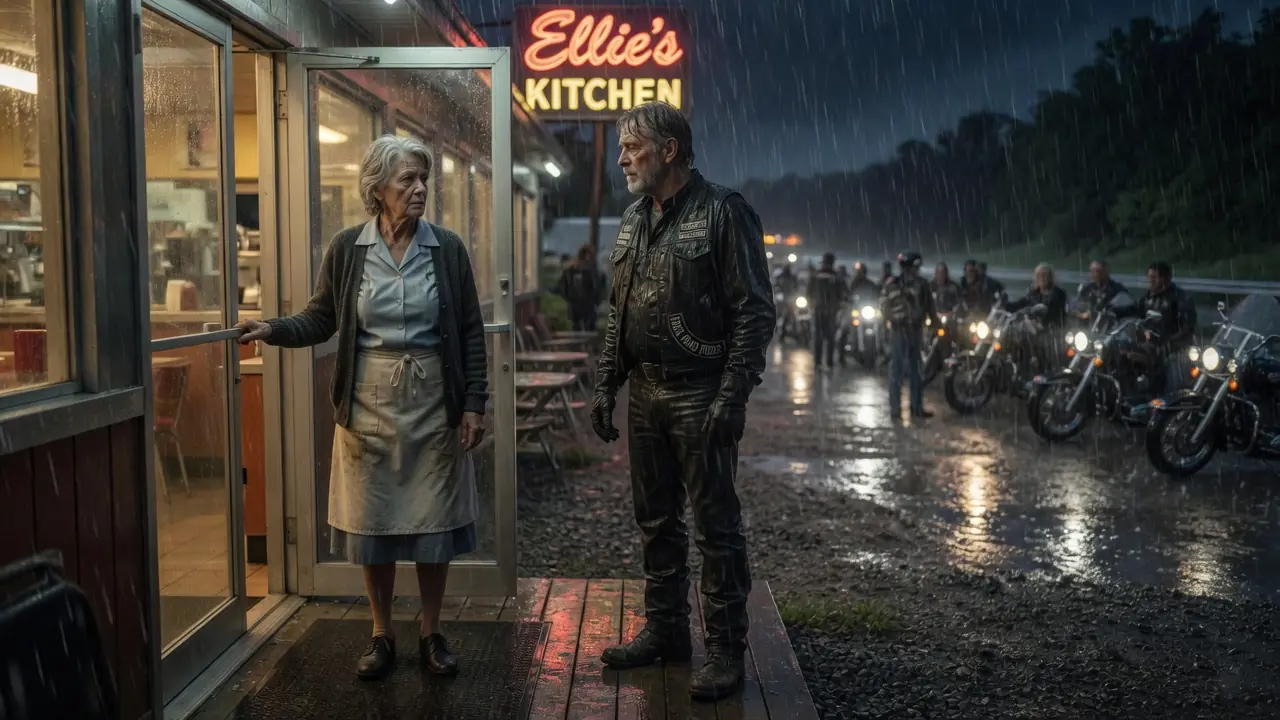
Every few minutes, thunder rolled across the dark hills, low and heavy, shaking the windows of the little roadside diner that stood alone near mile marker 214.
The diner’s sign flickered above the gravel lot.
Ellie’s Kitchen
Breakfast. Coffee. Pie. Open Since 1981.
Inside, Eleanor “Ellie” Parker stood behind the counter with a dish towel over her shoulder and a pencil tucked behind one ear. She was sixty-eight years old, small, strong, and stubborn enough to keep the diner open long after most people in town said she should have sold it.
Her husband, George, had built the place with his own hands.
He had passed away seven years earlier.
Ellie still kept his photograph near the register, beside a cracked coffee mug that read Boss Until Further Notice. She wiped the frame every morning, even on days when she forgot to wipe the windows. She told people it was just habit.
It was not just habit.
Ellie’s Kitchen had been their whole life. George cooked the first pancakes there before the ceiling was fully painted. Ellie served coffee while standing on a crate because the counter had been built too high for her. Their son had learned to walk between the booths. Their daughter had done homework in the back booth near the heater. Truckers, loggers, nurses, teachers, families, hunters, fishermen, and lonely men with nowhere better to be had all eaten under that roof.
But time had not been gentle.
The highway had been rerouted five years earlier, pulling steady traffic away from the old road. A gas station chain opened thirty miles south and took most of the travelers. Younger people wanted drive-thru coffee and food that looked good in pictures. Ellie still had loyal regulars, but loyalty did not always pay invoices.
The freezer was failing.
The roof leaked near the storage room.
The parking lot needed gravel.
The bank had sent a final notice three days earlier, folded in clean paper with cruelly polite language.
If she did not catch up on her payments within forty-five days, the diner could be taken.
Ellie had placed the letter beneath George’s photograph.
Then she opened the diner the next morning anyway.
That was what she knew how to do.
At 8:17 that stormy night, the front door rattled so hard Ellie thought the wind had grabbed it.
Then the bell above the door rang.
Once.
Twice.
Then again and again as people pushed inside.
Ellie looked up and froze.
Bikers.
A whole group of them.
Twelve in total.
They stepped into the diner soaked from head to boot, wearing leather jackets, denim vests, rain gear, heavy gloves, and helmets tucked under their arms. Water ran off them onto the floor in dark puddles. Some had gray beards. Some were younger. One woman had silver braids hanging over a black jacket. A tall man near the front had a weathered face, tired eyes, and a patch on his vest that read RIDGE ROAD RIDERS.
Ellie’s cook, Hank, appeared at the kitchen window.
He was seventy-two, half-deaf when convenient, and suspicious of anyone who entered after eight.
He looked at the bikers, then at Ellie.
Ellie looked back at him.
“Don’t start,” she said.
Hank lifted both hands and disappeared into the kitchen.
The tall biker stepped forward slowly.
“Ma’am,” he said, voice rough but polite, “we’re sorry to come in like this. Storm caught us hard about eight miles back. Road’s flooding near the bridge. One of our bikes won’t start, and we can’t ride safely until this lets up.”
Ellie glanced toward the windows.
Outside, headlights from their motorcycles glowed dimly through the rain. The machines were parked in a crooked line, slick and dark beneath the storm.
“You all planning to stand there and flood my entrance?” Ellie asked.
The biker blinked.
Then a few of the riders smiled.
“No, ma’am.”
“Then sit down before my floor decides to become a lake.”
They moved carefully, almost too carefully for people their size. They took off wet gloves and hung jackets over chair backs. The silver-braided woman immediately grabbed napkins from a table and started wiping the floor near the entrance.
Ellie pointed at her.
“Don’t waste napkins on my floor.”
The woman paused. “Sorry.”
“There’s a mop in the corner.”
The woman grinned.
“Yes, ma’am.”
The tall biker looked at Ellie again.
“We can pay for coffee. Maybe whatever’s easy. We don’t want to cause trouble.”
Ellie studied him.
His face was tired, not demanding. His men and women were cold, wet, and hungry. One younger rider near the back was trying not to shiver. Another held his left hand close to his chest, stiff from the cold.
“You eaten?” Ellie asked.
The tall biker hesitated.
“Not since lunch.”
“That was a different lifetime ago.”
He gave a soft laugh.
“Feels like it.”
Ellie reached for the coffee pot.
“Coffee first. Then food.”
He lifted a hand.
“Ma’am, there are twelve of us.”
“I can count.”
“We don’t want to clean you out.”
Ellie looked toward the kitchen.
“Hank.”
From the kitchen came a grumble. “I heard.”
“Big pot of stew.”
“Already heating.”
“And biscuits.”
“You want me to invent biscuits at this hour?”
“I want you to remember there’s dough in the cooler.”
A pause.
Then Hank muttered, “Bossy woman.”
Ellie smiled faintly.
“Living man.”
The bikers laughed quietly.
The sound softened the room.
Ellie moved down the counter, filling mugs. The riders accepted them with both hands, murmuring thanks. They were rough-looking, yes, but polite in a way that mattered more than appearances. They did not crowd. They did not complain. They looked around the diner with the respect of people who understood old places.
The tall biker sat at the counter.
Ellie set coffee in front of him.
“What’s your name?” she asked.
“Raymond Cole. Most folks call me Ray.”
“Ellie Parker.”
“I saw the sign.”
“That sign lies sometimes. The E flickers.”
Ray smiled. “Still got us here.”
Ellie glanced at his vest.
“Ridge Road Riders. You a club?”
“Mostly old friends who ride together.”
“Mostly?”
He looked toward the younger riders in the booth.
“And a few people we picked up along the way.”
Ellie understood that more than he knew.
The stew came out twenty minutes later, thick with beef, potatoes, carrots, onions, and enough pepper to wake the dead. Hank brought out a tray of biscuits too, golden and imperfect. Ellie carried bowls herself, ignoring Ray when he stood to help.
“If I let customers carry hot soup, I lose authority,” she said.
Ray sat back down.
“Yes, ma’am.”
The riders ate like people who had been pretending they were not hungry.
Not greedily.
Gratefully.
They passed bread. Poured coffee for each other. Offered the first biscuits to the youngest rider and the silver-braided woman. One man crossed himself quietly before eating. Another closed his eyes after the first spoonful, as if stew had reached some tired place inside him.
Ellie noticed.
She always noticed.
A diner owner learned to read hunger in all its forms.
Body hunger.
Loneliness hunger.
Warmth hunger.
The need to be treated like a person before being asked to explain yourself.
Ray ate slowly, then looked toward George’s photograph.
“Your husband?” he asked.
Ellie nodded.
“George. Built this place.”
“Looks like he built it to last.”
“He did. The bank disagrees.”
The words slipped out before she meant them to.
Ray turned back to her.
Ellie immediately wiped the counter.
“Forget I said that.”
Ray did not push.
Good men knew when not to pry.
But one of the older riders, a heavyset man with a white beard, looked around and said, “This place has soul.”
Ellie snorted.
“Soul doesn’t fix freezers.”
“No,” the man said. “But it keeps people from forgetting where they were fed.”
That line sat in the air.
Ellie did not answer.
The storm worsened.
Rain turned to sleet near ten. The road reports on the radio warned of flooding and dangerous conditions. Ray checked his phone, then spoke quietly with the others. It became clear they were not leaving soon.
Ellie looked at them.
“You can’t ride in this.”
Ray shook his head.
“No. We’ll wait until it breaks.”
“That may be morning.”
“We can sleep sitting up. Done it before.”
Ellie crossed her arms.
“Not in my diner.”
Ray’s face tightened. “We don’t want to impose.”
“You already imposed twelve wet jackets on my chairs. We’re past that.”
A few riders laughed.
Ellie pointed toward the back hallway.
“There’s a storage room with old banquet chairs and blankets from winter emergencies. Hank can clear space. Booths are better than saddles. Nobody goes in my office, nobody touches George’s tools, and if anyone snores loud enough to rattle the pie case, I’m charging extra.”
The silver-braided woman smiled.
“You sure?”
“No. But I’m doing it.”
Ray looked at her for a long moment.
“Why?”
Ellie’s face softened, but only a little.
“Because you’re stranded, hungry, and cold. That’s enough reason in a place with a stove.”
Ray lowered his eyes.
“Thank you.”
“Don’t thank me yet. Hank’s biscuits get mean after midnight.”
The riders settled in for the night.
Some slept in booths. Some on folded blankets in the back room. The younger rider, whose name was Caleb, called his mother to say he was safe, and Ellie pretended not to hear the relief in his voice. The silver-braided woman, Denise, helped wash dishes despite Ellie telling her not to. Hank disappeared to the kitchen but left the stew pot warming low.
Ray stayed awake at the counter longer than the others.
Ellie poured him another cup of coffee.
“You don’t sleep?” she asked.
“Not much.”
“Guilt or age?”
He smiled faintly.
“Both.”
“Dangerous combination.”
He looked toward the sleeping riders.
“We were headed to a memorial ride. One of ours passed last winter. We promised his wife we’d ride his old route together.”
“I’m sorry.”
Ray nodded.
“He loved places like this. Said if a diner had pie, coffee, and a woman behind the counter who looked like she could win a fight with a landlord, you were safe.”
Ellie laughed despite herself.
“Smart man.”
“He would have liked you.”
She looked toward George’s photograph.
“George would have liked your group. He used to say bikers and truckers understood road kindness better than church committees.”
Ray chuckled.
“Sounds like George knew things.”
“He did.”
A quiet settled between them.
Then Ray asked, “How bad is it?”
Ellie did not pretend not to understand.
She looked at the coffee pot.
“Bad.”
“Bank?”
“Bank. Roof. Freezer. Road reroute. Time. Take your pick.”
Ray nodded slowly.
“You got family?”
“Daughter in Grand Rapids. She wants me to sell and move closer.”
“And you don’t want that.”
“This diner is where my husband still feels nearby.” Ellie’s voice stayed steady, but her hand tightened around the pot. “Selling it would feel like packing him in a box.”
Ray looked down into his mug.
“I understand that.”
She studied him.
“You lost someone.”
“My brother.”
“I’m sorry.”
“He raised me after our father left. Taught me to ride. Taught me to fix engines. Taught me not to judge people by the jacket they wear.” Ray smiled sadly. “I still forget that sometimes.”
Ellie poured more coffee.
“People forget all kinds of things. Hunger reminds them.”
Ray looked at her.
“That sounds like something worth writing down.”
“Don’t. Makes it look like I know what I’m talking about.”
He laughed softly.
By morning, the storm had broken.
The road was wet but passable. The riders cleaned every corner they had used. Denise mopped the floor. Caleb took out trash. The white-bearded rider stacked chairs. Hank pretended not to be impressed.
Ellie made pancakes before they left.
Ray tried to pay for everything.
Ellie looked at the bills he placed on the counter.
“That’s too much.”
“It’s twelve people, dinner, breakfast, and shelter.”
“I run a diner, not a hotel.”
“Last night, you ran both.”
She pushed half the money back.
Ray pushed it forward again.
Ellie narrowed her eyes.
“Don’t get stubborn in my diner. I invented that.”
Ray smiled and took one bill back, leaving the rest.
Then he reached into his vest and pulled out a business card.
It was plain, black lettering on heavy cream paper.
Raymond Cole
Cole Heritage Restoration
Historic Buildings. Woodwork. Commercial Interiors.
Ellie looked at it.
“You restore buildings?”
“Sometimes. Mostly old ones people think are too tired to save.”
She glanced around the diner.
“Dangerous job.”
“Worthwhile one.”
He placed the card beside the register.
“If you ever want someone to look at the roof or the inside, call me.”
Ellie picked up the card.
“I can’t afford restoration.”
“I didn’t ask if you could.”
Her eyes sharpened.
“I don’t take charity.”
Ray nodded.
“I figured.”
“Then don’t offer it.”
“I’m offering a conversation.”
Ellie looked at him for a long moment.
“Conversations have a way of bringing invoices.”
“Mine can start with coffee.”
That made her smile a little.
Ray put on his gloves.
Before leaving, he looked back at her.
“Ellie.”
“What?”
“You kept twelve riders from making a foolish decision in a storm. That matters.”
She shrugged.
“I fed stranded people.”
“No,” Ray said gently. “You opened the door.”
Then he left.
The motorcycles roared to life outside, one after another. The sound rolled across the wet morning like thunder returning home. Ellie stood by the window as they pulled out of the lot in a slow, careful line. Ray raised one gloved hand before turning onto the road.
Then they were gone.
For three days, the diner smelled faintly of leather, rain, coffee, and stew.
Ellie placed Ray’s card in the drawer beneath George’s photograph.
Not because she intended to call.
Just because throwing it away felt rude.
Weeks passed.
The freezer failed completely on a Thursday.
Hank found half the contents thawing and swore so loudly Ellie told him George could hear it. The replacement cost made her sit down in the office for twenty minutes without moving.
The bank called on Friday.
The roof leaked again on Saturday.
By Monday, Ellie understood what she had been refusing to say.
She might lose the diner.
Her daughter, Beth, drove up from Grand Rapids after Ellie finally admitted the truth.
“Mom,” Beth said softly, sitting across from her in the back booth, “you can’t keep fighting alone.”
Ellie looked toward the mural George had painted above the counter, a sunrise over a road.
“I know.”
Beth’s eyes filled.
That answer scared her because Ellie usually argued.
“You could come live near me,” Beth said.
“I know that too.”
“But you don’t want to.”
Ellie shook her head.
“No.”
Beth reached across the table and touched her mother’s hand.
“Then let someone help.”
Ellie almost laughed.
“With what? A miracle?”
Beth looked toward the register.
“What about that man? The biker. The one with the restoration company.”
Ellie stiffened.
“I’m not calling him.”
“Why?”
“Because feeding people during a storm does not entitle me to ask them for salvation.”
Beth sighed.
“Mom.”
“No.”
“You kept his card.”
“For politeness.”
“You put it under Dad’s picture.”
Ellie looked away.
Beth stood, walked to the register, opened the drawer, and found the card.
Ellie pointed at her.
“You are invading a drawer of emotional significance.”
Beth held up the card.
“Good. Then it’s the right drawer.”
Ellie did not call Ray.
Beth did.
Ellie was furious for half an hour.
Then too tired to stay furious.
Ray arrived three days later in a black pickup truck, not on a motorcycle. He wore jeans, boots, and a work jacket with his company logo on the chest. He brought two other people: a woman named Alicia who managed grants and community projects, and a quiet man named Ben who inspected buildings with the seriousness of a doctor listening for a heartbeat.
Ellie met them at the door.
“I didn’t ask you to come,” she said.
Ray nodded.
“I know.”
“My daughter is meddlesome.”
“Seems like a good daughter.”
“She gets it from her father.”
Ray smiled.
“Can we look around?”
Ellie crossed her arms.
“No promises.”
“No promises,” Ray agreed.
They inspected the roof, the storage room, the kitchen, the wiring, the diner floor, the counter, the old booths, the sign, and the mural. Ben took notes. Alicia asked questions about the diner’s history. Ray moved through the room slowly, touching surfaces with respect.
When he reached George’s mural, he stopped.
“He painted this?”
“Yes.”
Ray looked at the sunrise.
“Good hand.”
“Best I knew.”
After two hours, they sat at the counter.
Ben gave the bad news first.
The roof needed repair immediately. The storage room had water damage. The freezer needed replacement. Some wiring needed updating. The exterior needed work. The parking lot drainage had caused erosion near the foundation.
Ellie listened without expression.
“I know,” she said.
Ray looked at Alicia.
She opened a folder.
Ellie groaned.
“A folder. That is never a good sign.”
Ray smiled faintly.
“This one might be.”
Alicia explained the possibility. Ellie’s Kitchen qualified for a rural heritage small-business preservation grant if they could document its community value and historical continuity. Ray’s company could partner with the diner as a restoration showcase, similar to projects they had done for old general stores and roadside inns. The Ridge Road Riders also ran an annual charity ride that supported small roadside businesses and emergency travel shelters.
Ellie frowned.
“Emergency travel shelters?”
Ray nodded.
“Places along rural routes willing to serve as safe stops during storms, breakdowns, or medical delays. Mostly informal. We’ve been trying to build a proper network.”
Ellie stared at him.
“You want my diner to become a shelter?”
“It already was one.”
She had no answer ready.
Alicia continued. With grant support, donor sponsorship from the rider network, and a partnership lease for a small restoration display wall, they could fund roof repairs, a new freezer, basic updates, sign restoration, and marketing that brought travelers back to the old route. Ellie would remain owner. The diner name would stay. George’s mural would be preserved. No one would turn the place into a themed attraction.
Ellie listened, suspicious and overwhelmed.
“What do you get?” she asked Ray.
“A restoration project that proves old roadside diners still matter.”
“That sounds expensive for a point.”
“It is.”
“And the riders?”
Ray’s face softened.
“Twelve of us were stranded here. You fed us, warmed us, and stopped us from riding into danger. They want to help.”
“I don’t want pity.”
“I know.”
“I mean it.”
“So do I.”
He leaned forward.
“This is not pity. This is debt with paperwork.”
Ellie almost smiled.
“I dislike paperwork.”
“You can dislike it after it fixes the roof.”
She looked toward George’s photograph.
For years, she had believed keeping the diner meant carrying it alone. But maybe that was not loyalty. Maybe it was fear disguised as devotion.
George had built the diner with help.
Neighbors poured concrete. His brother wired the first lights. Ellie’s mother sewed the first curtains. The town had shown up then.
Maybe showing up again was not betrayal.
Maybe it was how old things survived.
“What would change?” she asked.
Ray’s answer came quickly.
“As little as possible.”
That was the right answer.
The work began in spring.
Ellie complained every day.
She complained about the roofers.
“They walk like they’re punishing the ceiling.”
Ray replied, “They’re replacing part of it.”
“They can do that respectfully.”
She complained about the freezer.
“The old one had personality.”
“The old one nearly poisoned people.”
“Dramatic.”
“Accurate.”
She complained about the sign restoration.
“The flicker had charm.”
“The flicker made it look closed.”
“Only to quitters.”
She complained about the riders who came on weekends to help paint, haul lumber, clean the parking lot, and repair the picnic tables outside.
“They’re too cheerful.”
Ray looked at twelve bikers covered in paint and arguing about whether the trim was straight.
“That may be the first time anyone called them that.”
Denise, the silver-braided rider, became Ellie’s favorite and least favorite volunteer.
“You’re bossy,” Ellie told her.
Denise smiled.
“I learned from watching you.”
Hank returned from semi-retirement when he heard the diner might survive.
He claimed he was only there to supervise the stew pot.
Nobody believed him.
The community noticed.
Locals who had not stopped in for years came back to see the repairs. Truckers began posting about Ellie’s Kitchen online. Riders from other towns made it a stop. Families driving the old scenic route came for pie. A local paper wrote about the stranded bikers and the diner that became a safe stop.
Ellie hated the attention.
Then she saved every article in a folder.
The reopened diner was not new.
That was its beauty.
The roof no longer leaked. The freezer hummed quietly. The sign glowed cleanly. The booths had been repaired but kept their old red vinyl style. The counter was polished, not replaced. George’s sunrise mural was cleaned and sealed behind protective glass.
Beside the register, Ray installed a small framed sign:
Storm Stop Partner
Warm Meals. Safe Waiting. Phone Access. Road Help Contacts.
Ellie objected to the wording.
“Sounds official.”
“It is official.”
“That makes it worse.”
But she did not take it down.
The charity ride happened in June.
Riders came from across the region. Not twelve this time.
More than one hundred.
Motorcycles filled the gravel lot and the field beside it. Riders bought breakfast, coffee, pie, stew, T-shirts with George’s mural on the back, and meal vouchers for stranded travelers who might come through later. Beth came from Grand Rapids and cried when she saw the line outside the diner. Hank cooked like a general preparing for war.
At noon, Ray stood near the counter and tapped a spoon against a mug.
Ellie immediately pointed at him.
“No speeches.”
“One,” he said.
“Too many.”
“Necessary.”
The diner quieted.
Ray stood beneath George’s mural, wearing his Ridge Road Riders vest.
“Last winter,” he began, “twelve of us got caught in a storm on this road. We were cold, hungry, stubborn, and close to making a bad decision.”
Several riders murmured agreement.
“We came through that door expecting coffee. Maybe a place to wait. Ellie Parker gave us stew, biscuits, shelter, and a warning tone strong enough to make twelve bikers behave.”
Laughter filled the room.
Ellie crossed her arms but smiled despite herself.
Ray continued.
“She didn’t ask who we were before helping us. She didn’t decide whether we looked worth feeding. She saw stranded people and opened the door.”
The room grew quiet.
“This place is more than a diner. It is part of the road’s safety. It is memory, food, shelter, stubbornness, and heart. We are not saving Ellie’s Kitchen today. We are thanking it for saving people long before we arrived.”
Ellie looked down at the counter.
Ray turned to her.
“And Ellie, you told me you didn’t take charity. So we brought business, paperwork, riders, grant money, roofers, and one very expensive freezer.”
Hank shouted from the kitchen, “Still too small!”
Everyone laughed.
Ray reached into his vest and pulled out another card.
Not a business card this time.
A heavy metal card, shaped like the old diner sign.
He handed it to Ellie.
Engraved on it were the words:
Ellie’s Kitchen
The Door Stayed Open
Ellie’s eyes filled.
“I fed you stew,” she whispered.
Ray smiled.
“You kept us off the road.”
“That was common sense.”
“Common sense saved our lives.”
The applause rose around her.
Ellie wiped her eyes with her apron and blamed steam from the kitchen.
No one believed her.
Years passed, and Ellie’s Kitchen became known again.
Not famous in a flashy way.
Known in the way that mattered.
Riders stopped there. Truckers returned. Families made it part of their route. Storm Stop vouchers hung on a board near the register, prepaid by customers for anyone stranded, hungry, or short on money. The diner kept blankets in the back, phone chargers near the counter, and a list of local mechanics and tow drivers by the register.
Ellie worked shorter hours, but she still opened most mornings.
She still spoke to George’s photograph.
“Morning, sweetheart. The roof’s still holding.”
Sometimes Ray stopped by on his bike. Sometimes with Denise. Sometimes with a new rider who needed to understand why everyone treated the old diner like sacred ground.
Ellie always pretended not to be pleased.
One autumn evening, during a hard rain, the bell rang again.
A young couple stepped in, soaked and frightened, holding a baby wrapped in a blanket. Their car had broken down five miles north, and their phone was nearly dead.
Ellie looked at them.
Then at the storm.
Then toward the little framed Storm Stop sign.
She reached for the coffee pot.
“Sit down,” she said. “Road can be stupid. Soup is smarter.”
Ray happened to be there that night, sitting at the counter.
He watched as Ellie moved with the same decisive kindness she had shown twelve bikers years earlier. She gave them towels, called a tow driver, warmed milk for the baby, and told Hank to heat stew.
Ray smiled.
Ellie caught him.
“What?”
“Nothing.”
“You look sentimental.”
“I am.”
“Dangerous condition.”
“Yes, ma’am.”
Later, after the couple was safe and the diner quieted, Ellie sat with Ray beneath George’s mural. Rain ran down the windows. The sign outside glowed steady and bright.
“You know,” she said, “when you handed me that card, I thought you were just being polite.”
“I was.”
“You were not.”
Ray smiled.
“No. I wasn’t.”
“I almost threw it away.”
“I figured.”
“I kept it under George’s picture.”
“That seems like a good place.”
Ellie looked at the mural.
“I thought keeping this place meant never needing anyone.”
Ray shook his head.
“No. Keeping a place like this means letting the right people help carry it.”
She sat with that.
Then nodded slowly.
Years earlier, Ellie Parker had fed twelve stranded bikers because the storm was too dangerous and hunger was too honest to ignore. She gave them stew, biscuits, coffee, booths, blankets, and the kind of firm kindness that made rough-looking travelers feel trusted instead of judged.
Then one rider handed her a card.
Not just a card.
A door.
Through it came roof repairs, a freezer, riders, grants, customers, laughter, and the proof that kindness given on a stormy night can return with engines roaring and hands ready to work.
What Ellie received was not only a saved diner.
She received George’s dream still standing.
She received a road family in the Ridge Road Riders, a daughter proud enough to stop begging her to sell, a kitchen full of life again, and the deep comfort of knowing the old sign still meant what it said.
Open.
And every time the storm came down hard over mile marker 214, Ellie would look toward the door, tighten her apron, and say,
“Keep the coffee hot. Somebody out there still needs to get in.”