Elijah Brooks parked his mud-splattered pickup two blocks from Southern Heritage Bank and walked the remaining distance beneath the sharp Georgia sun. He wore a faded plaid shirt over a gray T-shirt, ripped work jeans, dusty boots, and the straw hat he used while checking fences on his cattle farm. Nothing about him suggested corporate wealth, private offices, or the authority to dismiss every executive inside the building. That was precisely the point.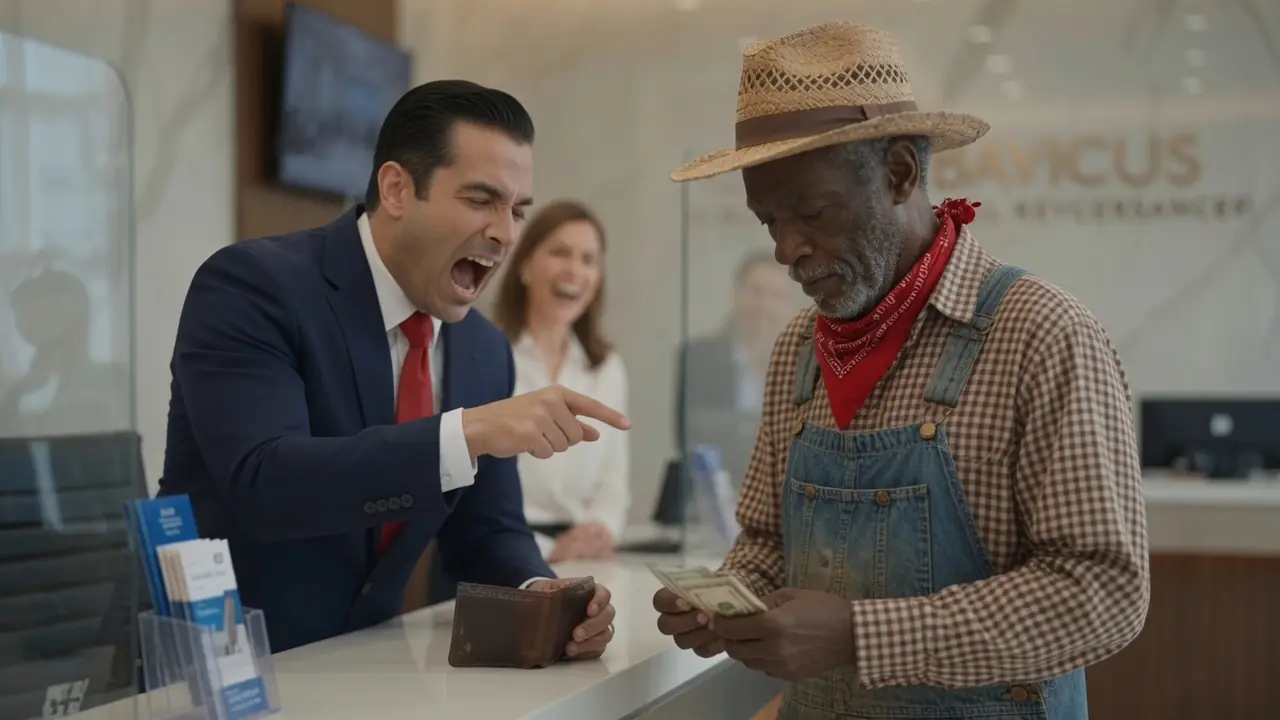
At sixty-eight, Elijah was still a working farmer despite being the founder, chairman, and chief executive officer of Southern Heritage Financial Group. He had built the company from a single agricultural lending office into a regional bank with forty-two branches across three states. Even after the bank became successful, he continued raising cattle and growing peanuts on the land his father had once nearly lost to foreclosure. Elijah never believed expensive suits made a person wiser than honest work.
Three months earlier, anonymous complaints began arriving at the bank’s ethics office about its Bellwood branch. Customers claimed they were ignored because of their clothing, questioned aggressively when depositing cash, and discouraged from opening accounts unless employees believed they were wealthy. Two farmers said staff members laughed at their loan applications before reviewing the financial records. An elderly Black customer alleged that Branch Manager Marcus Vale ordered security to follow him simply because he entered wearing work clothes.
Marcus denied every accusation.
He submitted polished reports showing strong sales, high-value clients, and increased deposits. According to him, the complaints came from “difficult individuals who misunderstood standard security procedures.” His regional director accepted the explanation because Marcus consistently exceeded his quarterly targets. Elijah did not.
Numbers could reveal performance, but they could not reveal character.
Elijah asked the compliance department to review camera footage, yet several key recordings were mysteriously missing. Employees interviewed by regional management claimed they had never witnessed discrimination, though one young teller began crying after the meeting and refused to explain why. Elijah realized that Marcus had created an environment in which workers feared telling the truth. A scheduled inspection would only give the manager time to perform kindness.
So Elijah went undercover.
Only three people knew the plan: Chief Counsel Danielle Price, Board Director Samuel Reed, and the head of corporate security. Elijah removed his executive watch, left his company phone at home, and placed thirty-seven dollars inside an old leather wallet. Beneath the bills rested a black executive access card engraved with his name and title.
He entered the bank shortly after ten on a Tuesday morning.
The Bellwood branch looked more like a luxury hotel than a community bank. White marble covered the floors, glass partitions separated private offices, and framed advertisements showed smiling families buying expensive homes. Behind the main counter, employees in tailored uniforms greeted selected customers by name. Elijah noticed that the warmest greetings were reserved for people wearing suits.
A young teller named Rebecca smiled when he approached, but her eyes immediately moved toward Marcus’s office. Marcus was standing behind the glass wall, watching.
“Good morning, sir,” Rebecca said nervously. “How may I help you?”
“I’d like to check the balance in an old savings account.”
“Of course. May I see your identification?”
Elijah placed his driver’s license on the counter. It showed his real name but listed only his farm address. The database had been configured so his personal account would appear separately from corporate executive records. Rebecca typed carefully, then paused when Marcus stepped beside her.
“I’ll handle this,” he said.
Rebecca moved away without argument.
Marcus Vale was forty-one, with slick black hair, a perfectly fitted navy suit, and a red tie chosen to draw attention. His smile appeared friendly until he looked directly at Elijah’s worn clothing. Then it became something else—amusement disguised as professionalism.
“What kind of account do you believe you have here?” Marcus asked.
“A savings account.”
“You believe?”
“It has been some time since I used this branch.”
Marcus inspected the old wallet in Elijah’s hand. “How much do you expect to find?”
“That is why I asked you to check.”
A woman waiting near the business counter began watching. Marcus noticed the audience and leaned forward, apparently deciding the old farmer could become entertainment.
“I’ll pay you double if you have a balance,” he said loudly. “Because men dressed like you don’t usually bank here.”
Several employees smiled awkwardly. One man near the lobby chairs laughed.
Elijah remained calm. “Check the account before you price my dignity.”
Marcus’s smile disappeared slightly. “We have security procedures. People cannot walk in from the street and demand access to accounts they may not own.”
“You have my identification.”
“It could be false.”
“The state issued it.”
“That does not impress me.”
Elijah looked toward Rebecca. She kept her eyes on the keyboard, but her face showed embarrassment. No one challenged Marcus. Their silence confirmed more than the anonymous complaints had.
“Enter the account number,” Elijah said.
He slid a handwritten number across the counter. It belonged to a small savings account opened during the bank’s first year. Elijah had deposited one hundred dollars and deliberately left it untouched as a reminder of where the institution began.
Marcus glanced at the paper without entering it. “People like you often find numbers on discarded statements and attempt to claim the accounts.”
“People like me?”
“Transient laborers. Drifters. Anyone desperate for quick cash.”
Elijah’s expression hardened. “I told you I am a farmer.”
Marcus looked at the mud on his boots. “That does not improve the situation.”
A customer stepped away from the counter, uncomfortable with the exchange. Marcus appeared to enjoy the attention. He lifted Elijah’s wallet from the marble surface without permission and opened it.
Thirty-seven dollars rested inside.
Marcus laughed.
“You came into a financial institution carrying less money than most people spend on lunch.”
Elijah took the wallet back. “A person’s pocket does not tell you what his life is worth.”
“This branch serves serious clients.”
“I thought it served the community.”
“This is not a charity.”
Elijah looked past Marcus toward the slogan mounted above the lobby entrance.
YOUR FUTURE. YOUR COMMUNITY. YOUR BANK.
“Then your sign is lying,” he said.
Marcus’s face reddened. “Leave.”
“Not until you check the account.”
“I said leave.”
“You promised to pay double if I had a balance.”
The laughter in the room faded. Marcus had expected submission, not resistance. He stepped around the counter and moved close enough for Elijah to smell expensive cologne.
“You think this is funny?”
“No.”
“You walked in here looking like you slept in a barn.”
“I was in one before sunrise.”
“Then go back.”
Marcus placed one hand against Elijah’s shoulder and shoved him away from the counter.
Elijah staggered one step but remained upright. The lobby became completely silent. Rebecca covered her mouth while another teller looked toward the security guard.
Marcus pointed toward the doors.
“Get out before security drags your broke ass into the street.”
Elijah straightened his plaid shirt. Then he removed the black access card from his wallet and slammed it onto the marble counter beside Marcus’s nameplate.
“Touch me again,” Elijah said coldly, “then explain to the board why their branch manager assaulted the bank’s owner.”
Marcus looked at the card.
The bank’s silver seal appeared beside Elijah’s engraved name.
ELIJAH BROOKS — FOUNDER, CHAIRMAN & CEO
For several seconds, Marcus did not move. His face shifted from anger to disbelief and then to fear.
“This is fake,” he whispered.
The front doors opened behind them.
Danielle Price entered first, carrying a leather legal folder. Beside her walked Samuel Reed and two members of corporate security. The regional director followed, visibly shaken by what he had witnessed from the surveillance vehicle outside.
Danielle stopped beside Elijah.
“Mr. Chairman,” she said, “the board representatives are ready whenever you are.”
Every employee in the lobby froze.
Marcus stepped backward. “CEO? You walked in dressed like a penniless farmer.”
Elijah removed his straw hat and placed it beside the executive card.
“I am a farmer,” he replied. “And I built the bank you used to humiliate people like me.”
Marcus’s mouth opened, but no words came.
Elijah turned toward corporate security. “Close the doors. No employee leaves until statements have been collected.”
The security officers locked the entrance while allowing customers to exit through a side door. Several people chose to remain, unwilling to miss what happened next. Phones appeared discreetly in their hands.
Marcus grabbed his name badge. “This was only a misunderstanding. I can explain everything.”
Elijah looked toward the place where Marcus had shoved him.
“You did not misunderstand my clothing.”
“I was following fraud-prevention procedures.”
“You never entered the account number.”
“Your behavior was suspicious.”
“I asked for my balance.”
“You challenged my authority in front of customers.”
“You insulted me before I challenged anything.”
Marcus turned toward the regional director. “Tell him. We have protocols.”
The director looked sick. “There is no protocol allowing physical contact with a customer.”
“He refused to leave.”
“Because you refused service.”
Danielle opened the legal folder and removed a suspension order. Elijah slid it across the counter.
“Explain it upstairs,” he said. “The board is waiting to hear why you shoved its owner.”
Marcus did not touch the paper.
“You cannot terminate me over one conversation.”
“This is not one conversation.”
Danielle placed another file beside the first. It contained sixteen discrimination complaints, five employee statements, three reports of altered camera records, and internal messages recovered from Marcus’s computer.
One message instructed staff to “screen out low-value customers before they waste officer time.” Another described agricultural workers as “muddy risks.” A third encouraged employees to redirect customers with accents toward online banking because they “slow down the lobby.”
Marcus stared at the printed messages.
“These were jokes.”
“No,” Elijah said. “They were instructions.”
“I brought millions in deposits to this branch.”
“You also taught employees that respect had a minimum balance.”
“That is not fair.”
Elijah’s eyes narrowed. “You shoved an old farmer because you believed he had thirty-seven dollars. Do not speak to me about fairness.”
Rebecca began crying quietly behind the counter.
Elijah turned toward her. “Were you afraid to serve me?”
She nodded.
“Why?”
Rebecca looked at Marcus, then at Danielle.
“He writes us up if we spend too long with customers he considers unprofitable,” she said. “He told us never to open accounts for farm laborers unless they brought a supervisor.”
Marcus pointed at her. “That is a lie.”
Rebecca flinched.
Elijah stepped between them. “You will not threaten another employee.”
One by one, the staff began speaking. A loan officer admitted Marcus ordered him to reject small agricultural applications without proper review. Another teller described being punished after helping an elderly woman complete a deposit slip. The security guard confessed that Marcus told him to follow Black customers more closely than white customers.
Each statement removed another layer from the polished image Marcus had built.
The man who dominated the lobby minutes earlier now looked toward every exit.
“You all benefited from my leadership,” he said. “This branch was failing before I arrived.”
“It was producing lower profits,” Elijah replied. “That is not the same as failing.”
“Banks exist to make money.”
“Banks exist because people trust them with money.”
“Trust does not pay shareholders.”
Elijah leaned forward. “I am the largest shareholder.”
Marcus fell silent.
Danielle formally suspended him pending termination and criminal review for altering surveillance records. When corporate security requested his keys and access badge, he refused at first. Then he saw the customers recording and understood that resistance would create another public humiliation.
He placed the badge on the counter.
As security escorted him away, Marcus looked back at Elijah.
“You destroyed my career over a costume.”
Elijah shook his head. “The costume revealed what you built your career on.”
By noon, the bank’s board had convened remotely. Investigators copied branch records, secured Marcus’s computer, and interviewed every employee separately. Elijah changed into no suit and entered no executive office. He remained in his faded shirt and dusty boots while listening to the people Marcus had silenced.
Rebecca described how the branch manager altered performance reports to reward employees who pushed high-fee products. Loan officers admitted they were pressured to discourage small farmers from applying because the paperwork took too long. One assistant manager revealed that Marcus had redirected community-development funds toward clients who already had significant assets.
The discrimination had not been merely personal.
It had become a business system.
Elijah ordered every rejected application from the previous two years reviewed by an independent team. He also requested direct contact with customers who filed complaints. Any account closed after discriminatory treatment would receive fee refunds and a written apology.
The regional director attempted to defend himself by claiming Marcus concealed the behavior.
“You accepted every polished report he submitted,” Elijah said.
“I had no reason to doubt him.”
“You had sixteen reasons.”
“The complaints appeared unverified.”
“You never verified them.”
The director lowered his eyes.
Elijah suspended him as well.
News of the incident spread before the bank closed that afternoon. A customer’s video showed Marcus laughing at Elijah’s wallet, shoving him, and freezing when the executive card appeared. By evening, the footage had been viewed hundreds of thousands of times.
Some headlines focused on the dramatic reveal.
UNDERCOVER BILLIONAIRE CEO EXPOSES HIS OWN BANK MANAGER.
Elijah disliked the word billionaire and hated that the story made wealth appear to be the reason the assault mattered. The next morning, he released a statement.
“The treatment I received was wrong before anyone knew my title. A customer should not need to own a bank to be treated with dignity inside it.”
That sentence traveled farther than the video.
Farmers began sharing their own experiences with financial institutions. Restaurant workers, landscapers, domestic employees, and construction crews described being judged by clothing or accents. Former Southern Heritage customers submitted dozens of new complaints from branches beyond Bellwood.
Elijah realized Marcus was not the only problem.
The bank’s success had created distance between executives and the communities they claimed to serve. Branches measured account value, sales referrals, and transaction time, but no report measured whether a frightened customer received patience. Employees were rewarded for attracting wealthy clients and quietly discouraged from spending time with anyone considered unlikely to produce profit.
Elijah called an emergency leadership meeting.
He entered the corporate boardroom wearing the same plaid shirt from the Bellwood branch. Executives in tailored suits watched as he placed the straw hat and old wallet on the table.
“This is what our employees saw,” he said. “Most of them decided the man wearing these things was not worth their time.”
Chief Financial Officer Laura Mitchell opened a report. “We have identified policy incentives that may unintentionally encourage customer screening.”
“Unintentionally?”
She hesitated. “The language never instructed discrimination.”
“But the rewards told employees which customers mattered.”
Several executives shifted uncomfortably.
Elijah ordered the bank to change its performance system. Employees would no longer be evaluated primarily by sales volume. Customer-service quality, fair access, complaint resolution, and community lending would carry equal weight.
He also created an independent office allowing employees to report misconduct outside the branch hierarchy. Complaints involving discrimination would automatically trigger review by regional compliance staff. Missing camera footage would create immediate suspension rather than a request for explanation.
The most controversial change involved agricultural and small-business lending.
Elijah established mobile banking teams that traveled to rural communities where customers struggled to reach branches. Loan officers were required to meet applicants on farms, inside shops, or wherever the actual work occurred. A dirty pair of boots could no longer be treated as evidence of financial irresponsibility.
Some board members warned that the reforms would be expensive.
“So was building trust the first time,” Elijah replied.
Marcus hired an attorney and threatened to sue for wrongful termination. He claimed the undercover visit had been designed to entrap him. However, video clearly showed Elijah requesting ordinary service while Marcus initiated every insult and physical confrontation.
The lawsuit never reached trial.
Investigators discovered that Marcus had altered records to hide complaints and had approved questionable loans for several wealthy acquaintances. One client received favorable terms after paying for Marcus’s luxury vacation. Those findings ended any chance of restoring his career.
He eventually pleaded guilty to falsifying bank records and accepted probation, restitution, and a permanent ban from working in regulated financial management.
Rebecca became interim manager of the Bellwood branch.
She almost refused the promotion because she believed her silence made her unworthy. Elijah invited her to walk through the lobby after closing, stopping at the exact place where Marcus shoved him.
“Why didn’t you speak?” he asked.
“I was afraid of losing my job.”
“Did the fear make his behavior right?”
“No.”
“Did it make you human?”
She nodded reluctantly.
“Then lead differently.”
Rebecca removed the private chairs Marcus reserved for wealthy clients and created an open assistance desk near the entrance. She hired two bilingual employees, expanded Saturday hours during planting and harvest seasons, and began monthly financial workshops for young farmers.
The first workshop attracted only six people.
The second attracted twenty-seven.
Within a year, the branch’s total deposits increased—not because it chased wealthy customers, but because people who once avoided the bank began trusting it. Small agricultural loans produced lower individual profits but stronger long-term relationships. Several customers who initially opened modest accounts later brought entire family businesses.
Respect proved profitable, though Elijah insisted that profitability was not what made it right.
Six months after the incident, he returned to the Bellwood branch without warning. He wore clean farm clothes, the same straw hat, and boots carrying fresh red mud from his fields.
Rebecca recognized him immediately but greeted the elderly man entering behind him first.
“Good morning, sir. How can we help you?”
The customer carried a jar filled with coins and wanted to open an account for his granddaughter. A teller helped him count the money without rushing, while another employee brought him a chair.
Elijah waited.
No one asked about his title.
No one inspected his clothing with suspicion.
When his turn came, Rebecca smiled. “Checking your old savings account?”
“Yes.”
She entered the number. Her eyebrows rose when she saw the opening date.
“One hundred dollars deposited forty-two years ago.”
“With interest?”
“Two hundred eighty-nine dollars and fourteen cents.”
Elijah removed three hundred dollars from his wallet and placed it on the counter.
“Add this.”
Rebecca completed the transaction. “Would you like a receipt?”
“Yes.”
When she handed it to him, Elijah examined the new balance and smiled.
Marcus had once promised to pay him double if the account existed. Elijah had never collected that wager, nor did he care to. The account’s value was not the lesson.
As he turned to leave, a teenage boy approached the counter wearing muddy overalls. He held a folder containing plans for a small lawn-care business and looked terrified.
Rebecca noticed him.
“Take your time,” she said. “Tell me what you’re trying to build.”
Elijah paused near the entrance and listened.
The boy explained that he wanted a loan for two used mowers and a trailer. Instead of laughing at the small amount, Rebecca invited a lending officer to sit with him. They reviewed the plan line by line.
Elijah stepped outside before anyone could notice the emotion in his face.
He had founded Southern Heritage Bank because his father once entered a financial office seeking money to save their farm. A loan officer dismissed him without reading the application, judging his patched clothes and calloused hands before considering the land beneath them.
Elijah never forgot the humiliation.
Years later, success had placed his own bank at risk of becoming the institution he created it to oppose. The undercover visit did not prove he was cleverer than Marcus. It proved that ownership meant little if the people entering his buildings still felt powerless.
He returned to his farm that afternoon and changed into work gloves before checking a broken fence along the western pasture. The straw hat remained dusty, the boots remained worn, and the cattle did not care how many branches he controlled.
That suited Elijah.
He had entered the bank carrying thirty-seven dollars and an executive card no one expected him to possess. Marcus laughed because he believed money was the only evidence of worth. Then he shoved the farmer, certain that no one important would ever demand an explanation.
The truth was not that Marcus accidentally mistreated a powerful man.
The truth was that he deliberately mistreated someone he believed had no power at all.
Elijah revealed his identity and removed the manager, but his greater decision came afterward. He changed the bank so the next farmer, laborer, widow, or frightened teenager would not need a title hidden inside a wallet to be heard.
Marcus had asked whether Elijah even had a balance.
By the time the investigation ended, the entire bank was forced to examine its own.