The gilded doors of Prestige & Co. opened at exactly 10:03 on a Thursday morning, and Alicia Monroe stepped inside without a single person recognizing her.
That was precisely what she wanted.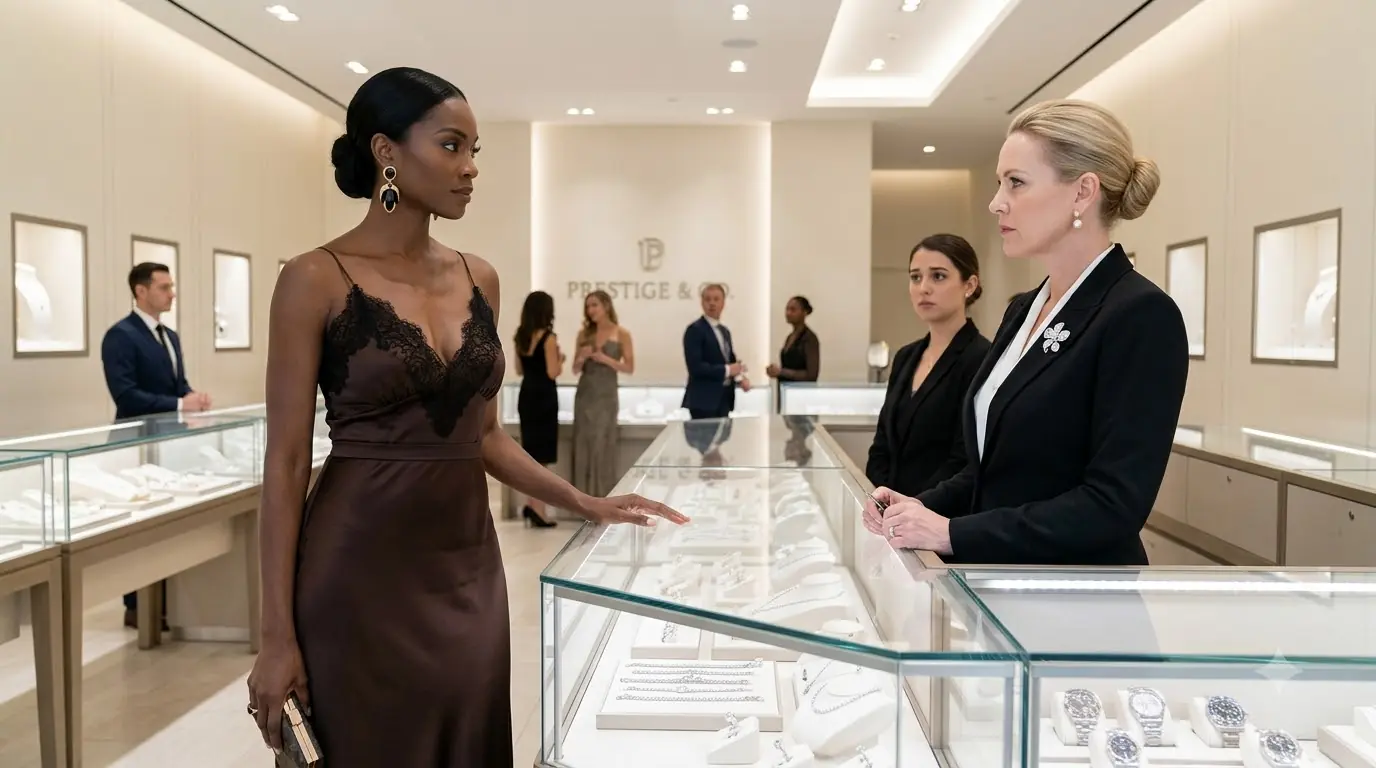
The Beverly Hills flagship store occupied almost eleven thousand square feet of one of the most expensive retail corridors in California. Cream limestone walls rose beneath a ceiling lined with recessed lights and crystal fixtures, while glass cases displayed diamonds, watches, emerald necklaces, platinum bracelets, and pieces so rare that some never appeared in the company’s online catalog.
Alicia had approved the redesign herself eighteen months earlier.
She knew the exact cost of the Italian marble beneath her heels.
She knew which security company monitored the cases.
She knew which diamonds had arrived from New York two days earlier.
And she knew the woman standing behind the main display counter had no idea who she was.
Vanessa Whitfield looked up from a tablet as Alicia entered.
For perhaps half a second, Vanessa’s professionally trained smile appeared.
Then it disappeared.
Alicia noticed.
She noticed almost everything.
At thirty-eight, Alicia had built her reputation on remembering details other people dismissed. She had deep-brown skin, refined features, dark expressive eyes, and an elegance that did not require obvious logos or visible price tags to announce itself.
That morning she wore a floor-length dark chocolate-brown satin gown with a black lace V-neck bodice, delicate straps, understated heels, large black-and-gold earrings, and a small clutch.
The outfit was expensive.
Very expensive.
But it did not scream a recognizable designer from ten feet away.
That distinction mattered.
Vanessa looked down at Alicia’s gown.
Then at the clutch.
Then toward the entrance as though checking whether someone more important might be behind her.
“Good morning,” Alicia said.
Vanessa gave a small nod.
“Morning.”
No welcome to Prestige & Co.
No name introduction.
No offer of assistance.
Alicia walked slowly toward the central bracelet case.
She stopped above a platinum piece set with seventeen colorless diamonds arranged in alternating marquise and round cuts.
She knew the bracelet.
It had been designed in the company’s New York atelier and completed six weeks earlier.
Wholesale production cost: approximately $214,000.
Retail price: $685,000.
Only three existed.
Alicia rested one hand lightly on the glass.
“This is beautiful.”
Vanessa continued looking at her tablet.
“Yes.”
“May I see it?”
Vanessa finally looked up.
Her expression remained polite.
But the warmth was gone.
“Which piece?”
Alicia pointed.
“The marquise diamond bracelet.”
Vanessa followed her finger.
Then smiled.
It was a different smile than the one Alicia had seen when she entered.
Thinner.
Controlled.
Almost sympathetic.
“Those pieces require a serious commitment.”
Alicia held her gaze.
“I’m sorry?”
“The high-jewelry collection.”
Vanessa gestured vaguely toward the case.
“We don’t normally remove pieces at that level unless we know the customer is seriously considering a purchase.”
Alicia looked down at the bracelet.
Then back at Vanessa.
“And how do you establish that?”
Vanessa seemed surprised by the question.
“We usually know our clients.”
“I’m not one of your clients?”
“I didn’t say that.”
“You said you usually know them.”
Vanessa placed the tablet on the counter.
“Prestige & Co. has a very established clientele.”
Alicia almost smiled.
She had personally approved the company’s customer-experience philosophy three years earlier.
The first line was printed in every employee training manual.
Every guest enters without assumption.
Apparently Vanessa had missed that section.
Alicia asked, “Do I need an appointment?”
“For high jewelry, appointments are strongly preferred.”
“Required?”
Vanessa paused.
“Preferred.”
“So not required.”
The manager’s expression tightened.
“Not technically.”
Alicia nodded.
“Then I’d like to see the bracelet.”
Vanessa did not reach for the key.
Instead she leaned slightly against the counter.
“May I ask what occasion you’re shopping for?”
“Myself.”
Vanessa’s eyebrows lifted almost imperceptibly.
“I see.”
Alicia waited.
Nothing happened.
Then Vanessa said, “Perhaps I can show you something from our accessible collection first.”
Accessible.
Alicia had heard the word used in executive meetings to describe pieces under twenty thousand dollars.
Never as a substitute for judging a customer.
“What price range is accessible?” Alicia asked.
Vanessa smiled.
“We have lovely bracelets beginning around three thousand.”
“I asked to see this one.”
“Yes.”
“So why are we discussing a three-thousand-dollar bracelet?”
The tension at the counter became noticeable.
A young sales associate standing several yards away stopped arranging rings.
Her name tag read Emily Park.
Alicia recognized the name.
Twenty-six years old.
Fourteen months with the company.
One of the highest customer-satisfaction ratings in the district.
Alicia had seen Emily’s file during an executive review.
Emily looked toward Vanessa.
Then toward Alicia.
She appeared uncomfortable.
Vanessa noticed too.
“Emily.”
The younger woman immediately looked down.
“Could you finish the Cartier watch inventory?”
“Yes, Ms. Whitfield.”
Emily disappeared toward the rear counter.
Vanessa returned her attention to Alicia.
“I’m simply trying to make your visit productive.”
Alicia tilted her head.
“By refusing to show me what I asked for?”
“I haven’t refused.”
“The case is still locked.”
Vanessa breathed through her nose.
“High-value pieces require discretion.”
“Whose discretion?”
“Management.”
“You?”
“Yes.”
Alicia nodded.
“Then you are refusing.”
Vanessa’s face hardened.
Only slightly.
Enough.
“Ma’am, I’m trying to avoid wasting everyone’s time.”
The words settled between them.
Alicia felt no embarrassment.
No anger.
Not yet.
Instead she felt something colder.
Confirmation.
For three months, Prestige & Co. had been receiving strange customer-service reports from the Beverly Hills store.
Not formal complaints.
Those were relatively low.
That was the problem.
Alicia had learned long ago that extremely low complaint numbers did not always mean excellent service.
Sometimes they meant unhappy customers simply left.
The first warning came from customer-retention data.
Repeat purchases among first-time walk-in clients had fallen twelve percent.
Then fourteen.
Then seventeen.
That was unusual for a location serving one of the wealthiest retail markets in the country.
High-net-worth clients might buy infrequently, but when treated well, they tended to return.
The Beverly Hills store was losing them.
Then two employees resigned within six weeks.
Neither accused Vanessa directly.
But both exit interviews used similar language.
“Culture mismatch.”
“Pressure to prioritize certain profiles.”
“Unequal client treatment.”
“Management expectations unclear.”
Alicia requested a deeper review.
Human resources found nothing dramatic.
No explicit discriminatory policy.
No written instruction telling staff to treat customers differently by race, clothing, accent, or perceived wealth.
Yet commission data revealed something strange.
Vanessa personally redirected high-value clients toward a small group of favored associates.
Walk-in customers judged “unlikely to convert” were pushed toward junior employees or ignored.
Who decided whether someone was unlikely to convert?
Usually Vanessa.
Alicia wanted to see it herself.
So she came without warning.
No executive assistant.
No company car.
No regional director.
No announcement.
Only Alicia.
Within four minutes, she understood.
The front doors opened again.
Vanessa’s expression transformed instantly.
A white couple entered.
The man appeared to be in his early fifties, wearing a navy blazer, open-collar shirt, expensive loafers, and a silver watch.
The woman beside him wore a cream designer suit and carried a recognizable Hermès bag.
Vanessa walked around the counter.
“Good morning! Welcome to Prestige & Co.”
Alicia remained beside the bracelet case.
Vanessa smiled broadly at the couple.
“Are we celebrating something special today?”
The woman laughed.
“Maybe.”
“Then you came to the right place.”
Vanessa signaled toward an associate.
“Would you like champagne? Sparkling water?”
“Champagne sounds dangerous,” the man joked.
“Only to your credit card.”
Everyone laughed.
Alicia watched.
No appointment question.
No discussion of commitment.
No concern about wasting time.
The woman walked toward the same display case.
She stopped approximately two feet from Alicia.
“Oh, that bracelet.”
Vanessa immediately reached into her blazer pocket.
The key appeared.
Alicia looked at it.
The woman pointed toward the marquise bracelet.
“Can I try that?”
“Of course.”
Click.
The case opened.
Vanessa put on gloves.
She lifted the $685,000 bracelet.
Alicia looked at her.
Vanessa avoided eye contact.
The customer held out her wrist.
Vanessa fastened the bracelet carefully.
“It’s one of only three.”
“Beautiful.”
“Exceptional clarity. The stones were matched over nine months.”
Alicia knew that.
She had approved the acquisition budget.
The woman turned her wrist under the lights.
“Stunning.”
Vanessa smiled.
“It was made for someone who understands pieces at this level.”
There it was again.
Not even subtle anymore.
Alicia leaned slightly against the counter.
The male customer glanced at her.
Then at Vanessa.
He seemed to sense something.
His wife did too.
“Were you waiting to see this?” she asked Alicia.
Alicia smiled.
“Yes.”
The woman looked toward Vanessa.