At 7:12 on a cold Saturday morning, Marcus Holloway had exactly three things on his mind.
Coffee.
The sports section.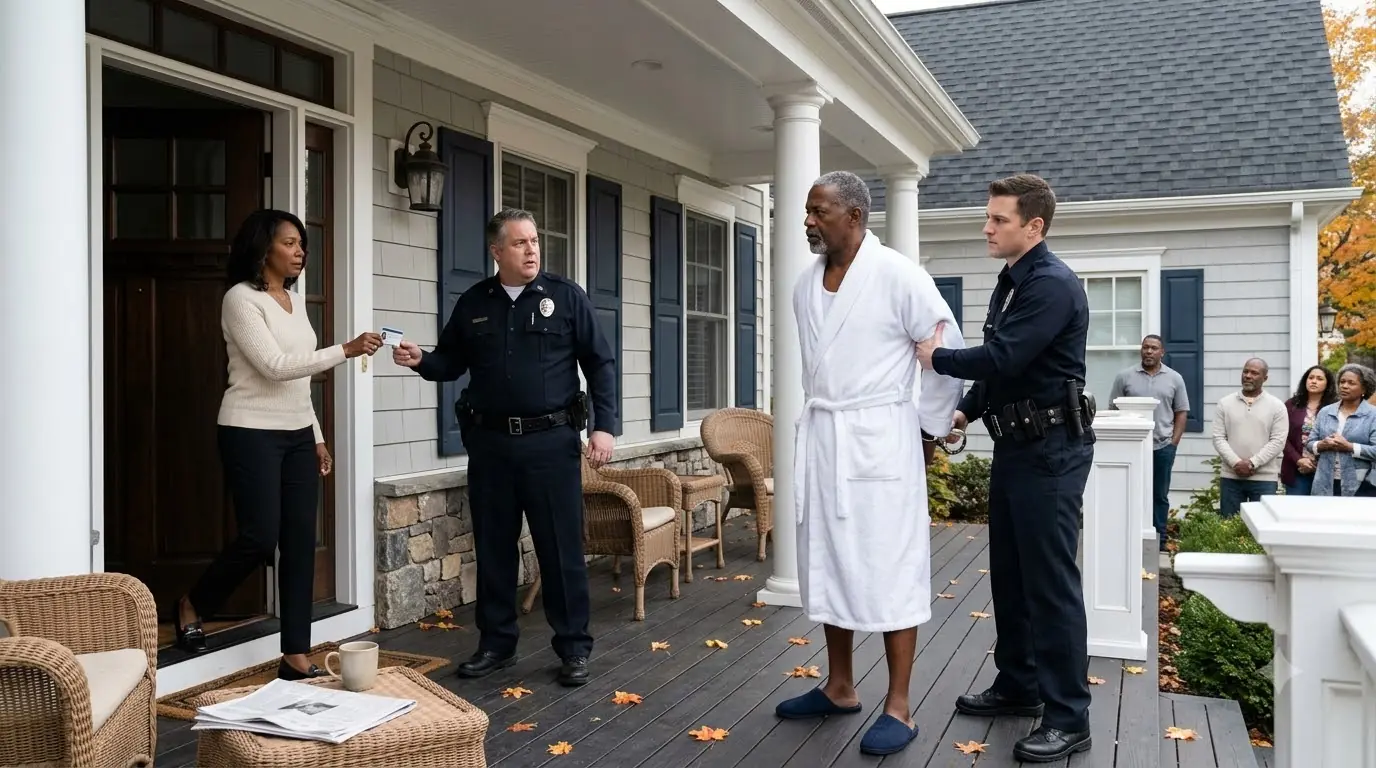
And whether the maple tree beside his driveway was going to drop another thousand leaves before he finally convinced himself to rake them.
Nothing about the morning suggested it would become one of the most consequential days of his life.
Marcus sat in a wicker chair on the wide front porch of his home in Ashford Hills, Virginia, wearing a thick white terry-cloth bathrobe tied securely around his waist and dark house slippers. At fifty-eight, he had short salt-and-pepper hair, a neatly trimmed gray beard, broad shoulders, and the calm expression of a man who had spent most of his adult life listening carefully before speaking.
Steam rose from the ceramic mug beside him.
The Washington newspaper rested open across his lap.
Behind him stood the house he and his wife, Elaine, had purchased eleven years earlier.
It was not modest.
Gray stone covered the lower exterior, white columns framed the porch, dark shutters bordered tall windows, and the backyard stretched toward a wooded creek beyond a cedar fence.
Marcus had never apologized for the house.
He had spent nearly thirty-five years working toward the life it represented.
So had Elaine.
Inside, she was still upstairs after returning late the previous evening from a medical conference in Baltimore.
Marcus intended to let her sleep.
At 7:16, he heard a vehicle slowing near the curb.
He ignored it.
Ashford Hills was full of joggers, dog walkers, landscaping crews, delivery drivers, and residents leaving early for children’s soccer games.
Then a door slammed.
Marcus looked over the newspaper.
A police cruiser sat partly angled along the curb.
Officer Derek Walsh stepped out.
Walsh was thirty-one, white American, athletic, with close-cut brown hair and the restless energy of someone who seemed to approach every encounter already irritated that it had interrupted something more important.
Marcus watched him cross the sidewalk.
“Morning,” Marcus said.
Walsh did not return the greeting.
“Stand up.”
Marcus lowered the paper.
He studied the officer for a second.
“I’m sorry?”
“I said stand up.”
Marcus glanced toward the street, then back toward Walsh.
“Is there a problem?”
“That depends.”
“On?”
Walsh walked toward the bottom porch step.
“Who are you?”
Marcus almost smiled.
It was an unusual question to receive before breakfast while sitting in front of your own front door.
“Marcus Holloway.”
“What are you doing here?”
Marcus looked at the coffee.
Then the newspaper.
Then the house.
“Drinking coffee.”
Walsh’s jaw tightened.
“You live here?”
“Yes.”
“Identification.”
“My wallet is upstairs.”
“Go get it.”
Marcus folded the newspaper carefully.
He did not stand.
Instead he asked, “What prompted the call?”
Walsh’s expression changed.
“Who said there was a call?”
“You didn’t come here because my coffee looked suspicious.”
The officer took another step.
“Sir, I asked for identification.”
“And I told you it’s inside.”
“Then get it.”
Marcus looked toward the open front door behind him.
“You’re asking me to walk into a house you apparently don’t believe belongs to me.”
Walsh hesitated.
It was only half a second.
Marcus saw it.
He had spent decades noticing half-seconds.
“What exactly was reported?” Marcus asked.
“Suspicious person.”
“Doing what?”
“Possible unauthorized entry.”
Marcus stared at him.
“Into this house?”
“Yes.”
“I’m sitting on the porch.”
“I can see that.”
“Drinking coffee.”
Walsh’s voice sharpened.
“Sir, stop being argumentative.”
Marcus leaned back slightly.
There it was.
The first transition.
A question became argument.
Marcus knew the pattern.
He had seen it described in hundreds of affidavits, civil-rights suits, suppression hearings, internal reports, and body-camera transcripts.
A civilian asks why.
The officer interprets the question as challenge.
Challenge becomes noncompliance.
Noncompliance becomes justification for escalation.
Marcus understood the pattern professionally.
Knowing it did not make experiencing it pleasant.
He placed both hands where Walsh could clearly see them.
“My name is Marcus Holloway.”
“I heard you.”
“This is my residence.”
“According to you.”
Marcus looked toward the officer’s body camera.
A small red light indicated it was active.
Good.
“Then confirm the property record.”
Walsh’s mouth tightened.
“You don’t tell me how to do my job.”
“No.”
Marcus remained calm.
“I’m suggesting the fastest way to finish it.”
Walsh reached for his radio.
He requested confirmation for the residence.
Dispatch answered several moments later.
“Property contact lists Marcus and Elaine Holloway.”
Marcus waited.
Walsh said nothing.
“So,” Marcus said quietly, “are we finished?”
“No.”
That answer interested him.
“What remains?”
Walsh looked toward the house.
“Anyone else inside?”
“My wife.”
“Name?”
“Elaine Holloway.”
Dispatch had just said the same name.
Walsh knew it.
Marcus knew he knew it.
“Any proof?”
Marcus stared.
“Of my wife?”
“Of residence.”
“The property database just confirmed us.”
“That’s not the same as proving you’re Marcus Holloway.”
Marcus nodded.
Technically, that was true.
But nothing about the interaction suggested Walsh was approaching the problem neutrally.
“Would you like me to call Elaine?”
“I told you to get identification.”
“Then I’ll go inside.”
Walsh stepped directly onto the porch.
“Stop.”
Marcus did.
“You just told me to retrieve it.”
“Hands where I can see them.”
Marcus raised both hands slightly.
“Officer, decide what you want me to do before ordering me to do it.”
Walsh’s expression darkened.
“Stand up.”
Marcus looked at him.
“Why?”
“Stand up now.”
Marcus slowly rose.
His bathrobe reached below his knees.
He still held nothing.
His coffee remained beside the chair.
A few houses away, a garage door opened.
An elderly white woman named Helen Morris stepped outside carrying a small trash bag.
She saw the cruiser.
Then Marcus.
She stopped.
Walsh moved closer.
“Turn around.”
Marcus’s expression changed.
“Am I being detained?”
“You are now.”
“For what?”
“Failure to comply with a lawful investigation.”
Marcus looked directly at him.
“What instruction did I refuse?”
Walsh stepped behind him.
“Turn around.”
Marcus did not move.
“Officer Walsh.”
The officer froze slightly.
Marcus had read his nameplate.
Nothing more.
But the calm use of his name seemed to bother him.
“I have answered every question you asked.”
“You refused identification.”
“I told you where it is.”
“Turn around.”
Marcus inhaled slowly.
His instinct was to argue the legal point.
His experience told him that was no longer useful.
He turned.
Walsh grabbed his left wrist.
Helen Morris dropped the trash bag.
“Officer!”
Walsh looked toward her.
“Stay back.”
Helen stared.
“That man lives there.”
Walsh ignored her.
Marcus felt his arm being pulled behind him.
“Officer, you have another witness confirming residence.”
“Stop resisting.”
“I am not resisting.”
A metal cuff closed around one wrist.
Marcus’s jaw tightened.
Walsh took the other hand.
Click.
Both wrists secured.
Marcus stood barefoot inside his slippers, in a white bathrobe, on his own porch, with his hands cuffed behind him.
Something about the absurdity almost made him laugh.
Then Walsh spoke.
“People make things harder than they need to be.”
Marcus turned his head.
“People?”
“You know what I mean.”
“No.”
Marcus’s voice became colder.
“I want you to explain it.”
Walsh tightened his grip on Marcus’s arm.
“Walk.”
“Where?”
“Down the steps.”
Marcus looked toward his coffee.
“My wife is sleeping.”
“She can sleep.”
“That is not the point.”
Walsh pushed him lightly toward the stairs.
Marcus stopped.
“Do not shove me.”
Walsh leaned closer.
“You’re in no position to give instructions.”
Marcus looked toward the body camera again.