“I am a dying man,” Caleb Rowan said. “Give me a child, and everything I own becomes yours.”
The damp cloth slipped from Eliza Bennett’s fingers and fell into the cloudy washwater. Beyond the thin wall of Pine Hollow Trading Post, men laughed over cards and whiskey, unaware that one quiet sentence had just torn open the narrow future she had spent years trying to protect. Eliza stared at the mountain trapper standing across from her, searching his weathered face for mockery, cruelty, or even madness.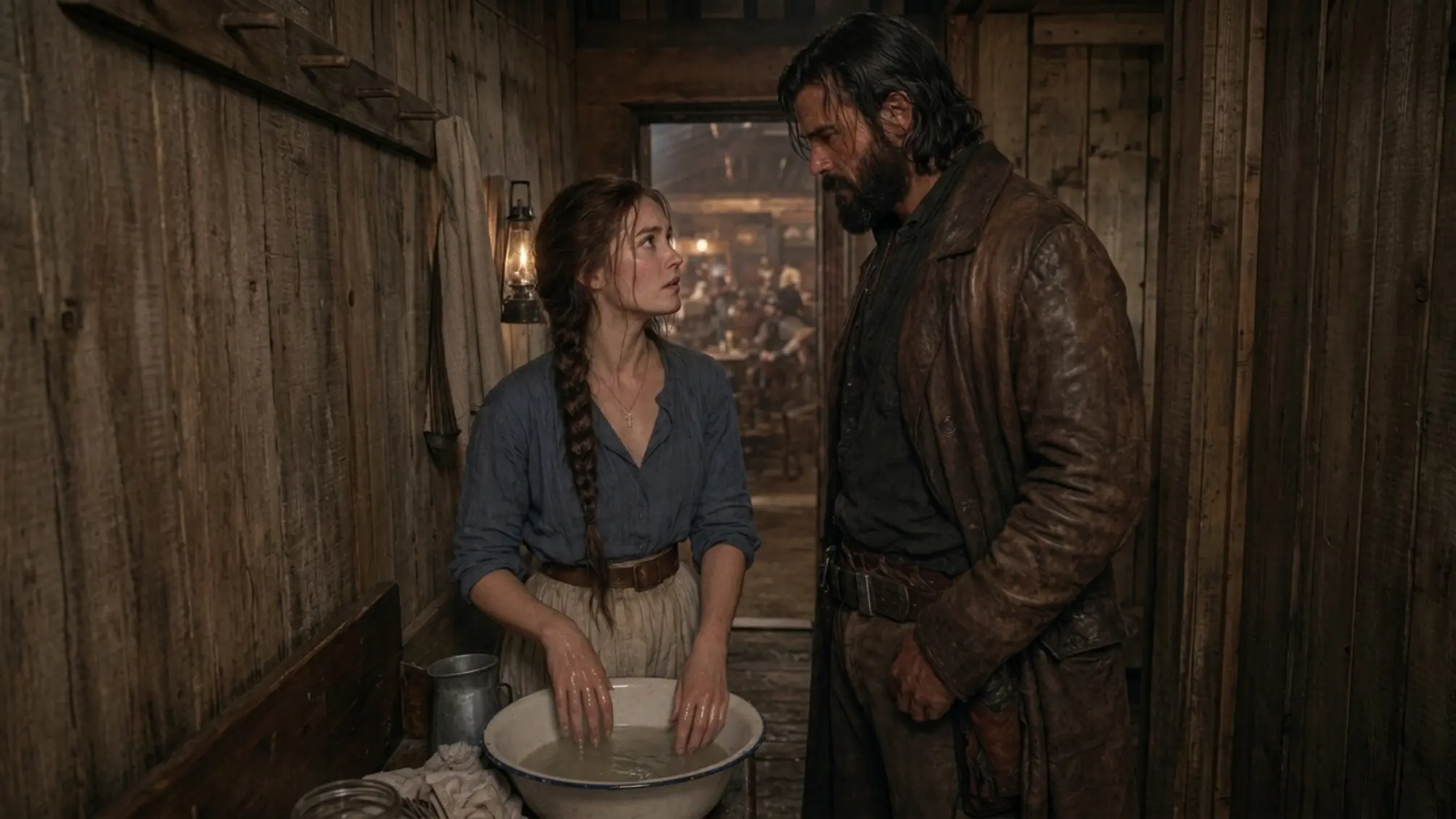
She found none.
Caleb looked exactly like a man negotiating the final entry in a ledger. His scarred leather coat still carried melting snow from the Bitterstone Range, and exhaustion darkened the skin beneath his intense brown eyes. At forty-one, he remained broad-shouldered and powerful, but something invisible had begun hollowing him from within.
Upstairs, Eliza’s aunt coughed.
The weak, rattling sound passed through the ceiling and reached both of them. Caleb’s gaze lifted briefly, then returned to Eliza’s frightened face. He did not pretend not to understand what that cough meant.
“My aunt raised me,” Eliza whispered. “She has no one else.”
“And you cannot afford the doctor.”
The bluntness of his answer made her flinch. “You have no right to speak about her.”
“No,” Caleb replied. “But I know what medicine costs, and I know what it sounds like when a sick person runs out of time.”
Eliza twisted the edge of her wet apron between her fingers. Her aunt, Margaret Bennett, had sacrificed twenty years to keep Eliza fed, clothed, and safe after fever took both of Eliza’s parents. Margaret had stretched flour into meals, traded sewing for firewood, and slept beside Eliza through every childhood illness.
Now Margaret’s lungs were failing.
The doctor at Fort Clay demanded payment before another visit. The trading-post owner had already warned Eliza that her work was too slow because she kept leaving the kitchen to check upstairs. Winter had closed the mountain roads, and every choice available to her seemed designed to end in loss.
Caleb placed a folded property deed beside the washbasin.
“I have a cabin in the Bitterstones,” he said. “One hundred sixty acres, spring water, timber, livestock, and enough gold hidden beneath the floor to keep a family secure for years.”
Eliza did not touch the document. “And you expect me to become part of that property?”
His jaw tightened. “No.”
“You offered to buy a child from me.”
“I offered you everything I own in exchange for the only thing I cannot leave behind.”
“That is not better.”
“No,” he said quietly. “It probably isn’t.”
The absence of argument unsettled her more than anger would have. Caleb did not attempt to disguise the ugliness of the bargain. He simply stood before her like a man too close to death to waste effort making himself appear honorable.
“My wife died during childbirth,” he continued. “Twenty years ago. The baby died before sunrise. I buried them together and never asked another woman to share my life.”
“Then why ask now?”
“Because a doctor told me my liver is failing. I may have a year. Perhaps less.”
Eliza looked toward the ceiling when Margaret coughed again.
Caleb reached inside his coat and removed a small leather pouch. He emptied several gold coins onto the table.
“That will pay for your aunt’s treatment and keep her somewhere warm through winter.”
Eliza stared at the money. “Before I agree?”
“Whether you agree or not.”
Suspicion sharpened her voice. “Why?”
“Because she is sick now. My loneliness does not make her medicine conditional.”
For the first time, the mountain man’s cold restraint cracked. Beneath it, Eliza glimpsed something painful and deeply human—a grief that had survived so long it had hardened into habit.
She covered the coins with the property deed and pushed both toward him.
“I will not be purchased.”
Caleb did not take them.
“Then call it a proposal.”
“A proposal requires respect.”
“What would respect look like to you?”
The question stopped her.
No man at Pine Hollow had ever asked what respect looked like to her. They offered wages, orders, warnings, and unwanted hands whenever the room became empty. Caleb’s bargain was terrible, but at least he had spoken it directly and left the decision with her.
Eliza slowly raised her eyes.
“If I go with you, my aunt comes too.”
“Yes.”
“She receives treatment before anything is expected from me.”
“Yes.”
“We marry legally at Fort Clay. My name goes on the land deed immediately.”
Caleb nodded.
“And I decide whether there will ever be a child.”
Silence filled the washroom.
That condition changed the bargain completely. Eliza expected him to refuse because it removed the one certainty he had come seeking. Instead, Caleb looked down at the coins, then back at her.
“Agreed.”
“You could die without an heir.”
“I could.”
“Then why accept?”
His voice became almost too soft to hear. “Because I would rather die without one than become the kind of man who takes one through fear.”
Upstairs, Margaret began coughing so violently that a chair scraped across the floor.
Eliza ran.
She found her aunt bent over the bedside basin, blood staining the handkerchief against her lips. Margaret’s face had turned pale, and each breath seemed to cut through her chest. Eliza wrapped one arm around her while panic stole every useful thought from her mind.
Caleb entered without waiting for permission.
He lifted Margaret as though she weighed nothing, wrapped her in blankets, and carried her down the narrow stairs. The card players stopped laughing when the mountain trapper crossed the main room with the sick woman in his arms.
“Where are you taking her?” Eliza demanded, following him into the snow.
“Fort Clay.”
“The pass is nearly closed.”
“Then we ride before it closes completely.”
Caleb secured Margaret inside his covered wagon, placed heated stones beneath the blankets, and gave Eliza his heavier coat. He drove through the night while snow erased the trail behind them.
For eleven hours, he barely spoke.
He stopped only to check the horses, warm Margaret’s water, and listen to her breathing. Once, Eliza woke to find him kneeling beside the wagon wheel with one hand pressed against his upper abdomen, his face twisted in pain.
“You should rest,” she said.
“So should you.”
“I am not the one dying.”
Caleb stood too quickly and nearly lost his balance. “Not tonight.”
They reached Fort Clay shortly after sunrise.
The doctor who had diagnosed Caleb, Dr. Horace Bell, lived above a small clinic beside the military stables. He examined Margaret, declared that infection had settled deep inside her lungs, and demanded twelve dollars before beginning treatment.
Caleb placed twenty on the table.
“Use what she needs.”
Dr. Bell recognized him. “You should not be traveling in your condition.”
“I managed.”
“You are worsening faster than I expected.”
Eliza noticed something strange pass between the two men. Bell’s concern looked practiced, while Caleb’s expression held the resigned obedience of a patient who had already accepted the verdict. The doctor opened a cabinet and removed a dark glass bottle.
“Continue taking this tonic twice daily,” he instructed. “It may ease the pain.”
Eliza watched Caleb drink a spoonful.
The liquid smelled faintly of bitter almonds and metal.
Margaret remained at the clinic for six days. Her fever slowly broke, and each breath became easier. During that time, Caleb slept in the stable loft rather than spend money on a hotel room, though he had enough gold to purchase the building.
Eliza found him there on the third night, sitting against a hay bale with sweat shining across his forehead.
“You paid for my aunt before I gave you an answer,” she said.
“You already gave me one.”
“I gave you conditions.”
“And I accepted them.”
“You do not even know whether I will become your wife.”
Caleb looked toward the stable doors. “The circuit judge arrives tomorrow. If you change your mind, I will still take both of you somewhere safe.”
“Why would you do that?”
“Because dying has made me impatient, not cruel.”
Eliza sat several feet away from him.
“Tell me about your wife.”
For a long time, Caleb said nothing. Then he spoke of a young woman named Sarah who loved mountain flowers and hated silence. They had married at nineteen and built the first room of the cabin together. When childbirth went wrong, a winter storm prevented the doctor from reaching them.
Caleb delivered his own son.
Neither mother nor child survived.
“I buried them beneath the cedar tree behind the cabin,” he said. “After that, every room felt like something I had failed to protect.”
Eliza’s anger toward him softened, though it did not disappear.
“You cannot replace them.”
“I know.”
“A child with me would not repair what happened.”
“I know that too.”
“Then what are you seeking?”
Caleb looked at her. “Proof that something of me might remain besides a grave no one visits.”
The circuit judge married them the following afternoon inside Fort Clay’s chapel.
Margaret stood beside Eliza, still weak but smiling through tears. Caleb wore a clean charcoal shirt beneath his old leather coat, while Eliza wore the best dress she owned. There was no celebration, no music, and no kiss beyond the brief touch Eliza permitted against her cheek.
Before they left, the judge recorded Eliza as equal owner of Caleb’s land.
Caleb handed her the deed.
“You do not have to trust me,” he said. “The law should protect you until you decide whether I deserve it.”
The journey to the Bitterstones took three days.
Caleb’s cabin stood in a sheltered valley surrounded by cedar, pine, and towering walls of snow-covered rock. It was larger and stronger than Eliza expected, with two bedrooms, a stone fireplace, a smokehouse, livestock pens, and a workshop filled with carefully maintained tools.
True to his promise, Caleb gave Eliza and Margaret the larger room.
He slept beside the fireplace.
The first weeks passed without romance. Eliza cooked, repaired curtains, and helped Margaret regain strength. Caleb hunted when his body allowed it, split firewood, and disappeared into the mountains for hours without explanation.
He never entered Eliza’s room without knocking.
He never touched her unless she offered her hand first.
The terrible bargain became something neither discussed.
Yet Caleb’s health deteriorated.
His skin developed a faint yellow cast. His hands trembled. He suffered terrible stomach pain after taking Dr. Bell’s tonic, though he insisted the medicine was the only thing keeping him alive.
Eliza began watching more closely.
Margaret had once worked as a nurse for an Army doctor before returning to Pine Hollow. When she saw Caleb’s symptoms, suspicion replaced concern.
“Liver failure can cause yellow skin,” Margaret said, examining his eyes beside the window. “But it does not usually make the fingertips numb after every dose of medicine.”
Caleb pulled his hand away. “Bell knows what he is doing.”
“Doctors are men,” Margaret replied. “Men can be wrong.”
Eliza remembered the smell of the tonic.
She poured a small amount into a tin cup and carried it to the workshop, where Caleb kept supplies for testing animal poisons. When she mixed the liquid with a copper solution Margaret remembered from her nursing years, the color changed immediately.
Margaret stared at the result.
“Arsenic.”
Eliza’s blood went cold.
Caleb had not been dying from natural illness.
Someone was poisoning him.
They hid the tonic and replaced it with harmless bitter tea so Caleb would not realize what they had discovered. Within four days, his vomiting eased. After ten, the yellow color began fading from his eyes.
When Eliza finally told him, disbelief gave way to fury.
“Bell said my liver was destroyed.”
“He was destroying it.”
“Why?”
The answer arrived two days later when riders approached the cabin.
The first was Dr. Bell.
Beside him rode Warren Pike, owner of Pine Hollow Trading Post and the man who had employed Eliza. Four armed men followed.
Caleb reached for his rifle, but weakness slowed him. Eliza stepped in front of the door with a revolver she had learned to use during their weeks in the mountains.
Pike smiled when he saw her.
“There is the new widow.”
“My husband is alive.”
“For now.”
Caleb emerged behind her. “You paid Bell.”
Pike’s smile vanished.
Years earlier, Caleb had discovered a narrow gold seam beneath the northern ridge of his property. He told no one except Bell, who treated a broken leg after the discovery. Bell later informed Pike, and together they created a plan.
They would slowly poison Caleb and purchase the land after his death.
When Caleb unexpectedly married, Eliza became an obstacle.
Pike held up a paper. “Your husband signed an agreement selling me the northern acreage.”
Caleb stared at the signature.
It resembled his, but the writing wavered like the hand of a sick man.
“You drugged me.”
“We conducted business while you were fully conscious.”
“You told him he was dying,” Eliza said. “Then made him sign documents while poisoning him.”
Pike looked at her with contempt. “A washwoman cannot prove any of that.”
Margaret stepped onto the porch holding Dr. Bell’s original tonic bottle.
“A former Army nurse can identify poison.”
Bell reached for his gun.
Caleb fired first.
The bullet struck the doctor’s wrist, sending the weapon into the snow. Pike’s men raised their rifles, but gunshots exploded from the tree line before they could aim.
Fort Clay cavalry riders emerged between the pines.
Eliza had sent a message three days earlier with a traveling trapper, enclosing a sample of the tonic and a letter describing the forged deed. The cavalry captain dismounted and arrested Bell, Pike, and their hired men.
Pike struggled as soldiers bound his wrists.
“You would have inherited everything if you had let him die,” he shouted at Eliza. “Instead, you chose a dying animal over a fortune.”
Eliza looked toward Caleb.
“No,” she said. “I chose the man you were too blind to see was still fighting.”
Dr. Bell confessed before winter ended.
Records in his clinic revealed repeated purchases of arsenic and payments from Pike. The forged land sale was invalidated, and both men received long prison sentences for attempted murder, fraud, and conspiracy.
Caleb recovered slowly.
The poison had damaged his body, but not beyond repair. The Army physician at Fort Clay believed he could live many years if he rested, ate well, and never touched Bell’s tonic again.
The news frightened Caleb more than death had.
For months, he had arranged every decision around the certainty that his life was ending. Survival required him to imagine a future he no longer knew how to inhabit.
One evening, he sat before the fireplace with the property deed in his hands.
“You are free,” he told Eliza.
She looked up from her sewing. “From what?”
“From our agreement. I was not dying when I asked you. The bargain was built on a lie.”
“You believed it.”
“That does not make what I asked right.”
“No.”
“I will transfer my remaining share of the property to you and leave after spring.”
Eliza set the fabric aside. “Where will you go?”
“Somewhere else.”
“That is not an answer.”
“It is the only one I have.”
Caleb rose, but Eliza crossed the room and stopped him. During the months of his illness, she had learned every line in his face, every movement hiding pain, and every silence shaped by fear. She understood now that Caleb had spent twenty years believing love always ended beneath frozen ground.
“You asked me for an heir because you were afraid of leaving nothing behind,” she said.
“Yes.”
“You offered land because you believed it was the only part of you worth accepting.”
His eyes lowered.
“And now you want to leave because staying would require you to believe I might choose you without payment.”
“Eliza—”
“You were wrong to offer that bargain.”
“I know.”
“But you honored every condition I gave you. You saved my aunt without demanding anything. You protected us, gave me legal ownership, and never crossed my door without permission.”
“That does not erase what I asked.”
“No. It tells me what you became after asking.”
Caleb’s breathing grew unsteady.
Eliza placed one hand over his heart.
“I am not staying because of the cabin.”
His gaze lifted to hers.
“I am not staying because of the gold, the land, or the promise of an inheritance.”
“Then why?”
“Because somewhere between Fort Clay and this fire, you stopped being a bargain.”
Caleb closed his eyes as though the words hurt.
When he opened them again, the cold restraint that once defined him had disappeared.
“What am I now?”
Eliza stepped closer.
“My husband.”
Their first kiss was quiet.
It carried no urgency, no debt, and no demand for a child. It was simply the beginning of something both had believed arrived too late for them.
Spring returned to the Bitterstones slowly.
Snow withdrew from the valley, wildflowers pushed through the dark soil, and Margaret planted herbs beside the cabin. Caleb regained his strength and began rebuilding the damaged northern fence, while Eliza transformed the spare room into a place where travelers and injured trappers could receive care.
Months passed before she discovered she was pregnant.
When she told Caleb, he did not celebrate immediately. Terror crossed his face as memories of Sarah and the child he lost returned all at once.
“I cannot bury you,” he whispered.
“You will not.”
“You cannot promise that.”
“No. But you can promise not to let fear turn love into another prison.”
Caleb knelt before her and placed both hands gently against her waist.
“This child owes me nothing.”
Eliza touched his face. “Neither do I.”
Their daughter was born during the first autumn snowfall, with Margaret and the Fort Clay physician beside them. Caleb waited outside until a newborn cry filled the cabin.
He entered trembling.
Eliza placed the child in his arms.
“What shall we call her?” he asked.
“Sarah Margaret Rowan.”
Caleb wept without shame.
Years later, travelers still told strange stories about the mountain trapper who once entered Pine Hollow Trading Post and offered a desperate woman everything he owned in exchange for an heir.
Most versions turned him into a monster or a dying romantic.
Neither was true.
He was a grieving man who made a terrible proposal because death had convinced him that love could be reduced to inheritance. Eliza was not the helpless woman who accepted it for gold; she changed its terms, demanded dignity, and saved him from the men who expected greed to make her silent.
Caleb once believed his child would be the only proof he had existed.
He was wrong.
His life remained in the cabin he opened to strangers, the injured travelers Eliza treated, the aunt who spent her final years surrounded by family, and the woman who chose him only after she no longer needed his fortune.
He had offered Eliza everything because he thought he was dying.
Then she discovered someone was killing him.
But the greatest truth came afterward.
Saving Caleb’s life did not make Eliza love him.
It gave him enough time to become a man she could freely choose.