The Farm Girl stood beside the rusted entrance gate while sixty-eight goats poured from two livestock trailers and scattered across the first fenced paddock. Thick kudzu vines covered the hills in every direction, swallowing old fence posts, climbing over utility poles, and forming a heavy green roof above the collapsed barn. She wore faded denim overalls over a beige work shirt, her chestnut-brown hair secured beneath a red gingham headscarf, and her worn boots already carried the red clay of North Georgia. Along the roadside, neighboring farmers watched from pickup trucks and laughed as if the county auction had delivered them an entire season of entertainment.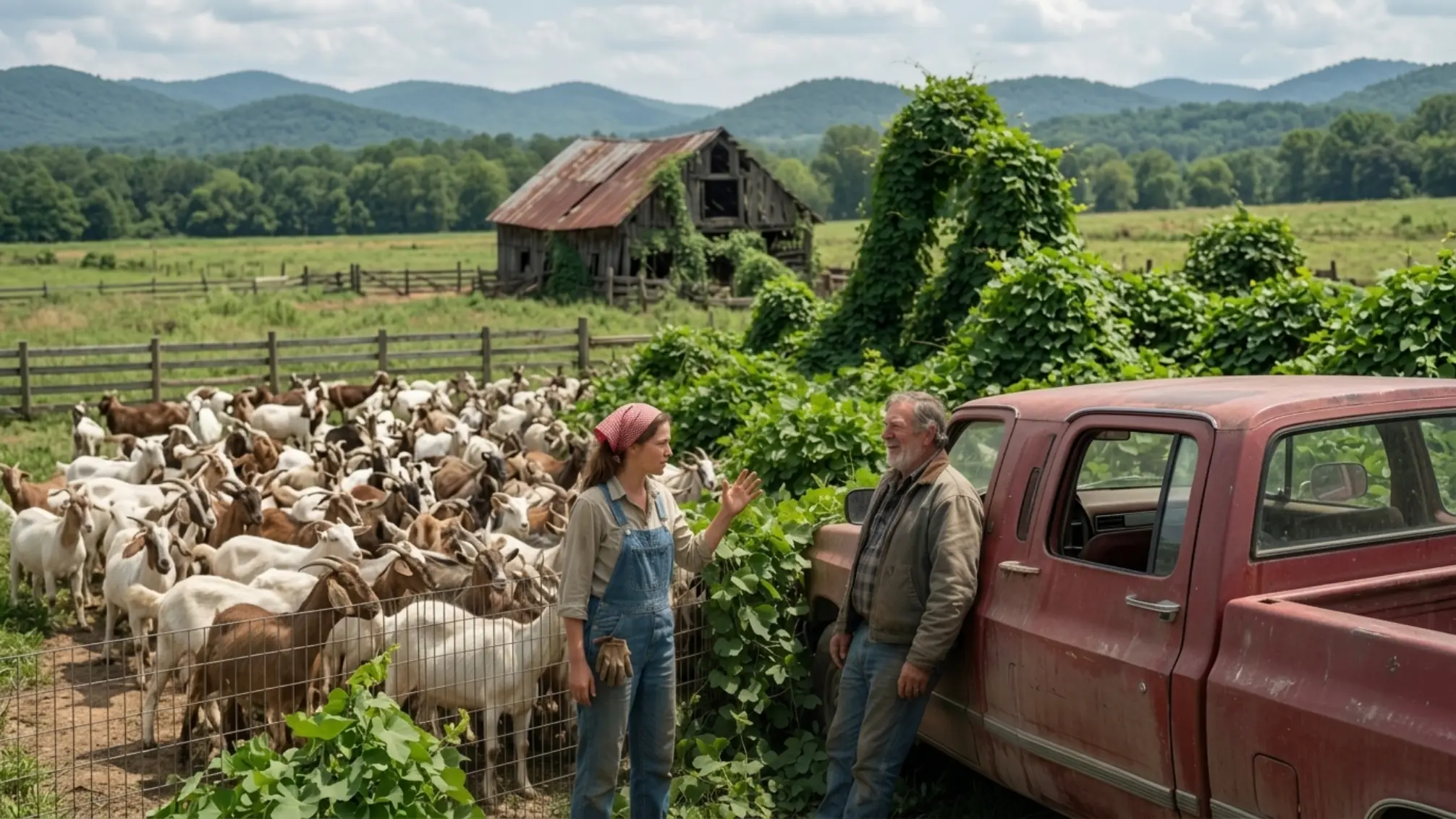
The broad-shouldered Cattle Rancher laughed louder than anyone else, although there was no true cruelty in his weathered face yet. He was sixty-three, respected across the county, and experienced enough to know what kudzu could do to neglected land. His family had fought the invasive vines with tractors, herbicides, fire, and bulldozers, only to watch them return after every wet spring. To him, the beautiful thirty-five-year-old woman from Atlanta represented another wealthy outsider who believed determination could replace agricultural experience.
The Farm Girl heard every comment but continued connecting portable electric fencing around the goats. She had already spent one hundred and forty thousand dollars purchasing the one hundred twenty-eight acres, nearly all the money she had saved during fifteen years in finance. The courthouse crowd had laughed when her bid became final because professional estimates suggested clearing the property would cost more than the land itself. She understood the risk better than they imagined, but understanding risk did not prevent fear from tightening her stomach whenever she looked across the endless vines.
Two weeks earlier, she had stood alone in the abandoned farmhouse and wondered whether she had destroyed her future. The roof leaked, the electrical system had failed, and vines pushed through cracks around the windows. She slept inside a small camper parked near the barn because the house was not yet safe, using a folding table as both kitchen and office. At night, she studied grazing research, livestock health manuals, soil maps, and historical county records beneath a battery-powered lamp.
The records revealed that the farm once supported a small pecan orchard, but no one knew what remained beneath twenty years of neglect. Several old aerial photographs showed neat rows of trees before the property disappeared under vines. Later images revealed only an unbroken blanket of green, and inspectors assumed the orchard had died decades earlier. The possibility of surviving trees influenced her decision, but she told no one because she had no evidence beyond faded photographs and fertile soil reports.
Her immediate plan did not depend on finding an orchard. She divided the farm into small sections and moved the goats through them in carefully controlled rotations. The animals stripped leaves, young stems, and tender growth without tearing away the valuable topsoil beneath. Once the vines returned, she planned to bring the herd back repeatedly until the enormous underground root systems exhausted their stored energy.
The Cattle Rancher watched for almost an hour before approaching the fence. “They’ll eat leaves,” he said. “The roots will still be alive when those goats are old and gray.”
“I know.”
“Then why waste time?”
“Because bulldozers would strip the hills, chemicals would damage the soil, and burning would leave the roots untouched.”
He studied her more carefully. Her answer did not sound like the optimistic guess he expected from a former office worker. Still, he shook his head and warned that patience would not pay feed bills, veterinary costs, or property taxes. The Farm Girl thanked him honestly because she preferred hard truth to empty encouragement. Then she returned to work while he drove away believing she would be gone before winter.
Winter arrived sooner than she expected. Frost covered the vines, water lines froze, and mountain fog concealed the farthest hills for days at a time. She woke before sunrise to check fences, break ice in troughs, and feed goats whose appetites did not care that her hands had become numb. Every evening, she stared across the property and wondered how months of exhausting work had produced so little visible change.
Friends from Atlanta called and asked whether farm life felt peaceful. She described quiet mornings, mountain views, and the satisfaction of working outdoors, but she rarely mentioned the broken fences or nights spent calculating how long her savings would last. She missed reliable salaries, hot showers, and weekends that did not begin with an escaped goat standing on the camper steps. Yet returning to the city felt worse than remaining, because she had not left finance merely to escape an office; she had left to discover whether she could build something that belonged to her.
During the second spring, the kudzu returned with frightening speed. Fresh vines stretched across open soil, wrapped around repaired fences, and climbed young trees almost overnight. Neighbors pointed toward the hills and declared the experiment finished. The Farm Girl moved the goats back into the same paddocks and began the rotation again.
Progress appeared in details too small for passing drivers to notice. Native grasses emerged in places where sunlight finally reached the ground. Wildflowers returned beside the creek, and birds began landing in areas that had been hidden for years. The Farm Girl recorded every change in a weathered notebook, measuring vine density, soil condition, and grazing time with the discipline she once applied to investment reports.
Her money continued disappearing, however. Fencing supplies, livestock trailers, veterinary medicine, insurance, and water systems consumed more than she had predicted. Instead of taking a large loan against the farm, she began offering controlled goat grazing to neighboring landowners. She refused to promise miracles, explaining that repeated browsing weakened invasive plants slowly rather than erasing them instantly.
The first person willing to hire her was the same Cattle Rancher who had mocked her beside the gate. Kudzu had spread across a steep section of his pasture where tractors could not operate safely. He arrived one morning in his old pickup, removed his hat, and avoided mentioning the laughter from their first meeting. “I heard your goats might eat what my machines can’t reach,” he said.
“They’ll reduce it,” she replied. “But I’ll need to bring them back more than once.”
“How much?”
She gave him the standard rate she had calculated from transportation, labor, fencing, and animal care. He expected her to offer a discount in exchange for his approval, but she did not. After a long pause, he accepted.
The goats cleared the first layer of vegetation within days. They climbed rocks, balanced on fallen trees, and reached vines wrapped around places cattle ignored. The results did not eliminate the kudzu, but the pasture became usable enough for the Cattle Rancher to repair fencing and begin a longer treatment plan. He paid the Farm Girl exactly what they had agreed and recommended her to two neighboring farmers.
The grazing contracts became the financial engine that kept her own farm alive. During the week, she transported sections of the herd across North Georgia, installed temporary fencing, and monitored the animals. On weekends, she returned home and continued rotating the remaining goats through her own hills. The work exhausted her, but income finally began entering the account instead of only leaving it.
By the end of the third year, people no longer laughed when her trailers passed through town. Farmers called weeks in advance to reserve the herd, and several purchased young breeding goats from her. The Farm Girl repaired the barn roof, installed a reliable well pump, and replaced the camper with one renovated room inside the old farmhouse. None of it looked luxurious, but each improvement represented money earned from the land rather than money borrowed against a dream.
One April morning, she moved a group of goats onto the steep western hillside. The vines there had been grazed repeatedly for nearly two years, and their growth had finally begun weakening. Beneath the dried stems stood several thick trunks arranged in an uneven line. The Farm Girl pushed through the remaining vines and placed one gloved hand against deeply furrowed bark.
Fresh buds had appeared on a branch above her.
She walked farther along the hill and found another tree, then another. By noon, she had counted twelve mature pecan trees, all damaged but still alive. Their upper limbs were thin, several trunks carried dead wood, and vines had strangled younger branches, yet each tree displayed new leaves.
The Farm Girl marked every trunk with bright survey ribbon. Her hands trembled as she opened the old aerial photographs and compared the rows with her location map. The surviving trees stood precisely where the central section of the forgotten orchard had once grown. The laughter at the courthouse, the frozen mornings, and the endless fencing repairs suddenly felt connected to something she had barely allowed herself to imagine.
She did not announce the discovery or begin ordering hundreds of new trees. Instead, she contacted the state agricultural extension office and requested an evaluation. An experienced orchard specialist arrived several days later with soil probes, pruning tools, and no interest in encouraging fantasies. He spent an entire day examining roots, leaves, bark, drainage, and surrounding soil.
Near sunset, he closed his notebook beneath the oldest tree. “These aren’t miracle trees,” he said.
The Farm Girl’s excitement weakened.
“They’re survivors,” he continued. “That may be more valuable.”
He explained that the trees were too damaged to become the center of a commercial harvest, but they proved pecans could thrive on the property. Soil tests revealed deep, well-drained ground with excellent mineral balance and little damage from intensive cultivation. The kudzu had nearly killed the orchard above ground, yet it had also discouraged decades of heavy machinery and chemical use that might have degraded the soil.
“You have land capable of supporting a new orchard,” the specialist said. “But it will require years.”
The Farm Girl looked across the reclaimed hillside. “I’ve already given it three.”
“You may need fifteen before this becomes what you’re imagining.”
“Then I should start now.”
The Cattle Rancher returned several days later after seeing the survey ribbons from the road. He climbed the hill beside her, breathing heavily but refusing help, and stood beneath the twelve trees. For the first time since meeting her, he had nothing skeptical to say. He removed his hat and examined the line of trunks stretching through the vines.
“What are they worth?” he finally asked.
“Right now? Mostly the cost of saving them.”
His eyebrows rose. “Then why are you smiling?”
“Because they proved the soil can grow another orchard.”
He looked across the remaining acres and understood the scale of her ambition. “You’re going to plant all this?”
“Not at once.”
“That sounds expensive.”
“It will be.”
“And slow.”
She smiled. “So were the goats.”
The Farm Girl designed a plan that connected every new acre of orchard to income earned from goats and grazing contracts. She refused to borrow enough money to plant the entire farm immediately because a drought, disease outbreak, or market crash could leave her buried beneath debt. Instead, each section reclaimed from kudzu would first support pasture, then earn enough to receive irrigation, soil preparation, and grafted pecan trees.
The first planting contained only one hundred sixty young trees. Neighbors who expected a grand transformation laughed again when they saw the small shipment. The Farm Girl did not respond because she had learned that patience often resembled failure to people measuring only speed. She spent weeks marking rows, improving drainage, installing protective tubes, and ensuring every tree received enough water.
The twelve old pecan trees remained at the center of the farm. She pruned dead limbs, treated damaged bark, and protected their roots from heavy equipment. Their harvests were small and inconsistent, but she never judged them by production. They had survived long enough to reveal what the farm could become.
The orchard expanded one section at a time. Some years brought strong growth, while late frost damaged tender branches during others. Drought forced her to haul water until improved irrigation lines could be installed, and several expensive trees died despite careful attention. She replaced them without pretending that effort guaranteed success.
The goats continued paying for the dream. Their grazing contracts expanded into neighboring counties, and young breeding animals became valuable to farms interested in managing invasive vegetation. The Farm Girl hired two employees, then four, choosing people willing to learn both livestock management and orchard care. She paid them before paying herself during difficult seasons.
Eight years after the auction, the earliest grafted trees produced their first meaningful crop. The harvest filled only several dozen sacks, too small to impress commercial buyers but large enough to prove the plan was working. The Farm Girl loaded the pecans into her pickup and drove them to a regional processor with tears gathering in her eyes. She remembered strangers laughing when she paid one hundred forty thousand dollars for land they considered worthless.
The Cattle Rancher purchased the first bag.
“You don’t even bake,” she said.
“My wife does.”
“You could wait until the price drops.”
“I’ve waited eight years.”
He paid twice the listed amount and refused change. It was not charity; he understood how much work the first harvest represented. When he left, the Farm Girl found a handwritten note tucked beneath the money: You saw the farm before the rest of us could.
The orchard gradually became profitable, but the Farm Girl continued expanding cautiously. She built a modest cleaning and drying facility rather than sending every harvest away. Later, she opened a small market where visitors could buy fresh pecans, honey, preserves, and products from neighboring farms. Families began arriving each autumn to walk beneath trees growing where vines once covered the sky.
The business succeeded because it rested on several sources of income instead of one lucky discovery. The goats still managed vegetation and produced breeding stock. The orchard sold pecans through wholesale contracts, direct customers, and specialty products. The market supported neighboring producers, drawing more visitors than the Farm Girl could have attracted alone.
Fifteen years after purchasing the land, more than six hundred healthy pecan trees covered the reclaimed hillsides. Grass lanes separated each row, native flowers attracted pollinators, and restored soil absorbed rainfall instead of washing down the mountain. The collapsed barn had become a working livestock facility, while the old farmhouse stood repaired without losing its original shape.
The Farm Girl was fifty now, with silver beginning to appear beneath the same red gingham headscarf. Her hands carried scars from fencing wire, pruning tools, and years of work, but her athletic frame remained strong. She still walked the orchard every morning before sunrise, checking trees before entering the office built inside the restored barn.
One autumn afternoon, the county organized an agricultural investment tour. The group included bankers, landowners, reporters, and officials who remembered the property from the auction. They expected the Farm Girl to describe the twelve old trees as hidden treasure that made her wealthy overnight. She corrected them immediately.
“The goats paid for the trees,” she said. “The grazing contracts paid for irrigation. The orchard paid for the market, and the market helped the neighboring farms bring customers here.”
A reporter pointed toward the surviving pecan trees. “But without those twelve, none of this would exist.”
“The farm would exist,” she answered. “It might have become something different.”
“So they were not the miracle?”
“No. They were evidence.”
The reporter asked what she meant.
“They proved the land could support something people had stopped believing in. Evidence doesn’t build anything by itself. Someone still has to do the work.”
The Cattle Rancher, now in his late seventies, stood near the back of the group leaning on a carved walking stick. He listened as visitors praised the Farm Girl’s vision, then laughed when someone asked whether he had always supported her plan. “I told her Atlanta made her stupid,” he admitted.
The visitors turned toward him.
“And she told me to come back when the vines fell.”
He pointed across the orchard. “I’m still counting what was underneath.”
The Farm Girl never sold the twelve old trees or replaced them with younger, more productive varieties. She created a protected circle around them with benches and an educational path explaining the property’s history. Children visiting the farm learned how the vines had hidden the orchard and how repeated grazing weakened the invasive roots without destroying the soil.
One year, lightning split the oldest tree during a summer storm. The damage was too severe to save it, and the Farm Girl remained beside the broken trunk long after the rain ended. Instead of turning the wood into expensive furniture, she used it to build a long table for the market pavilion.
Every autumn, employees and neighboring farmers gathered around that table after the final harvest. They shared food, reviewed the season, and discussed what the farm needed next. The table became another reminder that survival did not always mean remaining unchanged; sometimes it meant becoming useful in a different form.
More than two decades after the county failed to sell the property at ordinary market value, the farm became one of North Georgia’s most respected examples of patient land restoration. Its financial value had grown far beyond the original purchase price, but the Farm Girl refused offers from developers who wanted to divide the hills into luxury estates. She placed the acreage into an agricultural conservation trust ensuring that the orchard, grazing business, and restored habitat could not be destroyed for short-term profit.
The same people who once saw only vines now visited to study her methods.
The Farm Girl never claimed she had predicted every result. She had not known whether the old pecan trees survived, whether grazing contracts would succeed, or whether she could endure years without a meaningful harvest. She had simply recognized that neglected land was not necessarily worthless land.
The Cattle Rancher’s original challenge remained framed inside the farm office—not because she wanted to humiliate him, but because he had spoken the doubt she carried privately. There were nights when she also believed the land would produce nothing and someone would buy it from her for half. Continuing despite that fear became the most important investment she ever made.
On the farm’s twenty-fifth anniversary, the Cattle Rancher arrived before sunrise. He was eighty-eight and walked slowly, but he insisted on climbing the western hill with her. Together, they stopped beneath the eleven remaining survivor trees as light spread across rows of mature pecans.
“You were right,” he said.
“About what?”
“There was something hiding beneath the vines.”
The Farm Girl looked toward the trees, barns, pastures, employees’ homes, and families beginning another harvest. Then she shook her head.
“The orchard was hidden,” she said. “This wasn’t.”
“What do you mean?”
“This had to be built.”
The Cattle Rancher smiled because he finally understood. The true value had never been twelve forgotten trees waiting beneath kudzu like buried treasure. It was the system created around them: goats funding restoration, healthy soil supporting trees, patient expansion preventing destructive debt, and neighboring farms succeeding together.
The Farm Girl had purchased one hundred twenty-eight acres that everyone else considered defeated.
She did not conquer the land with machines or force it to transform overnight. She allowed goats to weaken the vines, seasons to restore native growth, and each earned dollar to finance the next careful step.
When the vines finally fell, the county saw twelve dying pecan trees.
The Farm Girl saw proof that the land had not finished telling its story—and spent the rest of her life giving it the time to speak.