In the spring of 1999, Walter Briggs stood at the edge of a farm auction outside Rapid City, South Dakota, while cold wind pushed dust across rows of machinery nobody wanted. Newer tractors occupied the front section, freshly washed and polished for buyers carrying loan approvals from local banks. Near the back fence sat a faded red 1978 Case tractor with cracked paint, a dented hood, and enough rust to make most farmers walk past without slowing down. Walter stopped directly in front of it and listened to the engine idle.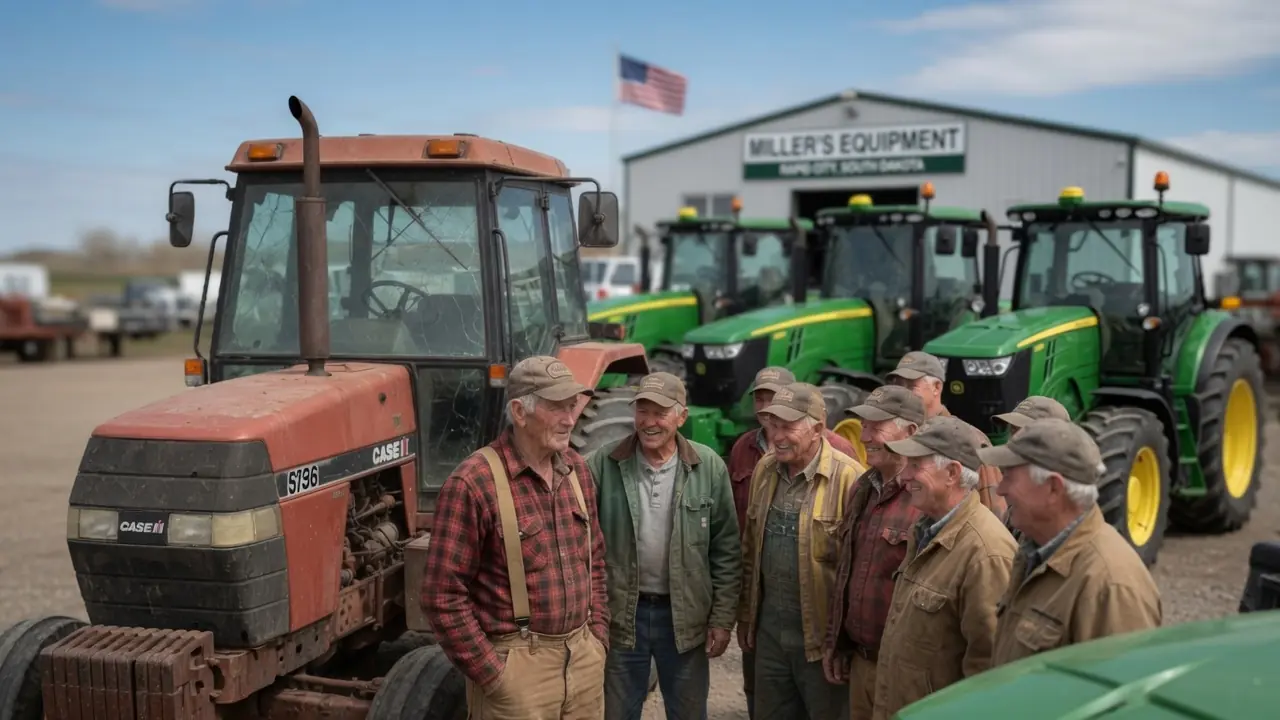
The tractor coughed once, rattled through the frame, then settled into a deep, uneven rhythm. The left rear tire was worn, hydraulic fluid had stained the housing beneath the seat, and several wires had been repaired with tape. A handwritten card tied to the steering wheel listed the opening bid at eight thousand dollars. Walter studied the machine for twenty minutes before raising his number.
His neighbor, Frank Halvorson, laughed loudly enough for everyone nearby to hear. “You planning to farm with that thing or bury it?”
Walter kept his eyes on the tractor. “Depends which one of us quits first.”
Frank had purchased a new green tractor the previous year and mentioned it in nearly every conversation. He said Walter was too old to waste time repairing worn equipment and too poor to survive another bad harvest. Walter’s own daughter, Karen, had asked him to reconsider buying anything without a warranty. She worried that her sixty-one-year-old father would spend his retirement underneath an engine instead of inside the house.
Walter bought the Case for eighty-four hundred dollars.
The auctioneer shook his hand with the sympathy usually reserved for men who had just made public mistakes. Two farmers offered to tow the tractor to a scrap yard when it failed. Walter declined both offers, filled the fuel tank, and drove the machine seventeen slow miles back to his farm. He reached home after sunset with the headlights flickering but the engine still running.
The following morning, he opened a black accounting ledger on his workbench and wrote the date, purchase price, engine hours, visible leaks, tire condition, and every sound he had heard during the drive. He replaced the filters, flushed the hydraulic system, repaired the wiring, adjusted the valves, and rebuilt the leaking cylinder with seals ordered through the mail. Nothing was hidden behind software, proprietary locks, or electronic warnings. If the tractor failed, it explained why through heat, noise, pressure, smoke, or vibration.
Walter recorded every repair.
He wrote down oil brands, filter numbers, torque specifications, temperatures, and the exact hours between changes. Each used filter was cut open and inspected for metal. Every year, he sent an oil sample to a laboratory in Minnesota and attached the report inside the ledger. His neighbors called the habit obsessive, but Walter believed machinery deserved the same honesty people expected from one another.
The Case did not become beautiful.
Its hood remained faded, the seat was repaired with black tape, and one side panel came from a different tractor. Yet it planted corn, pulled a grain wagon, cleared snow, and powered an auger through twenty-three harvest seasons. Whenever something failed, Walter repaired the part rather than replacing the whole machine.
Meanwhile, newer tractors began appearing across the county.
They came with climate-controlled cabs, computer screens, automated steering, and payments large enough to follow farmers through droughts and weak markets. Walter never claimed the machines were useless. He admired good engineering wherever he found it, but he distrusted equipment that could stop working because a sensor disagreed with the farmer sitting in the seat.
Miller’s Equipment became the largest dealership in the region.
Its owner, Carl Miller, had inherited one small parts counter from his father and transformed it into a polished showroom filled with green tractors, financing offices, and branded service trucks. Carl understood sales better than engines. He smiled warmly at farmers who signed contracts and barely noticed those who arrived carrying old part numbers.
Every few years, Carl approached Walter at the county fair.
“You’re still running that museum piece?” he would ask.
Walter usually answered, “It started this morning.”
Carl would laugh and hand him a brochure for a new tractor. “One day it won’t.”
“One day neither will I.”
By 2010, several neighboring farmers had traded their older machines through Miller’s Equipment. Frank Halvorson financed a new tractor after Carl warned him that parts for his previous model would soon disappear. The tractor performed well for three seasons, then developed hydraulic pressure problems shortly after an annual dealership service. Miller’s Equipment replaced a pump, billed Frank nearly twelve thousand dollars, and told him the failure came from age and heavy use.
Two years later, the replacement pump failed too.
Walter helped Frank tow the tractor from a field before a thunderstorm. While connecting the chain, he noticed the fluid dripping from a damaged hose appeared too thin for the cold temperature. Walter collected a small sample in a clean jar and compared it with the manufacturer’s specification. The color, smell, and viscosity did not match.
“Ask them exactly what fluid they used,” Walter said.
Frank shook his head. “They’re the dealer. They know what belongs in it.”
“Then asking should be easy.”
The invoice listed premium manufacturer-approved hydraulic fluid. The sample report identified a cheaper universal product that did not meet the tractor’s required cold-weather specification. Frank confronted Carl, but the dealership claimed the sample could have been contaminated after service. Without a sealed sample taken at the shop, Frank had no proof strong enough to force a refund.
Walter placed copies of the invoice and laboratory result in a second ledger.
Over the following years, similar stories reached him. A rancher named Dale Simmons paid for a complete transmission rebuild six months after dealership service. A widow named Marlene Price was told her late husband’s tractor needed a thirty-thousand-dollar replacement hydraulic system, then offered almost nothing for the machine as a trade-in. Two brothers from Sturgis lost steering pressure in separate tractors after receiving identical service packages.
Walter began asking questions.
He did not accuse anyone publicly. He requested invoices, photographed filters, recorded serial numbers, and encouraged farmers to obtain independent fluid analysis before authorizing major repairs. Some laughed at him, while others quietly brought paperwork to his kitchen table after dark.
The pattern became difficult to ignore.
Miller’s Equipment repeatedly billed customers for premium fluids and filters but appeared to install cheaper substitutes. Problems often appeared months later, after warranty periods or service guarantees had expired. When customers could not afford the recommended repairs, Carl offered low trade-in values and sold them expensive replacements through lenders connected to the dealership.
Walter’s old Case continued working because Miller’s Equipment had never serviced it.
He bought parts wherever he could find them, used manuals written before he was expected to ask permission, and tested everything he poured into the machine. Carl called this stubbornness. Walter called it knowing what was inside his own tractor.
In November 2022, the Case developed a slow leak near the steering control valve. Walter was eighty-four years old by then, thinner through the shoulders but still steady on his feet. He removed the valve, measured the worn seal, and found the original part number in a service manual stained with decades of fingerprints. The seal itself cost less than fifty dollars.
Every independent supplier listed the part as unavailable.
One warehouse showed a single remaining kit assigned to Miller’s Equipment. Walter called the dealership and spoke with a young parts clerk who confirmed the kit was on the shelf. Before Walter could reserve it, Carl took the telephone.
“That part is restricted to dealership installation,” Carl said.
“It is a rubber seal and two O-rings.”
“It requires certified service.”
“I have installed three of them before.”
Carl lowered his voice. “Walter, stop wasting time. Bring that wreck in, and I’ll give you five thousand toward a new tractor.”
“My tractor does not need replacing.”
“It is forty-four years old.”
“So is half the equipment your technicians use.”
Carl ended the call without reserving the part.
The next morning, Walter drove the Case toward Rapid City. The steering leaked slowly, but he had fitted a temporary return line and carried additional fluid. His grandson Noah followed in a pickup, worried the tractor would fail before they reached the dealership. Walter told him machines usually gave warnings before stopping, unlike people who often smiled until the moment they betrayed you.
When they entered the dealership lot, several farmers were already gathered near the service building.
Walter had called them the previous evening.
Frank brought invoices and two laboratory reports. Marlene carried photographs of filters removed from her tractor. Dale Simmons arrived with a failed pump and an independent mechanic willing to testify that the damage was consistent with incorrect fluid.
Carl walked out of the showroom wearing a spotless green jacket.
He looked at Walter’s tractor, then at the farmers forming a half-circle near the entrance. Salesmen and service employees gathered behind the glass doors. Carl forced a smile, apparently believing the crowd had come to watch Walter finally surrender.
“Why are you still dragging that worthless heap here, you stubborn old fool, when I told you to buy a real tractor?”
Several men laughed uneasily.
Walter climbed down from the Case and placed both boots on the gravel. His overalls were faded, his cap was stained, and his brown jacket had been repaired at one elbow. Beside Carl’s clean clothing and shining dealership, Walter looked like a man the modern equipment industry had already decided to forget.
He met Carl’s eyes.
“Because this heap outworked every overpriced machine your greedy dealership shoved onto desperate farmers.”
Carl’s smile vanished.
“You came here for a part I already refused to sell.”
“You have the seal kit on your shelf.”
“And I’ll install it after your tractor passes a full inspection. Three thousand dollars minimum.”
“The part costs forty-two.”
“You don’t decide our labor policy.”
Walter glanced toward the showroom filled with new tractors. “No. You only decide how much fear to attach to a simple repair.”
Carl stepped closer. “You broke old bastard. Without my parts, that rust bucket dies right here.”
Walter reached into the Case cab and removed two thick black ledgers bound together with a leather strap.
He placed them on the tractor’s hood.
“Then lock the damn doors, you lying crook, because these records prove your shop ruined their tractors, not mine.”
The laughter stopped.
Carl looked toward the farmers. “This is nonsense from an old man who cannot accept that machinery changes.”
Frank stepped forward and raised his invoices. “Did machinery change the fluid listed on these bills?”
Marlene held up a clear evidence bag containing a filter. “Your shop charged me for the manufacturer filter. This counterfeit came off my tractor one week later.”
Dale placed the failed pump on the gravel with a heavy metallic thud. “Your manager told me this failed because I overloaded it. The lab says your fluid destroyed the seals.”
Carl turned toward his employees. “Get these people off the property.”
No one moved.
The service manager, Brian Keller, stood near the door with his face pale. He had worked for Carl for nine years and knew which drums were stored behind the service bays. Walter watched the man’s eyes move toward the county road as two dark state vehicles approached.
A South Dakota consumer-protection investigator stepped from the first car. A representative from the tractor manufacturer emerged from the second, followed by an agricultural equipment compliance officer. Walter had sent copies of the records six weeks earlier, along with sworn statements, service invoices, fluid analyses, and photographs showing dealership inventory labels.
Carl’s anger became fear.
“You brought the government here over oil?”
The investigator opened a folder. “We are here because your invoices may document systematic consumer fraud, warranty misrepresentation, and the sale of improperly serviced equipment.”
“This is private property.”
“We have authorization to preserve relevant business records while a formal search order is reviewed.”
Carl looked at Walter. “You planned this.”
Walter rested one hand on the old tractor. “I maintained records. Your choices planned the rest.”
Investigators entered the service building and photographed fluid drums, storage labels, invoices, and workstation records. One drum contained universal hydraulic fluid purchased in bulk at less than half the price of the premium product billed to customers. Employees were interviewed separately. Before noon, two technicians admitted they had been instructed to fill machines from the cheaper drum while entering manufacturer product codes on invoices.
Brian Keller provided copies of internal emails.
Carl had written that customers would never know the difference. Another message instructed staff to describe resulting failures as age, contamination, operator error, or normal wear. When a repair estimate became too expensive, sales employees were told to push the customer toward trading the damaged tractor.
The showroom doors were locked shortly after one that afternoon.
A printed notice stated that the service and sales operations were temporarily closed pending an investigation and inventory review. Customers arriving for appointments found farmers standing beside Walter’s faded red Case, reading copies of laboratory reports laid across a folding table.
Carl was escorted from his office without handcuffs, but with none of the authority he had displayed that morning. He stopped in front of Walter and looked at the tractor with open hatred.
“You think that machine proves you were right about everything?”
Walter shook his head. “No machine proves everything.”
“Then what does it prove?”
“That honest maintenance lasts longer than a dishonest sale.”
The investigation continued for months.
Miller’s Equipment faced civil claims from forty-three customers. Eleven tractors showed damage likely connected to incorrect fluids or counterfeit filtration parts. Several farmers had traded machines at artificially low values after receiving repair estimates based on failures the dealership may have caused.
Carl’s lawyers argued that suppliers had mislabeled products and employees had acted without his knowledge. The internal emails made that defense difficult. He eventually accepted a settlement requiring customer reimbursement, debt adjustments, repair compensation, and the permanent surrender of his dealership franchise.
The building did not remain closed forever.
A group of former technicians, local farmers, and an independent equipment specialist formed a cooperative to purchase the property. The manufacturer approved them only after they agreed to transparent billing, sealed fluid samples, customer access to diagnostic records, and the sale of ordinary parts without forced installation. Every invoice listed the exact fluid brand, quantity, filter manufacturer, and technician responsible.
Walter received no free tractor.
He did not want one.
The cooperative sold him the forty-two-dollar seal kit at cost and allowed Noah to use a workbench. Walter installed the seals himself while three young technicians watched. He showed them how to inspect the valve surface, how to protect the O-rings during assembly, and why cleaning a housing mattered more than working quickly.
The Case returned to work two days later.
Its steering held pressure, the engine still rattled, and the cab continued letting cold air through gaps around the door. Walter recorded the repair in his ledger beneath the date, part number, cost, and hours. At the bottom of the page, he added one sentence.
A farmer must own the right to understand and repair what he depends on.
Frank visited the farm the following spring.
He found Walter using the Case to pull a planter through dark soil. The old tractor moved slowly but steadily, leaving straight rows behind it. Frank waited at the edge of the field until Walter stopped.
“I laughed when you bought that thing,” Frank said.
“I remember.”
“I thought buying new meant buying certainty.”
Walter climbed down. “New equipment can be good.”
“That is not what I expected you to say.”
“The problem was never new tractors. The problem was men selling trust they did not deserve.”
Frank looked at the Case. “How many hours now?”
Walter checked the meter, which had been replaced once but carefully documented. “Enough.”
Noah began helping more often after the dealership investigation. He had previously believed farming required the newest technology to survive, while Walter sometimes treated every modern system as a threat. Working together taught them both something less comfortable and more useful.
Technology was not the enemy.
Secrecy was.
A machine could carry computers, sensors, and software without taking power from the farmer if the owner still received service information, diagnostic access, fair parts, and honest records. An old tractor could also become dangerous if nostalgia replaced maintenance. Walter’s lesson was never to worship old iron.
It was to demand the truth from anything expected to carry a family through a harvest.
The following summer, the equipment cooperative held its first public repair day. Farmers brought tractors, combines, and balers while technicians demonstrated fluid testing, filter inspection, diagnostic tools, and basic preventative maintenance. Walter sat beneath a canopy with his ledgers open on a table.
Young farmers studied the pages.
They saw twenty-three years of oil analysis, valve adjustments, seal replacements, bearing temperatures, and handwritten observations. Nothing in the ledger looked impressive alone. Together, the records explained why the tractor had survived.
A reporter asked Walter whether he considered himself the man who closed Miller’s Equipment.
“No,” Walter replied.
“But your evidence caused the investigation.”
“The dealership closed because Carl chose fraud every time honesty looked less profitable.”
The reporter pointed toward the Case. “And you never regretted refusing to upgrade?”
Walter looked at the faded hood, worn tires, and repaired seat. He remembered the cold auction field in 1999, his daughter’s concern, his neighbors’ laughter, and the long drive home beneath flickering headlights.
“I regretted plenty of repairs,” he said. “I never regretted knowing how to make them.”
Walter continued farming for two more seasons before leasing most of his land to Noah. He kept forty acres near the house and refused to call himself retired. The Case remained in the equipment shed with a charged battery, clean filters, and fuel treated for winter.
Sometimes Noah used it when newer equipment was tied up elsewhere.
Sometimes Walter started it simply to listen.
The engine still coughed once before settling into its familiar rhythm. The sound was not beautiful, but it was honest. Every knock, vibration, and worn surface had a history recorded somewhere in Walter’s ledgers.
Miller’s old sign remained in storage behind the cooperative building. The name that once represented power had become evidence from a chapter nobody wanted repeated. Above the new parts counter hung a simple wooden board engraved with the cooperative’s service promise.
You own the machine. You receive the truth.
Walter never asked them to put his name beneath it.
He did not need credit.
The farmers who had once laughed now brought their grandchildren to see the battered red tractor at community events. They explained how one old man refused to trade away a working machine merely because a salesman called it worthless. More importantly, they explained how he kept records when everyone else accepted excuses.
In 1999, Walter Briggs had bought a tractor nobody wanted.
For twenty-three years, people mistook his patience for ignorance, his caution for fear, and his refusal to finance a replacement for poverty. They believed the old machine survived because Walter was lucky.
Luck had very little to do with it.
The tractor survived because someone listened when it warned him, opened it when it failed, documented every repair, and refused to surrender responsibility for understanding what he owned.
The dealership failed for the opposite reason.
Carl Miller stopped listening, hid every failure, erased responsibility, and treated customers as people who could be frightened into signing new contracts. His showroom had been full of newer machines, polished floors, and expensive promises.
Walter arrived with faded paint, grease-stained pages, and the truth.
By the end of that day, only one of them was still working.