The dusty stagecoach rolled into Cedar Bluff beneath a hard Montana sky, its wooden wheels groaning as though they had carried every sorrow in the territory. Clara Mercer sat rigidly near the window with three-year-old Pearl asleep against her shoulder, ten-year-old Eta clutching the sleeve of her faded navy dress, and seven-year-old Caleb staring through the dust at the horses tied outside the station. The journey had lasted twelve brutal days, but the distance behind them frightened Clara less than the man waiting ahead. A road could exhaust the body; rejection could destroy what little hope remained.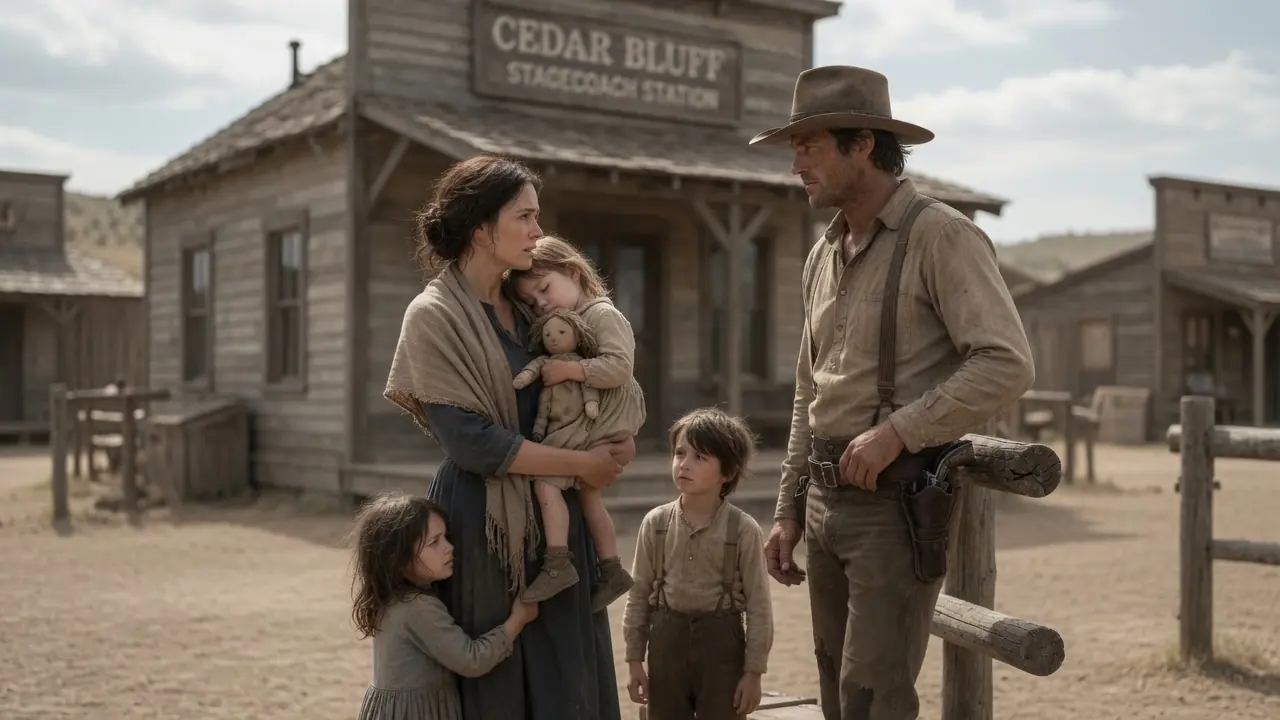
Clara had traveled west because Levi Hart had answered a matrimonial advertisement placed by her widowed cousin in St. Louis. His letters had been plain and careful, never filled with false romance or promises of an easy life. He had written about a cattle ranch outside Cedar Bluff, a sturdy house with empty bedrooms, and evenings so quiet that the wind seemed like another person at the table. Most importantly, he had known from the beginning that Clara had three children.
Still, ink was safer than reality.
A man could imagine obedient children from a letter. He could picture soft laughter, clean clothes, and grateful faces without thinking about fever, hunger, broken dishes, nightmares, or the endless work of keeping small bodies alive. Clara had watched kindness disappear before. Her late husband’s relatives had welcomed her after Daniel died, then quietly complained about the cost of feeding four extra mouths until she understood they wanted her gone.
The stagecoach stopped with a violent jolt.
Pearl stirred and tightened both arms around her worn cloth doll. Eta stood first, trying to appear braver than she felt, while Caleb swallowed hard and lifted the smaller of their two trunks. Clara took it from him because he had been trying to prove himself useful since the day they left Missouri.
“You stay beside me,” she whispered. “All of you.”
They stepped into the Montana heat together.
Cedar Bluff was little more than a broad dirt street lined with a hotel, general store, blacksmith shop, feed warehouse, and several wooden houses leaning beneath years of wind. Horses stamped near the hitching rails, men paused outside the saloon, and two women carrying baskets openly studied the newcomers. Clara felt every eye measure the worn hem of her dress, the children’s dusty faces, and the battered trunks containing nearly everything they owned.
Then she saw Levi Hart.
He stood beside the station fence holding the reins of a chestnut gelding and a patient gray mare hitched to a wagon. At thirty-eight, he was taller and broader than Clara had imagined, with weathered skin, dark hair beneath a dusty brown hat, and short stubble along a strong jaw. His beige work shirt was clean but faded, his dark suspenders bore years of wear, and the gun belt at his hip looked practical rather than threatening.
He did not smile immediately.
His calm gray eyes moved from Clara to each child, taking in Pearl’s rag doll, Caleb’s clenched fists, and Eta’s guarded stare. Clara recognized that pause. She had seen it whenever people first understood that “three children” meant three separate lives with separate needs.
Fear rose sharply inside her.
Before Levi could speak, Clara lifted her chin.
“No man wants to survive this frontier with a widow and three children, Mr. Hart.”
The street seemed to fall silent around them.
Eta pressed closer to her side. Caleb looked at the ground, while Pearl hid her face against Clara’s shoulder as though even she understood the danger in the moment.
Clara continued before courage deserted her.
“You have the right to change your mind now that you see us. I will not blame you. A man deserves to know what he has truly agreed to before carrying four strangers onto his land.”
Levi rested one hand on the fence rail.
“Mrs. Mercer, I knew how many children you had before I wrote the first letter.”
“Numbers are different from reality.”
“That is true.”
Her stomach tightened.
Then he stepped forward, removed his hat, and lowered himself until he was closer to Pearl’s height.
“What is your doll’s name?” he asked.
Pearl peeked at him through damp curls. “Molly.”
Levi nodded solemnly. “Does Molly travel well?”
Pearl considered the question. “She gets scared.”
“Then I am glad she has you.”
The little girl looked at Clara, uncertain whether she had permission to smile.
Levi rose and turned toward Caleb. “You like horses?”
Caleb nodded quickly.
“The gray mare is Willow. She is gentle, but she steals apples when no one is watching.”
A flicker of interest crossed the boy’s face.
Finally, Levi looked at Eta. He did not attempt to touch her or force conversation. “You do not have to trust me today,” he said. “You only have to ride home with us.”
Eta’s expression changed, though only slightly.
Clara tightened her hold on Pearl. “Kind words vanish when the crying, hunger, and trouble begin.”
Levi reached for the larger trunk.
“Then bring them to my ranch,” he said. “By sundown, I will begin proving none of you are burdens.”
He loaded both trunks into the wagon before Clara could protest.
The ride to Hart Ranch took nearly an hour. Cedar Bluff disappeared behind low hills, and the land opened into wide grasslands broken by cottonwoods, rocky ridges, and distant mountains touched with lingering snow. Caleb sat beside Levi and asked careful questions about every horse they passed. Eta remained near Clara, alert and silent, while Pearl fell asleep again with her head in her mother’s lap.
Clara watched Levi’s hands on the reins.
He never crowded Caleb’s answers or laughed when the boy misidentified a mule as a small horse. When the wagon struck a rut, Levi immediately slowed and looked back to ensure the girls were safe. Each small act seemed natural, which frightened Clara more than obvious charm would have.
Men could perform kindness for a day.
She needed to know what remained after exhaustion arrived.
Hart Ranch sat in a sheltered valley beneath a line of dark pines. A broad wooden house stood near the creek, with a long front porch, a red-roofed barn, corrals, a chicken yard, and several outbuildings. Cattle grazed beyond the fences, while horses lifted their heads as the wagon approached.
Pearl woke and stared.
“It is big,” she whispered.
Levi glanced back. “Big enough for Molly?”
The child nodded.
Inside, Clara found four bedrooms upstairs. One had been prepared for her with clean bedding and a small vase of wildflowers beside the window. Two smaller rooms contained narrow beds, quilts, washbasins, and empty wooden chests. Levi had even placed a tiny rocking horse in Pearl’s room.
Clara stopped in the doorway.
“You prepared all this?”
“I had help from Mrs. Becker in town.”
“You were certain we would come?”
“No.”
“Then why?”
Levi looked toward the children exploring the hallway. “Hope needs somewhere to sleep.”
The words reached too deeply, and Clara turned away before he saw her eyes fill.
That first evening, Levi cooked beef stew while Clara unpacked. She offered to take over, but he told her she had traveled farther that week than he had in months. At the table, Caleb accidentally knocked over his water cup. The boy froze, staring at Levi as though waiting for punishment.
Clara moved immediately. “I am sorry. He will clean it.”
Levi handed Caleb a cloth.
“Everyone who eats at this table spills something eventually,” he said. “Today was your turn.”
Caleb slowly wiped the water.
No anger came.
After supper, Pearl fell asleep on a chair. Levi carried her upstairs only after asking Clara’s permission, moving with surprising gentleness for such a large man. Eta watched from the landing, her eyes following every step.
When the house finally became quiet, Clara found Levi on the porch.
“I appreciate what you have done,” she said. “But the children will not interfere with your work.”
He looked toward the dark barn. “Children interfere with everything.”
Clara stiffened.
Levi glanced at her and almost smiled. “That is usually how they become part of a life.”
She did not know how to answer.
The following morning, Clara established rules before breakfast.
The children were not to run inside, shout near Levi, touch ranch equipment, approach horses alone, or disturb him while he worked. They would make their beds, clean their dishes, and remain grateful. Eta accepted the instructions seriously. Caleb nodded, and Pearl looked confused but agreed because her siblings did.
For the first week, Clara worked constantly.
She cleaned rooms that were already clean, mended curtains, baked bread, washed clothes, and prepared meals before Levi returned from the fields. She believed usefulness might protect them from becoming unwanted. Whenever Pearl wandered toward him, Clara gently pulled her back.
“Mr. Hart is tired,” she would say.
Whenever Caleb asked to accompany Levi to the barn, Clara found another chore for him. Eta needed no correction. The girl kept herself quiet, watching Levi from doorways as though studying how long his patience would last.
Levi noticed all of it.
One evening, he found Pearl sitting alone behind the woodpile, whispering to Molly. When he asked why she was hiding, she told him her laughter might disturb him. Levi sat on the ground beside her despite the dirt on his trousers.
“This ranch is too quiet,” he said. “You may laugh as much as you like.”
Pearl studied him. “Mama says not to trouble you.”
“You are not trouble.”
“Caleb breaks things.”
“So do I.”
“Eta does not.”
Levi looked toward the house. “Eta is carrying too much for someone her age.”
Pearl did not understand, but Levi did.
The next day, he invited Caleb to help check the water troughs. Clara refused immediately.
“He will slow you down.”
“That is likely.”
“He may frighten the cattle.”
“I will teach him not to.”
“He could be hurt.”
Levi’s expression remained gentle. “Mrs. Mercer, a boy can be protected so carefully that he never learns he is capable.”
Clara heard criticism in the sentence and bristled. “You do not know what he has survived.”
“No,” Levi said. “But I know what fear does when nobody gives it useful work.”
Caleb watched from the doorway.
Clara wanted to argue, but she saw the hope in her son’s face and finally nodded.
Caleb returned near sunset with dust on his boots and pride transforming his posture. He had helped repair a trough valve, counted thirty-seven cattle, and learned how to approach a horse from the side. He spoke through the entire supper, and Levi listened as though every detail mattered.
Clara should have been relieved.
Instead, she became more afraid.
The children were beginning to love him.
Love created another way to be wounded.
Two weeks after their arrival, Clara woke to unnatural silence. Pearl slept beside her after a nightmare, and Eta was folding clothes in the next room. Caleb’s bed was empty.
“Where is your brother?” Clara asked.
Eta went pale. “He was downstairs.”
Clara rushed through the house.
The back door stood open. Beyond it, the corral gate hung slightly ajar. Fear struck so hard she could barely breathe.
She imagined Caleb beneath a horse’s hooves. She imagined Levi carrying him back injured. Worse, she imagined Levi finally deciding that three children were too much danger, noise, and responsibility.
Then she heard his voice behind the barn.
“Keep your palm flat.”
Clara rounded the corner and stopped.
Caleb sat carefully on the lower fence rail while Levi stood beside Willow, the gentle gray mare. The horse lowered her head toward the boy’s trembling hand and breathed against his fingers.
Caleb smiled.
It was not the cautious smile he gave adults when he wanted approval. It was open, amazed, and filled with a joy Clara had not seen since Daniel died.
Panic escaped her before thought could stop it.
“Caleb Mercer! Do not trouble Mr. Hart!”
The smile vanished.
Caleb pulled back his hand. Willow lifted her head, startled by the sharp voice.
Levi turned.
There was no anger in his face, only disappointment so quiet that Clara wished he had shouted.
“A boy who wants to learn about horses is not trouble,” he said. “It is the finest company a rancher could ask for.”
Clara looked at Caleb’s lowered head.
“I was afraid,” she whispered.
“I know.”
“You left the gate open,” she told her son.
Caleb’s eyes filled. “Mr. Hart opened it. He came inside to get me.”
Levi rested one hand on the fence. “I invited him before breakfast.”
Shame burned through Clara.
She had assumed danger because danger was easier to trust than kindness.
That evening, she apologized to Caleb and then found Levi repairing a harness in the barn.
“I have spent so long keeping them from becoming burdens that I forgot they are children,” she said.
Levi continued working for a moment. “Who taught you they were burdens?”
Clara looked toward the open barn doors.
“Daniel’s brother took us in after the funeral. At first, he said family belonged together. Then food became expensive. Pearl cried too much. Caleb broke a lamp. Eta needed new shoes.”
Levi’s hands stopped.
“One night, I heard his wife say no man would ever choose a widow carrying three hungry children.”
“And you believed her.”
“I had nowhere else to go.”
Levi set down the harness. “Clara, people often call others burdens when they want permission to abandon them.”
She met his eyes.
The steadiness there frightened and comforted her at once.
“I cannot promise never to become tired,” he continued. “I cannot promise this ranch will always have money or that the children will never make me angry. But I can promise I will not confuse difficulty with regret.”
Clara looked away before tears fell.
The weeks passed, and the house slowly changed.
Caleb began helping with small ranch chores. Pearl followed Levi whenever Clara allowed it, carrying Molly beneath one arm and asking endless questions. Eta remained cautious, but she started reading aloud in the evenings while Levi repaired tack near the stove.
One night, Levi asked what she wanted to become.
Eta looked surprised. “Girls do not become much out here.”
“Mrs. Becker runs the hotel.”
“She is a widow.”
“Mrs. Collins owns the feed store.”
“She inherited it.”
Levi nodded. “Then perhaps you will become the first woman in Cedar Bluff who does not need widowhood or inheritance to begin.”
Eta lowered her book. “Could I teach?”
“If you learn enough.”
“Would you let me go to school?”
“If your mother agrees.”
It was the first time Eta smiled directly at him.
The ranch faced its first real test in early winter.
A blizzard descended from the mountains with almost no warning. Snow covered the valley within hours, wind hammered the house, and several cattle broke through a weakened section of fence. Levi left before dawn with two ranch hands to recover them.
By noon, only one man returned.
Levi had been thrown from his horse near the creek and injured his leg.
Clara rode out in the storm despite every warning. She found him sheltering behind a rock shelf, pale with pain but still giving instructions about the cattle. Together, she and the ranch hands brought him home on a makeshift sled.
For six weeks, Levi could not place full weight on his leg.
The ranch work did not stop.
Clara organized the household, prepared meals, managed supplies, and helped the ranch hands track livestock. Caleb fed chickens and carried messages. Eta kept written records, while Pearl sat beside Levi and told stories to keep him from trying to stand too soon.
One evening, Levi watched Clara review the feed inventory at the kitchen table.
“You were worried about burdening me,” he said.
She looked up. “You are injured.”
“And you are carrying this entire ranch.”
“Temporarily.”
“No. You have been carrying families for years.”
His voice softened.
“You arrived believing you had nothing to offer except problems. Clara, you brought everything this house was missing.”
The room became very still.
She folded the ledger closed. “You do not need to say things because you are grateful.”
“I am not.”
“Then why?”
“Because I love you.”
Clara’s breath stopped.
Levi looked almost angry with himself for saying it aloud, but he did not withdraw the words.
“I loved you before the snow,” he continued. “I loved you when you argued at the station, when you cleaned a house that did not need cleaning, and when you looked ready to fight an entire corral because Caleb touched a horse.”
A small laugh escaped her through rising tears.
“I have nothing elegant to offer,” he said. “Only this ranch, my name, and every year God permits me to remain here.”
Clara crossed the room.
She knelt beside his chair and took his rough hand in both of hers.
“I am still afraid kindness will disappear.”
“Then watch me tomorrow.”
“And the day after?”
“Watch again.”
She kissed him before courage could fail.
They married in the spring beneath the cottonwood near the creek. Mrs. Becker altered Clara’s best dress, Eta carried wildflowers, Caleb stood beside Levi with pride shining from his face, and Pearl scattered petals while Molly remained tucked beneath her arm.
The entire town attended.
Some came because frontier weddings were rare entertainment. Others came because they had watched Hart Ranch transform from a silent place into a home filled with children. Clara heard whispers but no longer measured her worth by them.
After the ceremony, Levi knelt before the children.
“I am not asking you to forget your father,” he said. “I am asking permission to stand beside his memory and care for you for the rest of my life.”
Caleb embraced him first.
Pearl followed.
Eta remained still for several seconds before stepping forward and placing both arms around his shoulders.
That night, laughter filled the house long after darkness settled over the valley.
Years passed.
Caleb became a skilled horseman and eventually managed the ranch’s breeding operation. Eta attended a teachers’ college in Helena and returned to establish Cedar Bluff’s first permanent school. Pearl grew into a fearless young woman who still kept Molly safely wrapped inside a cedar chest.
Clara and Levi had one more child together, a boy named Daniel Hart in honor of the man whose love had begun her first family.
Levi never treated the older children as less than his own.
He disciplined them when necessary, argued with them when they were stubborn, worked beside them, and appeared at every important moment. His love was not the perfect gentleness Clara feared losing. It was something more durable: daily presence.
On the twentieth anniversary of Clara’s arrival, the family gathered at the stagecoach station where their lives had changed.
The old building leaned more than before, and trains had begun replacing stagecoaches across the territory. Clara stood beside Levi while their grown children laughed nearby.
“Do you remember what I said?” she asked.
“That no man wanted a widow with three children.”
“I said no man wanted to survive the frontier with us.”
Levi smiled. “You were wrong.”
“I was.”
He took her hand.
“The children did not make survival harder,” he said. “They made survival worth doing.”
Clara looked toward Eta helping her own daughter climb onto the station platform. Caleb stood beside Willow’s granddaughter, teaching his young son how to hold out a flat palm. Pearl carried Molly beneath one arm because she insisted the doll deserved to attend the anniversary.
The family Clara once feared no man would choose now filled the entire station yard.
She thought of the trembling woman who had stepped from the coach with one battered trunk and a heart prepared for rejection. That woman believed strength meant needing nobody. She believed safety came from keeping children silent, gratitude came from taking up little space, and love had to be earned through usefulness.
Levi taught her something different.
A home was not a place where nobody caused trouble.
It was the place where trouble did not make anyone disposable.
When Clara arrived in Cedar Bluff, she gave Levi every reason to turn her away. She warned him about hunger, crying, broken belongings, and all the responsibilities hidden behind three frightened faces.
Levi looked at the children and saw none of those things first.
He saw a girl guarding her siblings.
He saw a boy pretending not to be afraid.
He saw a little child protecting a rag doll.
And where Clara saw burdens, he saw the family he had been waiting to love.