“Women like you survive in uniform only because men like me allow it.”
Captain Brooks Callahan planted his fist against the wood-paneled wall above Lieutenant Colonel Elena Ward’s head. The impact cracked through the Fort Bragg Officers’ Club, silencing conversations beneath framed photographs of soldiers who had never returned from war. Callahan leaned closer, using his height, medals, and reputation like weapons he believed no one would dare challenge.
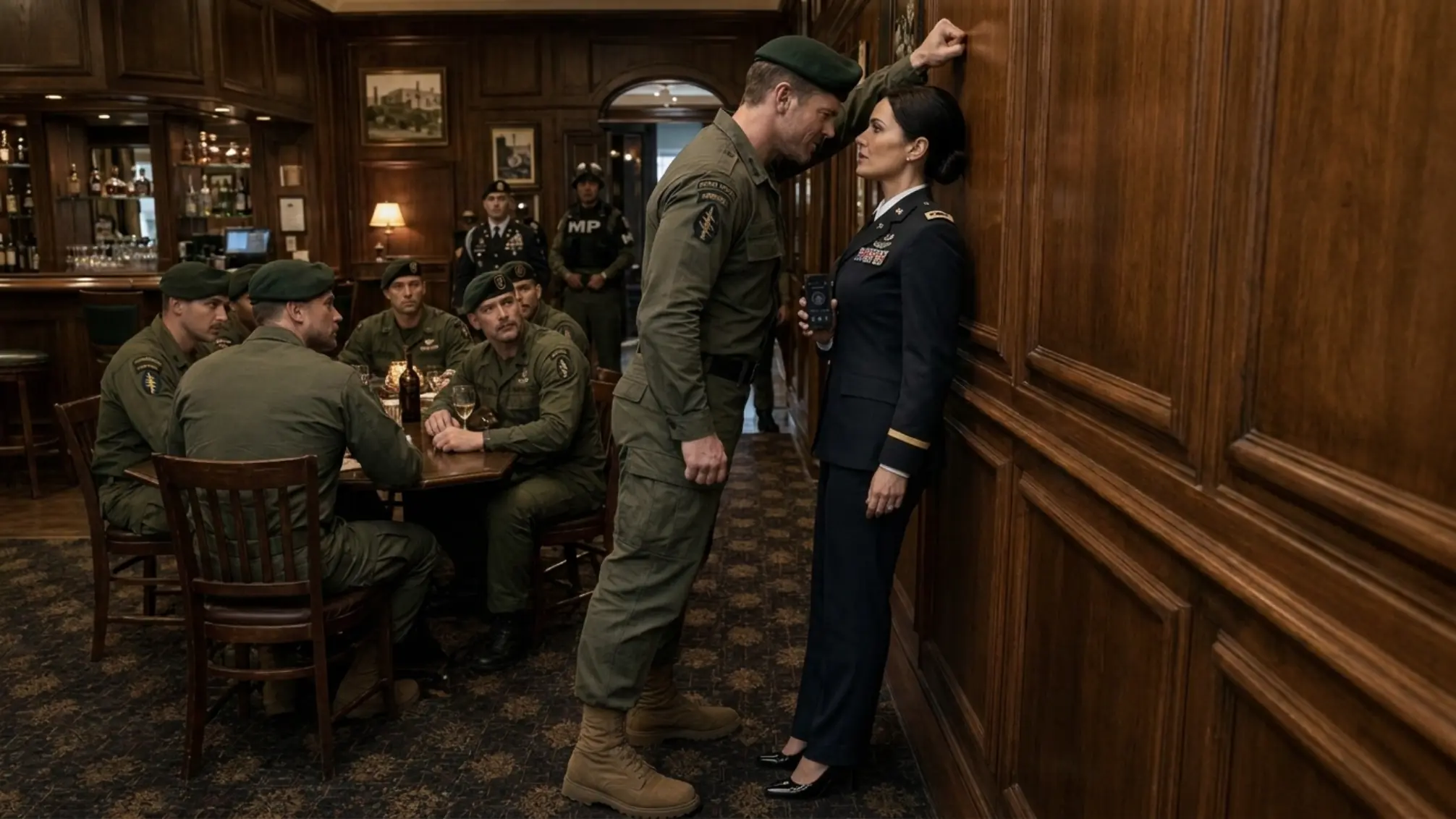
Elena did not step away.
Her back remained against the wall, but her posture was straight, her immaculate Army service uniform undisturbed. Her commanding hazel eyes stayed fixed on Callahan’s scarred face while one hand held a secure phone connected to command headquarters. Across the room, his Green Beret teammates watched from their table, though none looked amused anymore.
“Men like you deploy only when women like me sign the order,” Elena said.
Callahan’s cold blue eyes narrowed. “Approve my team by sunrise—or I’ll destroy your career before breakfast.”
Elena activated the secure call and held the phone where he could see the command seal glowing on its screen. “Then keep threatening me. The colonel carrying your arrest order is opening that door.”
The club entrance swung inward.
Colonel Martin Hayes stepped through carrying the red deployment folder Callahan had been trying to force Elena to sign. Beside him walked the staff judge advocate, Command Sergeant Major Douglas Reed, and two military police officers wearing black tactical vests. The MPs moved immediately to either side of the doorway and locked it behind them.
Callahan slowly removed his fist from the wall.
For the first time that evening, he looked uncertain.
Colonel Hayes placed the folder on the bar and opened it to the final page. Beneath the words FINAL OPERATIONAL RELEASE was one blank signature line. Elena Ward’s name and title were printed directly below it.
“Captain,” Hayes said, “step away from the officer who controls whether your team deploys—and whether you leave this building in command.”
Callahan backed away half a step.
“This is unnecessary, sir.”
“What part?”
“The military police. The public display. Whatever Lieutenant Colonel Ward told you.”
Elena moved away from the wall and adjusted one sleeve. “You threatened me in front of eleven witnesses while demanding approval for an operation under active counterintelligence review.”
Callahan glanced toward his teammates. “I was having a professional disagreement.”
One of the MPs looked at the fist-shaped mark in the wooden panel.
Hayes closed the folder. “Your definition of professional conduct appears to require correction.”
The captain’s confidence returned as soon as he recognized that no one had placed him in handcuffs yet. He straightened his olive-drab uniform and looked toward the soldiers seated at the long table. Two Silver Stars, a Bronze Star, and classified commendations rested behind his reputation. For years, men with fewer decorations had excused his behavior before he ever needed to defend it.
“My team deploys in less than forty-eight hours,” Callahan said. “If this mission is delayed, a high-value target disappears.”
Elena faced him. “If your movement schedule is already compromised, your team walks into an ambush.”
“That is speculation.”
“No. It is supported by network records, contractor communications, and an unauthorized terminal access occurring eleven minutes after your private call.”
Several operators shifted in their chairs.
Callahan’s jaw tightened. “You’ve been digging through classified communications without operational context.”
“I have the clearance and authority.”
“You are a staff officer.”
“I am the officer responsible for operational release.”
“You have never led men like mine into hostile territory.”
Elena’s expression remained calm. “That does not make their lives less valuable to me.”
Captain Aaron Doyle, Callahan’s communications specialist, looked down at his untouched drink. He had served beside Callahan for four years, trusted him under fire, and watched him carry a wounded operator across two miles of mountain terrain. Until that evening, loyalty had made every question feel like betrayal.
Now Elena’s words forced another possibility into the room.
Callahan might be willing to risk them to protect himself.
Hayes gestured toward an empty table. “Sit down, Captain.”
“I would prefer to discuss this privately.”
“You surrendered privacy when you cornered a senior officer in front of your team.”
Callahan did not sit.
Command Sergeant Major Reed stepped closer. “That was not a suggestion.”
The captain finally pulled out a chair.
Elena remained standing beside the bar as the judge advocate opened a separate evidence packet. Photographs, access logs, bank records, and communication summaries were placed across the table. The documents represented six weeks of quiet investigation and one decision Elena had been delaying until every important fact could survive review.
Callahan stared at the first page.
It contained a transfer of $48,000 from Sentinel Ridge Defense Solutions into an account controlled by his younger brother. The payment had been labeled consulting compensation, though his brother worked as a roofing contractor in Georgia and had no defense experience.
“This is not my account,” Callahan said.
“No,” Elena replied. “It is the account from which your mortgage received three payments.”
“My brother loans me money.”
“Immediately after receiving funds from a company bidding on the communications contract supporting your deployment?”
Callahan looked toward Hayes. “Sentinel Ridge supports half the Special Operations community.”
“They were not authorized to possess your team’s movement schedule.”
“They don’t.”
Elena slid a satellite image toward him.
“An unauthorized copy of the schedule was opened from a contractor terminal at 21:17 last Tuesday. At 21:28, you made a private call to Sentinel Ridge executive Nathan Cole. Thirty-one minutes later, the same movement information was transmitted through an encrypted civilian channel.”
Callahan did not touch the image.
“You cannot prove I transmitted anything.”
“No,” Elena said. “But we can prove your relationship with the person whose terminal opened it.”
Colonel Hayes watched him carefully. “Why did you call Cole?”
“To discuss equipment readiness.”
“On a private line?”
“He contacted me after normal working hours.”
“For twenty-three minutes?”
“The system had problems.”
Elena opened the red deployment folder and removed a maintenance certification. “The system passed readiness inspection six hours earlier.”
Callahan leaned back.
For the first time, he appeared to understand the investigation had moved beyond rumor. Elena had not delayed his deployment because she feared his personality or questioned his combat record. She had found a trail carefully hidden beneath administrative access, contractor relationships, and the reputation he assumed would protect him.
His eyes returned to her.
“You planned this.”
“I reviewed evidence.”
“You knew I would confront you.”
“I knew you were aware someone had started asking questions. I did not know you would threaten the person holding your release authority in a room full of witnesses.”
Callahan smiled faintly. “Convenient.”
Elena’s voice became colder. “Nothing about delaying an operation involving twelve soldiers is convenient.”
Six weeks earlier, the red folder had arrived on her desk through ordinary channels.
Operation Iron Lantern involved inserting Callahan’s team into a remote mountain region to capture a weapons broker connected to attacks against American personnel. The intelligence appeared strong, the target’s travel pattern had been confirmed, and aviation support was scheduled. Every page suggested the operation should receive immediate approval.
Elena almost signed it that afternoon.
Then she noticed one inconsistency.
A communications equipment report listed a newly installed encryption package produced by Sentinel Ridge. The company had received emergency approval following a previous system failure, but the approval date came three days before the failure was officially reported.
Elena requested the procurement history.
A major in logistics told her the discrepancy was administrative. Callahan’s team needed the equipment quickly, he explained, and minor date corrections occurred during urgent acquisitions. He advised her not to delay a critical mission over paperwork.
Elena did not like being told where not to look.
She requested the complete file.
Within two days, she discovered Sentinel Ridge had received three urgent contracts connected to Callahan’s deployments. Each contract bypassed normal competition because the captain personally certified an immediate operational requirement. Prices were significantly higher than comparable systems, yet senior leaders accepted them because Callahan’s combat record carried unusual weight.
Then an intelligence analyst reported a restricted movement schedule had been accessed from an unauthorized terminal.
The analyst’s supervisor initially dismissed the alert because the person using the terminal possessed temporary credentials. Elena asked who approved those credentials.
Captain Brooks Callahan.
She did not accuse him.
She ordered preservation of the logs and began following every legitimate path available to her.
Callahan learned of the review within four days.
He called Elena’s office under the pretense of discussing the mission and spent most of the conversation reminding her how many lives depended on speed. He described the target as mobile, the intelligence window as temporary, and administrative delays as more dangerous than enemy fire.
Elena agreed with all three points.
She still refused to sign.
That refusal became the first boundary Callahan could not cross through reputation alone.
He sent senior officers to persuade her. One praised his courage. Another warned that blocking a decorated Green Beret could damage Elena’s career. A general’s aide asked whether she truly wanted responsibility if the target escaped and later killed Americans.
Elena answered the same way each time.
“I will sign when the operation is secure.”
Callahan interpreted caution as weakness.
At the Officers’ Club, he attempted intimidation because everything more polished had failed.
Now the entire room understood why.
Captain Doyle stood from the team table. “Sir, was our route compromised?”
Callahan looked at him sharply. “Sit down.”
Doyle remained standing.
“That route takes us through a narrow valley with no alternate extraction point. If hostile forces know the schedule, we are trapped.”
“You think I would send you into an ambush?”
“I am asking whether the contractor accessed our route.”
Callahan’s face hardened. “You’re listening to staff officers who have never walked outside the wire.”
Elena turned toward Doyle. “The access occurred. Whether information reached hostile forces is still being determined.”
“That is not an answer,” Callahan snapped.
“It is the only honest answer available.”
Doyle looked at his teammates.
Their loyalty had been built through fire, funerals, and years of shared danger. None wanted to believe Callahan had betrayed them. Yet Elena’s uncertainty felt safer than their captain’s angry certainty.
One operator removed his green beret and placed it on the table.
“Captain,” he said quietly, “tell us why your brother received the money.”
Callahan looked around the room.
The silence that once protected him had changed sides.
He stood so suddenly that the chair struck the floor. One MP stepped forward, but Hayes raised a hand, allowing Callahan to speak. The captain’s breathing became heavier as he looked from Elena to the evidence and finally toward the men he commanded.
“Sentinel Ridge paid my brother for introductions,” he said. “That is not illegal.”
“What introductions?” Hayes asked.
“Civilian contacts. Property opportunities. Investment discussions.”
“And your mortgage?”
“A family loan.”
Elena placed another document on the table.
It showed a payment from his brother’s account to a company owned by Nathan Cole’s wife. The money returned to Sentinel Ridge through a consulting invoice fourteen days later.
The transaction did not resemble a loan.
It resembled laundering.
Callahan’s anger shifted toward panic.
“You built a story around ordinary financial activity.”
“The court authorized access to the accounts because investigators found probable cause,” Elena said.
“You brought civilian investigators into a classified operation?”
“I brought federal investigators into suspected corruption affecting classified material.”
Callahan stepped toward her.
The MPs moved instantly, but he stopped before reaching the table.
“You have no idea what men like Cole provide. Washington delays equipment while soldiers die waiting. He gave us systems when the government failed.”
“He charged the government three times the market price.”
“He delivered.”
“And what did you deliver in return?”
The question struck harder than the accusations.
Callahan said nothing.
The club doors opened after an MP unlocked them for a counterintelligence officer. Special Agent Marcus Bell entered carrying a sealed evidence bag containing a black phone recovered from Callahan’s quarters under authorization issued that morning.
The captain recognized it immediately.
His face became pale.
Bell placed the bag beside the red folder. “This device contains encrypted communication with Nathan Cole and a foreign intermediary connected to the weapons broker targeted by Iron Lantern.”
Captain Doyle slowly sat down.
The room seemed to lose air.
Callahan looked toward the phone. “That device was planted.”
“It was found inside a locked compartment beneath your desk,” Bell said.
“Someone had access.”
“The compartment contained your fingerprints and personal documents.”
“I want counsel.”
The judge advocate nodded. “Questioning stops now.”
The military police approached.
Callahan turned toward his team before they reached him.
“I never sold you out.”
Nobody answered.
“I got us the equipment we needed. I made agreements because the system is broken, but I never gave hostile forces our route.”
Doyle’s eyes were wet with anger. “Then who did?”
Callahan looked toward the floor.
That silence became the first answer his men believed.
The MPs removed his belt and secured his wrists. He did not resist, though the humiliation of handcuffs appeared more painful to him than the evidence. As they guided him toward the locked doors, he stopped beside Elena.
“You wanted this.”
“No.”
“You wanted to bring down the decorated operator who made staff officers feel small.”
Elena met his stare. “I wanted your team to come home.”
The doors opened.
Callahan was taken into custody while his soldiers remained seated beneath photographs of dead operators. Not one followed him into the hallway.
The deployment was suspended before midnight.
A second Special Forces team moved into the target area only after intelligence officers rebuilt the operation from the beginning. Callahan’s original route was abandoned. Surveillance later confirmed armed fighters had already positioned weapons along the valley his team would have entered.
Had Elena signed the folder, Callahan’s men would have walked directly into a coordinated ambush.
The weapons broker escaped during the delay.
Some leaders blamed Elena privately.
Three months later, the broker was captured during a different operation that resulted in no American casualties.
The investigation into Callahan revealed a complex truth.
He had not begun as a traitor.
Years earlier, Sentinel Ridge supplied experimental equipment during an emergency when official procurement failed. The system helped Callahan locate two missing operators, and he developed absolute loyalty to Nathan Cole. That loyalty slowly became dependence.
Cole offered gifts disguised as assistance.
Then money.
Then protection.
In exchange, Callahan promoted company products, influenced contracts, and shared restricted operational information described as necessary for technical support. Each compromise appeared small when viewed alone.
Eventually, Cole demanded movement schedules.
Callahan told himself the contractor needed them to prepare communication support. When he realized the information had reached a foreign intermediary, he attempted to withdraw.
Cole threatened to expose the payments and destroy his career.
Callahan approved one final operation, believing capturing the weapons broker would eliminate the person capable of proving what happened. He pressured Elena because Iron Lantern was not merely a mission.
It was his attempt to bury the evidence.
At court-martial, prosecutors charged him with conspiracy, bribery, mishandling classified information, obstruction, conduct unbecoming an officer, and assault-related offenses arising from the Officers’ Club confrontation.
Several former teammates testified.
They described his courage under fire honestly. They also described his attempts to force them into a compromised mission.
Elena testified last.
Callahan’s defense attorney focused heavily on their confrontation.
“You disliked Captain Callahan before the investigation, correct?”
“No.”
“You considered him arrogant.”
“I considered his behavior concerning.”
“He challenged your lack of combat experience.”
“He challenged my authority because he believed a woman could be intimidated into signing.”
“Did that offend you?”
“Yes.”
The attorney appeared satisfied. “So this became personal.”
Elena looked toward the panel.
“It became personal when twelve soldiers’ names appeared on an operation I believed could get them killed.”
The attorney changed direction.
“Captain Callahan had saved lives in combat.”
“Yes.”
“He had demonstrated bravery repeatedly.”
“Yes.”
“Yet you prevented him from completing an important mission.”
“I prevented a compromised operation.”
“You delayed the capture of a dangerous weapons broker.”
“I delayed an ambush.”
The courtroom became silent.
Callahan eventually pleaded guilty to several charges in exchange for dismissal of others. He lost his rank, decorations associated with compromised reporting periods, retirement benefits, and freedom. His sentence ensured that the uniform he used to dominate others would never again give him authority over soldiers.
Nathan Cole received a federal prison sentence.
Sentinel Ridge lost every defense contract and paid millions in restitution.
The major who turned away at the Officers’ Club faced administrative discipline after investigators found he had received earlier complaints about Callahan’s intimidation. He had dismissed them as personality conflicts.
Silence, the official report concluded, allowed misconduct to grow into operational danger.
Captain Doyle assumed temporary command of the team. Before their next deployment, he visited Elena’s office carrying the same red folder, now rebuilt with new routes, equipment, and intelligence protections.
He placed it on her desk.
“My men asked me to deliver it personally.”
Elena reviewed every page.
Doyle waited without pressuring her.
When she reached the final signature line, she looked up. “Do you have concerns you haven’t included?”
“One.”
“What is it?”
“I’m afraid I’ll miss something because I want the mission too badly.”
Elena nodded. “That fear will make you check twice.”
He gave a faint smile. “Callahan never admitted fear.”
“That did not mean he had none.”
Elena signed the release.
Doyle collected the folder but paused at the door.
“Ma’am, at the club… we should have stopped him before Colonel Hayes arrived.”
“Yes.”
“I’m sorry.”
“Remember the feeling the next time someone else remains silent.”
The team deployed safely and returned six weeks later with every member alive.
They presented Elena with a framed copy of the final operational release. Beneath her signature, the soldiers had added twelve names and one sentence:
THE SIGNATURE THAT SENT US OUT ONLY AFTER IT COULD BRING US HOME.
Elena hung it beside her desk.
Years later, people told the story as if her victory happened when military police entered the Officers’ Club. They remembered the arrogant captain, the threatening fist, and the moment he learned the woman against the wall controlled his deployment.
Elena remembered something else.
She remembered the major turning away.
The teammates staring at their glasses.
The laughter fading only when authority stronger than Callahan entered the room.
Her rank had eventually protected her, but rank should never have been required for basic dignity. The investigation proved Callahan’s danger did not begin with classified records or corrupt payments.
It began when people repeatedly excused the way he treated anyone he believed lacked power.
Brooks Callahan told Elena that women survived in uniform only because men like him allowed it.
Then the doors locked.
The evidence opened.
And every soldier in the room learned that his permission had never been the source of her authority.