“May I have what’s left in the pan?”
Eliza Harrow’s voice barely carried above the quiet crackle of grease cooling inside the black iron skillet. She stood beside the stove at Red Willow Ranch with a chipped blue saucer held against her waist, her shoulders folded inward as though even the question required an apology. Golden evening light entered through the kitchen window, touching the loose chestnut curls around her tired face and turning the wheat fields outside into a glowing sea. At the table, Grant Mercer slowly lowered his fork.
His plate was full.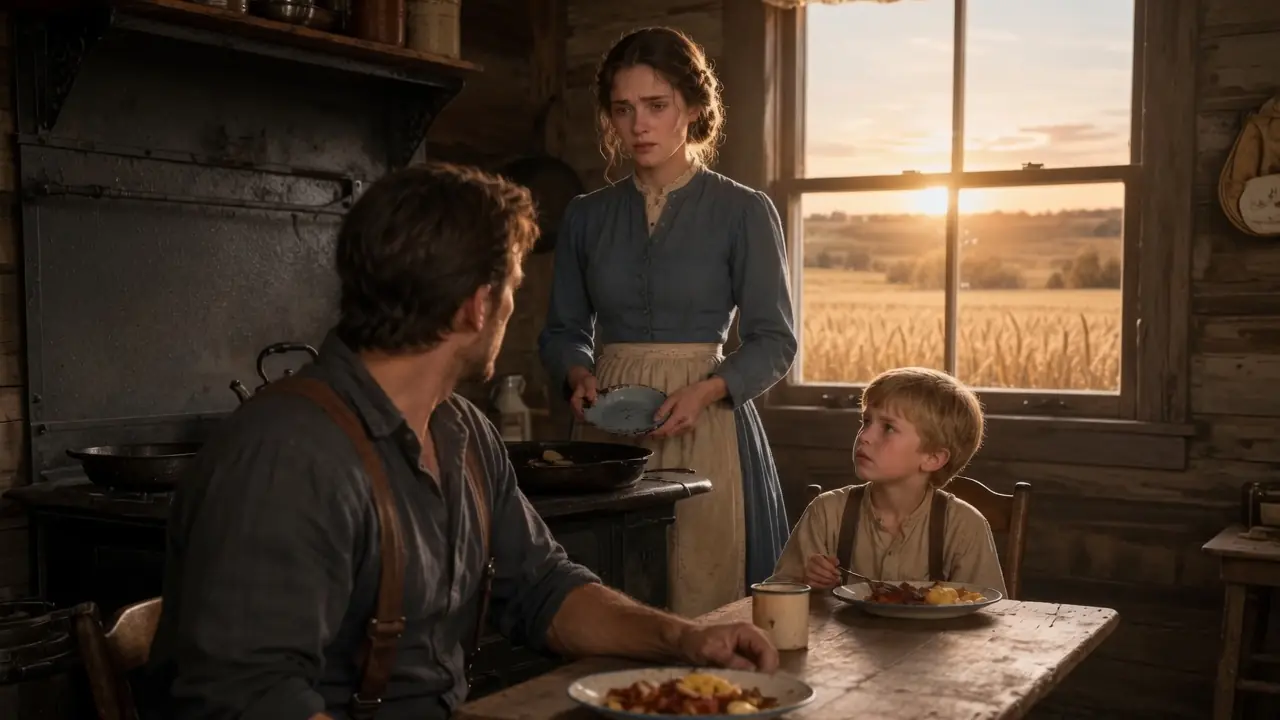
So was the plate belonging to his nine-year-old nephew, Samuel. There were fried potatoes, thick slices of bacon, warm biscuits, and beans Eliza had seasoned with onion and salt. Yet no third plate had been placed at the table, no cup waited beside an empty chair, and not one portion had been saved for the woman who had prepared the entire meal.
Grant looked back at the skillet. Only blackened potato edges and a ribbon of bacon grease remained. “Why isn’t there a plate waiting for you?”
Eliza’s fingers tightened around the saucer. “I know my place, Mr. Mercer. I eat after everyone else is finished.”
Grant pushed his chair backward.
The wooden legs scraped against the floor, and Eliza flinched so violently that the saucer nearly slipped from her hands. She stepped away from him, her face draining of color, and raised one arm slightly as though protecting herself from a blow that had not come. Grant stopped at once.
Samuel’s fork remained suspended halfway to his mouth. “Uncle Grant?”
Grant forced his hands open and lowered his voice. “I’m not angry with her.”
Eliza looked at the floor. “I shouldn’t have asked. I can wait until morning.”
“No.” Grant picked up his plate, crossed the kitchen slowly, and placed it on the worktable in front of her. “Not in this house.”
Her eyes rose toward him, wide and uncertain. “Mr. Mercer, I wasn’t trying to take your supper.”
“You didn’t take anything.”
“I thought the rest might be thrown out.”
Grant’s jaw tightened. He was not angry with Eliza, though she had no reason to understand that yet. He was angry with the person who had taught a grown woman to tremble because she admitted she was hungry.
“You will never eat burned scraps from a skillet while everyone else sits at my table,” he said.
Eliza stepped backward again.
Grant immediately softened his tone. “Sit down, and tell me who taught you that hunger was something to apologize for.”
Tears gathered along her lashes. She gave him a small, fragile smile—the expression of someone who had learned that kindness was usually temporary and might disappear if examined too closely.
“I know how to stay in my place,” she whispered.
“Then whoever showed you that place was wrong.”
Samuel climbed down from his chair and carried his plate toward her. He was a thin, solemn child with wheat-colored hair and eyes too serious for his age. “She can have mine.”
Eliza turned toward him. A tear escaped before she could hide it. “No, sweetheart. You need your supper.”
“So do you.”
Grant went to the cupboard, removed another plate, and divided the food. He added every remaining bite from the skillet, poured a third cup of water, and pulled out the chair between his and Samuel’s. For the first time since Eliza arrived at Red Willow Ranch, there were three places prepared at the table.
“Sit,” Grant said gently.
She obeyed, though only on the edge of the chair. Her back remained stiff, and she held the fork as if someone might order her to put it down. When she finally took one bite, tears filled her eyes again.
Samuel tilted his head. “Does it taste bad?”
Eliza shook her head.
“Then why are you crying?”
She placed the fork beside the plate and pressed her lips together until she could speak. “Because no one has ever waited for me to eat with them.”
Grant looked toward the window, afraid that if he kept watching her, the anger inside him would frighten her further. He had known loneliness, grief, and hunger, but he had never been taught that needing food was evidence of moral failure. Whoever had done that to Eliza had not merely neglected her.
They had trained her to participate in her own disappearance.
Three weeks earlier, Grant had traveled to the railroad station in Bell’s Crossing to meet the woman who had agreed to become his wife. He had not advertised for romance. His older sister and her husband had died during a winter fever, leaving Samuel in his care, and the boy had spent the following year drifting through the ranch like a ghost.
Grant understood cattle, horses, weather, fencing, and debt. He did not understand how to comfort a child who woke crying for parents who would never answer. He could provide a roof and food, but the ranch house had become silent and cold, and Samuel had begun speaking less each month.
A minister suggested Grant place a matrimonial notice in an eastern newspaper. Grant rejected the idea at first, believing no honorable woman would travel halfway across the country to marry a stranger. Then Samuel stopped eating for three days after finding his mother’s old shawl, and Grant wrote the notice that night.
He asked only for honesty, patience, and willingness to live far from town.
Eliza’s reply arrived six weeks later. Her letter was carefully written and almost painfully modest. She was twenty-seven, unmarried, accustomed to farm work, and willing to help care for a child. She asked for no promises except shelter and respectful treatment.
Grant met her at the station wearing his cleanest shirt.
She stepped from the train with one small trunk, a sewing basket, and a faded blue-gray dress that had been repaired so often the original stitching was difficult to find. She looked exhausted, but when Samuel hid behind Grant’s coat, Eliza crouched without trying to touch him. She simply introduced herself and asked whether he preferred stories about pirates or explorers.
Samuel answered, “Horses.”
Eliza smiled. “Then I shall need to find a story with all three.”
They married inside the Bell’s Crossing chapel that afternoon. The ceremony was practical and quiet, with the stationmaster and his wife serving as witnesses. Grant offered Eliza the separate bedroom beside the kitchen and explained that he expected no affection she did not freely choose.
Her visible relief troubled him, though he did not ask why.
During the first weeks, Eliza worked without rest. She rose before Grant, prepared breakfast, washed clothing, repaired curtains, scrubbed floors, and tended the kitchen garden until darkness covered the fields. Whenever he asked her to stop, she insisted there was more to do.
She never ate with them.
Grant assumed she preferred privacy or needed time to adjust. He did not notice how little food disappeared after meals because Eliza scraped the plates, saved every crust, and concealed hunger beneath constant movement. It took the question beside the stove for him to understand.
That night, after Samuel slept, Grant found Eliza washing the already-clean supper dishes. He leaned against the doorway rather than entering too quickly. “You don’t have to tell me anything you’re not ready to tell.”
Her hands paused inside the basin.
“But I need to know whether someone hurt you,” he continued. “Not because I own your past. Because you live under my roof now, and I won’t repeat what was done.”
Eliza stared at the water. “My father died when I was twelve. My mother married Silas Harrow the following year.”
Grant had heard the surname but assumed it belonged to her by birth.
“Silas had two sons,” she said. “They ate first. My mother and I ate after them. When she died, he said I remained only because I could work.”
“How old were you?”
“Fifteen.”
Grant’s hands curled at his sides.
Eliza continued before courage failed her. “If I made mistakes, supper was withheld. If I asked for more, he called me greedy. Eventually, I stopped asking. It was easier.”
“Easier than what?”
Her silence answered him.
Grant looked away, breathing slowly. “Did he strike you?”
“Not often enough to leave marks anyone cared about.”
The sentence entered the kitchen like winter wind.
Eliza dried her hands and faced him. “I am not telling you so you will pity me. I worked in his house until I saw your notice. Silas said no man would choose a woman without beauty, money, or proper family. I answered anyway.”
Grant stepped closer but stopped beyond her reach. “He lied about all three.”
“I have no money.”
“That is the least important thing he lied about.”
Her eyes lifted to his face.
Grant wanted to touch her hand, yet he feared kindness offered too quickly might feel like another demand. “Beginning tomorrow, you eat every meal with us.”
“I don’t want to take food Samuel needs.”
“The ranch has enough.”
“And if it does not?”
“Then we divide it three ways.”
She swallowed. “Why?”
“Because that is what a family does.”
The following morning, Grant found three plates on the table. Eliza stood beside the stove, watching him carefully, ready to interpret the smallest frown as rejection. Grant sat without comment and asked Samuel whether the north mare had foaled during the night.
Only when Grant began eating did Eliza lower herself into the third chair.
It became a daily ritual. Three plates, three cups, three chairs. At first, Eliza ate slowly and stopped long before she was full. Grant never ordered her to continue; he simply left food available and spoke about ordinary things until she began taking another biscuit without asking.
Samuel changed first.
He followed Eliza through the garden, carried vegetables too small to require help, and asked endless questions while she sewed. She taught him to read from an old geography book, turning each lesson into a journey across mountains, rivers, and distant oceans. Within a month, the boy who once answered Grant with shrugs began telling long stories at supper.
The house changed with him.
Laughter returned in small pieces. A blue cloth appeared over the kitchen table, dried flowers filled a jar beside the window, and Samuel’s drawings were nailed above the stove. Grant often paused in the doorway, stunned by how quickly rooms could feel inhabited again.
Eliza still startled at sudden movements.
If Grant raised his voice at a stubborn horse, she became quiet for hours. When he came inside angry over a broken plow, she disappeared into the pantry until his temper passed. He began announcing his frustration clearly.
“The axle is crooked,” he would say. “I am angry at the axle, not you.”
The first time, she looked confused.
The fifth time, she almost smiled.
By midsummer, the wheat stood waist-high across Red Willow Ranch. Grant expected a strong harvest, enough to pay the equipment debt and replace part of the barn roof. Then a letter arrived bearing the name Silas Harrow.
Eliza dropped it before opening the envelope.
Grant found her beside the porch, staring at the paper as though it contained a snake. “You don’t have to read it.”
“He knows where I am.”
“He cannot hurt you here.”
“You don’t know him.”
Grant picked up the letter but did not break the seal. “Then tell me what he might want.”
Eliza’s face became pale. “Money.”
“What money?”
“My mother inherited a small property from her sister. Silas sold it after Mother died. He told me the debt consumed everything, but before I left, I found an old county notice stating part of the sale belonged to me.”
Grant looked at the envelope. “Did you confront him?”
“He locked me in the smokehouse for two days.”
A cold stillness settled over Grant.
Eliza reached for the letter with shaking fingers. Inside, Silas demanded that she return to Missouri immediately. He claimed her marriage was fraudulent, accused her of stealing household property, and threatened to have Grant prosecuted for helping her escape lawful obligations.
“What did you take?” Grant asked.
“My clothing. The sewing basket belonged to my mother.”
“That is all?”
“Yes.”
Grant folded the letter. “Then he is afraid of something.”
Three days later, a stranger rode onto the ranch.
Silas Harrow was a thick-bodied man in his late fifties, dressed in a dark traveling coat despite the heat. His gray beard was neatly trimmed, and his smile carried the practiced patience of someone accustomed to appearing reasonable while others suffered. Two men rode behind him.
Eliza saw him from the kitchen window and dropped a cup.
Grant stepped onto the porch before Silas dismounted.
“You must be Mercer,” Silas said. “I came for my daughter.”
“She is not your daughter.”
“I raised her.”
“You worked her.”
Silas’s smile narrowed. “Eliza is unstable. Prone to lies, ingratitude, and improper attachments. I suspect she concealed those weaknesses before convincing you to marry her.”
Grant descended one porch step. “You should choose your next sentence carefully.”
Silas ignored the warning. “She stole from me and left without permission.”
“She was twenty-seven years old.”
“She owed me for years of food and shelter.”
Grant’s expression hardened. “The food she had to beg for?”
Movement appeared behind him.
Eliza stepped onto the porch wearing her blue-gray dress, though her hands trembled at her sides. Samuel stood inside the doorway, watching through a narrow gap.
Silas looked at Eliza. “Pack your things.”
“No.”
The single word sounded fragile, but it remained standing.
Silas took one step forward. “You do not understand the trouble you have caused. Come home now, and I may forgive this humiliation.”
Eliza’s fear was visible, yet she did not retreat. “I am home.”
Grant moved beside her.
Silas’s face changed. The reasonable guardian disappeared, revealing the man Eliza remembered. “You ungrateful little burden. Do you think this rancher will keep feeding you once he learns what you are?”
Samuel opened the door fully. “She belongs with us.”
Silas stared at the boy.
Grant descended another step. “Leave my land.”
“I have legal claims.”
“Then bring them to court.”
“I may do exactly that.”
Grant’s voice lowered. “Bring every account book you kept after her mother died. Bring the property sale, the inheritance documents, and records of the wages Eliza earned for twelve years. I would enjoy seeing a judge read them.”
For the first time, Silas looked uncertain.
Grant had already written to an attorney in Bell’s Crossing after the first letter. The lawyer found county records showing that Eliza’s mother left her a share worth nearly eight hundred dollars. Silas sold the property, concealed the inheritance, and continued using Eliza’s unpaid labor after she reached adulthood.
Silas had not come because Eliza owed him.
He came because her marriage gave her someone willing to investigate.
“You have no proof,” Silas said.
Grant removed a folded copy of the county record from his pocket. “Enough to begin.”
Silas looked at Eliza. “You would drag your family name through court?”
“My family name is Mercer now,” she replied.
His face reddened.
One of Silas’s companions shifted uncomfortably in the saddle. The other looked away, clearly unaware that the visit involved stolen inheritance rather than a runaway thief. Silas understood that intimidation had failed.
He pointed toward Eliza. “You will regret choosing strangers over blood.”
Grant stepped between them. “She chose people who feed her before asking what she can earn.”
Silas left before sunset.
The court case took five months.
Silas denied everything until Grant’s attorney found the original sale ledger and testimony from the clerk who recorded Eliza’s inheritance. Former neighbors described how she worked from dawn until night, and one elderly woman admitted seeing Silas lock her inside the smokehouse.
The judge ordered him to repay the stolen inheritance with interest.
He also warned that any further attempt to threaten or control Eliza would result in criminal charges. Silas sold part of his Missouri land to satisfy the judgment and never returned to Red Willow Ranch.
Eliza received the money in early winter.
She sat at the kitchen table holding the bank draft, staring at an amount larger than anything she had possessed. “I could repay what you spent bringing me here.”
Grant looked up from repairing Samuel’s wooden horse. “No.”
“I could contribute to the ranch.”
“You already do.”
“Then what should I do with it?”
“Whatever you choose.”
Freedom frightened her almost as deeply as Silas once had. Every decision in her old life had been made by someone else, and even simple choices felt dangerous. Grant did not choose for her.
After several weeks, Eliza used part of the money to purchase milk cows and laying hens. She reserved another portion for Samuel’s schooling and kept the rest in an account bearing only her name. Grant signed no papers and requested no share.
“You truly do not want control of it?” she asked.
“I want you to know no one can take it.”
Something in her expression broke open then.
She crossed the room and placed both hands against his chest. Grant remained perfectly still, allowing her to decide the distance between them. Eliza lifted her face and kissed him.
It was gentle, uncertain, and brief.
When she stepped back, panic flashed through her eyes. “I’m sorry.”
Grant touched her cheek. “Never apologize for giving me something freely.”
Their marriage changed slowly after that.
Eliza moved into Grant’s room in spring, not because their legal vows required it, but because trust had finally grown strong enough to carry desire. Grant learned that she talked in her sleep when worried and stole every blanket during cold nights. She learned that he secretly loved poetry and feared thunderstorms after surviving a barn collapse as a child.
Samuel began calling her Mama Eliza without anyone suggesting it.
The first time, she turned away and cried into her apron.
Years passed.
Red Willow Ranch expanded from wheat and cattle into dairy, horses, and a small schoolhouse Eliza helped establish for neighboring children. No one who visited their kitchen found only two plates prepared. Travelers, ranch hands, widows, and hungry children always discovered an open chair.
Eliza kept the chipped blue saucer.
It rested on a shelf above the stove, not as a reminder of shame but as proof of distance traveled. Whenever fear whispered that kindness might vanish, she looked at three chairs around the table and remembered the evening Grant pushed his full plate toward her.
On their tenth anniversary, Samuel—now a tall young man preparing to attend agricultural college—asked why she still kept such a damaged dish.
Eliza lifted it carefully. “Because this little plate brought me to the table.”
Grant stood behind her and wrapped one arm around her waist. “You belonged there before you asked.”
“I know that now.”
Outside, evening light spread across the wheat fields. Inside, supper waited on three plates, though a fourth stood ready in case anyone came to the door hungry.
Eliza Harrow had arrived at Red Willow Ranch believing food, kindness, and love were rewards she had to earn through obedience. She asked for burned scraps because someone had taught her that hunger made her greedy and that taking up space made her dangerous.
Grant Mercer could not erase what had been done to her.
He simply refused to repeat it.
And each day that he set a place beside his own, Eliza learned the truth no one had ever allowed her to believe:
She had never been asking for too much.
She had only been asking the wrong people.