Nora Callahan had become very good at pretending she was not hungry.
It was a skill nobody should have needed.
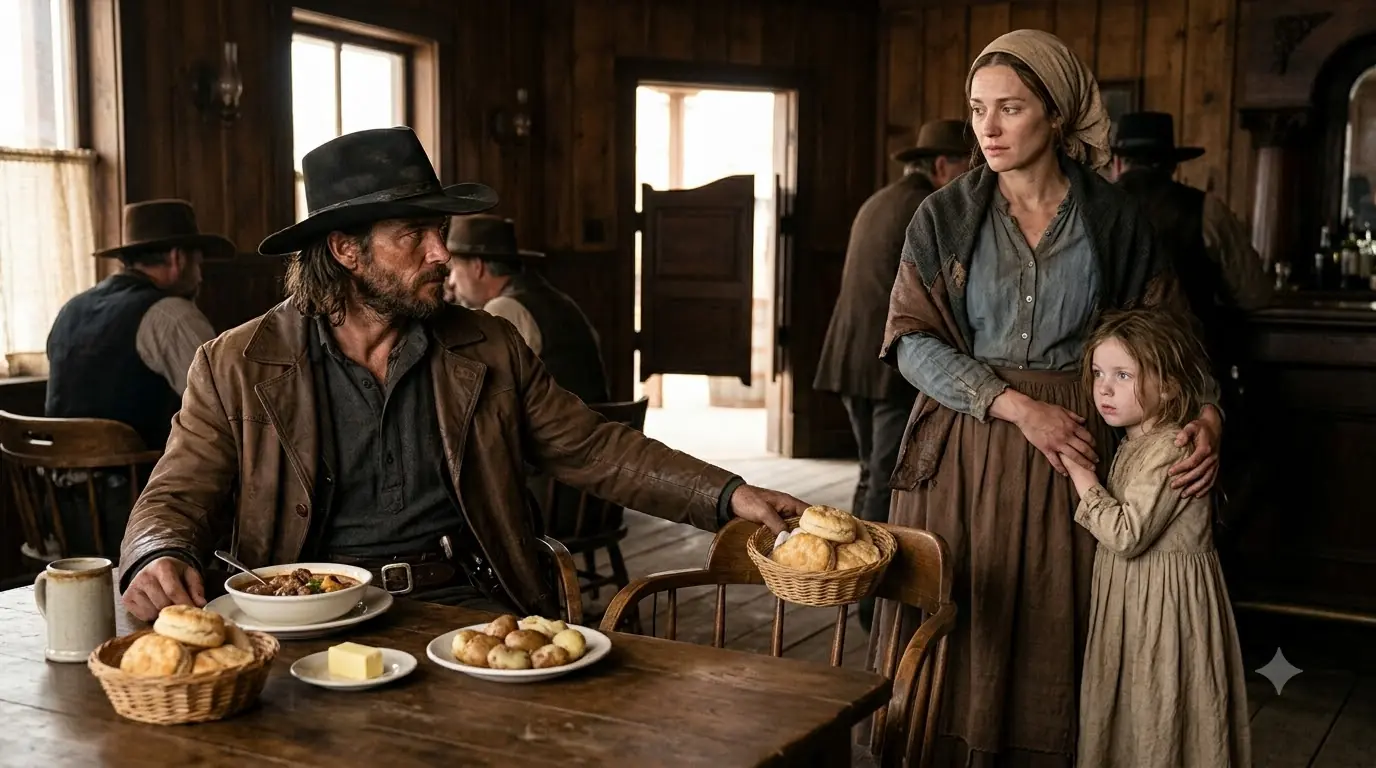
She could pour water into a tin cup, drink slowly, and tell her six-year-old daughter that she had already eaten.
She could break one biscuit into two pieces and somehow arrange them so Eda believed the larger half had gone to her mother.
She could smell roast beef from the hotel dining room, keep walking, and convince herself the ache under her ribs was merely exhaustion.
Six months of widowhood had taught Nora many things she never wanted to learn.
How much flour remained after a handful became precious.
How long potatoes could last in a cold cellar.
Which neighbors would extend credit without mentioning it publicly.
Which merchants smiled kindly while writing down every penny she owed.
And which men looked at a young widow and suddenly believed desperation had made her available.
Her husband, Matthew Callahan, had died in a mining collapse outside Silver Creek, Colorado, at the end of winter.
One moment he had been teasing Nora about the crooked kitchen shelf he promised to repair.
The next morning three men arrived at her door carrying his coat.
There had been no body she was permitted to see.
The mine had collapsed too deeply.
The company paid enough compensation to cover the burial service, several months of food, and almost nothing else.
Then the money disappeared.
Not wastefully.
It simply disappeared the way money always disappeared when survival depended upon it.
Mortgage.
Coal.
Food.
Medicine when Eda developed a winter cough.
Repairs to the roof.
Feed for the one remaining chicken.
By late summer, Nora had twelve dollars and forty-three cents left.
The bank wanted sixty-eight.
Her sewing machine was the only thing in the house worth enough to matter.
And that machine was also the only thing capable of earning the money she needed.
It was a cruel little circle.
Sell the machine and pay the bank temporarily.
Keep the machine and risk losing the house.
Nora chose to keep it.
She stitched dresses.
Mended trousers.
Repaired blankets.
Replaced buttons.
Turned old skirts into children’s clothes.
People praised her work.
Few wanted to pay what the labor actually cost.
That Wednesday afternoon, Nora entered the Dusty Spur Saloon for one reason.
Work.
Not food.
She repeated that distinction to herself as she held Eda’s small hand and pushed open the swinging door.
The saloon was busier than she hoped.
Several ranch hands sat around wooden tables.
A dealer from Denver argued loudly about cattle prices.
Three miners played cards beneath an oil lamp.
A piano sat silent against the far wall.
The smell hit Nora immediately.
Beef stew.
Fresh biscuits.
Potatoes.
Coffee.
Butter.
Her stomach tightened so violently she almost stopped walking.
Beside her, Eda inhaled.
Nora felt the little girl’s hand squeeze hers.
“Mama.”
Nora kept walking.
“Not now.”
“But it smells—”
“I know.”
The saloon keeper, Warren Pike, stood behind the counter polishing a glass.
He recognized her.
“Nora.”
“Mr. Pike.”
“What can I do for you?”
Nora forced a smile.
“I heard you might need someone cleaning upstairs rooms.”
Warren’s expression told her the answer before his mouth did.
“Had a girl start yesterday.”
“Oh.”
“Sorry.”
“No trouble.”
“You sew, don’t you?”
“Yes.”
“My wife may have curtains later.”
“When?”
“Maybe next month.”
Nora nodded as though next month were close enough to be useful.
“Tell her I’d be glad to do them.”
She turned toward the door.
Eda did not move.
Nora took one step.
Her daughter’s arm stretched behind her.
“Eda?”
The little girl was staring across the room.
Nora followed her gaze.
A man sat alone near the window.
Rancher, obviously.
Large shoulders.
Dark hair touching his collar.
Weathered brown coat.
Black hat resting on the table.
His face carried the hard lines of someone who spent more time outside than indoors.
Before him sat a bowl of thick stew.
Three biscuits.
Butter.
Potatoes.
Half an apple pie.
Eda stared as though someone had placed Christmas on a plate.
Humiliation rushed through Nora so quickly that her face became hot.
“Eda.”
The child finally looked up.
Nora leaned closer.
“Come on, sweetheart.”
Eda looked at the food again.
Nora lowered her voice.
“Let’s Go… We Can’t Pay.”
The words were barely audible.
Tate Bowen heard them anyway.
He had been lifting his coffee cup when the widow spoke.
He looked toward the doorway.
The mother was thin from exhaustion rather than nature, wearing a faded dusty-blue blouse beneath a patched charcoal shawl.
Dark-brown hair hid beneath a beige headscarf.
Her boots were old.
Her skirt had been repaired in three places so skillfully that most people would never notice.
The child beside her looked even more worn.
Six, perhaps.
Messy light-brown hair.
Pale face.
Dress faded nearly colorless.
And eyes locked on Tate’s biscuits.
Tate recognized that look.
It reached backward thirty-one years and found him sitting beside another table.
Seven years old.
His own mother telling him she had eaten earlier.
She had not.
Tate remembered discovering the lie because he woke after midnight and found her drinking hot water beside an empty stove.
Their father had died that spring.
Tate had been too young to understand money.
Old enough to understand hunger.
He never forgot it.
The woman began pulling her daughter toward the door.
Tate stood.
“Ma’am.”
Nora stopped.
Her shoulders tightened immediately.
She turned cautiously.
“Yes?”
Tate gestured toward his table.
“I made a mistake ordering.”
Nora looked confused.
“What mistake?”
“Too much food.”
She looked toward the bowl.
Then at him.
Tate continued casually.
“Would you and your girl help me keep it from going to waste?”
Nora’s face changed.
Pride arrived before gratitude.
“We don’t take charity.”
Tate nodded.
“Good.”
She seemed surprised.
“Because I’m not offering charity.”
He pulled out the empty chair.
“I’m asking for help finishing supper.”
Nora stared at him.
Tate looked toward Eda.
“You like biscuits?”
Eda looked at her mother before answering.
Nora closed her eyes briefly.
“Eda.”
“What?”
“Do not stare.”
“I wasn’t.”
“You absolutely were.”
Tate almost smiled.
The little girl whispered:
“Sorry.”
“No need.”
Nora tightened her hand around Eda’s.
“We should go.”
Eda took one reluctant step.
Tate looked toward the untouched pie.
Then said:
“I’m going to have to throw half of that away.”
Nora knew what he was doing.
He knew she knew.
The strange thing was that he never made her feel trapped by it.
No audience.
No loud announcement.
No “poor widow” expression.
Just an empty chair.
Eda looked up.
“Mama?”
That ended the battle.
A mother’s pride could survive hunger.
It had far less defense against her daughter’s.
Nora whispered:
“Only a little.”
Eda climbed into the chair before Nora finished speaking.
Tate pushed the bread basket toward her.
The girl reached.
Then stopped.
“Mama?”
Nora nodded.
Eda took one biscuit.
Slowly.
As though someone might change their mind.
Tate sat again.
Nora remained standing.
“You too.”
She looked at him.
“I’m fine.”
He glanced toward her.
That look was almost insulting in its accuracy.
Nora sat.
Tate poured stew into a second bowl.
She started to object.
He said:
“I genuinely ordered too much.”
“You expect me to believe that?”
“No.”
“But it sounds nicer.”
Nora surprised herself by laughing.
Eda smiled because her mother did.
Tate looked down at his plate.
Good.
Nobody needed to say more.
For several minutes, they simply ate.
Eda consumed the first biscuit quickly, then slowed down when she realized more remained.
Nora ate cautiously.
Small spoonfuls.
Tate recognized that too.
People who had gone hungry often ate carefully once food arrived.
As though speed might somehow make it disappear.
“What’s your name?” Eda asked.
Nora looked horrified.
“Eda.”
“What?”
“We do not interrogate strangers during supper.”
Tate smiled.
“Tate Bowen.”
The child nodded.
“I’m Eda.”
“I gathered that.”
“My mama is Nora.”
Nora sighed.
“Apparently introductions are complete.”
Tate extended his hand slightly across the table.
“Nora.”
She looked at it.
Then shook.
His hand was rough.
Warm.
Strong without squeezing.
Something about the simple contact unsettled her.
She withdrew quickly.
“You ranch nearby?”
She asked mostly to prevent silence.
“North of town.”
“Cattle?”
“Cattle.”
“How many?”
“Enough to lose sleep.”
Eda asked:
“Do you have horses?”
“Six.”
Her eyes widened.
“Six?”
“Seven if you count a mule that believes he’s a horse.”
Eda laughed.
Nora watched her daughter.
That laugh had become rare.
It hurt and healed something simultaneously.
Tate saw Nora’s expression.
He looked away before she caught him looking.
When they finished, Nora reached into her pocket.
Tate immediately said:
“No.”
She removed two coins.
“We ate.”
“You helped me.”
“That line worked once.”
“Still true.”
“I can pay something.”
Tate pushed the coins back gently.
“Keep them.”
Nora’s eyes sharpened.
“I told you—”
“Not charity.”
She stared.
“Then what?”
He thought.
“Consider it compensation.”
“For?”
“Saving me from eating three biscuits.”
She almost smiled.
Almost.
Then Eda said:
“He already ate two.”
Tate looked betrayed.
“Traitor.”
Eda giggled.
Nora laughed too.
That was how Tate Bowen first saw her smile.
He remembered it longer than he expected.
Three days later, Tate returned to town carrying a torn blue work shirt.
He went directly to the small house at the edge of Silver Creek where Nora lived.
She opened the door cautiously.
“Tate?”
“Morning.”
“What are you doing here?”
He held up the shirt.
“Emergency.”
Nora looked.
“There’s a six-inch tear.”
“Exactly.”
“That is not an emergency.”
“It is my favorite shirt.”
She examined it.
“You rode three miles for a torn shirt?”
“Seven.”
Nora stared.
Tate shrugged.
“You said you sew.”
She understood immediately.
Her expression became guarded.
“I’m not accepting invented work.”
“It isn’t invented.”
“You have other shirts.”
“Unfortunately.”
“Tate.”
“I tore it.”
“How?”
“Fence nail.”
She touched the fabric.
True.
“Two bits.”
He handed her four.
“That’s too much.”
“Then make it strong.”
“I always do.”
“Good.”
He started to leave.
Nora called:
“Tate.”
He turned.
“Thank you.”
He nodded.
“Thursday?”
“What?”
“Can I collect it Thursday?”
“Yes.”
“Good.”
Then he rode away.
The next week, he brought two blankets.
One needed repair.
The other did not.
Nora discovered that while working.
When he returned, she held up the perfect blanket.
“What’s wrong with this?”
Tate studied it.
“I don’t know.”
“You brought it for repair.”
“Maybe I brought the wrong one.”
“You did not.”
“Possible.”
“Tate.”
He smiled slightly.
Nora folded her arms.
“I will not let you manufacture charity.”
His expression became serious.
“I’m not.”
“This blanket has nothing wrong with it.”
“Then don’t charge me for it.”
“What about the other?”
“Charge me.”
“That’s work.”
“Yes.”
Nora stared.
He understood.
That mattered.
Tate did not want the power of being the man who rescued her.
He wanted to be a customer.
So Nora charged him fairly.
Then ranch hands began arriving.
One needed trousers repaired.
Another had a coat lining torn.
Another brought saddle blankets.
Then Mrs. Tanner from the mercantile requested new curtains.
Then the schoolteacher wanted twelve small cloth bags for winter supplies.
Nora became suspicious.
She asked Tate:
“Are you sending them?”
He answered:
“I mentioned you do good work.”
“That is sending them.”
“No.”
“That’s talking.”
“You talk unusually effectively.”
Tate shrugged.
Nora looked toward the stack of paid orders on her table.
“Why?”
“Because your stitching is good.”
“That simple?”
“Yes.”
She searched his face.
He was telling the truth.
Mostly.
Tate had spoken about her intentionally.
But he had never asked anyone to invent work.
He simply made certain people knew where real skill existed.
Nora accepted that.
Barely.
Autumn moved toward winter.
Eda began visiting Tate’s ranch whenever Nora delivered finished orders.
The first time, the girl saw chickens and forgot how shy she was.
She chased three before Tate explained that chickens preferred negotiations over pursuit.
“They don’t understand negotiation,” Eda said.
“Neither do cattle.”
“Then why do you talk to them?”
“Habit.”
Eda considered.
“Mama talks to bread.”
Nora turned.
“I do not.”
“You tell it to rise.”
Tate laughed so hard he had to lean against a fence.
Nora glared.
“Enjoy yourself.”
“I am.”
She turned away.
Tate watched her.
Something had changed.
She still looked tired.
But less defeated.
Her shoulders no longer folded inward when strangers looked at her.
There was flour on her sleeve.
A loose strand of brown hair near her cheek.