Eliza Mae Whitaker noticed Caleb Mercer watching her only after the milk pail was nearly half full. She was seated on a low wooden stool beside Molly, the largest Holstein on Whitaker Ranch, her sage-green dress gathered carefully around her dusty boots while her cream apron bore the evidence of another long morning’s work. Beyond the old fence, Caleb rested both forearms across the weathered top rail with his brown cowboy hat shading his eyes, apparently making no effort to pretend he had been studying the cattle. Eliza kept milking for another few seconds before smiling to herself.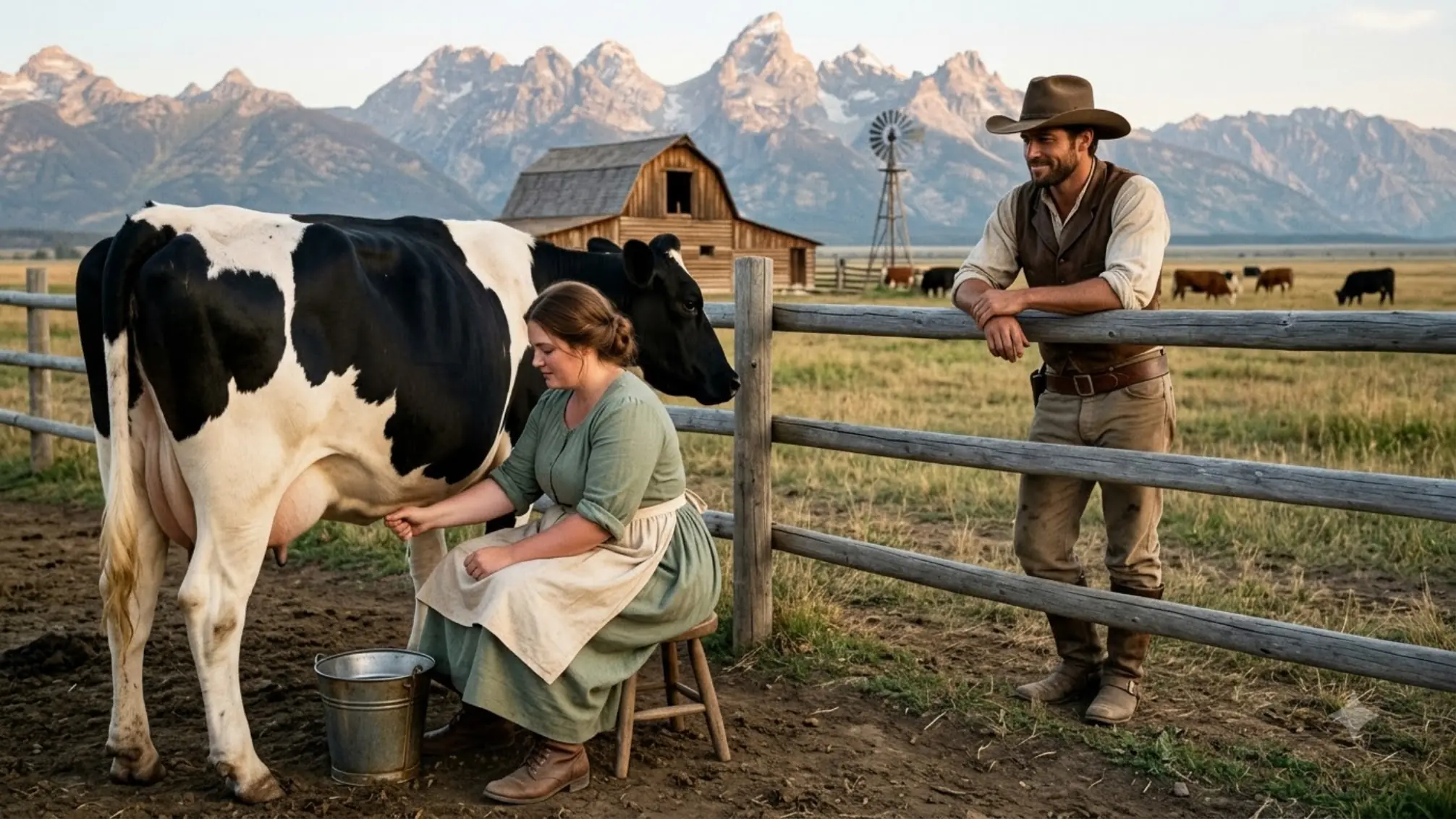
“You’ve been leaning on that fence a long time for a man who claims he came to check the cattle.”
Caleb’s mouth lifted slowly. “Maybe the cattle aren’t what keeps bringing me back.” Eliza stopped for half a heartbeat before continuing to work, determined not to let him see that a sentence so simple had somehow made her chest tighten. Caleb had been visiting more frequently since spring, sometimes carrying fencing wire, sometimes asking whether she needed a hand repairing the barn roof, and occasionally arriving with no convincing reason whatsoever.
“Then what does?” she asked.
Caleb removed his hat and turned it slowly between his hands. “The woman who somehow makes this old ranch feel like somewhere I’d want to stay.” Eliza finally looked at him, and for a moment neither seemed interested in the cow, the milk, or the approaching afternoon storm gathering beyond the Tetons. Then Eliza laughed softly and shook her head.
“You’ve been practicing that.”
“Three days.”
“That long?”
“Would’ve been four, but yesterday you threatened a rooster with a shovel and ruined the mood.”
Eliza laughed harder, and Caleb smiled as though making her laugh had been the entire purpose of coming. Their friendship had started nine months earlier when Caleb found her wagon stuck near Miller Creek during an early snowstorm. Instead of taking the reins from her, he had simply asked whether she wanted another pair of hands, a distinction Eliza remembered because most men in Jackson Hole treated a woman managing a ranch alone as either helpless or foolish.
Eliza had been neither. Her husband, Nathan Whitaker, had died from pneumonia four years earlier, leaving behind eighty-seven acres, eleven milk cows, three horses, a deteriorating barn, and debts that seemed to multiply every winter. Nathan had been kind, but he had handled every bank conversation, cattle contract, and equipment purchase, and his death forced Eliza to learn quickly what people assumed she could not. By the following spring, she could repair fencing, deliver calves, calculate feed costs, negotiate hay purchases, and tell when a merchant was adding a “widow’s price” to an invoice.
What she had never learned was how to stop hearing people whisper.
Too large.
Too old to start again.
Too stubborn.
Too much ranch for one woman.
Not enough woman for another man to want.
Eliza heard variations of those judgments at the mercantile, church suppers, cattle auctions, and whenever neighboring ranchers believed she had walked far enough away. She was thirty-one, broad-hipped and soft-bodied, with strong arms from daily work and a face her mother once called too expressive to hide anything. Men occasionally complimented her hazel eyes or chestnut hair, yet more than one had advised her that surviving alone meant accepting whoever was willing to marry a widow with land.
Eliza had chosen the land.
Then Caleb Mercer started appearing.
He owned a modest ranch eight miles east with his younger brother Samuel, keeping horses and cattle on ground rough enough that most men would have abandoned it. Caleb was thirty-six, quiet by nature, and had the irritating habit of listening to an entire sentence before answering. He never told Eliza what she should do unless she specifically asked, and even then he usually gave two possibilities instead of one command.
That made him dangerous.
Not because Eliza feared him.
Because she was beginning to trust him.
Trust had become expensive after Nathan died. Men who offered help often attached expectations later. A rancher repaired a section of fence and casually suggested Eliza should lease him twenty acres below market rate; another delivered winter grain and seemed offended when she paid him instead of accepting dinner as a substitute. Caleb had repaired half her windmill after a lightning strike and left before supper because he had promised Samuel he would return before dark.
Eliza remembered standing on the porch with a plate in her hands, oddly disappointed.
He returned two days later.
Not for payment.
He brought lemon candies because she had once mentioned liking them as a child.
That was when the problem began.
By late summer, Eliza could recognize Caleb’s horse before seeing the rider. She knew how he leaned slightly right when his back bothered him, that he hated overly sweet coffee but drank hers without complaint, and that his left eyebrow rose whenever he thought someone was lying. Caleb knew she sang badly while kneading bread, preferred thunderstorms to clear nights, and pretended not to be tired whenever she had worked beyond reason.
Neither discussed what was growing between them.
Until the fence.
Until the milk pail.
Until Caleb told her exactly why he kept returning.
Eliza carried the milk toward the barn while Caleb climbed through the fence. He took the heavy pail from her without asking, then caught himself and immediately offered it back. “Sorry.” She looked at his embarrassed expression.
“You can carry it.”
“You sure?”
“I survived the insult.”
Caleb smiled.
They walked together toward the cooling shed.
The mountains beyond the ranch were brilliant beneath the late-afternoon sky, and cattle moved lazily through yellowing grass while the old windmill squeaked with every rotation. Eliza glanced at Caleb twice before finally asking, “Were you serious?”
“About your rooster?”
“About staying.”
Caleb’s smile disappeared.
“Yes.”
Eliza opened the cooling-house door.
“You know I’m not selling this ranch.”
“I didn’t ask you to.”
“I’m not moving onto yours.”
“Didn’t ask that either.”
“I don’t need someone managing me.”
Caleb set the milk carefully on the table.
“Eliza.”
She turned.
“I said I wanted to stay. I didn’t say I wanted to own anything.”
The distinction mattered more than he probably understood.
Before she could respond, hoofbeats sounded from the southern road. Three riders approached the ranch, their horses moving too quickly for a friendly visit. Eliza recognized the man leading them and immediately lost whatever softness Caleb had managed to bring into the afternoon.
Silas Crowe.
He owned nearly six thousand acres surrounding the southern edge of Whitaker Ranch and had spent two years trying to purchase Eliza’s property. Silas was forty-nine, wealthy, recently widowed, and accustomed to hearing yes after naming a large enough number. Eliza had told him no six times.
He apparently intended to hear it again.
Silas dismounted near the barn while his foreman and another ranch hand remained mounted. He looked briefly at Caleb, then toward Eliza. “Mrs. Whitaker.”
“Mr. Crowe.”
Silas smiled.
“Thought you might reconsider my offer.”
“No.”
“You haven’t heard the new one.”
“Then save yourself time.”
Caleb leaned against a post, saying nothing.
Silas noticed.
“This involve you, Mercer?”
Caleb looked toward Eliza.
“Her ranch.”
Silas understood the answer.
He returned his attention to Eliza.
“Your north pasture’s nearly bare. Winter hay costs are climbing. Barn needs a roof, and your bank note comes due in November.”
Eliza’s stomach tightened.
She had never told him the payment date.
“Been studying my finances?”
“Small town.”
“Meaning someone at the bank talks too much.”
Silas shrugged.
“I’m offering eight thousand dollars cash.”
Caleb straightened slightly.
The amount was substantial.
More than enough for Eliza to leave Wyoming, buy a comfortable house in town, and live without waking before sunrise to milk cows.
She hated that temptation flickered.
“No.”
Silas’s smile hardened.
“You’re sentimental about dirt.”
“I’m attached to what’s mine.”
“It was Nathan’s.”
Eliza stared.
“It became mine when he died.”
Silas sighed dramatically. “This is exactly what I mean. Running a ranch takes more than stubbornness.”
Caleb’s jaw tightened.
Eliza raised a hand before he could speak.
“I’ve kept it running four years.”
“Barely.”
“Still running.”
Silas stepped closer.
“Winter’s coming.”
“So?”
“So one bad snow, one sick herd, one failed hay contract, and suddenly pride won’t feed cattle.”
Eliza held his stare.
“If that happens, I’ll solve it.”
Silas smiled.
“With him?”
He pointed toward Caleb.
Eliza’s expression sharpened.
“With whoever I choose.”
Silas looked from her to Caleb and understood something.
His amusement became ugly.
“Careful, Mercer. She needs labor more than romance.”
Caleb stepped forward.
Eliza caught his sleeve.
He stopped immediately.
Silas noticed that too.
“Eliza,” he said, “my offer expires Friday.”
She released Caleb.
“It expired before you rode through the gate.”
Silas mounted.
Before leaving, he looked toward the cattle.
“Winter has a way of changing people’s minds.”
Eliza watched the three riders disappear.
Only when they were gone did Caleb speak.
“How did he know about the bank?”
“I don’t know.”
“You want me to ask around?”
Eliza looked toward him.
“No.”
Caleb nodded.
That simple acceptance reassured her more than promises would have.
“I’ll handle it.”
“All right.”
Eliza stared toward the distant riders.
Then she added quietly, “But maybe stay for supper.”
Caleb smiled.
“I can do that.”
Three days later, the first problem arrived.
The hay supplier from Idaho sent a telegram canceling Eliza’s winter order.
No explanation.
Deposit returned.
Eliza read the message three times at the mercantile before folding it carefully into her pocket.
One supplier canceling was inconvenient.
The second refusing her business was alarming.
By Friday, three regional hay dealers claimed they had no available stock, although one admitted privately that Silas Crowe had purchased enormous quantities earlier that week.
Eliza understood.
Silas was not waiting for winter.
He was creating it.
Caleb found her Saturday morning in the barn sitting on an overturned bucket with ledgers spread across her knees.
“What happened?”
She showed him the figures.
“Seventy-two days of feed if I stretch what I have.”
“And after that?”
“I sell cattle.”
“How many?”
“Enough to destroy the herd I spent four years rebuilding.”
Caleb crouched beside her.
“I have hay.”
Eliza shook her head immediately.
“No.”
“You haven’t heard how much.”
“Doesn’t matter.”
“You’d pay me.”
“With money I need for the bank.”
“You can pay later.”
“No.”
Caleb stood.
“Eliza, this isn’t charity.”
“It becomes charity when the terms exist because you care about me.”
He went quiet.
She immediately regretted the harshness.
Caleb looked toward the barn doors.
“You’re right.”
Eliza blinked.
“I am?”
“Yes.”
He turned back.
“You shouldn’t take a bad business arrangement because I care about you.”
She had expected an argument.
Instead he continued.
“So make it a good one.”
“How?”
“You buy hay at market rate. Payment after spring calving, secured by six calves.”
Eliza considered it.
“That’s favorable.”
“It’s reasonable.”
“Why six?”
“Because seven would be robbery and five would make you suspicious.”
Despite everything, she smiled.
“You thought about this.”
“Since Tuesday.”
“You knew Crowe was buying hay?”
“I heard.”
“And you didn’t tell me?”
“You told me you’d handle it.”
Eliza stared at him.
Most men would have used the information to prove she needed them.
Caleb had waited.
Then offered help when she knew she needed it herself.
“Six calves,” she said.
Caleb extended his hand.
“Six.”
They shook.
The agreement should have solved winter.
Instead, Silas escalated.
A week later, Eliza discovered the creek gate on her western pasture open and five cows missing. Two were found the following morning near Crowe land. Three disappeared completely.
Sheriff Turner called it wandering livestock.
Eliza called it impossible.
She checked that gate every night.
Caleb examined the latch.
“Tool marks.”
Eliza crouched beside him.
“Someone opened it.”
“Looks that way.”
“Can you prove who?”
“No.”
She looked toward Crowe land.
Caleb followed her gaze.
“Don’t.”
Eliza stood.
“Don’t what?”
“Ride over there angry.”
“I wasn’t.”
“You absolutely were.”
She folded her arms.
Caleb smiled.
“Your left eyebrow does something.”
“So does yours.”
“That’s because I’m usually right.”
Eliza almost shoved him.
Instead she laughed.
The tension broke.
But the missing cattle did not return.
October brought early snow.
By November, Eliza’s bank payment came due.
She rode into Jackson expecting to make it with money from milk contracts and two horse sales. Bank manager Henry Sutton instead informed her that one purchaser’s payment had not cleared.
Eliza stared at the ledger.
“Why wasn’t I told?”
“The notice went out Monday.”
“I received nothing.”
Sutton adjusted his spectacles.
“You’re short four hundred and eighteen dollars.”
“I’ll have it within two weeks.”
“The note allows immediate action after default.”
Eliza became still.
“Are you threatening foreclosure over two weeks?”
“No.”
Sutton looked uncomfortable.
“Someone has offered to assume the note.”
She knew immediately.
“Crowe.”
Sutton said nothing.
That was answer enough.
Eliza leaned forward.
“If Silas Crowe buys this debt before I’m given reasonable opportunity to cure it, I’ll make sure every rancher in this valley knows exactly how this bank helped him take my property.”
Sutton paled.
“Mrs. Whitaker—”
“Fourteen days.”
She stood.
“You’ll have your money.”
Outside, snow fell heavily.
Caleb waited near the hitching post.
One look at Eliza’s face told him enough.
“How bad?”
“Four hundred eighteen.”
“I can—”
“No.”
Caleb stopped himself.
Then asked, “What are you going to do?”
Eliza looked toward the mountains.
“Sell Molly.”
Caleb frowned.
“Your best milk cow?”
“Yes.”
“Don’t.”
She looked sharply at him.
“You offering orders now?”
“No.”
He raised both hands.
“I’m asking for twenty-four hours.”
“Why?”
“I have an idea.”
Eliza wanted to refuse.
Then she remembered the hay agreement.
“Twenty-four.”
Caleb rode away.
He returned the following evening with Samuel and three ranchers Eliza recognized from cattle auctions.
Behind them came two wagons.
“What is this?”
Caleb climbed down.
“A market.”
Eliza stared.
Samuel explained.
Several ranch families had been buying dairy products from distant suppliers because nobody had organized regular delivery from smaller local ranches. Caleb spent the day calculating whether Eliza could create a winter dairy cooperative, selling milk, butter, cream, and cheese directly to twelve households and three boardinghouses.
Eliza looked at him.
“You did all that overnight?”
Caleb shrugged.
“Samuel did the mathematics.”
Samuel nodded proudly.
“I’m better with numbers.”
Caleb frowned.
“He tells everyone.”
The arrangement would produce enough immediate deposits to cover the bank shortage.
More importantly, it created stable winter income.
Eliza looked through the proposal.
“Why are they agreeing before seeing what I can produce?”
An older rancher stepped forward.
“Because your butter’s better than the imported stuff.”
Another added, “And Crowe tried buying every hay bale between here and Idaho just to squeeze you.”
Eliza looked up.
“So everyone knows?”
“Everyone.”
The rancher smiled.
“People don’t like bullies as much as bullies imagine.”
Eliza’s throat tightened.
For four years she believed the valley saw her as the stubborn widow barely surviving.
Perhaps some did.
Others had apparently been watching her survive.
She accepted the deposits.
The bank note was paid two days early.
Silas Crowe stopped smiling when she passed him outside the mercantile.
Winter settled over Wyoming.
Caleb continued visiting.
Their courtship, if it could be called that, remained strangely practical.
He repaired a gate.
She sent him home with bread.
He brought hay.
She inspected his limping mare.
They talked beside fences, over coffee, in barns, and once beneath the stars after helping deliver a calf during a blizzard.
Caleb never repeated his statement about wanting to stay.
Eliza noticed.
By January, it annoyed her.
She finally confronted him while they were stacking firewood.
“You’ve stopped courting me.”
Caleb nearly dropped a log.
“I have?”
“Yes.”
He looked genuinely confused.
“I’m here four days a week.”
“That’s helping.”
“Is there a difference?”
“A considerable one.”
Caleb removed his gloves.
“Eliza, I told you how I feel.”
“In August.”
“Still true.”
“That was five months ago.”
“You wanted monthly reports?”
She glared.
Caleb smiled.
Wrong response.
“You think this is funny?”
“No.”
His smile disappeared immediately.
Eliza leaned against the woodpile.
“You said this ranch felt like somewhere you wanted to stay.”
“It does.”
“And then?”
“And then Crowe tried taking it, winter arrived, your bank note became trouble, cows disappeared, and I figured proposing marriage in the middle of all that might look like another man using your vulnerability to get what he wanted.”
Eliza became silent.
Caleb continued.
“I want you.”
His voice softened.
“But I don’t want you agreeing because you’re afraid of losing the ranch.”
The anger disappeared from her face.
“What if I’m not afraid anymore?”
Caleb studied her.
“Are you?”
“Yes.”
“Of nothing?”
“I didn’t say that.”
She stepped closer.
“I’m afraid of plenty.”
Caleb waited.
“I’m afraid that if I let someone into this life, one day he’ll decide helping means deciding.”
Caleb nodded.
“Reasonable.”
“I’m afraid I’ve become so accustomed to doing everything alone that I won’t know how to share.”
“Also reasonable.”
“I’m afraid you’ll discover I’m difficult.”
He raised an eyebrow.
“That discovery occurred around week two.”
Eliza smacked his arm.
Caleb laughed.
Then his expression softened.
“What else?”
She looked toward the farmhouse.
“I’m afraid you’ll stop looking at me the way you do now.”
Caleb became completely still.
Eliza continued.
“Men have looked at me like I’m useful. Or too much. Or desperate. Or fortunate anybody would want me.”
Her voice dropped.
“You look at me like…”
“Like what?”
Eliza swallowed.
“Like I’m beautiful.”
Caleb stepped closer.
“You are.”
She looked away.
He waited until she looked back.
“You are beautiful when you’re dressed for church.”
She smiled faintly.
“You’re beautiful covered in flour.”
Another step.
“You’re beautiful threatening chickens.”
She laughed.
“You’re especially beautiful when you’re arguing with me, although I wish that were less frequent.”
“Careful.”
Caleb smiled.
Then he became serious.
“But none of that is why I want to stay.”
Eliza’s eyes searched his.
“Why?”
“Because when something breaks, you fix it. When somebody needs help, you show up. When you’re scared, you keep moving.”
He touched her gloved hand.
“And because every time I ride home from here, my ranch feels like the wrong direction.”
Eliza stopped breathing for a second.
“That was better than the fence speech.”
“I practiced longer.”
“How long?”
“Five months.”
Eliza laughed.
Then she kissed him.
Caleb froze completely.
She pulled back.
“You can participate.”
“I was surprised.”
“Try recovering.”
He kissed her.
Slowly.
Carefully.
As though even then he wanted to be certain she was choosing every second.
They became engaged in February.
Not publicly.
Not immediately.
Eliza insisted on waiting until spring before announcing anything because she wanted one final winter behind her before making another permanent decision.
Caleb agreed.
Of course he did.
Then Silas Crowe returned.
He arrived in March carrying documents.
Eliza met him on the porch.
Caleb was inside repairing a broken kitchen chair but remained out of sight.
Silas handed her a paper.
“You’ve got a boundary problem.”
Eliza read it.
He claimed the western eighteen acres of Whitaker Ranch belonged to his property according to an older survey.
“That’s nonsense.”
“County map says otherwise.”
“My deed includes the creek.”
“Your deed description is ambiguous.”
Silas smiled.
“You can fight me in court.”
Eliza looked up.
“That what you want?”
“I want the acreage.”
“No.”
“You really enjoy difficult roads.”
“I enjoy watching you waste money.”
Silas’s face hardened.
“A woman like you should understand when an offer is generous.”
From inside, the chair repair stopped.
Eliza knew Caleb had heard.
She raised her voice slightly.
“A woman like me?”
Silas realized his mistake but continued.
“Alone. Running more ground than she can handle.”
Eliza smiled.
“You haven’t been paying attention.”
Caleb stepped onto the porch.
Silas looked toward him.
“There he is.”
Caleb leaned against the doorframe.
Silas smirked.
“So she finally found someone to run the ranch.”
Eliza answered first.
“No.”
Caleb nodded toward her.
“She runs it.”
Silas laughed.
“Then what are you?”
Caleb looked at Eliza.
“Whatever she asks me to be.”
Silas’s amusement disappeared.
The boundary dispute reached court in May.
Eliza prepared everything herself with assistance from a Helena attorney recommended by the dairy cooperative.
Old surveys.
Tax receipts.
Nathan’s records.
Fence maps.
Water rights.
Then Samuel found the crucial evidence in county archives.
An 1869 survey showing the original creek boundary exactly where Eliza said it was.
Silas’s claim collapsed.
Worse for him, the court discovered one of his submitted maps had been altered from a later copy.
The judge referred the matter for investigation.
Eliza walked out of court still owning every acre.
Caleb waited on the courthouse steps.
“How’d it go?”
She held up the original survey.
“He lost.”
Caleb smiled.
“Good.”
“That’s all?”
“What do you want?”
“Celebration.”
Caleb removed his hat and shouted toward the street, “SHE KEPT THE CREEK!”
Everyone turned.
Eliza covered her face.
“You idiot.”
“You asked.”
She laughed until tears came.
Two weeks later, they married beside the wooden fence where Caleb first admitted why he kept visiting.
Eliza wore a simple cream dress made by Mrs. McKenna in town.
Caleb wore his best brown coat and looked terrified.
Samuel served as witness.
Half the dairy cooperative appeared with food.
Eliza’s milk cows watched from the pasture as though personally evaluating the arrangement.
Before the ceremony, Caleb pulled Eliza aside.
“One last question.”
“What?”
“You sure?”
She smiled.
“You’re asking me ten minutes before the wedding?”
“I can ask afterward if you prefer.”
Eliza took his face between both hands.
“Yes.”
Caleb kissed her forehead.
“I don’t get the ranch.”
“No.”
“Don’t get the cattle.”
“No.”
“Don’t get to tell you what to do.”
“Correct.”
He sighed.
“This marriage sounds poorly negotiated.”
Eliza laughed.
“You get me.”
Caleb looked into her eyes.
“That’s the part I wanted.”
Their marriage did not magically remove hardship.
The following winter brought pneumonia through the cattle herd.
Two years later, a barn fire destroyed months of stored hay.
They argued over money, fencing, Caleb’s tendency to work while injured, and Eliza’s refusal to admit when she needed rest.
Once, Eliza became so angry she threw a wooden spoon.
Caleb picked it up.
“Do I keep this as evidence?”
“Give it back.”
“Seems dangerous.”
She chased him through the kitchen.
Marriage became what neither had expected.
Not rescue.
Partnership.
When Caleb wanted to expand the cattle herd, he presented numbers.
Eliza challenged them.
When Eliza wanted to purchase new dairy equipment, Caleb asked questions.
Neither interpreted disagreement as disloyalty.
The ranch grew.
By 1892, Whitaker-Mercer Ranch had doubled its dairy operation and supplied butter and cream throughout much of the valley.
Eliza refused to change the original ranch name entirely.
The front gate still read:
WHITAKER RANCH
Below it, Caleb added a smaller sign.
MERCER LIVES HERE TOO
Eliza discovered it one morning and laughed for ten straight minutes.
Years passed.
The old wooden fence remained.
One summer afternoon, Eliza sat beside Molly’s granddaughter milking exactly as she had years earlier.
She was forty now.
Caleb had gray appearing at his temples.
He leaned against the fence.
Watching.
Eliza noticed.
“You’ve been leaning there a long time.”
Caleb smiled.
“Checking cattle.”
“Liar.”
“Probably.”
She kept milking.
“What keeps bringing you back?”
Caleb looked toward the farmhouse.
Children’s voices carried from inside.
Samuel’s wagon stood near the barn.
Cattle grazed beneath the mountains.
The windmill turned slowly.
Then he looked at Eliza.
“The woman.”
She smiled.
“Still?”
“Especially now.”
Eliza stood and carried the milk pail toward him.
Caleb reached for it.
She handed it over without hesitation.
That simple gesture meant more than either mentioned.
Years earlier, Eliza believed accepting help meant surrendering control.
Caleb had taught her something different.
Help could be offered without ownership.
Love could exist without debt.
Strength could mean carrying everything alone.
But it could also mean knowing exactly who deserved permission to carry something beside you.
They walked toward the barn together.
Eliza looked back once at the fence where their story had quietly begun.
She remembered Silas Crowe telling her winter would change her mind.
He had been right.
Winter changed many things.
It showed Eliza which neighbors would stand beside her.
It showed her that a ranch could survive pressure when people shared risk fairly.
And it showed her the difference between a man who wanted her property and a man who wanted her company.
Caleb never rescued Whitaker Ranch.
Eliza saved it herself.
He simply stood beside her while she did.
That was why, years later, whenever someone asked Eliza how she knew Caleb was the right man, she never mentioned the marriage proposal, the court case, or the difficult winters.
She told them about a fence.
A cowboy resting his arms across it.
A woman milking a cow while pretending she had not noticed him staring.
And one sentence that changed everything without demanding anything in return.
“Maybe the cattle aren’t what keeps bringing me back.”