The train abandoned Willa Hart beneath a cloud of black smoke, flying cinders, and the merciless attention of an entire frontier town. The wooden platform of Mercy Creek continued trembling beneath her worn boots even after the final carriage disappeared around the distant bend. She stood beside one battered trunk with a folded marriage contract clenched in her gloved hand, struggling to keep her chin raised while strangers whispered from the boardwalk. Across the dusty street, the man who had brought her four days west by letter was already walking away.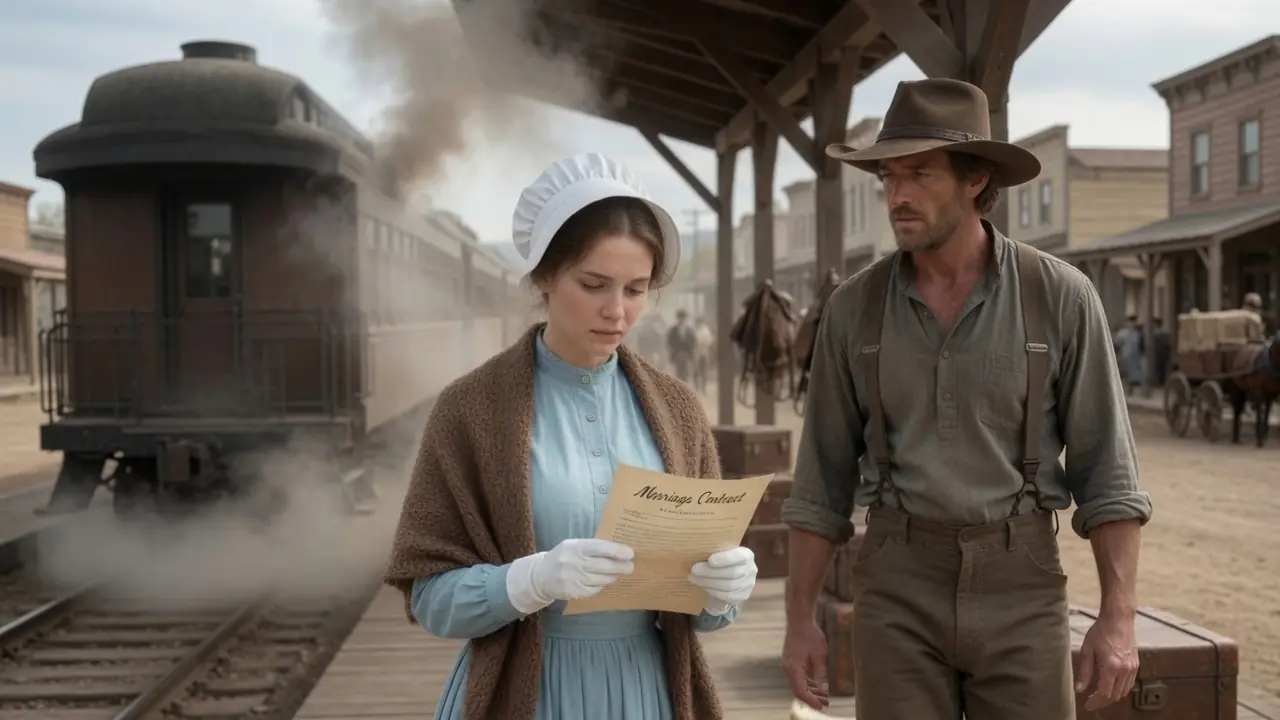
Albert Pugh had looked at her only once before deciding she was unworthy of the life he had promised. His polished boots had stopped several feet from her, and his narrow eyes had traveled from her plain brown bonnet to the carefully mended hem of her faded rose dress. He had not asked whether she had endured the journey safely or whether she was hungry after sleeping upright on hard train benches. He had simply frowned and said, “You neglected to mention that you were so plain.”
The words had carried farther than his quiet voice should have allowed. Two men beside the hitching post had laughed, while a woman leaving the general store had covered her mouth with one hand. Even the stationmaster had lowered his gaze as though Willa’s humiliation were something indecent he had accidentally witnessed. Willa had felt heat spread across her face, but she refused to lower her head.
“I told you that I could cook, sew, keep accounts, and work beside a husband,” she answered.
Albert’s mouth tightened. “A man expects more than labor when he pays a bureau to find him a bride.”
“I paid my own fare.”
“That does not change what stands before me.”
He returned the marriage contract using only two fingers, careful not to touch her glove. Then he announced that his circumstances had changed and suggested that the bureau in St. Louis might arrange another match for her. Before Willa could answer, he turned away and crossed the street, leaving her among the steam and soot like a parcel refused at delivery. He never looked back.
Willa did not call after him. She had survived twenty-five years without begging a man to recognize her value, and she would not begin in front of a town hungry for spectacle. She had been raised in an orphanage where weakness attracted punishment rather than comfort, then spent years working in kitchens and boarding houses where employers praised her usefulness while paying her barely enough to eat. She understood disappointment, but hope had made this particular wound cut deeper.
Albert’s letters had never promised romance. He had written about a respectable house, a small bookkeeping business, and his need for a practical wife who could create order. Willa had imagined a kitchen of her own, a table where she might sit rather than serve, and perhaps one day a child who would call for her because she belonged there. Those dreams now seemed foolish beneath the watching faces of strangers.
The wind lifted the edge of her brown shawl. Inside her bag were two dresses, a comb, a sewing kit, a small Bible, and three coins tied into a handkerchief. The hotel across the street was beyond her means, the church doors were locked, and the next train would not return for two days. Willa had known hunger before, but she had never felt poverty as sharply as she did while standing in a town where she did not possess enough money to leave.
Then a man stepped away from the hardware store and crossed the road toward her.
He was tall and broad through the shoulders, dressed in a faded gray work shirt with the sleeves rolled to his forearms. Sawdust clung to his dark trousers, and a weathered brown hat shaded tired blue eyes. He carried a paper sack filled with hinges and iron nails in one rough hand. Unlike the others, he did not stare at Willa as if her rejection were an afternoon performance.
He climbed the platform steps and stopped at a respectful distance. “Why did that coward send for you across the country only to shame you for being plain?”
The directness of the question startled her. Anger burned beneath his steady voice, but none of it was aimed at her. Willa tightened her fingers around the returned contract and answered through the ache gathering in her throat.
“Because he wanted a pretty possession,” she said, “not a wife with a heart and a will of her own.”
The man glanced toward the street where Albert had vanished. “Then let him keep his empty pride.”
A few listeners on the boardwalk shifted uncomfortably. The stranger appeared not to care that they could hear him. He removed his hat and introduced himself as Seth Callan, a carpenter and widower with two children living in a cabin beyond the edge of town.
Willa studied him cautiously. She had learned that kindness from men often carried conditions hidden beneath polite words. “What do you want from me, Mr. Callan?”
“Nothing you do not agree to.”
“That is not an answer.”
A brief spark of respect appeared in his eyes. “My daughter burned porridge yesterday, my son fed our last good bacon to a stray dog, and I have discovered that carpentry is easier than keeping two children alive while maintaining a house. I can offer you room, meals, and modest wages in exchange for cooking and household help.”
“And marriage?”
“No marriage.”
“Expectations beyond the work?”
“No.”
Willa looked toward her trunk and then toward the empty rails. Seth’s proposal sounded safer than Albert’s promises because it required no fantasy. Work was a language she understood, and clear terms were better than affection offered by strangers.
“I will stay one month,” she said. “If your home is unsafe, if your children cannot accept me, or if you change the agreement, I leave immediately.”
Seth nodded without hesitation. “Fair terms.”
She bent to collect her bag before he could touch it. Seth lifted her heavier trunk, then looked at her with an unexpected softness.
“I cannot promise you a fine house, Miss Hart,” he said. “But while you are beneath my roof, no one will make you feel unwanted.”
The words struck closer to her heart than any declaration of romance could have. Willa turned away before he saw the emotion rising in her face. Together, they walked through Mercy Creek while whispers followed them from every porch.
Seth’s home stood among cottonwoods half a mile beyond town. The cabin had weathered boards, a crooked chimney, and a roof that sagged slightly above the washroom. Fresh lumber was stacked beneath a lean-to beside a broad workbench. It was not fine, but smoke rose from the chimney and two children waited in the yard.
The older child, eight-year-old Clara, held a wooden spoon like a weapon. Her dark braids were uneven, and suspicion tightened her small face. Six-year-old Thomas crouched beside a brown dog with guilty eyes and an impressive belly. Both children stared as Seth carried Willa’s trunk toward the porch.
“This is Miss Hart,” Seth said. “She will be helping us for a while.”
Clara looked Willa over with the same blunt scrutiny Albert had used. “Are you the bride who got left at the station?”
Seth’s jaw tightened. “Clara.”
Willa raised one hand before he could scold her. “Yes, I am. But I am also the woman who may save you from burned porridge.”
Thomas immediately stood. “Can you make biscuits?”
“If you have flour.”
“We have flour,” Clara replied. “But it is poor flour.”
“Flour often receives blame for the failures of the cook.”
Seth covered his mouth with one hand, disguising what might have been a laugh. Clara’s expression remained guarded, but Thomas took Willa’s answer as proof of extraordinary wisdom. He followed her into the cabin while asking whether she could also make gravy, pie, and food that did not bend spoons.
The interior carried the unmistakable weight of a woman who had once shaped every corner and then disappeared. Faded curtains hung beside clean but neglected windows. A blue cup rested untouched on a high shelf, and a small bundle of dried lavender remained tied near the stove. The table was buried beneath tools, school slates, torn stockings, and plates that had not been properly matched in months.
Willa removed her bonnet, rolled up her sleeves, and opened the flour barrel. She found potatoes, two onions, a small jar of fat, and enough milk to soften biscuit dough. Seth fetched water when she asked, then stood near the doorway as if unsure whether his presence helped or hindered. By sunset, the table held biscuits, fried potatoes, onion gravy, and the first meal the children had seen in weeks that did not appear burned or boiled into surrender.
Thomas bit into a biscuit and stared at his father. “Pa, it’s soft.”
Clara kicked him beneath the table.
Willa kept her expression composed, although amusement warmed her chest. Seth ate slowly, his attention fixed on the plate until Thomas asked whether Willa could remain forever.
“Forever is not part of our agreement,” Willa said gently.
Clara lowered her eyes, but Willa saw relief and disappointment battling across the girl’s face. A motherless child might resent a woman entering her home while still fearing she would leave. Willa understood that contradiction better than most.
That night, Seth carried a narrow cot into the small storage room near the kitchen. He placed a faded blue-and-white quilt across it, then stood with one hand resting on the doorframe. “It belonged to my wife, Ruth.”
“I can use my shawl,” Willa said. “I do not wish to take something belonging to your grief.”
Seth’s face tightened. “Grief has taken enough from this house.”
He left before she could answer. Willa sat on the edge of the cot and touched the careful stitching. Some squares had been repaired, and one corner still smelled faintly of cedar and smoke.
The first weeks became a quiet test. Willa woke before dawn, baked bread, washed clothes, swept floors, and discovered every weakness in the household. The pantry lid did not close properly, the kettle handle burned whoever turned it toward the stove, and Thomas could not be trusted with jam, bacon, or any food that a dog might find appealing.
Clara resisted everything. She refused to let Willa brush her hair and frequently announced that her mother had cooked better, folded linens differently, and never put onions in gravy. Willa did not compete with a dead woman. She simply answered, “Then you must help me remember how your mother preferred things.”
One afternoon, Clara tore Ruth’s old shawl while pulling it from a nail. The ripping sound froze the child in place. Willa found her beside the bed with the fabric clenched against her chest, tears of fury filling her eyes.
“I ruined it,” Clara whispered.
“Then we will mend it.”
“You cannot make it hers again.”
“No,” Willa said, sitting beside her. “But I can help it continue keeping you warm.”
Clara’s face crumpled, and for the first time she leaned against Willa’s shoulder. Willa did not speak or promise that pain would disappear. She simply remained there until the child placed the shawl in her lap.
By lamplight, Willa pulled matching thread from the hidden hem and repaired the tear with tiny, careful stitches. Clara watched every movement. When Willa finished, the damage was visible only to someone who knew where to search.
“Thank you,” Clara whispered.
Willa handed the shawl back. “A repaired thing is not worth less because someone can see where it was broken.”
From the doorway, Seth stood silently. His expression revealed that the words had reached him as surely as they had reached his daughter. That evening, he repaired the leaking roof above the washroom without being asked.
Near the end of Willa’s first month, Albert Pugh arrived at the cabin.
Willa was kneading bread when she saw his black coat through the window. He stood in the yard with his hat held against his chest, appearing less proud than he had at the station but no more sincere. Seth was working beneath the lean-to and set down his plane when Albert called Willa’s name.
She stepped onto the porch but did not descend into the yard. “Mr. Pugh.”
“I have heard you are living here.”
“The entire town has heard.”
Albert glanced at Seth. “People are speaking unpleasantly about the arrangement.”
“Then perhaps you should correct them when you hear it.”
His face reddened. “I came to correct a different mistake. I acted too quickly at the station.”
Willa felt no relief, only the return of that cold platform beneath her feet. “You mean the town has mocked you long enough that I now appear acceptable?”
“I am offering to honor our original contract.”
“A contract you handed back because my face disappointed you.”
“A practical woman should understand that first impressions can be misleading.”
Willa looked through the open doorway. Clara and Thomas stood beside the table, watching her with frightened eyes. Seth remained near his workbench, close enough to protect her but wise enough not to answer in her place.
“I am not a shipment you may refuse and reclaim,” Willa said. “You wanted something beautiful to display, while Mr. Callan saw a person stranded without shelter.”
Albert’s expression hardened. “You believe a carpenter’s charity makes you respectable?”
“No,” she answered. “My conduct makes me respectable. Your conduct has only exposed what kind of man you are.”
Albert turned toward Seth. “You should know that no decent woman lives beneath a widower’s roof without marriage.”
Seth’s voice became cold. “And no decent man abandons a woman at a railway platform and then lectures anyone about honor.”
Albert stepped backward. For a moment, he seemed ready to strike Seth or summon some final insult. Instead, he put on his hat and walked away while Thomas watched through the door.
When Albert disappeared down the road, Thomas asked, “Does this mean Miss Willa is staying?”
Willa wiped flour from her hands. Her one-month agreement ended the following morning, but the thought of leaving tightened painfully around her heart. Clara stood very still, clutching her mother’s repaired shawl.
“That depends on your father,” Willa said.
Seth looked surprised. “On me?”
“You hired me for one month.”
“I was hoping you had forgotten.”
“I do not forget agreements.”
He glanced at the children. “Then I would like to offer permanent employment, better wages, and a room larger than a cupboard.”
Thomas cheered. Clara attempted to hide her relief, although she failed completely. Willa accepted, but the word permanent remained dangerously warm inside her.
Summer transformed the cabin. Willa planted beans, established a proper pantry, and taught Clara to roll dough. Seth built her a sewing table near the eastern window, claiming he was tired of finding needles near his dinner plate. She knew better but allowed him the excuse.
Their affection grew inside ordinary acts. Seth sharpened her scissors without being asked, and Willa left his supper warm when carpentry work kept him late. When his shoulder ached, she placed a heated cloth near his chair without comment. When her wrist hurt after sewing, he brought home finer needles from the general store.
Neither called these gestures love. Love sounded fragile and dangerous, while usefulness felt sturdy. Yet the cabin grew softer around them, and the children began speaking of Willa as though she had always been part of their days.
At the autumn harvest fair, Mercy Creek gathered to judge pies, livestock, quilts, and one another. Willa wore a dark green dress she had altered herself, while Clara proudly carried Ruth’s repaired shawl. Thomas filled his pockets with biscuits until Willa removed all but one.
Albert’s aunt cornered them near the pie table. “So this is the woman my nephew chose not to marry.”
Before Willa could respond, Clara stepped forward. “No. This is the woman who refused him when he came crawling back.”
The nearby crowd fell silent. Thomas added, “And she makes better biscuits than anyone.”
Seth tried to reprimand them, but pride softened his voice. Mrs. Pugh retreated with her face burning, and the story spread across the fair before sundown. The humiliation Albert had given Willa finally returned to him, but she felt no triumph.
On the wagon ride home, Thomas fell asleep among sacks of flour. Clara leaned against Willa’s side while Seth guided the horses beneath a sky filled with stars. For several miles, no one spoke.
When they reached the cabin, Seth carried Thomas inside, and Clara took Willa’s hand before going to bed. “You are not leaving, are you?”
“No.”
“Even if Pa is foolish?”
Willa looked toward Seth, who had heard the question. “Your father has not been foolish yet.”
Clara appeared satisfied and disappeared into the bedroom. Seth remained beside the table, hat in his hands like a nervous young man rather than a widower who had endured grief.
“I have been foolish,” he said.
“How?”
“By letting you believe employment was the only reason I wanted you to remain.”
Willa’s breath caught. Seth stepped closer but left enough distance for her to choose whether it remained.
“The day I met you, I saw a woman refusing to break while an entire town watched,” he continued. “Then I watched you give my children warmth without asking them to forget their mother. You repaired this house, but more than that, you made us want to live inside it again.”
Willa lowered her eyes. “Gratitude can sound very much like love when a man is lonely.”
“I know.” Seth’s voice softened. “That is why I waited until loneliness was no longer speaking for me.”
She looked up.
“I do not need a housekeeper,” he said. “I can hire help. What I want is the woman who argues about pantry shelves, tells my son dogs do not require half our bacon, and sits beside my daughter when sorrow has no words.”
Willa’s eyes burned. “And when the town calls me plain?”
Seth moved close enough that she could see the fine lines beside his tired blue eyes. “Then the town proves it has no understanding of beauty.”
She shook her head, fighting tears. “Do not offer marriage because I made your home easier.”
“I am offering because you made it a home, and because every road I imagine without you feels empty.”
Willa had once traveled west for a practical marriage without love because she believed shelter was the most a woman like her could expect. Now a hardworking man stood before her without promises of wealth, asking not for obedience but companionship. Behind him were two sleeping children who had given her a place in their grief without asking her to erase anyone who came before.
“I will not be owned,” she whispered.
Seth extended his open hand. “Then stand beside me as an equal.”
“I will speak when I disagree.”
“I would be frightened if you stopped.”
“The children must always be allowed to speak Ruth’s name.”
“She will remain part of this family.”
Willa placed her hand in his. “Then yes.”
Seth did not pull her into his arms immediately. He waited until she stepped toward him, then held her with a gentleness that made every cruel mile of her journey feel far away. Willa rested her cheek against his chest and listened to his heart beating beneath his work shirt.
The wedding took place beneath the cottonwoods three weeks later. Willa wore her dark green dress, Clara carried wildflowers, and Thomas forgot the ring in his pocket until the preacher asked for it. Mrs. Elkins supplied a pie and claimed it was only because she had baked too much.
Albert watched from across the road but did not approach. Willa saw him and felt nothing—not triumph, shame, or regret. He had once believed rejecting her made her worthless, but his opinion no longer possessed any authority over her life.
After the ceremony, Seth led Willa back to the cabin where the roof no longer leaked and the pantry shelves stood straight. Clara had placed Ruth’s blue cup on the table beside a new cup made especially for Willa. There was no replacement, only room made for another person to belong.
That evening, after the children slept, Willa stood with Seth beneath the porch lantern. The prairie stretched dark and quiet beyond the cottonwoods. He lifted her hand and kissed the place where her glove had once held a returned marriage contract.
“I promised you that no one would make you feel unwanted in my home,” he said.
Willa leaned closer. “It is not only your home now.”
Seth smiled. “No, it is not.”
She rested her head against his shoulder, listening to the wind move softly through the trees. The train had brought her to Mercy Creek as a woman hoping someone might choose her. She finally understood that her life had changed not when Seth offered her shelter, but when he gave her the freedom to choose him in return.