Rain struck the Montana valley so hard that the distant hills disappeared behind a gray curtain. Wind flattened the grass beside the road and turned the wagon ruts into rivers of mud. Silas Carter rode with his hat pulled low and his heavy coat soaked through, urging his tired horse toward the cabin before darkness swallowed the trail. He had almost passed the shape beside the ditch before it moved.
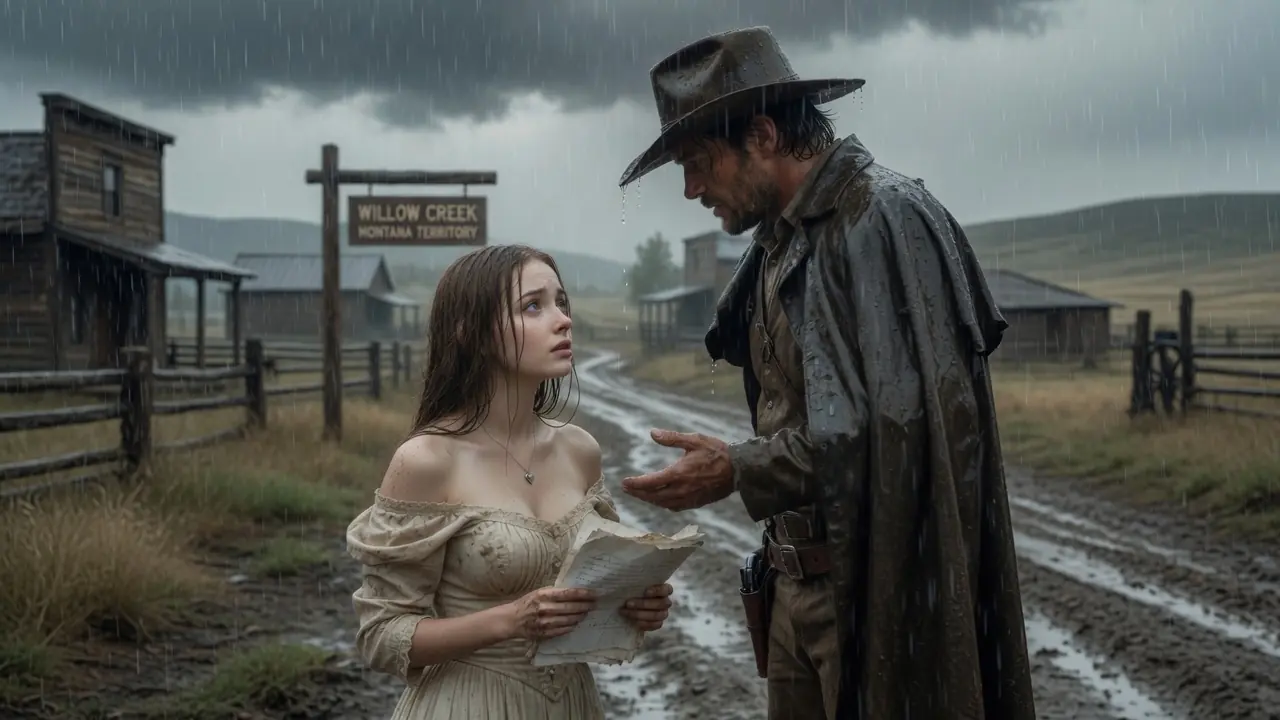
At first, Silas thought the storm had torn a blanket from a wagon. Then a pale hand emerged from beneath wet brown hair, and he realized a young woman was sitting half-collapsed in the mud. She held a small valise against her chest as though it contained the last pieces of her life. Her cream traveling dress was torn at the hem, her shoes were nearly ruined, and rain ran over her delicate face like tears she no longer had the strength to shed.
Silas dismounted and approached carefully. The woman lifted enormous brown eyes toward him, and even through exhaustion, he could see she was breathtakingly beautiful. Long chestnut hair clung to her cheeks and shoulders, her lips had turned pale from cold, and a small silver heart pendant rested against her throat. Yet there was nothing proud or calculating in her expression—only the stunned emptiness of someone who had followed hope until the road ended.
“Where are you headed?” Silas asked.
Her fingers tightened around the valise. “I don’t know anymore.”
The words stopped him more completely than any cry for help could have. The nearest town was five miles behind her, while his cabin stood less than a mile ahead. Silas had spent years learning not to invite trouble onto his land, but leaving her in that storm would have been the same as killing her. He removed one glove and extended his hand.
“Come with me.”
She stared at him as if kindness had become a language she no longer understood. When she finally reached up, her fingers were nearly frozen. Silas lifted her behind him, wrapped part of his coat around her, and turned the horse toward home. Within minutes, her forehead rested against his back, though her body continued trembling.
Silas’s cabin stood alone beneath a ridge of dark pines. The place was sturdy but neglected, built for survival rather than comfort, with smoke curling from a stone chimney and a porch silvered by years of weather. He helped the woman inside, lit the iron stove, and handed her the thickest blanket he owned. She remained near the door as though afraid that moving farther inside might create an obligation she could never repay.
“You can sit,” he said.
“I’ll ruin the chair.”
“It has survived worse than rain.”
That almost drew a smile from her. She lowered herself beside the stove and wrapped the blanket around her shoulders while Silas heated beans and black coffee. He did not ask questions until color returned to her lips and the violent shaking eased. Only then did he notice how carefully she guarded the valise, keeping one boot pressed against it even while eating.
“My name is Silas Carter,” he said.
“Faith Morgan.”
“Where did you come from, Miss Morgan?”
“Ohio.”
Silas waited.
Faith lowered her spoon. “I came to marry a man.”
The silence inside the cabin became heavier. She explained that her parents had died when she was seventeen, leaving her alone in Cincinnati. For six years, she worked in a sewing factory where the air filled with lint and women coughed until blood stained their handkerchiefs. Then she found an advertisement from a Montana rancher seeking a hardworking wife.
His letters had been patient and affectionate. He wrote about a wide valley, a warm house, and children they might raise beside the mountains. He described himself as a widower named James Hollister and promised to meet Faith at Willow Creek Depot wearing a blue kerchief. After three months, Faith sold nearly everything she owned and purchased a westbound ticket.
“He never came,” she said.
“How long did you wait?”
“Two days.”
Silas’s jaw tightened.
“I slept at the station the first night,” Faith continued. “The stationmaster made me leave the second evening. I asked around, but people looked at me as if I had done something shameful by believing him.”
She opened the valise and removed a bundle of letters tied with faded string. Silas recognized the handwriting before reading the signature. James Hollister owned the general store in Willow Creek, lived above it with his wife, Clara, and had two sons old enough to work behind the counter.
“He’s married,” Silas said.
Faith’s face went still.
“He has children.”
For several moments, she did not breathe. Then she rose, carried the letters to the stove, and fed them into the flames one by one. The pages curled, the promises blackened, and the careful handwriting vanished into ash. Faith did not cry until the last letter was gone, and even then, only one tear crossed her cheek.
Silas looked away to preserve what dignity he could offer. “You can stay here until you decide what comes next.”
“I don’t accept charity.”
“Then help with meals if that eases your pride.”
She met his eyes. “And after that?”
“We’ll decide after the storm.”
Faith slept for nearly fourteen hours. When Silas woke the following morning, the cabin smelled of cornbread, soap, and something he had not felt in years. Sunlight entered through windows Faith had wiped clean, and every dish had been washed and stacked properly. She stood at the stove with her long hair pinned loosely behind her, wearing one of his mother’s old aprons over her dried dress.
“I said I would work,” she told him.
Silas sat at the table. “You nearly froze yesterday.”
“And today I didn’t.”
The cornbread tasted better than anything he had eaten since his mother died. Faith cleaned without asking permission, but she never opened a drawer or entered a room that Silas had not shown her. By evening, the cabin looked less like a shelter and more like a place where a person might choose to remain. Silas found himself listening for her footsteps whenever he worked outside.
Over the next ten days, Faith repaired torn curtains, mended his shirts, and organized the pantry. She refused money but accepted clean fabric from town so she could sew herself a proper work dress. Her beauty became even more striking once exhaustion released its hold on her. With her chestnut hair falling nearly to her waist and her brown eyes no longer hollow, she carried a quiet grace that made Silas forget what he intended to say whenever she looked directly at him.
She never flirted with him.
That made his growing attachment more dangerous.
Silas had lived alone since his parents died when he was fourteen. His older brother sold the family’s original ranch and disappeared with most of the money, leaving Silas an isolated cabin and forty difficult acres. He spent the next eighteen years rebuilding what had been lost, trusting cattle, weather, and fences more than people. Faith’s presence entered that carefully defended life without demanding entry.
One afternoon, she asked whether she could plant flowers beside the porch. Silas almost laughed because the request seemed absurdly small after everything she had endured. He gave her a patch of ground and an old hand spade, then watched from the corral as she planted marigold and lavender seeds. When she caught him staring, she raised one eyebrow.
“Is the fence repairing itself, Mr. Carter?”
Silas struck the post harder than necessary. “Nearly.”
Faith smiled, and the sight followed him for the rest of the day.
A week later, they rode into Willow Creek so Faith could mail a letter to a former factory friend. She wore a simple brown dress she had altered herself, with her hair braided over one shoulder and the silver pendant visible at her throat. Men stopped speaking when she passed, while women watched from porches with expressions sharpened by curiosity. Silas noticed Faith’s shoulders tense but did not offer an arm she had not requested.
Inside the general store, James Hollister stood behind the counter.
He was forty, soft around the middle, and dressed in a clean waistcoat that made him look respectable. A blue kerchief hung from a peg behind him. When he saw Faith, the color left his face so quickly that his wife noticed.
Clara Hollister turned from the shelves. “James?”
Faith stepped forward with remarkable calm. “You promised to meet me at the depot.”
James glanced at Silas, then toward three customers who had stopped browsing. “I don’t know this woman.”
Faith’s eyes filled, but her voice remained steady. “You wrote to me for three months.”
“She is mistaken.”
Silas moved beside her. “She has your letters.”
James recovered enough to sneer. “A desperate woman can copy a name.”
The insult reached every corner of the store. Clara looked from her husband to Faith and slowly removed her hand from his arm. Faith reached into her valise, but then remembered the letters had burned. For one terrible moment, she possessed nothing except her word.
James saw the weakness and smiled.
“She probably came west looking for any man foolish enough to keep her,” he said.
Silas grabbed the front of James’s waistcoat and pulled him across the counter. Shelves rattled behind them, and Clara screamed. Silas wanted to strike him, but Faith placed one hand on his arm.
“Don’t,” she whispered. “He has already shown everyone what he is.”
Silas released James.
Faith lifted her chin. “I crossed a thousand miles because I believed you were honorable. I will not become ashamed because you were not.”
She walked out before anyone could answer.
By supper, Willow Creek had divided the story into versions that suited each listener. Some believed Faith had been deceived, while others called her a fallen woman inventing a respectable excuse for arriving alone. James told customers that she had pursued him despite his rejection. Martha Perkins, who considered gossip a public service, repeated that Faith now lived alone with Silas Carter.
Faith heard the whispers when they passed the church the following Sunday. She returned to the cabin before the service began and spent the afternoon pulling weeds from the flower bed. Silas found her there after sunset with dirt beneath her fingernails and tears standing in her eyes.
“You don’t have to hide,” he said.
“I’m not hiding.”
“You left.”
“I chose not to sit among people who had already convicted me.”
Silas crouched beside her. “I believe you.”
Faith looked at him. “Would you believe me if you weren’t lonely?”
The question hurt because it was honest.
“I was lonely before you came,” he answered. “Loneliness never made me trust anyone else.”
Faith’s expression softened, but she looked away.
The town’s judgment might eventually have faded if the Willow Creek Bank had not been robbed two weeks later. Four masked riders broke into the rear office at night and emptied the safe. Old Jenkins, whose eyesight failed him regularly, told Sheriff Harlan that he had seen a dark-haired woman near the alley shortly before the robbery.
By noon, people were speaking Faith’s name.
Sheriff Harlan rode to Silas’s cabin the following morning. Faith stood in the doorway wearing a flour-dusted apron while he questioned her in the yard. She answered every question plainly and said she had been inside the cabin all night. When Harlan asked Silas to confirm it, he did not hesitate.
“She never left.”
The sheriff closed his notebook. “You certain?”
“Yes.”
Harlan studied him. “A man can become blind when he wants something badly enough.”
Silas stepped closer. “And a town can become cruel when it wants an easy suspect.”
Harlan mounted without replying, but warned Faith not to leave the county. That evening, Silas found her packing. Her dresses were folded inside the valise, and the flowers she planted had been cut and laid on the bed as though she meant to leave no unfinished responsibilities.
“You’re staying,” he said.
“They will take your land if you protect me.”
“Let them try.”
“You do not understand what people will do when fear gives them permission.”
Silas took the valise from her hands and placed it on the floor. “I understand abandonment.”
Faith stared at him.
“My parents died, my brother stole what they left, and every person I trusted found a reason to leave. So hear me clearly: you may walk away because you choose another life. But you will not walk away believing your presence destroyed mine.”
Her lips trembled. “What if I bring you nothing but trouble?”
“You brought bread into a house that had forgotten its smell. You put flowers beside a porch that had never needed beauty because no one stayed long enough to notice. You made me speak more in six weeks than I had in six years.”
Silas swallowed and forced himself to continue. “Trouble was here before you. So was loneliness.”
Faith sat slowly on the bed.
Silas left the room because staying would have made him say more than she was ready to hear. At dawn, the valise remained closed beside the wall. Faith was in the kitchen kneading dough.
She had stayed.
The investigation continued for two weeks. Silas rode into Willow Creek repeatedly, questioning stable hands, freight drivers, and anyone who passed the bank road that night. Most refused to become involved, but a ranch boy remembered seeing four unfamiliar horses near Ridgewater Creek. Their tracks led toward an abandoned mining camp.
Sheriff Harlan followed the lead reluctantly.
He returned three days later with four prisoners and the missing money. The men confessed after one blamed the others, and every account confirmed there had been no woman involved. Old Jenkins had seen a blond teenage boy wearing a long coat, not Faith.
Harlan rode directly to the cabin.
Faith stood beside the porch flowers when he dismounted and removed his hat. “We caught them.”
She said nothing.
“You had nothing to do with it.”
“I knew that.”
The sheriff’s face tightened with shame. “So did Mr. Carter.”
Silas stood near the barn, watching.
Harlan lowered his eyes. “Miss Morgan, the town owes you more than an apology, but an apology is all I can offer today.”
Faith’s response was calm. “Then offer it publicly.”
The sheriff looked up.
“You questioned me publicly,” she continued. “People whispered publicly. James Hollister called me a liar before witnesses. I will not accept the truth in a private yard where no one else has to hear it.”
Silas felt pride rise inside him so strongly it almost hurt.
Harlan nodded. “Town meeting tomorrow evening.”
The Willow Creek church was full before sunset. Farmers stood along the walls, women crowded the pews, and James Hollister sat beside Clara with his face drawn tight. Faith entered with Silas, wearing a deep blue dress she had sewn from fabric bought with her first wages mending clothes for neighboring ranch families.
Every eye followed her.
Sheriff Harlan stood before the pulpit and announced that the bank robbers had confessed. He stated clearly that Faith had been wrongfully suspected and that Jenkins’s identification was false. Then he apologized to her in front of the entire town.
Faith accepted with a small nod.
Silas stepped forward carrying a leather mail pouch borrowed from Wilbur, the route carrier. He emptied its contents onto a table: seven letters in James Hollister’s handwriting. Faith’s factory friend in Ohio had preserved the letters James sent to her, including one Faith mailed before leaving Cincinnati. After hearing what happened, she forwarded every page west.
Clara picked up the first letter.
James lunged for it, but Sheriff Harlan stopped him.
Faith’s name appeared at the top. James’s promises followed beneath it—his imaginary ranch, his supposed widowhood, and the blue kerchief he would wear. One letter asked Faith to bring whatever savings remained after purchasing her ticket.
Clara read that line aloud.
The silence in the church became merciless.
James began explaining that it had been a foolish game, nothing more. He claimed he never expected Faith to travel and insisted she had misunderstood his intentions. Faith walked toward him until only the table separated them.
“You asked me to become your wife.”
James looked around for an ally and found none.
“You let me sell my belongings,” Faith continued. “You knew I had no family, no home to return to, and almost no money. Then you watched me wait at that depot while you stood safely behind your counter.”
Clara removed her wedding ring.
James’s face collapsed. “Clara, please.”
Faith gathered the letters but did not burn them. She handed them to Sheriff Harlan for the fraud complaint Clara intended to file. The man who had abandoned her would not disappear into ash this time. His promises would remain as evidence.
Outside the church, people approached Faith awkwardly. Martha Perkins offered an apology that contained too many explanations. Old Jenkins cried while admitting he had wanted attention and spoke before he was sure. Faith forgave neither immediately, but she thanked each person who told the truth without demanding relief from her.
Silas waited beside the horses.
When Faith joined him, he helped her mount and climbed behind her. They rode home beneath a clear sky, neither speaking until the town lights vanished behind the hills.
“You kept the letters this time,” Silas said.
“I’m done burning proof to make dishonest men comfortable.”
He smiled. “Good.”
Faith turned slightly in the saddle. “You made him answer before the whole town.”
“You asked for justice.”
“And if they had refused?”
“I would have brought the whole town to your porch.”
Faith laughed, and the sound carried across the valley.
Spring arrived early that year. The marigolds beside the cabin bloomed in gold and orange, cattle moved into greener pastures, and Faith’s sewing work became steady enough to give her independent money. Silas offered her a permanent share of the household income, but she refused until they wrote an agreement recognizing her labor and protecting her savings.
He respected her more for insisting.
One evening, Faith found Silas repairing the porch rail. She stood beside him in the sunset, her long chestnut hair loose across her back and her silver pendant shining against a soft cream blouse.
“I received an offer from Mrs. Bennett,” she said. “She wants me to manage the sewing room in Bozeman.”
Silas’s hammer stopped.
“It pays well.”
“You should take it if that’s what you want.”
Faith studied his carefully neutral expression. “Would you miss me?”
“Yes.”
The honesty surprised them both.
“How much?”
Silas set down the hammer. “Enough that this cabin would become empty again, even if every room stayed full.”
Faith’s eyes glistened. “Then ask me to remain.”
“I won’t ask you to trade one promise from a man for another unless you know exactly what I offer.”
“What do you offer?”
Silas faced her fully. “No grand ranch. No easy years. Forty acres, stubborn cattle, a roof that leaks near the chimney, and a man who will sometimes go silent when he should speak.”
Faith smiled through her tears.
He took her hand. “But I offer truth. Your own money, your own choices, and a place beside me—not behind me. If love grows here, it will grow because we work for it together.”
Faith stepped closer. “Silas Carter, it has already grown.”
He kissed her gently beneath the porch light, with no town watching and no promise larger than either of them could keep. She accepted the Bozeman position temporarily, traveling there twice each month while training another seamstress. Silas never asked her to abandon it, and Faith never used independence as a reason to keep her heart guarded.
They married in late summer.
Sheriff Harlan stood among the guests. Clara Hollister attended with her sons after separating from James, whose fraud case cost him the general store and much of the reputation he once protected. Martha brought a pie, Jenkins remained quietly in the back, and Faith’s friend traveled from Ohio carrying the final letter Faith had written before boarding the train.
The ceremony took place beside the porch flowers.
Faith wore a simple ivory dress made by her own hands. Her chestnut hair fell in soft waves nearly to her waist, and the silver heart pendant remained at her throat. Silas promised not to rescue her, own her, or decide her road.
He promised to walk it with her.
That evening, Faith placed her old valise beneath their bed. Inside were the first handkerchief Silas gave her, one dried marigold, copies of the letters used as evidence, and a folded piece of paper bearing a single word.
Home.
Months later, during the first hard storm of winter, Faith stood inside the warm cabin watching rain darken the road where Silas had found her. He came behind her and wrapped his arms around her waist.
“Thinking about that day?” he asked.
“I thought my life ended beside that ditch.”
Silas rested his chin against her hair. “So did I.”
Faith turned in his arms. “Your life wasn’t ending.”
“It had ended years before. I just kept working because no one told my body.”
She touched his face.
Outside, the valley disappeared behind rain. Inside, bread cooled on the table, firelight moved across clean windows, and two people once abandoned by others stood within a life they had chosen deliberately.
Faith had traveled west to become the wife of a man who never intended to claim her.
Instead, she found a lonely rancher who gave her shelter without demanding obedience, defended her without silencing her, and loved her without turning gratitude into debt.
James Hollister had written promises he never meant to keep.
Silas Carter made few promises at all.
But every morning he woke beside Faith, every evening he returned to the light in their window, and every difficult season they faced shoulder to shoulder became proof of the only vow that truly mattered.
He stayed.