“I slapped you once, nurse. Challenge me again, and I’ll break you in front of all forty-seven.”
Commander Ethan Cole stood in the center of Red Harbor Naval Medical Center’s combat-training hall with one fist raised and a satisfied sneer on his face. A red palm print spread across Lieutenant Claire Bennett’s left cheek, but she neither staggered nor looked away. The sailors surrounding the mat had stopped laughing, suddenly aware that the beautiful nurse standing before their commander was far too calm for someone who had just been publicly humiliated.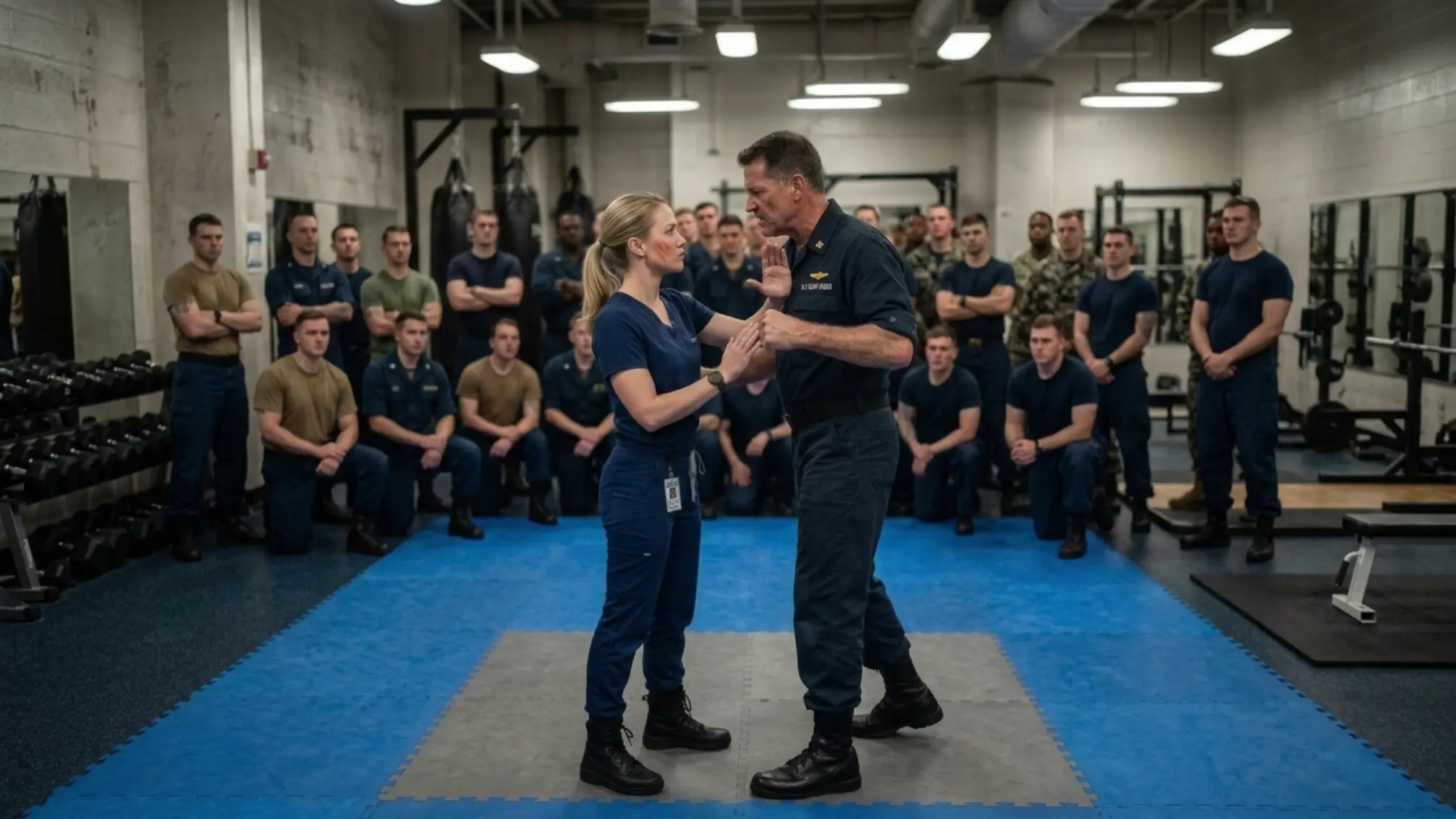
Claire lowered the clipboard in her hand. “Raise that fist again, and it won’t belong to you when it comes down.”
Cole squared his heavy shoulders. “You’re medical staff, not a warrior. I’ll bury you in this mat.”
Claire stepped inside his reach and locked her eyes on his wrist. “Then swing, Commander. Let them time how fast I end your career.”
He swung.
Claire moved before anyone fully understood that the attack had begun. Her left hand redirected his forearm, her right palm compressed a nerve cluster beneath his neck, and one precisely placed step broke his balance. Cole’s knees buckled, his body rotated, and the commander crashed onto his back with one wrist locked at an angle that made resistance impossible.
The entire reversal lasted less than two seconds.
Claire released him immediately.
She picked up her clipboard and looked at the forty-seven sailors around the mat. “That is the difference between medical restraint and losing control.”
Then she walked out.
No one helped Cole stand.
The incident began eight hours after Claire arrived at Red Harbor with one duffel bag and a transfer packet containing more blacked-out lines than readable information. She was thirty-one years old, average in height, athletic without appearing imposing, and quiet in a way that made people underestimate how carefully she observed everything around her. Her official assignment identified her as nursing staff attached to the combat-medicine rotation.
Nothing in the accessible record explained why entire sections of her service history remained classified.
Petty Officer Damian Ruiz processed her paperwork at the front desk. He flipped through the packet twice, paused at the redactions, and wisely decided not to ask questions he was not authorized to have answered.
“It says combat medicine,” he said.
“That’s right.”
“You’ve worked in naval hospitals before?”
“Among other places.”
Damian stamped the documents and returned them. “Locker room is through the west corridor. Commander Cole runs readiness evaluations on Tuesdays, so stay clear of Training Hall B unless you enjoy being made an example.”
Claire glanced toward the corridor. “Does he do that often?”
Damian gave a cautious smile. “Often enough that I mentioned it.”
Claire changed into navy medical scrubs and began her first shift. She assessed surgical wounds, checked medication records, and spent nearly twenty minutes helping a young seaman understand why pain did not always mean his recovery was failing. She did not seek attention or attempt to impress anyone.
By early afternoon, Commander Cole’s voice began carrying through the adjoining corridor.
Training Hall B and the postsurgical ward shared a wall because of a design decision no one had corrected when the facility expanded. Cole’s commands, insults, and exaggerated demonstrations reached patients trying to rest. Claire closed one door, then another, but the noise continued.
Finally, she set down her chart and entered the training hall.
Forty-seven sailors stood in a horseshoe around the central mat. Commander Ethan Cole occupied the middle like an actor who believed every room existed to provide him an audience. He was fifty-two, thick through the shoulders, and still physically powerful despite the softness that had begun appearing around his waist.
He saw Claire immediately.
“Perfect timing,” he announced. “We were discussing whether medical personnel should meet the same physical-readiness standards as combat staff.”
Several sailors turned toward her.
Claire remained near the door. “The noise is carrying into the recovery ward.”
Cole smiled. “Then perhaps you can help me finish quickly.”
Near the rear exit stood Fleet Command Master Chief Raymond Prior. He had served more than three decades and carried the still posture of a man who did not need to perform authority for anyone to recognize it. The moment he studied Claire’s stance, something changed in his expression.
“Cole,” Prior warned.
The commander ignored him.
“Come forward, Lieutenant,” Cole ordered. “Let’s give everyone a useful teaching moment.”
Claire could have refused. The demonstration was not part of her medical assignment, and Cole possessed no clinical reason to involve her. But turning around would allow him to transform her departure into proof that nurses lacked combat readiness.
She placed her clipboard on a folding table and stepped onto the mat.
“What is your name?” Cole asked.
“Bennett.”
“First day?”
“Yes.”
He looked at the sailors. “First day, and she is already confident enough to interrupt a command training session.”
A few people laughed.
Claire’s expression did not change.
Cole walked around her slowly. “Medical personnel develop a false sense of safety. They think protected roles mean hostile situations will politely avoid them.”
“Patients are trying to recover twenty feet away,” Claire said. “That is why I came in.”
His smile tightened.
“If someone grabbed you now, what would you do?”
“Depends on the grab.”
More laughter followed.
Cole intended to demonstrate a controlled arm restraint. Instead, he drove both hands against Claire’s shoulders and shoved her backward. She recovered in two steps without raising her hands.
“Lost my balance,” he told the room.
Master Chief Prior’s voice came again. “Commander.”
Cole continued as though he had heard nothing.
For the next four minutes, he corrected Claire unnecessarily, placed his hands on her shoulders without permission, and repeatedly referred to her nursing role as a weakness. Each insult was delivered as instruction, allowing him to hide personal humiliation behind the language of training.
Claire gave him no emotional response.
That was what finally broke his control.
Cole needed her embarrassed, angry, frightened, or apologetic. Her stillness denied him every result he expected. The sailors who had laughed began watching more carefully, sensing that the demonstration had stopped being professional.
Cole stepped toward her.
His open palm struck her left cheek with full force.
The sound silenced the room.
Claire’s head turned slightly.
Master Chief Prior went completely still.
Cole waited for her to cry, protest, or retreat. When she did none of those things, he mistook her discipline for paralysis.
“Like I said,” he told the sailors. “Liability.”
Claire turned her face back toward him.
The red mark on her cheek was the only visible sign of what he had done.
Then Cole raised his fist.
Two seconds later, he was on the floor.
The technique Claire used did not appear in standard naval training manuals. It belonged to a classified system designed for personnel required to neutralize stronger opponents inside confined environments without creating unnecessary injury. She could have dislocated Cole’s shoulder, crushed his throat, or rendered him unconscious.
She chose none of those outcomes.
She used exactly enough force to stop him.
Master Chief Prior understood what he had witnessed. Six years earlier, during a classified briefing, he had heard the name Claire Bennett connected to an extraction operation that officially did not exist. He had never met her directly, but the movement on the training mat confirmed the identity before any record could.
After Claire left, Prior removed his phone and sent one secure message.
Red Harbor. Bennett confirmed. Cole struck her in front of forty-seven witnesses. Security footage exists.
Claire returned to the postsurgical ward.
A twenty-four-year-old seaman named Torres lay in Room 118 recovering from injuries sustained during a training accident. He had seen the red mark on her face but did not ask about it.
“Does it get easier?” he asked.
Claire understood he was not talking about the wound in his side.
“Some things do.”
“And the others?”
“You become better at carrying them.”
“That’s not reassuring.”
“It’s true. Reassurance would have been easier.”
Torres laughed, then winced because laughing still hurt.
At the end of her shift, Chief Medical Officer Sylvia Horn summoned Claire to her office. Captain Walsh, Red Harbor’s commanding officer, had already received Cole’s account.
“He says you assaulted a superior officer.”
“He struck me first.”
“There were witnesses.”
“Forty-seven.”
“And security footage.”
“Yes.”
Dr. Horn folded her hands. “Commander Cole has significant influence here. His training program appears in multiple facility evaluations, and Captain Walsh supports him.”
Claire waited.
“I’m not telling you he is right,” Horn continued. “I’m telling you the structure surrounding him is strong.”
“A structure protecting misconduct is not strength.”
Dr. Horn studied her. “Your transfer record contains classified sections I cannot access.”
“They are unrelated to patient care.”
“I believe you. But I need to know whether anything inside those sections explains what happened on that mat.”
Claire looked directly at her. “He attacked someone he believed would not fight back.”
“That is not what I asked.”
“It is the answer that matters.”
Dr. Horn released her with instructions to return the following morning and avoid further confrontation.
Claire had crossed half the courtyard toward temporary housing when her phone rang from an unregistered number. The prefix belonged to a secure system she had been instructed never to ignore.
“Bennett.”
“This is General Marcus Vain, Joint Special Operations Command. Do not repeat my name.”
“Understood.”
“We received Prior’s report.”
Claire stopped walking.
“That was fast.”
“Cole has been under informal review for eight months. Multiple complaints, all buried by command. Yesterday’s incident moved the timeline.”
“That was not my intention.”
“I know. But what happens next will involve you.”
Claire looked back toward the medical center. “What do I need to do?”
“Remember your actual status. Your nursing role is current, but your reserve classification and operational authority are considerably higher than anything Red Harbor can access.”
The call ended.
The following morning, Cole filed a formal complaint accusing Claire of assault, insubordination, conduct unbecoming, and creating a hostile training environment. Captain Walsh suspended her duty assignment pending review.
Claire accepted the notice without argument.
Damian found her near the surgical ward. “People are saying you put Cole down in under two seconds.”
“Are they?”
“Is it true?”
“Closer to two than not.”
“The corpsmen have been timing two seconds with stopwatches since breakfast.”
Claire walked away before he saw her smile.
By early afternoon, three dark military vehicles entered Red Harbor’s front approach. They positioned themselves with the exact spacing used by special-operations security teams. A fourth vehicle arrived carrying legal personnel from Joint Special Operations Command.
General Marcus Vain entered first.
Six service members followed, then Colonel Diane Ferris from JSOC Legal. The group moved through the facility with a calm force that made conversations stop before anyone asked who they were.
Vain addressed the front desk.
“I need Captain Walsh, Commander Cole, the medical director, and every available witness from Training Hall B in the main conference room within twenty minutes.”
The young petty officer behind the desk swallowed. “Sir, I need to confirm your authority.”
“You confirm it by making the calls.”
Colonel Ferris approached Claire separately.
“Lieutenant Bennett, do not speak with Cole today. Do not seek him out, and do not respond if he approaches you.”
“Because anything I say becomes part of the record.”
“Correct. And the record is already doing well without help.”
“What is actually happening?”
Ferris glanced toward the administrative wing. “A pattern of misconduct protected for nearly a year has become impossible to conceal.”
The first conference began without Claire.
General Vain reviewed the security footage while forty-seven witness statements were collected independently. Fourteen sailors confirmed Cole struck Claire outside any approved demonstration. Eleven described the contact as deliberate humiliation.
Captain Walsh attempted to frame it as aggressive training.
Colonel Ferris opened Cole’s submitted lesson plan. No open-hand strike appeared anywhere in the document.
Then the investigation widened.
Eight prior complaints had been filed against Cole during twenty-six months at Red Harbor. Six came from junior personnel. Three were from women describing discriminatory behavior during physical training.
All eight had been closed without formal investigation.
One complaint belonged to former Lieutenant Sandra Moya. Fourteen months earlier, Cole had selected her for a nearly identical demonstration, used unauthorized physical contact, and mocked her ability to function in combat because she was a woman.
Sandra filed through the command system.
Captain Walsh’s office closed the case in thirty days without interviewing her.
She then filed directly with the Naval Inspector General. That complaint disappeared during an administrative transfer. Six months later, Sandra separated from the service, citing a hostile work environment.
By coincidence, her younger brother Daniel was now recovering in Red Harbor’s postsurgical ward.
Sandra agreed to return and testify.
Cole’s attorney attempted to suppress the training-hall footage on a technical argument concerning posted surveillance notices. The motion delayed one part of the review for forty-eight hours.
It could not silence Sandra Moya.
She arrived the following morning wearing civilian clothes and carrying seventeen years of service inside a single file folder. Her testimony was quiet, chronological, and devastating.
“I filed because I believed the system was supposed to work,” she told the panel. “Nobody interviewed me. Nobody asked for clarification. I received a form letter saying no action was warranted.”
Cole’s attorney questioned whether she held personal resentment.
Sandra looked directly at him. “I had seventeen years of service. I left because a commander struck me during training and the institution decided investigating him was less convenient than losing me.”
Before the hearing could continue, a military police officer entered.
“There is a medical emergency in the postsurgical ward.”
Claire was out of her chair before the sentence ended.
Daniel Moya’s blood pressure had dropped, his heart rate had climbed, and his morning hemoglobin was lower than the previous day. The ward staff had been monitoring him after a splenic repair, but Claire recognized the pattern immediately.
She pressed gently near the surgical site.
Daniel’s expression changed.
“You may be bleeding internally,” she said. “We are confirming it now.”
Dr. Reyes arrived with a portable ultrasound. The scan revealed free fluid accumulating inside the abdomen.
“He’s going back to surgery,” Reyes ordered.
Claire looked at him. “My suspension remains active.”
“You caught the bleed. You’re coming.”
The operation lasted fifty-three minutes.
Daniel had developed a postoperative hemorrhage complicated by low-dose anticoagulants. Claire worked beside Reyes and Dr. Faria, anticipating instruments and changes in pressure before they were requested. The bleeding was controlled, the repair was stabilized, and Daniel’s vital signs improved.
Reyes pulled down his mask afterward.
“You saw it at least two hours before the monitors would have forced an escalation.”
“The hemoglobin change was visible.”
“In retrospect.”
Claire said nothing.
Reyes studied her. “I’m documenting exactly what happened, including the fact that your intervention saved the margin we needed.”
Outside the operating room, Sandra waited alone.
“He’s stable,” Claire told her. “The repair held.”
Sandra released a breath she appeared to have held since the gurney disappeared.
“Thank you.”
Claire sat across from her.
“The hearing still continues,” Sandra said.
“Yes.”
“And Cole?”
“He will answer.”
“You sound certain.”
“I’m not certain about many things. That one I am.”
While Daniel recovered, the investigation team discovered that Cole’s pattern extended across three commands. Fourteen formal complaints carried similar descriptions: public humiliation, physical intimidation, selection of junior personnel unlikely to challenge him, and command systems that repeatedly closed reports without action.
General Vain summoned Claire for an on-record statement.
He made one fact clear before everyone present.
“Lieutenant Bennett’s response was not an uncontrolled attack. Her classified service record confirms she used exceptional restraint. Commander Cole was not injured because she deliberately chose not to injure him.”
Cole looked away.
“I want my attorney.”
“He has been notified,” Ferris replied.
“We already have the footage, the witnesses, the prior complaints, and your training plan.”
Cole was detained pending formal charges that morning. Captain Walsh was placed on administrative leave for suppressing complaints and failing to protect personnel under his command.
Commander Patricia Ashby assumed temporary control of Red Harbor.
Her first official act was to restore Claire’s duty status.
The memo contained no ceremony.
Suspension rescinded. Lieutenant Bennett returned to full clinical duties effective immediately.
Claire folded it and placed it inside her pocket.
Garrison, the young military attorney assigned to her, watched her carefully. “That’s all you have to say?”
“The paper caught up.”
“With what?”
“Reality.”
The investigation did not stop with Cole.
While reviewing old command files, the Inspector General discovered the complaint-processing system had been manipulated for at least eleven years, across three commanding officers. Thirty-one reports had been minimized, closed without interview, or lost during administrative transfer.
Nine complainants left the service within eighteen months.
Six cited hostile working conditions.
The other three gave “personal reasons,” language investigators increasingly understood as the safest explanation available to people who no longer trusted the system.
Cole eventually agreed to cooperate.
His statement implicated Walsh more deeply. According to Cole, Walsh instructed him not to stop targeting vulnerable personnel but to restructure his conduct so future complaints would become harder to prove.
Most damaging was Cole’s explanation for choosing Claire.
“She looked like someone who would not fight back.”
General Vain called Claire privately that night.
“That was his criterion across all three commands,” he told her. “He selected people he believed could be intimidated safely.”
“The fourteen complaints are not the real number,” Claire said.
“No.”
“They are only the people who fought back enough to file.”
“Yes.”
Formal charges became public the next morning.
Cole faced abuse of authority, assault, cruelty and maltreatment, conduct unbecoming, and other violations under military law. Walsh faced dereliction of duty and charges connected to active complaint suppression.
Press vehicles filled Red Harbor’s front entrance.
Acting Commander Ashby addressed the staff.
“This command experienced a systemic failure. Personnel reported misconduct, and the institution responded inadequately for years. That is not an opinion. It is a fact.”
She ordered anyone with information to contact the Inspector General directly rather than using Red Harbor’s administrative channels.
More witnesses came forward.
The documented total climbed beyond thirty-one.
Cole eventually accepted a formal agreement acknowledging the assault, discriminatory conduct, and repeated selection of junior personnel he believed were unlikely to resist effectively. His rank was stripped, retirement benefits were reduced, and he was removed from service under conditions that permanently marked his record.
Walsh’s case lasted longer.
His command career ended immediately, and the expanded investigation examined years of records tied to his office and its predecessors. Two former commanders cooperated. A third hired an attorney and refused to answer questions.
Claire’s actions underwent a separate review.
The board examined the training-hall footage, the forty-seven statements, her medical intervention during suspension, and a classified annex covering her operational history. Two members required special clearance just to read it.
They cleared her on every count.
Her force against Cole was ruled proportional, defensive, and deliberately restrained. Her intervention during Daniel Moya’s emergency was found consistent with her duty as a medical professional because a patient faced immediate danger and the senior surgeon had requested her assistance.
A commendation was added to her record.
Claire responded with one word.
“Okay.”
Garrison stared at her. “You were slapped before forty-seven people, suspended, investigated, and then cleared while exposing eleven years of misconduct. You only have ‘okay’?”
“I entered a room and responded to what was inside.”
“That is not all.”
“It is the part that fits in one sentence.”
Weeks later, Claire returned to Torres’s room.
He had advanced ahead of his physical-therapy schedule and was extremely pleased with himself.
“People will keep asking about the training hall,” he said.
“I know.”
“What will you tell them?”
Claire adjusted his chart.
“That stillness is not surrender.”
Torres nodded. “Better.”
Claire walked into the corridor.
The combat-training hall remained open, though the program had been suspended and placed under external review. Sailors still spoke about the two-second takedown and the moment Commander Ethan Cole realized the nurse he had selected as an easy victim possessed skills he could not comprehend.
But Claire understood that the dramatic reversal was never the entire story.
Putting Cole on the mat exposed one man.
The forty-seven witnesses, the buried reports, Sandra Moya’s testimony, and the thirty-one documented names exposed the institution that protected him. The truth had existed for eleven years, accumulating silently each time someone was ignored.
Claire did not create that truth.
She simply refused to remain small enough for it to stay hidden.
Cole struck her because he believed she would absorb the humiliation and disappear. Instead, she redirected his arm, dropped him in less than two seconds, and walked away without injuring him.
That single act broke the illusion surrounding his authority.
The response from Navy leadership and Joint Special Operations Command did not change who Claire Bennett was. She had been the same woman before General Vain arrived, before the formal charges, and before anyone at Red Harbor learned what the classified sections of her record contained.
She was a combat nurse who understood exactly how much force a situation required.
A special operator who had chosen healing over destruction.
And the woman Commander Cole slapped in front of forty-seven sailors because he thought she looked incapable of fighting back.
He discovered his mistake on the mat.
The entire command discovered theirs when JSOC came through the front doors.