The morning of September 14, 1887, dawned gray and oppressive over Clearwater, Kansas, as if the heavens themselves disapproved of what was about to unfold in the town square.
A crowd had gathered, not for celebration, but for commerce of the cruelest kind.
Men in dusty suits and women in faded calico stood shoulder to shoulder, their faces a mixture of curiosity and shame, because everyone knew that what they were about to witness was wrong, even if the law said otherwise.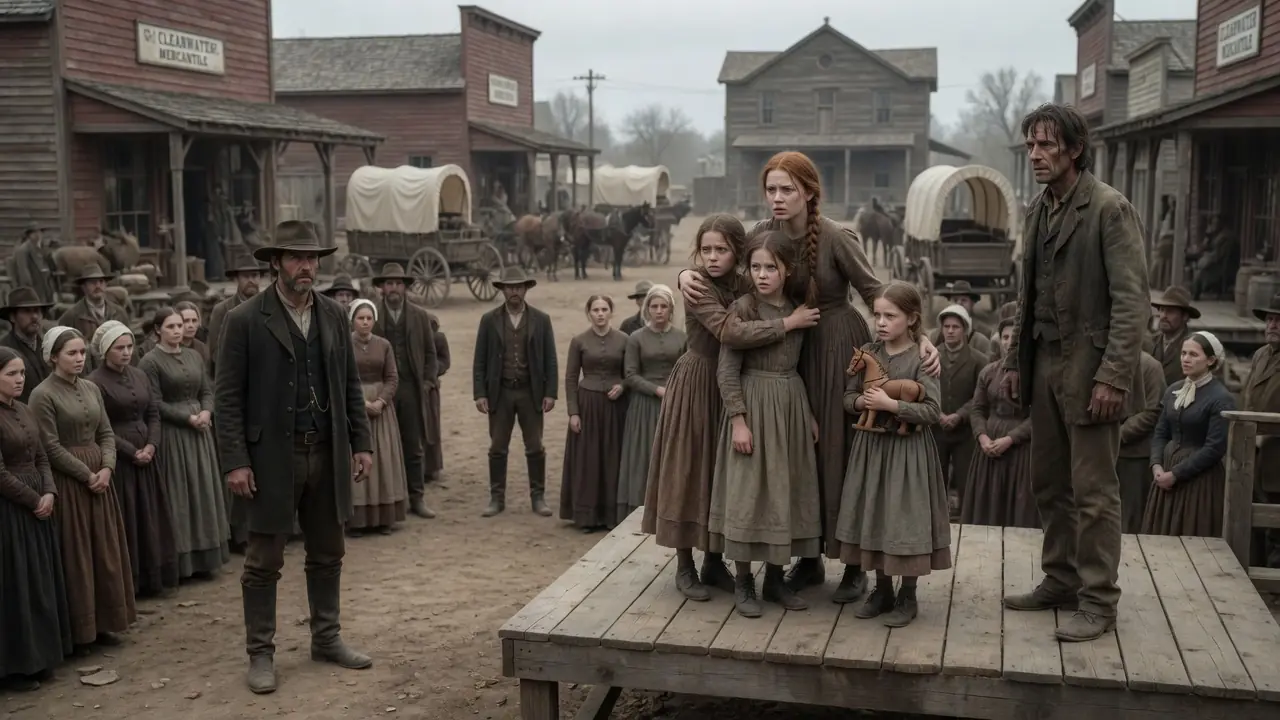
At the center of it all stood a makeshift wooden platform, hastily constructed for an auction that would have been more at home in the darkest days of the previous decade.
But these were not goods being sold.
These were not livestock, furniture, or parcels of land.
These were children.
Four girls, ranging in age from six to fifteen, huddled together on that platform like sparrows before a storm. Their dresses were clean but threadbare, mended so many times that the original fabric was barely visible beneath the patchwork.
Their faces were scrubbed pink. Their hair was braided with desperate precision, a final act of dignity before being stripped of everything else.
The eldest, Sarah Henderson, stood at the front, her spine rigid with a pride that poverty and tragedy had not managed to break. At fifteen, she had her mother’s copper hair and her father’s green eyes, both now dulled by grief and hunger.
Her right hand gripped the shoulder of twelve-year-old Emma, whose musical fingers trembled against her sister’s torn sleeve.
Behind them stood ten-year-old Kate, her intelligent eyes darting around the square, calculating, always calculating, trying to find a way out of the impossible.
Pressed against Sarah’s left side was six-year-old Lucy, who clutched a carved wooden horse, the last gift from their father before fever took him, and tried very hard not to cry.
“Lot seventeen,” barked Marcus Blackwood, the auctioneer, a portly man with mutton-chop whiskers and the moral flexibility of a weather vane. “Four healthy girls capable of domestic work, agricultural labor, and general service. Starting bid is twenty dollars apiece, or seventy for the lot.”
Sarah’s jaw clenched.
Twenty dollars.
That was what they had been reduced to.
Twenty dollars each, like sacks of grain or heads of cattle.
Their parents, James and Margaret Henderson, had been good people, respected in this very town. Their father had been a schoolteacher. Their mother had been a seamstress whose needlework was sought after by the wealthiest families in three counties.
They had lived a modest but happy life in a small house on Maple Street, where the smell of their mother’s bread greeted them every evening, and their father’s voice filled the rooms with poetry and laughter.
Then the fever came.
The scarlet fever swept through Kansas like wildfire in the summer of 1886, leaving broken families and fresh graves in its wake.
First their mother.
Then their father.
Both gone within a week of each other.
Sarah had nursed them both. She had watched helplessly as the life drained from their eyes. She had heard her father’s final words.
“Keep your sisters together, Sarah. Promise me. No matter what comes, you stay together.”
She had promised.
God help her, she had promised.
But promises meant nothing to their uncle, Silas Crane, their father’s younger brother, who had arrived at the funeral with calculation in his eyes and whiskey on his breath.
Silas had never amounted to much. A gambler, a drinker, a man who saw every relationship as a transaction and every tragedy as an opportunity.
When the lawyer read the will and revealed that the girls’ custody fell to him, Sarah had felt her stomach turn to ice.
For eleven months, they had lived in Silas’s decrepit farmhouse on the edge of town, working like servants while he drank away what little money their parents had left.
He sold their mother’s sewing machine first.
Then their father’s books.
Then the carved furniture their grandfather had made.
Piece by piece, their history disappeared into Silas’s pocket, then into the poker games at the Lucky Silver Saloon, then into thin air.
The final straw came the previous Tuesday, when three men in black suits appeared at the farm with papers that said Silas owed them fifteen hundred dollars. Gambling debts that had been accumulating for years.
They gave him one week to pay, or they would take the farm.
Sarah had listened from behind the door as Silas’s voice rose in panic, then dropped into a calculating murmur.
When the men left, he looked at the four girls with eyes that made Sarah’s blood run cold.
“You’re going to market,” he said flatly. “All of you should fetch enough to clear my debts and leave me with a fresh start.”
Emma had burst into tears.
Kate had stood frozen, her brilliant mind unable to process the enormity of the betrayal.
Little Lucy had simply looked at Sarah with absolute trust, because Sarah always found a way to protect them.
Except this time, Sarah had no plan.
This time, the law was on Silas’s side.
In Kansas in 1887, children were treated like property, and guardians could dispose of that property as they saw fit.
Sarah had gone to the sheriff, to the judge, and to the minister at the Methodist church where her parents were buried.
All of them had given her the same sad look and the same helpless shrug.
Legal was legal, they said.
Wrong, perhaps, but legal.
Now here they stood on this platform while Marcus Blackwood’s voice boomed across the square.
“Do I hear twenty? Twenty dollars for the eldest. She can read and write, gentlemen. A rare commodity. And look at those hands. Strong hands. Worker’s hands.”
Sarah felt bile rise in her throat as men in the crowd leaned forward, assessing her as they would a horse.
She wanted to scream. To fight. To grab her sisters and run.
But where would they go?
They had no money. No relatives except Silas. No one who would risk harboring runaways.
The law would drag them back, and Silas would punish them before selling them anyway.
“Twenty-five,” called a voice from the left side of the crowd.
Sarah’s eyes found the speaker, a farmer named Dutch Henderson, no relation despite the shared name. He was known for working his hired help nearly to death. His current farmhand had disappeared the previous winter, and rumors suggested he was buried in an unmarked grave behind the barn.
“Twenty-five for the lot or individually?” Blackwood asked.
“Just the oldest,” Dutch clarified. “Don’t need the little ones. Just need someone who can cook, clean, and keep her mouth shut.”
The implication in his tone made several women in the crowd turn away.
Sarah felt Emma’s hand tighten on her arm.
“Sarah,” her sister whispered. “Don’t let him.”
“I won’t,” Sarah breathed back, though she had no idea how to prevent it.
“Twenty-five for the eldest,” Blackwood repeated. “Do I hear thirty?”
Silence.
The crowd shifted uncomfortably.
Even for 1887 Kansas, this was crossing too many lines. Selling orphans was not uncommon. Indenture contracts and apprenticeships were standard practice.
But the way Silas Crane had orchestrated this, the naked greed in his eyes as he stood at the edge of the platform counting imaginary money, turned everyone’s stomach.
“Going once,” Blackwood said, his voice losing some of its bluster.
Sarah’s mind raced.
If Dutch bought her, what would happen to her sisters? Would they be split up, sent to different homes, different fates?
She had promised their father.
She had promised.
“Going twice.”
“Fifty.”
The voice came from the back of the crowd, deep and rough as gravel, carrying a weight that made people step aside.
Sarah’s eyes snapped to the speaker, and she saw him for the first time.
A man in his late thirties, tall and broad-shouldered, wearing a rancher’s coat and a flat-brimmed hat that shadowed a face carved from granite.
His eyes were steel gray, cold and hard, and fixed on the platform with an intensity that made Sarah’s breath catch.
“Fifty for the lot?” Blackwood asked, perking up.
“No,” the man said, stepping forward through the parting crowd. “Fifty for the eldest. One hundred for all four together.”
A murmur rippled through the square.
That was more than most families earned in three months.
Sarah watched as the man approached the platform, his boots striking the packed earth with purpose. Up close, she could see the lines around his eyes, the gray threading through his dark hair, and the scar that ran from his left ear to his jaw.
This was a man who had known hardship, who had faced violence and survived.
“Now hold on,” Dutch protested. “I bid first.”
“You bid twenty-five,” the stranger said without looking at him. “I bid one hundred. That’s how auctions work.”
Silas Crane scrambled forward, his piggy eyes gleaming with greed.
“One hundred for all four? You got that kind of money on you, mister?”
The stranger reached into his coat and pulled out a leather wallet, extracting a sheaf of bills that made Silas’s jaw drop.
“Right here. Cash for all four together.”
“Mr., uh…” Blackwood consulted his papers. “I’m sorry. I don’t believe I caught your name.”
“Grant Ashford. Twin Pines Ranch. Five miles west.”
Recognition flickered through the crowd.
Sarah had heard of Twin Pines. Everyone had. It was one of the largest cattle operations in three counties, five hundred acres of prime grazing land.
Grant Ashford was known as a hard man, fair but demanding, who had built his ranch from nothing after the war.
He had lost his wife to pneumonia three years earlier and had not been the same since. According to town gossip, he came to Clearwater once a month for supplies, spoke to no one, and left.
“Well, Mr. Ashford,” Blackwood said, recovering his auctioneer’s enthusiasm, “one hundred dollars is a fine bid. Do I hear one hundred twenty-five?”
Silence.
No one wanted to compete with Grant Ashford. The man had a reputation, and it was not one you challenged lightly.
“Going once. Going twice.”
Blackwood’s gavel rose.
“Wait!” Dutch Henderson’s face was red with anger. “This ain’t right. He can’t just swoop in and—”
“He can, and he did,” Blackwood snapped, his own patience wearing thin. “This whole spectacle has gone on long enough. One hundred dollars, going three times. Sold to Mr. Grant Ashford.”
The gavel fell with a crack that sounded like a gunshot.
Sarah felt the world tilt.
Sold.
They had been sold to a man they had never met, for reasons they could not fathom, into a future they could not predict.
Silas was already scrambling to collect his money, his hands shaking as Grant counted out the bills with cold precision.
“Pleasure doing business,” Silas stammered, trying for a smile that came out as a leer.
Grant’s response was to grab Silas by the collar and pull him close. His voice dropped to a growl that only Sarah, standing nearest, could hear.
“If I ever see you in this town again, if I ever hear you’ve laid a hand on another child, if I catch even a whisper of your name associated with anything like this, I will find you. And what I do to you will make you wish you’d never been born. Are we clear?”
Silas’s face went white.
The crowd, sensing violence narrowly averted, began to disperse, conversations breaking out in scandalized whispers.
Grant turned to face the platform, his hard expression unchanged.
“Come down from there,” he said to Sarah. “All of you.”
Sarah’s legs felt like wood as she guided her sisters down the steps.
Lucy was crying now, silent tears streaming down her face. Emma’s hand was ice cold in Sarah’s grip. Kate remained eerily silent, her analytical mind trying to process their new reality.
When they stood before him, Grant looked them over with the same assessing gaze Dutch Henderson had used, but there was a crucial difference.
There was no hunger in his eyes.
No cruelty.
Just evaluation, as if he was trying to figure out what he had gotten himself into.
“Names,” he said curtly.
“Sarah Henderson,” she replied, forcing her voice steady. “This is Emma, Kate, and Lucy. Ages fifteen, twelve, ten, and six.”
Grant nodded.
“Can you cook?”
“Yes.”
“Clean?”
“Yes.”
“Basic arithmetic?”
“All of it. Our mother taught us.”
“And you?” He turned to Emma. “You look like you’re about to faint. When did you last eat?”
Emma’s mouth opened, but no sound came out.
Sarah answered for her.
“Yesterday morning. Silas said we needed to look presentable but needy for the auction.”
Something flickered in Grant’s eyes. Anger perhaps, or disgust.
He turned to a woman standing nearby, a kindly-looking soul in a worn blue dress.
“Mrs. Hartwell, I need a favor.”
The woman stepped forward immediately.
“Of course, Grant.”
“Take these girls to Morrison’s restaurant. Order them whatever they want. Put it on my account.”
He pulled out a few more bills.
“Then take them to Schultz’s general store. They need proper clothing. Dresses, shoes, coats for winter. Everything. Don’t stint.”
Mrs. Hartwell’s eyes widened.
“Grant, that’s very generous, but—”
“Just do it, please. I need to settle some business at the land office. Then I’ll collect them in two hours. We’ll head to the ranch before dark.”
He looked down at the girls again, his expression softening by a fraction of an inch.
“You hungry?”
Four heads nodded in unison.
“Then go eat. Mrs. Hartwell will take care of you.”
He started to turn away, then paused.
“And Sarah?”
“Yes, sir.”
“Stop calling me sir. My name is Grant. We’ll figure out the rest later.”
Then he was gone, striding toward the land office with the same purposeful gait that had carried him through the crowd.
Sarah watched him go, her mind reeling with questions.
Why had he bought them? What did he want? What did “figure out the rest” mean?
Mrs. Hartwell placed a gentle hand on Sarah’s shoulder.
“Come, girls. Let’s get some food in you, and then we’ll talk about clothes. I suspect you have questions.”
“A thousand,” Sarah admitted.
Mrs. Hartwell smiled sadly.
“I’ll answer what I can. But first, let me say this. Grant Ashford is a hard man, and his ranch is no vacation. He’ll expect work from you, the same as he expects from everyone. But he’s not cruel, and he’s not improper. Whatever you’re afraid of, you can set aside at least some of those fears.”
“Why did he buy us?” Kate spoke for the first time, her voice small and analytical. “It doesn’t make economic sense. Four orphans represent a significant investment with uncertain return. What’s his motivation?”
Mrs. Hartwell looked at the ten-year-old with surprise.
“My, you’re a sharp one, aren’t you? The truth is, I don’t fully know. But I can tell you this. Three years ago, Grant’s wife, Mary, died. She had always wanted children, but the Lord never blessed them that way. Before she passed, she made Grant promise that if he ever had the chance to help a child in need, he wouldn’t turn away.”
She glanced back toward where Grant had disappeared.
“I think he saw you four up there and remembered that promise. The Grant Ashford I knew before Mary died would have walked right past. But grief changes people. Sometimes it makes them harder. Sometimes it makes them more human.”
They walked through Clearwater’s dusty streets toward Morrison’s restaurant, a modest establishment that smelled of fried chicken and fresh bread.
Inside, Mrs. Hartwell settled them at a corner table and ordered enough food to feed twice their number.
Chicken, potatoes, green beans, corn, fresh rolls, and, to Lucy’s wide-eyed wonder, apple pie with cream.
As the food arrived and the girls ate with desperate efficiency, Mrs. Hartwell talked.
She told them about Twin Pines Ranch, about the dozen men who worked there, about the vast herds and the comfortable ranch house that Grant had built for Mary, now empty except for him and his cook.
She told them about the rules.
Work hard. Speak honestly. Respect others. Never steal.
Grant had fired men for less, she said.
But he was also known to be fair, to pay above standard wages, and to care for his people when they were sick or injured.
“But what does he want with us?” Sarah pressed, finally voicing the question that gnawed at her. “Four girls can’t work cattle. We can’t do ranch labor. So what—”
“He wants to give you a chance,” Mrs. Hartwell interrupted gently. “A chance to live, to learn, to become something more than what that platform represented. That’s all.”
Emma swallowed hard.
“We were just sold. How is that freedom?”
“Because,” Mrs. Hartwell said, “the alternative was being separated, sent to different homes, different fates. Now you’re together. Now you have a home, at least for a while. What you do with that chance is up to you.”
After they had eaten until they could barely move, Mrs. Hartwell led them to Schultz’s general store, where Mr. Schultz himself, a portly German immigrant with kind eyes and an impressive mustache, greeted them warmly.
“Ah, Mrs. Hartwell. And these must be the young ladies I heard about. Terrible business, that auction. Just terrible. But Mr. Ashford, he is a good man. He will treat you well.”
For the next hour, they were measured and fitted for clothing.
Practical cotton dresses for work. Warmer wool dresses for winter. Sturdy leather shoes, stockings, undergarments, coats, gloves, and bonnets to protect them from the prairie sun.
Mr. Schultz threw in small extras.
Ribbons for Lucy’s hair.
A book of poetry for Emma.
A slate and chalk for Kate.
A small sewing kit for Sarah.
“On the house,” he insisted when Mrs. Hartwell protested. “Consider it my contribution to giving these girls a fresh start.”
As they walked back to meet Grant, laden with packages, Sarah felt something unfamiliar stirring in her chest.
Hope, perhaps.
Or maybe just the absence of immediate terror.
For the first time since her parents died, she was not worried about where their next meal would come from, whether they would have shelter, or whether they would be split apart.
But she was still worried, because nothing in life came free.
Eventually, Grant Ashford would expect something in return for his generosity.
The question was, what?
Grant was waiting outside the land office, leaning against a wagon loaded with supplies.
When he saw them approaching, he straightened and gestured to the wagon bed.
“Put your things in back. It’s a two-hour ride to the ranch. We’ll reach it before sunset if we leave now.”
They loaded their packages and climbed aboard.
Sarah and Kate sat on the bench beside Grant. Emma and Lucy climbed into the back with the supplies.
As Grant snapped the reins and the horses lurched forward, Sarah stole glances at his profile, trying to read the man who now controlled their fate.
“You have questions,” he said without looking at her. “I can hear you thinking from here.”
Sarah hesitated, then decided honesty was her only weapon.
“Why did you buy us? Mrs. Hartwell said it was because of a promise to your wife, but that doesn’t explain why now. Why us specifically?”
Grant was silent for so long that Sarah thought he would not answer.
Then he said, “I went to that auction to buy a breeding bull that was supposed to be sold after you. I had no intention of getting involved in that spectacle. But when I saw you four up there, when I heard the way that auctioneer was talking about you, when I saw that bastard Dutch Henderson looking at you like…”
He broke off, his jaw clenching.
“My Mary always said that good people have an obligation to act when they witness injustice. She said silence in the face of wrong is the same as participation. I failed to act when I should have many times in my life. I wasn’t going to fail again.”
“So you spent one hundred dollars out of guilt?” Kate’s analytical voice piped up from behind them.
Grant’s lips twitched, almost a smile.
“I spent one hundred dollars because it was the right thing to do. Whether you believe that or not is up to you.”
“What do you expect from us?” Sarah pressed. “You said we’d figure out the rest later. What does that mean?”
“It means I haven’t thought this through,” Grant admitted bluntly. “I acted on impulse, which I rarely do. And now I have four children to feed, clothe, and house. So here’s what I’m proposing. You work for your keep. Help Mrs. Chen, my cook and housekeeper, with the house, the garden, and the meals. Learn what you can about ranch management. Get educated. In return, you get food, shelter, safety, and, this is important, the chance to decide your own future when you’re old enough.”
“We’re not slaves,” Sarah said, her voice harder than she intended.
“No,” Grant agreed. “You’re not. Which is why I’m giving you a choice right now. If you want, I can turn this wagon around, find you a church or charitable institution in Clearwater that will take you. It won’t be comfortable, and you’ll probably be separated, but it’s an option. Or you can come to Twin Pines, work hard, and build something better. Your choice.”
Sarah looked back at her sisters.
Emma’s eyes were pleading. She wanted safety, stability.
Kate’s expression was calculating. She was weighing odds, assessing risks.
Lucy was simply staring at the carved horse still clutched in her hand, trusting Sarah to decide.
“We’ll come to Twin Pines,” Sarah said finally. “But I need your promise. You won’t split us up. Whatever happens, we stay together.”
Grant nodded.
“You have my word. Whatever else I am, I keep my promises.”
“Then we’ll work for you,” Sarah said. “We’ll work hard, harder than you expect, because we’re not charity cases, Mr. Ashford. We’re survivors, and we’ll prove it.”
This time, Grant did smile, a small, sad expression that made him look younger and infinitely more tired.
“I believe you will, Sarah Henderson. I believe you will.”
The wagon rolled westward as the sun began its descent, painting the Kansas prairie in shades of gold and amber.
Behind them, Clearwater disappeared into the distance, taking with it the auction block, Silas Crane, and the worst day of their lives.
Ahead lay Twin Pines Ranch, a place they had never seen, a home they had never chosen, and a future they could not predict.
But for the first time in eleven months, Sarah felt something besides despair.
As the prairie wind whipped through her copper hair and her sisters huddled together in the wagon bed, she allowed herself to imagine, just for a moment, that maybe this angry rancher who had bought them out of fury and guilt might actually keep his word.
Maybe survival was not enough anymore.
Maybe, just maybe, they could actually live.
The sun touched the horizon as Twin Pines Ranch came into view, and Sarah Henderson, who had been sold like livestock that morning, took her first breath of what might, against all odds, become freedom.
The ranch house materialized from the twilight like something out of a fever dream. Two stories of whitewashed wood and stone, with a wraparound porch that caught the last rays of sunlight.
It was larger than any house Sarah had ever seen, certainly grander than the modest home where her parents had raised them, and infinitely more impressive than Silas’s rotting farmhouse.
Behind the main house stood a massive barn, several outbuildings, and a corral where horses moved like shadows in the gathering dusk.
Grant pulled the wagon to a stop in front of the house and jumped down with the ease of long practice.
“Welcome to Twin Pines,” he said, his voice carrying none of the warmth the words implied. “Mrs. Chen will get you settled. Tomorrow, we’ll discuss your duties.”
Before Sarah could respond, the front door swung open, and a small Chinese woman in her fifties emerged, wiping her hands on her apron.
Her face was round and kind, etched with laugh lines that suggested a life lived with more joy than Grant seemed to hold.
When she saw the four girls in the wagon, her eyes widened with surprise, then softened with immediate understanding.
“Aiya, Grant,” she said, her English flavored with an accent that spoke of distant shores. “You bring home children. You tell Mrs. Chen nothing about children.”
“I didn’t know until this morning,” Grant replied, already unloading supplies from the wagon. “Mrs. Chen, this is Sarah, Emma, Kate, and Lucy Henderson. They’ll be living here now. They need rooms, food, and patience. Can you manage?”
Mrs. Chen’s hands flew to her hips in mock indignation.
“Can I manage? Mrs. Chen raised six children in Canton before coming to America. Four skinny girls. This is nothing.”
Then her expression gentled as she looked at each sister in turn.
“But they look like ghosts, Grant. What happened to them?”
“Later,” Grant said curtly, handing her a package. “Right now, they need beds and dinner. We can discuss details after they’ve rested.”
“Always with the later,” Mrs. Chen muttered.
But she was already moving toward the wagon, her arms outstretched.
“Come, girls. You come with Mrs. Chen now. I show you proper home, not whatever terrible place you come from.”
Sarah climbed down first, then helped Lucy, whose legs had gone stiff from the long ride. Emma and Kate followed, all four of them standing uncertainly in the yard while ranch hands emerged from the barn to help Grant unload.
The men cast curious glances at the girls but said nothing, their faces carefully neutral.
Mrs. Chen noticed their hesitation and clucked her tongue.
“Why you stand like scared rabbits? Inside, inside. Mrs. Chen not bite. I promise.”
She held out her hand to Lucy, who looked up at Sarah for permission.
“It’s all right,” Sarah said softly, though she was not sure it was.
But what choice did they have?
They had cast their lot with Grant Ashford, for better or worse.
Lucy took Mrs. Chen’s hand, and the small woman led them into a house that smelled of wood smoke, dried herbs, and something delicious cooking in the kitchen.
The entry hall was simple but well maintained, with polished wood floors and walls decorated with landscape paintings that looked expensive.
A staircase curved upward to the second floor, its banister carved with intricate detail.
“Upstairs,” Mrs. Chen announced, leading them up. “Grant’s room at end of hall. Mrs. Chen have room near kitchen downstairs. You girls get three rooms up here. Two bedrooms and sitting room between. Is good, yes?”
“Three rooms?” Emma breathed. “For just us?”
“You think Mrs. Chen lie?”
The housekeeper pushed open a door to reveal a bedroom with two beds, a dresser, a washstand, and luxury of luxuries, curtains on the windows.
“This room for two of you. Next room same. Sitting room have books, sewing table, space for learning. Grant say you must learn, so you learn.”
Sarah felt tears pricking her eyes and fought them back fiercely.
After eleven months of sleeping four to a bed in Silas’s freezing attic, after the horror of the auction block, this was almost too much to process.
“Why is he doing this?” she whispered.
Mrs. Chen’s expression turned somber.
“Grant is complicated man. He lose his Mary three years ago, and part of him died too. But other part remember what it like to have nothing, to need help. He born poor, you know. Build all this from dirt and determination. Maybe he see you girls and remember.”
She shrugged.
“Or maybe he just tired of seeing bad things happen and doing nothing. With Grant, sometimes even Mrs. Chen not know.”
“Will he…” Kate started, then stopped, her analytical mind struggling with something emotional and therefore harder to quantify. “Will he hurt us?”
“No.”
Mrs. Chen’s response was immediate and absolute.
“Many things Mrs. Chen say about Grant Ashford. He stubborn. He cold sometimes. He work too hard and smile too little. But hurt children? Never. Not ever. This Mrs. Chen promise on ancestors’ graves.”
She looked at each girl with fierce protectiveness.
“But if you steal, if you lie, if you lazy, then yes, he send you away. Grant demand honesty and work. You give him that, he give you home. Is fair trade, yes?”
“Yes,” Sarah said, finding her voice. “We’ll work. We’ll work harder than he expects.”
“Good. Then we understand each other.”
Mrs. Chen clapped her hands.
“Now wash. Dinner in thirty minutes. Come down when bell rings. And you?”
She pointed at Lucy.
“You sleep in same room as big sister tonight. New place is scary for little ones.”
After Mrs. Chen bustled out, the four sisters stood in the bedroom, staring at the two beds with their clean quilts and plump pillows.
Emma was the first to break, dropping onto the nearest bed with a sob that seemed to come from her very soul.
“It’s too much,” she gasped. “I can’t. I don’t understand what’s happening. This morning we were being sold, and now we’re in a beautiful house with beds and food and…”
“And we don’t know what he wants,” Kate finished, her voice shaking. “There’s always something people want. Always. Father wanted us to be educated. Mother wanted us to be kind. Silas wanted us to be profitable. What does Grant Ashford want?”
Sarah sat beside Emma and pulled her close, then gestured for Kate and Lucy to join them.
The four sisters huddled together on the bed as they had so many cold nights in Silas’s attic, finding warmth and strength in proximity.
“I don’t know what he wants,” Sarah admitted. “But Mrs. Chen was right about one thing. Whatever this is, it’s better than the alternative. We were going to be separated. Dutch Henderson was going to…”
She could not finish that sentence.
Not with Lucy listening.
“We’re together. We’re safe. We have food and shelter. Tomorrow, we’ll start figuring out the rest.”
“What if it’s a trick?” Emma whispered.
“Then we’ll survive it,” Sarah replied with more confidence than she felt. “We’ve survived worse. We survived losing Mama and Papa. We survived Silas. We’ll survive this too, whatever it is.”
A bell rang from somewhere downstairs, clear and musical.
Mrs. Chen’s voice followed.
“Dinner. Come eat before it get cold.”
They washed quickly in the basin. The water was actually warm, heated specially for them, and they descended the stairs together.
The dining room was smaller than Sarah expected, dominated by a long wooden table that could seat twelve but was currently set for six.
Grant sat at the head, his expression unreadable. Mrs. Chen bustled in from the kitchen carrying platters of roasted chicken, mashed potatoes, gravy, green beans, fresh bread, and butter.
“Sit, sit,” she commanded.
The girls obeyed, taking seats along one side of the table.
Sarah found herself directly across from Grant, which felt both exposing and oddly appropriate.
If she was going to understand this man, she needed to see his face.
Two ranch hands joined them, a lanky young man introduced as Tommy, who could not have been more than twenty, and an older man named Hector, whose weathered face suggested he had spent sixty years in the sun.
Both nodded politely to the girls but seemed uncertain how to interact with them.
“We don’t usually have children at this table,” Grant said, apparently reading their discomfort. “But things change. Tommy, Hector, these are the Henderson sisters. They’ll be living here now, helping Mrs. Chen and learning about the ranch. I expect you to treat them with respect.”
“Yes, boss,” Tommy said quickly.
Hector simply nodded, his eyes kind beneath bushy gray eyebrows.
“And girls,” Grant continued, his gaze settling on Sarah, “these men work hard every day to keep this ranch running. They deserve respect in return. We don’t have much in the way of formal rules here, but we do have expectations. Work hard. Tell the truth. Respect others. Help when you can. That’s it. Can you manage that?”
“Yes, sir,” Sarah said, then caught herself. “Yes, Grant.”
Something that might have been approval flickered in his eyes.
“Good. Now eat. Mrs. Chen made extra because she knew you’d be hungry.”
The meal was the best thing Sarah had eaten in a year.
The chicken was perfectly seasoned. The potatoes were creamy. The bread was still warm from the oven.
But more than the food, it was the atmosphere that struck her.
Despite the awkwardness of the situation, there was a fundamental decency to this table.
Grant did not shout. Tommy and Hector discussed the day’s work in measured tones. Mrs. Chen fussed over everyone, scolding Grant for not eating enough and insisting Lucy try the butter.
“Mr. Ashford,” Kate spoke up suddenly, her scientific mind apparently overcoming her fear. “What kind of cattle do you raise?”
Grant looked surprised by the question.
“Longhorns, mostly. Hardy breed. Good for Kansas weather. Why?”
“I read about animal husbandry in one of Papa’s books,” Kate explained. “He said selective breeding could improve livestock. Are you doing any experimental breeding?”
Now Grant looked genuinely interested.
“Some. I’ve been trying to breed for better weight gain without losing the Longhorn’s natural resilience. It’s slow work, but I think I’m making progress. You’re interested in that sort of thing?”
Kate nodded eagerly.
“I’m interested in how systems work. Animals, plants, businesses. They’re all systems that can be optimized. Papa said I had a gift for mathematics and logical thinking.”
“Did he now?”
Grant leaned back in his chair, studying the ten-year-old with new eyes.
“And what about the rest of you? What did your papa say about your gifts?”
Emma’s face flushed.
“He said I had Mama’s musical ear. That I could hear the mathematics in music. The patterns. He was teaching me piano before…”
Her voice trailed off.
“Before he died,” Grant finished matter-of-factly. “No need to dance around it. Death is part of life on a ranch. We lose cattle every year, horses occasionally, and people when their time comes. Your father and mother died. That’s a tragedy, but it’s not a secret we need to keep. Honest speech about hard things is better than pretty lies.”
Sarah felt something loosen in her chest.
For eleven months, Silas had forbidden them from mentioning their parents, saying it was morbid and dwelling on the past.
Hearing Grant acknowledge their loss so plainly, without flinching from it, was unexpectedly freeing.
“Papa said I was the responsible one,” Sarah offered quietly. “He said I had Mama’s practical mind and his stubbornness. He made me promise to keep my sisters together no matter what.”
“And you have,” Grant observed. “That takes strength.”
“What about you, little one?” He looked at Lucy, who had been silently eating, her eyes enormous in her thin face.
Lucy set down her fork carefully.
“Papa said I had a heart for living things. That I could gentle any animal if I was patient enough.”
“Is that so?”
Grant’s expression softened fractionally.
“We have horses here that could use a gentle hand. Maybe tomorrow you’d like to meet them.”
Lucy’s face lit up, the first real smile Sarah had seen from her since the fever took their parents.
“Really? You’d let me?”
“If your sister says it’s all right.”
Grant looked at Sarah.
“She’s young, but ranch work starts early out here. If she wants to learn horses, Tommy can teach her the basics. If she’s got your father’s gift, we’ll know soon enough.”
“I think,” Sarah said carefully, “that we’d all like to learn about the ranch. About the work. About everything. We’re not here to be passengers, Grant. We want to earn our place.”
“Fair enough,” Grant replied. “Then here’s how it’ll work. Mornings, you help Mrs. Chen with breakfast and house chores. Midmorning through early afternoon, you study. Mrs. Chen will teach you practical skills, sewing, cooking, preserving food. I’ll teach you ranch management, bookkeeping, inventory, basic veterinary care. Tommy can teach riding and horse care. Hector knows more about cattle than anyone in Kansas.”
“And what about regular schooling?” Kate asked. “Reading, writing, mathematics, history?”
Grant nodded toward a door off the dining room.
“Library is in there. My wife collected books before she died. Help yourself to any of them. And once a week, weather permitting, we’ll bring in Miss Sarah Brennan from town. She’s a retired teacher who does private tutoring. She’ll work with you on formal education.”
“You’re paying for a tutor?” Sarah could not keep the disbelief from her voice.
“I’m investing in people who are now my responsibility,” Grant corrected. “There’s a difference. You’re living in my house, eating my food, wearing clothes I bought. In return, I expect work. But I also expect growth. Ignorant people make poor decisions. Educated people build futures. I’d rather invest in your futures than waste time on regrets later.”
Mrs. Chen beamed at him from across the table.
“See? This why Mrs. Chen stay even when Grant grumpy and impossible. He have good heart, even if he hide it like treasure buried in desert.”
Grant’s jaw tightened.
“That’s enough, Mrs. Chen.”
“Is never enough,” she shot back. “You spend three years being sad ghost. Maybe these girls help you remember how to be alive again. Is good for everyone.”
The tension at the table stretched tight as a wire.
Sarah held her breath, waiting to see if Grant would explode as Silas would have at such impertinence.
Instead, Grant simply stood, his chair scraping against the floor.
“I have paperwork,” he said flatly. “Girls, finish your dinner. Mrs. Chen will show you where everything is. Tomorrow morning, we start at sunrise.”
He strode from the room without another word, his boots echoing on the hardwood.
After he left, Tommy let out a low whistle.
“Mrs. Chen, you’re the only person alive who can talk to him like that.”
“Someone must,” she replied unrepentantly. “He need to hear truth sometimes. Now you men clean up. I show girls their bathing room.”
“Bathing room?” Emma squeaked.
Mrs. Chen smiled mysteriously.
“You think Mrs. Chen let you sleep in nice clean beds smelling like auction house? No, no. Tonight, you bathe. Tomorrow, you work. This is how we do things at Twin Pines.”
The bathing room proved to be a small washroom off the kitchen with a large copper tub and, marvel of marvels, a pump that brought water directly into the house.
Mrs. Chen heated water on the kitchen stove and filled the tub halfway, adding lavender soap that made the whole room smell like summer.
“Two at a time,” she instructed. “Little ones first. You wash hair, scrub good, then dry and put on nightgowns Mrs. Chen leave in your room. Tomorrow we burn those dirty dresses you wearing.”
“But these are the only dresses we have,” Emma protested.
“Were only dresses,” Mrs. Chen corrected. “Now you have new clothes from Mr. Schultz. Old life is gone. New life starts with clean skin and clean clothes. This is important, you understand? Not just washing body. Washing away bad memories, bad times. Fresh start.”
Sarah understood exactly what Mrs. Chen meant.
As she helped Lucy into the warm water and gently scrubbed her little sister’s tangled hair, she felt the day’s terror beginning to wash away with the grime.
They had been sold.
They had been bought.
But they had also been saved, in a strange, uncomfortable, uncertain way.
After all four girls had bathed and dressed in the soft cotton nightgowns they found laid out on their beds, Mrs. Chen brought them hot milk with honey and sat with them in the upstairs sitting room.
This space was clearly Mary Ashford’s legacy, a woman’s touch evident in the embroidered pillows, the delicate curtains, and the bookshelf filled with novels and poetry.
“Mrs. Chen,” Sarah said quietly, “what happened to Grant’s wife? You said she died three years ago, but how?”
The housekeeper’s face grew sad.
“Pneumonia. Winter of 1884 was very bad, very cold. Mary catch cold that turn to fever. Fever turn to pneumonia. She die in bedroom down hall with Grant holding her hand. He not same after. Before, he laugh sometimes, smile more. After, he just work from sunrise to midnight, like if he stopped moving, grief catch him.”
“Did they love each other?” Emma asked, her romantic heart evident in her voice.
“Very much,” Mrs. Chen confirmed. “They marry young. Grant only twenty-two, Mary nineteen. She help him build this ranch from nothing. Smart woman, like you girls. She keep books, manage household, work as hard as any man. And she gentle Grant’s rough edges. Make him remember how to be kind.”
She looked at each girl meaningfully.
“She would have loved having you here. Mary always want children, but God not blessed them that way. She tried for years, prayed every Sunday, nothing. So she make Grant promise if he ever find children who need help, he not turn away. Today, he keep that promise.”
“But why anger?” Kate asked, ever analytical. “Mrs. Chen said he was angry when he bought us.”
“Because seeing children sold like animals make him remember,” Mrs. Chen explained. “Grant born very poor. Father die when he young. Mother work herself to death trying to feed three sons. Grant and brothers grow up hungry, desperate. When he fourteen, men come to take him and brothers to work in factory. Like buying, you understand? Like what happened to you. Grant’s brother Thomas never survived that factory. Die in accident two years later. Grant never forgave himself for not protecting Thomas.”
The pieces began to fall into place in Sarah’s mind.
Grant had not just seen four orphans being sold.
He had seen his own past, his own helplessness, his brother’s death.
The anger that drove him to bid was not really about them at all. It was about old wounds that had never healed.
“So we’re not just girls to him,” Sarah said slowly. “We’re a second chance.”
“Maybe,” Mrs. Chen agreed. “Or maybe you just four girls who need home and he man who can provide. Not everything need complicated reason. Sometimes good people do good things because it right thing to do.”
Lucy yawned hugely, and Mrs. Chen shooed them all toward bed.
“Tomorrow come early on ranch. You sleep now. Dream of better days ahead.”
In the bedroom they had chosen to share, Sarah and Lucy in one bed, Emma and Kate in the other, the sisters lay in darkness listening to unfamiliar sounds.
Wind in the pines. Horses moving in the distant corrals. The creak of the house settling.
“Sarah,” Lucy whispered. “Are we going to be okay?”
Sarah pulled her little sister closer.
“Yes, sweetheart. I think maybe we are.”
“Papa would have liked Grant,” Kate observed from the other bed. “He respected practical people who valued education.”
“Mama would have liked Mrs. Chen,” Emma added. “She’s kind, like Mama was.”
Sarah said nothing, but she thought about how Grant treated them like people, not property. How he set expectations instead of traps. How he was honest about grief instead of hiding behind false cheer.
She did not say any of this aloud because it felt dangerous to hope.
But as she drifted toward sleep in a clean bed, with a full stomach and her sisters safe beside her, Sarah Henderson allowed herself to believe, just barely, that maybe their auction had not been an ending after all.
Maybe, impossibly, it had been a beginning.
The weeks that followed settled into a rhythm that felt almost normal, almost safe.
Sarah rose before dawn each day to help Mrs. Chen prepare breakfast, her hands learning the choreography of feeding hungry ranch hands with an efficiency that would have made her mother proud.
Emma’s piano playing grew stronger, filling the house with Chopin and Mozart during her afternoon practice sessions.
Kate convinced Grant to let her track cattle rotation patterns in a notebook, creating what she called “empirical data for optimization.”
Lucy spent every free moment at the corral, where even Thunder, the temperamental gray stallion, had begun to tolerate her presence at the fence line.
It was too good to last.
Trouble arrived on a crisp October morning, three weeks after the auction, in the form of two men on horseback.
Sarah saw them first from the kitchen window.
One was portly and officious-looking in a city suit that seemed absurd on horseback. The other wore a sheriff’s badge that caught the morning sun like a warning.
“Mrs. Chen,” she said quietly, her stomach turning to lead. “We have visitors.”
The housekeeper looked up from the bread dough she was kneading, saw Sarah’s face, and moved to the window.
Her expression darkened.
“That is Sheriff Morrison. Good man, but weak. And that other one?”
She squinted.
“Mrs. Chen not know him, but he look like government trouble.”
Grant had already emerged from the barn, Tommy and Hector flanking him like guards. Even from a distance, Sarah could see the tension in Grant’s shoulders, the way his hands hung loose at his sides, ready for violence if needed.
“Girls,” Mrs. Chen said sharply. “Come here. All of you. Now.”
Emma, Kate, and Lucy appeared from various parts of the house, drawn by the urgency in her tone.
Through the window, they watched as the conversation outside grew heated. Grant’s voice carried through the glass, though the words were indistinct. The man in the suit gestured emphatically, waving papers.
Sheriff Morrison looked uncomfortable, like a man caught between duty and conscience.
Then Grant turned toward the house, his face carved from stone, and Sarah knew.
She knew with the certainty of someone who had already lost everything once before.
They had come to take the girls away.
“Upstairs,” she commanded her sisters. “Now. Stay together in our room and don’t come down unless I call for you.”
“Sarah,” Emma started.
“Now.”
The younger girls fled.
Sarah stood her ground as the front door opened and Grant entered with the two men.
Up close, the official looked even more unpleasant, jowly and self-important, with small eyes that assessed the house’s interior with obvious disdain.
“Mr. Ashford,” Mrs. Chen said coldly. “Who are these men interrupting breakfast?”
“Mrs. Chen, Sarah, this is Inspector Lawrence Vale from the Kansas Bureau of Child Welfare,” Grant said, his voice tight with controlled fury. “And you know Sheriff Morrison. Apparently, we have a problem.”
Vale pulled out the papers he had been waving and unfolded them with theatrical precision.
“Mr. Ashford, I’m here on a formal complaint filed by Mr. Silas Crane regarding four minor children allegedly under your care. Mr. Crane asserts that you coerced him into selling his wards under duress and that the transaction was therefore illegal. I’m authorized to remove the children and place them in proper institutional care pending a full investigation.”
Sarah felt the floor tilt beneath her feet.
“Silas is lying,” she said, her voice shaking. “He sold us willingly. Eagerly. He wanted Grant’s money to pay his gambling debts.”
Vale’s expression remained bureaucratically neutral.
“That is not what Mr. Crane’s complaint states. According to his sworn testimony, Mr. Ashford threatened him with physical violence unless he agreed to the sale. Furthermore, Mr. Crane claims he was intoxicated at the time and therefore unable to consent to the transaction.”
“That’s horse dung,” Grant growled. “Every word of that is a lie. Crane put those girls on an auction block like cattle. There were fifty witnesses.”
“And how many of those witnesses will testify?” Vale asked smoothly. “I’ve already spoken to several townspeople. Most don’t want to get involved. The auctioneer, Mr. Blackwood, has conveniently left town. The general store owner claims he doesn’t remember details. As far as my investigation shows, this was a private transaction between you and Mr. Crane, conducted under questionable circumstances.”
Sheriff Morrison finally spoke, his voice apologetic.
“Grant, I’m sorry. But Vale’s got legal authority here. If he says the sale was improper—”
“The sale was an act of mercy,” Grant interrupted. “Those girls were being sold to pay a drunk’s gambling debts.”
“I know,” Morrison said quietly. “But the law is the law. Vale’s within his rights to investigate.”
“Investigate? Fine,” Grant said. “But he’s not taking those girls anywhere.”
Vale’s smile was reptilian.
“Actually, Mr. Ashford, I am. The state of Kansas has facilities specifically designed for orphaned children. They’ll receive proper care, education, and moral instruction. Unlike here, where they’re living in a house with unmarried men without proper female supervision.”
“I am proper female supervision,” Mrs. Chen snapped. “You think Mrs. Chen let any man hurt these girls? You stupid man with stupid papers.”
“Mrs. Chen,” Vale said with exaggerated patience, “you’re an employee, not a legal guardian. And frankly, given your race and your accent, I question whether you’re an appropriate moral influence yourself.”
The silence that followed was arctic.
Grant took one step toward Vale, and the inspector actually backed up, his hand moving toward his coat.
“Careful, Mr. Ashford. Threatening a government official is a federal offense.”
“I’m not threatening,” Grant said softly, dangerously. “I’m promising. You’re not taking those girls. Not today. Not ever.”
Morrison stepped between them, his hand on Grant’s shoulder.
“Grant, think about this. If you resist, he can have you arrested. Then what happens to the girls? They go to that institution anyway, and you’re in jail. That help anyone?”
Sarah watched Grant’s jaw work. She watched the calculation in his eyes as he weighed options and found them all wanting.
This was the moment, she realized.
This was when they would learn whether Grant Ashford’s promise had been real or just another lie from another man who controlled their fate.
“How long?” Grant asked finally.
“How long what?” Vale responded.
“How long do I have before you take them?”
Vale consulted his papers.
“The order takes effect immediately. However, I’ll need to arrange transport back to the county facility. Given that it’s already midmorning…”
He checked his pocket watch.
“Three hours. I’ll return at noon with a wagon.”
“Three hours,” Grant repeated flatly. “Fine. You’ve delivered your message. Now get off my property.”
“Mr. Ashford—”
“Get off my property.”
Each word was a bullet.
“You’ve got your legal authority. I’m not going to fight it right now. But I’ll be damned if I let you stand in my house and insult Mrs. Chen and terrify those girls any longer. You want them at noon? Come back at noon. Until then, this is still my land, and you’re trespassing.”
Vale looked like he wanted to argue, but something in Grant’s eyes made him reconsider.
“Very well. Noon, Mr. Ashford. Don’t try anything foolish.”
He turned to Morrison.
“Sheriff, you’ll accompany me back to town and return with the transport wagon.”
Morrison nodded reluctantly.
“I will. Grant, please don’t make this harder than it has to be.”
After they left, Grant stood motionless in the entry hall, his hands clenched into fists.
Mrs. Chen touched his arm gently.
“What we do?”
“I don’t know,” Grant admitted.
Sarah had never heard him sound so defeated.
“He’s got the law on his side. If I hide them, I’m a kidnapper. If I refuse to hand them over, I go to jail, and they get taken anyway. I don’t see a way out.”
“There’s always a way,” Sarah said, surprised by the steadiness in her own voice. “We just have to find it.”
The answer came from an unexpected direction.
Kate appeared at the top of the stairs, her face pale but determined.
“With evidence,” she said. “With data. With quantifiable proof that we’re better off here than we would be in any institution.”
Sarah’s heart clenched.
“Kate, I told you to stay upstairs.”
“I know. I didn’t listen. I never do when something is important.”
Kate descended the stairs with the precision of a mathematician solving an equation.
“Grant has been teaching you bookkeeping, right? You’ve been tracking expenses, improvements, education.”
“Yes, but—”
“And Emma has been playing piano daily. Mrs. Chen has been teaching us cooking and sewing. Lucy has been learning animal care. I’ve been studying cattle management. Everything is documented, isn’t it? In journals, practice logs, ledgers.”
Sarah’s mind began to race, following Kate’s logic.
“You’re saying we show Vale our progress. Make him see that we’re not victims here. We’re students.”
“Exactly,” Kate said. “Inspector Vale thinks we’re being exploited or corrupted. We prove we’re being educated. We show him numbers, achievements, tangible results. We make it harder for him to justify removing us.”
Grant was already moving toward his office.
“It might work. It’s a long shot, but it’s better than nothing. Sarah, get those ledgers. Mrs. Chen, gather any records you’ve kept of the girls’ progress. Emma, Lucy, get down here. We’re going to mount a defense.”
The next three hours were a whirlwind of desperate preparation.
Grant and Sarah compiled financial records showing that he had invested over three hundred dollars in the girls’ care in just three weeks, including clothing, food, medical examinations, books, and supplies.
Mrs. Chen produced detailed logs of cooking lessons, sewing projects, and household management training.
Emma demonstrated her piano progress, playing pieces that would have been impossible for her three weeks earlier.
Lucy shyly explained her observations about horse behavior using terminology that Hector swore he had not taught her. She had learned it from books in Grant’s library.
Kate presented her ranch optimization study, complete with hand-drawn charts and calculations showing how rotation schedules could be improved to increase cattle weight gain.
At five minutes to noon, Tommy rode in fast from town, his horse lathered with sweat.
“Grant, I talked to everyone I could find. Got six people willing to testify about what really happened at that auction. They’re right behind me.”
Indeed, a small group was approaching.
Mr. Schultz from the general store. Mrs. Hartwell, who had helped the girls that first day. Red Donovan from the feed supply. Two farmers named Jepson and Crawford. And most surprising of all, Dutch Henderson, the man who had first bid on Sarah.
Dutch looked uncomfortable as he dismounted.
“Ashford, I’m not here because I like you. I’m here because what that bastard Crane is trying to do is lower than a snake’s belly. I might be a hard man, but I ain’t dishonest. I’ll tell Vale exactly what happened at that auction.”
Grant gripped his hand briefly.
“Appreciate it, Dutch.”
At precisely noon, a wagon rolled up to the house.
Inspector Vale sat beside Sheriff Morrison, who looked like he would rather be anywhere else. Behind them rode two women in severe gray dresses, matrons from the state institution, Sarah realized, come to collect their new charges.
Vale descended from the wagon with his papers, clearly expecting compliance.
Instead, he found himself facing an assembled crowd.
Grant, Mrs. Chen, Doc Henderson, six townspeople, and four girls who looked nothing like the terrified waifs he had been expecting.
“Mr. Ashford,” Vale began. “I trust you’ve prepared the children for—”
“I’ve prepared a defense,” Grant interrupted. “You claim these girls were acquired illegally. I claim they were saved legally and are now thriving. Before you take them anywhere, you’re going to listen to evidence.”
Vale’s expression curdled.
“Mr. Ashford, I don’t have time for—”
“Make time,” Grant said flatly. “Unless you want to explain to your superiors why you removed four healthy, educated children from a good home without even examining the facts. Pretty sure that’ll look bad in your report.”
The inspector’s jaw tightened, but he dismounted.
“Fine. You have fifteen minutes.”
“We’ll take thirty,” Grant replied. “Sarah, start with the ledgers.”
What followed was part trial, part performance, part desperate gambit.
Sarah presented the financial records, her voice steady as she explained every expense and every investment Grant had made in their welfare.
Mrs. Chen showed her teaching logs, demonstrating a structured education program that put many schools to shame.
Doc Henderson read his medical statement, emphasizing the dramatic improvement in the girls’ health.
Then the townspeople spoke.
Mr. Schultz described the auction, the way Silas Crane had eagerly counted money, and how Grant had bid fair and square, with no threats or coercion.
Mrs. Hartwell testified to the girls’ condition that first day, frightened, malnourished, but hopeful after Grant’s kindness.
Even Dutch Henderson spoke up, his gravelly voice cutting through Vale’s attempts to interrupt.
“I was there to buy the oldest girl,” Dutch said bluntly. “For farmwork. Nothing improper, but nothing kind either. She’d have worked dawn to dusk for room and board, same as my other hands. Ashford gave all four of them something better. Maybe it wasn’t proper legal procedure, but it was the right thing. And if you can’t see the difference between legal and right, you got no business making decisions about children.”
Vale’s face was red.
“This is highly irregular.”
“You want irregular?” Emma stood, moved to the piano that Grant and Tommy had dragged onto the front porch for this very purpose, and began to play.
She chose Beethoven’s Moonlight Sonata, a piece she had only started learning two weeks earlier but had practiced obsessively. Her fingers found the notes with trembling precision, pouring every ounce of fear and hope into the music.
When she finished, there were tears on Mrs. Hartwell’s cheeks.
“Three weeks ago, I couldn’t touch a piano,” Emma said quietly. “My mother died, and the music died with her. Grant gave it back to me. You want to take that away?”
Kate stood next.
“Inspector Vale, you should know that state institutions for orphans have an average mortality rate that is far too high, primarily from disease, malnutrition, and industrial accidents. Here we have adequate food, medical care, and education. The statistical probability of our survival and success is significantly higher. Removing us makes no logical sense.”
Vale stared at her.
“How old are you?”
“Ten. Does that make the statistics less true?”
Little Lucy did not make a speech.
She simply walked to Vale’s horse, a nervous gelding that had been dancing and tossing its head since they arrived, and placed her small hand on its neck.
The horse immediately calmed, lowering its head to nuzzle her palm.
“Your horse has a stone bruise on his right front hoof,” Lucy said. “That’s why he’s so agitated. If you don’t treat it, he’ll go lame within a week.”
She looked up at Vale with her father’s green eyes.
“Grant taught me how to see when animals are hurting. Before I came here, I couldn’t help anything. Now I can. Are you going to take that away from me?”
The silence stretched.
Vale looked at his horse’s hoof. The gelding was indeed favoring it slightly, a detail he had missed.
Sheriff Morrison cleared his throat.
“Lawrence,” he said quietly. “Maybe we should reconsider this investigation. These girls look healthy and happy to me. Their testimonies contradict Crane’s complaint, and you’ve got six reputable citizens saying the sale was legitimate.”
Vale’s jaw worked.
He was clearly a man who did not like being contradicted, who valued procedure over people. But he was also a bureaucrat who understood optics. Taking four thriving children from a good home because of a dubious complaint would look bad.
Very bad.
“Mr. Ashford,” Vale said finally, “I’m going to need verification from the county judge that this arrangement is legal. I’ll also be conducting follow-up inspections monthly for the next six months. If I find any evidence of impropriety, anything at all, these children will be removed immediately. Are we clear?”
“Crystal,” Grant replied.
“And you?” Vale turned to Sarah. “You will write a letter to my office every month detailing your living conditions, education, and treatment. If I don’t receive those letters, or if they give me any cause for concern, I’ll return with a federal marshal. Understood?”
“Yes, sir,” Sarah said, barely able to believe what she was hearing.
Vale gathered his papers with stiff movements.
“This is highly irregular, but given the circumstances and the testimony provided, I’m suspending the removal order pending judicial review. Judge Blackwell will hear this case next week. Be prepared to present everything you’ve shown me today, along with character references and formal documentation of guardianship.”
He climbed back into the wagon, signaling the matrons to do the same.
As they turned to leave, he paused and looked back at Grant.
“Mr. Ashford, you’ve put yourself in a precarious legal position. If those girls come to any harm, if there’s even a whisper of impropriety, I will personally ensure you face the full weight of the law. Don’t make me regret this decision.”
“Won’t happen,” Grant said.
They watched the wagon roll away, dust rising in its wake.
For a long moment, nobody moved.
Then Lucy let out a whoop of joy and threw her arms around Grant’s waist.
Emma started crying.
Kate smiled. Actually smiled, something Sarah had rarely seen since their parents died.
Sarah herself felt her knees go weak with relief.
“Did we just win?” Emma asked through her tears.
“We bought time,” Grant corrected. “We still have to convince Judge Blackwell. But yes, we won this round.”
The battle was not over.
Judge Blackwell’s hearing loomed ahead, and Inspector Vale would surely push back. But that day had proven something important.
Four girls could stand against a system that had tried to treat them as property.
And if they could do it once, perhaps they could do it again.
The week before the hearing passed in a blur of preparation and mounting tension.
Grant spent his evenings coaching the girls on how to present themselves in court, while his days were consumed with gathering documentation and securing character witnesses.
Sarah watched the worry lines deepen around his eyes and understood that this meant more to him than he would ever admit aloud.
This was not just about keeping four orphans.
This was about proving that redemption was possible, that one act of anger-fueled compassion could stand against a system designed to grind people into dust.
On the morning of the hearing, Sarah stood in front of the mirror in her bedroom, adjusting the collar of her best dress, a deep blue cotton that Mrs. Chen had hemmed to perfection.
Behind her, Emma fussed with Lucy’s hair while Kate read through her prepared statement for the fifth time, lips moving silently as she memorized statistics and dates.
“You don’t have to memorize it,” Sarah told her gently. “Judge Blackwell just wants to hear the truth.”
“The truth is more convincing when it’s supported by data,” Kate replied without looking up. “People trust numbers more than feelings.”
“Some people,” Emma corrected, tying a ribbon in Lucy’s hair. “But some people trust their hearts. Maybe the judge is one of those.”
“We’ll find out soon enough,” Sarah said, though her stomach churned with anxiety.
She had barely slept, kept awake by nightmares of being dragged back to Silas’s farmhouse, or worse, being separated from her sisters and sent to that cold institution Inspector Vale had threatened them with.
Grant appeared in the doorway, dressed in his finest suit, black wool that made him look more like a prosperous businessman than a rancher.
“Ready?” he asked, his voice carefully neutral.
“No,” Sarah admitted. “But we’re going anyway.”
The ride into Clearwater was silent except for the creaking wagon wheels and the steady clip-clop of the horses.
Mrs. Chen had stayed behind, though she had pressed a small jade pendant into Sarah’s hand before they left.
“For luck,” she had whispered. “Mrs. Chen’s mother give to her when she leave China. Bring much protection. You bring back to Mrs. Chen tonight.”
Sarah clutched the pendant now, feeling its smooth warmth against her palm.
As the town came into view, she saw that Main Street was more crowded than usual. Word of the hearing had spread, and it seemed half the county had turned out to watch.
“Grant,” she said quietly. “Why are there so many people?”
His jaw tightened.
“Because we’re entertainment. A spectacle. Orphans and outcasts challenging the system makes for good gossip.”
Then his expression softened slightly.
“But some of them are here to support us.”
He pointed to a cluster of familiar faces near the courthouse steps.
Mr. Schultz stood beside Doc Henderson, both men in their Sunday best. Mrs. Hartwell had brought three other women from the church. Red Donovan leaned against a post, chewing tobacco and glaring at anyone who came too close. Even Dutch Henderson had shown up, looking profoundly uncomfortable in a starched collar.
And there, separate from the supportive crowd, stood Inspector Vale with two severe-looking men in expensive suits.
Lawyers.
Sarah realized with a sinking heart.
Vale had brought lawyers.
“Grant,” she said urgently. “We don’t have a lawyer.”
“I know,” he replied grimly. “Couldn’t afford one. We’re going to have to present our own case against trained legal counsel.”
Kate’s voice rose with rare panic.
“That’s not a fair fight.”
“Nothing about this is fair, Kate,” Grant said as he pulled the wagon to a stop. “But fair and right aren’t the same thing. We’ve got the truth on our side. Sometimes that has to be enough.”
They climbed down and made their way through the crowd, feeling eyes on them from every direction.
Sarah heard whispers, some sympathetic, others speculative, a few openly hostile.
Someone muttered something about improper household arrangements, and Grant’s hand twitched toward his side, but he kept walking.
The courthouse was a two-story brick building that smelled of old wood and older secrets.
Inside, Judge Thaddeus Blackwell’s courtroom occupied the entire first floor, with high windows that let in slanting morning light.
The judge himself was already seated behind his massive oak bench, a man in his sixties with iron-gray hair and a face that suggested he had seen every variety of human foolishness and been unimpressed by all of it.
Sheriff Morrison stood near the front, looking like he would rather be anywhere else.
Inspector Vale took a seat at the prosecutor’s table with his lawyers, arranging papers with precise movements.
Grant led the girls to the defendant’s table, which suddenly seemed very small and very exposed.
As people filed into the gallery, Sarah noticed someone slipping in through the side door.
Someone who made her blood run cold.
Silas Crane.
He was dressed in clothes too fine for his station, clearly purchased with Grant’s one hundred dollars. He caught Sarah’s eye and smirked, a look that promised retribution for whatever embarrassment she had caused him.
“Don’t react,” Grant murmured, following her gaze. “That’s what he wants. Let him hang himself with his own lies.”
Judge Blackwell banged his gavel, and the courtroom fell silent.
“This hearing is now in session. We’re here to determine the legal status of four minor children currently residing with Mr. Grant Ashford of Twin Pines Ranch. Inspector Lawrence Vale has filed a complaint on behalf of the Kansas Bureau of Child Welfare, asserting that these children were acquired through illegal means and should be removed to state custody. Mr. Ashford contests this claim. Inspector Vale, you may present your case.”
Vale rose with the smooth confidence of a man accustomed to winning.
“Your Honor, this case is quite simple. Mr. Silas Crane, legal guardian of the four Henderson children, was coerced into surrendering his wards through threats of physical violence. The transaction took place while Mr. Crane was in an impaired state, unable to properly consent. Furthermore, the children are currently living in a household that violates basic standards of propriety, unmarried men and young girls under one roof with only a foreign servant as supervision.”
“Mr. Crane is present?” the judge asked.
“He is, Your Honor.”
Vale gestured, and Silas stood, affecting an expression of wounded dignity that would have been laughable if it had not been so dangerous.
“Mr. Crane, approach the bench and give your testimony under oath.”
Silas shuffled forward and placed his hand on the Bible, swearing to tell the truth with such obvious insincerity that Sarah wanted to scream.
But the oath was binding, and now he could speak.
“Your Honor,” Silas began, his voice quavering with false emotion, “I loved my brother James and his wife Margaret like my own family. When they passed, God rest their souls, I took in their four daughters despite my own financial hardships. I fed them, clothed them, kept a roof over their heads. But times were hard, and I fell into debt.”
He hung his head in theatrical shame.
“I thought perhaps the girls could be apprenticed to good families who could provide better than I could, so I arranged an auction, intending to place them with respectable households.”
“And then?” the judge prompted.
“Then Grant Ashford arrived,” Silas said, and now his voice took on an edge of fear that might have been genuine. “He’s a big man, Your Honor, and he was angry. He grabbed me by the collar, lifted me right off my feet, and said if I didn’t accept his bid, no matter what it was, he’d break every bone in my body. I was terrified. I’d had a few drinks that morning to steady my nerves, and in my impaired state, I agreed to his terms. One hundred dollars for all four girls. I didn’t want to split up the family, you see, but I was coerced. Forced.”
Sarah’s hands clenched into fists.
Every word was a lie, twisted just enough to sound plausible.
She glanced at Grant, whose face had gone dangerously still.
“Mr. Ashford,” Judge Blackwell said, “you’ll have your chance to respond. Mr. Crane, continue.”
“After the auction, I realized what a terrible mistake I’d made,” Silas went on. “I tried to see my nieces to check on their welfare, but Ashford wouldn’t let me near his property. He’s isolated them, Your Honor. Cut them off from their only remaining family. For all I know, they’re being mistreated, worked like servants.”
“That’s a lie.”
The words burst from Sarah before she could stop them.
She was on her feet, trembling with fury.
“Everything he just said is a lie.”
Judge Blackwell’s gavel cracked like thunder.
“Young lady, you will sit down and remain silent until called upon, or I will have you removed from this courtroom. Do you understand?”
Sarah sat, but she met the judge’s eyes steadily.
“Yes, Your Honor, I understand. But I also understand the difference between truth and lies, and what we just heard was lies.”
A murmur ran through the gallery.
The judge studied her for a long moment, then turned back to Silas.
“Mr. Crane, you claimed Mr. Ashford threatened you. Were there witnesses to this threat?”
“Well, no, Your Honor. He was careful about that. But the auctioneer, Marcus Blackwood, he saw—”
“Mr. Blackwood has left the state,” Vale interjected smoothly. “However, we have Mr. Crane’s sworn testimony, which should be given due weight.”
“And what about the fifty other people at that auction?” Grant asked, his voice cutting through the courtroom. “Your Honor, with respect, I’d like to call witnesses who can testify to what actually happened that day.”
Judge Blackwell nodded.
“You may do so. But first, Inspector Vale, have you completed presenting your case?”
“One more point, Your Honor. Even if we set aside the question of coercion, there remains the matter of propriety. These girls are living in a household with six unmarried men. The potential for corruption or abuse is significant. The state has appropriate facilities where they can be properly supervised and educated.”
“What facilities?”
Kate stood up, her ten-year-old voice clear as a bell.
“Your Honor, may I present evidence about these facilities Inspector Vale considers appropriate?”
The judge looked startled.
“Young lady, this is highly irregular.”
“So is selling children at auction,” Kate replied with devastating logic. “Yet here we are. I have data that’s relevant to this case. May I present it?”
Judge Blackwell’s lips twitched, almost a smile.
“Very well. Approach.”
Kate walked to the front with her notebook, and Sarah felt a surge of pride at her sister’s courage.
Kate opened to a page covered in neat handwriting and began to speak with the confidence of someone who knew her facts were unassailable.
“The Kansas State Orphan Asylum, where Inspector Vale intends to send us, currently houses one hundred forty-seven children in a facility designed for eighty. According to the state’s own records, children have died there from typhoid, influenza, and malnutrition. The facility has one teacher for every forty-five students, compared to the private tutor we’re receiving at Twin Pines. Children are required to work in the institution’s laundry and farm operations, providing labor that generates income for the state. In contrast, at Twin Pines Ranch, we work approximately three hours per day on educational tasks, receive nutritious meals, have individual bedrooms, and are being taught skills that will enable future independence.”
She looked up at the judge with eyes far older than her years.
“Your Honor, removing us from Grant Ashford’s care and placing us in that institution would statistically reduce our chances of survival and certainly eliminate our chances of receiving a quality education. I understand that legality matters, but surely the outcome matters more. If the law says we should go somewhere that might kill us, maybe the law needs to be questioned.”
The courtroom erupted.
Judge Blackwell banged his gavel repeatedly.
“Order. Order in this court.”
When silence finally fell, he looked at Kate with something like respect.
“Young lady, you make a compelling argument. However, you are not a lawyer, and you cannot simply declare the law insufficient.”
“With respect, Your Honor,” Kate replied, “someone has to. Children can’t vote, can’t hire lawyers, can’t advocate for themselves in any official capacity. So when we get the chance to speak, we have to say what needs saying, even if it’s irregular. Staying silent means accepting whatever adults decide for us, and adults don’t always decide well.”
“Point taken,” the judge said dryly. “Return to your seat. Mr. Ashford, call your witnesses.”
Grant stood.
“Your Honor, I’d like to call Mr. Heinrich Schultz.”
Mr. Schultz came forward, was sworn in, and began his testimony.
“I was at the auction that day, Judge. I saw the whole thing. Silas Crane was eager to sell those girls, kept asking the auctioneer when they’d be brought out. He wasn’t drunk, or if he was, it didn’t show. He was clear-eyed and calculating. When Grant bid one hundred dollars, Silas practically jumped for joy. I saw his face. There was no fear there, just greed.”
“And did you witness Mr. Ashford threatening Mr. Crane?” the judge asked.
“Not before the sale,” Schultz replied carefully. “After the sale, yes. Grant grabbed Silas’s collar and said something I couldn’t hear, but that was after the money changed hands, after the transaction was complete. Whatever Grant said, it didn’t affect Silas’s decision to sell.”
Vale rose.
“Your Honor, this witness admits he saw Mr. Ashford commit assault.”
“I saw a man express his anger,” Schultz interrupted. “I didn’t see him strike anyone. If every man who grabbed another man’s collar in anger was prosecuted, you’d have half of Kansas in jail.”
A ripple of laughter ran through the gallery.
The judge allowed himself a small smile before calling for the next witness.
One by one, Grant’s supporters testified.
Mrs. Hartwell described the girls’ desperate condition that first day.
Doc Henderson presented medical evidence of their improved health.
Dutch Henderson grudgingly admitted that the auction had been legal, even if it had been morally repugnant.
Then Grant called Sheriff Morrison to the stand, and the atmosphere in the courtroom shifted.
Morrison was a lawman, an officer of the court. His testimony would carry weight.
“Sheriff,” Grant said, “you were at the auction that day. What did you observe?”
Morrison shifted uncomfortably.
“I observed a legal auction of guardianship contracts, which is permissible under Kansas law. Silas Crane was the girls’ legal guardian, and he had the right to reassign that guardianship through sale or contract. It’s not pretty, but it’s legal.”
“Did Mr. Crane appear coerced or impaired?”
“No, sir. He appeared eager and calculating. I remember thinking it was a shameful thing he was doing, but not an illegal thing.”
“And after the sale?”
Morrison hesitated.
“I saw you grab his collar. I heard you say something that sounded like a threat, but the sale was already complete by then. Whatever you said didn’t influence the transaction itself.”
“Thank you, Sheriff.”
Grant turned to the judge.
“Your Honor, I won’t deny that I threatened Silas Crane. He had just sold four children like cattle, and I was angry enough to do violence. But I contained that anger until after the legal transaction was complete. I paid fair market price. Actually, I paid well over market price for the legal transfer of guardianship. Everything I did was within the bounds of Kansas law.”
Inspector Vale stood quickly.
“Your Honor, the law requires that such transfers be in the best interest of the children. Living in a house with unmarried men cannot possibly be considered appropriate.”
“I’d like to call Mary Chen to testify,” Grant interrupted.
The courtroom doors opened, and Mrs. Chen entered, dressed in her finest silk cheongsam, moving with dignity that commanded respect despite the prejudice Sarah knew she faced.
She was sworn in, her hands steady on the Bible.
“Mrs. Chen,” Grant said gently, “please tell the court about your role in my household.”
“I am housekeeper and cook at Twin Pines Ranch,” Mrs. Chen said, her accent more pronounced in the formal setting but her words clear. “I live in house. I supervise all domestic matters, and I watch over Henderson girls like they my own daughters.”
“Inspector Vale suggests you’re not adequate supervision,” Grant said. “What would you say to that?”
Mrs. Chen’s eyes flashed.
“I say Inspector Vale is ignorant man who judge people by skin color and accent instead of character. Mrs. Chen raised six children in China. All grow to be respectable adults. Mrs. Chen run household for Grant Ashford three years with no scandal, no impropriety, no problems. Girls are never alone with ranch hands. They have separate living quarters. They are clothed, fed, educated, protected. What more must Mrs. Chen do to be adequate? Be white? Be American-born?”
She looked directly at Vale.
“Mrs. Chen cannot change ancestors. But Mrs. Chen can be good guardian, and Mrs. Chen is.”
The courtroom was utterly silent.
Even Vale seemed momentarily at a loss for words.
Judge Blackwell leaned forward.
“Mrs. Chen, in your observation, are these girls being mistreated in any way?”
“No, Your Honor. They are treated with respect, kindness, and discipline when needed. They work, but not too hard. They learn, and they thrive. If court take them away, it break their hearts and maybe break their spirits too. They already lose mother, father, home. They cannot lose another family.”
“Another family,” the judge repeated. “You consider them family?”
“Of course,” Mrs. Chen said simply. “Family is not just blood. Family is people who choose each other, who protect each other, who want each other to succeed. Grant choose these girls. Girls choose him back. That is family.”
As Mrs. Chen returned to her seat, Sarah saw several people in the gallery wiping their eyes.
Even Sheriff Morrison looked moved.
But Silas’s face had gone dark with anger, and Inspector Vale was conferring urgently with his lawyers.
“Your Honor,” Vale said, “I’d like to call Silas Crane back to the stand to rebut these testimonies.”
Judge Blackwell nodded, and Silas slouched forward, retaking his oath with visible impatience.
Vale began questioning him, trying to reestablish the narrative of coercion and impropriety. But Silas was sweating now, his earlier confidence cracking under the weight of contrary evidence.
“Mr. Crane,” the judge interrupted, “I have a question for you. If you were so concerned about your nieces’ welfare, why didn’t you visit them before filing this complaint? Twin Pines Ranch is only five miles from your property.”
Silas stammered.
“I was afraid of Ashford. He threatened me.”
“You’re claiming you were too afraid to check on your beloved nieces,” the judge said, skepticism heavy in his tone, “yet you had the courage to file an official complaint with the state bureau and appear in this courtroom.”
“Well, I… that is…”
“Your Honor,” Grant said quietly, “I’d like to ask Mr. Crane one question.”
“Proceed.”
Grant stood and walked toward Silas with the slow, measured pace of a predator.
“Silas, how much of the one hundred dollars I paid you is left?”
Silas’s face went white.
“That’s not relevant.”
“How much?”
“I… some of it went to paying debts.”
“How much is left?” Grant’s voice was steel.
Silas looked at the judge but found no mercy there.
“Maybe ten dollars.”
“Ten dollars,” Grant repeated. “You spent ninety dollars in three weeks on what?”
“Living expenses.”
“On gambling and drinking,” Grant corrected. “Everyone in Clearwater knows you’ve been at the Lucky Silver Saloon every night since the auction, buying rounds and bragging about how you outsmarted the system. You sold those girls to pay gambling debts. And when the money ran out, you filed this complaint hoping to extort more from me. That’s what this is really about, isn’t it? Money.”
“That’s a lie!” Silas shouted, but his voice cracked.
“Your Honor.”
Sarah stood again, unable to remain silent any longer.
“May I speak?”
Judge Blackwell studied her for a moment, then nodded.
“Approach.”
Sarah walked to the front of the courtroom, very aware of every eye upon her.
She looked at Silas, and all the fear she had felt on that auction block crystallized into cold, clear anger.
“Your Honor, Silas Crane is my uncle by blood, but he was never family. When our parents died, he took us in not out of love, but out of obligation and the hope of profiting from our inheritance. He sold our mother’s sewing machine, our father’s books, everything they had worked for. He made us sleep four to a bed in an unheated attic. He fed us scraps. And when he ran out of things to sell, he sold us.”
She turned to face the courtroom.
“Grant Ashford paid one hundred dollars for our guardianship. Silas spent ninety dollars in three weeks, then came back asking for more by claiming the sale was illegal. But it wasn’t illegal. It was just uncomfortable. It forced this town to see what they usually ignore, that children are treated as property under Kansas law, and that property can be bought and sold like furniture.”
Sarah’s voice strengthened.
“Grant didn’t save us because he’s a saint. He saved us because he was angry at a system that allows this to happen. And then he did something harder than saving us. He kept us. He fed us, educated us, treated us like human beings with potential instead of burdens to be managed. Is that really what the state wants to punish? A man who sees children as people?”
She looked at Judge Blackwell.
“Your Honor, if you send us to that institution, some of us might not survive. Kate showed you the numbers. But even if we all survive, we’ll know that the law chose bureaucracy over humanity, rules over compassion. We’ll know that when someone did the right thing instead of the easy thing, he was punished for it. What kind of lesson is that to teach children?”
The silence in the courtroom was profound.
Judge Blackwell sat back in his chair, his fingers steepled beneath his chin.
“Young lady, how old are you?”
“Fifteen, Your Honor.”
“Fifteen,” he repeated. “And you speak like someone twice your age. Your father taught you well.”
“My father taught me to think,” Sarah replied. “Grant Ashford is teaching me to fight. There’s a difference.”
The judge’s lips quirked.
“Indeed, there is. Return to your seat.”
He looked around the courtroom, and Sarah could see the calculation in his eyes.
This was not just about four orphans anymore. This had become a referendum on how Kansas treated its most vulnerable citizens, and everyone present knew it.
“Inspector Vale,” the judge said, “do you have any further evidence to present?”
Vale stood, his expression tight.
“Your Honor, the legal irregularities remain. Regardless of Mr. Ashford’s intentions—”
“His intentions are irrelevant to the law,” Judge Blackwell interrupted. “What matters is whether the transaction was legal. Sheriff Morrison has testified it was. Multiple witnesses have confirmed that Mr. Crane was not coerced at the time of sale. The subsequent threat, while regrettable, did not affect the validity of the transaction. As for the question of propriety, Mrs. Chen’s testimony satisfies me that the girls are adequately supervised. Unless you have evidence of actual harm or abuse, I see no legal grounds for removal.”
Vale’s face darkened.
“Your Honor, I must protest.”
“You may protest all you like, Inspector, but you will do so outside my courtroom.”
The judge banged his gavel.
“I find that the transfer of guardianship from Silas Crane to Grant Ashford was legally executed and is in the best interests of the children involved. The complaint is dismissed. The girls will remain in Mr. Ashford’s custody.”
The courtroom erupted into noise.
Cheers from Grant’s supporters. Angry muttering from Vale and his lawyers. One furious shout from Silas before Sheriff Morrison escorted him forcibly from the building.
Sarah felt her knees go weak with relief.
Emma was crying. Kate had her eyes closed, lips moving in what might have been calculations or prayers. Lucy had thrown her arms around Mrs. Chen and was refusing to let go.
Grant stood perfectly still, as if afraid that moving might shatter the moment.
Then Judge Blackwell called him forward.
“Mr. Ashford,” the judge said quietly, “I’m making this custody arrangement official and permanent. But I’m also putting you on notice. Those girls are now legally your responsibility. If they are harmed, neglected, or exploited, you will answer to me personally. Is that clear?”
“Crystal clear, Your Honor,” Grant replied. “And thank you.”
“Don’t thank me. I didn’t do this for you. I did it because those girls deserve better than what the law usually provides.”
He looked past Grant to where the sisters stood clustered together.
“And because they’re right. Sometimes the right thing and the legal thing aren’t the same. And someone has to have the courage to choose right over easy.”
As they filed out of the courthouse, Sarah felt like she was floating.
People crowded around them. Mr. Schultz shook Grant’s hand. Mrs. Hartwell hugged each girl in turn. Doc Henderson promised to stop by the ranch next week to check on everyone. Even Dutch Henderson nodded grudgingly to Grant, a gesture that might have been respect.
Inspector Vale stood apart, his expression venomous.
“This isn’t over, Ashford,” he said as Grant passed. “I’ll be watching. One mistake, one slip, and I’ll be back.”
“Then watch closely,” Grant replied evenly. “You’re going to see four girls grow into remarkable women. Should be educational for you.”
On the ride back to Twin Pines, the girls were giddy with relief and leftover adrenaline.
Emma sang at the top of her lungs. Kate recited increasingly absurd statistical analyses. Lucy made Grant stop the wagon so she could pick wildflowers for Mrs. Chen.
Only Sarah remained quiet, processing everything that had happened.
Grant noticed.
“You all right?” he asked as the others ran ahead to pick more flowers.
“I’m thinking about what happens now,” Sarah admitted. “We won, but Inspector Vale was right about one thing. This isn’t really over. The system that allowed us to be sold is still in place. Other children are still being auctioned, still being treated as property. We saved ourselves. But what about them?”
Grant looked at her with something like awe.
“You’re fifteen years old, Sarah. You just survived an auction, moved to a new home, and fought off the state bureau in court. Maybe you could rest for a minute before trying to reform the entire social welfare system.”
“Could you?” Sarah challenged. “If you saw another auction like ours, could you walk away?”
Grant was silent for a long moment.
Then he smiled, a real smile, warm and genuine.
“No,” he admitted. “I couldn’t. Which means you’re exactly my daughter after all. God help us both.”
That night, Twin Pines Ranch celebrated with a feast that Mrs. Chen had been preparing in hopeful anticipation.
The ranch hands joined them, along with Mr. Schultz and Doc Henderson, who had followed them back from town. Red Donovan produced a fiddle, and Emma played piano while he played along, filling the house with music for the first time since Mary Ashford’s death.
As Sarah watched her sisters laughing, dancing, finally allowing themselves to be children again, she felt Grant’s hand on her shoulder.
“Thank you,” he said quietly.
“For what?”
“For reminding me why I did this. It would have been easy to give up when Vale showed up with his paperwork and lawyers, but you stood up in that courtroom and fought like a warrior. You made me remember that some things are worth fighting for, no matter how scared you are.”
Sarah looked up at him.
“You taught me that. You and Mrs. Chen and everyone else here who believed we were worth saving. We’re not your obligation anymore, Grant. We’re your family, and families fight for each other.”
“Yes,” Grant said softly. “They do.”
In the years to come, Sarah would look back on that night as the moment when everything truly changed.
They had won the legal battle, but more importantly, they had proven something to themselves and to Clearwater.
Children were people, not property.
Families could be chosen, not just inherited.
Anger at injustice could transform into action, and action could change lives.
But that night, Sarah did not know about the future. She only knew that for the first time since her parents died, she felt safe, protected, and home.
The revolution had been won in a courtroom with words and evidence and the courage of people willing to speak truth to power.
Now came the harder part.
Building something that would last.
Something that would ensure no other children would stand on an auction block and wonder if anyone would fight for them.
The celebration lasted until midnight, but the real work began the next morning when Sarah woke to find Grant already in his office, writing letters by lamplight though dawn had not yet broken.
She paused in the doorway, watching him scratch words onto paper with fierce concentration, his coffee gone cold beside him.
“You’re up early,” she said softly.
Grant did not startle. He just kept writing.
“Can’t sleep. Keep thinking about what you said yesterday. About the other children. About how winning our case doesn’t change the system that created it in the first place.”
Sarah moved closer and saw that he was composing a letter to the Kansas State Legislature.
Her breath caught as she read over his shoulder.
And therefore, I propose that the practice of selling guardianship contracts be abolished in favor of a supervised placement system that prioritizes the welfare of children over the financial interests of their guardians.
“You’re serious about this,” she said, wonder in her voice.
“Mary always said that surviving tragedy gives you two choices,” Grant replied without looking up. “You can become bitter and closed, or you can become bitter and open. I chose bitter for three years. Maybe it’s time I tried the other way.”
He finally met her eyes.
“But I can’t do this alone. I’m a rancher, Sarah. Not a reformer. I don’t know how to change laws. I barely know how to follow them.”
“Then we’ll learn together,” Sarah said, pulling up a chair beside him. “What do you need?”
What followed were weeks of relentless work that transformed Twin Pines Ranch from a simple cattle operation into the nerve center of something much larger.
Grant contacted every newspaper in Kansas, telling their story and challenging other ranchers and businessmen to examine their own practices.
Sarah wrote letters to state legislators, each one carefully researched and precisely argued.
Kate compiled statistics on orphan mortality rates, institutional failures, and the economic benefits of educated versus exploited children.
Emma composed a musical piece she called The Auction Block Symphony, which made grown men weep when she performed it at the Clearwater Town Hall.
Lucy, in her quiet way, continued working with the horses, proving daily that children given the chance to thrive would exceed every expectation.
Mrs. Chen kept them all fed, caffeinated, and focused, ruling the household with benevolent tyranny.
“You want to change world?” she would say, shoving plates of food at them. “Fine. But you do it on full stomach. Empty belly makes poor arguments.”
The response to their campaign was immediate and divided.
Some praised Grant’s courage and vision. Others, particularly those who profited from cheap child labor, condemned him as a radical and troublemaker.
Inspector Vale published a scathing editorial in a Kansas City paper, claiming that Grant was using the girls as propaganda tools and that his real goal was to disrupt the state’s child welfare system for personal gain.
“Let him write what he wants,” Grant said when Sarah showed him Vale’s article. “We’re not fighting him anymore. We’re fighting the idea that children are commodities. Vale’s just a symptom of a bigger disease.”
By December, their campaign had attracted attention beyond Kansas.
A reporter from Harper’s Weekly arrived to interview them, and his subsequent article, “The Rancher Who Bought Freedom: How Four Orphans and One Angry Man Are Challenging Kansas Law,” created a national sensation.
Suddenly, letters poured in from across the country.
Some were from families who had taken in orphans and wanted to share their stories. Others were from children in institutions begging for help. A few were from legislators in other states asking how they might implement similar reforms.
The weight of it all threatened to crush them.
Sarah would wake in the night, overwhelmed by the responsibility they had taken on. How could four orphan girls and a widowed rancher possibly change a system as entrenched as child welfare?
It seemed impossible.
But then she would remember standing on that auction block, remember the feeling of being reduced to livestock, remember Grant’s fury as he bid one hundred dollars for their lives.
If one act of anger could save four children, what could sustained effort accomplish?
On a cold January morning in 1888, four months after the court hearing, a telegram arrived.
Grant read it twice, then called everyone into the dining room.
His face was unreadable as he held up the thin paper.
“The Kansas State Legislature has agreed to hear testimony about orphan welfare reform,” he announced. “They want us to come to Topeka next month to present our case before the Committee on Public Welfare.”
The room erupted.
Emma squealed and hugged Kate, who actually smiled, a rare occurrence when mathematics was not involved.
Lucy jumped up and down until Mrs. Chen caught her and reminded her that proper young ladies did not bounce like rabbits.
Sarah felt tears streaming down her face and made no effort to stop them.
“This is it,” she breathed. “This is our chance to actually change things.”
Grant’s expression remained serious.
“It’s a chance, nothing more. The committee could listen politely and do nothing. They could dismiss us as naive idealists. We could travel all that way and accomplish exactly nothing.”
“Or,” Sarah countered, “we could travel all that way and start a revolution.”
“A revolution?” Grant repeated.
Then he smiled, that rare, warm smile that transformed his entire face.
“My angry fifteen-year-old revolutionary. Your father would be so proud. Your mother too.”
They spent the next three weeks preparing their testimony with the intensity of generals planning a campaign.
Sarah drafted and redrafted their core arguments.
Kate created visual presentations, charts, and graphs that made abstract suffering into concrete data.
Emma composed a piece specifically for the hearing, something that would capture the emotional truth of their experience.
Lucy worked with Grant on a practical proposal for ranch-based fostering, a system where working families could take in orphans not as servants, but as apprentices, teaching them trades while providing education and care.
The journey to Topeka took two days by train, the first train ride any of the girls had ever taken.
Lucy pressed her face against the window for hours, watching Kansas roll past in shades of brown and gold.
Emma hummed constantly, refining her composition in her mind.
Kate took notes on everything, from the train’s mechanical systems to the changing landscape to the demographics of their fellow passengers.
Sarah sat beside Grant, reviewing their testimony one more time.
“You nervous?” Grant asked quietly.
“Terrified,” Sarah admitted.
“Me too.”
That surprised her.
“I’m more scared than I’ve been since Mary died,” Grant said. “But also more alive. Strange how those feelings can coexist.”
They arrived in Topeka on a gray February afternoon, the capital city bustling with legislators, lobbyists, and the machinery of government.
Grant had arranged rooms at a modest hotel, and they spent that evening rehearsing one final time.
The Kansas State House was an imposing limestone building that made Sarah feel very small as they climbed its steps the next morning.
Inside, marble floors echoed with footsteps and important conversations.
A clerk directed them to committee room C, where the Committee on Public Welfare would hear their testimony at ten o’clock.
The committee consisted of seven legislators, six men and one woman, ranging in age from thirty-something to ancient.
Chairman Samuel Brooks, a prosperous-looking man in his fifties, sat at the center. To his right was Representative Margaret Whitmore, the only woman in Kansas state government, whose sharp eyes missed nothing.
The others were a mix of rural and urban representatives, farmers and businessmen, conservatives and progressives.
Sarah’s heart hammered as they took their seats at the witness table.
Behind them, the gallery had filled with spectators, some sympathetic, others clearly hostile. She spotted Inspector Vale sitting in the back row, his expression poisonous.
Chairman Brooks banged his gavel.
“This hearing will come to order. We’re here to receive testimony from Mr. Grant Ashford and the Henderson sisters regarding proposed reforms to Kansas orphan welfare laws. Mr. Ashford, you may proceed.”
Grant stood, and Sarah saw his hands were steady despite the tension in his shoulders.
“Mr. Chairman, members of the committee, thank you for hearing us today. I’m not a politician or a reformer. I’m a rancher who, four months ago, witnessed something I believe no civilized society should tolerate. The sale of four children like livestock to pay their guardian’s gambling debts.”
He proceeded to tell their story plainly and without embellishment.
The auction.
His impulsive bid.
The struggle with Inspector Vale.
The court hearing.
Finally, what the girls had accomplished in just four months, given the chance to thrive instead of merely survive.
“These four children aren’t exceptional because they’re special,” Grant concluded. “They’re exceptional because they were given resources, education, and, most importantly, dignity. How many other children are rotting in institutions or being exploited in improper households because the law treats them as transferable property rather than human beings with potential? How many Thomas Ashfords are dying in factories because nobody fights for them?”
His voice roughened on his brother’s name, and Sarah saw several committee members lean forward with interest.
Vulnerability, she realized, was its own kind of strength.
Representative Whitmore spoke first.
“Mr. Ashford, what exactly are you proposing? We can’t simply abolish the guardianship system without an alternative.”
“We’re proposing a supervised placement system,” Sarah said, standing before she could lose her courage. “May I explain?”
Whitmore nodded, and Sarah launched into the proposal they had spent weeks developing.
Instead of allowing guardians to sell or transfer custody at will, the state would establish a placement board that evaluated potential foster families. Families who took in orphans would receive a modest stipend to help with costs, but they would be subject to regular inspections to ensure the children’s welfare.
Children would be guaranteed education, health care, and the right to report abuse without fear of retaliation. At age sixteen, they could choose to remain with their foster families or seek independence with the state’s assistance.
“It’s not perfect,” Sarah acknowledged. “But it’s better than what exists now, where children have no rights and no recourse.”
“And the cost?” asked Representative Hamilton, a pinch-faced man known for fiscal conservatism. “Your proposal would require a substantial bureaucracy. Inspectors, oversight boards, stipends. Where does that money come from?”
Kate stood up, her small figure barely visible behind the witness table.
“May I address that, sir?”
Hamilton looked startled but nodded.
Kate pulled out her charts, and Sarah helped her display them where the committee could see.
“Currently, the state spends approximately two hundred dollars per year per child in institutional care,” Kate explained with perfect clarity. “This includes facility maintenance, minimal food and clothing, and inadequate education. Under our proposal, foster families would receive sixty dollars per year per child, less than one-third the institutional cost. The state would save money while providing better outcomes.”
“You’re a child,” Hamilton said, not unkindly. “How do you know these figures?”
“I read the state budget reports,” Kate replied. “They’re public record. Anyone can access them at the state library. I’m surprised more adults don’t bother.”
Laughter rippled through the gallery.
Even Chairman Brooks smiled.
“Young lady, you’ve done more research than some of my colleagues. Continue.”
Kate proceeded to demolish every financial objection with devastating precision, citing statistics, precedents from other states, and projected cost savings.
By the time she finished, Hamilton was nodding thoughtfully instead of frowning.
“Mr. Chairman,” Representative Whitmore said, “I’d like to hear from the other girls. We’ve heard from Mr. Ashford and Sarah and Kate. What about Emma and Lucy?”
Emma stood visibly trembling, but when she spoke, her voice was clear.
“Ma’am, I can’t talk about economics or policy. I only know what it felt like to stand on that auction block thinking my life was over, and what it feels like now to have a home and a piano and a future. I wrote a piece of music about that feeling. May I play it for you?”
The committee conferred briefly.
Then Brooks nodded.
“We have no piano here, Miss Henderson.”
“I brought my violin,” said a voice from the gallery.
They turned to see a young man standing, a legislative clerk, Sarah realized, who had been listening intently.
“If Miss Henderson can hum her melody, I can follow.”
What followed was something Sarah would remember for the rest of her life.
Emma hummed her composition, a haunting melody that started in minor-key despair and slowly, painfully, resolved into major-key hope.
The clerk’s violin wove around her voice, amplifying the emotion until there was not a dry eye in the room.
Even Inspector Vale looked shaken.
When the last note faded, Representative Whitmore was openly crying.
“Thank you,” she whispered. “That was… thank you.”
Lucy stood last.
At six years old, she was tiny behind the witness table, but her voice was strong.
“I don’t have music or numbers,” she said. “But I know horses. Grant taught me that horses remember how you treat them. If you’re cruel, they never trust you, even if you’re nice later. People are like that too. If you treat children like property, they remember. They grow up not trusting anyone, not believing in anything. But if you treat them like they matter, they grow up strong and kind and capable.”
She looked at the committee.
“I’m only six, so maybe I don’t understand complicated things. But I understand that how you treat the weakest people says everything about who you are. And right now, Kansas treats orphans like we don’t matter. I think you can do better.”
The silence that followed was absolute.
Chairman Brooks cleared his throat several times before speaking.
“Does anyone else wish to testify?”
Inspector Vale stood.
Sarah’s heart sank.
This was it. The moment he would undermine everything they had built with bureaucratic double talk and appeals to procedure.
But Vale did not attack.
Instead, he stood before the committee and said something Sarah never expected.
“Mr. Chairman, I came here today prepared to argue against Mr. Ashford’s proposal. I believed then, and believed until about twenty minutes ago, that existing systems are adequate and reform is unnecessary. But I’ve listened to these children, truly listened, and I find that I cannot in good conscience oppose their proposal.”
Shocked murmurs ran through the gallery.
Vale continued, his voice strained but sincere.
“I became an inspector because I wanted to protect children. Somewhere along the way, I began protecting the system instead. These girls have reminded me of the difference. Their proposal is sound, their reasoning solid, and their experience unimpeachable. If the committee chooses to move forward with reform, the Bureau of Child Welfare will support it.”
He sat down without another word.
Grant looked as stunned as Sarah felt.
Representative Whitmore leaned forward.
“Inspector Vale, are you saying you’ve changed your position completely based on this testimony?”
“I’m saying I was wrong,” Vale replied quietly. “I don’t expect forgiveness for the distress I caused these girls, but I can at least stop causing further harm by clinging to a failed system.”
Chairman Brooks looked around the table at his fellow committee members.
“I think we’ve heard enough. Do any of you have further questions for our witnesses?”
The representatives shook their heads, several of them still visibly moved.
Brooks addressed Grant and the girls directly.
“Mr. Ashford. Young ladies. Thank you for your testimony. The committee will deliberate and present our findings to the full legislature within two weeks. You’ll be notified of our decision.”
As they filed out of the committee room, Sarah felt simultaneously elated and terrified.
They had done everything they could. They had presented the best case possible.
Now it was out of their hands.
In the hallway, Inspector Vale approached them.
Grant immediately moved between Vale and the girls, but Vale raised his hands in a gesture of peace.
“I owe you an apology,” Vale said, looking at Sarah. “All of you. I was so focused on following regulations that I stopped seeing children. I’m sorry for the pain I caused, and I’m sorry I didn’t listen sooner.”
Sarah studied him, searching for deception and finding only exhausted sincerity.
“We appreciate that, Inspector. And we appreciate your testimony in there.”
“It was the least I could do.”
Vale turned to Grant.
“Mr. Ashford, if the committee approves this reform, I’d like to be involved in implementation. I know I’ve been your adversary, but I’d like the chance to be an ally instead.”
Grant extended his hand slowly.
“People change. Mary always said that. I’m willing to give you that chance if you’re willing to earn it.”
They shook, and something shifted in the air, a sense that maybe, just maybe, they had started something that would outlast their individual stories.
The two weeks waiting for the committee’s decision were agony.
They returned to Twin Pines and tried to resume normal life, but everyone was on edge. Sarah jumped every time a rider approached. Emma played piano obsessively, working through her anxiety in arpeggios and scales. Kate calculated probability distributions for various legislative outcomes until Grant gently suggested she find a less stressful hobby. Lucy spent entire days with the horses, finding peace in their simple, honest company.
Then, on February 28, 1888, a telegram arrived.
Committee approved reform proposal. Full legislative vote scheduled March 15. Your presence requested. Brooks.
They made the journey back to Topeka in a daze.
This time the state house was packed with spectators, journalists, and advocates on both sides of the issue.
The debate in the House chamber was fierce, with opponents arguing about cost, practicality, and the danger of government overreach.
Supporters countered with stories of institutional abuse, child mortality statistics, and moral imperatives.
Sarah and her sisters sat in the gallery watching democracy in action, messy, chaotic, but ultimately responsive to truth when that truth was spoken loudly enough.
Representative Whitmore gave the closing argument.
“Colleagues, we face a simple question. Are children people or property? If they are people, they deserve the basic dignities we afford all citizens: food, shelter, education, and protection from exploitation. If they are property, then we can continue as we have, treating orphans as transferable commodities and accepting unconscionable mortality rates as the cost of doing business. The children who testified before our committee were not asking for charity. They were asking for justice. I believe we have an obligation to provide it.”
The vote was called.
Sarah gripped Grant’s hand so tightly her knuckles went white.
The secretary called the roll, and representatives voted one by one. The count seemed to take forever, but finally the secretary announced the result.
“Fifty-eight ayes. Forty-two nays. The Orphan Welfare Reform Act passes.”
The gallery erupted in cheers.
Sarah burst into tears. Emma, Kate, and Lucy hugged each other, crying and laughing all at once.
Grant sat perfectly still, his eyes closed.
Sarah realized he was praying, thanking Mary perhaps, or God, or simply acknowledging that impossible things sometimes happened when people refused to accept the world as it was.
Representative Whitmore found them afterward.
“You did this,” she said, gripping Sarah’s shoulders. “You four girls and your stubborn rancher, you changed history.”
“We just told the truth,” Sarah replied through her tears.
“Sometimes that’s all it takes,” Whitmore said. “Now comes the hard part. Making sure implementation actually helps children instead of creating new bureaucracy. I’m chairing the oversight committee. I want you involved. Not officially, you’re too young for that, but as advisers. Will you help?”
“Yes,” Sarah said without hesitation. “Of course.”
Over the next two years, Sarah and her sisters became regular visitors to Topeka, consulting on implementation details and troubleshooting problems as the new system took shape.
Inspector Vale, true to his word, became one of their strongest allies, using his institutional knowledge to navigate bureaucracy and advocate for children who could not advocate for themselves.
The reform was messy and imperfect, plagued by the usual delays and complications.
But it worked.
Child mortality in state care dropped significantly in the first year alone. Foster placements increased, and families who took in orphans were properly supported and supervised.
Twin Pines Ranch became a model for ranch-based fostering.
Grant took in three more orphans over the years: two boys who had been working in a factory, and a girl whose parents died in a cholera outbreak.
The ranch grew, prospered, and became known throughout Kansas as a place where broken children could heal and thrive.
Sarah continued her education with unprecedented intensity, devouring every book in Grant’s library and corresponding with educators across the country.
At eighteen, she left Twin Pines to attend the University of Kansas, the first woman in her family to receive higher education. She studied social work and law, driven by the memory of standing on that auction block and by the determination that no other child would experience that horror if she could prevent it.
Emma’s musical gift blossomed. She performed her Auction Block Symphony at venues across Kansas and eventually in Chicago and New York, using her art to keep the story of orphan reform alive in the public consciousness.
Kate’s mathematical brilliance led her to study engineering at a time when few women entered the field. She became a civil engineer and designed innovative systems for water management and agricultural optimization. Her work improved life across the Great Plains, and she never stopped applying mathematical rigor to social problems.
Lucy became a veterinarian, the first female veterinarian in Kansas. Her gift for understanding animals made her legendary, and ranchers traveled for days to seek her expertise. She never forgot that Grant had been the first person to take her gift seriously, to believe that a six-year-old girl could see what others missed.
Grant himself changed in ways both subtle and profound.
The hardness never completely left him. He had lost too much for that. But it was tempered by love, purpose, and the daily evidence that second chances could transform lives.
He never remarried, remaining faithful to Mary’s memory.
But his house was never empty.
There were always children at Twin Pines. Always someone who needed saving. And Grant never turned anyone away.
Mrs. Chen remained the household’s heart until she died peacefully in her sleep at seventy-eight, surrounded by the extended family she had helped build.
Her funeral drew hundreds of people, many of them former orphans who had found refuge at Twin Pines.
The years passed, bringing joy and sorrow in equal measure.
The girls married, had children of their own, and spread across the country pursuing their callings. But they returned to Twin Pines every summer, bringing their families to the place where they had been reborn.
Grant grew old surrounded by grandchildren who were not his by blood, but were his in every way that mattered.
In 1912, Sarah, now Dr. Sarah Ashford, having taken Grant’s name legally when he formally adopted all four sisters, was invited to address the United States Congress about child welfare reform.
The Orphan Welfare Reform Act had inspired similar legislation in other states, but federal protection for children remained elusive.
Sarah had spent twenty-five years building toward this moment, assembling evidence, cultivating support, and waiting for the right time to push for national change.
She stood before Congress at forty years old, no longer the terrified fifteen-year-old on an auction block, but a respected advocate with silver threading her copper hair and fire still burning in her green eyes.
Behind her sat Emma, Kate, and Lucy, successful, accomplished women who had achieved things that should have been impossible for orphans sold at auction.
“Honorable members of Congress,” Sarah began, “I was sold at a public auction in Clearwater, Kansas, in 1887. I was fifteen years old, and I believed my life was ending. But a man I had never met saw my sisters and me being treated as livestock, and something inside him snapped. He did not save us because he was a saint or because he expected gratitude. He saved us because he was angry. Angry enough to act when others looked away.”
She proceeded to tell their story one more time, but now it was history instead of trauma.
The audience listened with rapt attention as she described Grant’s impulsive bid, their struggle with Inspector Vale, and the courtroom battle that established their right to dignity.
She presented statistics Kate had compiled showing how the Kansas reforms had reduced child mortality, increased educational attainment, and created a generation of orphans who had become productive citizens instead of broken victims.
“The question before you today is simple,” Sarah concluded. “Will the United States continue to allow children to be treated as property, subject to exploitation and neglect with no recourse? Or will we establish federal protections that guarantee every child, regardless of parentage or circumstance, the right to safety, education, and the opportunity to thrive? My sisters and I are living proof that when you invest in children instead of exploiting them, extraordinary things become possible.”
She paused, and her voice softened.
“Grant Ashford died last year at seventy-two. In his final days, he told me that buying us at that auction was the best decision he ever made. Not because we became successful, but because we became family. He said anger had motivated him, but love had sustained him. And maybe that was the lesson we should share with the world. Be angry at injustice. Be angry enough to act. But then love enough to build something better.”
The applause started slowly, then built to a crescendo that shook the chamber.
Representative after representative stood, and Sarah realized they were giving her a standing ovation, not for her eloquence, but for the truth she had carried for twenty-five years.
The Child Empowerment Act of 1912 passed both houses of Congress with overwhelming majorities.
It established federal standards for orphan care, guaranteed education for children, prohibited the sale or exploitation of minors, and created oversight mechanisms to ensure compliance.
It was not perfect. No law ever is.
But it was revolutionary.
President Taft invited Sarah to the White House for the signing ceremony.
As she stood beside him, watching him sign the bill into law, Sarah thought about that September morning in 1887 when she had stood on an auction block in Clearwater, Kansas, believing she had no future.
She thought about Grant Ashford, that angry widowed rancher who had seen injustice and refused to look away.
She thought about Mrs. Chen, who had taught them that family was choice, not blood.
She thought about Judge Blackwell, who had chosen right over easy.
She thought about Inspector Vale, who had found the courage to admit he was wrong.
Most of all, she thought about her sisters.
Emma with her music.
Kate with her mathematics.
Lucy with her animals.
Each of them had taken the second chance Grant gave them and built something beautiful from the wreckage of their childhood.
That evening, Sarah stood on the steps of the Lincoln Memorial as the sun set over Washington.
Emma had come with her husband and three children. Kate had traveled from Chicago with her engineering portfolio under her arm, never able to stop working. Lucy had brought her veterinary bag just in case, because that was who Lucy was.
“We did it,” Emma said quietly. “We actually changed the country.”
“Grant did it,” Sarah corrected. “We just carried it forward.”
“No,” Kate said with characteristic precision. “Grant started it. We finished it. And now thousands of other children will benefit from what began with one rancher’s anger and four sisters’ refusal to stay silent. That’s not Grant’s legacy or ours. It’s all of ours together.”
Lucy, who had remained the quietest of the four even in adulthood, spoke with the wisdom of someone who understood animals and therefore understood people.
“Grant used to say that love was worth the risk of pain. I think he was right. Loving us hurt him sometimes. Reminded him of everyone he had lost. But he did it anyway. And because he did, we learned to love too. We learned that broken things can be fixed, that lost things can be found, and that family is something you build, not something you’re born into.”
Sarah looked at her sisters, women now, with their own families and accomplishments, but still the girls who had clung together on that auction block, promising to stay together no matter what.
They had kept that promise.
And in keeping it, they had changed history.
“Do you think he knows?” Emma asked. “Grant, I mean. Wherever he is. Do you think he knows what we accomplished?”
“Mary’s probably already told him,” Sarah replied with a smile. “I like to think they’re together somewhere watching all this and arguing about who gets credit. Mary will say it was her promise that started everything. Grant will say it was his anger. And they’ll both be right.”
The sun dipped below the horizon, painting the sky in shades of gold and amber.
Kansas colors, Sarah thought, even here in Washington.
She imagined Grant on the porch at Twin Pines, coffee in hand, watching the same sunset with satisfaction in his eyes.
He had done what he set out to do.
He had protected four children.
And in protecting them, he had sparked a movement that would protect millions more.
The revolution had not happened overnight. It had taken twenty-five years, countless battles, and the collective effort of thousands of people who believed children deserved better.
But it had happened.
The auction block in Clearwater, Kansas, was gone now, torn down and replaced with a memorial garden.
A plaque there read:
In memory of all children sold as property, and in honor of those who fought to ensure it would never happen again.
Sarah thought about the child she had been, fifteen and terrified, standing on that platform with her sisters, waiting to be sold.
If she could go back and tell that girl what the future held, would she believe it?
Would she believe that the angry rancher bidding one hundred dollars would become her father?
That the woman cooking in his kitchen would become a second mother?
That the nightmare of the auction would transform into the triumph of federal legislation?
Probably not.
Fifteen-year-old Sarah had been too hurt, too scared, too convinced that the world was cruel and indifferent.
It had taken Grant Ashford’s stubborn compassion to teach her otherwise.
They walked back toward their hotel, four women in expensive dresses who had once been four orphans in threadbare cotton.
They had traveled so far from that auction block, but in some ways they carried it with them still.
Not as trauma, but as testimony.
They were proof that systems could change, that voices could matter, that one act of courage could ripple out across decades and transform a nation.
At the train station, as they prepared to return to their separate lives, Sarah pulled her sisters into a tight embrace.
“I love you,” she said fiercely. “I love you, and I’m so proud of us. Papa would be proud. Mama would be proud. Grant and Mary would be proud.”
“And Mrs. Chen would tell us to stop being emotional and eat something,” Emma added with a watery laugh.
“Probably,” Sarah agreed. “She’d be right too. Mrs. Chen was always right.”
The train carried them north toward Kansas, where Twin Pines Ranch still stood, now run by one of the boys Grant had fostered, who had taken on the mission of providing refuge for children who needed it.
The ranch would continue long after they were all gone.
Sarah knew that was the real legacy.
Not legislation or speeches or even the lives they had saved, but the idea they had planted.
The idea that children mattered.
That family was choice.
That anger at injustice could transform into action, action into change, and change into a better world.
As Kansas spread out beneath the train windows, endless prairie gold in the late afternoon sun, Sarah closed her eyes and let herself remember.
The auction block.
The wagon ride.
Mrs. Chen’s first meal.
Grant’s office, where she had learned that education was power.
The courtroom, where they had fought for their right to stay together.
The state house, where they had argued for reform.
Congress, where they had finally achieved it.
One story, she thought.
One angry rancher and four desperate orphans.
That was all it took to start a revolution.
She thought about all the children who would never stand on auction blocks now, who would be protected by laws that had not existed twenty-five years earlier.
She thought about the foster families who would be supported instead of exploited, the institutions that would be held accountable, and the lives that would be saved.
And she thought about Grant Ashford, who had taught her that sometimes the right thing and the legal thing were not the same, and that when they diverged, you chose right, even if it cost you everything.
“Thank you,” Sarah whispered to the man who was not there to hear it. “Thank you for being angry enough to save us. Thank you for being brave enough to love us. Thank you for showing us that broken things can be fixed if you refuse to accept brokenness as permanent.”
The train rolled on through the Kansas twilight, carrying four women who had been sold as children and had grown into warriors.
Their revolution was complete.
The auction blocks were gone.
The laws were changed.
Children were protected.
But more than legislation, reform, or even lives saved, they had proven something essential about human nature.
They had proven that one person could make a difference.
That family was something you chose and fought for.
That love was stronger than trauma, hope more powerful than despair, and angry compassion could move mountains.
The sun set over the prairie, painting the sky in shades of promise.
And somewhere, Sarah imagined, Grant Ashford smiled.