The handsome seventeen-year-old American Boy stood beside the weathered fence as another dump truck raised its bed over the eastern edge of his family’s Arkansas farm. Gray rice-husk ash poured onto the dry ground in a roaring sheet, sending a pale cloud across the cracked field and coating his faded work shirt. The Mill Owner watched from beside the truck with a satisfied smile, believing every new load pushed the family closer to surrender. He did not notice the rectangular block hidden beneath the Boy’s arm.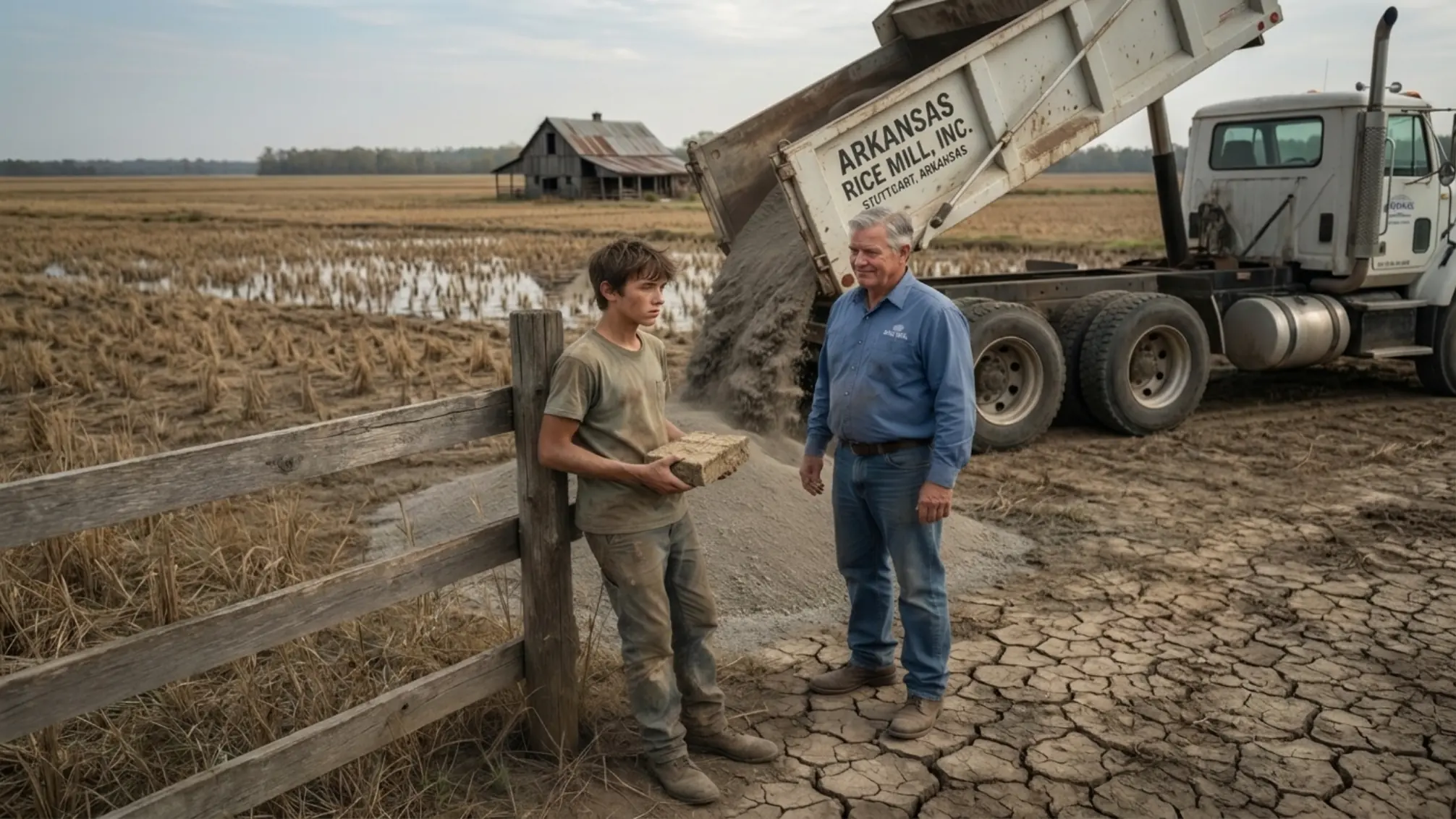
The farm had once produced corn, soybeans, and enough vegetables to supply three stores in the nearest town. After the Boy’s father died from a sudden heart condition, equipment payments, medical debt, and two dry summers consumed nearly everything the family possessed. His beautiful American Mother kept the household together by working mornings at a diner and evenings repairing clothes for neighbors. The Boy attended school only when the work at home allowed it, and every hour he missed made the bank’s approaching deadline feel heavier.
The neighboring rice mill had dumped husks beside the property for more than a decade. At first, the material came in pale, lightweight piles that scattered whenever the wind changed. Later, the mill installed a boiler and began unloading darker ash mixed with broken husks near the same fence. The Mill Owner claimed the waste was harmless and insisted the Boy’s father had once given verbal permission.
No signed agreement existed.
When the family complained about dust settling on their porch, the Mill Owner sent a crew to spray water over the piles. When the runoff flowed across the property and hardened parts of the field, he said the drought was responsible. Each complaint ended the same way—with the Mill Owner reminding them that he employed half the town and could make business difficult for anyone who opposed him.
After the Boy’s father died, the Mill Owner stopped pretending to be polite.
He offered to buy the entire farm for less than the remaining mortgage. He wanted the roadside frontage for a larger loading yard and the back acreage for another waste-storage site. The Mother nearly accepted because she saw no other way to keep her son fed and finish paying the hospital bills.
The Boy refused to sign.
“This land is failing,” his Mother told him one night. “Loving it will not make the bank patient.”
“I’m not asking the bank for love.”
“What are you asking for?”
“Time to find out why he wants it so badly.”
The Boy began studying the mill before studying the soil. He counted the number of trucks arriving each week and estimated how much the company spent hauling waste elsewhere when the piles near the farm became too large. He followed public records at the county office and discovered the mill had recently been warned that its storage capacity was nearly exhausted.
The Mill Owner did not simply want more land.
He needed somewhere cheap to place thousands of tons of waste.
That discovery gave the Boy leverage but not income. The bank would not postpone foreclosure because the Mill Owner had a disposal problem. The family needed money, and the farm’s next crop could not provide it.
The idea began after a lightning strike destroyed a neighboring poultry barn.
The fire moved through dry timber so quickly that the farmer lost the building before volunteers arrived. During the cleanup, the Boy noticed several old concrete blocks remained standing while the wooden walls became blackened debris. He also noticed a thin layer of ash from the rice mill had hardened where rainwater mixed it with clay near the fence.
He broke a piece loose with his shovel.
It was ugly, rough, and surprisingly strong.
The Boy took the fragment into the barn and struck it against the workbench. It chipped but did not crumble. He soaked another piece overnight and found it held together better than the dry clods across the field.
He knew almost nothing about construction materials, but he understood experiments.
His father had taught him never to trust a single successful repair. Test it twice, change one thing, and test it again. The Boy collected small amounts of rice-husk ash, clay from the drainage ditch, and chopped straw left from old bales. He pressed the mixture into wooden molds and allowed the first blocks to dry behind the barn.
Most failed.
Some cracked down the center. Others dissolved after rain. One became so brittle that the Boy crushed it accidentally while lifting it.
The Mill Owner’s workers saw the broken pieces and laughed.
“He’s making mud toys now,” one man shouted across the fence.
The Boy ignored him.
He changed the ratios, adjusted the moisture, and built a small hand-operated press using parts from a broken hay baler. He wrote every mixture in a notebook and marked each block with a number. His Mother believed he was distracting himself from the inevitable foreclosure, but she still helped him carry samples beneath the shed whenever rain threatened.
The first real breakthrough came from Sample Thirty-Seven.
It was denser than the others, lighter than concrete, and remained intact after three days in water. The Boy placed it beside an ordinary clay brick and directed the flame from a controlled propane torch toward both surfaces. The brick heated rapidly and cracked. Sample Thirty-Seven darkened but remained solid.
His Mother stared at it.
“What exactly did you make?”
“I don’t know yet.”
“That is not comforting.”
“It could be useful.”
“Useful enough to save a farm?”
The Boy looked toward the ash piles beyond the fence. “Maybe useful enough that the farm doesn’t have to stay a farm.”
That possibility frightened them both.
The property had belonged to the family for three generations. Every story about the Boy’s father began in one of its fields, barns, or irrigation ditches. Turning away from crops felt like admitting that years of sacrifice had failed.
Yet the Boy understood something his father had not lived long enough to accept. Saving land did not always mean forcing it to produce the same thing forever. Sometimes preserving a home required changing what the land was asked to become.
The Boy contacted a technical college forty miles away. He sent photographs, measurements, and a short explanation of his tests to the materials department. Most messages received no answer.
One instructor finally replied.
The Instructor was a handsome fifty-year-old American engineer who had spent years studying affordable building materials for rural communities. He arrived in an old pickup expecting to find an exaggerated school project. Instead, he found more than sixty labeled samples, water-resistance notes, weight comparisons, and a crude but functional compression press.
“You did all this alone?” the Instructor asked.
“My mother carried the heavy ones.”
The Instructor smiled. “Then you did not do it alone.”
He tested Sample Thirty-Seven with portable equipment and confirmed that the material contained silica from the burned rice husks. Properly processed and combined with suitable binders, it could contribute to strong, heat-resistant blocks. The Boy’s version was not ready for homes, but it might work for sheds, animal shelters, firebreak walls, and non-load-bearing structures.
The Instructor gave him one warning.
“If you start selling these before proper testing, one failure could destroy more than your business.”
“I don’t want to sell what I can’t prove.”
“That answer is why I’m willing to help.”
Together, they designed a formal trial.
The college tested compression strength, moisture absorption, heat resistance, and consistency. The Boy built improved molds and created several hundred blocks using controlled batches. His Mother kept records of every ingredient and cost while continuing her jobs in town.
The results were not miraculous.
The blocks could not replace reinforced concrete. They were unsuitable for foundations, bridges, or tall walls. But they were inexpensive, light enough for small crews to handle, and far more resistant to heat than ordinary wood construction.
That was enough to create an opportunity.
A brushfire had recently destroyed three county equipment sheds and damaged two livestock barns. The county needed inexpensive replacement structures before winter. The Instructor introduced the Boy to the County Works Director, who agreed to review a small demonstration wall.
The Boy built it at the edge of his farm.
The Mill Owner arrived before the county inspection began. He stood behind the fence with two workers and laughed at the gray blocks stacked in neat rows.
“You’re building a grave for this farm,” he said.
The Boy held up one finished block. “Come back tomorrow.”
The Mill Owner looked toward the county vehicle approaching along the road. His expression changed for only a second.
The County Works Director examined the test wall, reviewed the college results, and watched a controlled heat test performed by the Instructor. The surface blackened, but the wall remained standing. He walked around it twice before asking the Boy how many blocks he could produce in thirty days.
“Enough for three small equipment sheds if I can get consistent ash.”
The Mill Owner stepped forward. “That material belongs to my company.”
The Boy turned toward him. “You dumped it onto our property.”
“That does not transfer ownership.”
“You called it waste.”
“It remains company waste.”
The County Works Director looked between them. “Do you have a disposal agreement?”
The Mill Owner claimed one existed but could not produce it. He argued that the ash had commercial value only because his company created it.
The Boy answered calmly. “Your company paid trucks to get rid of it.”
The Director approved a limited county order, provided every batch passed inspection. The contract was not large enough to save the farm by itself, but it included an advance payment sufficient to delay foreclosure for three months.
For the first time since his father died, the Boy saw a path forward.
The Mill Owner saw a threat.
The following morning, he placed guards beside the waste piles and ordered every truck to stop unloading near the family’s land. He then demanded that the Boy return all ash already dumped beyond the fence.
The Mother laughed when she heard the demand.
“He wants us to shovel ten years of his garbage back to him?”
“He wants control.”
The Boy examined the piles already inside the property boundary. There was enough material for the county order, but not enough for long-term production. If he could not secure a reliable source, the business would end before it truly began.
Other rice mills existed across Arkansas, yet transportation costs could erase the savings that made the blocks competitive. The Boy needed either a supply contract or a different source.
He contacted three mills anyway.
Two ignored him. One requested a meeting.
A smaller family-owned mill agreed to provide clean rice husks if the Boy arranged transportation. Unlike the neighboring company, it did not burn all its husks. The material would require processing before use, adding expense and complexity.
The Instructor helped design a safer controlled system for preparing small batches. The Boy recruited two unemployed farm workers and trained them to record temperatures and separate unsuitable material. His Mother negotiated fuel prices and found a trucking company willing to make return trips at a discount instead of driving empty.
The county sheds began rising.
Local workers assembled the first walls in half the time expected because the blocks were lighter than standard masonry. The structures still required conventional framing and roofing, but their lower walls offered better protection from grass fires. Inspectors tested each batch and rejected several that failed moisture standards.
The Boy did not hide the failures.
He replaced them at his own expense.
That honesty impressed the County Works Director more than perfect marketing would have. When the first three sheds passed final inspection, the county issued a second order for fire-resistant storage walls near two volunteer fire stations.
The local newspaper published a photograph of the Boy standing beside the finished structure. The headline described him as the teenager who turned abandoned mill waste into county buildings.
The Mill Owner hated the word abandoned.
He visited the bank and offered to purchase the family’s loan at full value. The Bank Manager considered the offer because the Boy’s new business remained uncertain. If the loan changed hands, the Mill Owner could demand immediate compliance with every clause and push the property into default.
The Mother discovered the plan during a scheduled meeting.
“You said we had three months,” she told the Bank Manager.
“You do, under current ownership of the note.”
“And if he buys it?”
“He may exercise rights permitted by the contract.”
The Boy asked to see the original loan.
Several clauses allowed foreclosure if the property changed from agricultural use without written permission. The Mill Owner expected to argue that block production violated the farm classification.
The Boy noticed something else.
The loan required the bank to provide thirty days’ written notice before transferring the debt to any outside buyer. The family had received no notice. The Bank Manager claimed the transfer had not yet occurred.
“Then do not pretend it is inevitable,” the Boy said.
The Manager looked offended. “You are seventeen.”
“And I can still read thirty days.”
The Mother requested formal notice of every future action and sent a copy to the state banking regulator. The bank delayed the sale, unwilling to attract an investigation over a relatively small farm loan.
The Mill Owner changed tactics.
He reported the Boy’s operation for illegal industrial manufacturing. County inspectors arrived expecting smoke, chemical storage, and unsafe equipment. They found a clean yard, labeled materials, protective equipment, and records maintained more carefully than many established businesses.
The inspectors did identify improvements the Boy needed to make. He required better dust control, a covered curing area, and a formal wastewater plan. Compliance would cost nearly the entire profit from the county contract.
The Boy considered ignoring the requirements until the next payment arrived.
His Mother refused.
“We cannot build a future by repeating the Mill Owner’s mistakes.”
“If we spend everything now, we may miss the bank payment.”
“And if one worker becomes sick because we chose money over safety, what exactly have we saved?”
The Boy knew she was right.
They used their profit to install collection equipment, protective enclosures, and drainage controls. The bank payment became uncertain again, but the operation passed inspection and earned a permit that the Mill Owner had assumed they could never obtain.
Then a summer fire changed everything.
Dry grass ignited beside the highway and moved toward several farms under strong wind. Volunteer crews struggled to contain it. Flames reached one of the county equipment sheds built with the Boy’s blocks.
The wooden roof was damaged.
The lower block walls remained standing.
Firefighters sheltered equipment behind the wall long enough to move fuel tanks away from the advancing flames. The barrier did not stop the entire fire, but it slowed the spread at a critical point and protected machinery the county could not afford to replace.
News stations arrived the next morning.
The Boy refused to call the blocks fireproof. He explained that they were fire-resistant and only one part of a properly designed structure. His careful language made reporters trust him more.
Orders followed from farmers, volunteer fire departments, and two rural school districts seeking protective storage walls. The business suddenly had more demand than the family could handle.
The Mill Owner appeared at the farm with a contract.
He offered unlimited ash at a low price in exchange for fifty-one percent ownership of the block company. He would provide trucks, workers, equipment, and access to his commercial clients.
The Mother read the agreement and pushed it back across the table.
“You tried to take our farm.”
“Business is business.”
“You forged nothing, threatened no one, and blocked no roads this time,” she said. “That is an improvement.”
The Mill Owner looked at the Boy. “You need scale. Without me, you will disappoint these customers and lose everything.”
The Boy knew the warning contained truth. Demand could destroy a young business as easily as failure. If he accepted too many orders and produced weak batches, his reputation would collapse.
But surrendering control would allow the Mill Owner to cut costs, lower quality, and eventually remove the family from the operation they created.
The Boy refused.
Instead, he contacted every small rice mill that had waste problems and invited them to a public meeting at the technical college. He proposed a regional cooperative. Mills would supply husks under transparent contracts, farmers would invest in small processing sites, and the college would oversee quality standards.
At first, no one believed competing businesses would cooperate.
Then the Instructor presented the numbers.
Mills spent money storing or transporting waste. Farmers needed new income after years of poor crop prices. Counties needed affordable, fire-resistant construction materials. A cooperative could solve several problems without allowing one company to control the entire chain.
Five mills joined.
The neighboring Mill Owner did not.
The cooperative’s first processing building was constructed on a barren section of the Boy’s farm where crops had failed repeatedly. The healthy western acreage remained agricultural, leased to a neighboring farmer under a profit-sharing agreement. The family no longer depended on forcing every acre to grow corn or soybeans.
The land became two things at once.
Part farm.
Part manufacturing yard.
The Bank Manager visited after the cooperative signed its first major regional contract. The income projections exceeded anything the property had produced through crops alone. He offered the family a new commercial loan with better terms.
The Boy declined until another bank reviewed the proposal.
The Manager looked surprised. “We supported you.”
“You nearly sold our debt to the man trying to take our property.”
“That was a business consideration.”
“So is this.”
A community bank financed the expansion instead.
The original mortgage was paid off before the Boy’s nineteenth birthday.
The Mill Owner’s problems grew. Environmental inspectors reviewed his waste-storage practices after photographs showed ash piles spreading beyond approved boundaries. Records revealed the company had understated the volume dumped near the farm for years.
The mill was ordered to remove unstable piles, control dust, and contribute to restoring damaged drainage areas. The cost exceeded what a fair disposal contract with the cooperative would have required.
The Mill Owner finally asked to join.
The Boy did not refuse immediately.
He brought the request before the cooperative members. Several wanted revenge, arguing that the Mill Owner should be excluded after years of bullying smaller farmers.
The Boy understood the anger.
He also understood that thousands of tons of material would continue to exist whether they welcomed the mill or not. If managed responsibly, the waste could support jobs and construction. If rejected out of spite, it might simply be dumped somewhere else.
The cooperative approved the mill under strict conditions.
It received no special voting power. Every shipment had to meet quality standards. Past cleanup orders remained the Mill Owner’s responsibility. Pricing would be public, and contracts could not be used to control farmers’ land.
The Mill Owner signed because he had no better option.
Months later, he returned to the same fence where he had once laughed at the Boy. The giant uncontrolled piles were gone, replaced by covered storage buildings and marked containers. County trucks waited beside the cooperative yard for another shipment of finished blocks.
“You could have owned all of this with me,” the Mill Owner said.
The Boy rested his arms on the fence. He was taller now, stronger, and no longer looked like someone waiting for an adult to recognize his authority.
“No. You would have owned it.”
“You think a cooperative will stay loyal forever?”
“It doesn’t need loyalty.”
“What does it need?”
“Rules strong enough that no one man gets to decide everyone else’s future.”
The Mill Owner looked toward his former workers loading material under the cooperative supervisor. Several now earned higher wages than the mill had ever paid them.
“You cost me control of this county.”
The Boy shook his head. “You lost it when you thought control mattered more than people.”
The family did not become wealthy overnight. Manufacturing remained difficult. Some batches failed, contracts arrived late, and equipment broke at the worst possible moments. Yet every setback belonged to a future they had chosen rather than a decline someone else had designed for them.
The Mother left the diner but continued managing the company books. She kept her sewing customers because she enjoyed the work and refused to let success convince her that honest labor had become beneath her. She also established an emergency fund for cooperative workers whose families faced medical bills, remembering how quickly one illness had nearly erased her own home.
The Boy completed high school and studied materials engineering at the technical college while continuing to work at the cooperative. He did not abandon the farm or become embarrassed by his beginning. His classroom knowledge improved the blocks, reduced waste, and helped the company develop panels for barns, storage sheds, and firebreak structures.
The original Sample Thirty-Seven remained on a shelf inside the office.
It was uneven, chipped, and far weaker than the products eventually approved for construction. Visitors often assumed it had been preserved because it represented success.
The Boy corrected them.
“It represents the first failure that taught me enough to keep going.”
Five years after the first county order, a new volunteer fire station opened near the highway. Its storage walls used the cooperative’s latest blocks, and a plaque near the entrance recognized local farmers, mill workers, instructors, and county crews who had built the project together.
The Boy’s Mother stood beside him during the dedication.
“Your father wanted you to inherit a farm,” she said.
“I did.”
She looked toward the processing yard, the leased fields, and the cooperative trucks moving along the road. “This is not the farm he imagined.”
“No.”
“Do you think that would hurt him?”
The Boy considered the question.
“I think losing it because I was afraid to change would have hurt him more.”
His Mother took his hand.
The Mill Owner attended the ceremony but remained near the back. He no longer controlled the county’s processing contracts, waste routes, or farmers’ choices. Yet his mill survived because the cooperative gave it a responsible market for material he once treated as worthless.
That was the result no one expected.
The Boy did not destroy the mill.
He removed its power to destroy everyone else.
People later simplified the story. They said a clever farm boy watched trucks dump ash beside his dying fields, turned the waste into construction blocks, and saved his family’s land.
The truth was larger.
He tested dozens of failures, accepted outside expertise, followed safety rules even when compliance threatened his bank payment, and refused an investment that would have taken control away from his family. Most importantly, he built a system that did not depend on one powerful owner behaving kindly.
The dump trucks had arrived to bury the farm.
Instead, they delivered the material that allowed the Boy to rebuild its purpose.
The Mill Owner believed land was valuable only when he controlled it.
The Boy proved value could be created by people willing to share it.