A hundred motorcycles rolled down Maple Street that morning.
The engines shook the windows.
Kids froze on the sidewalk.
Chrome, leather, crimson patches, and headlights stretched for two full blocks, turning the quiet neighborhood into something that felt almost unreal.
Curtains moved in every house.
Doors opened.
People stepped onto porches holding coffee mugs, phones, and confused expressions.
Nobody on Maple Street had ever seen anything like it.
And at the end of the street, standing on a cracked driveway in a faded work hoodie, was a thirty-three-year-old single dad named Mason Adams.
His seven-year-old daughter, Lily, stood behind him, holding tightly to the back of his sweatshirt.
Her eyes were wide.
His hands were shaking.
Three weeks earlier, Mason had spent his last ten dollars helping a stranger on the side of the road.
The stranger did not explain who he was.
He barely said thank you.
He just handed Mason a cream-colored card, started his motorcycle, and rode away into the rain.
Mason thought that was the end of it.
He thought he had simply lost ten dollars he could not afford to lose.
But what he did not know was that the man he helped was not just an old biker with a flat tire.
He was Earl Dawson.
Founder of Dawson Iron and Steel.
President of the Crimson Reapers Motorcycle Club.
A man with more money than Mason could imagine and less time left than anyone around him wanted to admit.
And when Earl told his club what Mason had done, a hundred bikers decided one quiet single father was about to learn that kindness does not disappear just because nobody sees it.
But before the motorcycles came, before the cameras, before the tears, before Mason’s daughter watched her father’s entire life change in the driveway, you need to understand what ten dollars meant to Mason Adams.
Because for some people, ten dollars is nothing.
A sandwich.
A coffee.
Loose cash forgotten in a glove compartment.
But for Mason, ten dollars was the difference between getting through the week and starting over from nothing again.
Mason’s alarm went off at 5:00 every morning.
Not because he wanted to wake up early.
Because single fathers do not get to sleep until life feels fair.
His day started before the sun came up, in a small two-bedroom rental house with thin walls, uneven floors, and a heater that made a knocking sound whenever it tried too hard.
The kitchen faucet leaked.
The back door didn’t close unless you lifted it while turning the lock.
The living room carpet had a stain shaped vaguely like Texas from the time Lily spilled grape juice and tried to clean it herself with dish soap.
It was not much.
But it was clean.
Mason made sure of that.
His mother had once told him, “Poor is a situation. Dirty is a decision.”
So every night, no matter how tired he was, Mason washed dishes, wiped counters, swept the floor, packed Lily’s lunch, and laid out her clothes for school.
Lily was seven years old, all bright eyes, loose curls, and questions that never seemed to end.
She had asthma that got worse in cold weather, a laugh that could make Mason forget every overdue bill for three seconds, and the kind of heart that made her give away half her snack even when she was still hungry.
Her mother left when Lily was two.
No dramatic goodbye.
No big fight.
Just a note on the kitchen counter one morning.
I can’t do this anymore.
Mason had read it while Lily slept in her crib, one tiny hand curled under her cheek.
He never heard from her again.
At first, Mason thought grief would be the hardest part.
He was wrong.
The hardest part was explaining absence to a child who kept asking when Mommy was coming back.
The hardest part was learning how to braid hair by pausing videos on his phone.
The hardest part was working ten-hour shifts and still showing up at parent-teacher night with oil under his fingernails because Lily had drawn him a picture and expected him to be there.
The hardest part was smiling when Lily asked, “Are we okay, Daddy?”
And answering, “Always,” even when rent was due and the fridge was almost empty.
Mason worked at a small auto repair shop on the edge of Redville during the day.
At night, three times a week, he stocked shelves at the Fuel and Go gas station off Route 12.
He was good with engines.
Better than good.
People who knew cars could tell within ten minutes that Mason understood machines in a way that could not be taught from manuals alone.
He listened to engines.
Not just heard them.
Listened.
A loose belt, a failing bearing, a fuel pump beginning to struggle, the faint timing irregularity that would become a breakdown two weeks later if ignored.
He heard all of it.
But skill did not mean security.
The shop paid by the hour, not by talent.
The gas station paid less.
Most of Mason’s money went to rent, groceries, Lily’s inhalers, school fees, and gas for his old pickup truck.
His truck was a 1998 Ford Ranger with one rusted fender, a cracked windshield, and a driver’s seat that leaned slightly to the left no matter what he did.
Lily loved it anyway.
She called it Old Blue, even though the paint had faded into something closer to gray.
Every morning, Mason made her breakfast before school.
Usually eggs if they had them.
Toast if they did not.
On lucky weeks, oatmeal with brown sugar.
On harder weeks, peanut butter folded into bread and cut into triangles because Lily said triangles tasted better.
That morning, like every morning, Lily sat at the kitchen table swinging her feet while Mason packed her lunch.
“Daddy,” she said, watching him spread peanut butter thinly across bread, “when you have your own garage, will I get to paint the sign?”
Mason paused.
On the refrigerator, held up by two mismatched magnets, was a drawing Lily had made when she was five.
A little garage with three bay doors.
A smiling man holding a wrench.
A little girl standing beside him wearing a crown.
Above the building, in crooked purple letters, it said:
Adams Auto.
Mason looked at that drawing every morning.
And every morning, he looked away a little faster.
Dreams were heavy when you had to carry them beside utility bills.
“Of course,” he said. “You’re the official sign painter.”
“I’ll make it purple.”
“Purple?”
“And yellow stars.”
“Very professional.”
“It’ll be famous.”
Mason laughed softly and closed her lunchbox.
“Eat all your carrots today.”
“I’ll think about it.”
“You’ll eat them.”
“I’ll consider the business proposal.”
He looked at her.
“You’re seven.”
“I’m advanced.”
He kissed the top of her head.
“You are trouble.”
She grinned.
Every morning, that grin got him through the first half of the day.
But money was tight.
Tighter than usual.
Under Mason’s bed, inside an old work boot box, he kept seventy-six dollars in cash.
It had taken him almost six months to save it.
A few dollars from side jobs.
Tips from grateful customers.
Cash left over after choosing the cheaper groceries.
He was saving for a used diagnostic scanner.
A real one.
Not the cheap basic kind that only read simple codes, but a professional-grade OBD-II scanner that could help him take side repair jobs seriously.
It was the first step toward something bigger.
Not a garage yet.
Not Adams Auto with the purple sign and yellow stars.
Just one tool.
One piece of proof that the dream was not dead.
Every Sunday night, after Lily fell asleep, Mason counted the money and wrote the total on the inside of the box lid.
Seventy-six dollars.
Almost there.
That was what he told himself.
Almost there.
But life has a way of testing people right before they reach for something better.
And Mason’s test came on a rainy afternoon on Route 12.
It started with Lily’s school calling.
She had forgotten her inhaler at home.
A cold wind had moved in that morning, and her breathing had started to tighten during recess.
Nothing dangerous yet, the nurse said.
But Mason’s heart nearly stopped anyway.
He left work early, which meant losing two hours of pay, drove home, grabbed the inhaler from the kitchen counter, and rushed to the school.
Lily was sitting in the nurse’s office when he arrived, small legs dangling from the exam cot.
“I’m okay,” she said immediately, because she knew his face.
“I know,” Mason said, though his voice betrayed him.
He knelt in front of her and watched her take the inhaler properly.
In.
Hold.
Out.
Again.
Her breathing eased.
His didn’t.
The nurse smiled kindly.
“She’s fine now. Just keep an eye on her tonight.”
Mason nodded.
He wanted to stay with Lily.
Wanted to take her home.
But she had a spelling test, and he had already missed work, and the gas station shift started at four.
This was the math of his life.
Love on one side.
Money on the other.
Never enough of either to feel safe.
After school, he picked Lily up and dropped her at Mrs. Alvarez’s house across the street. Mrs. Alvarez watched Lily when Mason worked late, refusing to accept more than twenty dollars a week even though he knew she deserved more.
At three-thirty, Mason pulled out his wallet.
He had fifteen dollars in cash.
Ten of it was supposed to go into the boot box, replacing what he had borrowed earlier that week for groceries.
Five was for gas.
He put five dollars into Old Blue’s tank, watched the needle barely move, and headed toward Fuel and Go for his evening shift.
Route 12 cut through a lonely stretch of pine and open fields before reaching the gas station.
On clear days, it was almost pretty.
On storm days, it felt like the edge of nowhere.
The sky had been threatening rain all afternoon.
By four o’clock, the clouds had lowered into a bruised wall of gray, and the wind pushed hard against the truck.
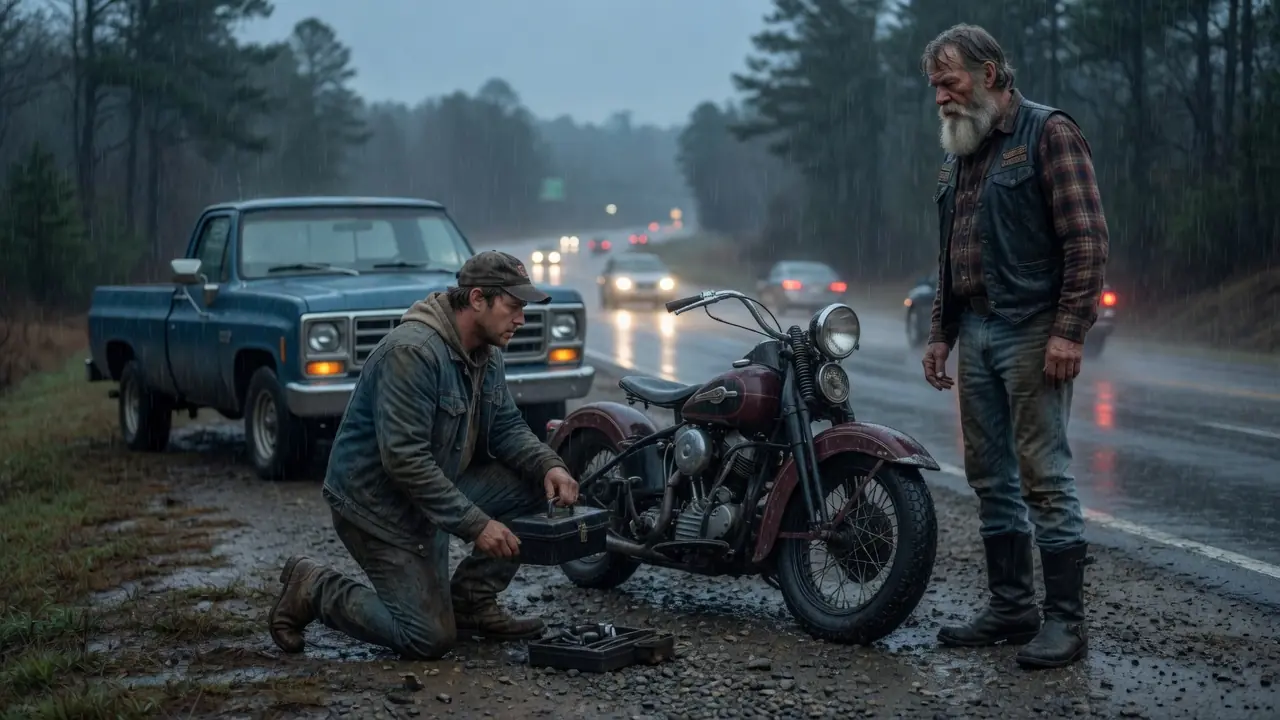
Mason was twelve minutes from work when he saw the motorcycle.
It sat on the shoulder, huge and low, chrome dulled by the first drops of rain.
A vintage Harley.
Not one of those polished weekend toys, either.
This bike had history in it.
Miles.
Weather.
A thousand stories in the vibration of its frame.
The rear tire was shredded.
Beside it stood an older man with a silver beard, a leather vest over a flannel shirt, and the posture of someone who had survived too many hard roads to ask politely for anything.
Mason slowed.
His first thought was to stop.
His second thought was his shift.
He had already been warned once about being late.
If he lost this gas station job, even temporarily, the week would break apart.
Rain began to hit the windshield harder.
The old biker stood with his arms crossed, staring at the tire.
No phone in his hand.
No help nearby.
No shelter.
Mason looked at the dashboard clock.
Then at the man.
Then at the darkening sky.
He muttered under his breath.
“Come on, Mason.”
He pulled onto the shoulder.
The truck jerked slightly as it stopped on gravel.
Mason stepped out, pulling up his hood.
Rain slapped cold against his face.
The old biker turned slowly.
His eyes moved over Mason.
The faded hoodie.
The work pants.
The tired face.
The rusted truck.
He did not speak.
Mason walked closer.
“Sir, you need help?”
The man looked back at the tire.
“Tire’s done.”
His voice was flat.
Rough.
Giving away nothing.
Mason crouched beside the wheel.
“Yeah. It’s shredded pretty bad.”
The old man said nothing.
Mason glanced toward the empty road.
“You got anyone coming?”
“No signal.”
“You got a spare tube?”
“No.”
“Nearest shop is Grady’s Tire Barn. Maybe four miles up.”
The old biker’s mouth tightened.
“I know.”
Mason looked at him.
Then at the tire.
Then at the rain.
He should leave.
He knew that.
He should give the man directions and get to work.
Instead, he walked back to Old Blue and opened the tailgate.
Inside, he kept a small tool bag, a cheap tire patch kit, jumper cables, two rags, a flashlight, and a jack that barely worked.
Nothing fancy.
But enough to try.
He carried the kit back.
The old man watched him.
“You know bikes?”
“Cars mostly,” Mason said. “But wheels still believe in physics.”
The man’s beard moved slightly.
Maybe a smile.
Maybe not.
Mason knelt on the wet gravel.
Within minutes, his jeans were soaked.
The rain intensified.
The rear tire was heavier than anything he could comfortably manage with the tools he had. The patch kit was cheap. Too cheap. The rubber was badly damaged, and the first patch failed almost instantly.
Mason peeled it off, cleaned the surface again, and tried a second time.
That one slipped.
The old biker watched silently.
Not offering help.
Not offering criticism.
Just watching.
Mason did not know that the old man’s left shoulder had been damaged years ago in a wreck and barely lifted past a certain point.
He did not know that the man’s heart had been failing for months.
He did not know that the old biker physically could not kneel in the rain beside him even if pride allowed it.
All Mason knew was that he was struggling alone while the stranger stood there saying nothing.
Still, he kept working.
His fingers went numb.
Rain blurred his vision.
Gravel dug into his knees.
He checked the time once and cursed under his breath.
Late now.
Definitely late.
The old man finally spoke.
“You’re going to lose skin off those knees.”
Mason didn’t look up.
“Already lost dignity fixing a minivan last week. Knees are cheaper.”
The old man’s mouth twitched.
That time, Mason saw it.
The third patch held, but not well enough.
Mason pressed his thumb along the edge and knew the truth immediately.
“This won’t get you far.”
The old biker looked down.
“How far?”
“Maybe a mile. Maybe less. But Grady’s has tubes. If he’s still open.”
Mason pulled out his phone and called.
Grady answered on the fifth ring.
“Need a tube that’ll fit an old Harley rear tire,” Mason said.
Grady grunted.
“Got one. Ten bucks. Cash.”
Mason closed his eyes.
Ten dollars.
There it was.
The exact amount sitting in his wallet.
The ten dollars meant for the boot box.
The scanner fund.
The dream fund.
The little proof that he was building something for Lily and himself beyond survival.
He looked at the old biker.
Rain ran down the man’s beard.
He still had not asked for anything.
That somehow made it worse.
Mason looked at the road.
No traffic.
No houses close by.
The light fading fast.
He could leave.
He had every reason to leave.
But then he imagined Lily years from now, stranded somewhere, waiting in the rain while people drove past because helping was inconvenient.
That thought made the decision for him.
Mason stood.
“I’ll be back.”
The old man’s eyes narrowed.
“Where are you going?”
“To get the tube.”
“You got cash?”
Mason hesitated.
“Enough.”
The old man said nothing.
Mason drove to Grady’s, bought the tube, and watched the last ten-dollar bill disappear into the register.
He came back twenty minutes later.
The old biker was exactly where he had left him.
Standing beside the Harley.
Rain falling around him.
But his expression was different now.
Not softer exactly.
More focused.
As if something had been confirmed.
Mason installed the tube carefully.
Not fast.
Not sloppy.
Correct.
He worked with the same attention he gave every repair, whether the customer paid full price or nothing at all.
By the time he finished, his hands were scraped, his hoodie was soaked through, and he was almost an hour late for work.
He stood and wiped his hands on his pants.
“That should hold until Cooperton,” he said. “There’s a Harley dealer off exit fourteen. Don’t push it too hard.”
The old biker looked at the tire.
Then at Mason.
“What’s your name?”
“Mason Adams.”
“You got a shop?”
Mason laughed once.
“Not unless you count my driveway.”
The old man reached inside his vest and pulled out a cream-colored card.
Thick stock.
Plain.
Just a name and number.
E. Dawson.
“You ever need anything,” the old man said, “you call that number.”
Mason accepted the card, too tired and wet to think much of it.
“Thanks.”
The old man climbed onto the Harley.
The engine kicked to life, deep and rough, like thunder under the road.
He pulled away without another word.
Mason stood there until the taillight vanished in the rain.
Then he got back in Old Blue and drove to the gas station.
He clocked in fifty-eight minutes late.
His manager docked his pay.
Mason did not explain.
He stocked the cooler with cold hands and wet socks, then worked until midnight.
When he got home, Lily was asleep on Mrs. Alvarez’s couch with Mr. Waffles, her stuffed bear, tucked under her chin.
Mrs. Alvarez opened the door before he knocked.
“You look like something the storm dragged in.”
“Feel like it too.”
“Did you eat?”
“Yes.”
She gave him a look.
He sighed.
“No.”
She handed him a foil-covered plate.
“I made too much.”
“You always say that.”
“And you always take it because you are not foolish.”
Mason took it.
“Thank you.”
He carried Lily home in the rain, her small arms around his neck, her breath warm against his shoulder.
Inside their house, he changed her into dry pajamas, tucked her into bed, and checked her inhaler on the nightstand.
Then he sat on the floor beside her bed for a long time.
Only when her breathing stayed steady did he go to his room.
The cream card was still in his pocket.
He set it on the dresser.
E. Dawson.
He pulled the boot box from under the bed and counted the money.
Seventy-six became sixty-six.
He stared at the total.
Then wrote the new number inside the lid.
The loss hurt.
More than he wanted to admit.
He slid the box back under the bed, turned off the light, and lay down fully dressed.
The next morning, Lily noticed his scraped hands.
“Daddy, what happened?”
“Helped someone with a tire.”
“Did they say thank you?”
Mason thought about the old man.
The card.
The silence.
“Sort of.”
Lily frowned.
“Sort of is not enough.”
He smiled faintly.
“No?”
“If someone helps, you say thank you properly.”
“I’ll remember that.”
Over the next week, nothing changed.
That was what made the decision feel heavier.
No miracle followed.
No sudden reward.
No stranger returned with money.
Mason still worked.
Bills still waited.
Lily still needed her inhaler.
Old Blue still coughed before starting.
The ten-dollar loss bit into the week.
Mason skipped lunch twice.
Told Lily he was eating at work.
Mrs. Alvarez sent leftovers more than usual and pretended not to know why.
Life went on.
And Mason tried not to think about the card on his dresser.
But Earl Dawson thought about Mason every day.
Sixty miles away, outside Harlan, Earl sat on his porch beneath an awning while rain dripped from the roof in slow, steady lines.
His Harley stood in the barn with a proper new tire.
His chest ached more often now.
The doctors had told him to slow down.
No more long rides alone.
No more stress.
No more pretending his heart was stronger than it was.
Earl had listened politely.
Then done exactly what he wanted.
He had built Dawson Iron and Steel from a single welding rig in a rented shed. He had ridden through forty states. He had buried friends, outlived enemies, and led the Crimson Reapers Motorcycle Club for nearly four decades.
He was not afraid of death.
But he was afraid of leaving one debt unpaid.
On his desk sat a framed photograph of a man in front of a small welding shop in Nashville.
Solomon Fletcher.
The man who had found Earl at sixteen, sleeping behind a dumpster, hungry, angry, and certain the world had already made up its mind about him.
Solomon had fed him.
Given him a cot in the back of the shop.
Put a welding torch in his hand and taught him how to use it.
“Hands that know how to work never have to beg,” Solomon had said.
Earl had built his whole life from that sentence.
Then he had become too busy to go back often enough.
Too successful.
Too important.
Too full of excuses.
Solomon died alone in that same shop ten years earlier.
Earl had never forgiven himself.
Now, after Route 12, he saw Solomon everywhere in Mason Adams.
Not because they looked alike.
They didn’t.
But because of the way Mason helped.
Quietly.
Without asking.
Without performing goodness for applause.
A man with almost nothing spending his last ten dollars on a stranger who had not even thanked him properly.
That kind of heart was rare.
Earl picked up the phone.
“Tommy,” he said when the call connected. “I need you to look into someone.”
Tommy Braddock, vice president of the Crimson Reapers and the closest thing Earl had to a brother, listened without interrupting.
“Mason Adams,” Earl said. “Single father. Works at a repair shop and a gas station near Redville. Daughter named Lily.”
Tommy was quiet for a moment.
“Route 12?”
“Yeah.”
“He the one?”
Earl looked at Solomon’s photograph.
“He might be.”
Over the next two weeks, small things happened around Mason.
Things he did not understand.
A man in a leather jacket came into the gas station one night and asked casually if he liked working on cars.
Mason answered politely.
The man bought a two-dollar coffee and left a five-dollar tip.
A woman called the gas station asking about Mason’s work experience and whether he had ever considered formal automotive training.
His manager shrugged and said it was probably some nonprofit survey.
A dark blue pickup parked near his street two mornings in a row.
Mason noticed a crimson sticker on the bumper but couldn’t make out the design.
He told himself he was being paranoid.
Then, on a Tuesday afternoon, Tommy Braddock walked into the Fuel and Go.
The bell above the door rang.
Mason looked up from the register.
The man in the doorway was huge.
Six feet four, with arms like bridge cables and a leather vest stretched over a broad chest.
On the vest was a crimson skull with crossed pistons beneath it.
Below the patch, stitched in white thread, were two letters.
VP.
Crimson Reapers MC.
Mason’s hand rested on the counter.
The man walked forward, set down a coffee, and looked at him calmly.
“Mason Adams?”
“Yes, sir?”
“You helped an old man on Route 12 a few weeks back. Big Harley. Flat tire. Rain coming down hard.”
Mason relaxed slightly.
“Yeah. Is he okay?”
“He’s okay because you stopped.”
The man extended his hand.
“Tommy Braddock. The man you helped is Earl Dawson.”
Mason shook his hand.
The name meant nothing to him.
Tommy noticed.
“Earl Dawson,” he repeated. “Founder of Dawson Iron and Steel. Built half the bridges in this state.”
Mason blinked.
Tommy continued.
“Also founding president of the Crimson Reapers. Three hundred members across four states.”
Mason stared at him.
“The motorcycle club?”
“That’s right.”
The gas station seemed suddenly too quiet.
Tommy leaned against the counter.
“Earl told me what happened. Told me you knelt in the rain for almost two hours. Told me you drove off and came back with a tube.”
Mason looked down.
“It was just ten dollars.”
“No,” Tommy said. “It wasn’t.”
Mason’s jaw tightened.
Tommy’s voice lowered.
“He saw you open your wallet. He saw you count what was inside. He saw you hesitate.”
Mason said nothing.
“That wasn’t spare money, was it?”
The question landed softly but hit hard.
Mason looked toward the window, where Old Blue sat under the gas station lights.
“No,” he said.
Tommy nodded.
Then he pulled out his phone and showed Mason a photograph.
A man in his fifties stood in front of a welding shop, smiling with a torch in his hand.
Faded writing at the bottom read:
Sal’s Shop, Nashville, 1989.
“This is Solomon Fletcher,” Tommy said. “When Earl was sixteen, Solomon found him sleeping behind a dumpster. Fed him. Gave him work. Taught him to weld.”
Mason studied the picture.
“Earl turned that skill into Dawson Iron and Steel,” Tommy continued. “Everything he owns started in that little shop. Solomon gave him a chance when nobody else would.”
Tommy put the phone away.
“Earl never paid it back while Solomon was alive. That regret’s been sitting in him for ten years.”
Mason swallowed.
Tommy looked him straight in the eye.
“When Earl saw a single dad with scraped-up hands and no money stop in the rain to help a stranger, he said it felt like Solomon had found him again.”
Mason’s eyes burned.
He blinked hard.
Tommy stepped back.
“Earl wants to see you Saturday. His place outside Harlan.”
Mason’s voice came out rough.
“I work Saturday.”
“Not anymore. Your gas station shift is covered.”
“What?”
Tommy smiled faintly.
“Earl’s persuasive.”
Mason almost laughed.
But he couldn’t.
His chest felt too tight.
Tommy turned to leave, then stopped at the door.
“One more thing,” he said.
Mason looked up.
“Bring your daughter.”
On Saturday morning, Mason dressed Lily in her best sweater and drove Old Blue to Harlan.
The truck rattled up a long gravel driveway lined with oak trees.
Lily sat in the passenger seat, gripping Mr. Waffles and staring out the window.
“Daddy,” she whispered, “are they scary bikers?”
Mason looked ahead at the rows of motorcycles already parked near a wide ranch-style house.
“Probably.”
Her eyes widened.
He smiled.
“But scary doesn’t always mean bad.”
At the end of the drive, Earl Dawson sat on the porch.
Same silver beard.
Same leather vest.
Same unreadable eyes.
But in daylight, Mason saw what the rain had hidden.
The man looked tired.
Not sleepy.
Worn down from the inside.
He stood slowly when Mason and Lily approached.
Lily hid behind Mason’s leg.
Earl looked down at her.
“You Lily?”
She nodded.
“I hear you wanted a purple sign.”
Her eyes widened.
Mason turned sharply toward Tommy, who stood nearby pretending innocence.
Lily stepped half out from behind her father.
“For Daddy’s garage.”
Earl nodded.
“Good color. Bold.”
Lily looked at Mason as if to say, See?
Earl led them toward a large workshop behind the house.
Mason stepped inside and forgot how to breathe.
Two hydraulic lifts.
Tool walls organized by size.
A welding station.
Diagnostic equipment.
Air compressor.
Motorcycle stands.
Everything clean, professional, and real.
The kind of shop Mason had only seen in videos.
Lily whispered, “Daddy.”
He could not answer.
Earl walked to a workbench where three chairs waited.
Coffee for the adults.
Hot chocolate for Lily.
She looked at Mason for permission.
He nodded.
She picked it up carefully.
Earl sat slowly.
“I’m going to say something,” he told Mason. “And you’re going to want to refuse before I finish. Don’t.”
Mason’s stomach tightened.
Earl leaned forward.
“I own a commercial lot in Redville. Corner of Maple and Fourth.”
Mason stopped moving.
The lot.
The empty lot.
The one with weeds through the concrete.
The one he saw every day and tried not to imagine.
Earl continued.
“I was going to sell it. I took it off the market.”
Mason’s mouth went dry.
“Why?”
“Because I’m leasing it to you.”
Mason stared.
“For a dollar a year.”
The room went silent.
Lily’s hot chocolate paused halfway to her mouth.
Mason shook his head.
“I can’t—”
Earl lifted one finger.
“I said don’t refuse before I finish.”
Mason closed his mouth.
“Dawson Iron and Steel has a community fund. It will cover the buildout. Lifts. Tools. Equipment. Licensing. Signage. Everything needed to open Adams Auto.”
Lily gasped.
“Daddy.”
Mason could not look at her.
If he looked at her, he would break.
Earl’s voice grew quieter.
“There’s a condition.”
Mason swallowed.
“What condition?”
“You don’t just run it as a business. You teach. You bring in kids who need a chance. Teenagers with nowhere to go after school. Young single parents who need a skill. Whoever the town is ready to throw away. You give them tools. You give them patience. You teach them work.”
Earl glanced at Lily.
“And you build something your daughter can be proud of.”
Mason pressed both hands against the edge of the bench.
“I don’t know how to run a shop.”
“You know how to work.”
“That’s not the same.”
“No,” Earl said. “But it’s where every good shop starts.”
Mason’s eyes filled despite his effort to stop them.
“Why me?”
Earl looked at Solomon’s photograph on the wall.
“Because somebody did it for me once.”
His voice roughened.
“And because on Route 12, you reminded me of him.”
Lily slipped her small hand into Mason’s.
He looked down at her.
Her eyes were full of wonder.
“Daddy,” she whispered, “Adams Auto.”
That did it.
Mason turned his face away, but tears came anyway.
He tried to hide them.
Failed.
Earl did not look away.
Neither did Tommy.
No one in that room treated his tears like weakness.
After a long moment, Earl reached across the table and placed a key in front of him.
Not a key to the lot.
Not yet.
A shop key.
Old, heavy, brass.
“Solomon gave me this when I was seventeen,” Earl said. “Opened the first welding shop I ever worked in. Kept it all these years.”
Mason stared at it.
“I can’t take that.”
“You can,” Earl said. “And you will. Because one day, you’ll hand someone else a key.”
Outside, engines began to rumble.
One motorcycle.
Then another.
Then ten.
Then twenty.
Lily jumped from her chair and ran to the window.
“Daddy!”
Mason stood.
Through the wide bay doors, he saw motorcycles rolling up the driveway in rows.
Chrome.
Leather.
Crimson patches.
The Crimson Reapers had arrived from four states.
One hundred riders.
They parked in formation across the yard.
Tommy walked outside and raised one hand.
The engines cut one by one until only the wind remained.
He turned to the crowd.
“Starting next Saturday, we build.”
A cheer rose.
“Adams Auto opens before winter.”
Another roar.
Not engines this time.
Voices.
Lily clapped both hands over her mouth.
Mason stood beside her, unable to move.
Tommy opened the back of his truck and pulled out a rolling tool cabinet.
Stainless steel.
Professional grade.
He pushed it across the gravel and stopped in front of Mason.
On the side, engraved in clean letters, were two words.
M. Adams.
Tommy nodded.
“From the club.”
Mason put one hand on the cabinet.
His fingers traced the engraving.
Then he looked at Lily.
She was crying too.
“Daddy,” she said, laughing through tears, “your name is on it.”
He knelt and pulled her into his arms.
“I see it, baby.”
Behind them, a hundred bikers stood quietly and let a single father hold his daughter while the future opened in front of them.
No one rushed him.
No one made a joke.
No one looked away.
Because some men understood that dignity sometimes looked like tears.
Over the next six months, the corner of Maple and Fourth changed.
Every Saturday, the motorcycles came.
The first week, they cleared the lot.
The second week, they poured concrete.
The third, steel framing went up.
The fourth, wiring.
Then plumbing.
Then insulation.
Then bay doors.
Then lifts.
Then tool walls.
The town came too.
At first, people watched from a distance.
Then curiosity became contribution.
The church ladies brought lunch.
A retired electrician offered help.
A teacher from Redville High asked if students could tour the site.
Jolene from the diner sent trays of food and refused payment.
Mrs. Alvarez brought Lily every Saturday and sat with her under a canopy while she drew design ideas for the sign.
Purple letters.
Yellow stars.
Earl came every week.
He sat in a folding chair near the edge of the lot, wrapped in his leather vest even when the weather turned cold.
Some days, he looked almost strong.
Other days, Mason noticed his hand pressing against his chest when he thought no one was watching.
Once, Mason brought him coffee and said, “You should go inside.”
Earl glared up at him.
“You running my job site now?”
Mason smiled.
“Trying to.”
Earl’s mouth twitched.
“Good.”
But Tommy watched Earl carefully.
And Mason began to understand that the old biker’s time was not unlimited.
Adams Auto opened on a cold Saturday morning in November.
The sign above the bay doors was exactly as Lily designed it.
Purple letters.
Yellow stars.
Adams Auto.
Underneath, in smaller print:
Repairs. Training. Second Chances.
Lily stood beneath it wearing a purple coat and a grin so big Mason thought his heart might split.
The first customer was Mrs. Alvarez.
Her minivan had been making a grinding sound for two months.
Mason fixed it in under an hour.
When she paid full price, he tried to argue.
She pointed a finger at him.
“You are a business owner now. Act like it.”
Lily nodded beside her.
“Yeah, Daddy. Act like it.”
The local news came.
Then regional news.
The story spread quickly.
A single dad helps a stranded biker with his last ten dollars.
Three weeks later, one hundred motorcycles help him build a garage.
People loved the headline.
But the real story was not the headline.
The real story was what happened after.
Mason hired his first apprentice two months later.
A sixteen-year-old named Devin who had missed more school than he attended and was one bad week away from dropping out completely.
Mason gave him a broom first.
Then a manual.
Then a wrench.
One system at a time.
Brakes.
Oil.
Belts.
Diagnostics.
Patience.
Respect.
“You don’t touch a car angry,” Mason told him. “You calm down first. Machines can feel when your hands are stupid.”
Devin laughed.
Then learned.
By spring, Adams Auto had four apprentices.
Two from Redville High.
One young single mother who worked mornings while her aunt watched her baby.
One quiet boy who barely spoke but could reassemble a carburetor after seeing it done twice.
Earl’s community fund covered stipends.
Tools.
Transportation.
Work boots.
Childcare when needed.
Lily came after school and did homework in the office behind the front desk.
She called herself assistant manager.
No one disagreed.
She made a rule that apprentices could not swear near the snack drawer.
The snack drawer existed because Mason remembered what it felt like to skip lunch.
Every Friday, he filled it with granola bars, crackers, apples, and whatever else the budget allowed.
No one had to ask.
No one had to explain.
If they were hungry, they ate.
Earl saw the drawer one Saturday and said nothing.
But later that week, a delivery truck arrived with six months of shelf-stable food and a note.
Solomon always kept crackers in the bottom drawer.
Earl.
Mason framed the note.
Eight months after Adams Auto opened, Earl Dawson passed away quietly at home on his porch.
Tommy called before sunrise.
Mason answered from the shop office, where he had fallen asleep over invoices.
He listened.
Said nothing.
Then stood.
The shop was dark except for the yellow glow of Lily’s desk lamp.
He walked into the main bay and stood beneath the sign.
Adams Auto.
His knees nearly gave out.
Lily found him there an hour later.
She was still in pajamas, Mrs. Alvarez behind her.
“Daddy?”
Mason turned.
She knew before he said it.
Children always know when adults are carrying news too heavy to hold normally.
“Earl died,” Mason said.
Lily’s face crumpled.
“He was my friend.”
Mason knelt and held her.
“He was mine too.”
Only after the funeral did Tommy tell Mason the truth.
Earl’s heart had been failing for more than a year.
The ride on Route 12 had been his last solo ride.
He had known it.
Tommy had begged him not to go.
Earl went anyway.
“If Mason hadn’t stopped,” Tommy said quietly, “Earl might not have made it home.”
Mason looked at him.
Tommy’s eyes were wet.
“You didn’t just help him fix a tire. You gave him enough time to finish what he needed to finish.”
The funeral procession stretched over a mile.
Three hundred motorcycles rolled through Harlan and then Redville.
The town lined the streets.
Mason rode near the front in Tommy’s sidecar, Lily seated safely beside him with a helmet too large for her head.
At the cemetery, Tommy spoke first.
Then club members.
Then business partners.
Finally, Mason stepped forward.
He had not planned to speak.
But when he looked at Earl’s casket, words came.
“I thought I lost ten dollars on Route 12,” Mason said. “I thought I was just helping a stranger and making my life a little harder.”
He paused.
His voice shook.
“But Earl taught me that kindness doesn’t vanish just because it costs you something. Sometimes it comes back bigger than you know what to do with.”
He looked at the bikers.
At Tommy.
At Lily.
“At first, I thought Earl gave me a garage. But he didn’t. He gave me a responsibility. He gave me work worth doing. He gave my daughter proof that dreams can survive hard years.”
Mason placed Solomon’s old brass key on the casket.
Then took it back, because Earl had told him to.
“I’ll pass it on,” he whispered.
One year to the day after the flat tire, Mason was driving down Route 12 with Lily in the passenger seat.
Rain fell softly.
Not as hard as that day.
But enough to shine on the road.
They were headed back from Cooperton with a box of parts when Lily pointed ahead.
“Daddy, car.”
A small sedan sat on the shoulder.
Hazard lights blinking.
A young mother stood beside it with a toddler on her hip, looking helplessly at a flat tire.
Mason pulled over without hesitation.
Lily smiled.
“You’re stopping.”
“Always.”
He changed the tire in fifteen minutes.
The young mother tried to pay him.
Mason shook his head and handed her a cream-colored card.
Adams Auto.
On the back, Lily had insisted on printing one sentence.
Pass it on.
“If you ever need the shop, come by,” Mason said. “And if you see someone stuck someday, stop if you can.”
The woman stared at the card.
Then at Mason.
Then nodded.
“I will.”
Back at Adams Auto, Mason parked the truck and carried the parts inside.
The shop smelled of oil, rubber, coffee, and possibility.
Devin was teaching a new apprentice how to check brake pads.
The young single mother was balancing invoices while her baby slept in a carrier in the office.
Lily sat at her desk doing homework beneath the purple sign she had painted.
On the wall behind the front counter hung three framed images.
A photo of Solomon Fletcher in front of his welding shop.
A photo of Earl Dawson sitting in his folding chair during the Adams Auto build.
And Lily’s crayon drawing of the garage with yellow stars.
Below them was a wooden plaque Mason had carved himself.
Hands that know how to work never have to beg.
Mason stood there for a long moment.
Then Lily came beside him and slipped her hand into his.
“Daddy?”
“Yeah?”
“Do you think Mr. Earl can see the shop?”
Mason looked at the wall.
Then at the busy bays.
At the kids learning.
At the snack drawer.
At the tools being passed from hand to hand.
“I think he can.”
Lily leaned against him.
“He’d like it.”
Mason smiled.
“He’d pretend not to.”
She giggled.
Outside, a motorcycle engine rumbled somewhere in the distance and faded down the road.
Mason touched the old brass key in his pocket.
Solomon had given it to Earl.
Earl had given it to Mason.
One day, Mason would give it to someone else.
A single father with almost nothing had stopped in the rain and spent his last ten dollars on a biker who didn’t even smile.
He did not know he was being watched.
He did not know the man was rich.
He did not know a hundred motorcycles would one day roll down Maple Street for him.
He only knew someone needed help.
And that was enough.
Because quiet kindness still exists.
Not loud.
Not performed.
Not posted for applause.
Just real.
A man stops.
A stranger gets home.
A daughter sees her father choose compassion.
A dying man finds a way to repay an old debt.
A garage rises from weeds and cracked concrete.
And a town remembers that sometimes, the smallest mercy can become a place where other people learn how to build their own future.
All because one single dad, already tired, already broke, already carrying more than anyone knew, saw someone stranded in the rain and chose to stop.