Clare Donovan had turned the key in the ignition more times than she could count. Each attempt produced the same sharp click, followed by silence. The silver SUV sat stubbornly in the parking lot of a small grocery store outside Westfield, Ohio, while rain slid down the windshield in thin silver lines. Clare stared at the dashboard as though the vehicle had personally chosen the worst possible moment to betray her.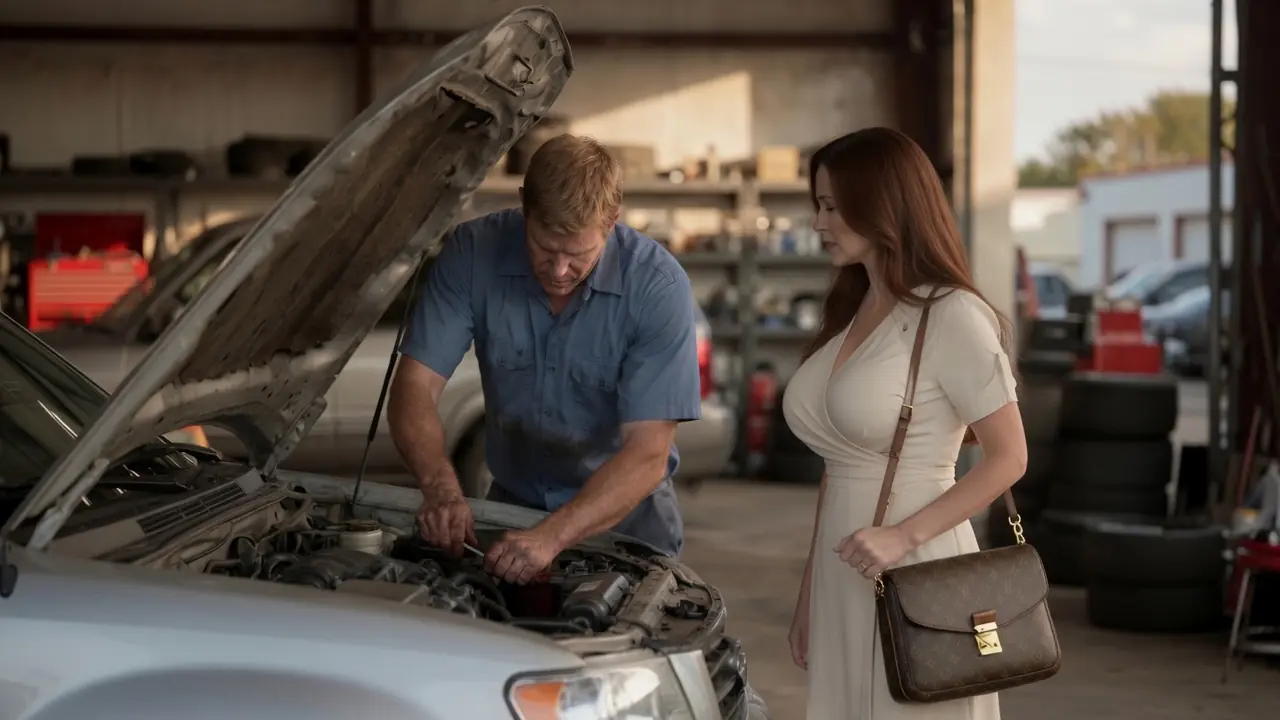
At thirty-six, Clare was the founder and chief executive officer of Donovan Enterprises, a national distribution company with offices in seven states. She had spent the morning touring a warehouse outside Columbus and was expected at a private investor dinner in Cleveland before seven. Her assistant had offered to send a driver, but Clare had insisted on handling the trip herself. She had always felt safer when she controlled the route.
The grocery store had nearly emptied as the rain grew heavier. Clare tried calling roadside assistance, but the automated system informed her that the nearest available technician was more than two hours away. She had just ended the call when an old blue repair truck pulled into the parking space beside her. Faded lettering on the door read Bennett Auto Repair and Roadside Service.
A broad-shouldered man stepped from the truck wearing jeans, work boots, and a blue mechanic’s shirt darkened by rain. His brown hair was wet at the edges, and a few streaks of gray showed near his temples. He walked toward Clare’s SUV carrying a weathered toolbox. His expression was calm, but exhaustion lived around his eyes.
“Car trouble?” he asked.
“It won’t start,” Clare replied. “I have roadside assistance coming, but apparently not during this century.”
The man gave a small smile. “I can take a look if you’d like.”
Clare studied the name stitched over his shirt pocket. “Luke Bennett.”
“That’s me.”
“Are you licensed?”
“I own the repair shop three miles from here.”
Clare nodded and released the hood latch. She disliked depending on strangers, but the rain was worsening and her schedule was already collapsing. Luke raised the hood, secured it, and leaned over the engine while Clare stood beneath a black umbrella beside him.
He checked the battery terminals, traced several cables, and tested the voltage using a small meter. Clare watched his hands move with the confidence of someone who trusted machinery more than conversation. Luke did not ask what her SUV had cost or make a joke about wealthy people ignoring maintenance. He simply listened to the engine as Clare turned the key again.
She stepped closer after the second attempt. “Is it bad?”
Luke looked up and met her eyes. “The car isn’t.”
Something in his voice made Clare lower the umbrella slightly. “But?”
Luke’s gaze moved toward the registration card lying inside the open glove compartment. Clare had taken it out for roadside assistance and left it on the passenger seat. Her full name was clearly visible.
Luke removed his hand from the battery. “But hearing your name opened a part of my life I thought was gone.”
Clare’s expression tightened. “Do we know each other?”
“No.”
“Then why does my name matter?”
Luke looked toward his truck, and for a moment he seemed uncertain whether to continue. “My wife knew it.”
Clare noticed the absence of a wedding ring, though a faint mark remained on his finger. “Where is she?”
“She died three years ago.”
The impatience left Clare’s face. “I’m sorry.”
“Her name was Rachel Bennett.”
Clare searched her memory. The name meant nothing to her, yet Luke watched closely as if he expected recognition. She shook her head.
“I don’t remember anyone named Rachel.”
“She knew you wouldn’t.”
Luke closed the toolbox and walked toward his truck. Clare remained beside the SUV as he opened the passenger door and reached beneath the seat. He returned carrying a faded cream envelope sealed with clear tape around the edges.
The front contained Clare’s name in careful handwriting.
Luke held the envelope but did not immediately surrender it. His fingers tightened slightly around the paper. Clare could see that it had been handled many times, though the seal remained unbroken.
“My wife gave me this during her last week in the hospital,” he said. “She made me promise I would place it in your hands if I ever found you.”
Clare looked from the letter to Luke’s face. “Why didn’t she mail it?”
“She was afraid someone else would stop it.”
“Who?”
“I only know what Rachel told me.”
Clare reached toward the envelope, but Luke hesitated. His grief appeared suddenly close to the surface, transforming him from a capable mechanic into a man standing beside his wife’s final unanswered question.
Clare touched his grease-stained hand gently. “Then don’t hide it from me, Luke.”
He looked down at her fingers resting against his. “I’m not trying to.”
“Then what are you afraid of?”
“That this letter will hurt you, and that Rachel will still be gone afterward.”
Clare’s voice softened. “Whatever she needed to tell me mattered enough for her to carry it until the end.”
Luke finally placed the envelope in her palm. “She believed finding you would finally bring both of us home.”
Clare held the letter carefully, but she did not open it. A strange fear moved through her, sharper than anything she had felt in a boardroom. The name written across the front was hers, yet the envelope felt as though it belonged to a life she had never lived.
Luke returned to the engine and replaced a corroded battery connector. He worked quietly while Clare stood beneath the umbrella with the letter pressed against her coat. Ten minutes later, the SUV started immediately. The engine settled into a steady hum.
“It should get you to Cleveland,” Luke said. “But have the battery cables replaced soon.”
“What do I owe you?”
“Nothing.”
Clare reached for her wallet. “You drove here and repaired it in the rain.”
“I stopped because I saw someone stranded.”
“I don’t accept free work.”
Luke looked at the letter in her hand. “Then consider us even.”
Clare opened her wallet anyway and removed several bills. Luke stepped back before she could offer them.
“My wife did not spend her last days hoping I would find you so I could hand you an invoice.”
“That isn’t what I meant.”
“I know.”
Clare put the money away. “Where is your shop?”
Luke pointed toward the road leading out of the parking lot. “Bennett Auto Repair. Old brick building beside the water tower.”
“I may need to speak with you after I read this.”
“You know where to find me.”
Luke closed the hood and walked back toward his truck. Before he climbed inside, Clare called his name. He stopped but did not turn around immediately.
“Did Rachel hate me?” Clare asked.
Luke faced her. “No. That was the problem.”
He drove away, leaving Clare alone with the SUV running and the rain striking the roof. She sat behind the wheel but could not place the key into gear. The envelope rested across her lap.
Her assistant called twice about the investor dinner. Clare ignored both calls. She had spent years responding immediately to every crisis, but for once, the future of Donovan Enterprises felt smaller than a dead woman’s handwriting.
Clare drove to a hotel outside Columbus instead of continuing toward Cleveland. She canceled the investor dinner, ordered tea she never drank, and placed the envelope on a small desk near the window. For almost an hour, she walked around it.
Her mother, Marianne Donovan, had died six years earlier after a short illness. Marianne had been gentle, private, and unusually quiet whenever Clare asked about her childhood. She had told Clare that she was an only child because the family had wanted only one child.
Clare had never questioned that answer.
She sat at the desk and carefully broke the old seal. Inside were six handwritten pages, a faded photograph, and a photocopy of a birth certificate. Clare unfolded the first page.
Dear Clare,
You do not know me, but I have known your name for most of my life. My name is Rachel Anne Bennett, although I was born Rachel Anne Mercer. Before I became Luke’s wife and Emma’s mother, I was the daughter your mother lost before she was allowed to become yours.
Clare stopped breathing for a moment.
She picked up the birth certificate. The child listed was Rachel Anne Mercer, born in Dayton, Ohio, seventeen years before Clare. The mother was identified as Marianne Elaine Mercer, the name Marianne Donovan had used before marriage. The father’s section was blank.
Clare turned to the photograph.
A teenage Marianne sat in a hospital bed holding a newborn baby. Her hair was longer, but Clare recognized her immediately. Around Marianne’s neck was a small silver bird pendant Clare had inherited after her death.
On the back of the photograph, Marianne had written one sentence.
My first daughter, Rachel, whom I will find again.
Clare covered her mouth with one hand.
She returned to the letter.
Rachel explained that Marianne had become pregnant at seventeen. Marianne’s parents, Charles and Vivian Mercer, considered the pregnancy a humiliation that could destroy their family’s social standing. They sent Marianne to live with relatives until the baby was born and arranged a closed adoption without allowing her to see the final papers.
For years, Marianne searched quietly.
She wrote to hospitals, adoption agencies, attorneys, and churches. Her parents intercepted some of the correspondence and threatened to withdraw financial support if she continued. Later, Marianne married Edward Donovan and gave birth to Clare, but she never forgot the daughter taken from her.
Rachel had discovered the truth at thirty-two after requesting her original birth records for medical reasons. By then, Marianne had already become seriously ill. Rachel located an address and mailed three letters, but none received a response.
The final page of Rachel’s letter was written less steadily than the others.
I do not know whether our mother ever saw my letters. I do not know whether you knew I existed. I am not writing because I want money, an inheritance, or a famous family name. I am writing because I have a daughter named Emma, and she deserves to know that her family is larger than grief.
Luke is a good man. He will pretend he can carry everything alone because that is how he loves people. Please do not insult him with pity. If you want to help him, stand beside him until he believes he no longer has to protect everyone by himself.
I wish I had met you. I spent years wondering whether you had our mother’s laugh. If you ever meet Emma, tell her I searched for the truth because I wanted her to inherit more than unanswered questions.
Your sister, if you will allow me to call myself that,
Rachel
Clare lowered the pages and cried.
She did not cry the controlled tears that came during funerals or private moments of exhaustion. Her shoulders shook, and her breathing became uneven. She cried for Rachel, for Marianne, and for a relationship stolen before either sister had been allowed to choose it.
The next morning, Clare drove back to Westfield.
Bennett Auto Repair stood exactly where Luke had described it. The brick building was small, with two garage bays and a hand-painted sign above the office. One bay contained a delivery van raised on a hydraulic lift, while Luke worked beneath the hood of an older pickup.
A young girl sat inside the office doing homework.
She looked up when Clare entered. Her light brown hair was tied in a loose ponytail, and she wore a purple sweater with one sleeve pushed above her elbow. Her eyes were gray-green, the same unusual color as Marianne’s.
Clare stopped in the doorway.
The girl tilted her head. “Are you here about your car?”
“I think I’m here about you.”
The child looked toward the garage. “Dad!”
Luke appeared from behind the pickup, wiping his hands on a cloth. His expression changed when he saw Clare holding the opened letter.
“You read it,” he said.
“Yes.”
Luke nodded toward the girl. “Clare Donovan, this is my daughter, Emma.”
Clare’s throat tightened. “Hello, Emma.”
Emma looked at her father. “Is she the lady Mom wrote to?”
Luke remained silent for a moment. “Yes.”
Emma stood slowly. “Are you my aunt?”
Clare had negotiated contracts worth hundreds of millions of dollars without losing her voice. Yet she could not answer a nine-year-old girl standing three feet away.
“I think I am,” Clare whispered.
Emma crossed the office and hugged her.
Clare froze in surprise before wrapping both arms around the child. Emma held her without caution or calculation, as though she had spent years expecting this exact moment. Clare closed her eyes and felt the shape of the family she had never known existed.
Luke looked away, but not before Clare saw tears in his eyes.
Emma finally stepped back. “Mom said you might come someday.”
“Did she talk about me?”
“She said she had a sister somewhere who probably didn’t know how to find us.”
Clare knelt so they were at the same height. “I didn’t know you were here.”
“I know.”
“You do?”
“Dad told me it wasn’t your fault.”
Clare looked at Luke. He folded the cloth and set it on the workbench, uncomfortable beneath her gratitude.
Emma retrieved a small wooden box from the office shelf. Inside were photographs of Rachel at different ages. Clare saw a laughing teenager with Marianne’s eyes, a young woman in a diner uniform, a bride standing beside Luke, and a tired mother holding newborn Emma.
“She was beautiful,” Clare said.
Luke smiled faintly. “She never believed it.”
Clare lifted a photograph of Rachel laughing beside an old red truck. “She had my mother’s smile.”
“She wondered if you had it too.”
Luke told Emma to finish her homework, then led Clare into the garage. They stood near her repaired SUV, though neither looked at the engine.
“Why did it take three years?” Clare asked.
Luke did not become defensive. “At first, I searched.”
“What happened?”
“I called Donovan Enterprises twice. An assistant told me that personal messages could not be forwarded to you. I mailed a copy of my contact information, but nothing came back.”
Clare frowned. “I never saw it.”
“I thought about driving to Denver, but Rachel was gone, Emma was six, and the shop was failing. Every day became about surviving until the next one.”
“Why did you keep the letter in your truck?”
“I didn’t always.”
Luke explained that two weeks earlier, he had found the envelope while cleaning a cabinet at home. The anniversary of Rachel’s death was approaching, and the promise he had failed to fulfill began weighing on him again. He placed the letter inside the truck, intending to visit Donovan Enterprises after completing several repair jobs near Columbus.
“Then your SUV refused to start,” he said.
Clare looked toward the vehicle. “Rachel would probably appreciate the timing.”
“She believed broken things sometimes knew where they needed to stop.”
Clare reached into her handbag and removed the photograph of Marianne with newborn Rachel. “Did Rachel ever find proof that my mother received her letters?”
“No.”
“I need to know.”
Luke’s expression became cautious. “Some answers will not change what happened.”
“No, but they may change what Rachel believed happened.”
Clare called her mother’s younger sister, Eleanor Mercer, from the garage office. Eleanor lived in Cincinnati and had avoided most family conversations since Marianne’s death. When Clare mentioned Rachel, the silence on the phone lasted so long that Clare thought the call had disconnected.
“You knew,” Clare said.
Eleanor began crying.
She admitted that Marianne had searched for Rachel throughout her life. Their mother, Vivian, controlled the family mail and destroyed several letters. After Vivian died, Eleanor found a box of correspondence hidden in the attic but was too afraid to give it to Marianne’s husband.
“Why?” Clare demanded.
“Your father knew Marianne had given birth before they met, but he believed the past should remain closed. He said revealing it would only bring pain.”
“It brought pain anyway. Rachel died believing our mother ignored her.”
Eleanor’s voice broke. “That was never true.”
Clare arranged to meet her that afternoon.
Luke initially refused to come, but Clare insisted that Rachel’s husband had more right to see the letters than anyone else. Emma accompanied them, carrying the wooden photograph box on her lap. During the drive to Cincinnati, Clare listened as Emma described her mother’s favorite songs, terrible cooking, and habit of leaving handwritten notes inside lunchboxes.
Eleanor lived in a narrow house filled with old furniture and family photographs. She opened the door holding a large cardboard storage box. The moment she saw Emma, she covered her mouth and whispered Marianne’s name.
“This is Rachel’s daughter,” Clare said firmly. “Her name is Emma.”
Eleanor knelt and took Emma’s hands. “You look like your grandmother.”
Inside the box were forty-seven letters Marianne had written to Rachel over more than two decades. Most had never been mailed because Vivian refused to reveal the adoption agency. Others had been returned after Marianne used incomplete or outdated addresses.
The final letters had been written during Marianne’s illness.
One envelope contained the name Rachel Bennett and an address in Westfield. It had been opened but never mailed.
Clare unfolded it with trembling hands.
My precious Rachel,
I received your letter. I have waited for it since the day they took you from my arms. I am ashamed that fear and family pressure kept me from fighting harder when I was young, but I have never spent one day forgetting you.
You have a sister named Clare. She is strong, stubborn, and kinder than she allows people to see. I want you to meet her because neither of you should inherit the silence that controlled my life.
Clare could not continue.
Luke took the letter and read the remaining paragraphs aloud. Marianne had written about wanting to meet Rachel, Luke, and Emma. She had included a telephone number, but before the letter could be mailed, Marianne suffered a medical crisis and entered the hospital.
Edward Donovan found the envelope among her personal papers.
He never sent it.
Clare’s father arrived at Eleanor’s house that evening after Clare called him. Edward was seventy-one, carefully dressed, and accustomed to entering rooms where people waited for his judgment. He stopped when he saw Emma sitting beside Luke.
Clare placed Marianne’s unsent letter on the table.
“You found it,” Edward said quietly.
“You knew Rachel contacted Mom.”
“Yes.”
“And you kept this letter.”
Edward looked toward the floor. “Your mother was dying.”
“She wanted to see her daughter.”
“She was weak. I believed the emotional shock could shorten the time she had left.”
“You did not have the right to decide that.”
“I was protecting her.”
Luke stood near the window, his jaw tense but his voice controlled. “Rachel died believing Marianne rejected her.”
Edward looked at him. “I am sorry.”
“You are sorry because the truth found you,” Clare said. “Not because you chose the truth.”
Edward’s face hardened. “You do not understand what those months were like. Your mother was in pain, the company was unstable, and every day brought another impossible decision.”
“Rachel was not a business problem.”
“I know that now.”
“You knew it then.”
Emma quietly removed a photograph from her wooden box. It showed Rachel in a hospital bed holding her daughter’s hand. Emma placed it beside Marianne’s letter.
“My mom wanted to meet her mother,” she said.
Edward’s composure broke.
He sat down and stared at Rachel’s photograph. For the first time, he saw the woman his silence had reduced to an inconvenient secret. He reached toward the picture but stopped before touching it.
“I failed both of them,” he whispered.
Clare did not forgive him that evening. Forgiveness was not a transaction that followed confession. She told him he would need to live honestly with what he had done and accept that the family’s response would not be controlled by him.
Clare returned to Westfield often during the following months. At first, she stayed in a hotel and scheduled visits around work. Gradually, she began spending Saturdays at Luke’s repair shop while Emma explained which tools Clare was not permitted to touch.
She learned about Rachel through ordinary stories.
Rachel hated thunderstorms but loved walking in light rain. She made pancakes too thick, cried during animal rescue commercials, and sang loudly even though she could not carry a tune. When Luke became overwhelmed by bills after opening the shop, Rachel took evening shifts at the grocery store without telling him until the first paycheck arrived.
“She saved this place,” Luke said one afternoon.
Clare looked around the aging garage. “Then it should survive.”
Luke immediately shook his head. “Rachel warned you not to rescue me with money.”
“She told me not to insult you with pity.”
“It sounds similar.”
“It isn’t.”
Donovan Enterprises operated more than three hundred delivery vehicles across Ohio. The company needed additional regional repair providers, and Bennett Auto Repair had a strong reputation among local businesses. Clare invited Luke to submit a proposal but removed herself from the selection committee.
Luke spent three weeks preparing the bid.
He did not receive the contract because Clare was his daughter’s aunt. He received it because his shop offered faster roadside response, honest pricing, and lower average repair times than two larger competitors. The agreement allowed him to hire three mechanics and replace equipment he had been repairing with borrowed parts.
When Luke received the confirmation, he brought the letter to Clare’s office.
“You knew about this?” he asked.
“I knew your company had been shortlisted.”
“And you didn’t interfere?”
“I promised Rachel I would stand beside you. She specifically warned me not to stand on top of you.”
Luke laughed, and the sound surprised them both.
Emma became part of Clare’s life with far less hesitation. She visited Clare’s Denver office during school vacations and asked executives direct questions no one else dared to ask. She also placed a framed photograph of Rachel and Marianne on Clare’s desk.
“So you remember why the car broke,” Emma explained.
“The car broke because of a corroded battery connector.”
Emma shook her head. “That’s what Dad says because he doesn’t understand signs.”
One year after Clare’s SUV failed, the three of them returned to the grocery store parking lot. The weather was clear, but Clare parked in the exact space where Luke had stopped beside her. Emma stood between them holding Rachel’s original letter.
They had created the Rachel and Marianne Family Search Fund, a small nonprofit that helped people access adoption records, locate relatives, and receive counseling before reunions. Clare funded its first year, but Luke and Emma chose its mission and name. The organization’s first office occupied a renovated room beside Bennett Auto Repair.
Emma looked toward Clare. “Do you think Mom knew this would happen?”
“No,” Luke said. “Your mother was hopeful, not psychic.”
“She knew Aunt Clare would come.”
Clare crouched beside her niece. “Your mother gave me the chance to come. You gave me a reason to stay.”
Emma wrapped her arms around her.
Luke watched them with the quiet expression Clare had come to recognize. It was grief mixed with gratitude, neither emotion defeating the other. Rachel remained absent, but she was no longer treated as a secret that had ended with her death.
Clare stood and looked at Luke. “Did finding me bring you home?”
He considered the question.
“For a long time, I thought home was the life Rachel and I were supposed to have,” he said. “Then I thought it was just Emma and me trying to survive what was left.”
“And now?”
Luke looked at his daughter holding Clare’s hand. “Now I think home is where the people we lost are still allowed to connect the people who remain.”
Clare felt tears rise but did not hide them.
The first time Luke had spoken her name, she believed he had opened an old wound. Instead, he had opened a door into a family that secrets, fear, and death had failed to erase.
Her SUV had needed only a small repair.
The rest of them had needed the truth.