Claire Morgan had never been late for a presentation in her life. Not in college, not in her first job, not in the twelve years she spent climbing through the brutal world of automotive technology until she became senior director at Helix Mobility. Her whole career had been built on control: controlled schedules, controlled language, controlled rooms, controlled outcomes. But on a freezing February morning outside Chicago, with the skyline blurred in the distance and snow crusted along the highway shoulder, control died under the open hood of her black Mercedes.
The engine had cut out without warning twenty minutes before the biggest presentation of her career. In less than two hours, Claire was supposed to stand in front of Helix Mobility’s board and present a proposal for a next-generation cold-weather engine efficiency system. If the board approved it, she would finally lead the division she had spent years building. If she failed, the project would be handed to someone with better politics and less understanding.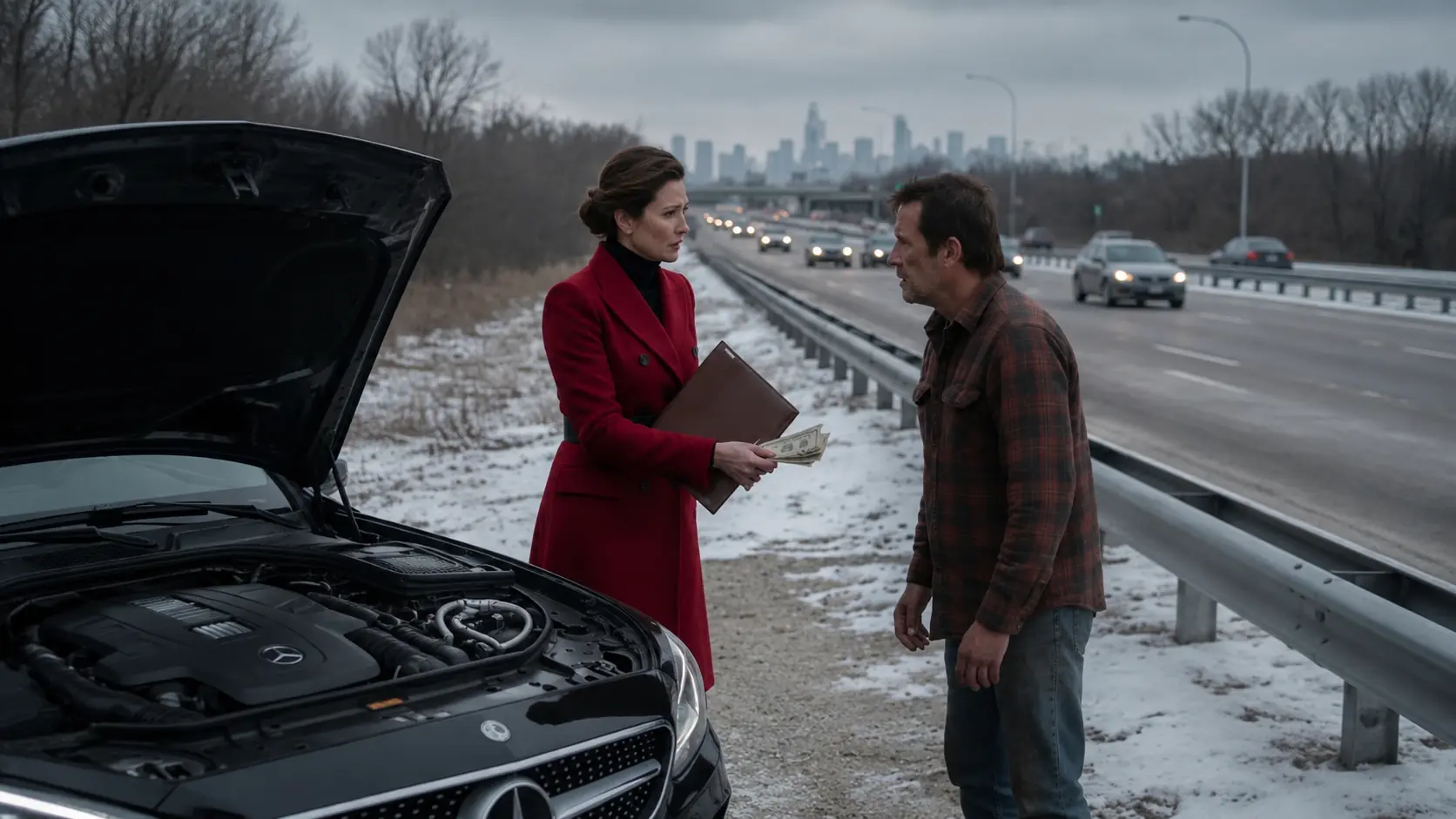
She stood beside the Mercedes in a long white coat, leather folder hugged tight against her chest, watching cars rush past without slowing. Her phone showed no service, then one weak bar, then nothing again. Roadside assistance had given her a forty-five-minute estimate before the call dropped. The wind cut through her gloves, and every passing minute felt like a door closing.
Then an old gray pickup slowed behind her.
Claire turned, cautious and already irritated by how helpless she looked. The pickup had a dented front fender, a cracked toolbox in the bed, and a child’s booster seat visible through the rear window. A man stepped out wearing a worn brown plaid jacket, faded jeans, and work boots darkened by slush. He looked to be in his mid-thirties, with short dark hair, tired eyes, and grease already worked into the lines of his hands.
“You need help?” he asked.
Claire glanced at the truck, then at him. “Roadside service is coming.”
He looked at the empty highway shoulder, then at the Mercedes. “How long ago did they say that?”
“Forty-five minutes.”
“When?”
Claire checked her watch and hated the answer. “Thirty minutes ago.”
The man nodded once, not smug, not amused. “You’ll freeze before they get here if that wind keeps up. Mind if I look?”
Claire hesitated. She did not usually let strangers touch her car, especially not strangers who looked like they had crawled out from under a tractor. But the presentation folder in her arms suddenly felt heavier than pride. “It’s a Mercedes,” she said, unable to stop herself.
The man looked at her calmly. “I noticed.”
“It has a specialized electrical system.”
“Most problems still start small.”
That answer annoyed her because it sounded too simple, but he was already moving toward the hood with the confidence of someone who had no interest in impressing her. Claire stepped aside, still clutching the folder. The man leaned over the engine bay, took a flashlight from his pocket, and studied the components without touching anything at first.
“What happened before it died?” he asked.
“It hesitated twice. Then the dashboard lit up, power dropped, and the engine cut out.”
“Cold start issues before today?”
Claire frowned. “Once last week.”
“Any service recently?”
“Yes. Dealer inspection two days ago.”
He gave a small hum, not surprised. “That explains half of it.”
Claire stared at him. “How can that explain anything?”
“Because people trust a clean report more than a stubborn sound.” He reached into his toolbox and pulled out a basic meter, a small socket set, and a rag. “Try starting it for one second when I ask. Don’t hold it.”
Claire slid into the driver’s seat, feeling ridiculous in her executive coat while this stranger worked in the cold. “Now,” he called. She pressed the button. The Mercedes clicked, coughed once, and fell silent again.
He listened more than he looked. That was what struck her first. Most mechanics she had dealt with talked, guessed, or blamed the computer. This man tilted his head slightly, as if the engine had spoken in a language he understood and everyone else had forgotten.
“Try it now,” he said.
Claire pressed the button again.
The Mercedes started.
The engine settled into a smooth, steady hum that felt like a miracle and an accusation at the same time. Claire stepped out slowly, looking from the car to the man beside the hood. He shut the cover, wiped his hands, and lowered the hood as if he had only tied a shoelace.
“How did you do that?” she asked.
“Loose signal connection affected by cold and moisture. Dealer probably ran diagnostics indoors, saw no hard fault, and cleared the warning.”
“You’re saying they missed it.”
“I’m saying the car didn’t miss it.”
Claire studied him more carefully. “What’s your name?”
“Ethan Cole.”
“Do you work nearby?”
He looked toward his pickup. “I do repairs when I can. Small jobs. Farm equipment, cars, generators, whatever people need.”
Claire reached into her coat and pulled out her wallet. “How much?”
Ethan shook his head. “No charge.”
“That’s not reasonable.”
“Maybe not.”
“I can pay you.”
“I know.”
The way he said it made Claire pause. It was not pride exactly. It was something firmer, something that had nothing to do with what she could afford. “Then why not take it?”
Ethan glanced toward the booster seat in his truck. “Because I stopped because you were stranded, not because I saw a Mercedes.”
Claire’s grip tightened around the cash. “At least let me give you something.”
He looked toward the folder tucked under her arm, then noticed the small lunch bag on the passenger seat. “You got food in there?”
Claire blinked. “What?”
“I left before breakfast. My daughter packed me half a sandwich, but she forgot she ate half of it last night.” His mouth twitched slightly. “If you’ve got a sandwich you don’t need, I’ll take that.”
Claire almost laughed because she thought he was joking.
He was not.
She reached into the car and pulled out the homemade turkey sandwich she had packed at dawn, still wrapped in wax paper. She had planned to eat it after the board meeting, assuming she would still have an appetite. When she handed it to him, Ethan accepted it with a quiet nod, like she had paid him in exactly the right currency.
“You fixed my Mercedes for a sandwich,” she said.
“I fixed your Mercedes so you could get where you were going.” He tucked the sandwich into his jacket pocket. “The sandwich just means I don’t have to lie to my daughter when she asks if I ate.”
Claire looked at him differently then. “You have a daughter?”
“Maya. She’s eight.”
“And you’re on your way to her?”
“After one parts delivery.” He picked up his toolbox. “You should get going too. Presentation folder looks urgent.”
Claire looked down at the folder, startled. “It is.”
“Then don’t waste the rescue standing in the cold.”
She should have smiled politely, gotten in her car, and driven away. Instead, she stood there for one more second, watching Ethan Cole walk back to a dented pickup with a sandwich in his pocket and hands that had just solved in minutes what a dealer had missed in two days. Something about him did not fit the life he appeared to be living. He was too precise, too calm, too familiar with systems he should not have known.
“Ethan,” she called.
He turned.
“Thank you.”
He gave a small nod. “Get there safe, Ms. Morgan.”
Claire froze. “I never told you my name.”
He pointed gently toward the folder. Her name was embossed in small silver letters near the bottom. Claire felt foolish, then oddly amused. Ethan climbed into his truck and drove away before she could ask anything else.
Claire made the meeting with six minutes to spare. Her hair was windblown, her cheeks were red from cold, and one page of her proposal had a faint water stain near the corner. The board barely noticed. What they noticed was the proposal.
She spoke about cold-weather inefficiencies, engine response delays, electrical signal stability, and the cost of ignoring real-world conditions outside clean testing labs. But halfway through her presentation, Claire heard Ethan’s voice in her own head. People trust a clean report more than a stubborn sound. She found herself saying something dangerously close to that aloud.
The room went quiet.
One board member leaned forward. “Can you repeat that?”
Claire did. Then she explained that Helix had spent too many years designing systems for controlled environments while drivers were stranded on real roads in real weather. The room shifted. They were listening now, not because she sounded polished, but because she sounded convinced.
The presentation was approved.
By noon, Claire should have felt victorious. Instead, she sat alone in her office, staring at the city through glass walls and thinking about a man in a plaid jacket who had refused money. Ethan Cole. The name stayed with her in a way she could not explain. It felt less like curiosity and more like a loose thread.
She searched his name that afternoon, expecting nothing.
At first, she found almost nothing. A small repair listing. An old address outside Joliet. A few scattered mentions in community pages, mostly thanking him for fixing generators during a storm or repairing cars for people who could not afford dealership prices. Then she found an archived engineering forum from eleven years earlier.
Ethan Cole, graduate researcher.
Claire leaned closer.
The post linked to a patent filing for adaptive thermal response control in hybrid engine systems. Claire knew the technology. Everyone in her field knew it. A version of it had shaped an entire generation of cold-weather efficiency design. But the name she remembered attached to it was not Ethan Cole.
It was Voss Automotive Systems.
Claire opened the patent file and read line by line. Ethan Cole’s name appeared as an original contributor on an early provisional filing. Two years later, in the commercial version, his name was gone.
Her pulse changed.
She pulled internal industry reports, old lawsuits, licensing records, and conference proceedings. The more she read, the clearer the pattern became. Ethan had not been a roadside mechanic who happened to understand her Mercedes. He had once been a brilliant young engineer involved in technology that major companies had quietly absorbed, renamed, and profited from.
Then he had disappeared.
Claire did not sleep well that night. She kept thinking about the booster seat in the pickup, the sandwich, the way Ethan had said his daughter would ask if he ate. She thought about the calm in his hands and the guard in his eyes. Men like Ethan did not bury their futures for no reason.
The next morning, she drove to the address listed for Cole Repairs.
The shop was not really a shop. It was a converted garage behind a small rented house on the edge of a working-class neighborhood. A faded sign leaned near the driveway, hand-painted and weather-worn. Inside the open garage, Ethan stood beside an old minivan with the hood raised while a little girl sat at a folding table doing homework.
Maya Cole looked up first. She had dark hair, bright eyes, and a serious expression that made her look older than eight. “Dad,” she said. “The Mercedes lady is here.”
Ethan froze.
Claire stepped out of her car holding a folder.
His expression changed before she said a word. He knew. Maybe not everything, but enough to understand that she had not come because the car failed again. He wiped his hands on a rag and walked toward her.
“Mercedes running fine?” he asked.
“Yes.”
“Then this isn’t a repair call.”
“No.”
Maya looked between them. “Should I go inside?”
Ethan softened immediately. “Finish your math first.”
“I already finished.”
“Then pretend to check it.”
Maya sighed dramatically but returned to her paper.
Claire held the folder tighter. “I looked you up.”
Ethan’s face closed. “That was a mistake.”
“I found the patent.”
His jaw tightened.
“And the early thermal response design.”
“Then you found something that doesn’t matter anymore.”
“It matters to my company.”
“That’s not my problem.”
Claire stepped closer, lowering her voice. “Ethan, your work was stolen.”
He gave a short, humorless laugh. “People like you use softer words than that.”
“I’m not using softer words.”
That made him look at her.
Claire opened the folder and showed him copies of the early filings. “You designed core logic that Voss commercialized under another team. Your name disappeared after the provisional stage. Why didn’t you fight it?”
Ethan looked toward Maya before answering. “Because my wife got sick. Because lawyers wanted money I didn’t have. Because I had a newborn daughter and medical bills and a company willing to spend more burying me than I could spend proving the truth.” His voice stayed low, but every word carried years. “Because sometimes being right doesn’t keep the lights on.”
Claire’s throat tightened.
Maya had stopped writing. Ethan noticed and forced calm back into his face. “Go inside, honey.”
“But Dad—”
“Inside.”
Maya gathered her notebook slowly, looking at Claire with suspicion before going into the house.
Ethan waited until the door closed. “You need to leave.”
“I came to offer you a role.”
“No.”
“You haven’t heard it.”
“I heard enough when you said company.”
Claire took the hit because he had earned the right to deliver it. “Helix is building the division I presented yesterday. I need someone who understands cold-weather failure in the real world. Not just theory. Not just polished lab models. You.”
Ethan shook his head. “No.”
“Director-level role. Full credit. Control over system testing. And if you want, I can have our legal team review the patent history.”
His eyes flashed. “There it is.”
“What?”
“The hook.”
“It’s not a hook.”
“It’s always a hook.” Ethan stepped closer, anger finally breaking through. “A company finds a man it can use, tells him he’s brilliant, offers him a title, then takes the work once he trusts the room.”
Claire held her ground, though his words landed hard. “I’m not Voss.”
“No. You’re just another person in a white coat holding a folder.”
For a moment, Claire could not answer. She had built her life on being respected in rooms where people dismissed her until she proved useful. She knew what it felt like to be underestimated. But Ethan had been erased, and that was deeper than dismissal.
“I’m sorry,” she said.
He looked away. “Don’t be sorry. Be gone.”
Claire closed the folder slowly. “I’ll leave. But I want you to know something first.” She waited until he looked back. “Yesterday, before you fixed my Mercedes, I thought I was going to save my career with a perfect presentation. You changed the presentation because you reminded me that real systems fail real people. That insight got my project approved.”
Ethan’s face shifted, but only slightly.
“I’m not here because I pity you,” Claire said. “I’m here because you were right. And because a man with your mind shouldn’t have to hide behind a garage door just because someone powerful once stole his name.”
Ethan looked toward the house. “My daughter is safe because I stopped chasing rooms that could ruin us.”
“And if she asks someday why you stopped building what you loved?”
Pain crossed his face before he could hide it.
Claire stepped back. “I’ll send the offer. Ignore it if you want. But this time, Ethan, your name stays on your work.”
She left before he could throw the folder back at her.
For three days, Ethan did not answer.
Claire tried to bury herself in work, but the division suddenly felt hollow without him. Her engineers were talented, but their thinking remained too clean, too confident, too removed from broken mornings on frozen highways. Every model assumed too much cooperation from the world. Ethan had built his whole life around the opposite assumption.
On the fourth day, Maya called Claire from Ethan’s phone.
“My dad says he’s not coming,” Maya said without greeting.
Claire sat up. “Does your dad know you called me?”
“No.”
“That’s a problem.”
“He’s mad because he wants to go.”
Claire closed her laptop. “Maya, this is between adults.”
“That’s what adults say when they’re scared.”
Claire almost smiled despite herself. “You sound like your father.”
“He says I sound like trouble.” Maya lowered her voice. “He still has old notebooks in a box. He looks at them when he thinks I’m asleep. He tells people he doesn’t care, but he does.”
Claire said nothing.
“I don’t want him sad forever,” Maya said. “But I don’t want him hurt again.”
That sentence broke something open in Claire. “Neither do I.”
“Then don’t be like the bad company.”
“I’m trying not to be.”
Maya was quiet for a moment. “You should bring another sandwich.”
Then she hung up.
Claire arrived the next evening with two sandwiches from a deli, a revised contract, and no white coat. She wore jeans, a navy sweater, and boots that could handle slush. Ethan opened the garage door before she knocked, looking furious and exhausted.
“Maya called you.”
“Yes.”
“She’s grounded.”
“She suggested sandwiches.”
“She’s still grounded.”
Claire held up the bag. “Turkey and roast beef.”
Ethan stared at the bag, then at her. “That’s not fair.”
“No. But it is lunch.”
He hesitated. Then he stepped aside.
They sat at the folding table in the garage while Maya watched from the kitchen window, pretending not to. Claire placed the revised contract in front of him. “No transfer of personal IP without separate written approval. Any new invention lists contributors by name. External patent counsel of your choice, paid by Helix, not assigned by Helix. Flexible hours around Maya’s schedule. Testing hub can be built here first, not downtown.”
Ethan looked at her sharply. “Here?”
“You know the roads. You know the weather. You know the people who get stranded when systems fail. That matters.”
He read in silence, chewing slowly. Claire waited. She had spent years filling silence in boardrooms, but with Ethan, she had learned that silence was not empty. It was where trust decided whether to enter.
Finally, he looked up. “Why are you doing this?”
“Because I need you.”
“That’s not enough.”
Claire nodded. “Because you were erased once, and I don’t want to build something on another erasure. Because my company needs to learn from people who don’t speak in polished slides. Because I think you still love engineering, even if you hate what it cost you.”
His expression tightened.
“And because,” she added softly, “your daughter is right. You look sad when you pretend you don’t care.”
Ethan looked toward the kitchen window. Maya ducked too late. He sighed, rubbing both hands over his face.
“If I say yes,” he said, “my daughter comes first.”
“As she should.”
“I don’t move downtown.”
“You don’t have to.”
“I don’t sit in rooms where men in suits explain my own designs back to me.”
Claire’s mouth curved faintly. “I can’t promise they won’t try. I can promise you’ll be allowed to embarrass them.”
For the first time, Ethan almost smiled.
He did not sign that night. He spent two weeks reading, asking questions, meeting Claire’s legal team, rejecting clauses, and testing whether her patience was real or professional. Claire answered every call. She rewrote terms twice. She let him bring an independent lawyer who looked at her like she was a snake until she proved otherwise.
When Ethan finally signed, Maya insisted on using her purple pen.
The first Helix field test under Ethan’s leadership happened six weeks later on a bitter morning much like the one when he had found Claire. Engineers from the city arrived in expensive jackets and clean boots, carrying tablets and assumptions. Ethan arrived in his old pickup with Maya’s school backpack in the passenger seat because he had drop-off duty afterward.
One engineer looked at the pickup and whispered something.
Ethan heard it.
Claire did too.
Before she could intervene, Ethan walked to the test vehicle, opened the hood, and began asking questions no one answered quickly enough. Within thirty minutes, the entire team realized that the man they had underestimated understood both their design and its failure points better than anyone in the room. By noon, they had stopped whispering.
By evening, they were taking notes.
Claire watched him work and felt something more dangerous than professional admiration. Ethan was not polished, but he was precise. He did not dominate rooms by speaking loudly. He changed them by being right in a way no one could ignore.
The project accelerated. Ethan’s cold-weather reliability system reduced start failures in test models by a margin that made the board suddenly very interested. But this time, Claire made sure every report carried his name clearly. Ethan Cole, Field Reliability Lead. Ethan Cole, System Architecture Contributor. Ethan Cole, inventor.
The first time he saw his name on an official Helix patent draft, he went quiet.
Claire found him outside the testing garage, staring at the paper. Snow drifted lightly around them. “Is something wrong?” she asked.
“No.” His voice was rough. “Just been a long time since my name stayed where I put it.”
Claire stood beside him. “It will stay.”
He looked at her, wanting to believe her and afraid of what belief might cost. “You know I almost didn’t take this because of you.”
“Because of me?”
“Because you scared me.”
Claire laughed softly in surprise. “I scared you?”
“You looked like every room that ever told me I should be grateful while taking something from me.”
Her smile faded. “And now?”
He looked through the window where Maya was sitting with headphones on, drawing at a spare desk Claire had arranged for her after school. “Now you look like someone who brought sandwiches twice.”
“That’s a low bar.”
“For me, it wasn’t.”
Their friendship grew in small, careful ways. Claire learned that Ethan hated empty praise but trusted practical help. Ethan learned that Claire’s confidence was partly armor, built from years of being the only woman in rooms where men waited for her to prove she belonged. Maya learned that Claire could not braid hair well but tried with scientific focus.
One evening, after a successful test run, Claire drove Ethan and Maya home because Ethan’s pickup was being serviced. Maya fell asleep in the back seat, her head against the window. Ethan sat beside Claire in the passenger seat, looking at the quiet neighborhood passing by.
“She likes you,” he said.
“I like her.”
“She doesn’t like many people.”
“She has good standards.”
Ethan smiled faintly. “She asked if you’re lonely.”
Claire’s hands tightened slightly on the wheel. “What did you say?”
“I said that’s not our business.”
“And what did she say?”
“She said lonely people make it everybody’s business by pretending too hard.”
Claire laughed once, then blinked back unexpected tears. “Your daughter is terrifying.”
“She gets it from me.”
“No,” Claire said softly. “She gets the honesty from you. The terrifying part might be hers.”
They drove in silence for a while. Then Ethan looked at her. “Are you?”
Claire knew what he meant. She could have deflected. She had built a career out of elegant deflection. But Ethan had fixed her car for a sandwich, rebuilt her project with truth, and trusted her with the part of him that still hurt.
“Yes,” she said. “I am.”
He nodded, not pleased, not pitying. Just receiving the truth. “You don’t have to be all the time.”
Claire looked at him then, and something between them changed quietly.
The climax came three months later at the Helix board presentation. Ethan’s system had exceeded expectations, and Claire had arranged for him to present the field results himself. He resisted until Maya told him not to be a coward in a nice shirt. That ended the argument.
The boardroom was glass, steel, and old money. Ethan stood at the front in a clean button-down shirt that still could not hide the posture of a man more comfortable near engines than executives. Claire sat to his right, ready to intervene if anyone tried to reduce him to a charming blue-collar story.
One board member, Martin Vale, smiled halfway through Ethan’s explanation. “This is impressive work, Mr. Cole. Though I assume Director Morgan’s team refined the core concept?”
The room cooled.
Ethan stopped.
Claire’s eyes sharpened, but Ethan lifted one hand slightly, asking her not to answer for him. He looked at Martin with the same calm he had used on the highway.
“You’re asking because a single dad with grease under his nails doesn’t look like the man who designed the system saving your launch timeline,” Ethan said.
Martin’s smile vanished.
Ethan clicked to the next slide. His name appeared on the architecture diagram, the field test reports, and the patent draft. “So let me make it easy. I built the failure model, redesigned the thermal response logic, led the field validation, and corrected the assumptions your lab team missed because they were testing winter from a warm room.”
No one spoke.
Then Ethan placed one worn notebook on the table. “And I learned the first version of this lesson ten years ago when another company took my work and counted on me being too broke, too tired, and too busy raising my daughter to fight back.”
Claire felt the room shift.
Martin cleared his throat. “That wasn’t what I meant.”
“It never is,” Ethan said.
The board approved the system unanimously.
Afterward, in the hallway, Claire found Ethan standing near the windows, breathing like he had just stepped out of a storm. Maya ran to him first, throwing her arms around his waist. “You did it,” she said.
Ethan held her tightly. “We did it.”
Claire stood back, giving them the moment, but Maya reached for her too. “You’re in it,” she said, pulling Claire into the hug.
Ethan looked at Claire over his daughter’s head. There was gratitude there, but also something deeper, steadier, and no longer hidden behind fear. Claire felt it and did not look away.
A year after Claire’s Mercedes died on the highway, Helix opened the Cole Field Reliability Center just outside the city. Ethan insisted the name was too much. Claire told him it had already been approved, printed, and bolted to the building. Maya said it looked good, which ended the debate.
The center hired mechanics, engineers, and technicians from places that companies usually ignored. Ethan built a team where field experience mattered as much as degrees. Claire protected the program from boardroom politics with a fierceness that made even Martin Vale speak carefully.
The morning of the opening, Ethan found Claire standing beside the first display vehicle, the black Mercedes he had fixed a year earlier. She had bought it from the company fleet and kept it exactly as it was, right down to a small plaque under the hood that read: One bad connection. One good sandwich. One second chance.
Ethan stared at it. “You are ridiculous.”
“You like it.”
“I tolerate it.”
Maya appeared beside them. “He likes it.”
Claire smiled. Ethan tried to look annoyed and failed.
Later, after the ceremony, after the speeches, after everyone left except the three of them, Ethan stood outside with Claire while Maya explored the new break room vending machine. The sky was cold and clear, the city bright in the distance. Cars moved along the highway where they had met, headlights streaming like quiet proof that life never stopped for anyone’s plans.
“I thought I was just fixing a car that morning,” Ethan said.
Claire looked at him. “I thought I was just late for a meeting.”
“You were very late.”
“I was six minutes early.”
“Because of me.”
She smiled. “Because of a sandwich.”
Ethan laughed softly, then grew quiet. “You gave me my name back.”
Claire shook her head. “No. You kept it alive. I only stopped looking away.”
He took her hand then, not suddenly, not dramatically, but with the same careful certainty he used when repairing something precious. Claire looked down at their joined hands, then up at him. For once, she did not need a presentation, a plan, or perfect words.
Maya’s voice called from inside. “Dad! Claire! The vending machine has terrible sandwiches!”
Ethan closed his eyes. “That child has no respect for a moment.”
Claire laughed, and Ethan laughed with her.
The Mercedes sat behind them, polished and repaired, no longer just a symbol of failure on a freezing highway. It had become the place where two lives collided: one woman racing toward power, one single dad hiding from the world that had taken too much, both stranded in different ways.
Ethan had fixed her car for a sandwich.
Claire had found the genius he buried to survive.
And together, they built something neither of them could have reached alone: a future where his name stayed on his work, her heart stayed open, and Maya never had to wonder whether brilliance and love could live under the same roof.