Luke Harper found the woman in black on a lonely country road just after sunset, standing beside a dead motorcycle like she had been abandoned by the whole world. The road ran between soybean fields and low wooded hills outside Willow Creek, Tennessee, where traffic thinned after six and most people knew better than to travel alone after dark. Luke was driving home in his old blue pickup with his eight-year-old daughter, Lily, asleep against the passenger door, her school backpack tucked under her feet. He almost passed the stranded biker, not because he did not care, but because every delay in Luke’s life cost something he barely had left to spend.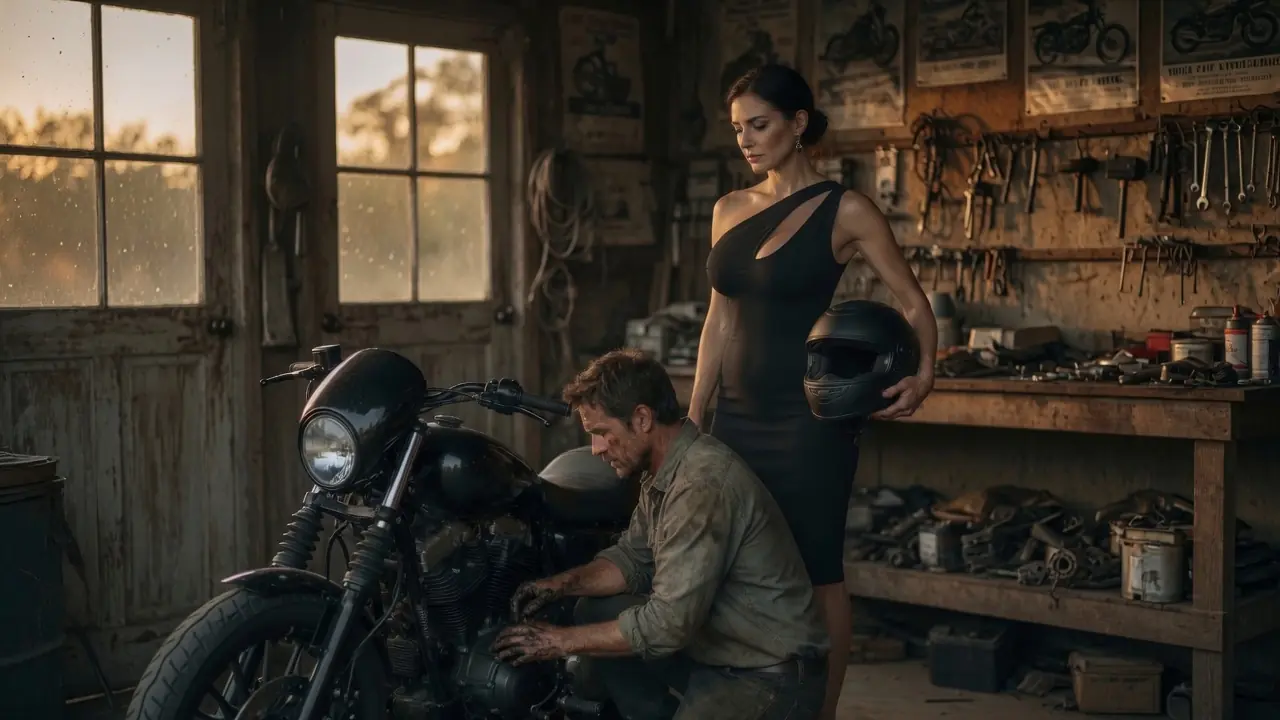
Then the woman lifted one hand, not waving wildly, not begging, just raising it with the tired dignity of someone who hated needing help. Luke slowed. His headlights washed over a sleek black motorcycle, a woman with dark hair tied neatly back, and an elegant fitted black dress beneath a leather jacket, the kind of dress no one wore on country roads unless life had gone badly off plan. She held a black helmet against her waist, and her face was calm, but her eyes were not.
Luke pulled onto the shoulder and shut off the engine. Lily stirred and mumbled, “Are we home?” He brushed a hand over her hair and said, “Not yet, sweetheart. Somebody needs help.” The woman watched him step out, her posture guarded, as if she expected kindness to come with a price.
“Bike won’t start?” Luke asked.
“It died three miles back,” the woman said. “I pushed it until my shoes decided they were done suffering.”
Luke glanced down and saw expensive black heels ruined with road dust. “You pushed that bike in those?”
“I’ve made worse decisions in better shoes.”
He almost smiled, then crouched beside the motorcycle. He knew engines better than he knew people, which had been both a gift and a punishment in his life. Machines told the truth eventually; people often waited until the damage was already done. He checked the fuel line, wiring, battery connection, and starter response while the woman stood nearby, quiet and observant.
“My name’s Luke Harper,” he said after a minute.
The woman hesitated. “Raven.”
“Just Raven?”
“For tonight, yes.”
Luke heard the answer and decided not to press. People on the side of the road were allowed to keep a few secrets, especially when night was coming down fast and their hands were shaking. He tried the ignition again, listened to the weak click, and shook his head. “It’s not starting here. I’ve got a garage about ten minutes away. I can load it into the truck bed if you trust me that far.”
Raven looked at the truck, then at the sleeping child inside. “Your daughter?”
“Lily. She had a long day at school and an even longer one at the dentist.”
That softened something in Raven’s face. “You should take her home.”
“I am,” Luke said. “But I’m not leaving you out here either.”
Raven studied him as if those words were harder to understand than the broken engine. In her world, men stopped for cameras, contracts, favors, or advantage. They did not stop because someone was alone in the dark. After a long pause, she nodded once.
Luke lowered the tailgate and pulled out two old loading ramps. The bike was heavy, but he had moved worse with less help, and Raven surprised him by stepping in without being asked. Her dress made the work awkward, but she gripped the handlebar and pushed anyway, jaw tight, refusing to stand aside like decoration. By the time the motorcycle was secured, her hands were dusty and Luke’s shirt was damp with sweat.
Lily woke fully when Raven climbed into the back seat. She looked at the woman’s black dress, dark jacket, and elegant earrings with wide eyes. “Are you famous?”
Raven froze.
Luke glanced in the mirror. “Lily, manners.”
“It’s all right,” Raven said, though her voice had changed. “No, I’m not famous.”
Lily tilted her head. “You look like someone who would be.”
Raven gave a small, sad smile. “That may be the nicest dangerous thing anyone has said to me today.”
Luke drove the rest of the way in silence. His garage sat behind a small rented house at the edge of town, a narrow building with peeling white paint, a tin roof, and one bright work light over the main bench. It was not impressive, but it was clean, organized, and honest. Every tool had a place because Luke could not afford to lose time searching for what he could not afford to replace.
Lily ran inside to wash up while Luke rolled the motorcycle into the garage. Raven stood just inside the open door, still holding her helmet, looking at the walls lined with tools and old photographs. One picture showed Luke in a cleaner shirt standing beside a woman with gentle eyes and a baby in her arms. Raven noticed the way his gaze avoided that photograph.
“Your wife?” she asked softly.
Luke tightened a bolt on the bike stand. “Maggie. She passed four years ago.”
“I’m sorry.”
“Me too.”
Raven did not offer the empty phrases people usually offered. She simply stood there with the silence, and Luke appreciated that more than he expected. He had heard enough polished sympathy to last a lifetime. Quiet respect was rarer.
Lily came back wearing pajamas and carrying two peanut butter sandwiches on a plate. “Daddy says guests eat even if they say they’re not hungry.”
Luke looked over. “I did not say that tonight.”
“You always say it.”
Raven looked at the sandwiches like they were something fragile. “Then I suppose I should listen to house rules.” She took one and sat on a wooden stool near the workbench, careful with her dress, though dust had already found its way to the hem. Lily climbed onto another stool and watched her like a mystery from a storybook.
Luke began working on the bike under the garage light. Raven ate slowly, as if no meal served on porcelain had ever required so much attention. Lily asked questions with the innocent persistence of a child who had not yet learned that adults hid behind names, titles, and careful lies. Raven answered most of them, dodged a few, and smiled more each time Lily caught her doing it.
“Do you ride motorcycles every day?” Lily asked.
“When I can.”
“Does your dad worry?”
Raven’s smile faded. “My father passed away.”
“Oh.” Lily lowered her sandwich. “Mine too. I mean, my mom. Not my dad.”
Luke paused, his hand still on the wrench. Raven looked at Lily with sudden tenderness. “That must hurt.”
“It does,” Lily said. “But Daddy says love doesn’t leave. It just gets quieter.”
Raven’s eyes moved to Luke. He pretended to focus on the engine because that was easier than holding her gaze. She looked at him as if she had just discovered something more valuable than the motorcycle under his hands. For a woman who had lived among people measuring worth in billions, it startled her to hear wealth explained by a child with peanut butter on her fingers.
Luke found the problem after an hour. A failed regulator had drained the battery and disrupted the ignition system. He had a compatible used part in a labeled drawer, not perfect but good enough to get her safely moving. He worked carefully, cleaning contact points, testing current, and explaining each step because Lily liked learning and Raven seemed to like listening.
When the bike finally started, the engine filled the garage with a smooth, low growl. Lily clapped. Raven stood very still, one hand against the seat, as if she had expected the night to end badly and did not know what to do with relief. Luke shut the engine off and wiped his hands on a rag.
“That should get you where you’re going,” he said. “I’d still have a proper shop inspect it tomorrow.”
“How much do I owe you?”
Luke waved it off. “Nothing.”
Raven blinked. “Luke.”
“It was a used part from my drawer and an hour of work.”
“That is not nothing.”
“It is tonight.”
Her expression sharpened, guarded again. “Men don’t help women like me for nothing.”
Luke looked at her then, truly looked, past the black dress, the perfect earrings, the careful posture, and the fear hiding behind pride. “I didn’t stop for your name. I stopped because you were stranded.”
Raven’s fingers tightened around the helmet. “What if I told you I could buy this whole town?”
Luke gave a tired half smile. “Then I’d still only ask if your bike starts.”
The answer struck her harder than flattery ever had. She looked away quickly, but not before Luke saw the shine in her eyes. Lily, too young to understand the weight of the moment but old enough to sense it, slid off the stool and hugged Raven around the waist.
“You can stay for cocoa,” Lily said. “Daddy makes it too watery, but it’s still nice.”
Raven laughed softly, and this time the sound was real. “That may be the best invitation I’ve had all year.”
They went inside. The house was small, with mismatched furniture, a clean kitchen, and a patched quilt over the couch. Raven had been inside penthouses, estates, private jets, and ballrooms where flowers cost more than Luke’s truck, but none of them had felt like this little house. There was a child’s drawing on the refrigerator, a stack of unpaid bills partly hidden under a cookbook, and a pair of tiny sneakers by the door.
Luke made cocoa in chipped mugs while Lily showed Raven her spelling test, her favorite plastic horse, and the picture she had drawn of herself, her father, and her mother as a star in the sky. Raven listened to every word. She did not glance at her phone, did not rush the child, did not pretend interest while thinking elsewhere. Luke noticed, and something in him softened against his will.
After Lily went to bed, the house became quiet. Raven stood near the kitchen window, looking out toward the garage where her motorcycle waited under the light. Luke poured coffee because he suspected neither of them was ready for goodbye. She had removed her leather jacket, and the black asymmetrical dress made her look even more out of place in his worn kitchen.
“You’re not from around here,” he said.
“No.”
“Running from something?”
Raven smiled without humor. “Several things.”
He leaned against the counter. “I won’t ask.”
“That’s rare.”
“I’ve learned people tell the truth when they’re ready. Pushing just teaches them to lie better.”
Raven turned from the window. “And what truth are you not telling me, Luke Harper?”
He looked down at his coffee. “That I’m two months behind on the garage rent. That Lily needs new shoes and I told her we’d wait because her old ones still have some life. That every time someone drives past instead of stopping, I understand because everybody is fighting their own battle.” He took a breath. “And that I’m tired.”
Raven’s face changed. Not pity. Recognition. “I know tired.”
Luke almost laughed. “You look like you stepped out of a magazine.”
“I did,” she said quietly.
He studied her.
She set her mug down. “My name is Raven Steele.”
The name landed slowly, then all at once. Luke had seen it on business pages in waiting rooms, on news clips at the diner, on magazines stacked near grocery store registers. Steele Global Holdings. Raven Steele, billionaire heiress, investor, philanthropist, scandal magnet depending on which headline wanted to sell more copies. He looked at the woman in his kitchen and then toward the garage.
“Well,” he said after a long silence, “that explains the dress.”
Raven let out a shaky laugh. “That’s all?”
“I’m still deciding whether to be impressed or annoyed you let my daughter ask if you were famous and said no.”
“I said I wasn’t famous. I did not say no one knew my name.”
“That sounds like billionaire grammar.”
She smiled, then the smile faded. “I was at a charity gala in Nashville. I left before the speeches. There were cameras, donors, men pretending concern, and one former fiancé who loved my company more than he ever loved me.” Her voice lowered. “I got on the bike because it was the only place no one could follow me fast enough.”
Luke said nothing.
Raven touched the edge of the chipped mug. “People look at me and see money first. Then access. Then headlines. Sometimes desire, but even that feels like a negotiation. Tonight, you saw a woman on the road and stopped.”
“That should be normal.”
“It isn’t.”
Luke wished he had something wise to say, but he had never trusted easy comfort. So he said the truth. “I’m sorry the world made kindness feel suspicious.”
Raven looked at him for a long moment. Then she reached across the small distance between them and brushed a smear of grease from the back of his hand with her thumb. “You helped me before you even knew my name, Luke, and that scares me because I’m not used to being cared for so honestly.”
Luke’s breath caught, but his voice stayed gentle. “I didn’t need your name to know you were tired, Raven. I only saw a woman standing alone on the road who deserved someone to stop.”
Her eyes filled. “Most men looked at my fortune before they ever looked into my heart, but you looked at me like I was just a person worth protecting.”
Luke closed his hand around hers, warm and steady. “Then stay here as yourself tonight, not as a billionaire hiding from the world, because the woman in front of me is already enough.”
For a few seconds, neither of them moved. The kitchen hummed softly with the old refrigerator. Somewhere down the hall, Lily turned in her sleep. Raven lowered her eyes to their joined hands as if she had never seen anything so dangerous and so safe at the same time.
She stayed in the guest room that night. In the morning, Luke found her in the kitchen with Lily, both of them wearing flour on their cheeks and making pancakes from a box mix. Raven’s elegant dress had been replaced by one of Luke’s old flannel shirts over her leggings, and somehow she looked more herself than she had the night before.
“Miss Raven burns pancakes,” Lily announced.
“Only the first three,” Raven said. “The rest are artistically dark.”
Luke looked at the smoking pan. “That’s one way to confess.”
For one morning, Raven Steele was not a headline. She was a woman laughing in a small kitchen while a child corrected her pancake technique and a tired man watched from the doorway with a feeling he had not allowed himself in years. Hope was not loud. It arrived quietly, wearing flour and pretending not to matter.
Of course, the outside world found her by noon.
A black SUV rolled into Luke’s gravel drive, followed by another. A man in a tailored gray suit stepped out first, his face tight with irritation. Raven saw him through the window and went still. Luke stood beside her.
“Trouble?” he asked.
“My chief security officer,” she said. “And the man behind him is Pierce Caldwell, my former fiancé.”
Pierce emerged from the second SUV with perfect hair, polished shoes, and the expression of someone offended by gravel. He looked at Luke’s house, the garage, the old truck, and then at Raven standing in flannel in the doorway. His disgust was subtle, but Luke saw it.
“Raven,” Pierce called. “This is embarrassing. Everyone is looking for you.”
Raven stepped onto the porch. “I didn’t ask to be found.”
“You vanished from a major event, ignored your phone, and spent the night here?” Pierce’s eyes moved to Luke. “With him?”
Luke felt the old instinct to step back. Men like Pierce had rooms waiting for them, lawyers answering calls, and confidence sharpened into a weapon. But Lily’s small hand slipped into his, and he stayed where he was.
Raven’s voice cooled. “Choose your next words carefully.”
Pierce laughed. “You’re Raven Steele. You don’t get to play country-house charity case with a mechanic and his kid because you had a bad evening.”
Luke felt Lily flinch beside him.
Raven did too.
Something changed in her face. The lonely woman from the road vanished, and the billionaire the world feared stood in her place. She walked down the porch steps, still wearing Luke’s flannel, and stopped close enough that Pierce’s smile faltered.
“That mechanic fixed my motorcycle, fed me, gave me shelter, and asked for nothing,” she said. “You had three years and never managed that much without calculating what it earned you.”
Pierce’s face reddened. “You’re emotional.”
“No,” Raven said. “I’m finally clear.”
He lowered his voice. “Do you know how this looks?”
“Yes,” she answered. “It looks like I found people who saw me before they saw my money.”
Pierce glanced at Luke with open contempt. “And what do you think happens next? He falls in love with you, and you play family with his little girl? How long before he asks for a check?”
Luke’s jaw tightened, but Raven answered before he could.
“He already had the chance,” she said. “He asked if my bike started.”
The security officer looked away, hiding a smile. Pierce noticed and stiffened. His control was slipping, and men like him became cruel when charm failed.
“Raven, get in the car.”
“No.”
“I said get in the car.”
Luke stepped forward then, calm but firm. “She said no.”
Pierce stared at him as if a chair had spoken. “This is none of your business.”
“It became my business when you raised your voice in front of my daughter.”
The driveway went silent. Lily held Luke’s hand tighter. Raven looked at him, and the gratitude in her eyes nearly undid him. Pierce looked between them and understood, perhaps for the first time, that money was not the only thing capable of making a person powerful.
Raven turned to her security officer. “I’m safe. Take Mr. Caldwell back to Nashville. If he contacts me again without my permission, send it to legal.”
Pierce stepped back as if slapped. “You can’t be serious.”
“I have never been more serious.”
Within minutes, the SUVs were gone, leaving dust hanging in the road. Raven stood in the driveway, breathing hard, her hands trembling again. Luke did not touch her immediately. He waited until she turned toward him.
“Are you all right?” he asked.
She gave a broken little laugh. “I’m a billionaire, Luke. People assume that means no one can hurt me.”
He nodded. “That must make it lonelier when they do.”
Raven crossed the distance between them and leaned into him. Not dramatically, not like a woman in a movie, but like someone whose strength had carried too much for too long and had finally found a safe place to rest. Luke wrapped his arms around her carefully. Lily wrapped her arms around both of them.
Raven stayed in Willow Creek for three days. Then three became seven. She paid Luke for the motorcycle repair only after he wrote a fair invoice and refused every extra dollar. She bought Lily shoes because Lily needed them, but only after asking Luke’s permission and letting Lily choose the plain purple pair instead of the expensive ones Raven first suggested.
Slowly, the town learned who she was. Some people came by the garage pretending they needed work just to see her. Others whispered that Luke had found a rich woman and would never turn a wrench again. Luke ignored them. Raven noticed, but she no longer seemed surprised by gossip.
“What if people say I’m using you?” she asked one evening.
Luke looked up from repairing an old mower. “Then they don’t know you.”
“What if they say you’re using me?”
“Then they don’t know me.”
“That simple?”
“No,” he said. “But simple answers are easier to carry.”
Raven smiled and sat beside him on the workbench. “You make poor sound peaceful.”
Luke shook his head. “There’s nothing peaceful about unpaid bills. But there is peace in knowing what matters when money isn’t loud enough to drown it out.”
She rested her head against his shoulder. “Teach me that.”
“You already know more than you think.”
Months later, Raven helped Luke expand the garage, but not by buying it for him. She invested under terms he approved, with paperwork reviewed by a local attorney and every dollar treated like a partnership, not a rescue. Luke hired two young mechanics, including a boy from the high school whose mother could not afford trade school. Raven started spending weekends in Willow Creek, sometimes arriving in designer clothes, sometimes in jeans, always leaving her helmet on the same hook by the garage door.
Lily loved her without caution. Children do not care about net worth unless adults teach them to. She cared that Raven came to school plays, learned to make pancakes without smoke, and listened seriously when Lily explained why her mother-star drawing needed to stay on the refrigerator even after the paper curled. Raven never tried to replace Maggie. She simply made room beside the memory.
One spring evening, almost a year after the motorcycle broke down, Luke and Raven stood outside the garage as fireflies blinked over the grass. Her black motorcycle was parked near the bay door, polished and running perfectly. Luke’s hands were clean for once, and Raven wore a simple black dress that reminded him of the first night, though now she looked less like a woman hiding and more like one who had chosen where to stand.
“You know,” she said, “I used to think real love would be proven by someone willing to enter my world.”
Luke looked at the little house, the garage, Lily’s bicycle in the yard, and the fields beyond the road. “And now?”
Raven took his hand. “Now I think real love is someone giving me a place where I don’t have to perform.”
Luke squeezed her fingers. “You found that on a bad road with a broken bike?”
“I found it because you stopped.”
He looked at her, remembering the lonely road, the dead motorcycle, the guarded woman who asked if men ever helped for nothing. “I almost didn’t.”
“But you did.”
From inside the house, Lily called that dinner was ready and that nobody was allowed to talk about motorcycles at the table unless she got to talk about horses too. Raven laughed, bright and unguarded. Luke watched her turn toward the sound, toward the small house and the child waiting inside, and he understood that wealth had not brought her here.
Kindness had.
A broken machine had.
A lonely road had.
And a single choice, made by a tired father who could barely afford the delay, had opened the door to a love none of them had known they were still allowed to want.