Astrid Larissa was twenty-seven years old, and the world had felt cold to her for longer than she wanted to admit.
She had grown used to being the person people forgot to invite, the person whose messages went unanswered, the person who smiled politely when relatives made plans around her instead of with her.
She was not weak. She was not helpless. She worked as an illustrator, earning modest but honest money from book covers, greeting cards, and artwork for children’s magazines.
Her hands could turn a blank page into something beautiful, something full of warmth and color. But beauty on paper did not always make real life feel less lonely.
Long waves of blonde hair framed features that seemed too soft for the hardness life had shown her.
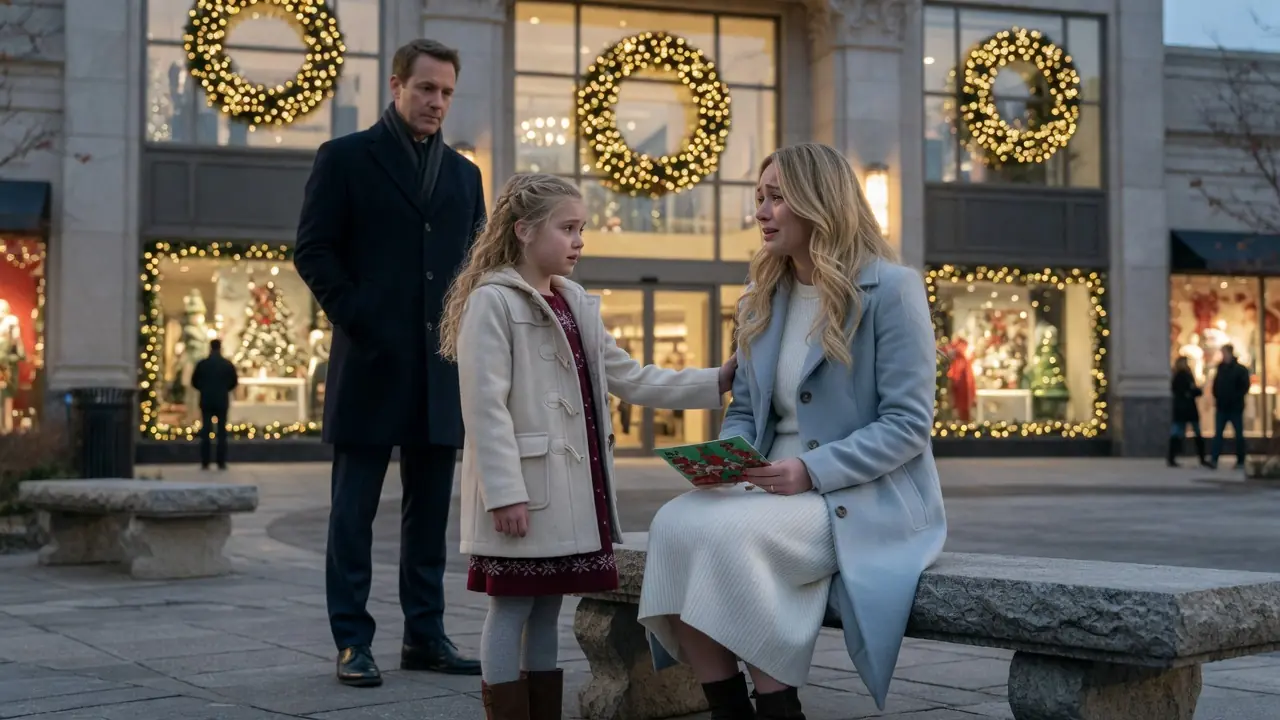
Tonight, she wore a white knit dress beneath a pale blue wool coat, the kind of outfit she had chosen carefully because her family had told her this dinner mattered, that they wanted to spend the holiday together for once.
But her family had never truly accepted the life she chose.
To them, Astrid’s work was not a real career. Her quiet nature was weakness. Her independence was stubbornness. Her unmarried life at twenty-seven was something they discussed in lowered voices, as if she had failed at becoming respectable.
Her mother loved appearances more than truth. Her father rarely defended her when relatives spoke carelessly. Her older sister, Amanda, treated her like a disappointing child who needed to be corrected, managed, and reminded of her place.
They had found every excuse over the years to exclude her from important events, from celebrations, from family trips, from the simple daily rhythms of belonging. And tonight, on Christmas Eve, they had done it again.
The text message had arrived two hours ago while Astrid sat in the food court waiting.
Family emergency, it read, as if those two words could excuse the fact that she had traveled across the city in the snow, had dressed up, had skipped lunch so she would arrive hungry for dinner, had allowed herself to hope.
She knew there was no emergency.
There was only the same familiar pattern.
They had changed their minds. Or they had decided the evening would be easier without her. Or Amanda had complained that Astrid always made things “heavy.” Or her parents had chosen comfort over honesty again.
Astrid had not gone home right away because her small apartment felt too empty tonight. It was clean and quiet, filled with the artwork she created in solitude, but on Christmas Eve, quiet could become cruel. So she stayed at the mall because at least there were lights, music, families, laughter, and the illusion of not being completely alone.
She sat by the fountain and watched people pass.
Children pulled their parents toward the enormous Christmas tree in the center of the atrium. Couples held hands and laughed at private jokes. Families carried shopping bags, took pictures, argued gently about where to eat, then forgave each other without even knowing how lucky they were.
Astrid watched all of it and felt the familiar ache of being close to warmth but not included in it.
Henry Corbin noticed her because his daughter Audrey noticed her first.
At thirty-five, Henry had learned to see the world through his child’s eyes, to pay attention to the things she found important. Audrey was seven years old, bright and observant in the way children often are before the world teaches them to look away from suffering.
She had blonde hair like her father’s late wife, blue eyes that seemed too large for her small face, and a heart that broke easily for anyone in pain.
“Daddy,” Audrey whispered, pulling on his sleeve.
Henry followed his daughter’s gaze across the crowded food court. He saw what Audrey saw: a young woman sitting alone, her shoulders curved inward as if trying to make herself smaller, tears sliding down her cheeks that she wiped away quickly, as if ashamed to be seen.
“She looks sad,” Audrey whispered.
Henry’s chest tightened.
He knew what it felt like to be alone during the holidays. His wife had left when Audrey was two years old. She had looked at their small apartment, at Henry’s irregular income, at the life of modest struggle stretching ahead of them, and decided it was not enough.
She wanted more money, more status, more than Henry could provide. So she walked away, and Henry raised their daughter alone, working long hours, accepting help from their neighbor Constance Matilda when childcare was needed, building a life that was simple but full of love.
He knew what it felt like to be abandoned. He knew what it felt like to sit alone during a holiday and wonder if anyone in the world cared that you existed.
“Come on,” he said softly to Audrey. “Let’s go say hello.”
They crossed the food court together, weaving between tables and chairs. Audrey held her father’s hand tightly, nervous but determined. When they reached Astrid’s table, Henry stopped at a respectful distance, not wanting to startle her.
“Excuse me,” he said gently.
Astrid looked up, confusion crossing her face, then something like weariness. She was used to people glancing at her tears and looking away. She was not used to anyone stopping.
Henry gave a small, careful smile.
“Are you okay?”
Astrid immediately wiped her cheeks.
“Yes,” she said quickly. “I’m fine. Thank you.”
“She doesn’t look fine,” she whispered, loudly enough that Astrid heard it.
For the first time all evening, a tiny laugh escaped Astrid through her tears.
Henry looked embarrassed.
“Audrey.”
But Astrid shook her head.
“It’s all right,” she said softly. “She’s honest.”
Audrey stepped a little closer.
“My name is Audrey. This is my daddy. His name is Henry.”
Astrid looked at the little girl’s open face, her innocent concern, and felt something in her chest loosen.
“My name is Astrid.”
“That’s pretty,” Audrey said.
“Thank you.”
Henry pulled out the chair across from Astrid but did not sit.
“May we sit for a minute?”
Astrid hesitated.
A part of her wanted to say no. It was safer to keep pain private, safer not to owe anyone explanations. But there was something about Henry’s calm voice and Audrey’s worried eyes that made refusing feel harder than accepting.
She nodded.
Henry sat, and Audrey climbed into the chair beside him, still watching Astrid carefully.
“Do you have somewhere to go tonight?” Henry asked.
Astrid looked down at her hands.
The truth felt humiliating.
She was twenty-seven years old. She should have been old enough not to care when her family disappointed her. She should have been used to it by now. But hope had a way of returning even after being punished many times.
“My family was supposed to meet me,” she said. “They canceled.”
“On Christmas Eve?” Audrey asked, horrified.
Astrid gave a sad smile.
“Yes.”
Henry’s expression softened.
“I’m sorry.”
“It happens,” Astrid said.
But her voice broke on the last word, betraying the lie.
Henry did not rush to comfort her with empty phrases. He did not say everything happens for a reason. He did not say family is complicated. He did not tell her to be strong. He only sat there, present and quiet, as if her sadness did not make him uncomfortable.
That alone nearly made her cry again.
Audrey reached across the table and gently touched Astrid’s sleeve.
“You can come with us,” she said.
Astrid blinked.
Henry looked at his daughter, surprised, but not displeased.
“Audrey.”
“What?” Audrey said. “She’s alone. We’re going to have dinner and decorate the tree. We have extra cookies.”
Astrid stared at the little girl, then at Henry.
He looked slightly shy now, as if Audrey had said out loud what he had been trying to approach more carefully.
“She is right,” Henry said. “We were going to get dinner and then go home to decorate our tree. It’s nothing fancy. But if you don’t want to be alone tonight, you’re welcome to join us.”
Astrid stared at him.
People did not do things like this.
Strangers did not invite crying women from mall food courts into their Christmas Eve. This was the kind of kindness that existed in movies, in stories, in things people shared online and forgot by morning. Real life was usually busier, colder, less willing to stop.
“You don’t know me,” Astrid said.
“No,” Henry replied. “But I know no one should be sitting alone and crying on Christmas Eve.”
Audrey nodded with great seriousness.
“And my daddy makes really good hot chocolate.”
Astrid felt something crack open in her chest, some wall she had built to protect herself from disappointment. She looked at Henry, searching his face for pity or judgment, but found neither. She looked at Audrey, who smiled up at her with such pure hope that refusing felt impossible.
In her coat pocket was a Christmas card she had intended to give to her family.
Inside the card was a printed certificate announcing that she had won an international illustration competition, that her work had been recognized by people who saw value in what she created.
She had wanted to share this with her family. She had imagined their faces when they learned that she was not drifting, not wasting her talent, not failing at life. She had imagined, foolishly perhaps, that they might finally be proud.
But they had not shown up to receive it.
The card felt heavy now, a reminder of hope misplaced.
Astrid took a breath.
“Okay,” she said quietly.
Audrey’s face lit up.
“Really?”
Astrid nodded.
“Really.”
The mall experienced a power surge just as they were preparing to leave. The lights flickered once, twice, then went dark completely. A few people gasped. Somewhere nearby, a child began to cry. Emergency lighting came on after several seconds, but the bright festive atmosphere had shifted into something dimmer and uneasy.
Outside, the storm had intensified. Snow fell heavily beyond the tall mall windows, and wind rattled the glass hard enough to make people turn their heads.
The crowd began moving all at once.
Some hurried toward the exits. Others searched for family members. Store employees stood in doorways trying to guide customers. A security guard spoke loudly near the escalator. The food court, bright and cheerful moments earlier, became a place of confusion.
Astrid froze.
Not because she could not understand what was happening, but because crowded panic had always frightened her. When she was a child, her older sister Amanda had once locked her in a closet during a thunderstorm as a joke. Astrid had cried and begged to be let out, but Amanda had laughed from the hallway, telling her not to be so dramatic.
Their mother had eventually opened the door, but instead of comforting Astrid, she had scolded her for making a scene.
Since then, darkness in crowded places made Astrid’s chest tighten.
Her breath came too fast.
Her vision narrowed.
People brushed past her shoulders, and for one terrible moment, she felt like that little girl in the closet again, trapped and unheard.
Then Henry moved into her line of sight.
“Astrid,” he said firmly but gently. “Look at me.”
She did.
“You’re safe. We’re going to walk out together. I’ve got Audrey, and I’ve got you. Just stay with me.”
Audrey reached for Astrid’s hand.
Astrid looked down at the small fingers wrapping around hers.
That simple trust anchored her.
Henry held Audrey’s other hand, and the three of them formed a small chain as he guided them through the crowd toward the exit. Audrey looked back at Astrid every few steps, offering little smiles of encouragement.
A security guard appeared in front of them suddenly, speaking quickly.
“This exit is slow. Use the west doors if you’re parked near section D.”
Henry nodded.
“Thank you.”
He turned to Astrid.
“We parked near the west entrance. It’s close.”
Astrid nodded, still breathing hard.
The security guard moved on, and Henry continued guiding them through the shifting crowd. He did not rush her. He did not make her feel foolish. He simply kept steady, one step at a time, until they reached the doors and stepped into the cold night air.
Snow fell thick and fast around them.
The parking lot was already covered in white. The familiar rows of cars looked strange and dreamlike beneath the storm. The wind stung Astrid’s cheeks, but the cold air helped clear the panic from her lungs.
Henry led them to his car, an older sedan that had seen better days but was clearly well-maintained. He opened the passenger door for Astrid, then settled Audrey in the back seat. Before starting the engine, he looked at Astrid.
“The roads are bad,” he said. “It may take a while to get home.”
“That’s okay,” Astrid replied.
And it was.
The idea of returning to her empty apartment now, of spending Christmas Eve alone after everything that had happened, felt unbearable. This stranger and his daughter were offering her something she had not experienced in years: the simple gift of not being alone.
Henry drove carefully through the snow-covered streets, his hands steady on the wheel, his attention fixed on the road. Audrey talked from the back seat about cookies, ornaments, her school Christmas play, and how she wanted to put the star on top of the tree herself this year.
Astrid listened, watching the city pass by through the window. The buildings looked softened by snow. Red and green lights glowed along storefronts. Families moved behind apartment windows, small silhouettes in warm rooms.
Hope stirred inside her.
Quietly.
Cautiously.
Then the car hit a patch of ice and skidded sideways.
Henry gripped the wheel, corrected the turn, and brought the car safely to the shoulder. The car stopped with one tire pressed into a shallow snowbank. For a moment, no one spoke.
Audrey’s voice came small from the back seat.
“Daddy?”
“We’re okay,” Henry said, though his hands were shaking slightly. “Everybody okay?”
“I’m okay,” Audrey said.
Astrid nodded.
“Yes. I’m okay.”
Henry exhaled slowly.
“I’m sorry. That was scary.”
“You kept us safe,” Astrid said. “Thank you.”
Audrey leaned forward between the seats.
“Daddy, I think Miss Astrid needs a family.”
Henry looked at her in the rearview mirror.
“Sweetheart, we just met her.”
“But she doesn’t have anywhere to go tonight,” Audrey insisted. “And it’s Christmas, and I like her. She’s nice.”
Astrid turned toward the window, trying to hide the tears forming in her eyes.
She had not realized how badly she wanted someone to say that.
Not that she was successful.
Not that she was talented.
Not that she should be stronger.
Just that she was nice.
Just that she was wanted.
Henry got out to push the car free from the shallow drift. Snow covered his coat almost immediately, and his breath showed white in the cold air. Astrid watched him work, this stranger who had noticed her sadness and chosen to step into it. The metaphor was not lost on her.
She had felt buried for years under her family’s disappointment, under her own loneliness, under the repeated humiliation of hoping people would choose her and watching them choose convenience instead.
And now someone was literally digging her out of the snow.
When they finally made it to Henry’s apartment building, the warmth that greeted them felt like an embrace. It was a modest place, the kind of building where working families lived, where neighbors knew one another’s names and helped carry groceries upstairs.
Henry’s apartment was on the third floor, a small two-bedroom unit that felt instantly welcoming.
The furniture was worn but clean. The walls were decorated with Audrey’s drawings and school projects. A small Christmas tree stood in the corner, half decorated, ornaments scattered on the coffee table as if the celebration had been interrupted halfway through.
“Welcome to our home,” Henry said, sounding a little shy, as if worried she might judge the simplicity of what he was offering.
But Astrid felt no judgment.
Only relief.
She looked around at the warm yellow lights, the stockings taped carefully to the wall, the simple beauty of a space filled with love rather than expensive things. It reminded her of the home she had imagined as a child before she understood that her family measured success in appearances, not tenderness.
Audrey ran to her room and returned with a blanket, which she carefully draped over Astrid’s shoulders.
“You’re cold,” Audrey announced solemnly. “You need to be warm.”
Astrid pulled the blanket tighter, touched by the gesture.
“Thank you.”
Henry disappeared into the kitchen and returned with two mugs of hot chocolate, then made a smaller one for Audrey with extra marshmallows. He handed one to Astrid and sat across from her, keeping a respectful distance.
For a long time, they simply sat together in the glow of the Christmas lights. Audrey worked on decorating the tree, humming to herself, occasionally turning to show Astrid a particularly pretty ornament.
Henry watched his daughter with gentle attentiveness, and Astrid felt her chest tighten with an emotion she could not quite name.
Eventually, Henry said, “You don’t have to tell me anything you don’t want to tell me. But if you want to talk, I’m here.”
Astrid held the mug in both hands.
“My family was supposed to meet me tonight,” she said. “They promised. Then they canceled while I was already waiting.”
Henry’s face darkened with quiet sympathy.
“I’m sorry.”
“It’s not the first time.”
That was the sentence that opened everything.
She told him about years of small exclusions. Family dinners she heard about afterward. Birthdays where Amanda’s achievements were celebrated while Astrid’s art was treated like a hobby. Holidays where she was invited late, seated at the edge, asked careless questions, then forgotten.
She told him how her parents never openly said they were ashamed of her, but their silence often felt worse. She told him how Amanda called her unrealistic, oversensitive, difficult, childish. She told him how she had spent most of her life trying to become impressive enough to be loved properly.
Henry listened without interrupting.
Audrey listened too, though she did not understand all of it. She only understood that Astrid had been hurt.
“That’s mean,” Audrey said when Astrid finished.
Astrid looked at her.
“Yes,” she said softly. “It was.”
Audrey climbed onto the couch beside her and leaned against her arm.
“You can stay here tonight.”
Henry smiled gently.
“If you want to.”
Astrid looked down at the blanket on her lap.
“I don’t want to be a burden.”
“You’re not,” Henry said.
The words were simple, but they struck deeply.
Astrid pulled the Christmas card from her coat pocket, the one she had carried all evening, and handed it to Henry.
“I was going to give this to them.”
Henry opened it carefully. He read the message she had written to her family, then unfolded the certificate inside. His eyes widened as he read it.
“You won an international illustration competition?”
Astrid looked down, embarrassed.
“Yes.”
“This is incredible.”
Audrey leaned over.
“What is it, Daddy?”
Henry explained that Astrid had won a very important prize for her art, that people from all over the world had recognized how talented she was.
Audrey’s face lit up.
“You’re famous?”
“No,” Astrid said, laughing through tears. “Not famous.”
“But you won.”
“Yes.”
“Then you’re famous enough.”
Astrid laughed again, and this time the sound came easier.
Audrey threw her arms around her neck.
“I’m proud of you.”
The words were so sudden and sincere that Astrid froze.
Then she hugged the little girl back.
Her family had not waited long enough to hear the news. They had not cared enough to ask why the evening mattered to her. But here, in a modest apartment with a crooked Christmas tree and a child in pajamas, Astrid heard the words she had wanted all night.
I’m proud of you.
Henry looked at the certificate again.
“They should have cared,” he said quietly.
Astrid wiped her eyes.
“Yes.”
“They were wrong not to.”
She nodded, unable to speak.
They spent the evening decorating the tree together. Henry helped Audrey hang the higher ornaments while Astrid arranged the lower ones, her artist’s eye creating balance and color that transformed their simple tree into something beautiful. Audrey declared that Astrid had “tree magic,” which made Henry laugh.
They drank hot chocolate and ate cookies that were slightly burned but still delicious. They played a card game that Audrey taught Astrid, though Audrey changed the rules twice in her own favor and claimed that Christmas allowed it.
Slowly, gradually, Astrid felt something inside her unclench.
Then, near midnight, there was a sharp knock at the door.
Henry stood.
Audrey looked up from the couch.
Astrid’s stomach tightened for no reason she could name until Henry opened the door.
Amanda Wilfried stood in the hallway.
Astrid’s older sister was dressed expensively, her hair perfect despite the snow, her coat designer and spotless. Her expression was cold, furious, and polished in the way only Amanda could manage.
Astrid stood up, the blanket falling from her shoulders.
Amanda pushed past Henry without invitation and strode into the apartment.
“What the hell do you think you’re doing?” she demanded.
Astrid stared at her.
“How did you find me?”
“Your phone location,” Amanda snapped. “Mom was worried you were going to make some dramatic scene.”
Astrid almost laughed.
“Mom was worried?”
Amanda looked around the modest apartment with barely concealed disdain. Her lip curled slightly at the worn furniture, the handmade decorations, the obvious simplicity of Henry’s home.
“You’re spending Christmas Eve in a stranger’s apartment?” Amanda said. “Do you have any idea how embarrassing this is?”
Henry moved to stand beside Astrid.
“Your family left her alone at the mall on Christmas Eve,” he said calmly. “I think that’s the embarrassing part.”
Amanda turned her cold gaze on him.
“And who are you?”
“Henry Corbin.”
“Some random man who thinks he can rescue my sister?”
“I don’t think she needs rescuing,” Henry said. “I think she needed someone to be kind.”
Amanda laughed sharply.
“You don’t know Astrid. She always makes herself the victim. She sits around waiting for people to feel sorry for her, then acts wounded when life doesn’t revolve around her.”
Audrey stood from the couch, her small face fierce.
“She wasn’t acting. She was crying.”
Amanda looked down at her.
“This is none of your concern, child.”
Audrey stepped closer to Astrid anyway.
“She’s nice. You’re being mean.”
Amanda’s face hardened.
“Astrid, get your coat. We’re leaving.”
For years, that tone had worked.
It was the voice Amanda used when she wanted Astrid to shrink, apologize, obey, and make things easier. It was the voice that told Astrid she was always too sensitive, always wrong, always the problem.
But something was different now.
Maybe it was the warm blanket around her shoulders.
Maybe it was Audrey’s small hand finding hers.
Maybe it was Henry standing beside her without speaking over her.
Or maybe Astrid had simply reached the end of letting people who did not love her properly decide where she belonged.
“No,” Astrid said.
Amanda blinked.
“What?”
“I said no.”
Amanda’s face flushed.
“Don’t be ridiculous.”
“I’m not leaving with you.”
“You’re making a scene.”
“I’m making a choice.”
The words surprised even Astrid.
But once spoken, they gave her strength.
“I’m choosing to stay somewhere I’m wanted for once. I’m choosing people who noticed I was hurting instead of pretending they didn’t see. I’m choosing not to go back with someone who only came because she was embarrassed, not because she cared.”
Amanda stared at her.
Henry remained silent.
This was Astrid’s moment.
Amanda’s voice turned sharp.
“You are throwing away your family for strangers.”
“No,” Astrid said. “My family left me alone tonight. Strangers brought me in.”
The room went still.
For a moment, something flickered across Amanda’s face. It might have been shame. It might have been anger at being told the truth where someone else could hear it.
Then the familiar mask returned.
“Fine,” Amanda said. “Stay here. But don’t come crying back when this little holiday fantasy falls apart.”
Astrid lifted her chin.
“I won’t.”
Amanda looked at Henry with contempt.
“Good luck with her.”
Henry’s voice stayed calm.
“I don’t need luck to treat someone with basic respect.”
Amanda opened her mouth, then closed it.
There was nothing useful left for her to say.
She turned and left, slamming the door hard enough to rattle the frame.
In the silence that followed, Astrid felt her knees weaken. She had stood up to her sister for the first time in her life, had chosen herself over the family that had rejected her, and the weight of it was overwhelming.
Henry stepped closer.
“You okay?”
Astrid shook her head honestly.
“No.”
Audrey wrapped both arms around Astrid’s waist.
“You were brave.”
Astrid looked down at her.
“I don’t feel brave.”
“My daddy says brave people are scared and do the thing anyway.”
Astrid looked at Henry.
He gave a small smile.
“She quotes me when it helps her win arguments.”
Despite everything, Astrid laughed.
That night, Astrid slept on Henry’s couch wrapped in warm blankets that smelled faintly of laundry detergent and cinnamon. She lay awake for a long time, watching the lights from the Christmas tree cast gentle shadows on the ceiling.
The apartment was quiet.
But this quiet felt different from the silence of her own place.
It did not feel empty.
It felt peaceful.
In the morning, Audrey was the first one awake, as children often are on Christmas morning. She crept into the living room and found Astrid already sitting up, watching snow fall outside the window. The storm had passed during the night, leaving the city blanketed in white.
Audrey held out a small wrapped package, the paper wrinkled and the bow crooked, clearly wrapped by small hands without adult supervision.
“For you,” she whispered.
Astrid took the gift with trembling hands.
Inside was a pair of knitted gloves, cream-colored and soft, slightly uneven in places, but made with obvious care.
“I made them,” Audrey said proudly. “Daddy helped a little, but not too much.”
Astrid slipped them on.
They fit almost perfectly.
“You made these for me?”
Audrey nodded.
“I was making them for my teacher, but I think you need them more because you looked cold last night.”
The simple thoughtfulness of it broke something loose in Astrid’s chest. She pulled Audrey into a hug, holding the little girl close.
“Thank you,” she whispered. “I love them.”
Henry appeared in the doorway holding three mugs, coffee for himself and Astrid, hot chocolate for Audrey. His hair was messy from sleep, and his smile was warm.
“Merry Christmas,” he said.
Astrid looked at him, then at Audrey, then at the small tree glowing in the corner.
“Merry Christmas.”
After breakfast, Henry said gently, “I know we just met. I know this is fast and probably overwhelming. But if you need a safe place to stay while you figure things out, you’re welcome here for a little while. No pressure. No expectations. Just a couch, hot chocolate, and a little girl who will probably make you play cards until you regret accepting.”
Audrey gasped.
“I am very good at cards.”
“You cheat.”
“I improve the rules.”
Astrid laughed.
Then she looked down at the gloves on her hands.
For years, she had mistaken endurance for strength. She had stayed near people who hurt her because she believed family was something you had to keep no matter how cold it became. But maybe family was not only blood. Maybe family was also the people who saw you sitting alone in a crowded place and decided you should not have to stay that way.
“I want to stay,” Astrid said softly.
Audrey squealed with delight and threw her arms around her again.
Henry smiled, and there was something in his eyes that made Astrid feel seen in a way that had nothing to do with pity.
They spent Christmas Day together.
They ate scrambled eggs and toast. They opened small presents, nothing expensive, but chosen with care. They watched Audrey’s favorite movies, played cards, and ordered Chinese food when Henry accidentally burned the potatoes because he was trying too hard to make the meal special.
Astrid showed them pictures of her artwork on her phone. Audrey asked if she could draw a princess riding a dragon in outer space. Astrid said yes, and within an hour, the two of them were sprawled on the living room floor with colored pencils, creating a story that made no sense and somehow made perfect sense.
In the evening, Audrey fell asleep between them on the couch, one hand resting on Astrid’s sleeve.
Henry looked at Astrid over his daughter’s head.
“Thank you for staying.”
Astrid smiled through unexpected tears.
“Thank you for asking.”
Outside, snow covered the city in soft white silence. Inside, the Christmas tree lights twinkled against the window, reflecting three figures on the couch: a single father, a little girl, and a young woman who had been alone the night before but no longer felt unwanted.
Astrid did not know what would happen next.
She did not know whether her family would apologize, whether Amanda would ever understand, whether her career would grow after the award, or whether this new connection with Henry and Audrey would become friendship, love, family, or simply one beautiful chapter that helped her begin again.
But for the first time in years, she did not feel like someone waiting outside the warmth.
She felt like she had been invited in.
She felt like she belonged.
And in the simple acceptance of two people who had chosen to see her value when her own family could not, Astrid found the courage to believe that maybe, just maybe, her life could be different from that day forward.