The snow came without warning.
One moment, the road was visible, pale gray asphalt cutting through the mountain dark.
The next, it vanished beneath a wall of white so dense that headlights became useless, pointing at nothing but their own reflection.
Jack Mercer had driven this road a hundred times.
He knew where it curved, where the guardrail ended, where the drop on the left side fell four hundred feet into a frozen creek bed no one had ever bothered to name.
He knew all of this.
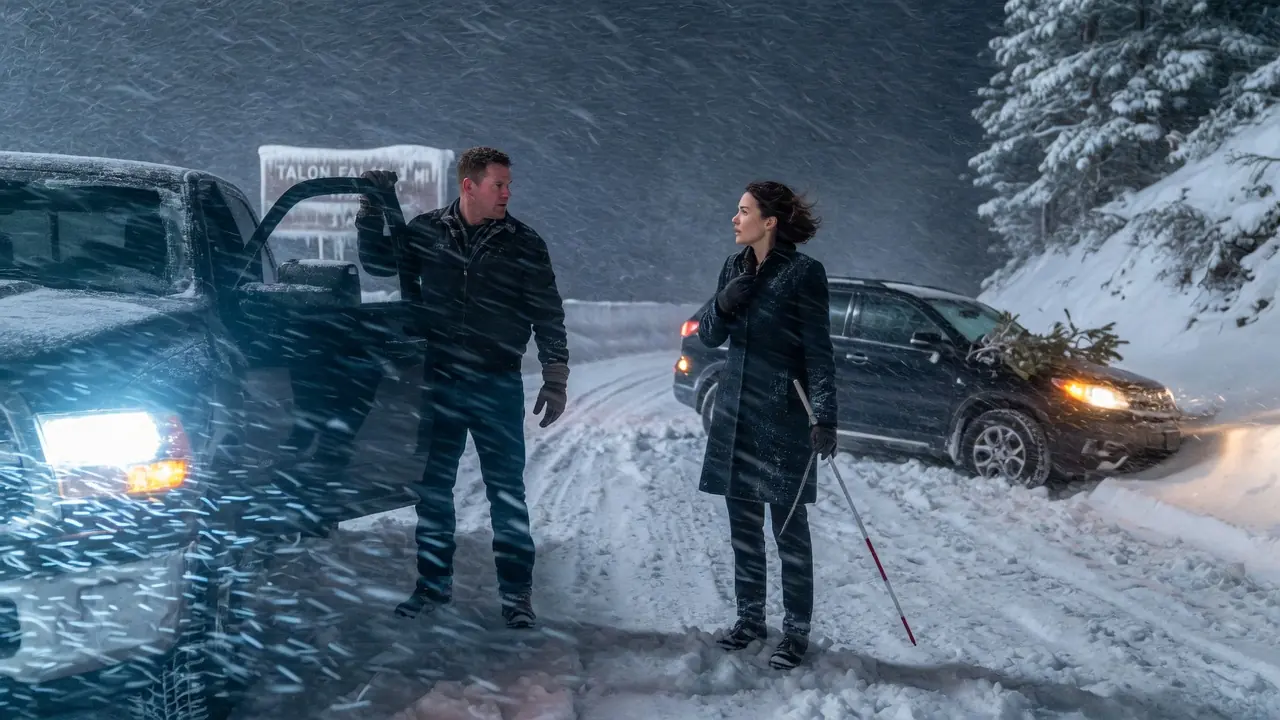
What he did not know was that tonight, someone had parked a black SUV sideways across the only lane that existed on this mountain.
And standing beside it, perfectly still in the howling wind, was a woman in a charcoal coat with no luggage, no phone in her hand, and no visible fear on her face.
His daughter, Lily, pressed her nose to the passenger window.
“I see her. She’s not moving.”
“I know.”
Jack stopped the truck and got out.
The cold hit him like a fist, sharp, immediate, merciless.
He squinted through the snow and walked toward her.
She turned before he reached her.
She turned before she could have heard his footsteps over the wind.
Then she said, without any preamble, without any tremor in her voice,
“Mr. Mercer, I was hoping it would be you.”
He had never seen this woman in his life.
The woman’s name, she told him, was Elena Voss.
She said it in the way people say their name when they have rehearsed it.
Not their real name, but the one they have decided you will get.
Jack noticed that.
He noticed most things.
It was the habit of a man who had learned early and the hard way that the details other people missed were usually the ones that mattered.
She was perhaps thirty-five, possibly older.
There was something in the stillness of her face that made her age difficult to read, as if she had passed through some particular fire and come out the other side with all her softness burned away.
Her hair was dark and wind-loose.
Her coat was expensive.
Her shoes, he clocked immediately, were entirely wrong for the terrain.
Low heels.
Italian leather.
Already darkening with snow.
She held a white cane loosely in her left hand, not using it, just holding it.
“You know my name,” he said.
“I know several things about you.”
She said it without apology.
“Your truck is a 2019 Ford F-150, and you take this road every Tuesday and Thursday evening because your daughter attends the Ridgecrest after-school program in Talon Falls, which closes at six. Tonight, you are forty minutes late, which means the storm caught you partway down. You were hoping to make it home before it worsened.”
Jack stared at her.
“You’re right,” he said carefully. “Who are you?”
“Someone who needs to get off this mountain before the men following me realize their vehicle isn’t the only one stuck on it.”
That was when Lily climbed out of the truck.
She was eight years old, his daughter, small for her age, red-haired like her mother had been, with the kind of calm curiosity that some children are simply born with and others spend their whole lives failing to achieve.
She walked up and stood beside Jack and looked at Elena Voss with no fear whatsoever.
“Your cane has a scratch on the handle,” Lily said. “From something metal, like a doorknob.”
Elena turned toward the sound of Lily’s voice with the precision of a compass needle finding north.
“You’re right,” she said.
Something in her expression shifted.
Not softened exactly, but recalibrated.
“Your name is Lily.”
“You can’t see me,” Lily said, not cruelly, just stating a fact.
“No, but I can hear the way your father breathes when he looks at you, and I can hear that you’re not afraid of me.”
A pause.
“Most people are afraid of me because I know things I shouldn’t.”
Lily considered this.
“So does my dad. He knew my tooth was loose before I did.”
Elena almost smiled.
Almost.
Jack looked at the black SUV wedged across the road.
The front left wheel had gone over the shoulder’s edge.
The vehicle was not going anywhere without a tow truck and a miracle.
He looked back at the woman.
“You said men are following you.”
“Two vehicles, approximately twelve minutes behind me when I stopped. That was eight minutes ago.”
“How do you know?”
She did not answer that.
“I can take you to the next town,” he said slowly. “There’s a gas station, a diner.”
“Not the town.”
Her voice was quiet but absolute.
“They’ll check the town first. There’s a service road three-quarters of a mile back on the east side of the ridge. It leads to a maintenance cabin. I need to reach it before they crest the hill.”
Jack looked at her, really looked at her.
She was standing in a blizzard on a mountain road at night.
No bodyguards.
No panic.
Just the stillness of someone who had already thought through every version of what happened next and had decided on one.
“Get in,” he said.
She found the door handle on the first try.
The service road was exactly where she said it was.
Jack had driven past it for three years without ever noticing it.
A gap between two pine trees barely wide enough for the truck, marked only by a rusted reflector post almost entirely swallowed by undergrowth.
He would have missed it in daylight.
At night, in a blizzard, with visibility at maybe thirty feet, he would not have found it in a hundred tries.
Elena told him to turn eight seconds before they reached it.
Not when the headlights touched the reflector.
Eight seconds before.
“How?” he said after he had taken the turn and they were grinding slowly through six inches of untracked snow.
“Sound. The tree density changes before the gap. The wind pitch shifts slightly.”
She had her hands resting flat on her knees, perfectly still.
“You learn to hear the shape of a space.”
“That’s not normal.”
“No, it’s not.”
Lily was in the backseat, wrapped in the emergency blanket Jack kept behind the driver’s seat.
She had fallen into the half-sleep of children on car rides.
Not fully out.
One eye cracked open, listening with the unguarded attention that adults forget they ever had.
“How long have you been blind?” Jack asked.
“Four years.”
A beat.
“Officially.”
“What does officially mean?”
She turned her face toward the passenger window.
Outside, the snow pressed against the glass in shifting curtains.
“It means the medical records say four years. The truth is more complicated. Most truths are.”
She looked at him then, or did the thing she did that looked like looking.
She angled her face toward him with a precision that made the hair stand up on the back of his neck, as if being observed by something that did not need eyes to see.
“You’re not afraid of me,” she said.
“You said that about Lily.”
“I’m saying it about you.”
He kept his eyes on the narrow track through the trees.
The snow was heavier here, sheltered from the wind but accumulating fast.
“I’ve had harder nights than this,” he said.
A silence.
Then,
“Your wife.”
His jaw tightened.
“I’m sorry,” she said.
This time, it sounded unrehearsed, raw at the edges.
“That wasn’t my place.”
“No, it wasn’t.”
Another silence.
The kind that had weight to it.
Shape.
The way a room has shape when you turn off the light.
Lily shifted in the backseat.
The heater hummed.
The wipers beat their slow, steady rhythm against the snow.
“She died two years ago,” Jack said finally.
He did not know why he said it.
Maybe because something about a woman alone on a mountain at midnight had earned a small truth in exchange for the large one she was clearly withholding.
“Lily was six. I sold the house in Denver, moved up here. My brother has a garage in Talon Falls. I work for him.”
“Reynolds Automotive,” Elena said.
He glanced at her sharply.
“You know the town?”
“I know the region.”
A careful answer.
Not quite a lie, not quite the truth.
“You knew my name before you met me.”
She said nothing.
“Elena.”
It was the first time he had used her name.
She registered it, a slight stillness, a micro-adjustment of posture.
“Whatever you’re running from, you brought it up my mountain. You brought it near my daughter. I think you owe me more than careful answers.”
For a long moment, there was only the sound of the truck pushing through snow, the trees closing in on both sides, the dark pressing down from above.
“Yes,” she said finally. “I do.”
But she did not say anything more.
Not yet.
The cabin appeared out of the dark like a held breath finally released.
It was small, two rooms at most, built from rough timber that had gone silver gray with decades of weather.
A woodpile under a canvas tarp on the south wall.
Shuttered windows.
A door with a hasp lock that Elena told him the combination to without being asked.
L-U-A-R-D-Z-O-E.
Jack did not ask how she knew.
He got Lily inside first, settled her on the single cot with both their coats layered over her.
The child fell back into sleep with the unselfconscious ease that children possess and adults mourn.
Jack started a fire in the iron stove.
There was seasoned wood, matches in a tin.
Everything arranged with the quiet efficiency of a place that had been prepared by someone who knew it might be needed.
“You set this up,” he said.
Elena was standing near the door, listening.
Not to him.
To the outside.
“Two weeks ago,” she said.
“Planning to get stranded?”
“Planning to survive it.”
She moved to the window and pressed two fingers to the shutter, angled slightly.
Feeling the vibration of the wind, Jack realized.
Reading it.
“They’ll find the SUV within the next thirty minutes. After that, they’ll check the road in both directions. The service road tracks will be covered by the time they reach them, but not completely.”
“How many of them?”
“At least three in the vehicle I saw. Possibly a second team coming from the south access road.”
She turned from the window.
In the firelight, her face was all angles and shadow.
“I want to tell you that you and Lily are not their targets, but I’d be lying if I said your presence doesn’t complicate things.”
“Complicate how?”
“They’re professional. They won’t hurt bystanders unless the bystanders become obstacles.”
Jack was quiet for a moment.
“So we become obstacles if they find us together.”
“Yes.”
He looked at his daughter sleeping on the cot, her red hair spread across the rough pillow, her small chest rising and falling.
The particular peace of a child who still believes in the marrow of her bones that the dark holds nothing her father cannot handle.
He thought about what it cost to keep that belief intact.
“Then we make sure they don’t find us together,” he said.
He went to the door and opened it a crack.
Snow.
Wind.
Dark.
He looked for thirty seconds, parsing the shapes, the movements, the quality of the silence.
There were tracks in the snow.
Not his.
Not Elena’s.
Already there when they arrived, partially drifted over, but visible if you knew what to look for.
Overlapping boot prints.
Two sets.
Circling the cabin from the east side and stopping at the woodpile.
Someone had been here recently.
He closed the door quietly and turned back to the room.
Elena was already standing in the center of the space, her head tilted at a slight angle, her expression gone flat and watchful.
“You see them?” she said.
“Tracks. East side. Two people. They came through here approximately four hours ago.”
She said it without drama.
“They were checking whether the cash was intact.”
“Cash?”
She reached under the cot, reaching directly to a specific board without feeling around for it, and pressed her thumb to a knot in the wood.
A section of floor came up.
Beneath it was a waterproof case, matte black, large, with a biometric pad.
“What is that?” Jack said.
“Insurance,” she said. “For now, that’s all you need to know.”
He looked at her for a long moment.
The fire snapped.
Lily murmured something in her sleep.
A word.
Perhaps his name.
Both of them went still for a moment, involuntarily, the way adults do when children make small sounds that remind them what is actually at stake.
“I’m going to need to know a great deal more than that,” Jack said quietly.
“I know,” she said. “And I’ll tell you. But first, I need you to trust me for about four more hours.”
“Why four hours?”
“Because by then, either we’ll both be safe and I can tell you everything…”
A pause.
“Or we won’t, and it won’t matter.”
Lily woke at two in the morning with the matter-of-fact clarity of a child who had decided it was time to be awake.
She immediately wanted to know if Elena was hungry.
“There’s crackers,” Lily said, having already located the emergency supplies Jack kept in his pack. “And chocolate. Dad always has chocolate. He says it’s for emergencies, but I think he just likes chocolate.”
“He’s allowed,” Elena said.
“Do you want some?”
“Yes, thank you.”
Lily distributed crackers and a broken chocolate bar with the gravity of a diplomat brokering peace.
Then she settled cross-legged on the cot and regarded Elena with her usual forthright attention.
“Can you see anything?” Lily asked. “Or is it all dark?”
“Lily,” Jack said.
“It’s all right,” Elena said. “The honest answer is, it depends.”
Lily accepted this.
“On what?”
“On what kind of light. On how much I’ve slept. On…”
She stopped, then started again differently.
More carefully, as if choosing the weight of each word.
“My eyes were damaged, but not the way most people’s eyes are damaged.”
“What way then?”
“The kind that was done on purpose.”
The fire had burned lower.
Jack put another piece of wood on it without being asked, and the flame took hold and threw new shadows across the walls.
Elena sat with her hands around a tin cup of water.
Her cane was leaning against the wall beside her.
Not forgotten, but set aside in a way that suggested she only used it when she needed to seem more helpless than she was.
“Four years ago,” she said, addressing this largely to the fire, “I was the chief executive of a private equity group called Voss Capital. My father founded it. When he died, I inherited it. When I inherited it, I discovered that it had been doing things for decades that it was never supposed to do.”
“What kinds of things?” Jack said.
“The kind that certain people will go to extraordinary lengths to keep buried.”
She turned the cup in her hands.
“I had a board meeting, a negotiation over a specific acquisition. There was a dinner afterward. I had a single glass of wine, and by the following morning, I couldn’t distinguish between daylight and shadow.”
“They poisoned you,” Jack said flatly.
“The doctors found nothing. No toxicology panel found anything. Every specialist I saw in the following six months documented progressive bilateral optic neuropathy of unknown origin.”
She said the clinical words with the hollow precision of someone who had to repeat them so many times they had lost all emotional charge.
“Unknown. That’s the word that matters.”
“They made it unknown.”
“Who is they?”
She was quiet.
“Elena.”
“My brother,” she said. “And three members of my board.”
The fire popped.
Lily had gone very still, as children do when they sense the conversation around them has become something significant.
Something they want to remember even if they do not fully understand it.
“My brother, whose name I won’t say yet in front of your daughter, believed that if I were incapacitated, the board would appoint him acting chief executive, and he would have eighteen months to complete the acquisition I had been blocking.”
She paused.
“He was mostly right.”
“Mostly?”
“He didn’t account for the fact that I had spent the year before the poisoning preparing for exactly that possibility.”
She set down the cup.
“I had been watching them watch me. I knew what they were planning. I simply didn’t know when.”
A long pause.
“I was wrong about the wine. I thought it would be something more obvious, something I could avoid.”
Jack leaned forward with his elbows on his knees, studying her face in the firelight.
She looked exhausted in a way that had nothing to do with tonight.
The exhaustion of years.
“The case under the floor,” he said.
“Contains evidence sufficient to result in criminal charges against eleven people,” she said. “Fraud, conspiracy, aggravated assault, the poisoning, if we can reclassify it.”
She said it methodically.
“I’ve spent four years collecting it while appearing to be a blind woman with no power and nothing left to lose.”
“While they thought you were neutralized.”
“They thought I was gone,” she said.
And something in her voice, something cold and hard and brilliantly patient, made Jack understand for the first time who he was actually sitting across from.
Not a victim.
A strategist who had allowed herself to appear to be a victim.
“My vision,” she said, more quietly now, “comes back in fragments, under certain conditions. Low, warm light, like this.”
She glanced toward the fire.
Actually looked at it, not just oriented toward it.
“I can see outlines, shapes, movement.”
A beat.
“Not enough to read. Not enough to drive. But enough.”
“Enough to know that there are two of them coming across the field to the east,” Lily said quietly.
Both adults went still.
Lily was at the shutter Jack had told her not to go near, standing on her tiptoes, looking through the crack.
“Two flashlights,” she said. “They’re being sneaky about it, but the snow makes them easy to see.”
Jack was already moving.
They had twenty minutes by Elena’s estimate.
She said it without panic, without the performance of calm that frightened people produced.
Just the flat, working calculation of someone who had run contingencies until contingencies were all she knew.
“The case,” Jack said. “It goes with me regardless of what happens.”
“I wasn’t suggesting otherwise.”
He was pulling on his coat, checking the door, thinking through the geometry of the cabin and the terrain beyond it.
“There’s a creek bed fifty yards north, frozen solid this time of year. If we move along it, we’re below their sightline from the field. I know the creek.”
“Of course you do.”
He looked at Lily.
His daughter was already putting on her boots, lacing them with methodical focus.
Eight years old and not crying, not demanding explanations, not doing any of the things that would make this harder.
Just lacing her boots.
He felt the particular sharp love that has no name, the love that comes from watching a child be brave.
“I need you to stay very close to me,” he told her. “Not five steps. Not three. One step.”
“I know, Dad.”
He looked at Elena.
She had the black case in her left hand, her cane in her right, the coat buttoned to the throat.
“When we reach the creek bed,” she said, “I need you to trust my directions for the last quarter mile.”
“Because you know this route?”
“Because I placed a series of directional markers along the creek bank two weeks ago at heights and intervals I can find by touch.”
She said it simply.
“I knew I might need to move in the dark. I knew I might not be alone.”
Jack looked at her.
“Did you know it would be me?”
She paused for the span of one breath.
“I knew I needed someone who knew the mountain. Someone with a reason to be on this road on this night. Someone who wouldn’t run.”
Another pause.
“Your brother mentioned you. Casually, months ago. He didn’t know I was listening.”
“My brother?”
“He has a work contract with one of my subsidiary companies. He doesn’t know that. Not yet.”
She met his eyes, really met them in the firelight, with the odd, searching directness of someone who could see more than you expected.
“I’m sorry. I know how that sounds.”
It sounded like he had not been a coincidence.
It sounded like she had needed a specific piece and had positioned it and had waited.
He wanted to be angry about that.
He found, standing in a freezing cabin with his daughter pulling on her second boot, that he could not quite get there.
“We’ll have this conversation later,” he said.
“Yes,” she said. “We will.”
He put out the fire.
They went into the dark.
The creek bed was exactly what he had said.
Frozen hard.
A white channel between banks of scrub pine and granite running northeast through the bottom of the valley.
The snow muffled sound in every direction.
Their footsteps were nearly silent.
Elena moved along the bank with one hand extended, fingers grazing the ice-crusted reeds at intervals.
Finding something.
Jack watched her and tried to understand what she was reading in those frozen stems.
The position of a marker.
A notch.
A specific bend.
He could not.
But she moved without hesitation, faster than he would have in the dark.
Lily kept pace without complaint.
One step behind her father.
Eyes everywhere.
Behind them, maybe three hundred yards away, two flashlight beams swung across the field, looking for tracks.
Finding the cabin.
Going in.
They had minutes before the search expanded.
“Here,” Elena said quietly, stopping at a section of bank where a large granite boulder broke through the ice.
She reached into a gap in the rock face and pulled out a small waterproof bag similar to the case, but flat like an envelope.
She transferred it into her coat pocket.
“Backup,” she said when she felt Jack watching her.
“Of what?”
“Of everything in the case. Different format. In case they take the case.”
She started moving again.
“The case contains the primary evidence. Physical documents, original recordings, a chain of custody that can be traced and verified. The backup is digital, encrypted, already uploaded to three separate servers in three different countries under the direction of an attorney whose name neither I nor anyone associated with me knows.”
“A dead man’s switch.”
“An alive woman’s switch,” she said. “It releases automatically if I fail to authenticate to one of the servers every forty-eight hours.”
Jack was quiet for a moment, processing this.
“When’s the last time you authenticated?”
“Thirty-one hours ago.”
“Seventeen hours.”
He looked at her profile in the dark, the slight angle of her face upward into the wind, reading it.
Reading something in it.
“Tell me what’s on the recordings,” he said.
She did not answer immediately.
They walked.
The creek curved northeast, and Elena curved with it, her hand brushing the bank, reading the reeds like braille.
“A conversation,” she said finally. “Between my brother and two members of the board. Three weeks before the dinner, discussing the specific compound to be used, the dosage, the medical cover story they had established in advance, and the timeline for the transition of power once I was…”
She stopped, selected a different word.
“Once I was no longer functional.”
Jack stopped walking.
Elena took two more steps before she realized, then stopped too.
“They planned it for three weeks,” he said.
“They planned it for longer. The recording is from three weeks before, but the plan existed for at least a year prior.”
“And you listened to it.”
“I had the room wired.”
A pause.
“My father taught me that. He said, never trust the people around power, because they are always, in some small or large way, planning to take it.”
She turned to face him in the darkness.
“I thought he was being paranoid until he died and I found out that the circumstances of his death were…”
She stopped.
“That investigation is ongoing.”
The creek ran quiet beneath the ice.
Somewhere behind them, a light swept across the trees at the edge of the field.
Getting closer.
“Your daughter,” Elena said quietly. “She should know that she’s extraordinarily brave.”
“I’ll tell her.”
“Tell her now. People should hear things like that when they can.”
Lily, one step behind Jack, heard this.
Her chin came up slightly.
Her spine straightened in the almost invisible way that praise straightens a child’s spine.
“Let’s move,” Jack said.
They came out of the creek bed onto the old service road twenty minutes later.
Elena stopped and tilted her head.
Then she said very quietly,
“Vehicle northeast, approximately a quarter mile. Not moving.”
Jack listened.
Heard nothing.
Thirty seconds later, he heard an engine idling.
“How?” he said.
“Low frequency vibration carries differently through frozen ground than through air.”
She was already adjusting direction, moving south along the road’s edge.
“They’ve blocked the north exit, which means they’re assuming we’ll go toward the town.”
“South route adds four miles.”
“Yes, but it has a cell signal.”
She pulled something from her coat.
Not the case.
Not the backup envelope.
A small device he had not seen her retrieve.
It looked like a thick watch.
She pressed a button.
“I’ve activated a signal. There’s a contact who will respond. An attorney. And behind the attorney, a federal prosecutor’s office in Denver that has been waiting approximately fourteen months for me to be ready.”
Jack stared at her.
“You’re ready now?”
“I’ve been ready for six months.”
Her voice was steady.
“I needed the right night. The right conditions. The right…”
She stopped herself.
“The right person,” Jack said.
She did not deny it.
“They were always going to come for me this winter,” she said. “The acquisition closes in eleven days. After that, what I know becomes retroactively less dangerous. The damage will already be done. They needed me gone before the close, and I needed to be found before the close. But found by the right people.”
A pause.
“You are not in danger because of coincidence, Mr. Mercer. You are in danger because I put you in proximity to this situation with the belief that you could handle it. That was a decision I made for you without your knowledge.”
“I know,” he said.
“You should be angry.”
“I should be a lot of things.”
He looked at Lily, who was watching this exchange with the absolute attention of someone who understood more than adults expected.
“Are we going to make it through this?”
“Yes,” Elena said.
And the way she said it, not hopeful, not reassuring, but certain, the way a navigator is certain of position, was the most convincing thing he had heard all night.
They heard the dogs a few minutes later.
Not official dogs.
Not search and rescue.
Something faster and less trained.
Pulled along by someone who wanted them to run, not track.
The sound of them came from the east, bounding and chaotic, crashing through the brush above the creek bed.
“They found the cabin,” Elena said.
“They found our tracks leaving it,” Jack corrected.
“Run,” she said.
They ran.
The south road was a track barely distinguishable from the surrounding snow.
Two parallel compressions left by decades of maintenance vehicles, white as everything else, visible only because the trees framed it on both sides.
Jack held Lily’s hand.
Elena was at his shoulder, matching his pace with uncanny accuracy.
Her cane was folded and tucked under her arm, moving through the dark like someone who had rehearsed this.
Like someone who had rehearsed this.
He did not ask when.
He just ran.
They reached the south access point forty minutes later.
A locked gate.
A parking turnout.
A forestry department sign half buried in a drift.
And a car waiting with its lights off.
Elena stopped, raised one hand, and said,
“Don’t.”
Jack had already started to move toward it.
He stopped.
The car’s engine was cold.
It had been parked for at least an hour.
No exhaust visible in the frozen air.
“That’s not your contact,” he said.
She turned her face in a slow arc, the way she did when she was reading everything.
Air pressure.
Sound.
The thousand small signals that the rest of them were too loud inside their own heads to hear.
“There’s one person in it,” she said. “Driver’s seat. Not moving.”
A pause.
“Been there for a while, waiting.”
Jack set Lily behind him.
His voice, when he spoke, was very quiet.
“Is it your brother?”
A long silence.
“Yes,” she said.
He looked at her.
“Did you know he’d be here?”
And here was the moment he had been building toward since she said his name in a blizzard.
The moment where the shape of the evening shifted, and all the angles he had been holding in peripheral vision came suddenly and directly into view.
“Elena.”
“I suspected,” she said. “Not knew. Suspected.”
“There’s a difference?”
“In law? Yes.”
“In trust?”
She stopped.
“I understand that to you they may be the same thing.”
Jack looked at the car.
Looked at the dark mountain around them.
Looked at his daughter behind him, red hair frosted at the edges, breath pluming in the cold, watching him with those steady eyes.
He had signed up for a woman stranded in a blizzard.
He had ended up in the final act of a four-year game of chess being played by someone who had lost her eyes and spent every waking hour since making sure that the people who took them would lose everything else.
He thought about that.
Really thought about it.
“What happens if we walk away right now?” he said. “Lily and I.”
She was quiet for exactly the time it took to decide whether to lie.
“I survive,” she said. “Probably. The signal was sent. The contact will come with or without us reaching the access point. The forty-eight-hour window doesn’t close for seventeen hours.”
She paused.
“But the evidence is with me, and my brother knows that. And my brother is thirty feet away and has been waiting here for an hour and hasn’t moved.”
“Which means he came here to talk, not to…”
She stopped again.
“Not to hurt you,” Jack finished.
“He never wanted to hurt me,” she said.
And the way she said it, with that particular flatness that was not lack of emotion, but rather the sound of emotion so large it could not be inflected, told Jack everything about the last four years.
“He wanted you gone,” Jack said.
“He wanted me manageable.”
She exhaled slowly.
“There’s a difference there, too. Just not a very comforting one.”
Lily stepped out from behind Jack.
He reached for her, and she let him take her hand, but kept walking forward.
“Maybe you should talk to him,” Lily said.
Both adults looked at her.
“If he came to talk,” Lily said, with the plain reasonableness of someone who had not yet learned to complicate the simple things, “maybe you should let him.”
Elena turned toward the car.
His name was Daniel Voss.
He was six years older than Elena and looked nothing like her.
Broad where she was slight.
Loud in the face where she was quiet.
He stood beside the car in the falling snow and looked at his sister, and at Jack, and at the child between them.
And he looked, Jack thought, like a man who had driven a long distance to say something and was not sure anymore that he had the right words.
“You were supposed to run,” he said to Elena.
“I don’t run,” she said.
“You’ve been running for four years.”
“I’ve been preparing for four years.”
She stopped six feet from him, and Jack stayed at her shoulder with Lily’s hand in his.
“There’s a difference.”
Daniel Voss looked at Jack.
“Who are you?”
“A mechanic,” Jack said. “With a truck and a bad sense of timing.”
Something moved across the other man’s face.
Not quite a smile, but the shadow of one.
He looked back at Elena.
“The others don’t know I’m here,” he said. “Reinholdt and the others. They think I’m driving the south intercept.”
“I know,” Elena said.
“They’re not going to stop, El.”
His voice dropped.
It had lost its edge.
What was left was something raw, older, the voice of someone who had spent years talking himself into a thing and had arrived at the last possible moment at its true cost.
“When the acquisition closes, you become a loose end. That’s not me saying I want that. That’s me saying that’s what they’ve decided.”
“I know that too.”
“The prosecutor.”
He looked at the device on her wrist.
“You already called them.”
A long silence.
The snow fell between them, filling in everything.
The tracks.
The years.
The particular distance between a brother and sister who had once been on the same side of something and had chosen different walls.
“The recordings,” he said. “Including the one from the Meridian meeting.”
“Everything.”
He nodded slowly.
The motion of a man measuring what he was about to say against everything it would cost.
“If I testify,” he said.
Elena went very still.
“Against Reinholdt and Barker and the others,” he said. “If I give them what they need to make it stick for everyone above me.”
A pause.
“Can you talk to the prosecutor about terms?”
Jack watched Elena’s face.
In the faint glow of the SUV’s parking lights, her expression was completely unreadable.
Not because there was nothing there.
Because there was too much.
“You knew what they did to me,” she said.
Not accusatory.
Not forgiving.
Just the plain geography of it.
“You didn’t stop it.”
“No.”
A beat.
“I told myself it was temporary. That you’d recover. That the doctors were wrong about the permanence.”
He stopped.
“I know how that sounds.”
“It sounds like what people say when they’ve done something they can’t make smaller by saying it.”
He looked down at the snow.
Lily, beside Jack, was watching Daniel Voss with the same direct attention she had given Elena in the beginning.
Not afraid.
Not unkind.
Just looking.
Seeing.
“She’d like you to say yes,” Lily said to Elena quietly.
Elena looked at the child.
“Wouldn’t she?” Lily said.
Elena looked at her brother.
The snow came down between them, quiet and indifferent and clean.
“The prosecutor’s name is Kathleen Marsh,” Elena said. “She’s going to want everything. Your testimony, the financial trail, your communications with Reinholdt going back to the beginning.”
She paused.
“If you hold anything back, the deal falls, and I cannot protect you.”
“I know.”
“It will be public. Your name, your role.”
“I know that too.”
“And the company will likely not survive it intact.”
“El.”
His voice cracked slightly on that single syllable.
Her name.
What was left of it between them.
“Just tell me if you’ll try.”
A very long silence.
“Yes,” she said. “I’ll try.”
Jack exhaled quietly so as not to disturb whatever was happening between them.
This fragile and terrible and possibly insufficient thing being rebuilt in the snow between two people who had been brother and sister before they became adversaries.
He pulled out his phone.
Full bars.
The signal had done its work.
He handed it to Elena.
She took it, found the number by feel, and pressed call.
By four in the morning, there were three federal vehicles on the south access road and a helicopter circling the ridge.
Reinholdt and the others were found in two vehicles on the north road, having turned around when the dogs lost the scent at the creek bed.
They were detained without incident.
“The kind of men,” Jack observed, “who are dangerous when they have the advantage and deflate entirely when they don’t.”
Daniel Voss sat in the back of a federal SUV and gave a preliminary statement that lasted two hours.
Elena stood beside Jack’s truck at the edge of the turnout, the black case in her hands, watching the helicopter lights sweep the mountain.
Lily was asleep in the back seat again, curled under both their coats, breathing in the easy rhythm of a child who had decided the emergency was over.
“You could have done this without me,” Jack said.
“No,” Elena said.
“Why not?”
She was quiet for a moment.
The helicopter banked north, its light dragging across the tree line.
“I’ve spent four years being methodical,” she said. “Careful. Alone. I had contingencies for everything. The approach, the evidence, the timing, the prosecutor, the signal.”
She turned the case in her hands.
“What I didn’t account for was Daniel. Specifically, the version of Daniel who might still choose differently at the end.”
She paused.
“I needed someone he didn’t know. Someone outside the system. Someone he couldn’t calculate.”
She turned toward Jack.
“And Lily?”
“What about her?”
“When she said what she said.”
A small pause.
“He’d been steeling himself against me for years. Against everything I represented. But he had no defense against an eight-year-old girl who looked at him without judgment and said what was true.”
She shook her head slightly.
“I can plan many things. I can’t plan that.”
Jack looked at his truck.
At the sleeping shape in the backseat.
“Her mother was like that,” he said. “Lily’s mother. She could just see what was true about a person and say it without making it feel like an accusation.”
He was quiet for a moment.
“I thought that died with her, the capacity for it.”
A beat.
“Apparently, it just waited in the next generation.”
Elena nodded slowly.
The kind of nod that meant something was being filed, held, treated with care.
“Your brother’s garage,” she said. “Reynolds Automotive.”
“What about it?”
“I own the property it sits on. Not directly. Through a holding company that owns the commercial block on Fourth Street in Talon Falls.”
She said it without evasion, but also without apology.
“When this is resolved, the company will be restructured. I intend to transfer the property deed directly to the tenants.”
She paused.
“It’s one of several things I’ve been planning to do once the legal situation is settled.”
Jack thought about this for a moment.
“You don’t have to do that.”
“I know.”
Another pause.
“I want to.”
He looked at her in the pre-dawn dark.
The storm had passed, or was passing, and the sky to the east had gone from black to the particular shade of dark blue that precedes everything else.
The snow had stopped.
The mountain was very quiet.
“Will your vision come back?” he asked.
“The specialist I was never able to consult safely thinks partial recovery is possible,” she said. “Low light will always be better. High contrast. Warm spectrum.”
She glanced at the sky.
“I don’t know what I’ll have. I know it’s not nothing.”
“Is nothing what you thought it was?”
She tilted her head slightly, as if the question had an angle she wanted to look at.
“I thought nothing was what they gave me,” she said finally. “When I couldn’t see, couldn’t prove, couldn’t fight, I thought that was what nothing felt like.”
A long pause.
“But I was wrong. Nothing is when you stop. Nothing is when you decide the truth isn’t worth the cost of finding it.”
She turned toward him, and in the thin growing light, her eyes caught something.
Reflected it.
Held it.
“I never stopped. That was never nothing. That was everything.”
The helicopter made another pass.
A federal agent crossed the turnout with a clipboard and nodded at them without stopping.
“Where do you go from here?” Jack said.
“I have to be in Denver in nine hours. There will be a great many lawyers and a great deal of paperwork.”
She almost smiled.
“And then I have to rebuild a company, dismantle a board, and convince a federal prosecutor that my brother is more valuable to the case as a witness than as a defendant.”
She exhaled.
“A full day.”
“After that?”
She was quiet.
“I haven’t thought past this,” she said.
And for the first time all night, she sounded genuinely uncertain.
Not strategically uncertain.
Actually uncertain.
“For four years, this was the horizon. I didn’t let myself put anything beyond it.”
Jack looked at the mountain.
The sky was definitely lighter now.
“There’s a diner in Talon Falls,” he said. “Opens at six. Best coffee in the county, which admittedly isn’t high competition, but the claim stands. They do a breakfast sandwich with egg and poblano that is, and I say this as someone who has eaten it a hundred times, genuinely perfect.”
Elena said nothing for a moment.
“I can’t really see a menu,” she said.
“I’ll read you the menu.”
A pause.
Slightly longer than necessary.
“All right,” she said.
He opened the truck door.
She found it herself on the first try, as always, and got in.
He stood for a moment in the blue pre-dawn light before he got in too.
He looked at the mountain, the departing storm, and the first thin stripe of gray-orange appearing over the eastern ridge.
Lily stirred in the backseat.
“Are we safe?” she murmured, not quite awake.
“Yeah,” Jack said. “We are.”
She settled back into sleep with the absolute confidence of someone who believed this.
And the morning came on, slow and cold and certain, over a mountain that was already forgetting last night’s darkness, the way mountains do.
Quietly.
Completely.
With no particular ceremony.
In the days that followed, the newspapers wrote about the Voss case in the language of corporate scandal.
Board conspiracies.
Securities fraud.
A stunning paper trail that the prosecutor called one of the most methodically assembled cases of her twenty-year career.
They mentioned Elena Voss’s visual impairment.
They noted her remarkable composure during testimony.
They did not write about a service road in a blizzard, or a cabin with a floor cache, or a child who had laced her own boots and kept pace without complaint through a frozen creek bed in the dark.
They did not write about a man who had stopped to help a woman in a storm and had ended up standing inside the kind of night that quietly, permanently, divides a life into before and after.
Some stories are not for the news.
They belong to the people who were in them.
To the specific cold of that specific mountain.
To the particular quality of a fire in an iron stove.
To the sound of a child breathing in safe sleep while the wind knocked against shuttered windows.
They belong to the truth, which does not require an audience.
It only requires, as Elena had known for four years and Jack was beginning to understand, someone willing to carry it.
And on a mountain, in a storm, in the middle of an ordinary Tuesday night that had turned out to be enough, the only truly blind ones were those who had never been willing to look at the truth.