On a rainy evening in Columbus, a struggling single mother was wiping down tables in a restaurant, earning every dollar she could to keep a roof over her little boy’s head.
Suddenly, an older man stepped in, his coat soaked, his face uneasy as if he had walked into the wrong place. The other servers ignored him, assuming he would not leave a decent tip.
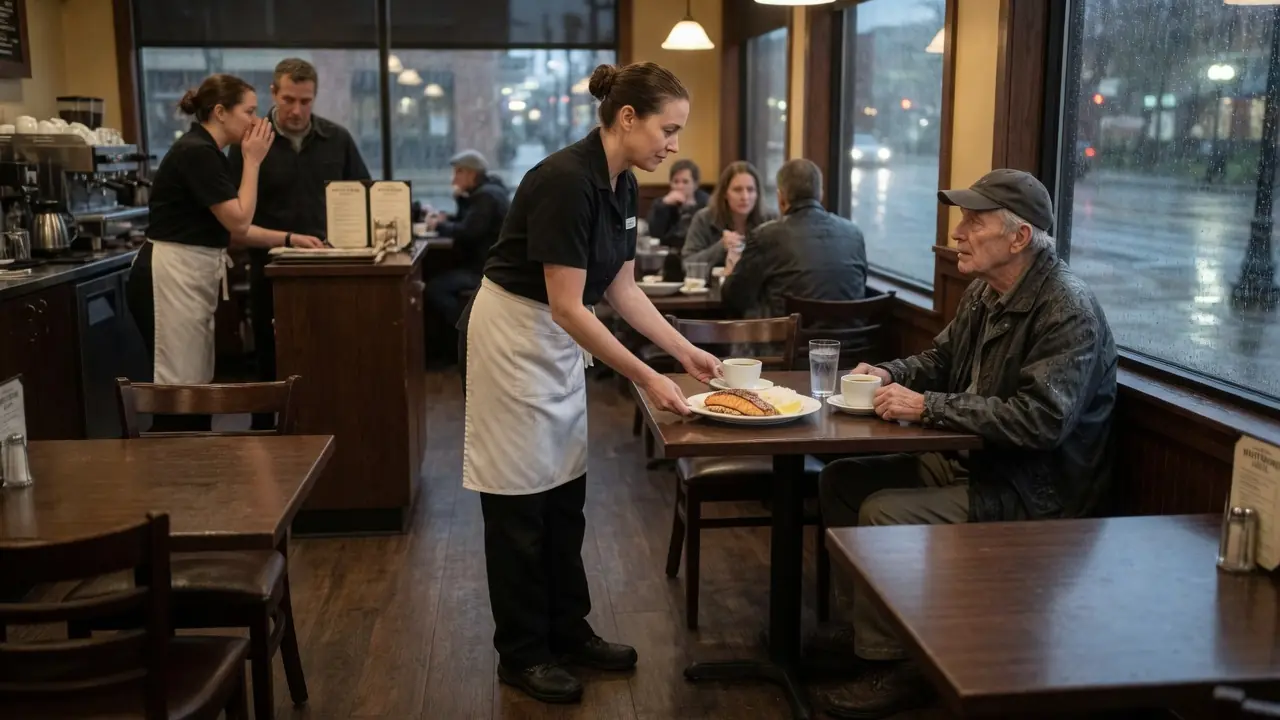
Only she approached, welcoming him with quiet kindness, offering him a warm cup of coffee and a grilled salmon.
The next day, she was suddenly fired because of that simple act of kindness. But when the man returned and revealed who he really was, everything changed.
The rain came down soft and steady over Columbus that Monday evening, tapping against the wide windows of Whitmore Grill.
The lights inside glowed a little too yellow, reflecting off polished tables, empty wine glasses, and plates stacked neatly near the pass window. The dinner rush had long passed, leaving the restaurant in that quiet middle stretch between early families and late drinkers.
The hum of an old ceiling fan mixed with the low murmur of a radio playing something from the seventies.
Lisa Harper wiped down the counter for the third time, not because it needed cleaning, but because staying busy helped her stay awake. She had been on her feet since morning, and her back ached in the deep, familiar way it always did after a double shift.
Lisa was thirty-two years old, a single mother, and the kind of woman who had learned to keep moving because stopping gave worry too much room.
Her six-year-old son, Evan, was at home with Mrs. Delgado from the apartment downstairs, probably asleep by now with his dinosaur blanket half kicked onto the floor. Lisa had kissed him goodbye that morning before school, promising she would be home before he woke up the next day if the buses ran on time.
Promises were expensive when you were a single mother.
Rent was due Friday. Evan needed new sneakers because his toes had started pressing against the front of the old ones. The electric bill sat folded inside Lisa’s purse like a threat. She still owed Mrs. Delgado forty dollars for watching Evan last weekend, and she had three dollars and change in the cup holder of her car.
So Lisa wiped the counter again.
Her brown hair was tied back tight, her sleeves rolled up from habit. After three years working at Whitmore Grill, she knew the rhythm of the place. She knew which tables wobbled, which customers complained before reading the menu, which cooks swore under their breath when an order came in five minutes before closing, and which servers smiled only when they expected a big tip.
Beth, one of the senior servers, leaned against the espresso machine scrolling through her phone. Jason, the other waiter on duty, stood near the front with that easy slouch of someone who had never had to calculate whether a missed shift meant choosing between groceries and gas. Neither of them had children waiting at home. Neither of them understood the particular fear of counting coins while your child asked if there would be cereal in the morning.
The bell over the door jingled, soft and uncertain.
A tall older man stepped in from the rain.
He wore a dark jacket, clean but frayed at the cuffs, and a plain cap pulled low over his forehead. Drops of water clung to his shoulders. He hesitated just inside the doorway, glancing around the room like he was not sure he belonged there.
Beth did not look up.
Jason kept scrolling.
Lisa dried her hands on her apron and walked forward.
“Evening,” she said with a smile. “Come on in, sir. You’re getting soaked out there. Would you like a booth or a table by the window?”
The man’s eyes softened with a kind of tired surprise.
“Table’s fine,” he said, voice low and gravelly. “Window’s good.”
Lisa guided him to the window where the streetlights blurred in the rain. She noticed the careful way he moved, as if his knees hurt but his pride did not want anyone to see. He removed his cap slowly and set it beside him.
“Coffee?” she asked.
“Black, if it’s fresh.”
“It always is,” she said, and meant it.
She poured from the pot she had brewed half an hour earlier, still hot enough to steam, and set it before him with a steady hand.
“Take your time. The salmon’s good tonight. Fresh batch just came off the grill.”
He looked up at her, studying her with quiet gratitude.
“You’ve got a good eye,” he said. “Salmon sounds fine.”
From across the room, Beth snickered.
“Wasting your charm on a slow tipper,” she muttered.
Jason grinned but did not look up.
Lisa caught the whisper and pretended she had not. She had learned early that responding to every small cruelty only made the shift longer. Besides, kindness had become a habit for her, not because life had been kind, but because she knew exactly what it felt like when people decided you were not worth their best manners.
She rang in the order.
As she passed the counter, Jason leaned closer.
“He’s all yours, sweetheart. Don’t say we didn’t warn you.”
Lisa did not bother replying.
She thought of Evan instead, the way he waved at strangers from the back seat of her old car because he still believed the world was mostly good. She wanted him to keep that belief as long as possible. Maybe that was why she could not ignore people who looked like they had already been ignored too many times.
When the salmon was ready, Lisa took the plate herself. It was perfectly grilled, golden on the edges, with steamed vegetables, rice, and a lemon wedge on the side. She carried it to the man’s table and set it down carefully.
“Here you go, sir. Would you like anything else?”
He looked up at her, eyes kind but weary.
“No, ma’am. This will do fine. You folks must be near closing.”
“Not quite,” she said. “We’ve got time.”
For a moment, neither spoke. The rain pattered softly against the glass. Lisa watched him unfold his napkin with careful hands, slow but sure. There was dignity in the way he sat, like a man used to taking up little space even when the room belonged to him more than anyone guessed.
People who had been ignored too often learned to make themselves smaller.
He took a bite, then nodded once.
“Honest food,” he said. “Hard to find that these days.”
Lisa smiled.
“That’s my favorite kind.”
When she turned back toward the counter, she could feel Beth’s eyes on her, sharp and judgmental. She ignored it and went about refilling water glasses that did not need refilling, checking empty tables, wiping down menus, and making sure the man by the window had everything he needed.
The small act of serving him with simple respect had drawn a line she could not erase.
Later that night, as she clocked out, Beth leaned close.
“You really ought to pick your guests better, honey. The world runs on tips, not charity.”
Lisa’s jaw tightened.
She did not answer.
Out in the parking lot, the air smelled of wet leaves and oil-slick pavement. Lisa sat in her car for a while, watching the rain bead on the windshield. Her old sedan took three tries before starting most nights, and every time it did, she whispered thank you as if the engine had made a moral decision.
Maybe it was foolish, she thought.
Maybe she should have kept her head down.
Maybe she should have done what Beth and Jason did and saved her energy for tables that looked profitable.
But then she pictured the old man’s quiet nod. The way his shoulders lowered after the first sip of coffee. The way his face changed when she treated him like he belonged there.
That small shift mattered more than any dollar left on a table.
She drove home in silence, headlights slicing through mist, a tired song playing low on the radio. When she reached her apartment, Mrs. Delgado opened the door in slippers and a faded robe.
“He ate all his macaroni,” Mrs. Delgado whispered. “He asked if you were coming home before morning.”
Lisa’s heart squeezed.
“I’ll check on him.”
Evan was asleep on the couch, one small hand still wrapped around a blue crayon. A drawing lay on the coffee table: Lisa in her apron, Evan beside her, and a crooked yellow sun above them both.
Lisa picked up the paper gently.
At the bottom, in careful uneven letters, he had written:
Mommy works hard.
She pressed the drawing to her chest and closed her eyes.
When she crawled into bed later, she could not quite sleep. Her body was heavy, but her mind kept replaying the look on the old man’s face. The gratitude that did not need words.
You did the right thing, she told herself.
Even if no one saw it.
The next morning dawned gray and cold.
Lisa woke before her alarm, made Evan toast with peanut butter, packed his school lunch, and listened while he told her a long story about a classmate who claimed his uncle had seen a real dinosaur bone. She smiled in all the right places, even though worry sat like a stone behind her ribs.
“Mommy, are you tired?” Evan asked.
“A little.”
“You should take a nap.”
“I’ll put that on my list.”
He giggled.
She kissed his forehead and dropped him off at school before driving to Whitmore Grill with her coffee still half full. Inside, Beth and Jason stood near the hostess stand, whispering and grinning. Something about their faces set her on edge.
“Morning,” Lisa said, hanging her coat.
They did not answer.
The manager, Tom, appeared from the office door. His face was flat. Practiced.
“Lisa,” he said, “can I see you for a minute?”
Her stomach sank.
Inside his office, the blinds were half closed. A clock ticked loudly on the wall. Tom did not sit.
“We’re letting you go,” he said, like he was reading a memo.
Lisa stared at him.
“What?”
The word came out smaller than she meant.
“It’s not working out.”
“I’ve been here three years,” she said quietly. “I’ve never missed a shift unless Evan was sick. I’ve covered doubles. I’ve trained new servers. I’ve stayed late every time you asked.”
Tom shrugged.
“Doesn’t seem like a fit anymore.”
Lisa stood there, hands trembling just enough that she crossed her arms to hide it.
“Did I do something wrong?”
Tom looked past her toward the window.
“Let’s not make this harder than it has to be.”
That was it.
No explanation.
No warning.
Just dismissal.
She unfastened her apron and folded it neatly on the desk because dignity was sometimes the only thing a person could still control.
“All right,” she said softly. “I hope you have a good day, Tom.”
He did not answer when she stepped out.
Beth’s grin was small and mean. Jason did not even pretend not to watch.
Lisa walked straight through the dining room, out the front door, and into the crisp morning. She made it to her car before her eyes stung.
She sat there with both hands on the steering wheel.
Now what?
Her phone buzzed.
Unknown number.
She almost ignored it, then sighed and answered.
“Hello?”
A calm low voice spoke on the other end.
“Miss Harper, this is Miller Lawson. You served me last night at Whitmore Grill.”
Lisa blinked, surprised.
“Oh. Yes, sir. Of course. Is everything all right?”
There was a pause.
“I heard you were let go this morning.”
She gripped the phone tighter.
“Word travels fast.”
“I suppose it does,” he said. His tone carried something gentle but firm. “That’s exactly why I’m calling.”
Lisa frowned.
“I’m sorry, but how did you…”
“I own Whitmore Grill,” the man said simply. “And I think we need to talk.”
Lisa sat back in her seat, breath caught in her chest.
The rain had stopped. The world outside was still gray, but for the first time in a long while, something small and bright flickered inside her.
A spark of disbelief.
Of hope.
Of change coming from the most unexpected place.
She did not know it yet, but that quiet act of kindness had just turned her whole world on its head.
Miller suggested a coffee shop a few blocks away, one of those old places with squeaky wooden floors and pictures of Columbus in black and white. When Lisa walked in, he was already there, sitting by the window with a folded newspaper and that same quiet posture.
He looked up when she approached.
“Miss Harper,” he said, standing just enough to shake her hand. “Thank you for meeting me.”
“Of course,” she said. “I wasn’t exactly busy.”
Miller smiled faintly.
“I suppose not.”
They sat. The waitress brought coffee without asking. Clearly, he was a regular. Steam rose between them.
“I need to start by apologizing,” he said. “What happened to you this morning should not have happened the way it did.”
Lisa folded her hands in her lap.
“It’s all right,” she said softly. “I’ve been through worse.”
“I don’t think it is all right,” Miller said.
His tone was not angry, just firm.
“I own several restaurants in this area. I like to visit without announcing myself. You learn a lot more that way.”
She looked up at him, confusion mingling with disbelief.
“So last night you were checking on us.”
“In a way. I wanted to see the culture for myself.”
He leaned forward, voice low.
“What I saw bothered me. The way I was ignored. The way your coworkers sized up customers before deciding whether they mattered. The way kindness had become something to mock.”
Lisa swallowed.
“That’s how it’s been for a while. You learn to stay quiet if you want to keep your job.”
He nodded slowly.
“And yet you didn’t.”
She gave a small, tired smile.
“I guess I forgot to be afraid for a minute.”
Miller’s eyes softened.
“That forgetfulness cost you your position, but it showed me exactly what’s wrong with my restaurant.”
He paused, then said, “Truth is, I wanted to see what Tom and his team would do once I left. I let the situation play out, even though I knew it was unfair to you. I needed to be sure.”
Lisa stared at him.
“You let them fire me.”
“I did,” he admitted quietly. “And I regret that. But now I know who I can trust.”
She sat back, emotions mixing faster than she could name them. Shock. Anger. Relief. Disbelief.
“I’m a single mom, Mr. Lawson,” she said, her voice suddenly sharper than she intended. “I have a little boy at school right now, rent due Friday, and a car that sounds like it has loose change in the engine. This morning, I walked out of that restaurant thinking I didn’t know how I was going to feed my son next week.”
Miller did not look away.
“You are right to be angry.”
That surprised her.
Most men with money did not accept anger from women like Lisa. They corrected it, dismissed it, or called it misunderstanding.
Miller simply accepted it.
“So what happens now?” she asked.
Miller folded his hands.
“You come back. But not as a server.”
The room seemed to pause around her. A cappuccino machine hissed in the background. The smell of cinnamon and roasted beans filled the air.
“What do you mean not as a server?”
“I want you to manage Whitmore Grill,” he said plainly. “Starting immediately.”
Lisa blinked.
“Manage? Me?”
“You understand fairness. You know what it feels like to be overlooked. That is the kind of leadership a place like Whitmore needs.”
She shook her head slowly.
“Mr. Lawson, I’m a server with a community college degree, a used car that barely starts, and a six-year-old who still thinks cereal counts as dinner if it has marshmallows in it. I’ve never managed a restaurant.”
“Experience matters,” he said. “But heart matters more. You’ve already done the hard part. You cared when no one was watching.”
Lisa looked down at her coffee.
“They’ll hate me for it. Beth, Jason, Tom…”
“Tom is no longer your problem.”
She looked up.
“He’s not?”
“No. He is done.”
A strange silence settled.
Miller continued. “Beth and Jason may resist. Some people confuse cruelty with seniority. But respect grows from consistency.”
For a long moment, Lisa did not answer.
She thought about Evan.
About the rent due Friday.
About the drawing on her coffee table.
About how small she had felt walking out of Whitmore Grill that morning.
She also thought about the man across from her, who had walked into the restaurant looking like someone everyone could ignore, and had revealed the truth without raising his voice.
Finally, Lisa lifted her head.
“If I come back,” she said, “we do this right. No favoritism. No cruelty. No treating people like they only matter if they look rich. Staff included.”
Miller nodded.
“That is exactly why I asked you.”
The next morning, sunlight broke through the clouds for the first time in days. The air felt clean, sharp, almost new. Lisa parked behind Whitmore Grill and sat for a moment, watching the golden light hit the windows.
Before going inside, she called Mrs. Delgado.
“Is Evan okay?”
“He is eating cereal and arguing with a cartoon,” Mrs. Delgado said. “So, yes.”
Lisa smiled.
“Tell him I’ll pick him up on time today.”
“You sound different, mija.”
Lisa looked at the restaurant.
“I think today might be different.”
Inside, the staff was gathering for morning prep. Beth and Jason were joking by the counter. Tom stood near the pass window with his clipboard.
The laughter died when Lisa walked in.
Miller stood right behind her.
Tom’s expression curdled.
“Lisa? What’s she doing here?”
Miller’s voice cut through the quiet.
“Good morning, everyone.”
Heads turned.
Even Beth straightened.
“As of today,” Miller continued, “Whitmore Grill begins a new chapter. Some changes will be made immediately.”
He looked at Tom.
“Tom, thank you for your time here. Your position ends today.”
Tom blinked.
“Excuse me?”
“Excused,” Miller said simply. “You’ll receive full severance.”
Beth gasped.
Jason muttered something under his breath.
Miller turned to Lisa.
“This is Lisa Harper. She will be your new manager. She is here to rebuild the culture of this restaurant from the ground up. I expect your full cooperation.”
Lisa’s pulse hammered in her chest.
Every eye was on her, some skeptical, some angry, a few quietly curious. She forced herself to stand tall.
“I know this is unexpected,” she said, her voice steady. “I’m not here to make enemies. I’m here to make this place better for all of us.”
Beth crossed her arms.
“So what? We’re supposed to take orders from you now?”
Lisa met her gaze.
“No. You’re supposed to work with me.”
Silence hung for a beat.
Then Miller nodded once, satisfied.
“You have my full support,” he said. “I’ll be checking in, but this is your house now.”
When he left, the room stayed quiet except for the sound of the refrigerator humming in the kitchen.
Lisa let out a slow breath.
“All right,” she said softly. “Let’s get to work.”
By the lunch shift, it was clear the others were not going to make things easy.
Orders went in late. Silverware ran short. Jason forgot to restock the sugar. Beth rolled her eyes whenever Lisa spoke. But Lisa did not raise her voice.
She handled each small act of defiance the same way: calmly, directly, with no judgment.
“Jason,” she said quietly at one point, “the sugar is low. Please refill it.”
He sighed loud enough for everyone to hear.
“Right away, boss,” he said, dripping sarcasm.
Lisa smiled faintly.
“Thank you.”
The simple, even tone caught him off guard.
He grumbled but did it.
Later during a lull, Lisa called everyone to the front.
“We’re changing a few things,” she said. “No more choosing tables based on who looks like a good tipper. We’ll rotate sections evenly. Everyone greets guests within thirty seconds. No exceptions.”
Beth raised an eyebrow.
“You’re kidding.”
“No,” Lisa said. “We treat everyone like they matter. That’s the rule.”
The others exchanged looks.
Some smirked.
Some did not react at all.
Lisa felt her stomach twist, but she held steady.
Give it time, she told herself.
Show them.
That evening, a young couple came in wearing paint-stained clothes. Jason was nearest the door, but he turned away, pretending not to notice.
Lisa caught it immediately and stepped forward.
“Welcome,” she said with an easy smile. “Come on in. Booth or table?”
They chose a booth by the wall. She brought menus, water, and a genuine welcome. The couple thanked her twice, clearly surprised to be treated kindly in a place that usually looked down on their kind of clothes.
When Lisa passed the counter again, she saw Jason watching.
Their eyes met briefly.
He looked away, embarrassed.
A moment later, he picked up a tray and helped clear a table without being asked.
It was small, but she noticed.
As the couple finished their meal, the young man said, “We’ll be back. Feels different in here tonight.”
Lisa smiled.
For the first time all day, she believed it.
That night, after closing, she locked the doors and stood alone in the quiet restaurant. The tables gleamed under the soft light. The smell of grilled fish lingered faintly in the air. She ran her fingers over the counter, remembering the same spot where Beth had mocked her days ago.
Kindness is not weakness, she thought.
It is strength that does not need applause.
Outside, the rain started again, light and steady. Lisa pulled on her coat, turned off the lights, and stepped out into the cool night. The neon sign above the door flickered softly.
Whitmore Grill.
Bright again after so long.
When Lisa got home, Evan ran to her in dinosaur pajamas and hugged her knees.
“Mommy! Mrs. Delgado said you got a better job.”
Lisa laughed and knelt in front of him.
“I did.”
“Are you the boss now?”
“I guess so.”
His eyes widened.
“Can bosses still make pancakes?”
“Only the best bosses.”
He threw both arms around her neck.
“I knew you could do it.”
Lisa closed her eyes and held him tightly.
The following weeks rolled in quietly, like a new season settling over Columbus. Mornings at Whitmore Grill began earlier now, lights on before sunrise, the smell of fresh coffee filling the air. Lisa was always first through the door.
She liked that still hour before the others came in, when the restaurant was only hums and shadows waiting to wake up. It gave her time to breathe, to remember why she was there.
She started a list in a small notebook she kept behind the register.
Fairness.
Dignity.
Gratitude.
Patience.
Every morning, she read it like a quiet promise to herself.
Being a manager did not make life easy. It made life fuller and harder in new ways. Lisa still had to get Evan to school, still had to answer calls from the landlord, still had to figure out childcare when shifts ran late. But now she had a steady salary, health insurance, and something she had not felt in years.
Room to breathe.
Friday night came heavy and fast. The line outside reached the sidewalk, and every table inside was full. The air smelled of sizzling butter and garlic, the noise of clinking plates filling the room.
Lisa moved between tables, keeping an eye on everything.
Orders flowing.
Guests content.
Staff steady.
Then near the kitchen, she saw it.
Beth ignoring a table of construction workers. Her attention was fixed on a group of businessmen waving hundred-dollar bills.
Lisa walked over, voice calm but firm.
“Beth, table six has been waiting for ten minutes.”
Beth did not look at her.
“I’ll get there.”
Lisa took a breath.
“Go now, please.”
Beth turned, eyes sharp.
“You think you can tell me what to do just because you got lucky? You’re not better than me, Lisa.”
The words hit harder than Lisa expected.
She kept her voice even.
“I’m not better than anyone, Beth. But they deserve the same service as anyone else.”
Beth laughed under her breath.
“You and your little crusade for kindness.”
Something inside Lisa tightened.
Not anger exactly.
A quiet strength.
“No crusade,” she said. “Just respect. Start there.”
Beth stared at her for a moment, then finally grabbed a pad and headed to the table.
The night went on, but the air felt tense. Later, when the rush slowed, Jason came by the counter, voice low.
“You handled that well.”
Lisa glanced at him.
“Old Beth would have walked out.”
Lisa managed a small smile.
“Maybe old me would have too.”
He nodded, thoughtful.
The guests were not the only ones learning something.
The following evening, thunder rolled through the city, shaking the windows. Customers came in drenched, laughing, shaking off umbrellas. Lisa moved through it all with a towel over her arm, drying chairs, offering hot drinks on the house.
A woman in her seventies arrived alone, clutching a small floral umbrella. Her coat was soaked through and her glasses were fogged. She hesitated near the entrance, uncertain.
Lisa walked up with a gentle smile.
“Welcome in, ma’am. Let’s get you somewhere warm.”
The woman’s voice trembled.
“I’m just here for a bowl of soup, dear. Don’t want to be a bother.”
“You’re no bother at all,” Lisa said. “Sit right here by the heater.”
She brought her a dry napkin, a cup of coffee, and later a steaming bowl of tomato soup.
When the woman took her first spoonful, tears welled in her eyes.
Lisa crouched beside her.
“Is everything all right?”
The woman nodded quickly, embarrassed.
“It’s silly. My husband and I used to come here years ago. He passed last winter. I didn’t think I could come back.”
Lisa’s heart caught in her throat.
“I’m glad you did.”
The woman smiled weakly.
“The place feels different now. Kinder.”
Lisa blinked back her own tears.
“We’re trying.”
That is why you’re here, she thought.
Not just to run a restaurant.
To make space for moments like this.
The next Monday, Lisa called everyone together after closing. The dining room was dim except for a few lamps over the bar. Coffee cups steamed on the counter.
“I know the last few weeks have been rough,” Lisa began. “Change always is. But I want to thank each of you for sticking it out.”
Jason nodded.
Noah, the quiet server who usually helped in the kitchen, smiled. Even Beth stood near the back, arms folded but listening.
Lisa went on.
“I want to share something Mrs. Howard said tonight. The woman who came in during the storm. She said, ‘This place feels different.’ That’s because of all of you.”
Beth’s eyes flickered.
“I didn’t do much,” she muttered.
Lisa looked at her kindly.
“You stayed. That’s a start.”
A small laugh rippled around the room. The tension eased.
Then Lisa said something she had not planned.
“You know, I used to think kindness was just about being nice. But it’s more than that. It’s about courage. Doing the right thing even when it costs you. Sometimes especially then.”
For a long moment, no one spoke.
Then Noah said softly, “Guess you’d know about that.”
Lisa smiled.
“Maybe we all do now.”
When the others left, Beth lingered.
“Lisa,” she said finally.
Lisa turned.
“I wanted to say I’m sorry for the way I was.”
Lisa looked at her, surprised but touched.
“Thank you, Beth.”
Beth nodded, eyes low.
“You were right. Feels better this way.”
By the end of the month, word had spread.
Old customers returned.
New ones came by recommendation.
The atmosphere shifted. Lighter, easier. People laughed more. Even Jason, who used to judge every table by the suit of the guest, now opened doors for families and retirees alike.
One evening, Miller Lawson stopped by unannounced.
Lisa did not notice him at first. He had chosen a quiet corner near the window, same as before. When she finally saw him, she smiled, remembering that first rainy night.
“Mr. Lawson,” she said. “You caught us on a good night.”
He looked around the room: the chatter, the steady rhythm of service, Beth laughing with a young couple, Jason helping an elderly man with his coat.
“I’d say I caught you on the right night,” he said.
Lisa poured him coffee, black as always.
“You’ve done well,” he said. “Better than I hoped.”
Lisa shook her head.
“We did. Took all of us.”
He nodded.
“You were the spark, though. Never underestimate what one person’s decency can do.”
For a moment, Lisa thought of that first night, of the look on his face when she set down his cup of coffee, not knowing who he was.
“I wasn’t trying to impress anyone,” she said. “I just didn’t want someone to feel small.”
“That’s the best reason there is,” Miller said.
Saturday evening came bustling, every seat filled again. The door opened, and a frail older man stepped inside, leaning on a cane. His coat was threadbare, his steps slow.
Jason was nearest the door.
Lisa watched him instinctively shift, old habits rising, but then he stopped. He turned toward the man and smiled.
“Evening, sir,” Jason said. “Let me get that door for you.”
Lisa froze, watching.
The man thanked him softly. Jason led him to a table by the wall and poured water without being told.
For Lisa, it was like watching the end of a long silent prayer.
She felt her chest loosen, her eyes sting.
Beth came up beside her, whispering, “You see that?”
Lisa nodded.
“I did.”
“Guess you were right,” Beth said quietly. “Kindness spreads.”
Lisa smiled, eyes glistening.
“So does respect.”
The dining room was alive with easy laughter and warmth. The clatter of dishes had rhythm now, not chaos. Even the lights seemed softer.
Later that night, when the last guests left, Jason walked up to her.
“I used to think being nice made you look weak,” he said. “Now I think it means you’re strong enough not to care what cruel people think.”
Lisa smiled.
“Took me a while to learn that too.”
After closing, Lisa stood alone by the window table, the same one where everything had begun. The reflection in the glass showed the warm lights behind her, the soft rain outside. She touched the tabletop gently, like greeting an old friend.
It was never just about a job anymore, she thought.
It was about seeing people again.
All of them.
Including herself.
When Lisa got home that night, Evan was asleep on the couch again, his dinosaur blanket twisted around his legs. Mrs. Delgado had left the drawing from weeks before taped to the refrigerator.
Mommy works hard.
Lisa stood in the kitchen looking at it for a long time.
Then she took out a marker and wrote beneath it:
And Mommy is building something better.
She turned off the kitchen light and carried Evan to bed, his sleepy arms wrapping around her neck.
“Did you boss people today?” he mumbled.
Lisa kissed his cheek.
“A little.”
“Were you nice?”
She smiled.
“I tried.”
“Good,” he whispered. “Nice bosses are better.”
Lisa tucked him in and stood for a moment in the doorway, watching him sleep.
The rent would be paid.
The shoes would be bought.
The car still needed work, but now the future did not feel like a wall pressing toward her. It felt like a road, difficult but open.
The next morning, she walked into Whitmore Grill before sunrise, unlocked the door, and turned on the lights one by one. The restaurant glowed awake around her.
Kindness was not something you did once, she thought.
It was something you built, one small choice at a time.
A cup of coffee.
A warm meal.
A fair schedule.
A door opened without judgment.
A tired stranger treated like he mattered.
And as Lisa Harper stood behind the counter of the restaurant that had once fired her for doing the right thing, she realized maybe for the first time in her life that she had not just changed a place.
She had changed the way people saw one another.
And she had shown her son something more valuable than money.
She had shown him that kindness could survive hardship, that dignity could be rebuilt, and that even a single mother with tired hands and an uncertain future could become the reason a whole room learned how to be better.