The elderly man stood at Clara Bennett’s checkout with an empty wallet open in his trembling hands. A gallon of milk, two cans of soup, a loaf of bread, and a bottle of heart medication waited beside the register while a line of impatient customers watched from behind him. His total was three dollars and forty-seven cents more than the collection of coins scattered across the counter.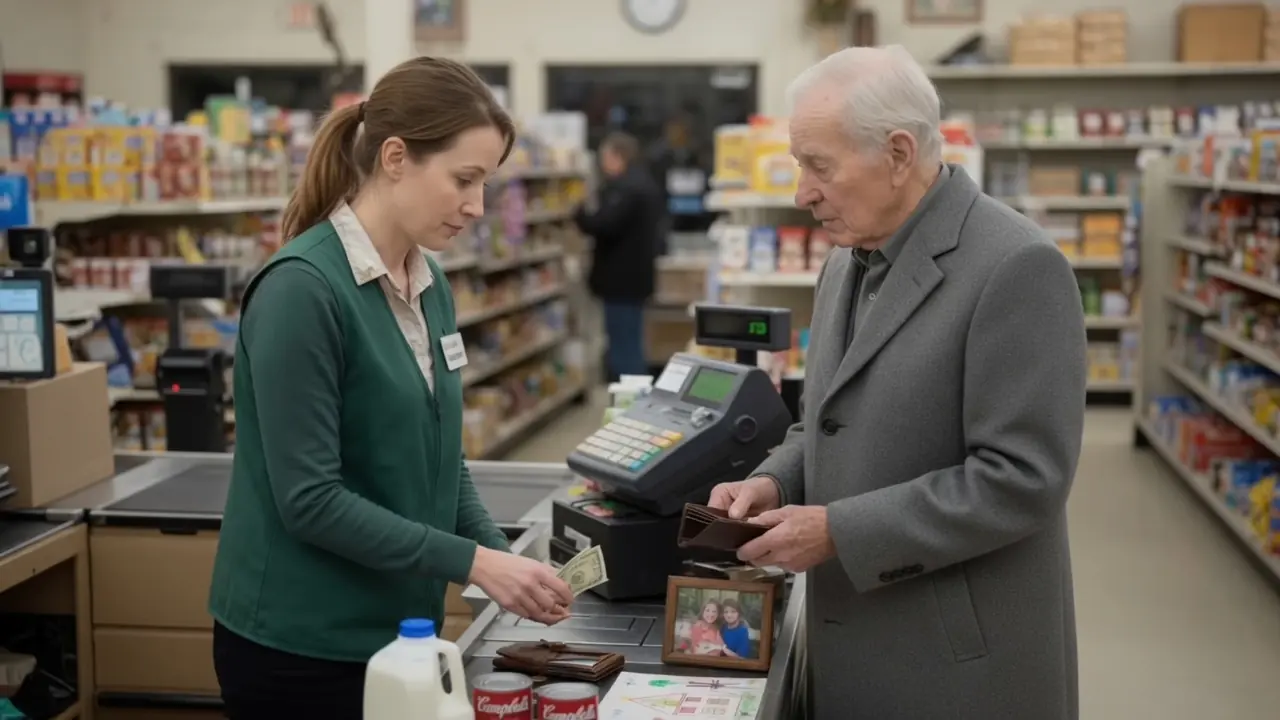
Clara glanced at the gray-haired man’s embarrassed face and then toward the service desk. Her manager, Richard Coleman, was already watching her with the irritated expression he wore whenever compassion threatened to slow down a transaction. Clara knew the rules, and she knew she could not afford another warning. Still, she opened her worn brown wallet and placed four dollars in the register.
“I don’t need to know who you are,” she said softly. “Just take the milk, and tell your daughter someone cared when you needed it most.”
The man looked at the bills as if Clara had handed him something far more valuable. His name was written on the prescription label: Samuel Hale. He wore an old gray coat with one missing button, and a framed photograph rested carefully beside his groceries, showing him years younger beside a smiling woman and a little girl in a red dress.
“You have children?” Samuel asked.
“One daughter,” Clara replied.
“Then she is fortunate.”
Clara smiled, though the words hurt more than she expected. Her eight-year-old daughter, Sophie, was sitting in the employee break room with colored pencils and a math workbook because the after-school program had closed early. Clara had already missed one shift that month when Sophie developed a fever, and Richard had warned her that personal problems could not continue interfering with the store.
Samuel gathered his groceries slowly. Before leaving, he looked toward the service desk and noticed Richard staring at Clara. Something in the old man’s face changed, but he said nothing. He simply lifted the bag against his chest and walked through the automatic doors into the cold November afternoon.
Richard waited until the checkout line disappeared.
Then he approached Clara’s register and lowered his voice.
“What did you just do?”
Clara closed the cash drawer. “He didn’t have enough money. I covered the rest out of my own pocket. That is all I did.”
Richard did not look at her. He studied the transaction record as if searching for a crime hidden between the numbers.
“You know employees are not supposed to interfere with customer purchases.”
“I didn’t change a price or give away store merchandise.”
“You created a scene.”
“The only scene was an old man being forced to choose between his medication and his milk.”
Richard’s jaw tightened. He was forty-six, always perfectly shaved, and wore a red manager’s tie even though nobody had required one in years. He treated store policy like a shield, but only when using it against people beneath him.
“You are not here to judge what customers can afford,” he said. “You scan products, collect payment, and keep the line moving.”
Clara looked directly at him. “He was three dollars short.”
“That is not your responsibility.”
“No. It was my choice.”
Richard stepped closer. “You are already on thin ice because of your attendance.”
“My daughter was sick.”
“And the store still opened without you.”
Clara swallowed the answer rising inside her. She needed this job, and Richard knew it. Rent was due in nine days, Sophie needed new winter boots, and the power company had sent a yellow notice after Clara paid only half the previous month’s bill.
“I understand,” she said.
Richard pointed toward the service desk. “My office after closing.”
For the remaining two hours of her shift, Clara scanned groceries while imagining every possible version of losing her job. She pictured herself telling Sophie they might have to leave their apartment. She pictured calling her landlord, who had already shown more patience than most. She pictured the unopened envelope from the hospital collection agency waiting beneath a stack of school papers at home.
Clara had become a single mother three years earlier when Sophie’s father disappeared after promising that leaving was temporary. He moved to another state, stopped answering calls, and sent two support payments before becoming unreachable. Clara had learned how quickly a shared life could become one person’s responsibility.
Before that, she had worked as an assistant manager at a small family-owned pharmacy. She handled schedules, customer complaints, inventory, and insurance paperwork. The pharmacy closed after the owner retired and sold the building to a developer, forcing Clara into the first job she could find.
Harrison Market paid less than the pharmacy but offered regular hours and health insurance after six months. Clara accepted the green cashier cardigan, the name badge, and the way Richard spoke to her as if experience disappeared when someone stood behind a register. She told herself pride did not pay for groceries.
At seven fifteen, Clara entered Richard’s office.
He sat behind a metal desk with a printed disciplinary form already prepared. The document stated that Clara had violated professional boundaries, delayed store operations, and created an uncomfortable customer interaction. She read it twice, then placed it back on the desk.
“The customer was grateful.”
“That is not the issue.”
“There was no complaint.”
“The complaint is mine.”
Clara folded her hands in her lap. “Are you firing me?”
Richard leaned back. He seemed to enjoy making her wait.
“I should.”
“But?”
“But the holidays are coming, and replacing cashiers is inconvenient.”
The word struck exactly as he intended. Clara was not useful or valued. She was inconvenient to replace.
He slid the form toward her. “Sign this. One more violation, late arrival, or unscheduled absence, and your employment ends immediately.”
Clara read the final paragraph. Signing would acknowledge wrongdoing she did not believe she had committed. Refusing might cost her the job that same evening.
She thought of Sophie waiting in the break room, probably drawing a house with too many flowers because she always added flowers when she wanted a picture to feel safe.
Clara signed.
When she left the office, Sophie was asleep with her head on a backpack. A half-finished drawing lay beside her. It showed Clara behind a grocery register, wearing a green crown.
At home, Clara heated canned tomato soup and divided one grilled-cheese sandwich between them. Sophie asked why her mother looked sad. Clara said she was tired, which was the answer adults gave when the truth felt too heavy for children.
“Did something bad happen at work?” Sophie asked.
“Something unfair happened.”
“Did you do anything wrong?”
Clara hesitated. “I helped someone.”
“That doesn’t sound wrong.”
“Sometimes people care more about rules than reasons.”
Sophie dipped one corner of her sandwich into the soup. “Rules are supposed to stop bad things.”
“They should.”
“Then that was a bad rule.”
Clara smiled faintly. “Maybe.”
After Sophie fell asleep, Clara sat at the kitchen table with the disciplinary form. Richard had given her a copy, perhaps believing it would frighten her into obedience. Instead, it reminded her how little dignity could survive when someone had no financial room to say no.
She opened a notebook and calculated the month again. Rent, electricity, bus fare, medication, school lunches, and the minimum payment on a credit card she had used during Sophie’s illness. The numbers did not improve no matter how many times she rearranged them.
Still, Clara did not regret paying for Samuel’s milk.
She regretted only that four dollars had become an act of courage in a world where it should have been ordinary.
The following morning, Harrison Market opened at seven.
Clara arrived twelve minutes early because she no longer trusted traffic, buses, or chance. She placed Sophie’s emergency contact list inside her locker, tied back her brown hair, and took register three.
Richard passed without greeting her.
At nine twenty, a black sedan stopped near the entrance.
A woman stepped out wearing a dark navy coat over a gray suit. She appeared to be in her early forties, with her hair pulled into a low bun and a leather folder tucked beneath one arm. A younger man carrying a tablet followed her, along with a woman Clara recognized as the district human-resources director.
Richard noticed them before anyone else.
He rushed from the service desk, straightened his tie, and met the group near the doors.
“Ms. Hale,” he said with sudden warmth. “We weren’t expecting a regional visit.”
Clara looked up when she heard the name.
The woman’s gaze moved across the store and stopped at register three.
“Clara Bennett?” she asked.
Richard’s expression changed. “Yes. Is there a problem?”
The woman walked toward Clara.
“My name is Evelyn Hale.”
Clara understood immediately. “Samuel’s daughter.”
“Yes.”
Fear arrived before relief. Clara wondered whether Samuel had become ill after leaving the store or whether Evelyn believed a cashier had humiliated him by paying the difference. Richard positioned himself nearby, ready to witness Clara’s final mistake.
“Is your father all right?” Clara asked.
“He is.”
Evelyn studied her for a moment. Her professional expression softened.
“He told me what happened yesterday.”
Clara glanced at Richard. “I only covered a few dollars.”
“My father has early-stage memory loss,” Evelyn said. “He sometimes leaves home without telling his caregiver. Yesterday, he walked nearly two miles because he wanted to buy the milk my mother always used in her soup.”
Clara looked toward the framed photograph she remembered beside the register.
“My mother died six months ago,” Evelyn continued. “He carries that photograph everywhere now.”
“I’m sorry.”
“He had enough money when he left home. He gave most of it to a veteran outside the pharmacy because the man said he needed bus fare.”
A small smile touched Evelyn’s face.
“My father has always been generous, even when generosity becomes inconvenient.”
Richard cleared his throat. “Ms. Hale, I assure you we take customer safety very seriously. Clara should have called management instead of handling the situation herself.”
Evelyn turned toward him. “What would management have done?”
Richard paused.
“We would have followed store procedure.”
“That is not an answer.”
“We might have removed an item from the purchase.”
“The milk?”
“Possibly.”
“Or the medication?”
Richard’s face tightened. “The pharmacy operates separately.”
Evelyn opened her leather folder. “My father said Clara treated him with dignity. She did not announce his shortage, lecture him, or make him feel like charity.”
“She violated employee boundaries,” Richard said.
Clara felt anger rise, but Evelyn lifted one hand before she could speak.
“Did she take money from the register?”
“No.”
“Did she change store prices?”
“No.”
“Did she force the customer to accept assistance?”
“No, but—”
“Then she made a personal purchase.”
Richard adjusted his tie. “The line was delayed.”
Evelyn looked toward the security-camera monitor above the service desk. “By how long?”
Richard said nothing.
The younger man carrying the tablet spoke. “Twenty-eight seconds, based on the transaction footage.”
Silence spread around the checkout area.
Richard’s expression turned pale. “You reviewed the footage?”
“I requested it this morning,” Evelyn said.
Clara looked at the human-resources director. The woman avoided Richard’s eyes.
Evelyn faced Clara again. “My father also told me you have a daughter.”
Clara nodded.
“He said you helped because you wanted your child to know that someone cared.”
“She wasn’t watching yesterday,” Clara said. “But I knew what I would want her to believe about me.”
Evelyn’s eyes softened. “That matters.”
Richard stepped forward. “I’m sure this is touching, but Clara is scheduled to work. We can continue this conversation somewhere private.”
“We will,” Evelyn replied. “In your office.”
Richard forced a smile. “Of course.”
Evelyn did not move. “Clara is coming with us.”
The office felt smaller with five people inside.
Richard took his usual chair, but Evelyn remained standing. The human-resources director opened a laptop while the younger man placed several printed reports on the desk. Clara stood near the door, uncertain whether she was attending her own termination.
Evelyn looked at the disciplinary form.
“You wrote that Clara created an uncomfortable interaction.”
“Yes.”
“For whom?”
“The customers in line.”
“Did anyone complain?”
“Not formally.”
“Informally?”
Richard hesitated. “No.”
Evelyn turned another page. “You also cited her attendance record. She missed one shift to care for a sick child and provided documentation.”
“We need reliable employees.”
“Your scheduling records show that Clara covered nine additional shifts during the past four months.”
“That is unrelated.”
“It demonstrates reliability.”
Richard leaned back. “May I ask why you are personally involved in one cashier’s disciplinary record?”
Evelyn closed the folder.
“Because I own thirty-two percent of Harrison Regional Markets.”
The room went silent.
Clara stared at her.
Evelyn continued. “My investment group entered the company eighteen months ago after Harrison requested capital for expansion. I chair the customer-experience and workforce committee.”
Richard’s face lost its color. “I was not informed.”
“You were informed that ownership representatives may conduct unannounced reviews.”
“I meant I did not know Mr. Hale was your father.”
“That is precisely the problem.”
Evelyn’s voice remained calm, which made every word carry more weight.
“You believe dignity becomes important only after learning someone’s status.”
“No, that is not fair.”
“You punished an employee for spending her own money to protect an elderly customer from humiliation.”
“I enforced policy.”
“There is no written policy prohibiting employees from purchasing merchandise for a customer.”
Richard looked toward human resources. “There are professional-boundary expectations.”
The director opened a document. “Nothing applicable to this situation.”
Richard stared at her. “You approved the warning.”
“I received a summary that described Clara as using register funds.”
Clara turned toward him.
Richard looked away.
Evelyn placed the disciplinary form on the desk. “You misrepresented what happened.”
“It was a misunderstanding.”
“No. You wrote a version that justified the punishment you had already chosen.”
Richard stood. “I have managed this store for seven years.”
“And during those seven years, employee turnover became the highest in the district.”
“That is retail.”
“Customer complaints about staff shortages doubled. Exit interviews repeatedly mention humiliation, retaliation, and inconsistent scheduling.”
Clara remembered former cashiers who disappeared between shifts, young employees crying in the break room, and older workers suddenly reduced to five hours a week after disagreeing with Richard.
Evelyn continued. “Yesterday did not create this review. It confirmed it.”
Richard looked at Clara with open hatred. “She has been complaining about me.”
“I have never spoken to Ms. Hale before today,” Clara said.
Evelyn met Richard’s eyes. “Your employees did not destroy your record. They documented it.”
The human-resources director asked Richard to surrender his keys and badge pending a formal investigation. He protested, demanded a lawyer, and accused Clara of manipulating an elderly man to gain attention. The accusation ended whatever restraint Evelyn still possessed.
“My father did not tell Clara who he was,” she said coldly. “She helped when she believed he had nothing to offer her. You became polite only after seeing my car.”
Richard left through the employee entrance with the district director beside him.
Clara remained in the office, still holding the edge of her cardigan.
“I don’t want his job,” she said.
Evelyn looked surprised. “I didn’t offer it.”
“I know. But I don’t want anyone believing I paid for your father’s milk to replace my manager.”
“That would require you to know who my father was.”
“People don’t need logic to create ugly stories.”
Evelyn nodded slowly. “That is true.”
She sat across from Clara and opened a second folder.
“I did come to offer you something.”
Clara’s stomach tightened. “Money?”
“No.”
“Good.”
Evelyn almost smiled. “My father predicted you would say that.”
She slid a job description across the desk.
Harrison Regional Markets was creating a ninety-day paid pilot role called Customer Dignity and Community Support Coordinator. The position would review how stores handled elderly customers, families in crisis, medication conflicts, food insecurity, and employee discretion during small emergencies.
Clara read the salary twice.
It was nearly double what she earned as a cashier.
“This position didn’t exist yesterday.”
“The need existed,” Evelyn said. “Yesterday made it impossible to keep ignoring.”
“You created a job because I bought milk?”
“I created a pilot because your judgment exposed a weakness in our stores.”
Clara looked down at the description. “I’m not qualified for a corporate role.”
“You managed a pharmacy for six years.”
Clara looked up sharply.
“I reviewed your employment application,” Evelyn explained. “You handled insurance disputes, customer complaints, scheduling, and inventory. You also trained four employees who later became supervisors.”
“That was a long time ago.”
“Experience does not expire because life forces someone into a lower-paying job.”
The words touched a wound Clara had stopped admitting existed.
“What happens after ninety days?” she asked.
“We evaluate results. If the program fails, the position ends. If it works, it expands across the region.”
“And if I’m bad at it?”
“We hire someone else.”
Clara nodded slowly. “That sounds fair.”
“It is meant to be.”
She did not accept immediately.
Clara asked about hours, health insurance, childcare emergencies, performance standards, travel requirements, and whether store employees could report managers without retaliation. Evelyn answered every question without impatience.
When Clara finally signed the trial agreement, her hands trembled.
Not because she believed her life had been rescued.
Because someone had finally offered her a chance to use skills she thought the world had forgotten.
Samuel visited the store that afternoon with Evelyn.
He wore the same gray coat, but this time his daughter held his arm. He carried a small paper bag and walked directly toward Clara.
“I brought back your four dollars,” he said.
Clara shook her head. “You don’t owe me.”
“It isn’t payment.”
He opened the bag and removed a jar of homemade strawberry jam.
“My wife made this every summer. The last jar.”
Clara stared at it. “Then you should keep it.”
“I have the memory. You should have the jam.”
She accepted it with both hands.
Samuel looked around the checkout area. “Did my daughter cause trouble?”
“A little.”
“Good. She gets that from her mother.”
Evelyn laughed.
Clara began the new role the following Monday.
Her first week revealed how many small emergencies store policy had never prepared employees to handle. An elderly man forgot his debit-card code while a line formed behind him. A mother discovered her benefits card would not cover infant formula until the following morning. A diabetic customer opened a bottle of juice before paying because his blood sugar had dropped.
Employees were frightened to use judgment because managers treated every deviation as misconduct.
Clara designed a limited emergency-assistance fund with strict documentation, low spending limits, and manager review. She created training that taught employees how to protect dignity without making promises they could not keep. She also recommended private payment-resolution areas so customers were not forced to discuss poverty in front of strangers.
The pilot did not rely on giving away unlimited products.
It connected customers with food banks, transportation programs, prescription discounts, senior-care contacts, and local emergency services. It gave employees clear options instead of forcing them to choose between indifference and risking their jobs.
Within three months, customer complaints declined in all four pilot stores.
Employee retention improved.
Checkout disputes requiring security dropped by nearly a third.
The company expanded Clara’s position and gave her a small team. She negotiated a predictable schedule that allowed her to collect Sophie from school three days each week. For the first time in years, Clara paid rent without waiting for the account balance to update.
Sophie received new winter boots.
When Clara showed her the office badge, Sophie studied the title carefully.
“What does dignity mean?”
“It means making sure people don’t feel small just because they need help.”
Sophie nodded. “You already did that.”
Samuel became part of their lives slowly.
He visited Clara’s office with handwritten suggestions, most of which involved giving every senior citizen free pie. Clara rejected the policy but occasionally bought him a slice from the café. He attended Sophie’s school art show and stared proudly at a painting of three people standing beside a grocery cart.
Evelyn visited too, though always after asking.
She and Clara became friends despite the difference in their lives. Evelyn admitted that caring for Samuel had become difficult after her mother’s death. Some days he was fully himself; other days he forgot Evelyn had already called and believed he had been abandoned.
“I can buy professional care,” Evelyn said one evening. “I cannot make him feel that losing memory is not the same as losing worth.”
Clara looked at Samuel laughing with Sophie across the room.
“No one can promise he won’t be afraid,” she said. “But you can make sure he is never afraid alone.”
Evelyn held those words quietly.
Richard’s investigation uncovered altered schedules, retaliatory hour reductions, inaccurate disciplinary reports, and unpaid work performed by employees before clocking in. He was terminated and later required to repay wages through a labor settlement.
Clara did not celebrate.
She remembered how close she had come to losing everything because one man enjoyed having power over people who needed their paychecks. Accountability mattered, but she refused to build her future around his downfall.
A year after the milk incident, Harrison Market held a community-service event at the original store. Employees from across the district gathered beside tables representing senior programs, food pantries, childcare resources, and prescription-assistance organizations.
Clara stood near register three.
The same register where Samuel had counted his coins.
He approached slowly with Evelyn beside him and placed a gallon of milk on the counter.
Clara scanned it.
Samuel opened his wallet and pretended to search inside. “I may be short.”
“You say that every time.”
“Will you help me?”
Clara leaned closer. “Only if you take the milk and stop trying to frighten the cashier.”
He smiled.
For one clear moment, his eyes held no confusion.
“You did not know who I was,” he said.
“No.”
“And you helped anyway.”
“Yes.”
“Why?”
Clara looked toward Sophie, who was arranging pamphlets at the community table while explaining the word dignity to another child.
“Because she was learning from me,” Clara said. “Even when she wasn’t in the room.”
Samuel followed her gaze.
“You taught more people than your daughter.”
Clara placed the milk in his bag and handed him the receipt.
“No,” she said gently. “I only reminded them of something they already should have known.”
People deserved kindness before their names became important.
Workers deserved respect before someone discovered their hidden skills.
And help meant more when it opened a fair door rather than creating a debt.
Clara had paid four dollars because an old man needed milk.
The money did not make her remarkable.
The choice did.
And the offer that changed her life did not come because Samuel Hale was connected to wealth or ownership. It came because someone finally recognized that the woman standing behind the register had been leading with dignity long before anyone gave her the title.