“Those stars mean nothing here. Your skin tells me exactly where you belong.”
Officer Cole Mercer pressed both hands against Lieutenant General Amelia Grant’s face and shoved her backward against the open door of his patrol cruiser. Behind them, the stone church still carried the final notes of the hymn played at her mother’s funeral. White roses covered the steps, the honor guard had barely folded the flag, and dozens of mourners stood frozen beneath the bright Virginia sky.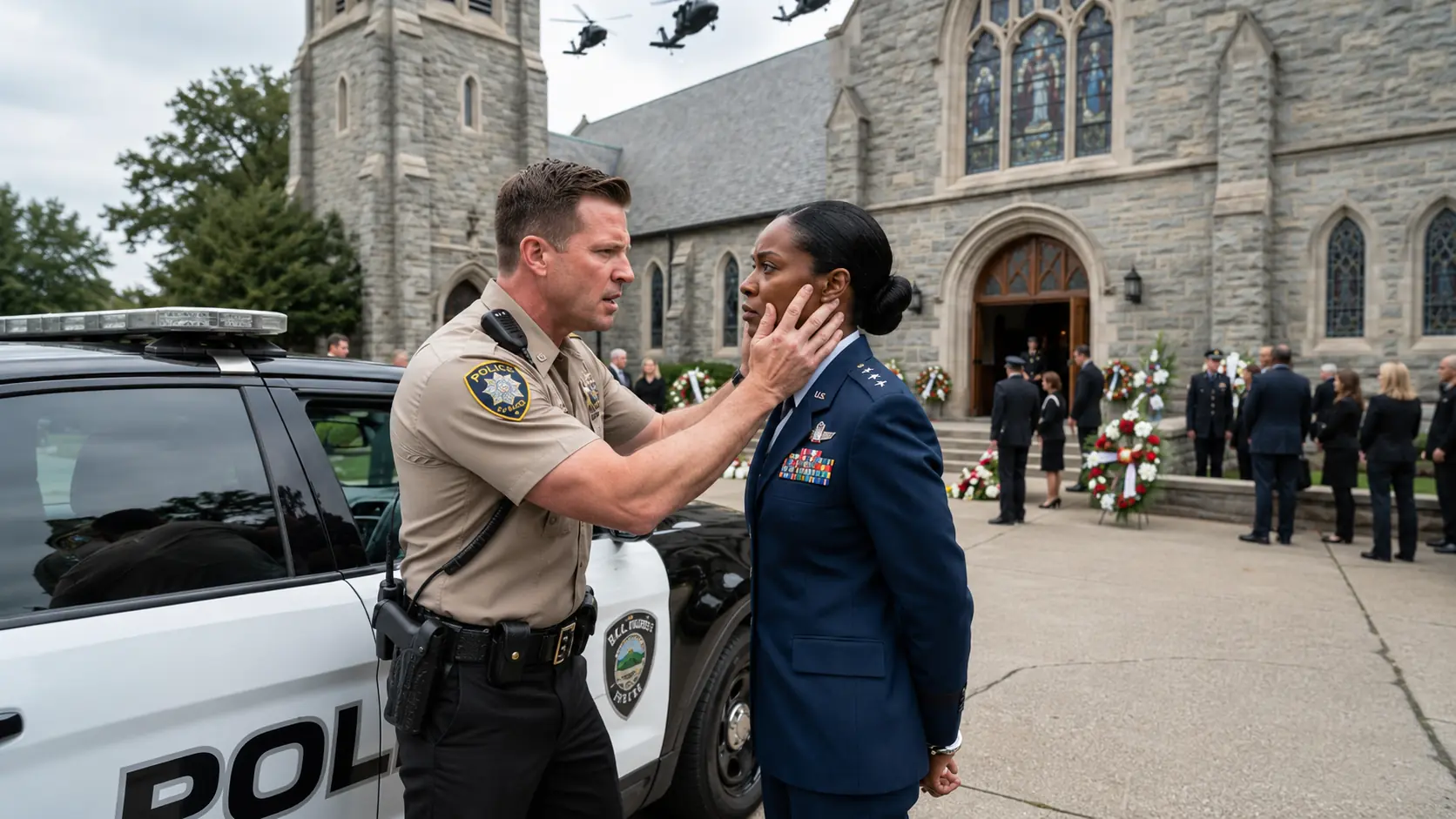
Amelia did not lower her eyes.
“Take your hands off me,” she said, “before this becomes an assault on military command.”
Cole tightened his grip. “I am the law in this town. I’ll bury you before anyone believes that uniform belongs to you.”
Then rotor blades thundered beyond the church roof.
Amelia turned her eyes toward the sky. “Look up, Officer. The military just came to collect the man who assaulted its general.”
Three dark helicopters appeared above the tree line.
Cole’s hands slowly fell from her face.
Thirty minutes earlier, Lieutenant General Amelia Grant had been standing beside her mother’s casket, trying to remain the composed officer the world expected her to be. She wore her formal dark-blue Air Force uniform, three silver stars on each shoulder, pilot wings above her ribbons, and the pearl earrings her mother had given her on the day she graduated from the academy.
The uniform had carried her through command briefings, combat operations, congressional hearings, and ceremonies attended by presidents. That morning, it felt heavier than ever.
Amelia’s mother, Evelyn Grant, had been a public-school music teacher in Bellhaven, Virginia, for thirty-eight years. She had raised Amelia alone after Amelia’s father died in a factory accident, working evenings at the church and tutoring students on weekends to pay for books, uniforms, and eventually college applications.
Evelyn never cared about rank.
When Amelia earned her first star, her mother congratulated her and immediately asked whether she was eating enough. When the second came, Evelyn complained that generals seemed to receive beautiful jackets but no sensible winter hats. When Amelia was promoted to three-star command, her mother placed both hands around her daughter’s face and whispered, “Just promise me power will never make you cruel.”
Amelia had promised.
Now Evelyn was gone.
Cancer had taken her in less than six months, reducing a woman who once filled classrooms with music to a fragile body inside a hospital bed. Amelia rearranged her command schedule, traveled home whenever possible, and spent the final week sleeping in a chair beside her mother.
Evelyn’s last coherent words were not about illness.
“Do not fight everyone who fails to recognize you,” she whispered. “Some people are blind because nobody ever made them look.”
Amelia had carried those words into the church.
The funeral was deliberately small. Former students filled several pews, neighbors brought food, and the Air Force sent an honor guard because Evelyn had spent a lifetime supporting a daughter who served. Amelia requested no press and no political guests.
She wanted one morning as a daughter rather than a general.
Officer Cole Mercer destroyed that possibility before the hearse left the church driveway.
Cole had worked for the Bellhaven Police Department for fourteen years. He was tall, muscular, and accustomed to filling physical space until other people surrendered it. In a town where everyone knew his father had once been chief, his authority rarely faced meaningful resistance.
He considered himself a protector.
The people he protected usually resembled him.
His complaints record contained accusations of unnecessary force, racial profiling, and intimidation, but none had survived internal review. Witnesses changed statements, body-camera files became unavailable, and supervisors described every confrontation as a misunderstanding caused by an uncooperative civilian.
Amelia knew none of that when she first saw him beside her rental car.
The black sedan was parked near the church entrance because Amelia planned to accompany the hearse to the cemetery. Cole stood beside the driver’s door, studying its temporary government security permit.
“Is there a problem?” Amelia asked.
He looked at her uniform and then at her face. His expression suggested he had already decided both were fraudulent.
“This vehicle belongs to a federal delegation.”
“It belongs to the Air Force transportation office.”
“And you are?”
“Lieutenant General Amelia Grant.”
Cole laughed.
Several mourners stopped walking.
Amelia remained still. “My credentials are inside my left breast pocket. I will retrieve them slowly.”
“You’re not reaching for anything.”
“My identification will answer your question.”
“I said no.”
She studied the officer’s badge and nameplate. “Officer Mercer, what exactly do you believe is happening?”
“I believe someone stole a uniform and approached a restricted vehicle during a funeral.”
“This is my mother’s funeral.”
Cole glanced toward the church. “That’s convenient.”
Amelia’s grief sharpened into anger, but she kept her voice controlled. “The woman inside that casket taught half this town. Ask anyone standing here who I am.”
A retired teacher named Mrs. Holloway stepped forward. “Cole, that is Evelyn’s daughter.”
Cole raised one hand without looking at her. “Stay back, ma’am.”
“She grew up here.”
“I said stay back.”
Amelia noticed that his body camera showed no active recording light.
“Activate your camera.”
Cole’s eyes narrowed. “You giving me orders?”
“I’m asking you to preserve the encounter.”
“You people always become experts in procedure when you’re caught.”
The phrase settled across the church driveway.
Several mourners began raising their phones.
Amelia looked directly at him. “You people?”
Cole stepped closer. “Take off the jacket.”
“No.”
“I want to see whether you even know what those medals mean.”
“You will not remove any part of my uniform.”
“Then turn around.”
“For what purpose?”
“I’m detaining you.”
Amelia’s biometric security system registered the change in her heart rate before Cole touched her. The device beneath her left sleeve was standard for senior officers working with classified command infrastructure. It continuously confirmed her identity and monitored distress indicators during travel.
Ordinarily, it remained passive.
A sudden combination of restricted movement, elevated pulse, unauthorized separation from her secure vehicle, and failure to respond to a coded prompt triggered an automatic alert.
Amelia felt the device vibrate twice.
Her military security center had been notified.
Cole grabbed her wrist.
“Do not touch me,” she said.
He twisted her arm behind her back. “You don’t tell me what to do.”
The first handcuff closed.
The honor guard commander stepped off the church stairs. “Officer, release her immediately.”
Cole turned toward him. “Stay out of police business.”
“You are arresting a lieutenant general.”
“I’m arresting a suspect impersonating one.”
The commander reached for his phone.
Cole pointed toward him. “Another step, and I arrest you too.”
Amelia could have resisted.
She had trained for close protection, emergency escape, and hostile detention. Cole’s position exposed his elbow, knee, and balance. She could have placed him on the pavement before he understood she was moving.
She heard her mother’s final words.
Do not fight everyone who fails to recognize you.
Amelia allowed him to secure the second handcuff.
“Officer Mercer,” she said, “you are detaining a verified active-duty three-star officer during a military funeral. Check my identification before this gets worse.”
“You’re not important enough to threaten me.”
“I am trying to protect you from your own decision.”
Cole pulled her toward the cruiser.
The gesture became more aggressive when he noticed the growing crowd. Humiliating her had become essential because backing down would reveal that the authority he displayed so confidently had never rested on evidence.
“Move.”
Amelia remained planted.
Cole shoved her shoulder.
She turned and faced him. “You have no probable cause, your camera is disabled, and more than twenty witnesses heard me identify myself.”
“You think legal words make you untouchable?”
“No. I think the Constitution makes both of us accountable.”
Cole’s face reddened. “Get in the car.”
“I will enter after you contact military command.”
“You’re going in now.”
He seized her face with both hands.
The church steps disappeared behind his shoulders. For one terrible second, Amelia saw not an officer but every man who had ever decided her composure was permission to test her dignity.
Cole squeezed her cheeks and leaned close.
“Those stars mean nothing here. Your skin tells me exactly where you belong.”
A phone fell from someone’s hand.
The honor guard commander took one step forward.
Amelia’s voice dropped. “Take your hands off me before this becomes an attack on military command.”
Cole shoved her against the cruiser. “I am the law in this town. I’ll bury you before anyone believes your rank.”
The biometric tracker issued a third vibration.
The response protocol had escalated.
At Langley Air Force Base, a security officer received Amelia’s distress alert at 10:14 a.m. The system displayed her verified identity, location, restricted movement, and physiological stress indicators. Her secure vehicle remained stationary, but she had been separated from it by more than the permitted distance.
The officer attempted to reach her encrypted phone.
No response.
He contacted the funeral security liaison.
The liaison answered from the church steps and spoke only one sentence.
“Local police have General Grant in handcuffs.”
The command center changed instantly.
A security response team already airborne for a training exercise was redirected. Military investigators notified federal law enforcement. The regional Air Force legal office contacted Bellhaven’s police chief while three helicopters turned south toward the church.
Chief Randall Pierce was eating breakfast with his wife when the call reached him.
At first, he believed it was a prank.
Then the caller identified himself as Brigadier General Thomas Avery, commander of military security operations for the region.
“One of your officers has detained Lieutenant General Amelia Grant.”
Pierce stood so quickly that his chair fell backward. “That cannot be correct.”
“We have biometric confirmation, live location data, and visual verification from her funeral detail.”
“Which officer?”
“Cole Mercer.”
The chief closed his eyes.
Cole had generated more complaints than any other officer in Bellhaven. Pierce had defended him repeatedly because Cole’s father had given him his first opportunity in law enforcement. Every warning sign had been softened by loyalty.
Now that loyalty was becoming a catastrophe.
“I’ll handle it,” Pierce said.
“You had better arrive before we do.”
The call ended.
Outside the church, Cole pulled open the rear cruiser door.
Amelia looked toward the horizon before he could push her inside. A low vibration moved through the air, growing quickly into the unmistakable thunder of military rotors.
Cole heard it too.
Three helicopters rose above the trees.
They approached in tight formation, turning toward the church grounds while the funeral flowers trembled beneath the increasing wind. Mourners shielded their faces as dust and loose petals lifted across the driveway.
Cole stepped backward.
“What did you do?”
Amelia’s eyes remained on him. “My security tracker did what it was designed to do.”
The helicopters descended beyond the cemetery wall.
The first touched down on an open field, followed by the second and third. Uniformed security personnel emerged before the rotor blades slowed, spreading into disciplined positions around the landing zone.
Cole’s hand moved toward his radio.
It erupted with the chief’s voice.
“Mercer, release the detainee immediately.”
Cole pressed the transmission button. “Chief, she’s impersonating military personnel.”
“You have detained Lieutenant General Amelia Grant.”
“She could be using a fake identity.”
“Her command confirmed her biometrics.”
Cole looked at Amelia’s stars.
For the first time, he saw them rather than merely noticing them.
The lead military security officer crossed the church lawn with two investigators beside him. Brigadier General Avery followed in full uniform, his expression colder than the morning air.
The honor guard snapped to attention.
Avery stopped several feet from Amelia.
“General.”
Her hands remained cuffed behind her.
“At ease,” she said.
His eyes moved toward Cole. “Remove those restraints.”
Cole hesitated.
A military investigator stepped forward. “Now.”
Cole unlocked the handcuffs.
Amelia brought her arms forward slowly. Deep red marks circled both wrists. She rotated her hands once, then adjusted the front of her uniform with quiet precision.
Avery saluted.
The entire security team followed.
Amelia returned the salute.
Cole stood between them, suddenly smaller than he had appeared minutes earlier.
Chief Pierce’s vehicle entered the driveway at dangerous speed. He braked near the cruiser and hurried toward the group without closing his door.
“General Grant, I am Chief Randall Pierce. I sincerely apologize.”
Amelia looked toward Cole’s disabled camera. “Did you know this officer repeatedly deactivated his body camera?”
The chief’s face tightened. “We will investigate.”
“You have already investigated him, haven’t you?”
Pierce said nothing.
“How many complaints?”
“I don’t have the number in front of me.”
“Estimate.”
“Seven formal complaints in four years.”
“Unnecessary force?”
“Yes.”
“Racial profiling?”
The chief hesitated.
“Yes.”
“And he remained assigned to public patrol.”
“We lacked sufficient evidence.”
Amelia gestured toward the mourners holding phones. “You lacked courage.”
Cole stepped forward. “I was doing my job.”
Avery moved between them.
Amelia raised one hand. “Let him speak.”
Cole looked around for support. “She refused commands. She approached a restricted government vehicle. Anyone can buy medals online.”
“You refused verification,” Amelia said.
“I had to control the scene.”
“You created the scene.”
“You threatened me with the military.”
“I warned you that your actions had consequences.”
Cole pointed toward the helicopters. “This is intimidation.”
“No,” Amelia replied. “This is the security response automatically triggered when a senior command officer is unlawfully restrained and separated from secure communications.”
“You think those stars put you above the law?”
Amelia stepped closer until they stood only a few feet apart.
“My rank does not place me above the law. Your badge does not place you above evidence.”
Cole’s mouth tightened.
“You did not arrest me because I behaved suspiciously,” she continued. “You arrested me because accepting my identity would have required you to believe a Black woman could outrank every officer you have ever met.”
“That’s not true.”
“Then explain the sentence about my skin.”
Cole glanced toward the phones.
He finally understood that his words had survived.
A federal investigator requested the officers’ body-camera systems, patrol-car recordings, and dispatch logs. Cole claimed his camera had malfunctioned. A military technician examined it and found that it had been manually disabled twenty-three minutes before the confrontation.
The timing matched Cole’s arrival at the church.
He had turned it off before approaching Amelia.
Chief Pierce suspended him immediately.
Cole laughed bitterly. “You’re sacrificing me because she’s important.”
Amelia’s expression hardened. “You still do not understand.”
She turned toward Mrs. Holloway, the retired teacher who had tried to identify her. “He ignored her too.”
Then she looked toward the honor guard commander. “And him.”
Finally, she pointed toward the phones held by ordinary mourners. “He ignored every person who challenged the story he wanted to create. My importance did not make his conduct wrong. It only prevented you from hiding it.”
Cole was escorted away in another patrol vehicle.
Not arrested yet.
But no longer in control.
Amelia asked that the helicopters move to a nearby military landing site so the funeral could continue without becoming a spectacle. Before leaving, Avery quietly asked whether she needed medical attention.
“No.”
“Your wrists are injured.”
“They can wait.”
“General—”
“My mother is waiting.”
The cemetery service resumed forty minutes late.
Amelia stood beside the grave while the folded flag was placed in her hands. White flower petals still covered parts of the church driveway where the rotor wash had scattered them.
She did not cry until the final mourners left.
Then she knelt beside the fresh earth, pressed the flag against her chest, and allowed the grief to come without discipline, rank, or witnesses.
“I tried not to fight him,” she whispered. “Just like you asked.”
Wind moved softly through the cemetery trees.
The investigation expanded during the following weeks.
Federal agents reviewed Cole’s previous arrests and discovered a pattern. He stopped Black motorists at nearly four times the rate of white drivers on the same roads. His body camera repeatedly failed during confrontations involving people of color, while recordings remained intact during ordinary traffic stops.
Several victims came forward after seeing the funeral video.
A Black college student described being forced onto the pavement after asking why he had been stopped. A retired Army sergeant said Cole mocked his military identification and accused him of stealing the vehicle he drove. A Latina mother reported that Cole threatened to place her children in state custody when she attempted to record him.
Chief Pierce had closed every complaint.
His communications showed why.
In one message, he told an internal investigator, “Cole is rough, but his instincts are usually right.” In another, he warned that disciplining him would create political trouble with several influential families.
The problem was not one officer.
It was the protection surrounding him.
Cole was charged with unlawful detention, civil-rights violations, official misconduct, assault, and falsifying records. Chief Pierce resigned before the town council could remove him and later faced obstruction-related charges for suppressing evidence in prior complaints.
Bellhaven’s police department entered federal oversight.
Body-camera systems were changed so officers could not deactivate recording without an automatic alert. Civilian complaints were moved outside the department, and every use-of-force review required independent examination.
Cole’s trial began eleven months after Evelyn Grant’s funeral.
The video from the church driveway was played for the jury.
They watched him reject Amelia’s credentials, dismiss witnesses, disable his camera, apply handcuffs, and seize her face. His voice filled the courtroom.
“Those stars mean nothing here. Your skin tells me exactly where you belong.”
Cole lowered his eyes.
His attorney argued that the pressure of protecting a government vehicle caused a brief lapse in judgment. Prosecutors answered with records from years of similar encounters.
Amelia testified last.
She wore a civilian black suit rather than her military uniform.
Cole’s attorney asked why.
“Because my rank is not the victim in this case,” she replied. “I am.”
“You authorized a military operation against a local officer.”
“No. My biometric system triggered a security response automatically.”
“Three helicopters arrived.”
“Yes.”
“Would that have happened for an ordinary citizen?”
“No.”
The attorney looked satisfied.
Amelia continued before he could sit.
“That difference is why this case matters. An ordinary citizen might have been placed in the cruiser, charged with resistance, and disbelieved because his camera was off. I was protected by a system powerful enough to force immediate scrutiny.”
The courtroom became quiet.
“My rank did not expose his character,” she said. “It exposed what happened when his usual victim possessed evidence he could not erase.”
Cole was convicted on every major charge.
At sentencing, he addressed Amelia without apologizing. He said his life had been destroyed because of one mistake and accused the government of turning a local misunderstanding into a political event.
Amelia listened.
When her turn came, she stood.
“You believe your life was destroyed in one morning,” she said. “But that morning contained years of choices. Every disabled camera, ignored witness, false report, and protected complaint led you to my mother’s funeral.”
Cole stared forward.
“You thought you were the law because people around you lacked the courage to enforce it against you. The helicopters did not take your power. They revealed that it had never been lawful.”
The judge imposed a substantial prison sentence.
Months later, Amelia returned to Bellhaven without security helicopters, honor guards, or formal dress. She wore jeans, a dark coat, and her mother’s pearl earrings.
The town had renamed the elementary school music room in Evelyn Grant’s honor.
Children performed one of the songs Evelyn had taught for decades. Amelia sat in the front row holding the same folded flag she received at the cemetery.
After the ceremony, a young Black girl approached her.
“My teacher said you’re a general.”
“I am.”
“Did you always know you would be one?”
“No.”
“Were people ever mean because they didn’t believe you?”
Amelia thought about Cole’s hands against her face.
“Yes.”
“What did you do?”
“I made sure their disbelief did not become my definition.”
The girl considered that answer, then saluted awkwardly.
Amelia smiled and returned it.
Outside, she walked alone to her mother’s grave.
She placed fresh roses beside the stone and sat on the grass.
The funeral confrontation had become famous because of the helicopters. People shared the footage of rotor blades appearing above the church, the officer’s face changing, and an entire military security team saluting the woman he had handcuffed.
Amelia understood why the reversal fascinated them.
But the helicopters were never the most important part.
The important part was what happened before they arrived.
A police officer saw a Black woman wearing three stars and decided her appearance was more believable than her identity. He ignored credentials, witnesses, rank insignia, and a military honor guard because every fact challenged the prejudice he trusted more than evidence.
Amelia’s biometric tracker saved her from disappearing into his report.
Others had possessed no such protection.
She rested one hand against her mother’s headstone.
“You were right,” she whispered. “Some people are blind because nobody ever made them look.”
Cole Mercer had finally been forced to look.
So had the police chief, the town, and every institution that once accepted his excuses.
He claimed to be the law in Bellhaven.
Then the sky filled with helicopters—not because Amelia Grant stood above the law, but because the law had finally arrived with enough power that he could no longer push it aside.