“Same price as a mule—and she works harder.”
The trader’s voice carried across the livestock yard of Dry Hollow, Texas, as he jerked the rope binding the young woman’s wrists. Laughter rose from beneath dusty hats while horses stamped inside crowded pens and cattle pushed against wooden rails. The woman stood barefoot on the splintered auction platform, dressed in torn cream fabric, her pale face streaked with dirt and her long chestnut hair tangled by wind and neglect. One trembling hand rested over the unmistakable curve beneath her dress.
Mason Callaghan had come to purchase two breeding mares.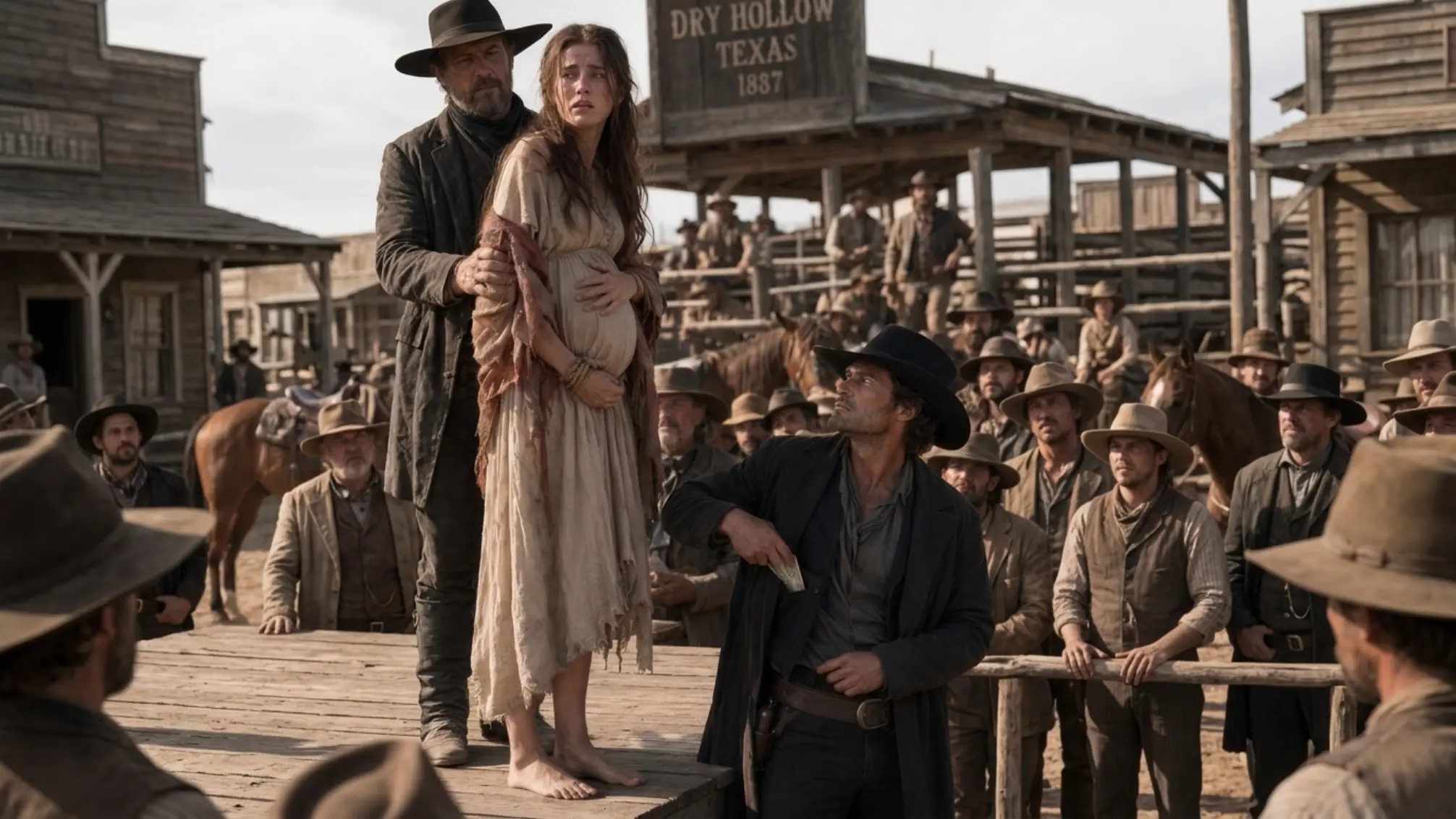
Nothing more.
At thirty-eight, he was known throughout the county as a quiet rancher who paid his debts, kept his word, and rarely entered town unless work demanded it. Three winters had passed since his wife, Elise, died after falling from a cliff road during a storm. Since then, Mason had withdrawn into the thousand acres surrounding Callaghan Ranch and allowed silence to fill every room she once touched.
He had no interest in Dry Hollow’s cruel entertainments.
Then the trader pulled the rope again.
The woman stumbled toward the edge of the platform. Her knees buckled, but she refused to cry out. When she raised her head, Mason saw terror in her gray-blue eyes—and beneath it, a defiance that had survived whatever brought her there.
“Who gives me twenty dollars?” the trader shouted. “Strong back, quiet mouth, and young enough to give a man several children.”
Several men laughed.
One raised five dollars.
Another offered seven and demanded that the woman turn around so the crowd could inspect her.
Mason walked forward.
“I’ll pay twenty.”
The yard fell silent.
The trader blinked. “Twenty?”
“You heard me.”
A rancher near the cattle rail muttered that Callaghan had finally lost his mind. Mason ignored him and removed folded bills from his coat. The trader reached eagerly, but Mason kept the money beyond his grasp.
“Cut the rope first.”
“Money first.”
Mason’s expression hardened. “Touch her again and you get neither.”
The trader studied Mason’s gun belt, then sliced through the rope with a small knife. Instead of helping the woman down, he shoved her from the platform.
Mason caught her before she hit the dirt.
She recoiled so violently that he released her immediately, keeping only one hand near her elbow in case she collapsed. Her frightened gaze moved from his face to his revolver.
“I won’t hurt you,” he said.
She appeared not to understand the words.
Mason removed his dark coat and placed it around her shoulders without touching her skin. He handed the trader the money, then turned to the men watching from the rails.
“She belongs to no one.”
The trader laughed nervously. “You bought her.”
“I bought the rope off her wrists.”
Mason guided her toward his wagon. She walked unsteadily beside him, clutching the coat closed with both hands. Behind them, someone called out that Callaghan had paid mule money for another man’s trouble.
Mason stopped.
He looked over his shoulder. “Anyone who wants to repeat that closer is welcome to try.”
No one moved.
The woman remained silent until Dry Hollow disappeared behind a curtain of dust. She sat at the far end of the wagon seat, ready to jump if Mason reached toward her. He gave her water, bread, and enough distance to decide whether she trusted either.
After several miles, she spoke.
“Clara.”
Mason glanced sideways. “That your name?”
She nodded.
“Mason.”
Her hand returned protectively to her stomach.
He noticed but asked nothing.
At Callaghan Ranch, Clara expected to be sent toward the bunkhouse or kitchen. Instead, Mason led her upstairs and opened the door to a small bedroom overlooking the horse pasture. The bed had clean sheets, a washbasin stood beside the window, and folded clothes had once belonged to Elise.
“You can lock the door from inside,” he said.
Clara stared at him.
“You don’t owe me work, money, or anything else. Stay until you decide where you want to go.”
“Why?”
Mason had no easy answer.
“Because what happened in that yard was wrong.”
Her eyes lowered. “Men do wrong things every day.”
“That doesn’t make them right.”
He left before she could respond.
For the first three nights, Clara placed a chair beneath the bedroom handle. Mason knew because he heard the legs scrape across the floor after he walked away. He brought food to the landing and never crossed the doorway.
By the fourth morning, the tray was empty.
A week later, Clara appeared in the kitchen before sunrise. She wore one of Elise’s plain blue dresses and had washed most of the dust from her hair. Her face remained thin and guarded, but she no longer looked prepared to flee through the nearest window.
“You said I owe nothing,” she told him.
“You don’t.”
“I can still work.”
“You need rest.”
“I need usefulness.”
Mason understood that word. Work had carried him through the months after Elise died when grief made breathing feel like betrayal. He handed Clara a basket of eggs and showed her where the pantry shelves needed sorting.
She began with small tasks.
Within weeks, she was feeding chickens, repairing shirts, gathering herbs, and keeping the house warmer than it had felt in years. Mason never ordered her. Clara simply noticed what needed doing and completed it before he could object.
One afternoon, he tried to carry six fence posts at once to avoid making another trip. The stack shifted, throwing him sideways into a patch of mud.
Clara laughed.
The sound was brief and startled, as though it escaped before she could stop it.
Mason remained on the ground, covered from shoulder to boot.
“You find this amusing?”
She pressed one hand over her mouth. “A little.”
“Then you can help me up.”
Her laughter followed them toward the barn.
For one moment, the ranch felt alive again.
The change frightened Mason.
He had loved Elise with the certainty of a man who expected to grow old beside her. Allowing warmth back into the house felt disloyal, as though every new memory erased part of the woman buried beneath the cottonwood tree.
But Clara never tried to take Elise’s place.
She dusted around the framed wedding photograph without moving it. She kept Elise’s sewing box closed until Mason offered permission. When she found a pressed wildflower inside an old book, she placed it carefully on his desk rather than asking questions.
Peace settled slowly over the ranch.
Then Mason noticed Clara becoming ill.
She ate little in the mornings, tired easily, and sometimes pressed one hand against her stomach when she believed he was not looking. Whenever riders appeared on the distant road, all color left her face.
One evening, while reaching for a bucket inside the barn, she swayed.
Mason caught her before she struck the floor.
“Clara.”
She gripped his sleeve while he lowered her onto a hay bale. Her breathing came quickly, and tears gathered in her eyes.
“I have to tell you something.”
He knelt before her.
Both hands moved over her stomach.
“I’m carrying a child.”
The barn became painfully quiet.
Clara rushed to fill his silence. “I didn’t tell you because I thought you would send me away. I thought you’d believe I trapped you or that the auction man cheated you.”
“No.”
“I can leave before winter. I’ll find work somewhere.”
“You’re not leaving because you’re frightened of me.”
Her eyes met his.
Mason asked the question he had delayed since Dry Hollow.
“Is the father alive?”
Clara’s face emptied of color.
For several seconds, she seemed unable to breathe.
“Yes.”
“Does he know about the child?”
“Yes.”
“Is he searching for you?”
Her gaze moved toward the barn door. “He never stopped.”
Mason sat beside her, leaving space between them.
“Tell me his name.”
“I can’t.”
“If he comes here, I need to know what we’re facing.”
“You don’t understand. He owns judges, deputies, ranches—half the freight companies between here and San Antonio. Men disappear after speaking against him.”
Mason’s jaw tightened. “Who?”
Clara whispered the name.
“Silas Vane.”
Mason stood so quickly that the hay bale shifted beneath them.
Silas Vane was one of the wealthiest cattle barons in Texas. He controlled grazing rights, rail contracts, and enough hired guns to frighten entire towns. More importantly, Vane was the last person known to have seen Elise alive.
Three years earlier, Elise had traveled to Vane’s estate to deliver school records from the small mission she operated for ranch workers’ children. She never returned.
Her wagon was later discovered near the cliff road. The authorities concluded that the horses panicked during the storm, sending the wagon into the ravine. Elise’s body was found below.
Mason had accepted the explanation because grief left no strength for suspicion.
Now Clara was trembling before him.
“How do you know Silas Vane?”
“I worked in his house.”
“What happened?”
“He forced me into his room for months. When I learned I was carrying his child, I threatened to tell his wife and the newspapers. He had me locked inside an old workers’ cabin.”
Mason forced himself to remain still.
“How did you reach Dry Hollow?”
“One of his men transported me toward Mexico. The trader was supposed to sell me under another name so no one could connect me to Vane.”
“Why didn’t he kill you?”
Clara looked down. “He wants the baby alive.”
Mason’s stomach tightened.
“Why?”
“Because Silas has no son. His wife cannot have children, and his daughters cannot inherit control of several family trusts. He planned to take the baby after birth and make everyone believe his wife delivered him privately.”
Mason paced toward the barn entrance. Every instinct demanded that he ride directly to Vane’s estate and put a bullet through the man’s heart.
Then Clara spoke again.
“Elise knew.”
Mason stopped.
“What did you say?”
“Your wife knew what Silas was doing.”
He turned slowly.
Clara reached into the hidden seam of her dress and removed a small brass key tied to a faded blue thread. Mason recognized the thread instantly. Elise had used that exact shade to bind the school registers she carried between ranch settlements.
“She gave me this,” Clara said.
“When?”
“Three years ago.”
The barn tilted around him.
“You knew my wife?”
“She came to Vane’s ranch to teach the workers’ children. She found me locked inside the west cabin after hearing someone crying. I told her what Silas had done to two other women before me.”
Mason’s voice became rough. “Elise never mentioned you.”
“She said she needed proof before telling anyone. She copied names, payments, and letters from Vane’s office. She planned to bring everything to a federal marshal.”
Clara held out the key.
“She hid the evidence somewhere only you would recognize.”
Mason could barely lift his hand to accept it.
“What does the key open?”
“I don’t know. She said, ‘Tell Mason to look where our first winter survived.’”
The phrase struck him like a physical blow.
During their first winter on the ranch, a blizzard destroyed half the roof and trapped Mason and Elise inside an abandoned stone smokehouse for two days. They survived by burning broken shelves and sharing one wool blanket. Afterward, Elise joked that the smokehouse had guarded their marriage before they even had a proper home.
Mason ran from the barn.
The smokehouse stood behind the cottonwoods, unused since Elise’s death. He forced open the swollen door and searched every shelf, stone, and floorboard. Clara watched from the entrance as he found a small iron keyhole beneath the wooden base of an old curing table.
The brass key fit.
A hidden panel opened.
Inside lay a waterproof satchel.
Mason’s hands shook as he removed it.
The first item was a letter addressed to him in Elise’s handwriting.
He sat on the floor before opening it.
Mason, if you are reading this, I was unable to return safely. Silas Vane has been imprisoning women from worker settlements and using his freight network to move people under false debt contracts. Clara witnessed enough to destroy him, but she is terrified and has nowhere safe to go.
Mason stopped reading.
Grief pressed against his ribs with the same force it had the day they found Elise’s body.
Clara knelt nearby without touching him.
He continued.
I copied his ledgers and letters. If anything happens to me, do not trust Sheriff Bell or Judge Harland. Both receive payments from Vane. Take the evidence to Federal Marshal Isaac Ward in Austin. Most importantly, find Clara. She carries the truth, and I promised her she would not remain alone.
The satchel contained account books, signed transport orders, photographs, and letters proving Vane had purchased judges, bribed lawmen, imprisoned workers, and arranged illegal human auctions through several frontier towns.
At the bottom lay Elise’s broken necklace.
Mason closed his fist around it.
“Her death wasn’t an accident,” he said.
Clara’s tears fell silently. “I heard Silas order his men to stop her before she reached town.”
Mason looked at the woman his wife had died trying to protect.
For three years, he believed Elise left him through chance.
Now he understood she had chosen courage.
And Silas Vane had murdered her for it.
Mason prepared to ride for Austin before dawn. Clara refused to remain behind.
“If you take those papers without me, Vane will say they’re forged.”
“It’s dangerous.”
“He’ll find me whether I hide here or not.”
“You’re carrying a child.”
“I’ve spent months being told that makes me weak.”
Mason looked at her gray-blue eyes.
They were frightened.
Still not defeated.
“You ride in the covered wagon,” he said. “And you follow my orders if shooting starts.”
Clara almost smiled. “I’ll consider them.”
They never reached Austin.
Vane’s riders intercepted them near Red Creek.
Six armed men blocked the road while three more emerged from behind the trees. Silas Vane rode at their center in an immaculate black coat, silver hair bright beneath his hat.
He looked first at Mason, then at Clara.
“You purchased something that belongs to me.”
Mason stepped down from the wagon with a rifle in his hands.
“She belongs to herself.”
Silas smiled. “That language sounds like Elise.”
Mason’s finger tightened near the trigger.
“You killed her.”
“Elise killed herself by confusing kindness with authority.”
Clara appeared behind Mason despite his order to remain hidden.
Silas’s gaze dropped toward her stomach.
“There is my heir.”
Clara’s fear transformed into rage. “This child will never carry your name.”
“He already carries my blood.”
“That is the only thing you gave him.”
Silas ordered his men to seize her.
Gunfire broke across the creek.
Mason shot the first rider from his saddle and rolled behind the wagon as bullets struck the wooden panels. Clara crawled beneath the axle, clutching the evidence satchel against her chest.
Then another group of riders charged from the eastern ridge.
Federal Marshal Isaac Ward led them.
Elise had mailed him a partial copy of her evidence before her death. It lacked enough detail for arrests, but he had watched Vane quietly ever since. When Mason sent a telegraph from the previous town, Ward immediately rode to meet them.
Vane’s men surrendered after a brief fight.
Silas attempted to escape through the creek but Mason followed, dragged him from the saddle, and drove him into the mud.
For one terrible moment, Mason pointed the rifle at his chest.
Silas laughed. “Do it. Then everyone calls this revenge, and my lawyers destroy the woman’s story.”
Mason saw Elise’s face in his memory.
She had hidden evidence instead of choosing vengeance.
He lowered the rifle.
“You’re going to live long enough to hear every name.”
Silas Vane’s trial lasted six weeks.
Clara testified publicly about the cabin, the auction, the women who disappeared, and Elise’s final attempt to expose him. The ledgers identified judges, deputies, traders, and freight operators across Texas.
Sheriff Bell and Judge Harland were arrested.
The Dry Hollow trader received twelve years in federal prison.
Silas was convicted of murder, kidnapping, unlawful confinement, conspiracy, and trafficking. His estates were seized and sold to compensate surviving victims and workers held under false debts.
Elise’s name appeared in newspapers across the country.
Not as a rancher’s wife who died in a wagon accident.
As the woman whose evidence shattered one of Texas’s most powerful criminal empires.
When the trial ended, Clara returned to Callaghan Ranch.
She no longer needed Mason’s protection. Vane was imprisoned, the court awarded her part of his seized assets, and several safe places were available to her.
Still, she remained.
Her son was born during a thunderstorm in early spring. Clara named him Elias, using the first two letters of Elise’s name without taking it completely.
Mason held the child only after Clara placed him in his arms.
“You bought my freedom,” she said.
“No. Elise did. I only finished carrying it home.”
Months passed.
Mason rebuilt the smokehouse but left the hidden compartment untouched. Inside, he kept Elise’s original letter beside the broken necklace and a new photograph of Clara holding Elias beneath the cottonwood tree.
One evening, Clara found Mason standing at Elise’s grave.
“I used to think caring for anyone again would mean leaving her behind,” he said.
Clara stood beside him. “She led you to me.”
Mason looked toward the ranch house, where Elias slept near the open window.
“Yes.”
Clara reached for his hand slowly, allowing him time to step away.
He did not.
The auction trader had presented her as property worth no more than a mule. Silas Vane had treated her body as a means of preserving his name. The men in Dry Hollow had laughed because cruelty cost them nothing.
Mason paid twenty dollars.
But the money had never purchased Clara.
It purchased one interrupted moment—enough time to cut the rope, uncover Elise’s final secret, and give the truth somewhere safe to live.
And when Mason finally opened his heart again, he understood that Elise had not sent him a replacement for the life he lost.
She had entrusted him with the family he had not yet learned how to save.