Yorkshire, England, November 1815.
She was hired to run his house.
Not to speak at his meetings.
Not to offer opinions.
Not to exist beyond the corridors, the linen counts, the dinner arrangements, and the quiet machinery that kept a great estate from collapsing into disorder.
Louisa Weston knew that.
She accepted that.
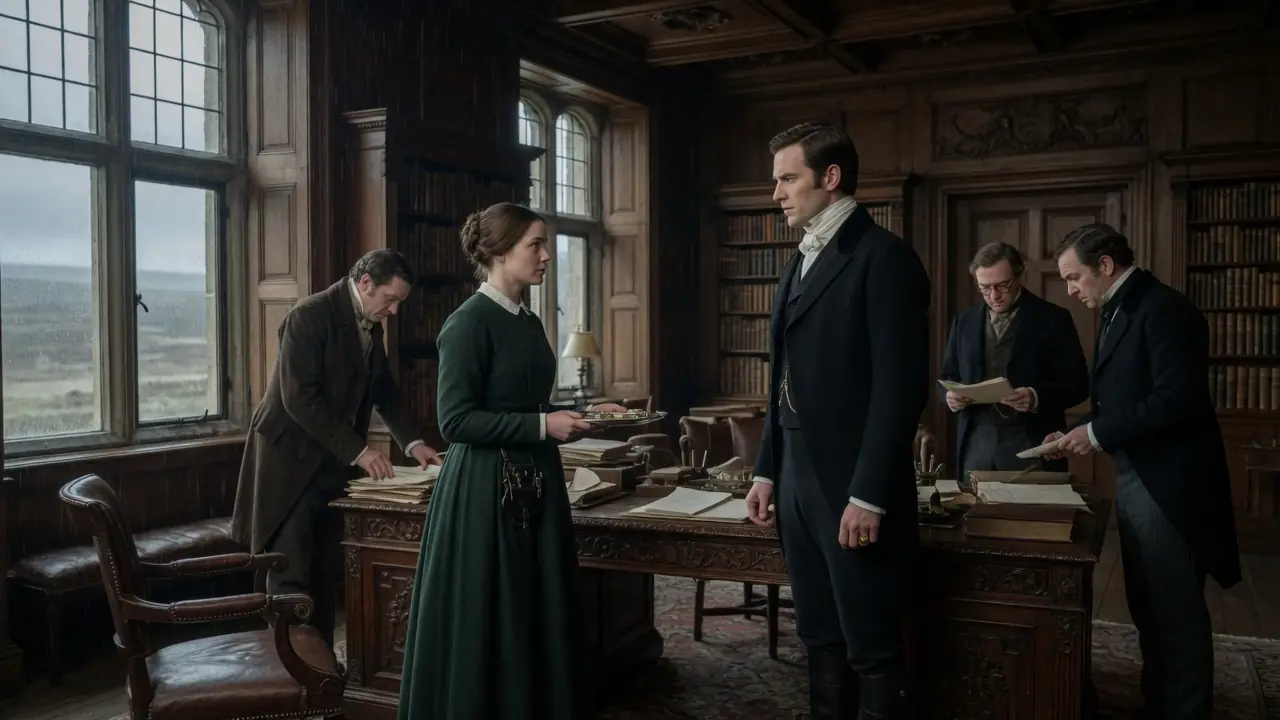
Until the afternoon she stood in the doorway of the Duke of Dunmore’s study, holding a silver tray, listening to three men fail to solve a problem she had already solved in her head.
She set down the tray.
Took one breath.
And spoke.
“If I may, Your Grace, there is another way to approach this.”
The Duke did not look up from his papers.
“A woman cannot solve this.”
The room went quiet.
Louisa did not argue.
She did not flinch.
She picked up the tray and walked out.
That night, she sat at her small desk in the East Wing and wrote for two hours.
The next morning, the Duke of Dunmore called his advisers back into the study, held up a document, and said, “Finally. This is exactly what we needed. Who wrote this?”
Nobody answered.
Because nobody knew.
Except her.
The Duke of Dunmore did not look up from his desk when Louisa Weston arrived.
That told her everything she needed to know.
She stood in the study doorway with her traveling coat still fastened, her letter of appointment folded in her pocket, and the steady expression of a woman who had managed three households before she turned twenty-five.
Louisa knew how to read a house in the first ten minutes.
The temperature of the rooms.
The way the staff moved through corridors.
Whether floors were swept out of habit or pride.
Whether fires were lit for comfort or merely for show.
Dunmore Hall was cold.
Not from lack of firewood.
From something else.
“Miss Weston,” said Mr. Hatch, the estate steward, standing slightly behind her.
He carried the posture of a man who had learned to make himself small in doorways.
“Your Grace, this is Miss Weston. The new housekeeper.”
The Duke set down his pen.
He looked at Louisa the way he probably looked at everything.
Quickly.
Completely.
Without expression.
Dark eyes. Precise face. The kind of stillness that did not come from calm, but from practice.
“Miss Weston,” he said.
“Your Grace.”
“Mrs. Pemberton managed this house for fourteen years.”
“I know,” Louisa replied. “She trained me.”
Something shifted in his expression.
Not warmth.
A recalibration.
He picked up his pen again.
“Mr. Hatch will show you the household accounts. I expect the same standard.”
“You will have a higher one,” Louisa said.
The Duke looked up.
She met his eyes without difficulty.
She was not being bold.
She was being accurate.
For a moment, the room seemed to notice her.
Then the Duke looked back down at his papers.
He said nothing.
Louisa understood that the conversation was finished.
She followed Mr. Hatch out of the study and did not look back.
Dunmore Hall had twelve bedrooms, four reception rooms, a kitchen that needed reorganizing, and a linen inventory nobody had counted properly in eight months.
The east corridor had a draft through the third window from the left.
The dining room fire smoked when the wind came from the north.
The silver pantry was arranged by memory rather than logic.
The scullery girls were overworked.
The footmen were undertrained.
The cook was competent, exhausted, and suspicious of change.
Louisa noted all of it.
She noted other things, too.
No flowers anywhere in the house.
Not a single vase.
No music room in use.
No cushions placed for comfort.
No open curtains in the south parlor, though the room had the best afternoon light.
And in the main hallway, above the long carved table near the staircase, hung the portrait of a woman in blue.
She had dark hair, a direct gaze, and the sort of face that looked as though it had opinions and expressed them.
The portrait was turned slightly toward the wall.
Not fully.
Just enough that one did not quite see her face when walking past.
Mr. Hatch mentioned that the Duke was a widower.
He did not mention how recently.
Louisa did not ask.
It was not her business.
She was there to manage the house.
She spent the first three days learning every room, every supply cabinet, every staff member’s name, and every silent rule by which Dunmore Hall functioned.
She reorganized the kitchen on the second day.
She sealed the draft window on the third.
She did not ask permission for either.
They were household matters.
Her job.
On the fourth day, she heard raised voices from the study.
She was carrying a tea tray down the corridor when she heard them.
Not shouting.
Not quite.
But the sound of men who were frustrated and trying not to show it.
She knocked.
Mr. Hatch opened the door.
The Duke stood behind his desk. Beside him were two men Louisa recognized from Mr. Hatch’s descriptions: Mr. Ford, the head accountant, and a solicitor whose name she had not yet learned.
Papers spread across the desk the way papers spread when nobody agrees on anything.
“Tea, Your Grace?” Louisa said.
The Duke waved one hand without looking at her.
She entered and began setting down the cups.
She did not mean to listen.
But the room was small, and the problem was loud.
A merchant named Briggs had supplied the estate for eleven years: coal, grain, lumber, lamp oil, and various winter necessities.
For three years, he had overcharged Dunmore Hall.
Not dramatically.
Just enough that it had taken time to notice.
And he had threatened to cut off supply entirely unless the Duke signed a new contract at prices thirty percent above market rate.
The solicitor wanted legal action.
Eighteen months minimum.
Mr. Ford wanted to negotiate.
Briggs refused to negotiate.
The Duke stood with his arms crossed and said nothing, which meant he liked neither option.
Louisa set down the last cup.
She looked at the papers on the desk.
She looked at the numbers Mr. Ford had written on the top sheet.
She saw it immediately.
Briggs needed this contract.
Not wanted.
Needed.
His entire supply operation ran on three major clients.
Dunmore Hall.
The Harwick estate.
Lord Pembridge’s house.
If Briggs lost Dunmore, the other two would smell weakness. If the other two moved, his business would collapse before spring.
He was bluffing because he was afraid.
Louisa knew this because she had managed the Ashby estate supply accounts for two years and had seen this exact pattern before.
A supplier overreached.
Got caught.
Threatened.
Waited to see if anyone would call his bluff.
Louisa placed the tray against her hip.
“If I may, Your Grace.”
The room went quiet in the way rooms go quiet when someone unexpected speaks.
She kept her voice level.
“There is another way to approach this. Briggs has two other major clients in the county: the Harwick estate and Lord Pembridge’s house. If Dunmore quietly contacted both estates about forming a joint supply arrangement with a different merchant, Briggs would know within a week.”
She looked at the figures again.
“He would not wait for legal action. He would return to the table.”
She said it clearly.
Simply.
The way she said everything important.
The Duke looked at her.
Not the inventory look from the day she had arrived.
Something different.
For exactly two seconds.
Then he looked back at his advisers.
“A woman cannot solve this,” he said.
The solicitor glanced at his papers.
Mr. Ford looked toward the window.
Mr. Hatch went very still.
Louisa stood unmoving for a moment.
Then she picked up the tray, turned, and walked out.
She closed the door behind her without a sound.
She walked down the corridor, past the portrait turned slightly toward the wall, past the window she had sealed against the draft.
Then she said quietly, to no one in particular, “The problem does not care who solves it.”
She did not know anyone heard.
She went through the door to the East Wing and up the narrow stairs to her room.
She set the tray on her small desk.
Sat down.
Outside, the November wind pressed against the glass.
The candle on her desk moved once, then settled.
Louisa pulled out a sheet of paper and wrote at the top:
Briggs. Harwick. Pembridge. Three estates. One solution.
Then she began.
She wrote for two hours that night.
Not because she was angry.
Because the problem sat there, fully visible, and leaving it unsolved felt like waste.
She wrote down Briggs’s three principal accounts.
She wrote down the supply routes.
She wrote down the weakness in his pricing.
She wrote down the merchant in Leeds who had expanded his territory two years earlier and needed exactly this kind of foothold.
She wrote down the three letters Dunmore Hall should send.
One to Harwick.
One to Lord Pembridge’s steward.
One to the Leeds merchant.
She included the expected response, the likely counteroffer, and the precise point at which Briggs would return.
When she finished, she read it back once.
Then she folded the paper, wrote Mr. Hatch’s name on the front, and left it outside his door.
She went to bed.
She slept well.
The next morning, Mr. Hatch was not at breakfast.
His door stood open.
The folded paper was gone.
From somewhere down the corridor, Louisa heard the Duke’s study door close.
Mr. Hatch found the Duke standing at his desk at seven in the morning.
This was not unusual.
Frederick Wycliffe, Duke of Dunmore, rose early by necessity rather than temperament.
But the way he stood, not reading, not writing, only holding a single folded sheet of paper in his hand, was unusual.
“Your Grace,” Hatch said.
The Duke looked up.
“Where did this come from?”
Hatch looked at the paper.
He recognized it immediately.
The handwriting.
The clean, precise columns of numbers along the margin.
The logic that moved from point to point without wasted words.
He had read it himself at six that morning while standing in the corridor outside his own door.
“It was left for me last night,” Hatch said carefully.
“By whom?”
Hatch paused for exactly one second.
“I am not certain, Your Grace.”
The Duke looked at him with the expression of a man who suspected he was being managed and had not decided how he felt about it.
“Read it,” he said, and held out the paper.
Hatch took it.
He read it slowly, though he already knew every word.
The plan was simple.
Elegant, even.
Contact the Harwick estate and Lord Pembridge’s house, Briggs’s two other major clients in the county.
Propose a joint supply arrangement with a merchant from Leeds who had been trying to enter the northern estate market for two years.
When Briggs learned all three estates were moving together, and he would learn because Yorkshire talked, he would return within a fortnight on their terms rather than his.
No legal action.
No months of delay.
Three letters and patience.
“Well?” the Duke said.
Hatch set the paper on the desk.
“It is correct. The logic is sound. I checked the figures this morning against the supply records.”
He paused.
“All of them hold.”
The Duke looked at the paper again.
He picked it up.
Read it a second time slowly.
That told Hatch something.
The Duke was not a man who read things twice unless he was looking for the flaw.
He did not find one.
“Who wrote this?” the Duke asked again.
“I will look into it,” Hatch said.
It was not an answer.
They both knew it.
Louisa was in the kitchen at half past seven, going through the weekly supply list with the cook, when she heard the study door open and close twice in twenty minutes.
She did not look up from the list.
“The flour order,” she said. “We are running low.”
“I ordered last Tuesday,” the cook said.
“Order again. Winter is coming, and I do not want to be short in January.”
The cook wrote it down.
Louisa moved to the next item.
She was completely calm.
This surprised even her a little.
She had expected to feel something after leaving that paper outside Mr. Hatch’s door.
Nervousness, perhaps.
Or doubt.
She felt neither.
She felt the same thing she always felt after solving a problem correctly.
The Duke passed through the kitchen at eight.
Dukes, in Louisa’s experience, did not pass through kitchens.
They existed in studies, dining rooms, entrance halls, and occasionally gardens.
The kitchen was her territory.
She did not expect him in the doorway with his coat on and his expression set in the way it became when something unresolved had attached itself to him.
The cook froze.
Louisa did not.
She looked up from the supply list, noted his presence, and waited.
“Miss Weston,” he said.
“Your Grace.”
“The Harwick estate.”
He said it the way he said things he was testing aloud.
“Do you know them?”
Louisa kept her face still.
“I managed the Ashby estate for two years. Ashby and Harwick share a northern boundary. I know their steward.”
Something moved in his expression.
Attention.
The kind that narrows and focuses.
“And Lord Pembridge?”
“His house is twelve miles from Ashby. His cook came to our market on Fridays.”
She paused.
“His steward’s name is Mr. Galloway. He has wanted to renegotiate their coal supply for the past year. He mentioned it more than once.”
The Duke stood in the kitchen doorway and looked at her for a long moment.
The cook found something very important to do near the back wall.
“I see,” the Duke said.
He left.
Louisa looked back at her supply list.
Her pen did not shake.
Her handwriting remained exactly the same.
Flour, double order.
The meeting happened that afternoon.
Louisa was not in it.
She was counting sheets with the housemaid in the linen room when she heard the study door open and the sound of Mr. Ford’s voice below.
Then the solicitor.
Then a third man she did not recognize.
She counted sheets.
Forty minutes later, the voices rose slightly.
Not in argument.
In the energy of men who had found a direction and were moving toward it.
She knew that sound.
It meant something had been decided.
She finished the linen count.
Wrote the numbers in her record book.
Went downstairs to supervise the afternoon fires.
She passed the study door just as it opened.
The solicitor came out first.
Then Ford.
Then the unknown man.
They talked quickly, the kind of talking that happens when a plan begins to move.
Then the Duke appeared in the doorway.
He saw her immediately.
Louisa stood six feet away with her record book under her arm and the composed expression she wore in corridors.
He looked at her.
She looked at him.
Neither said anything.
Then Mr. Ford appeared at the Duke’s shoulder with a question about the Leeds merchant.
The Duke turned.
Louisa walked toward the East Wing.
She did not look back.
But she was almost certain he watched her go.
That evening, she was writing the weekly household report when she heard a knock at her door.
It was Mr. Hatch.
He stood in the doorway with the expression of a man who had thought about something all day and finally decided to say it.
“The plan,” he said quietly. “He is going to use it.”
“Good,” Louisa said.
“He wants to know who wrote it.”
“You do not know,” she said.
Hatch looked at her for a long moment.
He was a careful man.
Careful for thirty years, with no intention of changing.
“No,” he said. “I do not.”
He left.
Louisa looked at the door after it closed.
The fire in the small grate made the room warm.
Outside, November pressed sharp against the window.
She thought of the Duke standing in the kitchen doorway that morning.
The way he had said Harwick and Pembridge, testing the words, following the logic backward.
He was close.
She picked up her pen and finished the household report.
Three days later, the letters went out.
Two to Harwick and Pembridge.
One to the merchant in Leeds.
All three signed by the Duke of Dunmore.
None of them written by him.
On the eighth day, a message arrived from Briggs.
He wanted to meet.
The Duke read it at his desk and stood very still for a moment.
Then he called for Hatch.
“Find out who wrote that plan,” he said. “Today.”
Hatch found the Duke in the east corridor at half past nine.
The Duke walked toward the main staircase with the focused stride of a man who had made a decision and moved toward it.
Hatch fell into step beside him.
“Your Grace.”
“Did you find out?”
“Yes.”
The Duke stopped walking.
Hatch stopped, too.
The corridor was quiet.
A clock ticked somewhere down the hall.
Morning light came through the tall east window and placed a long rectangle of pale gold on the floorboards between them.
“Who?” the Duke said.
Hatch looked at him steadily.
“Miss Weston.”
The Duke said nothing.
“She left it outside my door the night of the meeting,” Hatch continued. “I recognized the handwriting when I read it. I should have told you immediately. I apologize for the delay.”
The Duke still did not speak.
He looked past Hatch’s shoulder toward the east window, toward the pale November light.
His expression worked to remain controlled.
“Miss Weston,” he said.
“The housekeeper.”
“Yes, Your Grace.”
Another silence.
“Where is she?”
“The kitchen garden, I believe. She inspected the winter stores this morning.”
The Duke turned and walked toward the back of the house.
Louisa stood beside the root cellar with a lantern and a record book, counting sacks of turnips with the patience of a woman who found inventory genuinely useful.
She heard his footsteps on the stone path and looked up.
She knew immediately that Hatch had told him.
Not because the Duke’s expression gave it away.
Not quite.
But she had spent eleven days learning the particular quality of his presence in a room, and right now that quality was different.
Changed in a way it had not been before.
She closed her record book.
“Your Grace.”
He stopped three feet from her.
He looked at her the way he had looked at that paper.
Searching for the flaw.
Finding none.
“The plan,” he said. “Briggs. Harwick. Pembridge. You wrote it.”
“Yes.”
He was quiet for a moment.
The wind came off the moor and moved through the kitchen garden. It smelled of cold earth and dead leaves.
“Why did you not say it was yours?”
Louisa looked at him.
Her voice stayed even.
Her eyes direct.
“You told me a woman cannot solve this.”
She paused.
“I thought you might find it easier to use the solution if you did not know where it came from.”
Something moved through his face.
Quick, then gone.
“That was…”
He stopped.
“Practical,” she supplied. “That is all.”
He looked at her for a long moment.
She did not look away.
Louisa had learned early that looking away in moments like this was a concession she was not willing to make.
“You worked for the Ashby estate,” he said.
“Two years. Supply accounts and household management.”
“And before that?”
“My father was steward at Pembroke Hall for twenty-three years. I grew up around estate accounts.”
She paused.
“I know how supply networks work. I know how merchants like Briggs work. I saw this exact situation before.”
“And you saw it while serving tea.”
There was something in his voice when he said it.
Not sarcasm.
Closer to something he forced himself to say plainly because he believed in plain speech even when it cost him.
“Yes,” Louisa said.
He looked at the root cellar.
Then at her record book.
Then at the lantern she still held.
Practical rather than decorative.
Which was everything about her in one object.
“Briggs wants to meet,” he said.
“I heard.”
“Of course you did.”
He said it quietly.
Not as criticism.
Almost something else.
He put his hands behind his back.
He looked at the kitchen garden wall and fell quiet in the way Louisa had learned he did when revising something.
“The meeting is Thursday,” he said. “I want you there.”
She went very still.
“Not to serve tea,” he added. “To advise.”
She looked at him.
Careful not to let anything show.
Not the surprise.
Not the warmth that moved through her chest at those words.
“That would be irregular,” she said.
“Yes.”
He met her eyes.
“It would.”
She held his gaze.
He held hers.
“Thursday,” she said. “What time?”
“Ten.”
He paused.
“Bring your notes.”
Then he turned and walked back toward the house.
Louisa watched him go.
Then she opened her record book and looked at the turnip count.
The numbers were exactly the same as before.
The morning was exactly the same as before.
Somehow everything felt entirely different.
She wrote Thursday, 10:00.
She underlined it once.
She spent Wednesday evening reviewing every piece of information she had gathered on Briggs in two weeks.
His supply routes.
His three major clients.
His outstanding debts with the Leeds merchant.
She had found that detail in a misdirected letter, the sort of administrative error people rarely noticed, but which occasionally contained more useful information than anything intentional.
She organized her notes into a single page.
Clear.
Numbered.
The way her father had taught her to present information to men who needed to make decisions quickly.
She was nearly finished when someone knocked at her door.
She opened it.
The Duke stood in the corridor, still in his day clothes, which meant it was earlier than she thought.
He held a single sheet of paper.
“The Pembridge steward replied,” he said.
He held it out.
She took it.
Read it.
Galloway, the steward from Friday markets, had written back with considerably more enthusiasm than the Duke’s initial letter perhaps warranted. He included a name, another merchant in Leeds, smaller but reliable and hungry for exactly this kind of contract.
“Better than expected,” Louisa said.
“Yes.”
He watched her read.
“You knew Galloway would respond this way.”
“I thought he might.”
“You knew,” the Duke said again.
Not accusatory.
Precise.
She looked up from the letter.
He stood in her doorway in the evening quiet. The corridor behind him was dim, and the situation was one she needed to be careful about.
She handed the letter back.
“It is a good development, Your Grace. It gives you a stronger position on Thursday.”
He took the letter.
He did not move immediately.
“Miss Weston.”
“Yes?”
He looked at her for a moment.
Something moved behind his eyes.
The thing he had not said in the kitchen garden.
The thing he had not said in the study the day she arrived.
The thing he carried like a coat he never quite took off.
“Get some sleep,” he said. “Thursday will be a long day.”
He turned and walked down the corridor.
Louisa closed the door.
She stood with one hand on the frame for a moment.
She thought about the way he said her name.
Not Miss Weston the housekeeper.
Just Miss Weston.
She sat back at her desk.
Looked at her notes.
Added one more line at the bottom.
Underlined it.
Then told herself it was about Thursday.
Mr. Briggs was a large man who had made himself larger over the years through the confidence of someone never seriously challenged.
He sat across the desk from the Duke with his hands on his knees, his coat well-made, and his expression set in the pleasant, immovable way of a man who believed he already knew how the conversation would end.
He looked at Louisa once.
Then at the Duke.
“Your Grace,” he said. “I was not aware we would have additional company.”
“Miss Weston advises on estate supply matters,” the Duke said.
The same flat tone he used for everything.
No explanation.
No apology.
Briggs smiled the smile of a man making a private decision.
“Of course.”
Louisa opened her notes.
She did not look at Briggs immediately.
She looked at the top of her first page and let the silence sit for a moment, just long enough for Briggs to feel it.
Then she looked up.
“Mr. Briggs,” she said, “you have supplied Dunmore Hall for eleven years.”
“That is right.”
“In that time, the estate has paid you reliably. Never late. Never in dispute.”
She turned a page.
“In return, your prices increased fourteen percent above the county average over the past three years.”
Briggs shifted slightly.
“Supply costs have—”
“The Leeds supply index for coal dropped seven percent last winter,” Louisa said. “Grain was stable. Lumber was down four.”
She looked at him pleasantly.
“So that is not it.”
The room went very quiet.
Briggs looked at the Duke.
The Duke said nothing.
He leaned back slightly in his chair, arms crossed, wearing the expression he wore when watching something he found instructive.
“The new contract you proposed,” Louisa continued, “adds a further thirty percent. That would bring your pricing to forty-four percent above market.”
She set down her pen.
“We will not be signing it.”
“Then you will need to find another supplier,” Briggs said.
His voice lost its pleasantness.
“On short notice. In November. I think you will find that difficult.”
“We already found one.”
Briggs went still.
“The Harwick estate and Lord Pembridge’s house are moving to a joint supply arrangement with a merchant from Leeds,” Louisa said. “We have been in discussion for two weeks. There is room for a third estate in the arrangement. That would be us.”
She paused.
“The pricing is eighteen percent below what we currently pay you, which is coincidentally seven percent below actual market rate, because that merchant wants the business.”
She closed her notes.
“We are willing to continue with you at a rate five percent above market. Fair, and in writing today. Or we join the Leeds arrangement next month.”
She folded her hands on the desk.
“Those are the options.”
Briggs looked at her.
Then at the Duke.
Then at the papers on the desk, clearly not written by anyone in this room in the last ten minutes.
He understood then.
She had prepared this for two weeks.
His jaw worked once, silently.
“Five percent above market,” he said.
“Yes.”
“And a two-year term.”
“One-year renewable.”
Another silence.
Briggs picked up his hat.
Turned it once in his hands.
He was a man recalculating, and he was not used to recalculating in front of a woman who watched him do it with perfect composure.
“I will need to review the figures.”
“Of course,” Louisa said. “We will need your answer by Friday.”
He stood.
He shook the Duke’s hand.
He nodded barely in Louisa’s direction.
Then Mr. Hatch showed him out.
The door closed.
The study was quiet.
Louisa gathered her notes into a neat pile and set them aside.
She looked at the Duke.
He watched her with an expression she had never seen on him before.
Not the inventory look.
Not the controlled look.
Something open.
Something that had not decided yet what it was.
“Friday,” he said.
“He will agree by Thursday.”
The Duke looked at her.
“He needs this contract. He agreed in the room. He simply does not know it yet.”
The Duke looked at her for a long moment.
“You knew that before you walked in.”
“Yes.”
“And you let him think he was still deciding.”
“It is kinder,” Louisa said simply. “Men like Briggs need a moment to arrive at the inevitable on their own terms. It costs nothing to give them that.”
Something changed in his face when she said it.
Something that was almost a smile.
Not quite.
But close enough that she noticed and filed it away with the other things she collected without meaning to.
He stood and walked to the window.
He looked out at the November grounds, the bare oak along the north drive, the gray sky pressing down over the moor.
“The plan,” he said to the window. “The night of the first meeting. You wrote it that same night.”
“Yes.”
“How long did it take?”
“Two hours.”
She paused.
“The first half hour was thinking. The writing was faster.”
He was quiet.
“I told you a woman cannot solve this.”
“Yes.”
“I was wrong.”
He said it simply.
No performance.
No elaborate apology.
Just the plain statement of a man revising a position directly and without waste.
Louisa looked at his back, at the set of his shoulders, at the way he stood at the window alone, looking at the grounds that were his and that he carried the weight of by himself.
“But you worked with the information you had,” she said.
He turned from the window.
“That is a generous interpretation.”
“It is an accurate one.”
He looked at her for a moment.
The long, focused look she had come to understand was his version of paying close attention.
“Miss Weston,” he said, “stay for the Pembridge meeting next week and the Leeds arrangement until this is finished.”
“I am the housekeeper.”
“You are whatever this estate needs you to be.”
He held her gaze.
“Right now, it needs you in that chair.”
She looked at the chair across from his desk.
Then at him.
“All right,” she said.
That evening, Louisa passed through the main hallway and stopped.
The portrait of the woman in blue, turned slightly toward the wall since the day Louisa arrived, remained in the same position as always.
Louisa stood before it for a moment.
At the bottom of the frame, in small letters, it read:
Cecily, Duchess of Dunmore, 1812.
Three years ago.
Louisa looked at the portrait for a long moment.
The woman in the painting was perhaps twenty-eight.
Dark hair.
Direct gaze.
The kind of face that looked as though it had opinions and had spoken them.
Louisa thought about the cold house when she arrived.
The empty vases.
The way the Duke carried his stillness like something he was protecting.
She walked upstairs.
She did not examine what she was feeling.
She made a rule of not examining things before she had enough information.
She did not have enough information yet.
Briggs sent his answer the next morning.
Thursday.
One day early.
He agreed to the terms.
Hatch brought the message to the Duke at breakfast.
The Duke read it.
Set it down.
Looked at the empty chair across the breakfast table.
Then looked at Hatch.
“Tell Miss Weston,” he said.
Hatch went to find her.
She was in the linen room.
She read the message.
Smiled once, briefly.
The kind of smile one allows oneself when no one is watching.
Then she folded the note, put it in her pocket, and went back to counting sheets.
That afternoon, the Duke walked past the linen room.
The door was open.
He stopped.
Louisa did not look up.
He stood in the doorway for three full seconds.
Then he walked on.
Neither of them mentioned it.
But Hatch, who stood at the end of the corridor and saw the whole thing, made a private note in his own mental ledger.
Some things did not need to be written down to be recorded.
The lease arrangement was signed on a Tuesday.
Three estates.
One merchant.
A contract that saved Dunmore Hall four hundred pounds a year.
Louisa sat at the Duke’s right in every meeting that led to it.
She spoke when she had something to say and stayed quiet when she did not, a skill she observed that roughly half the men in those rooms had never learned.
The Duke never asked her twice for anything.
She noticed he stopped asking once.
He simply looked at her across the table when a question came up, and she answered, and they moved on.
It was the most efficient working arrangement she had ever been part of.
She told herself that was why she looked forward to the meetings.
She almost believed it.
On the Wednesday after the contract was signed, she came down to the study at nine in the morning to return the supply files.
The Duke was at his desk.
He looked up when she knocked.
“The Leeds files,” she said. “Completed and indexed.”
“Thank you.”
He took them.
Set them on the desk.
Looked at her in the way he had been looking at her lately.
Longer than necessary.
With the quality of a man building toward something he had not yet decided to say.
She waited.
“Sit down,” he said.
She sat.
He opened the top file.
Looked at the index she had written, a clean organized summary of every document inside, with page references and dates.
“You did this last night.”
“Yesterday evening, yes.”
“It must have taken an hour.”
“Maybe less.”
He looked at the index.
Then at her.
“Miss Weston, what exactly were you doing before you came to Dunmore Hall?”
She paused.
“Managing houses.”
“Managing houses,” he repeated, in the tone of a man who found the answer both accurate and completely insufficient.
“Yes.”
“With this level of…”
“Organization?” she offered.
“I was going to say capability.”
She looked at him carefully.
He was not performing a compliment.
He was stating a fact that had accumulated for three weeks and had finally reached the point where he could not leave it unsaid.
“My father believed in thorough work,” Louisa said. “He said if something is worth doing, it is worth doing so well that no one has to do it again.”
The Duke finished the sentence softly.
“If something is worth doing, it is worth doing so well that no one has to do it again.”
Louisa went very still.
“That is… yes,” she said. “That is exactly what he said.”
The Duke looked at the file in his hands.
“My father said the same thing. Word for word.”
He set the file down.
“Almost nobody says it that way.”
They looked at each other across the desk.
The fire in the grate made a small sound.
The clock on the mantel ticked.
“Almost nobody,” Louisa agreed quietly.
That afternoon, Hatch found Louisa in the kitchen garden.
She was inspecting the winter stores again, which was her excuse for standing in cold air and thinking clearly.
Hatch appeared at the garden gate with his coat on and his usual expression of careful neutrality.
“The county dinner,” he said. “Saturday. Lady Forsyth’s house.”
“Yes.”
“I arranged the Duke’s travel.”
“That is good.”
“He asked that you attend.”
Louisa turned from the root cellar.
“As the housekeeper?”
“As his guest.”
Hatch’s expression stayed perfectly neutral.
“Those were his words. Ask Miss Weston if she will attend as my guest.”
Louisa looked at Hatch for a moment.
Hatch looked back with the serenity of a man who had watched two people not say things to each other for three weeks and found the situation both obvious and none of his business.
“I will need to know the time,” she said.
“Seven.”
She nodded.
She turned back toward the root cellar.
“Miss Weston,” Hatch said.
She looked back.
“The dark green dress,” he said, “if you have one.”
Then he walked back to the house before she could respond.
Louisa stood in the kitchen garden in the November cold and thought that, for a man of careful neutrality, Mr. Hatch had expressed a very clear opinion.
Lady Forsyth’s dinner was twenty people, candlelit and warm in the way of houses where the fires burned for days in anticipation of guests.
Louisa arrived beside the Duke and understood immediately that her presence was noted.
Not unkindly.
But thoroughly.
The Duke introduced her as Miss Weston, his adviser on estate matters.
He said it without hesitation.
Without qualification.
Without the slight apologetic tone men sometimes used when introducing women in professional capacities.
She noticed that.
She filed it away.
She sat four places from him at dinner.
Between her sat Mr. Alcott, a retired solicitor with opinions on everything, and Lady Forsyth herself, who had the sharp, warm intelligence of a woman who had spent decades observing people accurately.
“The Dunmore supply business,” Lady Forsyth said somewhere between the soup and the fish. “I heard it was resolved rather efficiently.”
“The Duke has good advisers,” Louisa replied.
Lady Forsyth looked at her with a small smile.
“So I understand.”
From four seats away, Louisa heard the Duke say something to the man beside him about the Leeds merchant.
Precise.
Confident.
Using exactly the framework she had built.
She looked at her soup.
Lady Forsyth watched all of this with the expression of a woman who had arrived at a firm conclusion and kept it entirely to herself.
The funny moment happened after dinner.
The guests moved to the drawing room, and Louisa was in conversation near the window when Mr. Alcott approached her with the particular energy of a man who had spent dinner forming an opinion and was ready to share it.
“Miss Weston,” he said. “The Duke’s adviser, yes?”
“On supply matters.”
“Mhm.”
He looked across the room, where the Duke stood.
Then back at her.
“How long have you and the Duke been…”
He paused, searching for the word.
“Acquainted?”
“Three weeks,” Louisa said.
Alcott blinked.
“Three weeks?”
“Yes.”
“Only three weeks?”
He looked at the Duke again.
At that precise moment, the Duke looked in Louisa’s direction from across the room.
He looked away immediately when he realized Alcott was watching.
Alcott turned back to Louisa with the expression of a man recalculating something.
“I see,” he said. “I had assumed that is the way he…”
He stopped himself.
Cleared his throat.
“The Leeds arrangement was very well done.”
“Thank you.”
Alcott excused himself and walked directly to his wife, whom he began speaking to in a low, urgent voice while glancing periodically across the room.
Louisa looked at her glass of wine.
From beside her, Lady Forsyth said very quietly, “Three weeks, and he already looks at you like that.”
Louisa looked up.
“Like what?”
Lady Forsyth smiled.
“Like you are the only person in the room who makes sense.”
Louisa opened her mouth.
Closed it.
Looked at her wine again.
“I am the housekeeper.”
“My dear,” Lady Forsyth said warmly, “you stopped being just a housekeeper at least two weeks ago.”
In the carriage back to Dunmore Hall, they were quiet for the first mile.
The Yorkshire night was clear and cold.
The stars were out.
Louisa looked at the dark road and thought about what Lady Forsyth had said and told herself she would not think of it further.
“Alcott,” the Duke said.
“Yes?”
“He spoke to you after dinner.”
“He did.”
“What did he say?”
Louisa considered this.
“He asked how long we had been acquainted.”
The Duke was quiet.
“What did you tell him?”
“Three weeks.”
Another silence.
The carriage moved through the dark.
“And what did he say to that?” the Duke asked.
“He said the Leeds arrangement was very well done.”
The Duke nodded.
He looked back out the window.
Louisa looked at her hands in her lap and said nothing further.
Neither did he.
The Yorkshire night continued around them, and the silence was full of everything neither had said yet.
They arrived at Dunmore Hall at half past ten.
The Duke stepped out first and offered his hand to help her down.
She took it.
He held it one second longer than necessary.
Neither of them mentioned it.
He said good night at the foot of the stairs.
She said good night at the top.
She went to her room.
Sat at her desk.
Did not open her record book.
She sat for a long time looking at the candle.
Then she heard footsteps in the corridor outside her door.
They stopped.
She looked at the door.
A long silence.
Then the footsteps continued away down the corridor toward the main wing.
She looked at the candle a while longer.
Then she blew it out, sat in the dark, and thought about her hand held one second too long.
She was in the east garden at seven the next morning.
Not for work.
There was no inventory to do, no count to finish, no practical reason to stand in the cold with her coat on and her breath visible in the November air.
She was there because she needed to think.
She thought better outside.
She had learned that about herself long ago.
She heard his footsteps on the stone path before she turned.
The Duke was already dressed.
He had the look of a man who had not slept much.
Not badly.
Just insufficiently.
The way people look when something kept their mind moving after it should have stopped.
He halted a few feet away.
“Miss Weston.”
“Your Grace.”
He looked at the garden.
Then at the bare oak at the far end.
Then at the gray sky pressing down over the moor.
He looked at everything except her for a moment, and Louisa recognized a man arranging himself to say something he had avoided for longer than one night.
She waited.
“I stopped at your door last night,” he said.
“I know.”
He looked at her then.
“I stopped twice.”
“I know that, too.”
He was quiet.
The wind came off the moor and moved through the garden. It smelled of cold earth and coming frost.
“I am not good at this,” he said.
“At what?”
His gaze steadied on hers.
“Saying true things when they are about people rather than figures or contracts.”
She held his gaze.
“You have been saying true things to me since the day I arrived.”
“Not all of them.”
She waited.
He put his hands behind his back, looked at the garden wall, then turned back to her and said it.
All of it.
Plainly.
Directly.
The way he said everything that mattered.
“The night of the meeting,” he said, “when you spoke, when you tried to say the thing you saw that nobody else in that room saw, I told you a woman could not solve it. Then I went back to my papers.”
He paused.
“You picked up the tray and walked out. You did not argue. You did not flinch. I told myself it was the correct response to an inappropriate interruption.”
Louisa said nothing.
“I was wrong,” he said. “Not just about the answer. About you. I looked at you and saw a housekeeper. I saw a category. I did not see…”
He stopped.
Started again.
“You walked into this house three weeks ago and sealed the draft window, reorganized the kitchen, corrected the accounts, solved a problem I had circled for months, and did it in two hours without asking for credit, recognition, or anything at all.”
His voice was steady, but something moved beneath it.
“And when Briggs sat across that desk, you took him apart with four sentences and a smile that never once told him what you were doing.”
Louisa looked at him.
The morning light was pale and clear on his face.
“You told yourself the problem does not care who solves it,” he said.
She went still.
“In the corridor,” he continued. “After you left the meeting room. You did not know I heard.”
He held her gaze.
“You were wrong about that.”
“Was I?” she said quietly.
“It matters,” he said. “It matters enormously who solves it. The wrong person solves a problem once and moves on. The right person seals the window, reorganizes the kitchen, fixes the supply chain, and then returns to counting sheets as though none of it was exceptional.”
He looked at her.
“All of it was exceptional, Louisa.”
Her name.
Not Miss Weston.
Not the housekeeper.
Louisa.
She felt it land somewhere precise and deep.
“You stayed,” he said. “I told you a woman could not solve this. You walked out of that room and solved it the same night. You stayed in this house when I gave you every reason not to.”
He took one step toward her.
“Why?”
Louisa looked at him.
She had asked herself the same question several times over three weeks.
She had given herself several reasonable answers.
All accurate.
None complete.
“Because the problem was there,” she said, “and I could see it. Leaving it unsolved would have been wasteful.”
“The problem,” he said, “or the house?”
She held his gaze for a long moment.
“Both.”
“For the first week?”
She paused.
“For the first week.”
“And after that?”
“After that,” she said, “it became harder to justify on purely practical grounds. I was running out of practical grounds.”
Something moved through his face.
The almost smile she had cataloged and collected.
Now it arrived fully.
Not contained.
Not managed.
Real.
Completely real.
He crossed the remaining distance between them.
He stood in front of her in the cold east garden, the moor behind him, the bare oak at the garden’s edge, the November sky pressing everything close and clear.
“I have been closed,” he said, “for a long time. Since Cecily.”
His voice changed slightly on the name.
It did not break.
It acknowledged the weight of it.
“I made a policy of it. I thought it was safer.”
He looked at her steadily.
“You dismantled it in three weeks without even trying.”
“I was not trying.”
“I know,” he said. “That is what made it work.”
He raised his hand and tucked a strand of hair back from her face, slowly, deliberately, giving her every opportunity to step back.
She did not step back.
“Stay,” he said.
“Not as the housekeeper. Not as the estate adviser.”
He paused.
His eyes did not leave hers.
“Stay because I cannot look at that study chair without seeing you in it. Stay because this house has been warm for three weeks for the first time in three years, and I know exactly why.”
Another pause.
The moor was quiet behind him.
Frost sat on the grass.
“Stay because you are the most remarkable person I have encountered in my entire life.”
His voice dropped.
“And I was too proud and too blind and too broken to see it until a letter arrived on my desk without a name on it. I read it and thought, finally, someone who understands.”
He looked at her directly.
“Then I found out it was you, and I understood that I was the one who had not understood anything.”
Louisa looked at him.
She thought about the letter of appointment in her pocket the day she arrived.
The cold house.
The turned portrait.
The study doorway.
The tray in her hands.
The words that landed in the room and were filed away.
She thought about two hours at a desk on a November night, writing because the problem was there and the solution was obvious.
She thought about a hand held one second too long.
“You said a woman could not solve this,” she said.
“Yes.”
“You were almost right.”
His eyes narrowed slightly.
“There was one thing I could not solve.”
“What?”
“You,” she said. “I could not solve you. I tried for three weeks and could not manage it.”
The almost smile became real again.
His face open.
Undefended.
His.
“And now?” he said.
She placed her hand on his arm.
Flat.
Deliberate.
“I think,” she said, “you may have solved yourself.”
He covered her hand with his.
He looked at her the way she had been afraid to name for two weeks.
Not afraid of him.
Afraid of what it would mean to name it correctly.
Then he kissed her.
It was not tentative.
It carried the quality of something decided carefully and now executed completely.
She kissed him back with the same precision she brought to everything she committed to fully.
The east garden was cold around them.
The moor was gray.
The November sky was entirely indifferent.
None of it mattered in the slightest.
When they separated, he kept his forehead against hers.
“Louisa,” he said.
“Frederick,” she answered.
He laughed quietly, surprised, as though he had not expected to.
It was the first time she heard him laugh.
It was a good sound.
She filed it under essential information.
“Stay,” he said.
“I never left.”
He looked at her for a long moment.
Then he reached into his coat pocket and took out something small.
A ring.
Plain gold, worn at the edges.
His grandmother’s, she learned later.
He held it between them.
“This is not a practical matter,” he said. “I want to be clear about that.”
She looked at the ring.
Then at him.
“No,” she said. “It is not.”
“Louisa Weston,” he said.
He said her name the way he said everything important.
Directly.
Without decoration.
“Will you stay permanently?”
She looked at the cold east garden.
The bare oak.
The moor.
The house behind them, warm for the first time in three years.
She looked at him.
“Yes,” she said. “Obviously.”
He almost smiled.
Then he did smile.
Fully.
Completely.
The way she had waited three weeks to see.
He put the ring on her finger.
It fit.
She suspected that was probably not a coincidence.
They were married in February in the village church at the edge of the Dunmore estate.
Mr. Hatch stood at the back with the expression of a man who had known this was coming since approximately the second week of November and had simply waited for everyone else to catch up.
It was a small ceremony.
Exactly what both of them wanted.
Outside, Yorkshire was cold and gray and entirely itself.
Inside, it was warm.
By spring of 1817, the vases had returned.
Louisa did not order them.
She found them one morning in the main hallway, three of them filled with early spring flowers from the south garden.
She stood and looked at them for a moment.
Then she went to find Frederick.
He was in the study.
He looked up when she appeared in the doorway.
He wore the expression he always wore when he was pleased with something and refused to announce it.
“The vases,” she said.
“The garden had flowers,” he replied. “It seemed wasteful not to use them.”
She looked at him for a moment.
He looked back with the open expression that had arrived in November and never quite left.
“The portrait,” she said.
He was quiet for a moment.
“I straightened it last week.”
She nodded.
Cecily’s portrait now faced the hallway fully, no longer turned toward the wall.
Not hidden.
Not erased.
Kept.
Remembered.
Allowed to remain.
Louisa crossed to the desk and set down the weekly household report, precise and indexed as always.
Frederick picked it up.
Read the first page.
Made the small sound that meant everything was in order, which it always was.
“The Leeds merchant,” he said without looking up. “He is asking about expanding into the Alderton estate.”
“I know,” Louisa said. “Alderton’s steward wrote to me last week.”
He looked up.
“Of course he did.”
“I told him I would need to review their supply history first.”
“Of course you did.”
He set down the report.
Leaned back in his chair.
Looked at her across the desk with the full, unguarded attention that was entirely hers now.
“What did you find?”
“Their coal supply is overpriced by eleven percent.”
“Naturally.”
“It is fixable in about—”
“Two hours,” he said.
She smiled.
He watched her smile the way he watched everything about her, with the focused attention of a man who had learned the cost of not paying attention and had no intention of making that mistake again.
“Louisa,” he said.
“Frederick.”
“Sit down,” he said. “Tell me about Alderton.”
She sat across from him.
Opened her notes.
Outside the study window, April light crossed the Dunmore grounds, warm and direct.
The oak on the north drive had come back into leaf.
The south garden was in color.
The moor beyond the property line turned green at the edges in the slow, reliable way it did every spring, whether anyone was watching or not.
The clock on the mantel ticked.
The fire in the grate was steady.
She talked.
He listened.
And the house, which had been cold for three years, was warm.