The first truck arrived at Bennett Farm before sunrise carrying eighteen tons of peanut hulls.
By seven in the morning, three more trucks were waiting beside the white fence while the Young Farmer stood in dusty boots directing drivers toward the south field. She wore a blue plaid work shirt rolled to her elbows, faded jeans, and a black cowboy hat that had belonged to her father. Behind her stretched 110 acres of West Texas soil so exhausted that the surface had begun splitting into hard red plates beneath the summer sun.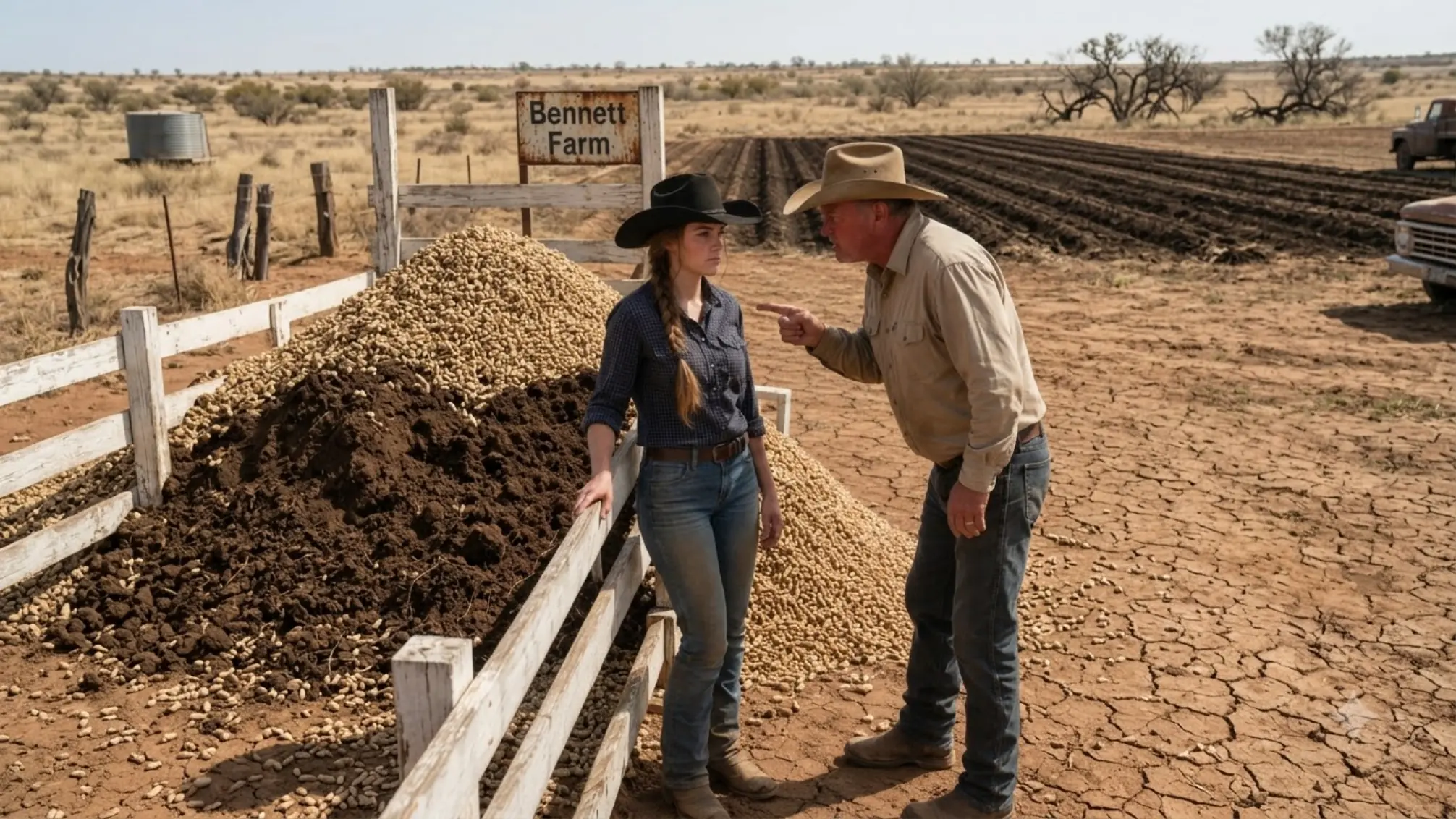
The truck driver leaned out of his cab.
“You sure you want all this dumped here?”
The Young Farmer nodded.
“Every load.”
He looked toward the field.
“Looks like enough shells to bury half the county.”
“That’s the idea.”
He laughed because he assumed she was joking.
She was not.
For four years Bennett Farm had produced less with every season.
The ground had once grown cotton, sorghum, and peanuts well enough to support a family. Then came decades of aggressive tillage, increasingly expensive fertilizer, herbicide applications, and one dry year after another. By the time the Young Farmer inherited the place at twenty-four, several sections had lost so much organic matter that rain struck the surface and ran away instead of sinking into it.
Her father had known the farm was declining.
He simply had not lived long enough to solve it.
Before he died, he had left her two tractors, a rusted grain drill, a mountain of bank paperwork, and a sentence she remembered more clearly than any financial number.
“Land remembers how you treat it.”
For months after the funeral, she thought that sentence was merely sentimental.
Then she began digging holes.
Not deep ones.
Six inches.
Twelve inches.
Eighteen.
She dug them across every field and discovered something that frightened her.
Beneath the cracked surface, the soil had no structure.
No dark crumb.
No earthworms.
Very little smell.
When she squeezed a handful after watering it, the dirt either turned into a hard lump or fell apart like powder.
The farm was not simply dry.
It was starving.
She began reading university extension reports at night.
She studied organic matter, carbon-to-nitrogen ratios, soil aggregation, fungal networks, water infiltration, mulch systems, manure composting, and what happened when crop residues were returned instead of removed.
One repeated idea caught her attention.
Dead soil needed food.
Not merely fertilizer.
Food.
Carbon.
Biological activity.
Moisture protection.
She began asking what agricultural waste existed nearby in enormous quantities and cost almost nothing.
The answer was peanuts.
A processor thirty miles south generated truckloads of shells and hull fragments every season.
Most were sold cheaply for bedding, fuel, or low-value feed uses.
Some simply became a disposal problem.
The Young Farmer drove there in an old pickup and asked the Peanut Processor what he charged for damaged hulls unsuitable for feed.
He laughed.
“How many bags?”
“Not bags.”
She pointed toward the loading yard.
“All of that.”
He stopped laughing.
“You building a mountain?”
“Maybe.”
He looked at her.
“For what?”
“My soil.”
The processor frowned.
“You farming peanuts?”
“Not this year.”
“Then why would you put peanut waste back into ground that isn’t growing peanuts?”
“Because the hull doesn’t care what crop comes after it.”
He scratched his chin.
“You know this stuff breaks down slow.”
“I want slow.”
“You’ll tie up nitrogen if you bury too much.”
“I’m not burying it fresh.”
That answer changed his expression.
She explained the plan.
Fresh hulls would be mixed with manure from a nearby dairy, chopped crop residue, and a smaller quantity of mature compost. Some would be composted first. Other hulls would remain as surface mulch between rows where decomposition could happen gradually without robbing the crop root zone of immediately available nitrogen.
She had calculated ratios.
Temperatures.
Application depths.
Moisture needs.
The processor stared.
“You’ve been thinking about this.”
“For six months.”
He gave her the first loads nearly free.
Transportation cost more than the material.
By afternoon, Bennett Farm looked ridiculous.
Huge pale mounds rose beside the fence.
The Young Farmer was standing atop one pile when the Neighbor Rancher arrived.
He was fifty-eight, broad through the waist, permanently sun-reddened, and known for owning nearly eight hundred acres west of the county road. His tan cowboy hat was expensive enough to stay clean despite years of outdoor work because somebody else usually handled the dirtiest jobs.
He stopped beside the fence.
“What in God’s name is this?”
“Peanut hulls.”
“I can see that.”
He looked toward the growing piles.
“Why are they on your farm?”
“Because I bought them.”
He stared at her.
“You bought trash?”
“Mostly paid freight.”
“That supposed to make it smarter?”
She climbed down.
The rancher stepped closer.
“You buried your land under peanut trash like a fool, and now the whole county gets to watch you kill what little soil you had left.”
The Young Farmer wiped dust from her gloves.
“Funny how you called it trash before I even spread the first load.”
“I’ve farmed longer than you’ve been alive.”
“That doesn’t make the hulls different.”
“It makes me know what ruins fields.”
She looked past him toward his own land.
“What’s your organic matter?”
His face tightened.
“Don’t start talking laboratory nonsense at me.”
“So you don’t know.”
“I know crops.”
“And I know your soil sample came back under one percent last year.”
He stared.
“How do you know that?”
“You complained about it at the feed store loud enough for half the county to hear.”
A farmhand nearby laughed before quickly turning away.
The rancher pointed at her.
“Don’t get smug with me, girl. When this stunt fails, I’ll make sure every lender in Lubbock hears how you ruined your farm.”
The Young Farmer folded her arms.
“Then keep talking.”
She nodded toward his hard, pale field across the road.
“Because in three more weeks, you’re either going to beg for my secret or explain to the bank why your ground is already dead.”
He stepped closer.
For one moment, the two of them stood so near that the farmhands stopped working.
The rancher’s jaw clenched.
“You think your father would’ve approved this?”
That landed.
The Young Farmer’s expression changed.
He knew it.
So he pushed.
“Your father knew how to farm.”
“My father knew this ground was dying.”
“He never dumped garbage across it.”
“No.”
Her voice became colder.
“He ran out of time.”
The rancher’s mouth opened.
She stepped toward him.
“I didn’t.”
Neither spoke.
Eventually he looked toward the peanut hulls again.
“You’ll regret this.”
The Young Farmer put her gloves back on.
“Bring a shovel when you come back. I’ll let you check.”
He walked away furious.
By sunset, the first windstorm arrived.
The Young Farmer discovered the first major problem with her plan immediately.
Peanut hulls were light.
Much lighter than compost.
Wind caught the upper layer and sent pieces tumbling across the field.
She spent two hours adjusting the manure mixture, lightly wetting the piles, and running the spreader differently so the heavier organic material anchored the hulls.
It was messy.
Her hair filled with dust.
Her shirt stuck to her back.
Nobody photographed that part.
Nobody saw the nights she sat alone at the kitchen table worrying that the Neighbor Rancher might be right.
She had nearly thirty thousand dollars of operating credit depending on the coming crop.
Her father’s medical expenses had already weakened the farm’s finances.
Another poor season could force her to sell the north forty.
A disastrous season could cost the entire farm.
Still, she continued.
The south field received a thick surface application.
The west field received a lighter mix incorporated shallowly after partial composting.
The smallest five-acre section became her experiment.
Different rows received different ratios.
She wrote everything down.
Date.
Temperature.
Soil moisture.
Material quantity.
Compost temperature.
Rainfall.
Crop emergence.
Every week she dug more holes.
At first, nothing appeared different.
The neighbors noticed.
At the diner, men began calling Bennett Farm “the peanut dump.”
One Saturday morning, the Feed Store Owner asked whether she planned to grow crops or roast snacks.
She bought irrigation fittings without responding.
Another rancher offered to haul her hulls away “when she came to her senses.”
The Neighbor Rancher told anyone who listened that she had inherited land before earning enough wisdom to deserve it.
That hurt more than she admitted.
But the Young Farmer had learned something from her father.
Arguments were expensive.
Work was usually cheaper.
So she worked.
Two weeks passed.
Then the first difference appeared after a thunderstorm.
The county received less than an inch of rain.
On neighboring fields, water collected briefly in low places before running along compacted rows and disappearing into roadside ditches.
At Bennett Farm, the mulched field barely produced runoff.
The Young Farmer stood in rain boots with a stopwatch.
She drove a metal infiltration ring into the soil and poured measured water inside.
The treated ground absorbed it quickly.
The untreated control section remained slower.
She repeated the test.
Then again.
A month later, she saw earthworms.
Only three.
She was so excited that she called the County Agronomist.
He thought she was joking.
“You called because you found worms?”
“I called because I haven’t seen one in that field since I was seventeen.”
He drove out the following week.
The agronomist was a quiet man in his forties who cared more about data than gossip.
He walked the rows.
He examined decomposition.
He pushed a soil probe into the treated ground, then into the untreated border.
“Difference is obvious.”
The Young Farmer tried not to look too pleased.
“Good obvious?”
“Promising obvious.”
He crouched.
“You’re not finished proving anything.”
“I know.”
He smiled.
“That’s why I like talking to you.”
He recommended testing nitrogen regularly.
Peanut hulls could help improve organic matter, but decomposition could alter nutrient availability. Too much fresh carbon incorporated too deeply might hurt a crop instead of helping it.
The Young Farmer adjusted.
She did not romanticize the hulls.
They were not magic.
They were material.
Useful only if managed properly.
That distinction would later become important.
By early summer, Bennett Farm looked strange from the county road.
The treated field was darker.
Not dramatically greener yet.
But darker.
The surface stayed cooler beneath mulch.
A soil thermometer showed afternoon differences large enough to surprise even the agronomist.
Then June stopped bringing rain.
July brought almost none.
Temperatures climbed.
Farmers increased irrigation.
Wells began dropping.
The Young Farmer reduced tillage further.
She protected the surface.
She watered less frequently but measured carefully.
Across the road, the Neighbor Rancher cultivated between rows repeatedly because he believed loose surface soil would conserve moisture.
Instead, every pass exposed more ground.
Wind carried dust.
His crop leaves began curling by noon.
The Young Farmer’s crop curled too.
But later in the day.
And recovered faster.
The difference remained small.
Until it didn’t.
By the third week of July, the county entered serious drought.
One afternoon the Neighbor Rancher stopped his pickup beside Bennett Farm.
The Young Farmer was checking soil moisture near the south field.
He did not get out.
“Still playing scientist?”
She looked up.
“Still farming.”
He nodded toward the field.
“Doesn’t look miraculous.”
“I never promised miraculous.”
“You told me I’d beg.”
“I said either that or the bank.”
His face reddened.
“You got a mouth on you.”
“You keep driving over to hear it.”
He almost smiled.
Almost.
Then his eyes moved toward her field.
“How much water you putting down?”
The question was casual.
Too casual.
The Young Farmer noticed.
“Less than last year.”
“How much less?”
“Why?”
He looked away.
“Curious.”
She walked toward his window.
“Want the real answer?”
“No.”
“About thirty percent.”
His head snapped toward her.
“That’s impossible.”
She shrugged.
“I meter every line.”
“You’re lying.”
“Come look.”
He hesitated.
She opened the gate.
That surprised him.
The Neighbor Rancher climbed from the pickup.
They walked into the field.
The Young Farmer dug beneath the hull layer.
The upper soil was dry.
Two inches lower, it was cool and slightly damp.
She handed him the clump.
He squeezed it.
His expression changed.
Then he tried digging beside the county road outside her treatment area.
Hard.
Dry.
Hot.
The Young Farmer said nothing.
He stood slowly.
“How?”
“Surface protection.”
“That’s not thirty percent.”
“No.”
She pointed toward the dark soil.
“Organic matter holds moisture. Better aggregation improves infiltration. Roots go deeper when they can breathe.”
He looked at her.
“You saying peanut shells did all this?”
“No.”
That answer surprised him.
“I’m saying management did.”
She pointed around.
“Peanut hulls were part of it. Compost was part. Less tillage was part. Cover crop roots were part. Keeping the ground covered was part.”
The rancher stared at the field.
Then his pride returned.
“Still don’t mean it’ll yield.”
“No.”
“Harvest decides.”
“Yes.”
He nodded.
“Then we wait.”
August became brutal.
Cotton squares dropped.
Sorghum heads stayed small.
Several farms began pumping wells continuously.
A neighboring well collapsed.
The Neighbor Rancher lost pressure on his south irrigation system.
For the first time, the Young Farmer saw fear replace arrogance in the county.
Farmers stopped talking about profit.
They talked about survival.
The bank began sending letters.
Insurance adjusters drove county roads.
Auction companies quietly contacted families.
Bennett Farm remained stressed.
But alive.
The agronomist visited again.
He brought two university soil specialists.
They measured infiltration.
Bulk density.
Surface temperature.
Organic matter.
Microbial respiration.
The Young Farmer watched them place samples into bags.
“What?”
One specialist looked up.
“You know your treated section gained measurable organic matter.”
“I hoped.”
“In one season, not enough to transform the entire profile. But enough near the surface to matter.”
The agronomist pointed toward root depth.
“Your plants are also exploring deeper.”
The Young Farmer smiled.
“Meaning?”
“Meaning what you’re seeing isn’t imagination.”
That evening she sat alone on the farmhouse porch.
Her father’s black cowboy hat rested beside her.
She imagined telling him.
Not that she had proven everyone wrong.
That part mattered less now.
She imagined telling him the soil was responding.
Land remembers how you treat it.
Maybe recovery was the land remembering kindness.
Harvest began early because drought had accelerated maturity.
The Neighbor Rancher harvested first.
His yield was terrible.
Not zero.
Worse in a different way.
Just enough to remind him what a normal year should have produced.
The Young Farmer harvested one week later.
The combine monitor showed numbers she did not trust.
She stopped.
Calibrated.
Restarted.
Still higher.
Not record yields.
Not even excellent yields by good-year standards.
But compared with the county?
Extraordinary.
The south treated field outperformed her untreated comparison by enough to cover the cost of hauling the hulls several times over.
More importantly, it had done so using less irrigation.
The agronomist confirmed the numbers.
Then the story escaped.
A local farm reporter published an article.
YOUNG FARMER’S WASTE-MULCH TEST OUTLASTS DROUGHT.
The Young Farmer hated the headline.
It made the result sound accidental.
Within three days, pickups began arriving.
The first belonged to a farmer who had once laughed at the feed store.
He stood at the gate holding his hat.
“I need to ask you something.”
She leaned against the fence.
“About snacks?”
His face tightened.
“I deserved that.”
“Yes.”
He looked toward her field.
“How much hull did you use?”
The Young Farmer studied him.
Then opened the gate.
“Come inside.”
By the end of the week, twelve farmers had visited.
Then twenty.
The Peanut Processor called.
“You’ve caused a problem.”
“What?”
“Everybody wants hulls.”
She laughed.
“You raised the price?”
“A little.”
“Traitor.”
“Businessman.”
Then the Neighbor Rancher arrived.
Not in his pickup.
On foot.
His farm bordered hers, so he crossed the road and approached the white fence.
The Young Farmer was loading compost samples.
He stopped.
“You busy?”
“Yes.”
He waited.
She continued working.
Finally:
“What ratio?”
She looked up.
“What?”
“The mix.”
His jaw tightened.
“You know what I’m asking.”
She did.
The man who had threatened to tell lenders she was destroying Bennett Farm now wanted the method.
“You told me harvest decides.”
He stared toward his failed field.
“It decided.”
The Young Farmer removed her gloves.
“How bad?”
He looked away.
“Bad.”
“How bad?”
“Bank wants a meeting.”
His voice had changed.
No aggression.
Only exhaustion.
For the first time, she saw not the man who had insulted her, but a farmer in his late fifties terrified of losing land he had worked most of his life.
She could have enjoyed it.
Part of her wanted to.
Then she remembered watching her father sit at the kitchen table with bills.
Pride did not make bank letters less frightening.
She opened the gate.
“Come on.”
The Neighbor Rancher blinked.
“That’s it?”
“What did you expect?”
“Thought you’d make me beg.”
She looked him directly in the eye.
“I said you would.”
A faint smile crossed her face.
“I didn’t say I’d enjoy it.”
He actually laughed.
Once.
Then followed her into the field.
She showed him everything.
Not simply peanut hull quantities.
That was the mistake everyone wanted to make.
They wanted one ingredient.
One trick.
One secret.
She explained there was no secret.
The hulls had supplied carbon and surface protection.
Compost and manure had balanced decomposition.
Cover crops contributed roots.
Reduced disturbance protected aggregates.
Nutrient testing prevented deficiencies.
Moisture measurements determined irrigation.
“You can’t dump shells on five hundred acres and expect miracles,” she said.
The rancher frowned.
“Then why is everybody calling it your peanut-hull method?”
“Because ‘integrated soil restoration strategy’ doesn’t fit on a newspaper headline.”
He laughed again.
She continued.
“Start small.”
“How small?”
“Ten acres.”
“I own eight hundred.”
“And right now you understand ten acres worth of this.”
That wiped away his smile.
But he nodded.
“Fair.”
The following spring, Bennett Farm hosted an informal field day.
The Young Farmer expected thirty people.
Nearly two hundred arrived.
Farmers came from three counties.
Soil specialists came from Texas universities.
The Peanut Processor brought samples.
The bank sent an agricultural lending officer.
Even equipment dealers showed up hoping soil restoration would somehow require expensive machines.
The Young Farmer stood beside her white fence in the same blue plaid shirt.
The Neighbor Rancher stood ten feet away.
One visitor pointed toward the hull pile.
“So how deep do we spread?”
The Young Farmer shook her head.
“Wrong first question.”
The crowd quieted.
“Your first question is what problem your soil actually has.”
She held up two soil cores.
One pale.
One darker.
“If you copy my application rate without testing your land, you’re not farming. You’re gambling.”
The agronomist smiled from the crowd.
Someone asked whether hulls caused nitrogen problems.
“They can.”
Another asked whether they attracted pests.
“They can if handled badly.”
“What about chemicals from processing?”
“Know your source.”
“What about cost?”
“Transportation matters more than material if you’re too far away.”
The audience seemed disappointed by each complicated answer.
They wanted certainty.
The Young Farmer gave them responsibility instead.
Then the Neighbor Rancher stepped forward.
“I’ve got something to say.”
People turned.
He removed his hat.
“A year ago, I stood right there.”
He pointed toward the fence.
“And told this woman she was destroying her father’s farm.”
The Young Farmer watched silently.
“I told her lenders would hear what she was doing.”
Several farmers shifted uncomfortably.
The rancher continued.
“I said age meant I knew more.”
He looked toward the Young Farmer.
“I was wrong.”
Nobody laughed.
“I spent forty years farming.”
He faced the crowd.
“And somewhere along the way, experience became an excuse to stop asking questions.”
The Young Farmer had not expected that.
Neither had anyone else.
The rancher nodded toward his own fields across the road.
“I tested ten acres her way.”
He paused.
“Not her exact recipe.”
He glanced toward her.
“She’ll yell if I call it a recipe.”
A few people laughed.
“I tested my soil. Added compost. Used hull mulch. Planted a cover crop. Reduced tillage.”
He looked toward his boots.
“The ground is already different.”
The Young Farmer felt something loosen in her chest.
Not victory.
Something better.
Change.
A reporter asked whether Bennett Farm would patent the process.
The Young Farmer laughed.
“You can’t patent taking care of soil.”
Another businessman approached later with a different idea.
He represented an agricultural products company from Dallas.
He wanted to package pelletized peanut hull blends under a branded name.
“We’d license your story.”
“My story?”
“Your farm. Your image. Young woman saves dead Texas soil.”
She immediately disliked the wording.
He offered money.
A lot.
Enough to pay off part of her operating note.
She listened anyway.
Then asked the critical question.
“What happens when somebody’s soil test says your product is wrong for them?”
He smiled.
“That’s what recommended application rates are for.”
“No.”
She shook her head.
“Soil isn’t identical.”
“We simplify for consumers.”
“There’s your problem.”
The businessman left without a deal.
The bank officer thought she was insane.
“You understand what they offered?”
“Yes.”
“You could reduce your debt dramatically.”
“I could also put my face on something farmers might misuse.”
The banker stared.
“You worry too much.”
The Young Farmer smiled.
“My father used to say farmers who don’t worry eventually give bankers something to worry about.”
The banker did not laugh.
She did.
Two years passed.
Then three.
The county changed.
Not every farm adopted peanut hulls.
That was never the point.
Some had access to cotton gin trash.
Others used composted manure.
Some relied heavily on cover crops.
Several changed grazing rotations.
A few reduced tillage dramatically.
The lesson that spread was larger than any material.
Feed the soil.
Cover it.
Disturb it less.
Measure before assuming.
Store rain where it falls.
Bennett Farm became a demonstration site.
The Young Farmer refused to call herself an expert.
She preferred farmer.
By twenty-eight, her soil organic matter had increased enough that the county agronomist brought students to examine the difference.
Water infiltration improved.
Earthworm counts increased.
Her irrigation requirement fell in several fields.
Yields became more stable during dry years.
Not perfect.
Stable.
That word mattered most.
One September afternoon, another drought arrived.
Not as severe as the first.
Enough to frighten people.
The Young Farmer drove county roads.
She saw something she had never seen before.
Fields remained covered.
Residue protected surfaces.
Neighbors compared moisture readings.
Farmers discussed organic matter instead of laughing about it.
The Neighbor Rancher had planted cover crops across eighty acres.
He waved when she passed.
She stopped.
“How’s the field?”
He crouched and pushed his hand into the soil.
“Want to see?”
They walked twenty yards.
He dug beneath surface residue.
Darkness appeared beneath his fingers.
Moist soil.
The Young Farmer smiled.
The rancher looked at her.
“You remember that day by the fence?”
“Yes.”
“I was awful.”
“Yes.”
He laughed.
“You could soften that.”
“You’d know I was lying.”
“True.”
He looked across his field.
“I really thought you were disrespecting your father.”
The Young Farmer’s smile faded slightly.
“I know.”
“I was wrong about that too.”
He held the soil in his hand.
“You were finishing what he started.”
She looked toward Bennett Farm across the road.
Maybe.
Or perhaps she had simply listened to the land differently.
That evening, she sat on her porch beneath a fading orange sky.
Her father’s hat rested on the railing.
The original field lay beyond the house.
Dark rows.
Healthy residue.
A living surface where cracked plates once dominated.
She remembered the trucks.
The laughter.
The threatening finger.
The fear she had hidden every night while wondering whether she had gambled the farm on an idea nobody respected.
She remembered finding three earthworms.
At the time, they had seemed like treasure.
Now she could dig almost anywhere in the treated ground and find life.
A pickup approached.
The Neighbor Rancher stepped out carrying two jars.
He climbed onto the porch.
“What’s that?”
“Soil.”
“Romantic.”
“One from my place.”
“And the other?”
He smiled.
“The patch by your fence where you first spread the hulls.”
He set them beside each other.
The differences were subtle.
Both were dark.
Both held structure.
The Young Farmer looked at him.
“What am I supposed to notice?”
“That they look alike.”
She understood.
Years earlier, his land had been pale and hard.
Now he was proud because it resembled hers.
He leaned against the railing.
“County meeting tomorrow.”
“I know.”
“They want you speaking again.”
“I already told them there’s no secret.”
“That won’t stop them asking.”
She sighed.
“They always ask the wrong question.”
“What’s the right one?”
The Young Farmer looked across the fields.
Not at the hull pile.
Not at the machinery.
At the ground itself.
“How do we leave soil better than we found it?”
The rancher nodded.
“That doesn’t sound profitable.”
She smiled.
“Give it time.”
Years later, people still referred to the season Bennett Farm was covered in peanut hulls.
The story grew with repetition.
Some claimed the Young Farmer had discovered a miracle fertilizer.
Others said she rescued the county with discarded peanut shells.
Both versions irritated her.
There had never been a miracle.
There had been observation.
Experiment.
Failure.
Adjustment.
Patience.
She had used material other farmers considered worthless because she had looked at it and asked a different question.
Not what is this worth today?
What could it become?
That question had changed Bennett Farm.
Then her neighbor’s farm.
Then dozens more.
And whenever younger farmers visited her years later, nervous about trying something their neighbors considered foolish, she never told them to ignore experience.
She told them something harder.
“Respect experience.”
Then she would pick up a handful of dark Texas soil.
“But make experience prove itself.”
Because age could teach wisdom.
So could failure.
So could science.
So could a twenty-four-year-old woman standing beside a mountain of peanut hulls while an older rancher pointed in her face and promised the entire county would watch her destroy the farm.
The county did watch.
They simply witnessed a different ending.
The soil did not die.
It came back.
And eventually, the same people who once arrived to criticize Bennett Farm began arriving with shovels, soil tests, notebooks, and one humble question.
“How did you make the ground alive again?”