Mason Cole bought eighty acres for one dollar on a Tuesday morning in Red Hollow, Kansas.
The county clerk slid the quitclaim deed beneath the glass partition and looked at him as though he had misunderstood the terms. Mason signed his name anyway, accepted a rusted gate key, and placed a single dollar bill on the counter. By noon, everyone in town knew the twenty-four-year-old mechanic had purchased the most useless land in the county.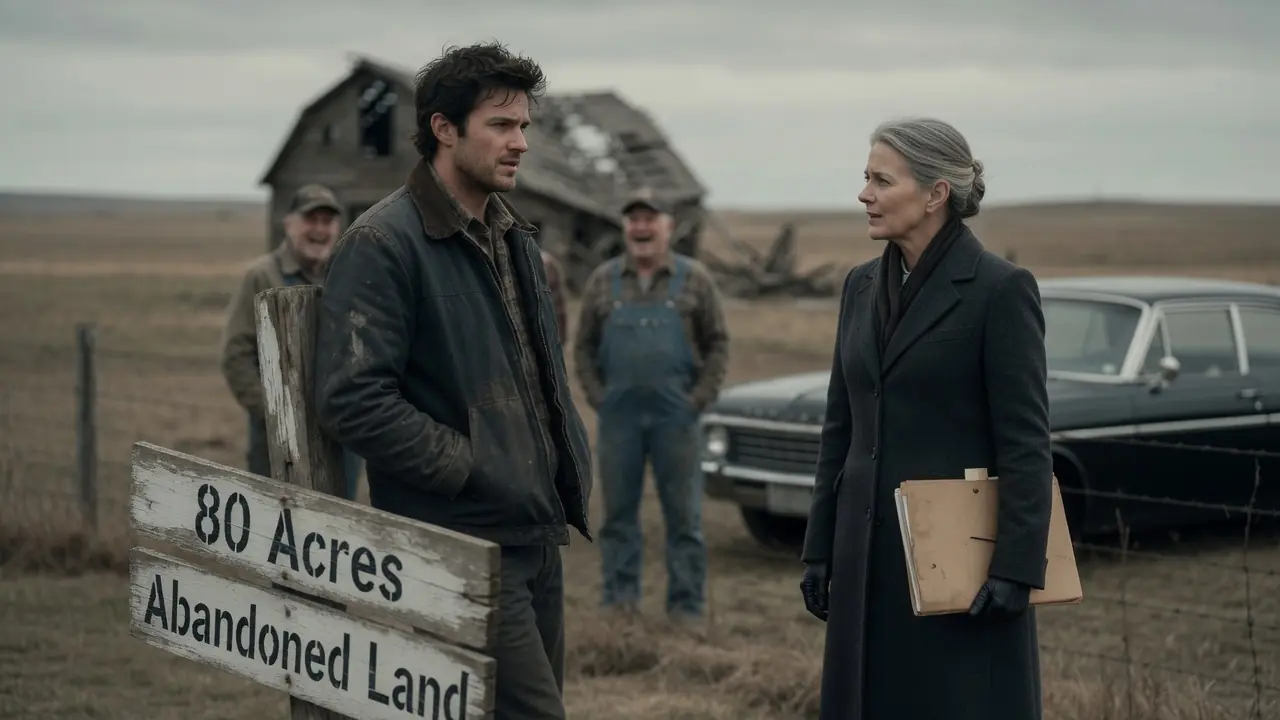
The property stood six miles beyond the last paved road, where wheat fields gave way to dry grass and low limestone ridges. A weathered sign beside the gate read 80 ACRES ABANDONED LAND, though nobody remembered who had painted it. Beyond the fence sat a collapsed barn, a roofless farmhouse, and a field covered with waist-high weeds. Three separate reports described the soil as unproductive, possibly contaminated, and unsuitable for residential use.
Mason had read every warning before bidding.
He also knew the county had offered the parcel at auction five times without receiving a single bid. The taxes had been forgiven, but the buyer would accept responsibility for cleanup, fencing, and any hidden environmental problems. Most people believed the land would cost hundreds of thousands of dollars before it produced one useful acre.
Mason saw something different.
He repaired tractors, combines, irrigation engines, and farm trucks at Holloway Agricultural Service in Red Hollow. He had spent most of his life learning how machines failed and how owners sometimes described those failures incorrectly. A dead engine could be a ruined block, but it could also be one loose wire hidden beneath years of dirt.
Land, Mason believed, might be the same.
He drove to the property after work in his faded blue pickup. The gate leaned so badly that he had to lift it while turning the key. Grass scraped beneath the truck as he followed two worn tire tracks toward the collapsed barn.
Three neighboring farmers were already waiting.
Walter Briggs leaned against a red pickup with his arms folded. Beside him stood Dale Mercer and Hugh Benton, both older men who owned large farms along the southern highway. Their expressions told Mason they had come for entertainment rather than conversation.
Walter pointed toward the crooked sign.
“You really bought it?”
Mason stepped from the truck. “The deed says I did.”
“For one dollar?”
“One dollar.”
Dale laughed first.
Hugh followed.
Walter removed his hat and looked across the field as though presenting evidence to a jury. “The well failed thirty years ago, the topsoil blew away, and there may be chemical waste beneath that barn. You didn’t buy a farm, kid. You bought eighty acres of expense.”
Mason closed his truck door.
“Then you should be glad I took it off the county’s hands.”
Walter smiled. “We’re glad. We just wanted to see what a one-dollar landowner looks like.”
Mason ignored them and walked toward the barn. Its western wall had collapsed inward, but the heavy timber frame remained partly standing. Old machinery lay beneath rotting boards, including a belt-driven pump, a cracked grain drill, and the remains of a small diesel engine.
The machinery interested him more than the weeds.
Walter and the others remained near the gate, laughing when Mason crouched beside the pump. He brushed dirt from a cast-iron housing and found a manufacturer’s plate dated 1952. The unit was far larger than anything required for a shallow livestock well.
A vehicle approached from the county road.
It was not a farm truck.
A black sedan stopped beside the fence, and a silver-haired woman stepped out carrying a weathered brown folder. She wore a gray jacket despite the afternoon heat and moved carefully across the uneven ground.
The farmers stopped laughing.
Walter’s expression changed first.
Mason noticed.
The woman walked directly toward him.
“Why did you buy land everyone warned you to avoid?” she asked.
It was the first question anyone had asked without treating him like a fool.
Mason glanced toward Walter and the others. “Because nobody laughs that hard without hiding something.”
The woman looked at him for a long moment.
Then she opened the folder.
“My name is Evelyn Shaw,” she said. “Your grandfather died protecting this land.”
Mason did not answer.
He had heard very little about his grandfather, Silas Cole. Mason’s father described him as stubborn, secretive, and obsessed with a farm that never succeeded. Silas died before Mason was born, and the family left Red Hollow soon afterward.
Mason returned only after his father’s death.
He believed the Cole name had no connection to the abandoned property.
Evelyn removed a faded photograph.
It showed a younger Silas standing beside the same barn when the roof was still intact. Behind him stood a tall windmill and a steel storage tank. A painted sign above the doorway read COLE WATER AND EQUIPMENT WORKS.
Mason studied the photograph.
“That was here?”
“Yes.”
“My grandfather owned this land?”
“For twenty-seven years.”
Walter Briggs pushed away from his truck.
“You should be careful with old stories, Evelyn.”
She did not look at him. “And you should be careful when the truth has records.”
Walter’s jaw tightened.
Evelyn handed Mason a copy of a deed dated 1956. Silas Cole had purchased the eighty acres from the county and registered both agricultural and industrial use. A second document granted him senior access to an underground water source known as the Red Hollow limestone basin.
Mason read the water certificate twice.
The rights were permanent as long as the original collection system remained physically connected to the parcel.
“Why wasn’t this listed in the auction documents?” he asked.
“Because the county claims the system no longer exists.”
Evelyn pointed toward the pump beneath the fallen boards.
“It exists.”
Walter walked closer.
“That equipment hasn’t moved in decades.”
“The certificate does not require it to be operating,” Evelyn replied. “It requires a physical connection to the original intake.”
Hugh Benton looked toward the pump.
Dale stopped smiling.
Mason turned another page.
The folder contained soil tests from three laboratories. None showed chemical contamination. The samples were old, but every result contradicted the warning attached to the county file.
“What happened here?” Mason asked.
Evelyn looked toward the field.
“Your grandfather discovered that the limestone basin beneath this ridge recharged even during drought. Not quickly, but steadily. He built an infiltration gallery below the northern slope and designed a low-pressure pumping system that supplied this field and four neighboring farms.”
Mason glanced at Walter.
The older farmer looked away.
Evelyn continued.
“Silas wanted to form a cooperative. Each farmer would pay for maintenance and receive water according to acreage. Several families agreed, but three large landowners wanted private control.”
“Whose families?”
Evelyn finally looked toward the men near the trucks.
“Briggs. Mercer. Benton.”
Silence settled across the field.
Walter stepped forward. “Our fathers are dead.”
“So is Silas Cole,” Evelyn replied.
“That doesn’t make every accusation true.”
“No. Evidence does.”
She removed a black-and-white photograph showing metal barrels beside the barn. Each barrel carried the name Briggs Chemical Supply. Another photograph showed two men tipping the containers onto the property during the night.
The images were grainy but clear enough to identify one of them.
Walter’s father.
Mason felt anger rise slowly.
“They dumped chemicals here?”
“They dumped empty containers and a small amount of residue,” Evelyn said. “Enough to create fear, not enough to poison the ground. Then they paid an inspector to describe the entire parcel as contaminated.”
Walter shook his head. “That is speculation.”
Evelyn handed Mason an affidavit signed by the inspector before his death.
The statement admitted everything.
Silas refused to surrender the water rights. He prepared to challenge the contamination order, but his pickup went off a bridge three days before the hearing. Authorities called it an accident.
Evelyn believed otherwise.
“Did they kill him?” Mason asked.
“I cannot prove that.”
“Did you know him?”
Her expression softened.
“I worked for him.”
Evelyn had been nineteen when Silas hired her to organize invoices and copy equipment drawings. She planned to study engineering, but her family could not afford tuition. Silas taught her surveying, pump maintenance, and water measurement during evenings inside the barn.
He also trusted her with his evidence.
Before the hearing, Silas gave Evelyn a duplicate folder and told her to deliver it to his attorney if anything happened. She tried, but the attorney’s office had already been emptied. The local bank threatened to foreclose on her parents’ home if she continued asking questions.
Evelyn left Kansas.
She carried the folder for forty-two years.
“Why bring it now?” Mason asked.
“Because the water certificate passes with the land.”
She looked at the deed in his hands.
“And because you are the first person outside those families to own this parcel since Silas lost it.”
Walter laughed again, but the sound lacked confidence.
“This boy cannot reactivate a water system built before his father was born.”
Mason looked toward the buried pump.
“I repair machines.”
“That one isn’t a machine anymore. It’s scrap.”
“Then you have nothing to fear.”
Walter moved closer until only several feet separated them.
“Sell the land.”
Mason studied his face. “You just said it was worthless.”
“I’ll give you ten thousand dollars so you don’t ruin yourself.”
The offer confirmed more than the folder had.
Mason folded the deed and placed it inside his shirt.
“No.”
Walter’s expression became cold.
“You don’t understand what you’re getting into.”
“Then I suppose I’ll learn.”
The farmers left together.
Evelyn remained.
She walked with Mason through the collapsed barn and showed him where the original pump room had stood. Most of the system was buried beneath timber and soil, but a six-inch steel pipe still disappeared into the northern wall.
Mason tapped it with a wrench.
The sound was solid.
“If the intake remains connected,” Evelyn said, “the water rights are legally active.”
“And if the pipe is broken?”
“The county can declare the certificate abandoned.”
Mason looked toward the northern ridge.
“How much water?”
“At its best, sixty gallons per minute.”
That was enough to irrigate crops carefully, supply livestock, and give the parcel value far beyond one dollar.
It was also enough to threaten every nearby farmer dependent on failing wells.
Mason spent the next week clearing the barn after work. He borrowed a loader from his employer, raised the fallen beams, and separated usable metal from rotted wood. Evelyn returned each morning with notebooks and old diagrams.
Most of the pump was salvageable.
The bearings were frozen, the fuel system had rusted, and several valves had been removed. Yet the cast-iron housing remained intact. Mason found the original manufacturer’s manual online and began rebuilding the engine on his garage workbench.
Walter visited twice.
The first time, he offered twenty-five thousand dollars.
The second time, fifty thousand.
Mason refused both offers.
On the ninth day, someone broke into the barn.
Mason arrived at sunrise and found the rebuilt pump shaft bent across a concrete block. The northern pipe had been struck repeatedly with a sledgehammer. Whoever entered had tried to sever the system’s physical connection.
They failed.
The pipe was thick industrial steel.
Mason called Sheriff Rachel Monroe and showed her the damage. There were no clear footprints because the intruder entered during heavy wind. Walter claimed he had been fifty miles away at a cattle auction.
Mason installed cameras and slept in the barn the following night.
Evelyn told him Silas had done the same.
“That should frighten me,” Mason said.
“It should warn you.”
The deeper Mason dug into the pump room, the more deliberate the destruction appeared. Bolts had been removed rather than rusted away. The pressure regulator was filled with hardened concrete, and the main intake valve had been welded shut.
Time did not do that.
People did.
Mason cut away the weld and removed the valve.
Behind it, he found a steel plate inserted across the pipe. Someone had blocked the intake from inside before sealing the system.
He photographed everything.
Evelyn added the images to the folder.
They hired attorney Naomi Grant, a water-rights specialist from Wichita. Naomi reviewed the certificate, county records, photographs, and current state law. She confirmed that Mason legally controlled the oldest documented water right in the Red Hollow basin.
There was one danger.
The county could challenge the certificate if the system failed an operational test within thirty days.
The notice arrived the next morning.
County Commissioner Harold Briggs, Walter’s older brother, had scheduled the test.
Mason had twenty-eight days to produce measurable water.
The pressure was intentional.
He worked before sunrise, completed his shifts at the garage, then returned to the land until midnight. He rebuilt the diesel engine, fabricated missing brackets, and replaced the damaged pressure regulator with a modern unit hidden inside the old housing.
The intake remained the greatest problem.
Old drawings showed the steel pipe continuing nearly six hundred feet beneath the northern ridge. If any section had collapsed, surface repairs would mean nothing.
Mason rented a pipe camera.
At one hundred and eighty feet, the lens reached packed mud.
At two hundred and twelve feet, it stopped.
Evelyn examined Silas’s diagrams.
“There should be an access shaft near that point.”
They searched the ridge for three days.
Grass, erosion, and old plowing had erased every visible marker. Mason finally noticed a straight line of limestone fragments beneath the weeds. He followed it to a shallow depression.
They dug.
Four feet below the surface, his shovel struck a circular iron cover.
Beneath it lay the access shaft.
The pipe was not collapsed.
It had been filled intentionally with clay bags.
Mason climbed down wearing a safety harness while Evelyn and two friends remained above. He removed sixteen rotted canvas sacks, each stamped with the name Briggs Milling Company.
When the final bag came free, cold air moved through the pipe.
Then they heard water.
It was faint but unmistakable.
A slow current ran somewhere beyond the darkness.
Mason climbed from the shaft covered in mud and smiling for the first time in weeks.
“We have flow.”
They still needed the pump.
On the morning of the test, nearly sixty people gathered beside the barn. Some came to support Mason, but most expected failure. Walter stood near the county officials with a smile he no longer bothered hiding.
Harold Briggs carried the inspection forms.
“If the system cannot produce continuous measurable water,” he announced, “the senior certificate will be declared inactive.”
Naomi objected that a commissioner related to an interested neighboring landowner should not oversee the test. Harold claimed he was acting only in his official capacity.
A state water inspector stood beside him.
That prevented the Briggs family from controlling the final result.
Mason checked the fuel line, opened the restored intake valve, and placed one hand on the starter.
Nothing happened.
The engine turned once, coughed, and stopped.
Walter smiled.
Mason tried again.
The starter spun, but the engine failed to catch.
Whispers moved through the crowd.
Evelyn stepped beside him.
“Silas used to open the bypass before ignition.”
Mason looked at the diagram.
The bypass valve had been removed years earlier. He had replaced it, but left it closed because modern systems generally started under pressure.
He opened it.
The engine started on the third attempt.
Black smoke rolled from the exhaust, and the entire pump housing began shaking. The sound was uneven, heavy, and loud enough to silence the crowd.
For thirty seconds, nothing came through the outlet.
Walter laughed.
Then brown mud burst from the pipe.
The first flow carried silt, insects, and fragments of old canvas. It struck the dry basin and spread across the dirt. The inspector stepped back.
The water cleared gradually.
Within two minutes, a steady stream poured through the outlet.
Cold, clean water.
The state inspector measured forty-three gallons per minute.
The certificate remained active.
Walter’s smile disappeared.
Mason stood beside the machine while water darkened soil that had been dry for decades. He thought of Silas watching the same stream before fear, money, and power buried it.
Evelyn placed one hand against the pump housing.
“You brought it back.”
“No,” Mason said. “We uncovered it.”
The folder did more than preserve the water right.
Its evidence triggered a state investigation into the old contamination report, county record changes, and recent sabotage. The soil was tested again and declared safe for agricultural use.
Security footage later showed Dale Mercer’s truck near the property on the night of the break-in.
Dale confessed after investigators found the damaged sledgehammer in his workshop. He admitted Walter offered him money to disable the intake before the county test. Walter denied ordering the sabotage, but phone records and bank withdrawals supported Dale’s statement.
Walter was charged with conspiracy and property destruction.
Harold Briggs resigned from the county commission after investigators found he had accessed sealed auction records and attempted to suppress the water certificate. The old crimes could not all be prosecuted, but the newer actions revealed how far the family remained willing to go.
The eighty acres increased dramatically in value.
A regional agricultural company offered Mason two million dollars. A private water investor offered more, provided Mason transferred the entire senior right and allowed them to restrict neighboring access.
For several days, Mason considered it.
Two million dollars would change his life. He could open his own repair shop, buy a home, and never again worry about missing rent. Nobody could blame a twenty-four-year-old mechanic for accepting wealth his grandfather never lived to see.
Evelyn did not tell him what to choose.
Instead, she gave him the final envelope in the folder.
It contained a letter from Silas.
If anyone finds this after I am gone, the water belongs with the land, but its purpose belongs to the people. Do not let one frightened man become another powerful one.
Mason read the sentence several times.
Then he rejected both offers.
He formed the Red Hollow Water Cooperative.
Farmers who joined paid according to acreage and labor rather than wealth. The cooperative funded maintenance, monitored extraction, and limited use to what the basin could naturally replace.
The senior right remained attached to Mason’s land.
Control did not.
Some farmers refused to join because they disliked accepting terms from a young mechanic. Others arrived quietly after their wells dropped another ten feet.
Walter’s farm joined under new management after his legal troubles forced him to sell part of the operation.
Mason did not deny them water.
He required the same rules.
During the first year, only twenty acres of Mason’s property returned to production. He planted drought-tolerant wheat, sorghum, and cover crops instead of forcing every acre to earn money immediately.
Evelyn helped restore the barn.
They saved the original beams, rebuilt the roof, and hung the old COLE WATER AND EQUIPMENT WORKS sign above the door. Mason installed two service bays inside and opened his own agricultural repair business.
Farmers who once laughed began bringing tractors.
He charged them honestly.
The abandoned farmhouse became Evelyn’s home after Mason learned she had been living alone in a rented room outside Wichita. She resisted until he reminded her that she had carried his family’s truth for forty-two years.
“You do not owe me a house,” she said.
“No. But you deserve a place where the folder no longer has to hide.”
She accepted.
Five years later, the property looked nothing like the land Mason purchased for one dollar. Green cover crops protected the soil, cattle grazed along restored fencing, and the pump sent water toward a lined storage pond during carefully scheduled hours.
The collapsed barn stood again.
Near the gate, Mason kept the old sign.
80 ACRES ABANDONED LAND.
He added a smaller board beneath it.
ABANDONED BY PEOPLE. NOT BY POSSIBILITY.
Visitors often asked whether his grandfather had hidden treasure beneath the field.
Mason always shook his head.
Silas had hidden nothing valuable.
Other men had buried the truth because they understood exactly how valuable it was.
On the anniversary of the pump test, Evelyn brought the original folder into the rebuilt barn. Mason placed it inside a glass cabinet beside Silas’s tools, the blocked valve, and one of the clay bags removed from the intake.
Walter Briggs’s laughter was not preserved.
It did not deserve space.
What remained was the deed, the water certificate, the old letter, and proof that a mechanic with one dollar had looked at land everyone dismissed and asked the question nobody wanted answered.
Why were they so desperate for him to believe it was worthless?
The answer restored more than eighty acres.
It restored a family name, exposed a buried crime, and returned water to farmers who had nearly forgotten cooperation.
Mason never became the richest man in Red Hollow.
He became something the town needed more.
The man who understood that ownership meant little unless what had been recovered could help others survive.